
- Guide – Health & Safety
Installation in an industrial park: approval, permits, hazardous areas
By Tobias Schott · 21-minute read · Updated October 2026
Any contractor wanting to install in an industrial park needs more than an order: approval from the site operator, inducted fitters with site passes, the right permits and, in potentially explosive areas, the operator's release. Installation in an industrial park therefore begins long before the first spanner.
An industrial park is not an ordinary factory site. Many companies share roads, pipe bridges, energy, site fire brigade and site security. Above everything are the site operator's rules. Below them apply the rules of the plant in which the work takes place. In chemical parks, hazardous substances and areas with explosive atmospheres are added.
This guide explains how a contractor is approved, which permits exist and what applies in hazardous areas. It shows the sequence from the client's perspective and the typical mistakes. And it says what you as the client have to prepare so that the fitters do not wait at the gate on the day.
We are an installation and maintenance company from Rodgau near Frankfurt. What generally has to be arranged when using contractors on your own site is set out in our guide on contractor management. Here it is about what an industrial park additionally requires.
Key points at a glance
- An industrial park or chemical park is a site where several companies use shared infrastructure. A site operator provides it and sets the rules.
- A contractor is approved before its first job: registration, certificates, staff list, site induction, site passes, vehicle registration.
- In the plant on site a separate induction follows. Before work starts the team signs in with the responsible point, and signs out afterwards.
- Work with special hazards needs a permit: hot work, entering confined spaces, opening lines, work in hazardous areas.
- Whether and where an explosive atmosphere can occur is assessed by the operator. It sets the zones and releases work there.
- Electrical work in hazardous areas is done only by qualified electricians with the appropriate Ex qualification.
- Plan in lead time. Most of the work of an installation in an industrial park lies before the first work day.
What is an industrial park – and what changes for installation?
An industrial park is an industrial site where several companies produce on shared grounds and use shared infrastructure provided and managed by a site operator. A chemical park is an industrial park focused on chemicals, pharmaceuticals and related industries.
Many of these sites used to be the works of a single group. Today companies of different sizes work there side by side. What connects them is provided by the site operator: site roads and rail tracks, pipe bridges and networks, power, steam and cooling water, waste disposal, site fire brigade, site security and often the approval of contractors too.
Two levels of rules
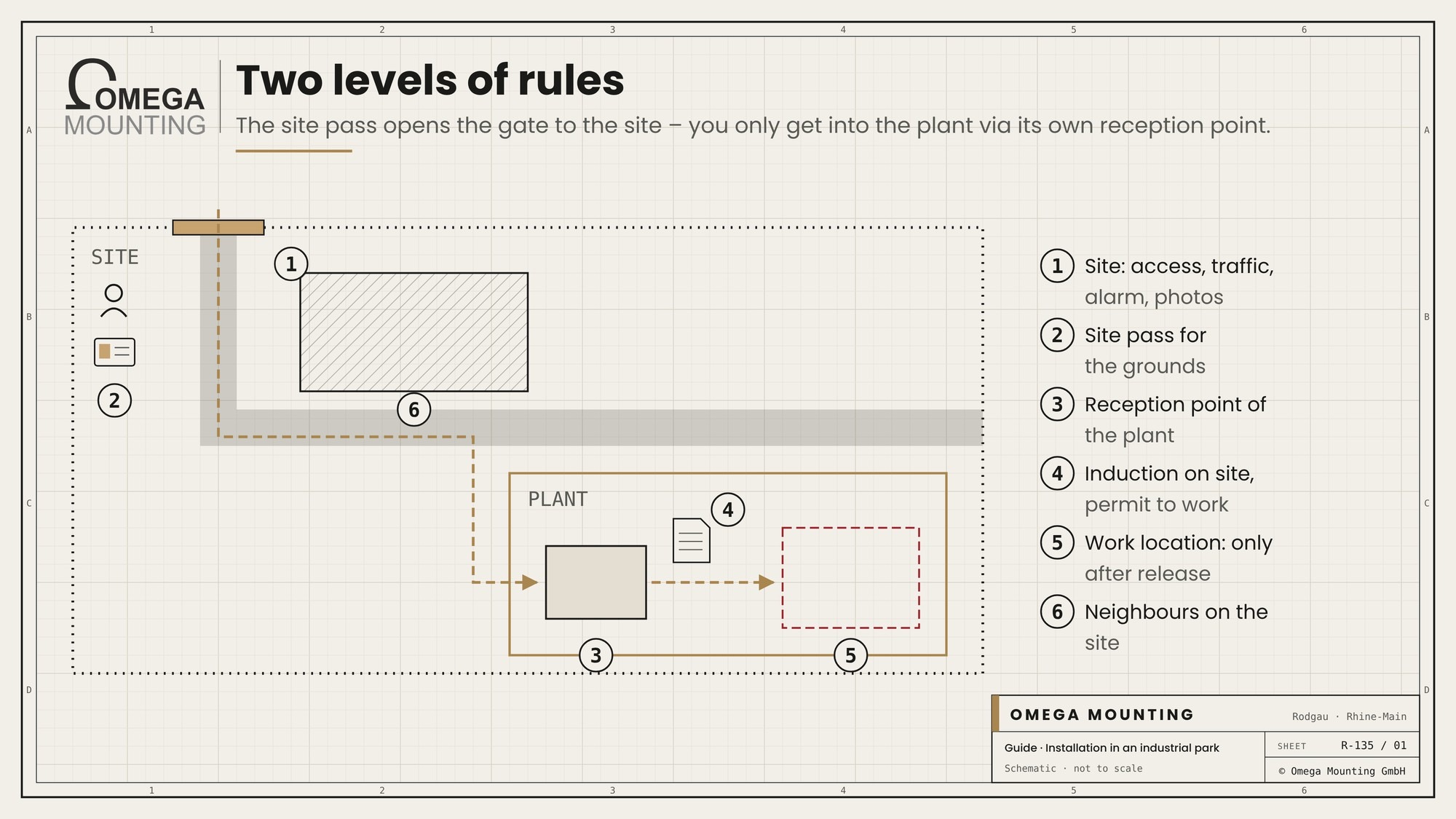
For a contractor this means: two levels of rules apply. The first level is the site. The site operator governs access, passes, traffic, alarms, smoking ban and photography. The second level is the plant that commissions you. It governs induction on site, permits, isolating its installations and explosion protection in its areas.
Both levels must be met. A site pass does not replace an induction in the plant. And an induction in the plant does not replace a site pass.
What is different about installation in an industrial park
Installation in an industrial park does not change the mechanics. A bearing is replaced here just as elsewhere, a steel platform set just the same. What differs are the surroundings and the preparation:
- More parties. Site operator, client, neighbouring plants, site fire brigade and site security each have their own requirements.
- More certificates. Before the job the contractor has to prove that it is organised, inducted and qualified.
- Hazardous substances nearby. In chemical parks, lines carrying products and gases run over and next to the work location.
- Potentially explosive areas. Where an explosive atmosphere can occur, special rules apply to tools, equipment and hot work.
- Fixed procedures. Signing in, permit, countersigning on site, signing out – every day.
Neighbours and shared infrastructure
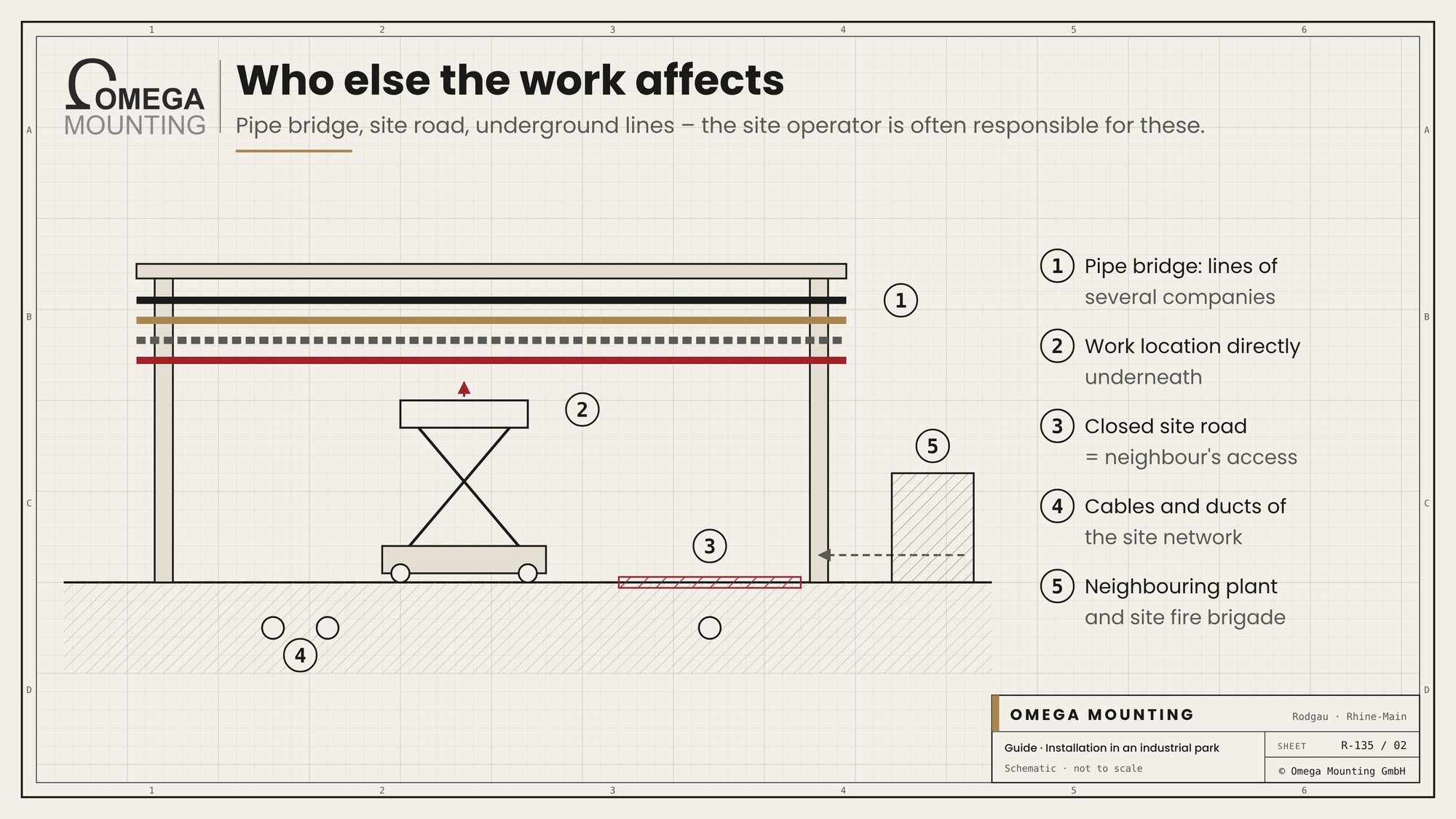
In an industrial park nobody works alone. A pipe bridge over the work location often carries lines of several companies. A site road closed for a crane is the access for the neighbouring plant. Under the asphalt lie cables and ducts belonging to the site network.
For such questions the site operator is usually responsible, not the plant that commissions you. Anyone working in a chemical park as a contractor therefore clarifies early who else a job affects besides the client. For work in a chemical park that can include the site fire brigade if access routes are affected.
Approval as a contractor: registration, certificates, induction, passes
Before a contractor may work in an industrial park, it is approved by the site operator: it registers, submits certificates, registers its fitters, has them inducted and receives site passes and entry permits for its vehicles.
The details differ from site to site. But the building blocks of contractor approval are almost the same everywhere.
Registering the company
Many site operators keep a list of approved contractors. Newcomers register with company details and a contact. The operator often requires a company on the site to commission or register the contractor. The route then runs via your purchasing department or your contractor coordination.
Records
Typically required are evidence of occupational safety organisation, a risk assessment, fitters' qualifications and insurance. Some sites require a safety certificate for service providers. For work with lifting equipment, work platforms or welding equipment, competences and inspection records for the work equipment are added.
What an installation company should generally provide is described in our guide on subcontractor credentials. How risk assessment and method statement come together in one document is shown in our guide on RAMS for installation work.
Staff list and site induction
Everyone who is to enter the grounds is registered by name. Before the first entry there is a site induction. It covers access, traffic rules, alarm signals, behaviour in an emergency, first aid and the basic safety rules. It often ends with a short test and a signature.
The induction is personal. Anyone who has not done it does not get in – not even as a replacement for a sick colleague.
Site pass
After the induction, site security issues a site pass for the contractor. It is tied to the person and valid for a set period. It is checked at the gate, often the vehicles too. Material leaving the site often needs a permit.
Vehicles, tools and substances
Vehicles are registered and receive an entry permit. Site roads have their own traffic rules, rail tracks often cross without barriers. Larger equipment such as work platforms, forklifts or cranes is registered separately.
Many plants want to know beforehand which tools, equipment and substances are coming. Hazardous substances such as solvents, welding gases or spray cans are registered. A prepared tool and equipment list saves time on the day.
When subcontractors come along
If the contractor itself brings a subcontractor, for example for scaffolding, crane or insulation, that company needs approval too. Many sites require the client to know and agree beforehand. So clarify at the enquiry stage who will come onto the site. A subcontractor nobody knew about stays at the gate.
The contractor's own induction
Inductions by site and plant do not relieve the contractor of its own duty. It inducts its fitters itself: on its work equipment, its work sequence and the rules it has learned from the client. A good installation company passes the site's rules on to its team before travelling. Then the first day at the gate is no surprise.
Induction in the plant
The site induction is not enough for the work location. The plant where the work takes place inducts in addition: hazards of the installation, substances, hazardous areas, escape routes, assembly point and contacts. Only then does work begin.
Permits: which permit for which work?
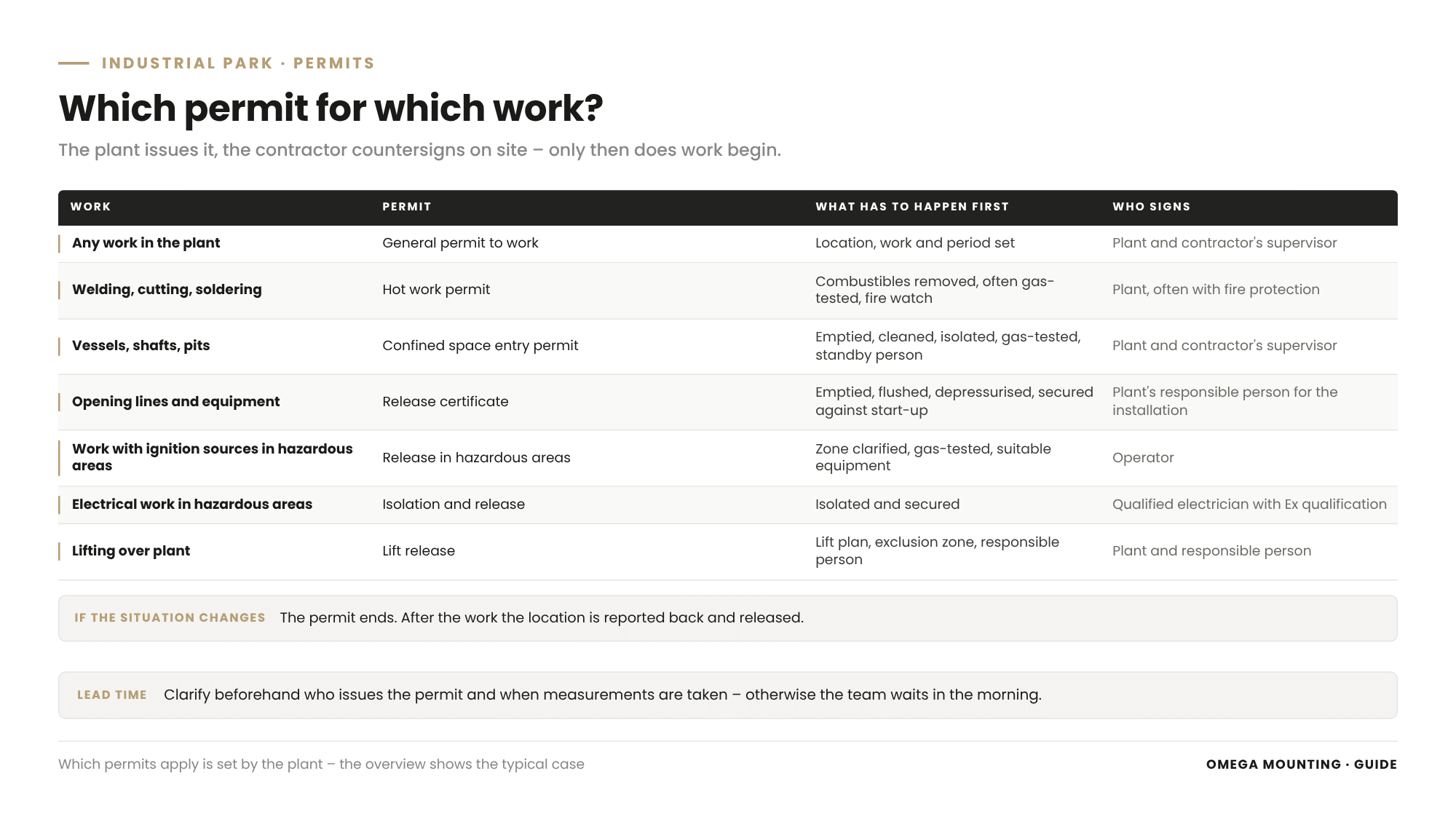
In an industrial park, work with special hazards needs a written permit from the plant: hot work, entering vessels and confined spaces, opening lines and equipment, work in hazardous areas and work on isolated installations.
Every permit in a chemical park applies to a particular job, a particular location and a particular time. There the permit is not a form for filing. It is the conversation between plant and contractor, recorded on paper. Whoever issues the permit confirms that the installation is prepared. Whoever countersigns confirms that they know and follow the measures.
The most common permits
- General permit to work. Many plants require a permit for any work in their installations. It records what is done, where and until when.
- Hot work permit. Welding, flame cutting, cut-off grinding and soldering create sparks and hot surfaces. Beforehand combustibles are removed or covered, often the area is gas-tested, and a fire watch stands by.
- Confined space entry permit. Vessels, silos, shafts and pits are only entered once they are emptied, cleaned, isolated and gas-tested. A standby person stays outside.
- Release certificate for installations and lines. Before a line or piece of equipment is opened, it is emptied, flushed, depressurised and secured against restarting.
- Release in hazardous areas. Anyone working there with possible ignition sources needs the operator's release, usually with gas testing.
How a permit works
The plant prepares the installation and issues the permit. On site the issuer and the contractor's supervisor go through together what has been done and what remains. Then it is countersigned. If the situation changes, the permit ends. After the work the location is reported back.
What a permit contains and how it works on site is explained in our article on the Permit to Work. How isolation, personal locks and release work together is set out in our guide on Lockout tagout in maintenance.
Who signs the permit
On the plant side, a person who knows the installation and is responsible for it signs. For hot work, fire protection is often added. On the contractor side the supervisor signs. They are on site throughout the work, understand the language of the permit and pass the measures on to their team. If the supervisor changes, this is noted on the permit.
Lead time for permits
The most common stumbling block is time. The team is ready in the morning, but the issuer is in a meeting, the gas test is missing or the installation is not yet empty. So clarify beforehand which permits the job needs, who issues them and when measurements are taken. For hot work it pays to discuss the sequence the day before.
Explosion protection and hazardous areas: what contractors need to know
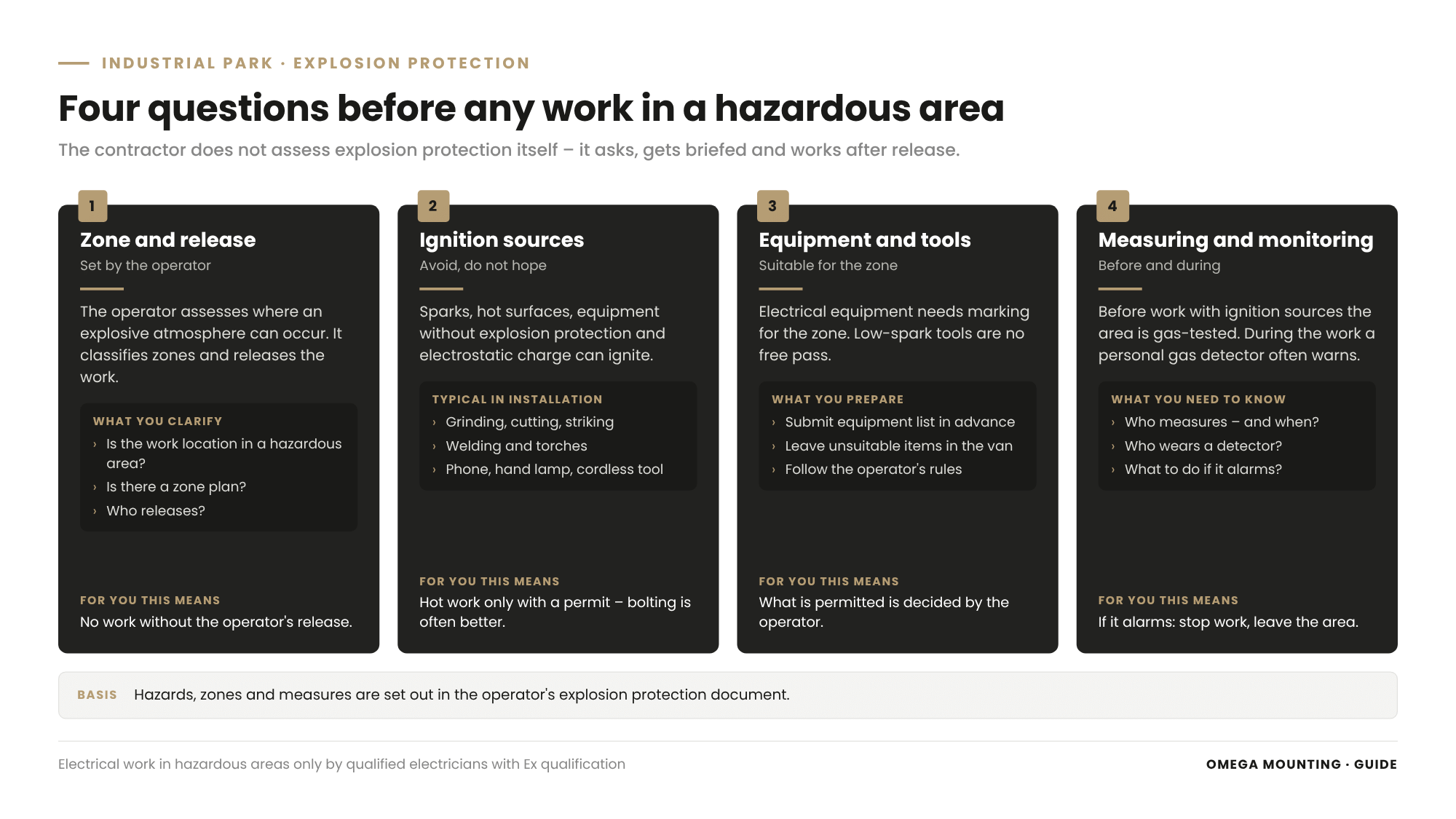
In hazardous areas an explosive atmosphere can form from gases, vapours, mists or dusts. Where this is the case and how likely it is is assessed by the operator. It divides the areas into zones and sets which equipment, tools and work are permitted there.
For the contractor this is the most important rule: it does not assess explosion protection itself. It asks, gets briefed and works after the operator's release.
Who sets what
Under the German Hazardous Substances Ordinance the operator draws up an explosion protection document. It sets out the hazards, the zoning with a plan, the protective measures and how cooperation with contractors is arranged. What applies in the individual case follows from this.
Electrical work in hazardous areas is a matter for qualified electricians with Ex qualification. This applies to connecting, disconnecting and interventions on electrical equipment. Inspection of installations and equipment in hazardous areas is carried out by a competent person, as the German Ordinance on Industrial Safety and Health provides. Who takes this on in the job we agree with you beforehand – nobody without Ex qualification.
This guide is not legal advice. What applies at your work location follows from the explosion protection document and the operator's release.
Avoiding ignition sources
Explosion protection during work means above all: no effective ignition sources. Typical ignition sources in installation work are:
- Sparks from grinding, cutting and striking. Steel on steel can strike sparks too.
- Hot surfaces. Welds, torches, overheated tools.
- Electrical equipment without explosion protection. Cordless screwdrivers, drills, hand lamps, mobile phones and chargers.
- Electrostatic charge. Plastic films, unsuitable clothing, flowing liquids.
- Vehicles and combustion engines. They may only go where the operator allows.
Deposited dust is a topic of its own. It is not stirred up with compressed air or a broom but removed as the plant specifies.
Equipment and tools
Electrical equipment in hazardous areas needs marking that matches the zone. What the contractor brings from its van is often not suitable. That is why the equipment list goes to the plant in advance.
Low-spark tools made from special materials are often mentioned. But they are no free pass. Whether they are enough or whether work may only take place after gas testing or in the released state is set by the operator.
Measuring and monitoring
Before work with possible ignition sources the area is usually gas-tested. This is done by the plant or a person it appoints. During the work the fitters often wear a personal gas detector. If it alarms, work stops immediately and the area is left.
The released state
Sometimes the operator makes an area safe for the duration of the work. It shuts down the installation, empties, flushes or ventilates it and gas-tests. Then work may be done there that otherwise would not be possible. But this state only applies as long as the conditions are right. If a line is refilled or the gas detector alarms, the release ends. Only the operator decides on the state.
Hot work in hazardous areas
Hot work is the exception in hazardous areas. If it has to happen, the area is made safe beforehand: installation emptied and flushed, surroundings gas-tested, openings covered, fire watch posted, follow-up check planned. It is often better to work on components outside or to bolt rather than weld. What matters when welding on existing installations is described in our guide on repair welding on industrial plant.
PPE, alarms and rules of conduct on site
In an industrial park, besides the work release, fixed rules of conduct apply: personal protective equipment by area, clear alarm signals with set behaviour, assembly points, an internal emergency number for the site fire brigade, and rules on smoking, phone use and photography.
Personal protective equipment
Helmet, safety shoes and safety glasses are compulsory almost everywhere. In chemical plants, depending on the area, chemical protective gloves, flame-retardant or antistatic clothing and an escape respirator are added. Which equipment applies where is in the plant's induction. The contractor provides it for its own people.
Alarm and assembly point
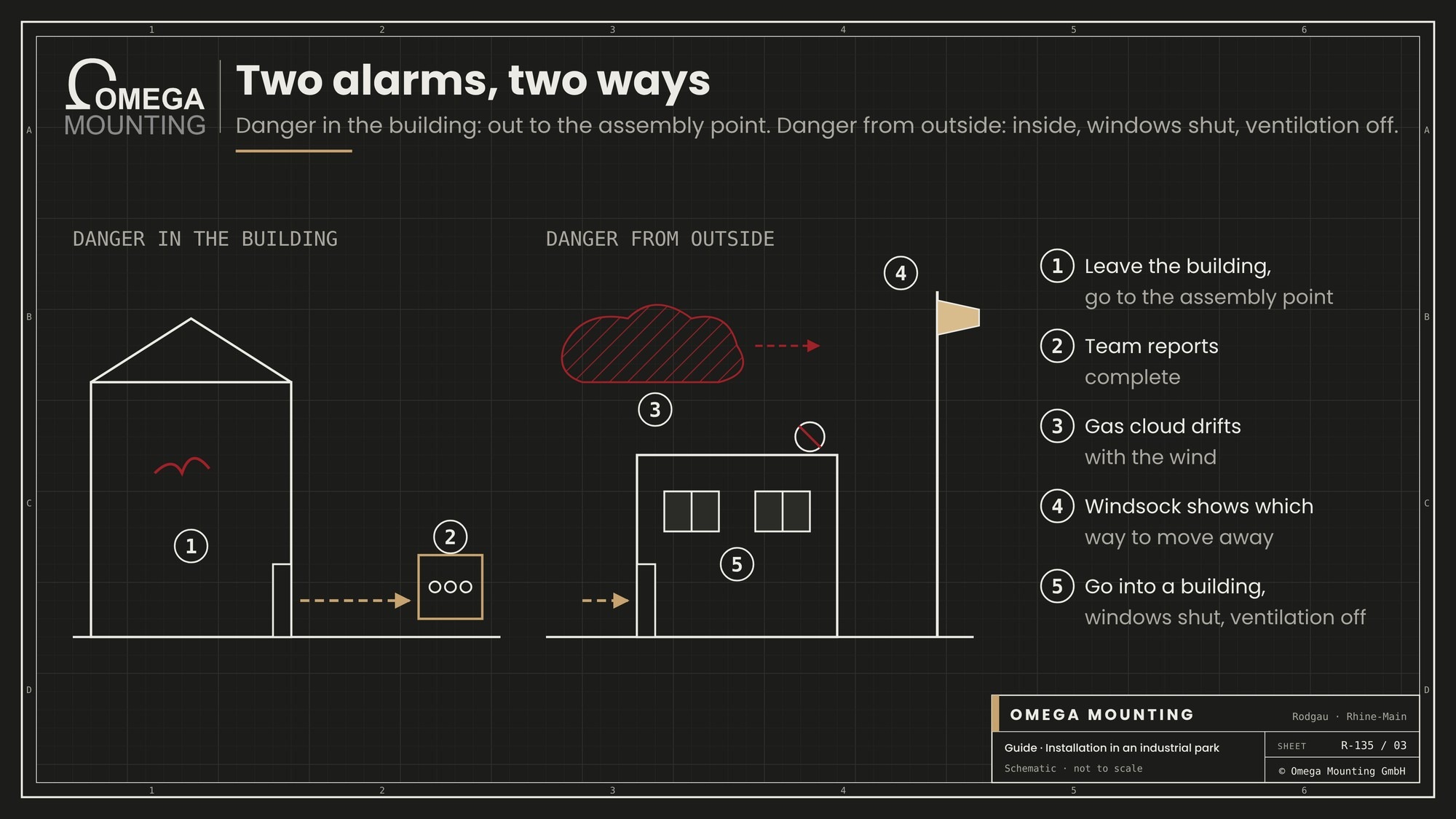
Many sites distinguish between alarms for a danger in the building and for a danger from the surroundings, such as a gas cloud. The behaviour differs: leave the building or go into a building, shut windows, ventilation off. Every fitter must know the signals.
In a gas release the wind direction counts. Windsocks on the site show which way to move away. At the assembly point the team reports complete to the person in charge.
Site fire brigade and emergency number
The site fire brigade can be reached via an internal emergency number. This number is on the site pass or displayed in the plant. Every accident, every fire and every leak is reported immediately – even if it looks like a minor matter.
Smoking, phone, photos
Smoking is only allowed at marked places. Mobile phones are off limits in many areas, in hazardous areas anyway. Photography and filming need permission. That also applies to photos the fitter only wants to take for their own documentation.
Signing in and out
Before work starts the team signs in at the plant's reception point, for example in the control room. Sequence and protective measures are agreed there. At the end it signs out again and hands back the work location.
Installation in an industrial park from the client's perspective: the sequence
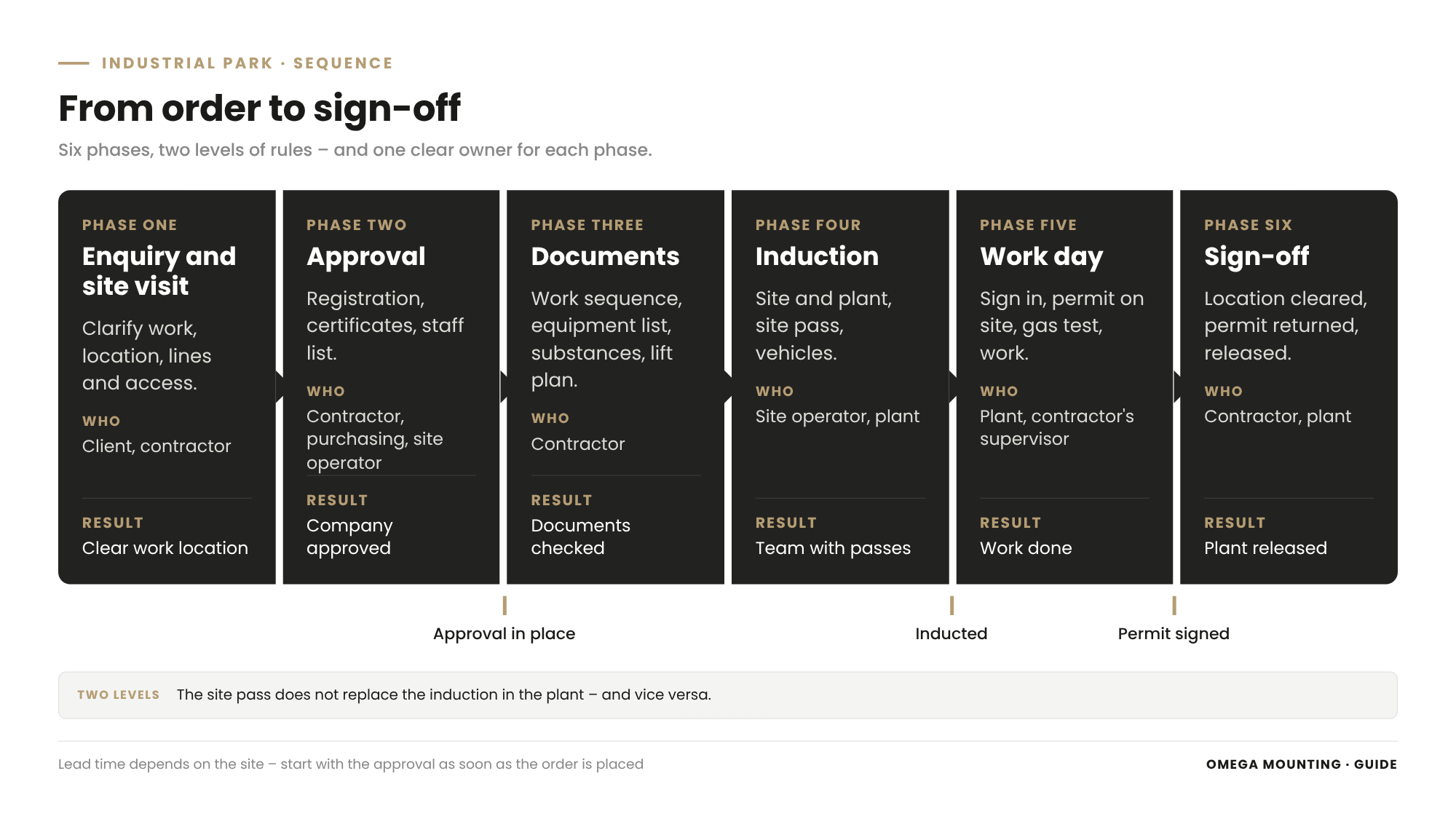
From the client's perspective an installation in an industrial park runs in six phases: enquiry with a precise description of the work location, approval of the contractor, documents and work preparation, induction, work day with permit and finally sign-off with release.
Enquiry
Describe not just the work but also the location. Is it in or near a hazardous area? Do product lines run over it? How do you get material there? Which rules apply on the site? The more precise the enquiry, the more precise the quote.
Site visit
A site visit with the plant clarifies access, lifting equipment, storage area and hazards. Often even this needs an escort and a visitor pass.
Approval
The contractor registers, submits certificates and registers its staff. Your purchasing department or contractor coordination supports this. The lead time depends on the site. Start early.
Documents and preparation
The contractor's risk assessment and work sequence, tool and equipment list, list of substances, lift plan for lifting work. Material that can be prefabricated is prefabricated. What does not have to happen on site happens in the workshop.
Lifting work on site
If a crane is to stand on a site road, further questions arise: does the ground carry it, what lies underneath, does a pipe bridge run in the slewing area? The road closure is coordinated by the site operator. For installation in a chemical plant there is the added question of whether the crane stands in a hazardous area. What has to be settled before a lift is shown in our guide on Planning a crane lift.
Work day
Sign in, induction in the plant, permit on site, gas test, work. For lifting work it is clear beforehand who carries the responsibility. How this role is organised is described in our guide on the appointed person for lifting operations.
Sign-off and release
Work location tidied, tools complete, permit returned, installation released. Only then does the plant put the installation back into operation.
Overview: step, what matters, who is responsible
Every step of an installation in an industrial park has an owner – the table summarises who provides what.
| Step | What matters | Who is responsible |
|---|---|---|
| Describe the work location. | Hazardous area, lines, access, storage area. | Client. |
| Register the contractor. | Company details, contact, commission on the site. | Contractor with the client's purchasing department. |
| Submit certificates. | Occupational safety organisation, qualifications, insurance, inspection records. | Contractor. |
| Register and induct staff. | Everyone by name, site induction, site pass. | Contractor, site operator. |
| Register vehicles and equipment. | Entry permit, equipment list, hazardous substances. | Contractor. |
| Clarify explosion protection. | Zones, permitted equipment, gas testing. | Operator |
| Prepare permits. | Which permits, who issues them, when measurements are taken. | Plant with contractor. |
| Induction in the plant. | Hazards, escape routes, assembly point, contacts. | Operation. |
| Electrical work in hazardous areas. | Ex qualification, isolation. | Qualified electrician with Ex qualification. |
| Sign out and release. | Work location cleared, permit returned, installation released. | Contractor, plant. |
Typical mistakes in installation in an industrial park
The typical mistakes in installation in an industrial park are too little lead time for approval, missing details on the work location, unsuitable equipment in hazardous areas, permits without a time and fitters without a personal induction.
- Approval started too late. The order has been placed, the date is fixed, but the contractor is not yet registered on the site.
- Work location described only roughly. Only at the site visit does it turn out that the work is in a hazardous area or under a product line.
- Wrong equipment brought. Cordless screwdriver, hand lamp and phone are not suitable for the area, and there is no replacement.
- Permit without a time. Nobody has clarified who issues the permit and when gas testing takes place.
- Replacement fitter without induction. A colleague drops out, the replacement has no site pass and no induction.
- Hot work not discussed beforehand. Only on site does it become clear that welding is needed, and the area is not prepared for it.
- Photo without permission. A fitter documents his work with his phone and thereby breaks the site rules.
- Electrical interface open. The mechanical installation is finished, but nobody with Ex qualification is ready for the connection.
The mistake behind the mistakes
Behind many mistakes lies the same assumption: that installation in an industrial park is a normal installation with a bit more paperwork. But the paperwork is only what is visible. Behind it lie hazards a contractor cannot know without the operator.
What we know from security areas
We have not yet documented a job in an industrial or chemical park. What we know are jobs in which access, background checks, preparation and operator rules determined the sequence. Three examples from our project diary show this related experience.
Nuclear facility: background check before the first working day
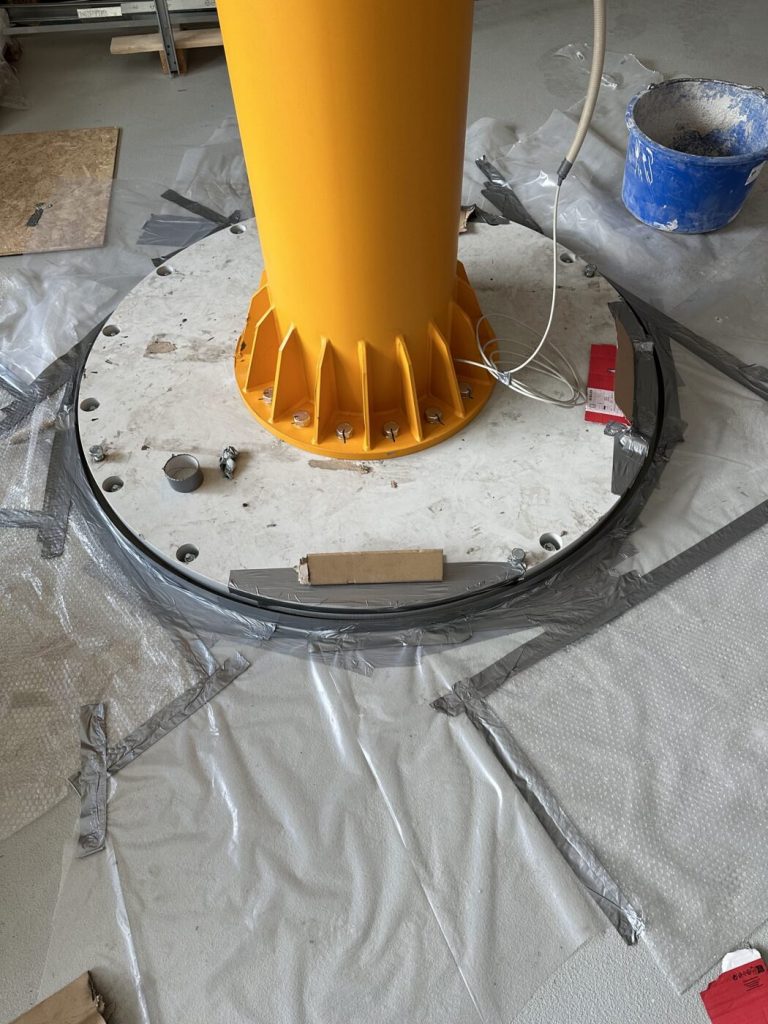
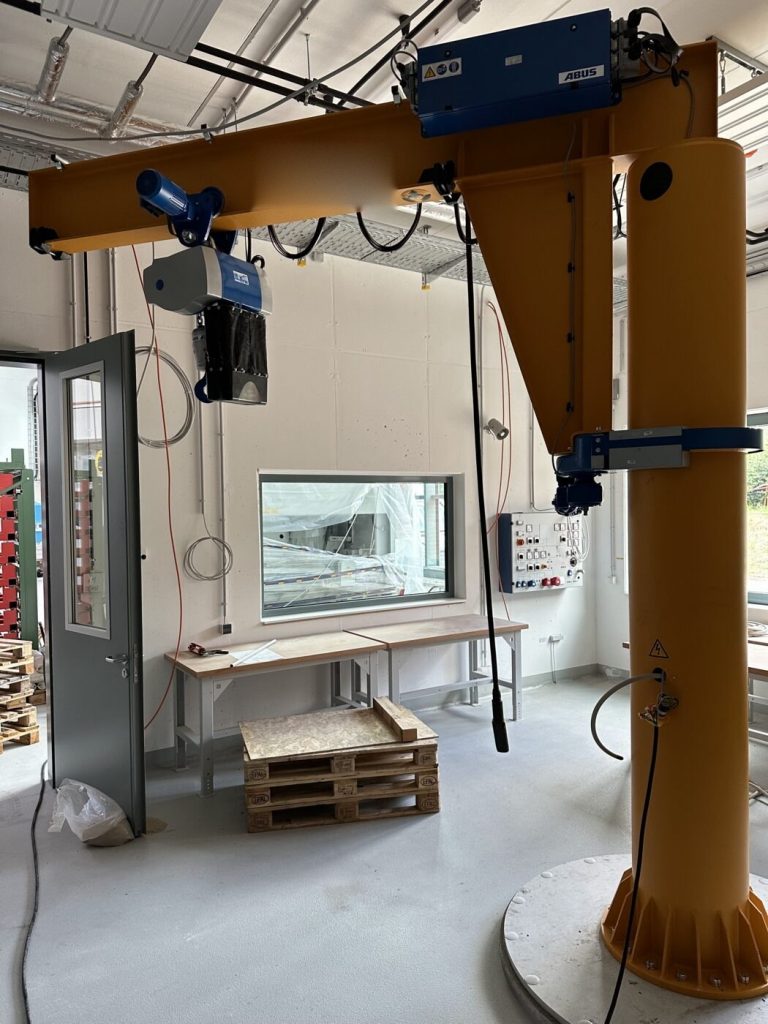
With the workshop fit-out with pillar jib cranes in a nuclear facility, every fitter went through an individual background check before the first working day. Only then was the team allowed to travel. The area was finished: floors, installations and cranes were in place.
Before the first tool was unpacked, floors and routes were covered and existing cranes and plant parts shielded. Drilling was done with extraction, dust was captured at the source. Hot work was coordinated and secured.
For installation in an industrial park this means: approval of the people determines the start date, not the technology.
Frankfurt Airport: access and preparation before the window
With the retrofit of emergency stop buttons on a sorting system at Frankfurt Airport our fitters had the necessary background checks and aviation security training. The passes for the security area were in place. Retaining plates and housings were prepared before the shutdown window and sorted by installation point. Work was done during the day in the installation's downtimes.
For installation in an industrial park this means: what is prepared beforehand costs no time in the work window. How access to security areas is planned is described in our guide on installation in airport security areas.
Food plant: by the rules of the house
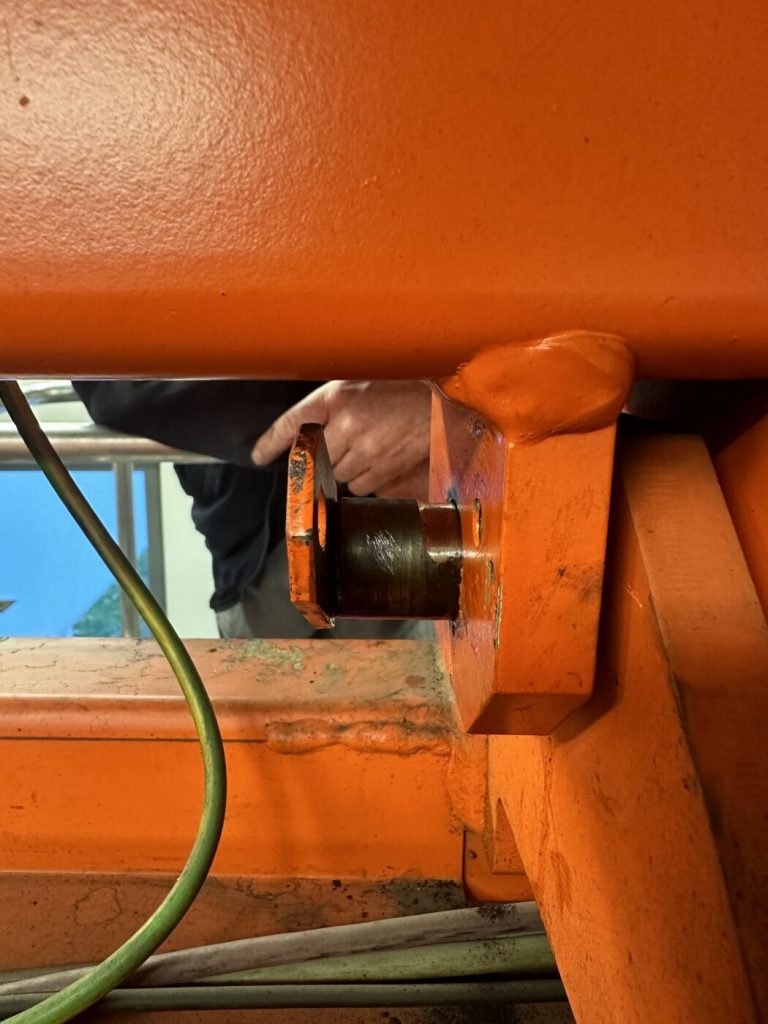
With the pin repair on an electric monorail system in a food plant, all work took place during non-production time at the weekend. We know the hygiene and access requirements of food production plants. On every carrier the pin was driven out, the bearing point cleaned and a new one fitted.
For installation in an industrial park this means: every plant has its own rules, and the contractor follows them.
Questions about installation in an industrial park?
Do you have a mechanical installation or repair coming up at a site with its own rules? Then get in touch with us. We say openly what we bring for the approval and what still needs to be clarified.
Installation in an industrial park in the Rhine-Main area: what we take on
In the Rhine-Main area we take on the mechanical part of an installation in an industrial park: bringing in, setting, aligning and anchoring machines and plant parts, installing steelwork and platforms, replacing assemblies, planning and carrying out lifting work.
The region has large industrial and chemical parks, plus many factory sites with site security and their own rules. From Rodgau, Frankfurt, Offenbach, Hanau, Darmstadt and Aschaffenburg are short distances. What we offer in Industrial installation overall is set out on our service page.
Working as a contractor in a chemical park means for us: preparing approval, certificates and induction as if the job were tomorrow. Our fitters know access rules, passes and work windows from security areas.
What we don't take on, we say clearly beforehand. Explosion protection is assessed by the operator. Electrical work in hazardous areas is done by qualified electricians with Ex qualification. Gas tests and permits are provided by the plant. If you want to know what we can prepare for your site, write to us.
What this means for your role
For buyers: Ask early whether the contractor is registered on the site. Plan the approval into the schedule, not after it.
For designers: Record in the documents whether the work location is in a hazardous area, which lines are nearby and how material gets there.
For project managers and site managers: As project manager you collect certificates, staff list and equipment list and coordinate the permits with the plant. As site manager you take care of signing in, countersigning and signing out on the day.
For technical managers and plant managers: You know zones, substances and installations. Give the contractor a clear briefing and a contact who can be reached in the morning.
For occupational safety specialists: Check the contractor's risk assessment and work sequence in advance. Pay attention to equipment in hazardous areas and to hot work.
For management: Give the project the lead time that approval and releases need.
Contractor check for industrial parks: template on request
The contractor check for industrial parks is a one-page working document for client and installation company. It has four blocks: approval, work location, permits and work day. Each point has a field for the responsible party and the status “clarified” or “open”. Deadlines and numbers are deliberately not pre-filled – they depend on the site. Request the template via our contact form – keyword “contractor check”.
Conclusion
Installation in an industrial park differs less in technology than in preparation. Two levels of rules apply: those of the site and those of the plant. A contractor needs approval, induction and a site pass before travelling. Work with special hazards needs a permit. In hazardous areas the operator sets the rules, and electrical work stays with electricians with Ex qualification. Those who plan early do not stand at the gate on the day. If you are preparing a mechanical installation at such a site, send us your enquiry – we will get back to you with an honest assessment.
Planning a move-in, installation or maintenance in the Rhine-Main region?
Tell us briefly what you need – we'll come back with an honest assessment.
Free, no-obligation callback
You may also be interested in these guides

About the author
Tobias Schott
Managing director of Omega Mounting GmbH, Rodgau · more than 20 years of hands-on experience in installation and maintenance
A trained mechatronics technician, working in maintenance, servicing and industrial installation since 2004 – first alongside his father, and with Omega Mounting since 2012: from overhead conveyors in Frankfurt to the crane system in a new-build hall. He plans and leads lifting operations as an appointed person (AP) in data centers and on industrial sites in the Rhine-Main region, trains and examines operators of cranes, mobile elevating work platforms and telehandlers, and is a qualified occupational safety specialist. On jobs abroad he is known as the “German Troubleshooter” – the person you call when a site gets stuck. He learned what quality means from his father, not from a manual: Made in Germany as a standard for his own work, not a label. That is why quality comes first at Omega Mounting – ahead of speed and price. He writes these guides from that practice: what works on our sites is in them – what exists only on paper is not.
Frequently asked questions
It needs approval from the site operator with registration, certificates and staff list. Every fitter is inducted on site and receives a site pass. Vehicles need an entry permit. In the plant a separate induction follows and, for hazardous work, a permit.
Both are sites where several companies use shared infrastructure. A chemical park is an industrial park focused on chemicals, pharmaceuticals and related industries. Hazardous substances and hazardous areas play a bigger role there.
The operator. It assesses where an explosive atmosphere can occur, divides the areas into zones and records this in the explosion protection document. The contractor is briefed on the zones and works after its release.
Only with the operator's permit and according to its requirements. Beforehand the installation is emptied and flushed, the surroundings gas-tested and a fire watch posted. It is often better to work on components outside or to bolt them.
Electrical equipment needs marking that matches the zone. Low-spark tools are often required but are no free pass. Which tools and equipment are permitted is set by the operator. Submit your equipment list beforehand.
Qualified electricians with Ex qualification. This applies to connecting, disconnecting and interventions on electrical equipment. Nobody without Ex qualification does this work – who takes it on we agree beforehand.
That depends on the site, the certificates and the number of people. Plan in lead time and start the approval as soon as the order is placed – not just before the job.
The team follows the alarm signals it knows from the site induction. Depending on the alarm it leaves the building or goes into one. In a gas release the wind direction counts. At the assembly point it reports complete.
Send us a short enquiry with three details: what is to be installed, where the work location is and which rules apply on the site. Photos and a note on hazardous areas help. Together with you we clarify what is still missing for approval and the job. Your contact is Tobias Schott – reachable via our contact form.
 English
 German