
- Guide – Crane technology
Installing an overhead crane
By Tobias Schott · 20-minute read · As of November 2026
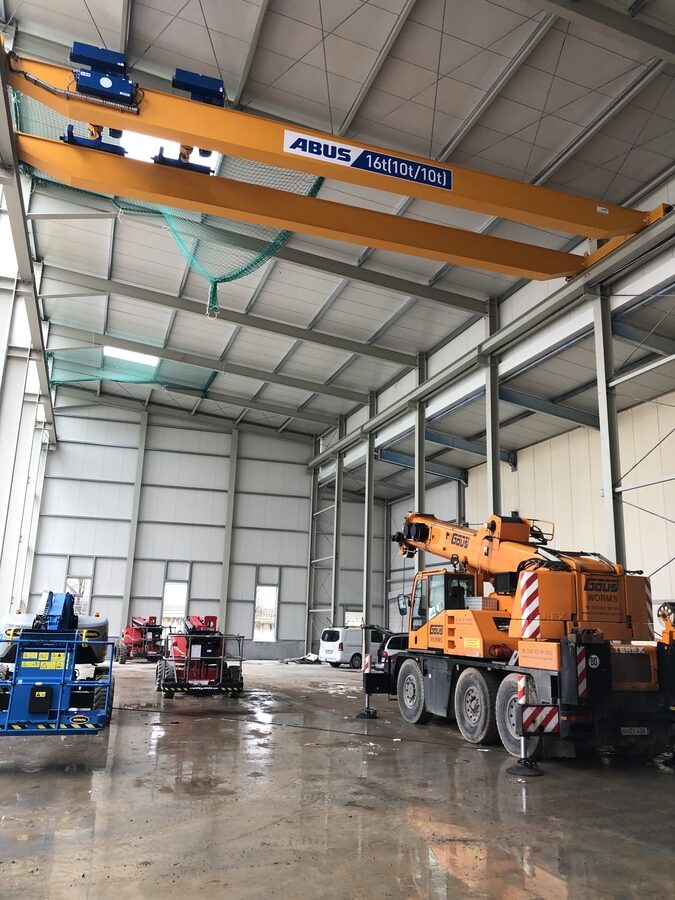
On the runway by evening: when installing an overhead crane, every centimetre under the roof counts.
Installing an overhead crane means pre-assembling the crane bridge on the ground as far as possible, lifting it under the hall roof with a suitable mobile crane, turning it in over the diagonal onto the crane runway and then connecting the conductor rail, limit switches and controls. The diagonal and the clearance under the roof decide whether it can be done in one day.
An overhead crane is the heart of many halls. It lifts machine frames, beams, coils and tools, and it does so reliably for years – if it was installed properly. The installation itself is a short, intense moment: in the morning the bridge lies on the hall floor, in the evening it travels on its runway.
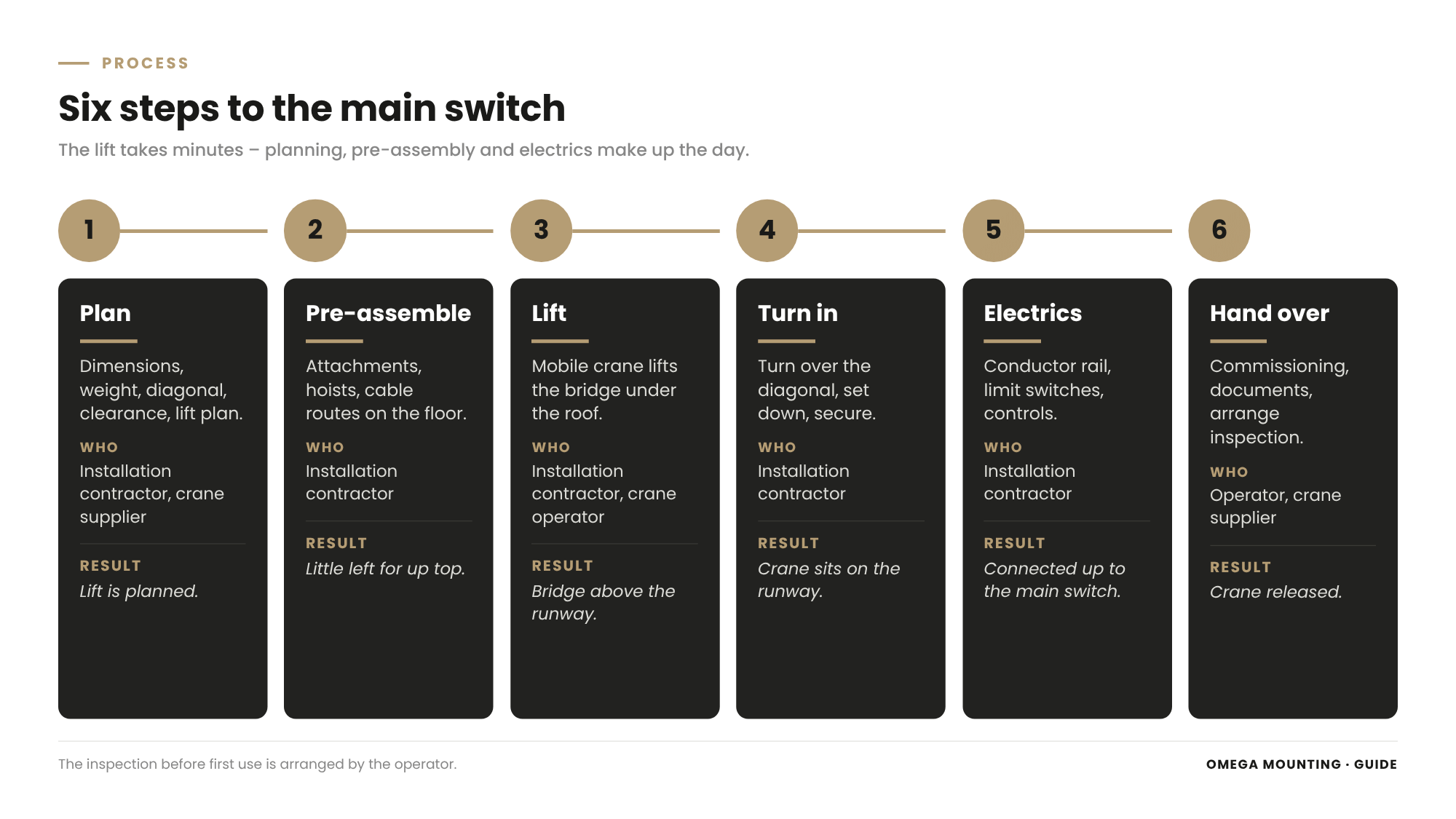
If you search for installing an overhead crane, you find manufacturers selling cranes and inspection bodies approving them. How the installation in between works is rarely described anywhere. What is pre-assembled on the ground? Which mobile crane is suitable? Why can a crane that fits the hall on paper still get stuck while being turned in? And where does the electrical installation end? This guide answers these questions from the point of view of an installation contractor.
Key points at a glance
- It is written for clients and project managers of new hall buildings, for crane manufacturers and crane dealers looking for an installation partner, for plant and maintenance managers, planners and buyers. is a six-step process: plan, deliver and pre-assemble, lift, turn in and set down, electrical installation, handover.
- A lot goes faster on the ground. Attachments, hoists and wiring are pre-assembled before the bridge is lifted.
- The diagonal decides. When being turned in, the crane moves through its diagonal – and that is larger than the span.
- Clearance under the roof is tight. A mobile crane with a fly jib allows short slinging when there is little room between the roof and the crane runway.
- Open wall bays help. If you schedule the installation for the construction phase in which the hall is still open, you save time and risk.
- Electrical work is part of it. Conductor rail, pre-limit and final limit switching, controls and connection up to the main isolator come from a single source.
- The interface is clear. From the main isolator onwards, the plant electrician takes over; the operator arranges the inspection before first commissioning.
What does installing an overhead crane actually involve?
An overhead crane – also called a bridge crane – consists of a crane bridge that travels on two crane runways along the hall walls, and one or more trolleys that travel across it on the bridge. The hoist with bottom block and hook hangs from the trolley. On a single-girder crane, one girder carries the trolley; on a double-girder crane, it travels on top between two girders.
Installing an overhead crane means bringing this bridge onto its runway and making it operational. First comes planning: weight, dimensions, clearance, crane standing area, time window. Then the crane is delivered and pre-assembled on the ground. A mobile crane lifts the bridge under the roof, it is turned in over the crane runway and set down. Then follow the conductor rail, limit switches, controls and connection. At the end comes the handover to the operator and plant electrician.
Crane runway and crane: two trades
The crane runway – girders, rails, brackets – usually belongs to the hall construction and is installed by the steel fabricator. Whether it is straight, parallel and at the right distance decides how the crane will run later. Before installation, we check whether the runway is ready. How to survey it is described in the guide Surveying a crane runway.
New build or existing hall?
In a new build, the hall is often still open, with walls and roof partly missing. That makes the lift easier. In an existing hall, everything is closed, and the crane has to pass through doors and between columns. Then planning becomes more demanding. Whether a crane is worthwhile in an existing hall at all is described in the guide retrofit an overhead crane.
Three dimensions that decide the installation
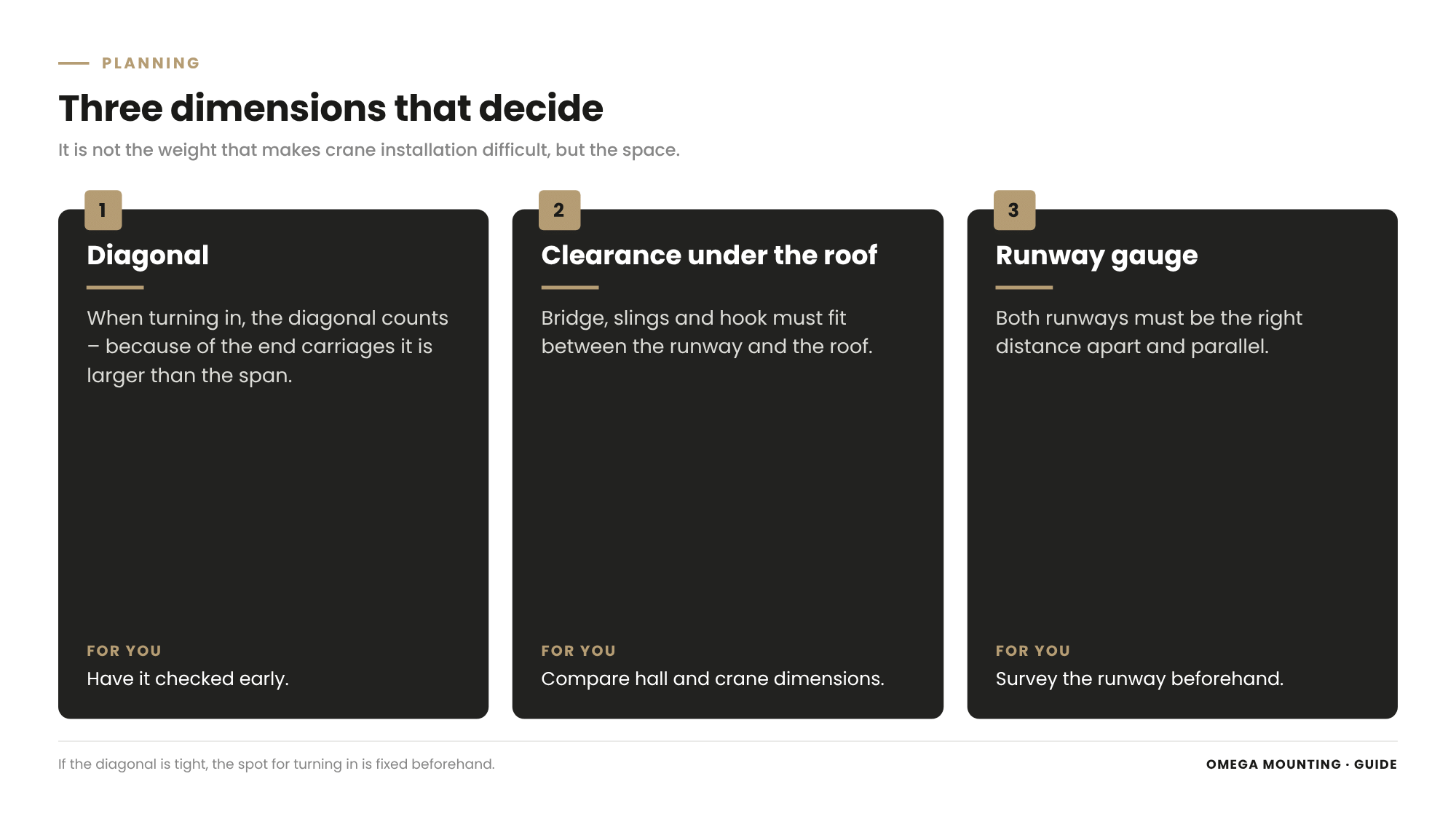
Whether an overhead crane is on its runway in one day depends less on the weight than on three dimensions. If you know them beforehand, there are no surprises on installation day.
The diagonal
A crane is not set onto the runway from above but turned in at an angle. In doing so it moves through its diagonal – and because of the end carriages at the ends of the bridge, that is considerably larger than the span. If the diagonal does not fit between the walls, the crane will not go in.
The clearance under the roof
There is often little room between the top of the crane runway and the underside of the roof. The bridge, the lifting accessories and the hook of the mobile crane all have to fit into this space. The tighter the clearance, the shorter the slinging has to be.
Gauge and tolerance of the runway
The crane runways must be at the right distance and parallel. If the gauge deviates, the crane will not fit on the rails or will later run crooked. We re-measure the gauge before the lift.
Single girder or double girder: what it means for installation
Whether single-girder or double-girder crane – the basic principle of installation is the same. In detail, weight, dimensions and pre-assembly differ.
The single-girder crane
On a single-girder crane, the trolley hangs under a single girder. The bridge is lighter and narrower, the diagonal smaller. A smaller mobile crane is often enough, and in an existing hall the bridge can sometimes even be brought onto the runway with lifting devices instead of a mobile crane.
The double-girder crane
On a double-girder crane, the trolley travels on top between two girders. It carries more and makes better use of the hook height, but is heavier and wider. The end carriages are longer, the diagonal larger. Here, careful planning of the turning-in is particularly worthwhile.
Several trolleys
If a crane has several trolleys, they are usually mounted on the ground if the lifting weight allows. Otherwise they follow individually after the bridge has been lifted – with a lift of their own.
Tandem operation: two trolleys, one load
Some overhead cranes have two trolleys that can travel and lift together. That is ideal for long, bulky loads such as machine frames, beams or coils that have to be picked up at two points.
What installation adds
For tandem operation, both trolleys must be linked in the controls. We install the controls as the manufacturer specifies and check during commissioning that both trolleys travel and lift in sync.
What the operator should know
In tandem operation, the load is shared between two hooks. How much each trolley may carry and when the total capacity of the crane applies is stated in the operating manual. The operators are instructed accordingly.
Planning before installation day
An installation day without surprises starts weeks beforehand. We clarify all points affecting the lift with the client, crane supplier and hall builder.
Documents from the crane supplier
We need the dimensions and weights of the bridge, trolleys and attachments, the position of the lifting points and the manufacturer's installation instructions. From these we derive the lifting weight, centre of gravity and slinging method.
Crane standing area and access
The mobile crane needs a load-bearing standing area close to the hall and access for crane and lorry. On construction sites the ground is often freshly backfilled – we check whether it can bear the load and plan in load-spreading plates.
Lifting plan
For the lift we draw up a lifting plan: weight, radius, hook height, lifting accessories, crane position, slewing range. The person responsible for lifting in our team checks and approves it. More on this in the guide Planning a crane lift.
Material and staff on installation day
On installation day, everyone has to be there at the same time: lorry with the crane, mobile crane, mobile elevating work platform, lifting accessories, tools, fitters. We set the sequence – first the work platform, then the mobile crane, then the lorry – and keep the phone numbers of everyone involved to hand. If a vehicle drops out, we know who provides a replacement. A mobile crane waiting because the lorry is stuck in traffic costs time and money.
Mobile elevating work platform for work at height
After setting down, work continues at height: conductor rail, limit switches, connections. A suitable mobile elevating work platform that safely reaches the height of the crane runway is ready for this. More on this in the guide MEWPs in installation work.
Time window and weather
On construction sites, many trades work at the same time. We agree the time window for the lift and keep an eye on the weather. In strong wind, no lifting takes place.
How the crane gets into the hall
The bridge of an overhead crane is long and heavy. How it gets into the hall depends on how open the hall is.
By lorry through the door
If the hall door is big enough, the lorry drives into the hall with the bridge and is unloaded there. That saves a lift from outside and creates space for pre-assembly on the ground.
Through open wall bays
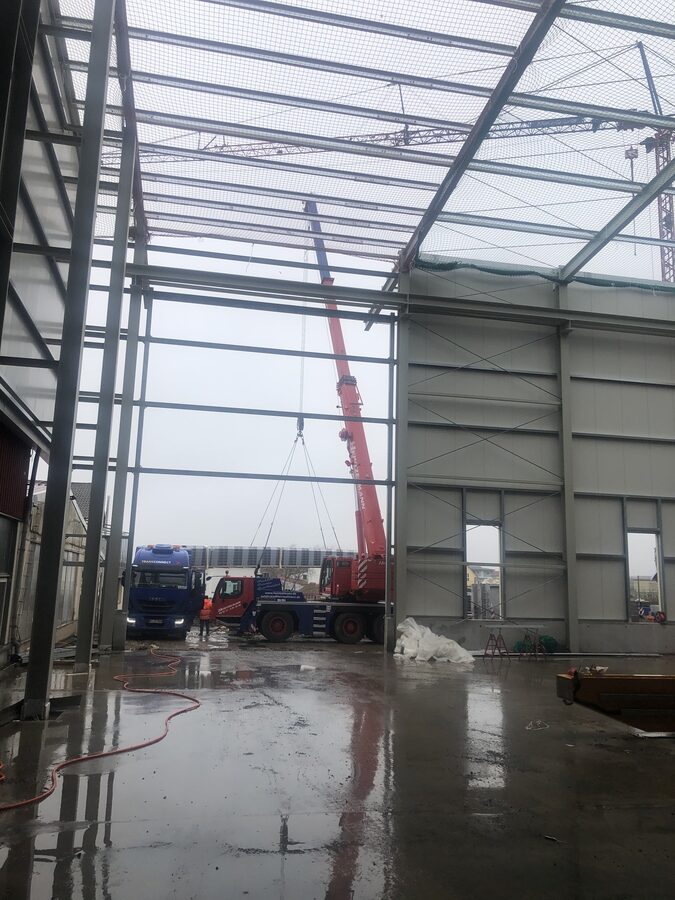
In a new build, wall bays are often still open. Through them, a mobile crane can reach into the hall from outside. If you schedule crane installation for this construction phase, it is much easier.
When everything is closed
In a closed hall, the crane has to pass through doors and between columns. Then every narrow point is measured and the route planned. Sometimes the bridge is brought in in parts and only bolted together in the hall. How to plan moving equipment in is described in the guide Planning a move-in.
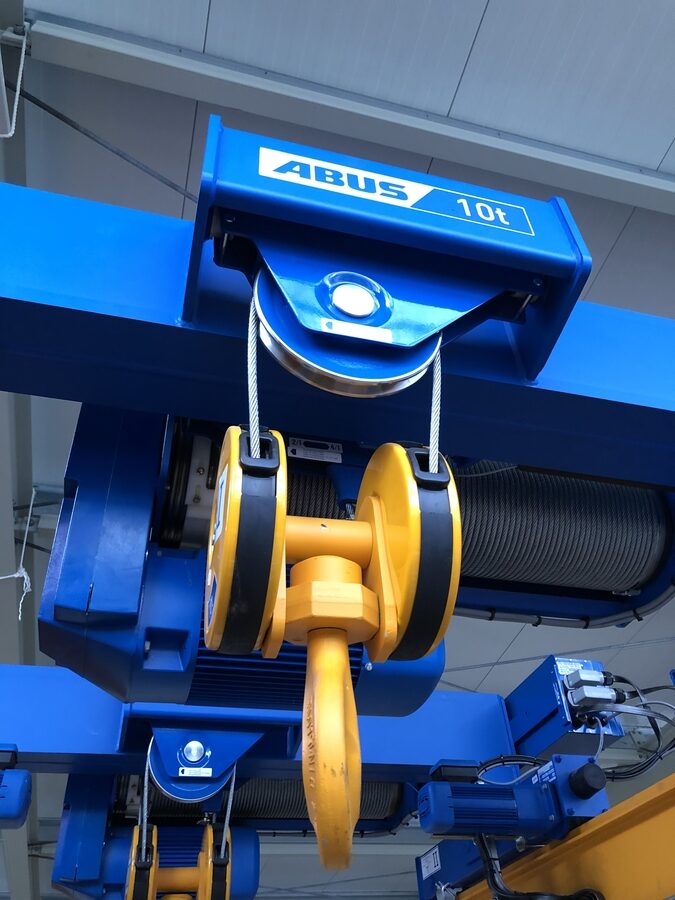
Pre-assembly on the ground: everything that is faster down below
Working at height is slower and riskier than on the ground. That is why as much as possible is done down below before the lift.
Attachments and hoists
Trolleys, hoists, end carriages with travel drives, walkways and attachments are installed on the ground, as far as the manufacturer provides for it and the lifting weight allows. Every bolt tightened down below no longer has to be reached up above.
Preparing the wiring
Cable routes, switch boxes and control cables on the bridge are prepared. After the lift, only the connections remain.
Check before the lift
Before lifting, we check all bolted connections, the position of the lifting points and the centre of gravity. Loose parts are secured or removed. Tools left lying on the bridge are collected now at the latest – nothing may fall during the lift.
Preparing lifting accessories
Lifting accessories are selected according to the lifting plan, checked for condition and attached at the intended points. Chains and slings must not run over sharp edges; edge protection is ready.
The diagonal: will the crane fit when being turned in?
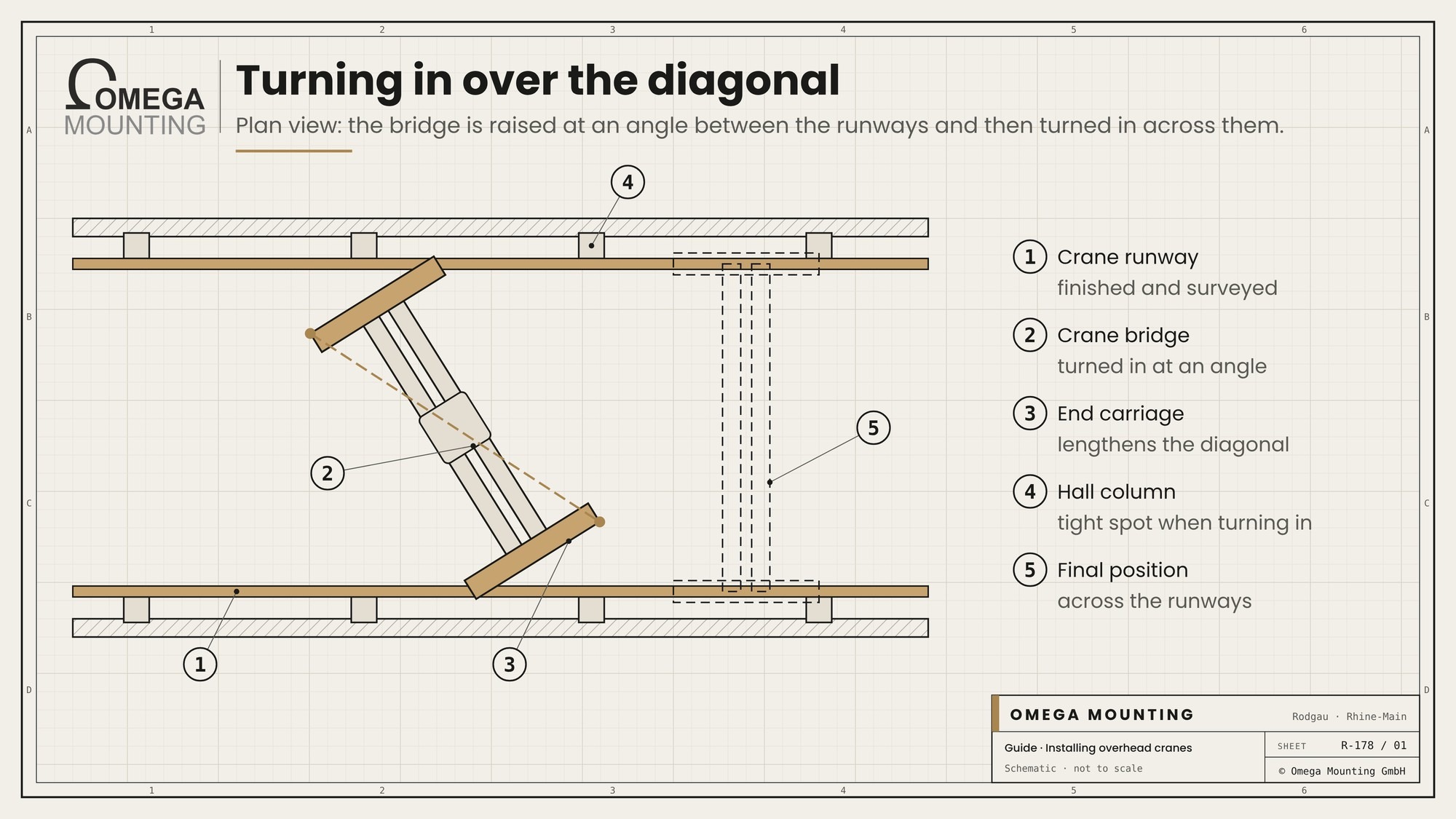
The diagonal is the dimension on which crane installation most often fails – and the one least often considered beforehand.
Why the diagonal is larger
An overhead crane has end carriages with wheel sets at both ends. They are longer than the bridge is wide. If the crane is turned at an angle to bring it up between the crane runways, its diagonal comes into play – and that is larger than the span.
When the diagonal does not fit
Then the crane will not pass between the walls. Two options remain: find places where the diagonal just swings through between hall columns, or schedule the installation for a time window in which the hall is still open.
Calculating it in good time
We recalculate the diagonal from the manufacturer's dimensions and compare it with the clear width of the hall. If it is tight, we fix the place for turning in. A crane that cannot be turned in is, in the end, just steel on the hook.
Lifting and setting down on the crane runway

Now comes the actual lift. It does not take long, but every movement has to be right.
The right mobile crane
The mobile crane must carry the weight of the pre-assembled bridge at the planned radius and reach the required hook height. If the clearance under the roof is tight, a crane with a fly jib helps: it allows the load to be slung particularly short. Which crane suits which job is described in the guide Spider crane or mobile crane.
Lift, turn in, set down
The bridge is lifted, brought under the roof and guided at an angle over the crane runway. Then it is turned in until both end carriages are above their rails, and slowly set down. Tag lines guide the ends, a signaller gives the commands.
Centimetre work
When turning in, it gets tight: between roof and bridge, between wall and end carriage. The team coordinates every movement centimetre by centimetre. Only when both wheel sets sit cleanly on the rails is the load taken off the mobile crane.
Securing
As soon as the crane is in place, it is secured against rolling away until the limit switches and buffers work.
Conductor rail, controls, main isolator: the electrical installation
A crane lying on the runway is only half the job. Now it needs power, controls and safety.
The conductor rail
Along the crane runway, the conductor rail is installed, which supplies the crane over its entire travel length. Hangers, rail and current collector must be in line so that the collector runs cleanly.
Controls and radio remote control
The controls on the bridge are installed and connected, often with radio remote control. Our own electricians carry out this electrical installation on the crane.
Up to the main isolator
The final step is the power connection up to the main isolator. From this interface onwards, the customer's plant electrician takes over. We agree this boundary beforehand so that nothing is done twice or not at all.
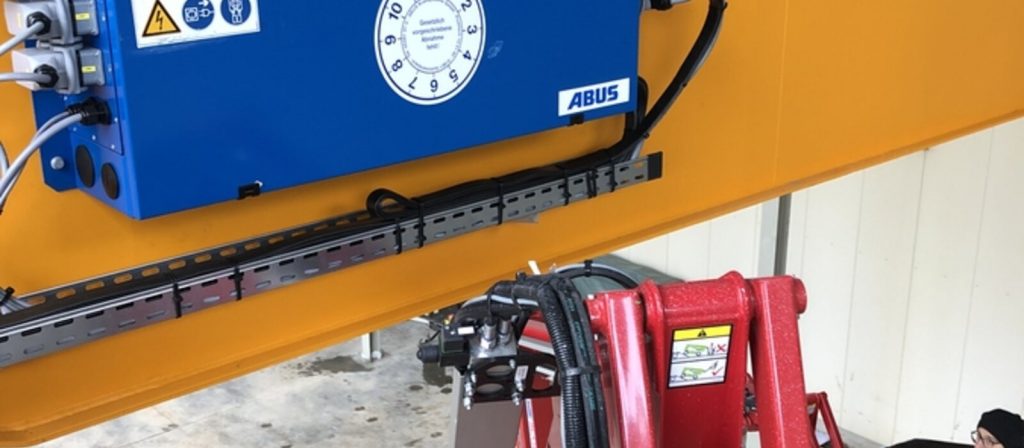
Pre-limit and final limit switching: before the buffer comes into play
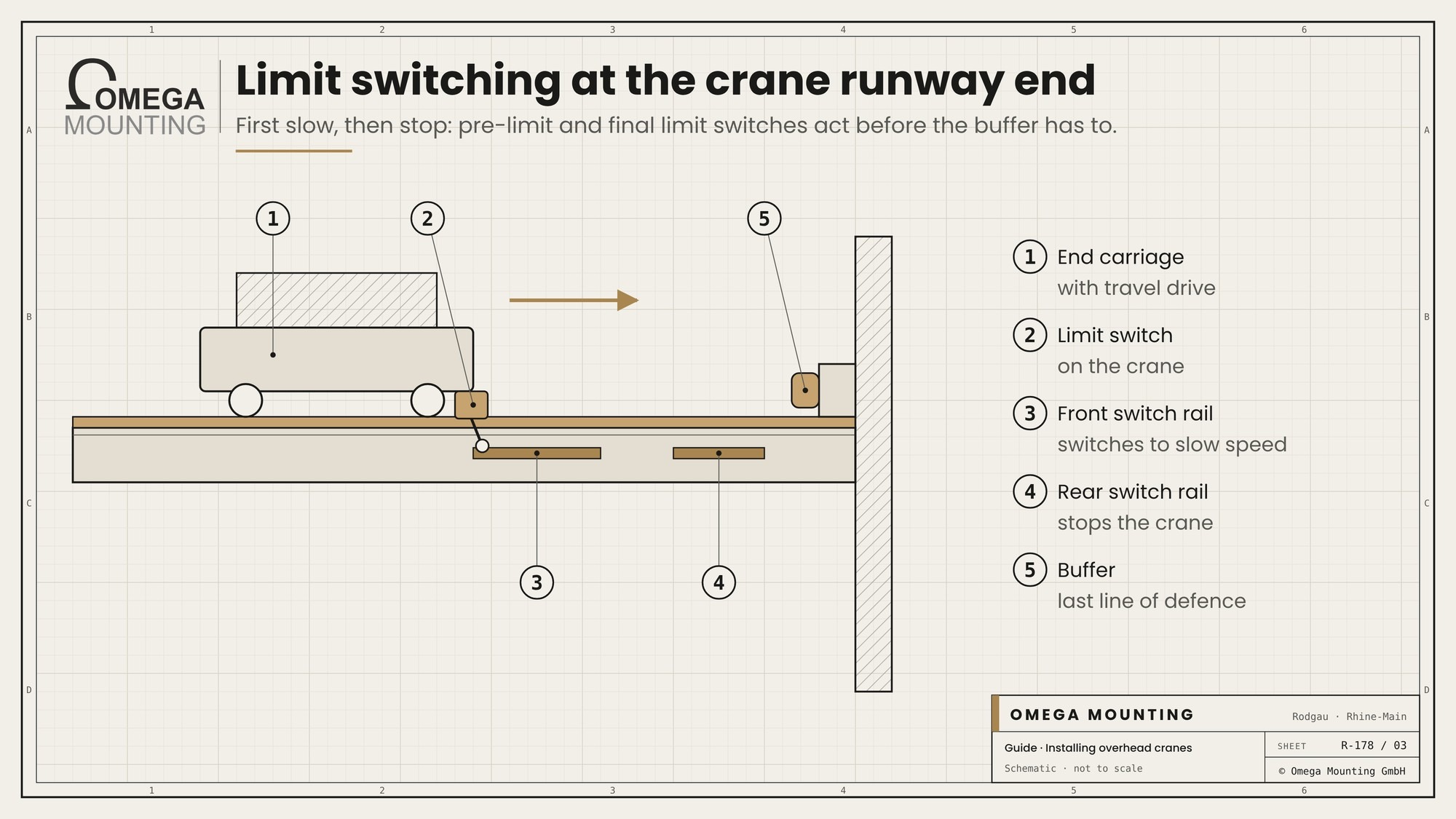
A crane must not travel unbraked against the end of the runway. That is what limit switching is for, acting before the mechanical buffers.
Pre-limit switching
Shortly before the end of the runway, the pre-limit switch slows the crane to creep speed. It approaches the end under control.
Final limit switching
The final limit switch stops the crane before it reaches the buffer. Only if both fail does the buffer at the end of the runway absorb the energy.
Setting and checking
Switch rails or switch flags are set on the runway so that pre-limit and final limit switching trigger at the right point. On the first run we check that both act reliably.
Handover and inspection before first commissioning
Installation alone does not release the crane for use. Before the first run under load come commissioning and inspection.
Commissioning
We agree commissioning with the crane supplier. It includes function tests of all movements and checks of the limit switches and brakes.
Inspection before first commissioning
Cranes must be inspected before first commissioning – depending on the crane, by a competent person or an approved expert. The operator arranges this inspection. We hand over the installed crane so that it can take place without delay.
Documents
The handover includes the manufacturer's documents, an installation record and the details of the electrical installation up to the main isolator. Who may operate the crane later is decided by the operator – more on this in the guide Crane operator certificate.
Installing an overhead crane in an existing hall
Not every crane goes into a new build. Often an existing hall is to get a crane or an old crane is to be replaced. Then installation is more demanding.
Through the door and between columns
In a closed hall, the bridge has to pass through the door and between the columns. Every narrow point is measured. Sometimes the bridge is delivered in parts and only bolted together in the hall.
Lifting without a mobile crane
Where no mobile crane can reach into the hall, other lifting equipment is used: lifting devices, gantry cranes or existing lifting points on the roof structure – if the structural engineer approves them. How heavy parts are moved without a large crane is described in the guide heavy-load skidding.
Old crane out, new crane in
If an old crane is replaced, removal comes on top. It is released in reverse order, lifted off and taken away before the new one arrives. The crane runway is inspected on this occasion.
Production continues
In existing halls, operations often continue. We cordon off the installation area, agree times with production and work so that the rest of the hall remains usable.
Safety during crane installation
Lifting under the roof, working at height, a site with many trades: the rules are clear.
The basic rules
- Nobody under the suspended load, slewing range of the mobile crane cordoned off.
- One signaller, clear commands, tag lines at the ends of the bridge.
- No lifting in strong wind.
- Work at height only with a mobile elevating work platform and fall protection.
- Secure the crane against rolling away after setting down.
- Electrical installation only in the isolated state.
Legal framework
Lifting operations, work at height and the inspection of cranes are subject to the German Occupational Safety Act (ArbSchG), the Industrial Safety Ordinance (BetrSichV) and the rules of the statutory accident insurance. This guide is not legal advice – which inspections and obligations apply to your crane you should clarify with your occupational safety specialist and the crane supplier.
After installation: maintenance from the start
A new crane runs best if maintenance is considered from day one. Installation is the moment to set the course for this.
Access to maintenance points
Walkways, maintenance platforms and access to travel drives and hoists should be reachable without fetching a work platform every time. During installation we make sure these accesses stay clear.
The first weeks
In the first weeks, bolts and brakes settle. The manufacturer specifies when they are retightened and readjusted. These dates belong in the maintenance plan.
Keeping an eye on the crane runway
The crane runway moves too. Rails can shift, clamping plates loosen. A check of the runway after the first months of operation shows whether everything is in place. What regular care of cranes involves is described in the guide crane system maintenance.
Wheels and buffers
Wheels and buffers wear over time. If you document their condition from the start, you will later recognise when replacement is due.
Who does what when installing an overhead crane?
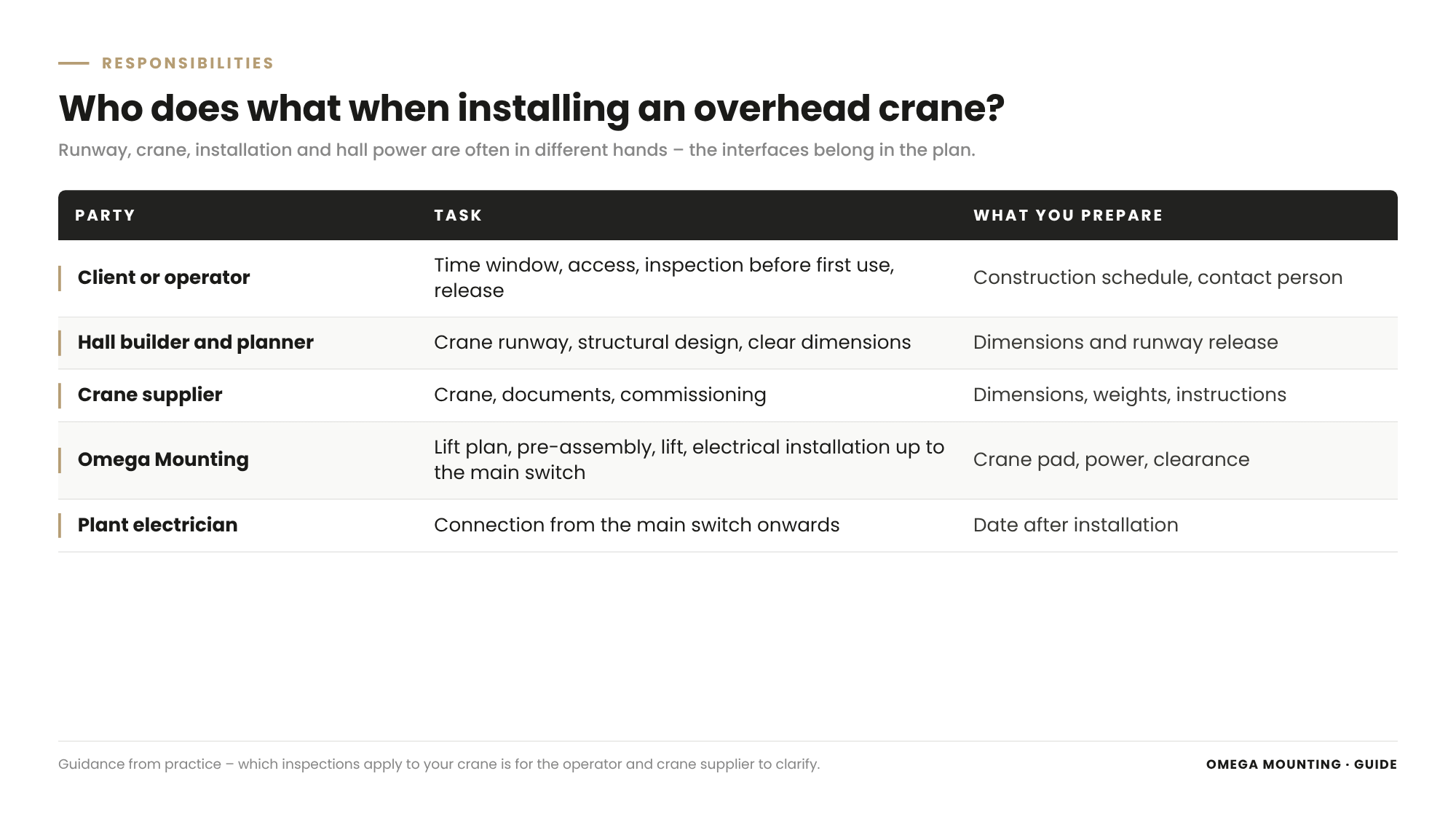
Several parties work together on a crane installation. Knowing the boundaries avoids gaps.
Client or operator
The client sets the time window and access, provides the finished crane runway, arranges the inspection before first commissioning and releases the crane for use.
Hall builder and planner
The hall builder and planner are responsible for the crane runway, structural design and columns. They supply the dimensions needed for the diagonal and clearance.
Crane supplier
The crane supplier delivers the crane, documents and installation instructions and supports commissioning.
Omega Mounting
We plan the lift, pre-assemble on the ground, lift, turn in, set down, install the conductor rail, limit switches and controls and connect up to the main isolator.
Plant electrician
From the main isolator onwards, the customer's plant electrician takes over the connection to the hall supply.
Installing an overhead crane: what it means for your planning
A good crane installation starts with four questions.
Is the crane runway finished and surveyed?
No finished, surveyed runway, no lift. Clarify with the hall builder when it will be ready.
Does the diagonal fit?
Have the diagonal and clearance calculated early. If it gets tight, schedule the installation for the construction phase with open wall bays.
Where will the mobile crane stand?
Provide a load-bearing standing area and clear access on installation day.
Where does the electrical work end?
Define the interface with the plant electrician – ideally at the main isolator.
Typical mistakes when installing an overhead crane
Most problems arise not during the lift but in planning.
- Diagonal not checked: the crane fits on paper but will not turn in.
- Hall closed too early: the open wall bays would have been the easy route.
- Crane runway not surveyed: the crane does not fit on the rails or runs crooked.
- Too little pre-assembled: what would take minutes down below takes hours up above.
- Electrical interface left open: nobody feels responsible for the last metre of cable.
- Limit switches not set: the crane runs into the buffer on its first test.
The mistake behind the mistakes
Almost all these mistakes have one cause: crane installation was seen as a delivery and not as a trade in its own right with its own planning. If you include it in the construction schedule early, installation day runs calmly.
Installing an overhead crane in the Rhine-Main region: how we do it
From Rodgau we quickly reach Frankfurt, Offenbach, Hanau, Darmstadt, Aschaffenburg and Wiesbaden. New halls for production, logistics and trades are constantly being built in the region – and many of them get an overhead crane.
Before installation day, we look at the hall, crane runway and access, recalculate the diagonal and clearance and draw up the lifting plan. On installation day, we pre-assemble, lift, turn in and connect. How else we work is on our page on Industrial installation.
Our fitters carry out the mechanical and electrical installation on the crane up to the main isolator. For you, that means one point of contact from unloading to handover.
Project examples
A job from our project diary shows how an overhead crane gets onto its runway in one day.
double-girder overhead crane in the Aschaffenburg area
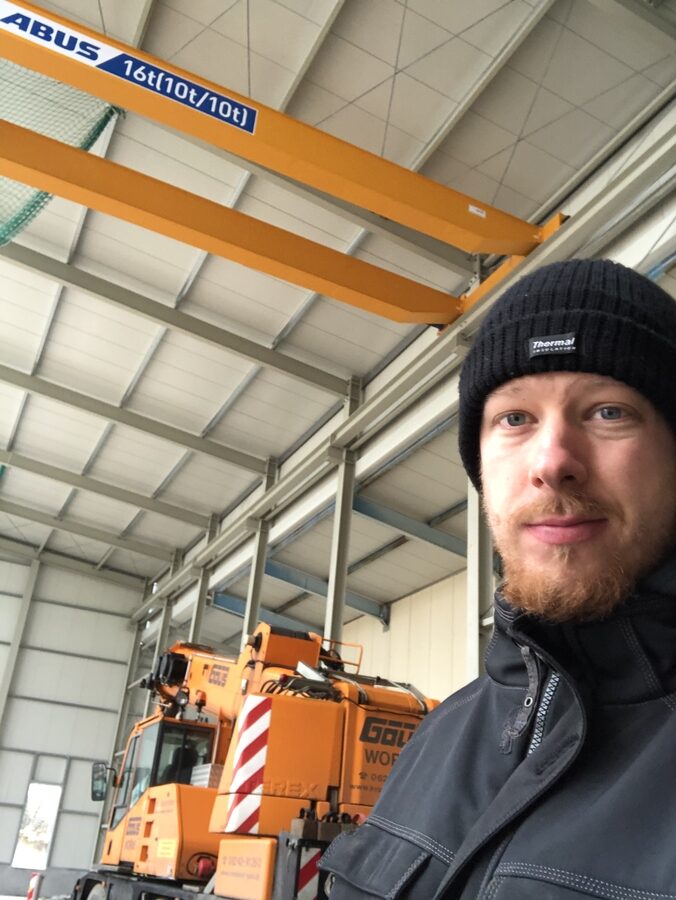
In a new hall building in the Aschaffenburg area, two fitters installed a double-girder overhead crane with two trolleys that can lift together in tandem. The crane was driven into the hall by lorry, unloaded and pre-assembled on the ground as far as possible. A mobile crane with a fly jib lifted the bridge under the hall roof; the fly jib allowed the short slinging that the tight clearance required. Above the crane runway, the bridge was turned in and set down on both runways. Because the walls were not yet fully closed, turning in through the open wall bays worked without a millimetre gamble. We then installed the conductor rails along the crane runway, the pre-limit and final limit switching and the controls with radio remote control, and connected the crane up to the main isolator. From there the plant electrician took over. By evening the crane was on its runway – after a day on site in all weathers.
Is a crane installation coming up for you?
Send us crane dimensions, hall plans and your construction schedule – we will tell you what we need for the installation. Get in touch now.
What this means for your role
Clients or project managers for hall construction: Include crane installation in the construction schedule early – ideally before the walls are closed.
Crane suppliers: Pass on dimensions, weights and lifting points early. An installation partner who also handles the electrical work saves you coordination.
Planners: Check the clearance above the crane runway and the diagonal against the clear width of the hall.
Plant managers: Decide who may operate the crane and arrange the inspection before first commissioning.
Buyers: Compare quotes not only by the mobile crane. Ask whether pre-assembly, conductor rail, limit switches, controls and connection are included.
Overhead crane installation plan: template on request
For your next crane installation, we have put together the overhead crane installation plan. On one page it asks about the crane, the hall, the lift, the electrical work and the handover. You fill it in, and we plan the installation without follow-up questions. Request the template via our contact form – keyword “Overhead crane installation plan”.
Why Omega Mounting?
With over twenty years of experience in installation, moving equipment in and crane work, we know that an overhead crane is lifted quickly but only installed well if diagonal, clearance, crane runway and electrical work were thought through together beforehand. That is why we plan the lift with a person responsible for lifting, pre-assemble as much as possible on the ground and carry out the electrical installation on the crane up to the main isolator. For you, that means a crane that only needs switching on. Talk to us about your hall – get in touch.
Conclusion
Installing an overhead crane is a short, precise job with long preparation. The crane is pre-assembled on the ground, a suitable mobile crane lifts the bridge under the roof, it is turned in over the diagonal and set down on the crane runway. Conductor rail, pre-limit and final limit switching and controls turn steel into a crane.
New build or existing hall: if you clarify the diagonal, clearance and interfaces early, you will have a crane on its runway by evening. If an overhead crane is coming up for you, get in touch with us.
Planning a move-in, installation or maintenance in the Rhine-Main region?
Tell us briefly what you need – we'll come back with an honest assessment.
Free, no-obligation callback
You may also be interested in these guides

About the author
Tobias Schott
Managing director of Omega Mounting GmbH, Rodgau · more than 20 years of hands-on experience in installation and maintenance
A trained mechatronics technician, working in maintenance, servicing and industrial installation since 2004 – first alongside his father, and with Omega Mounting since 2012: from overhead conveyors in Frankfurt to the crane system in a new-build hall. He plans and leads lifting operations as an appointed person (AP) in data centers and on industrial sites in the Rhine-Main region, trains and examines operators of cranes, mobile elevating work platforms and telehandlers, and is a qualified occupational safety specialist. On jobs abroad he is known as the “German Troubleshooter” – the person you call when a site gets stuck. He learned what quality means from his father, not from a manual: Made in Germany as a standard for his own work, not a label. That is why quality comes first at Omega Mounting – ahead of speed and price. He writes these guides from that practice: what works on our sites is in them – what exists only on paper is not.
Frequently asked questions
That depends on size, hall and pre-assembly. In our example, a double-girder overhead crane was on its runway after one day on site with two fitters, connected up to the main isolator.
The largest corner-to-corner dimension the crane occupies while being turned in onto the crane runway. Because of the end carriages, it is larger than the span and decides whether the crane fits between the walls.
Usually a mobile crane that carries the weight at the required radius. If clearance under the roof is tight, a fly jib helps to sling the load short.
Yes. Our own electricians install the conductor rail, pre-limit and final limit switching, controls and the connection up to the main isolator. From the main isolator onwards, the plant electrician takes over.
Yes, cranes are inspected before first commissioning – depending on the crane, by a competent person or an approved expert. The operator arranges the inspection.
Yes, but planning takes more effort. The diagonal and narrow points are measured precisely; sometimes the bridge is brought in in parts.
Ideally when the crane runway is finished and the walls are still open. Then the lift is easiest.
Yes. From Rodgau we are quickly on site throughout the Rhine-Main region, including Frankfurt, Hanau, Darmstadt, Aschaffenburg and Offenbach.
Send us crane dimensions and weights, hall plans, details of the crane runway and your construction schedule. We will come back with our questions and an assessment. Go to the contact page.
 English
 German