
- Guide – Crane technology
Crane licence in the plant: who may operate the overhead crane?
By Tobias Schott · 22-minute read · Updated October 2026
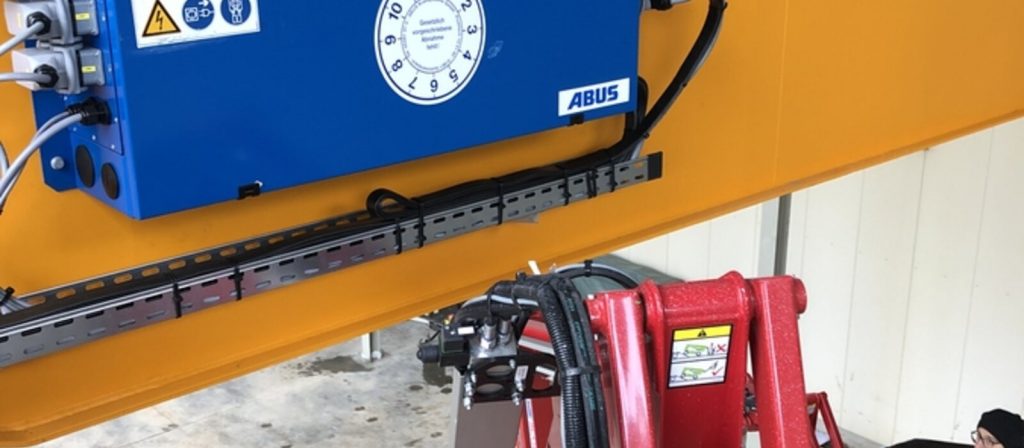
There is no state-issued crane licence. What is meant is proof that someone has been trained as a crane operator. But only someone who is suitable, inducted on the specific crane and appointed by the employer may operate an overhead crane in the plant.
The new overhead crane hangs under the roof, the controls are connected, the transmitter is ready. Then the question comes from production: who is actually allowed to operate it now? Does everyone need a crane licence, or is it enough if the supervisor shows them quickly?
This guide explains what a crane licence is and what it is not. It shows which cranes are covered and what you as the employer have to arrange. Plus the checks before starting work, the difference from the crane inspection, an overview and typical mistakes.
We are an installation and maintenance company from Rodgau near Frankfurt. We install, maintain and repair cranes. But we do not train crane operators and do not issue crane licences. We say that right at the start so you know who you are talking to. What maintaining and replacing a crane installation involves is set out in our guide on Crane systems, maintenance and replacement.
Key points at a glance
- “Crane licence” is an everyday term. What is meant is proof of training as a crane operator with theory, practice and a test.
- A crane licence is not a driving licence. No authority issues it, and it does not allow you to operate any crane anywhere.
- Anyone operating a crane independently must be suitable, trained, inducted on the specific crane and appointed by the employer.
- This also applies to floor-controlled overhead cranes, pillar jib cranes and gantry cranes – not just to cranes with a cab.
- The appointment applies to the named cranes. A crane licence from a previous employer does not replace it.
- The induction is repeated regularly and documented, in a language the crane operator understands.
- The inspection of the crane is something else. It concerns the crane, not the person, and is carried out by experts or competent persons.
What is a crane licence?
A crane licence is the everyday name for proof that a person has completed training as a crane operator – usually a certificate or card after a course and test. It proves competence but replaces neither the induction at the crane nor the appointment by the employer.
Many people think of a driving licence when they hear the word. There is no such thing for cranes in plants. There is no licensing authority, no state examination board and no register. The crane licence is a private document from a trainer. It says: this person has learned how to operate a crane safely and has shown it in a test.
Is the crane licence mandatory?
What is mandatory is competence, not a particular piece of paper. The rules require that only competent, inducted and appointed persons operate a crane. The crane licence is the usual way to prove this competence. That is why almost all plants require it, and so should you.
What the training covers
Crane operator training has a theoretical and a practical part. Typical contents are:
- Design and operation of the crane, types and controls.
- Safety devices such as limit switches, emergency stop, overload protection and warning device.
- Rated capacity, load handling and the basics of slinging.
- Communication with slinger and signaller, hand signals and radio.
- What to do in case of faults, defects and accidents.
- Checks before starting work and the crane operator's duties.
- Practical exercises at the crane and a test at the end.
A recognised route for this training is a principle of the German statutory accident insurance institutions on the selection, induction and qualification of crane operators. Following it puts you on the safe side. The scope depends on the crane type. For a floor-controlled overhead crane the training is usually shorter than for a crane with a cab or a mobile crane.
Where to get a crane licence
Training is offered by training providers, by the accident insurance institutions in their seminars and by some crane manufacturers. Larger plants often train in-house, with a qualified trainer and on their own crane. What matters is not the name on the certificate but that content, practice and test are traceable.
We are not one of these providers. We do not train, we do not test crane operators and we do not issue crane licences. If you are looking for a provider, ask your employers' liability insurance association or your occupational safety specialist.
Crane licence and slinger certificate
Crane operator and slinger are two roles. The crane operator operates the crane. The slinger selects the lifting accessories and attaches the load. In small plants one person often does both. Then they need both: the competence to operate the crane and to sling. Many courses combine the contents. Which lifting accessories exist and how to use them correctly is described in our guide on lifting accessories for heavy loads.
Which cranes are covered: overhead crane, pillar jib crane, gantry crane
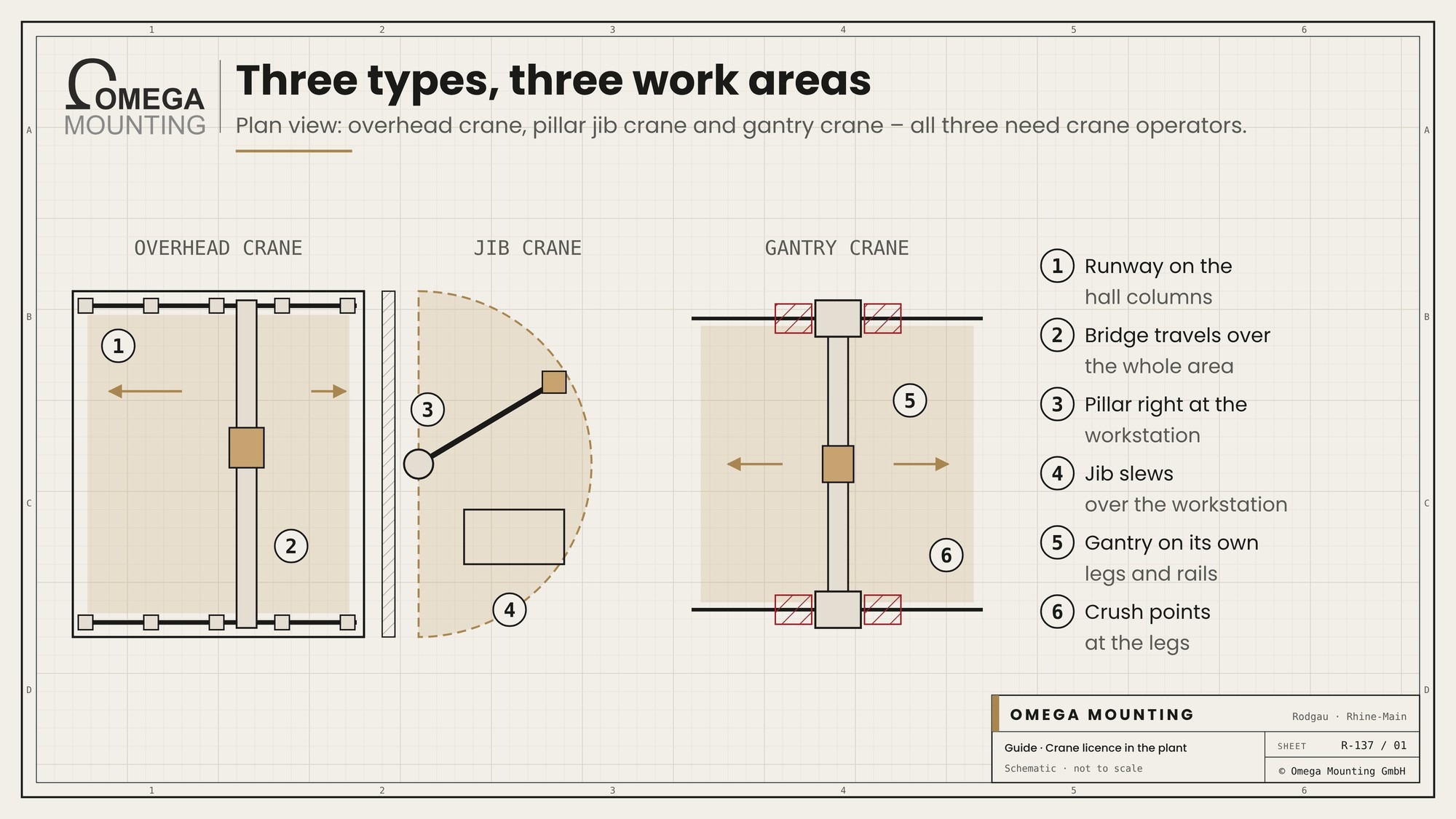
All power-driven cranes in the plant are covered – including the small ones. The overhead crane is the best-known example, but pillar jib cranes, wall jib cranes and freestanding gantry cranes are cranes too. Anyone operating them independently needs competence, induction and appointment.
The overhead crane
The overhead crane runs on a runway under the hall roof. It has a bridge with trolley and hoist and moves loads over the whole hall area. How overhead crane and runway are built is explained in our article on overhead cranes and crane runways.
The pillar jib crane
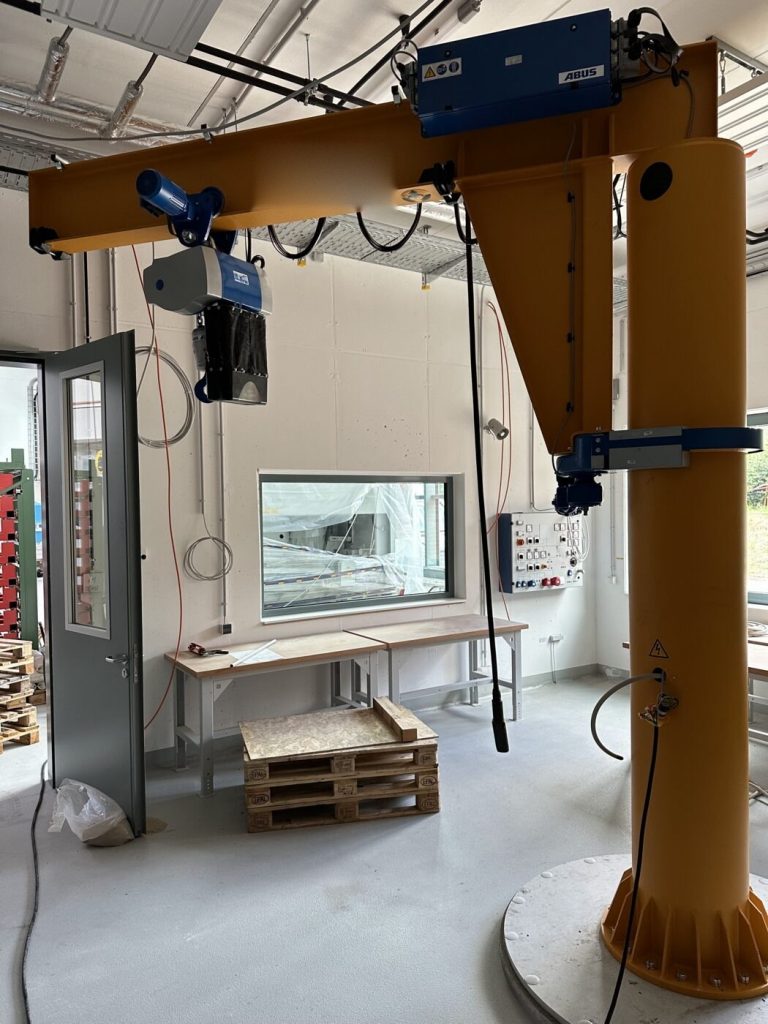
The pillar jib crane stands on its own pillar at the workstation. Its jib slews, a chain hoist lifts the load. Many plants see it as a better tool. Legally it is a crane. Anyone who is to operate a pillar jib crane therefore needs the same steps as on the overhead crane, usually with shorter training. What characterises it is described in our article on the Pillar jib crane.
The gantry crane
The gantry crane stands on its own legs and does not load the building. For operation the same applies as for the overhead crane. Add hazards at floor level, such as crush points at the legs when the crane travels.
Floor-controlled or with a cab
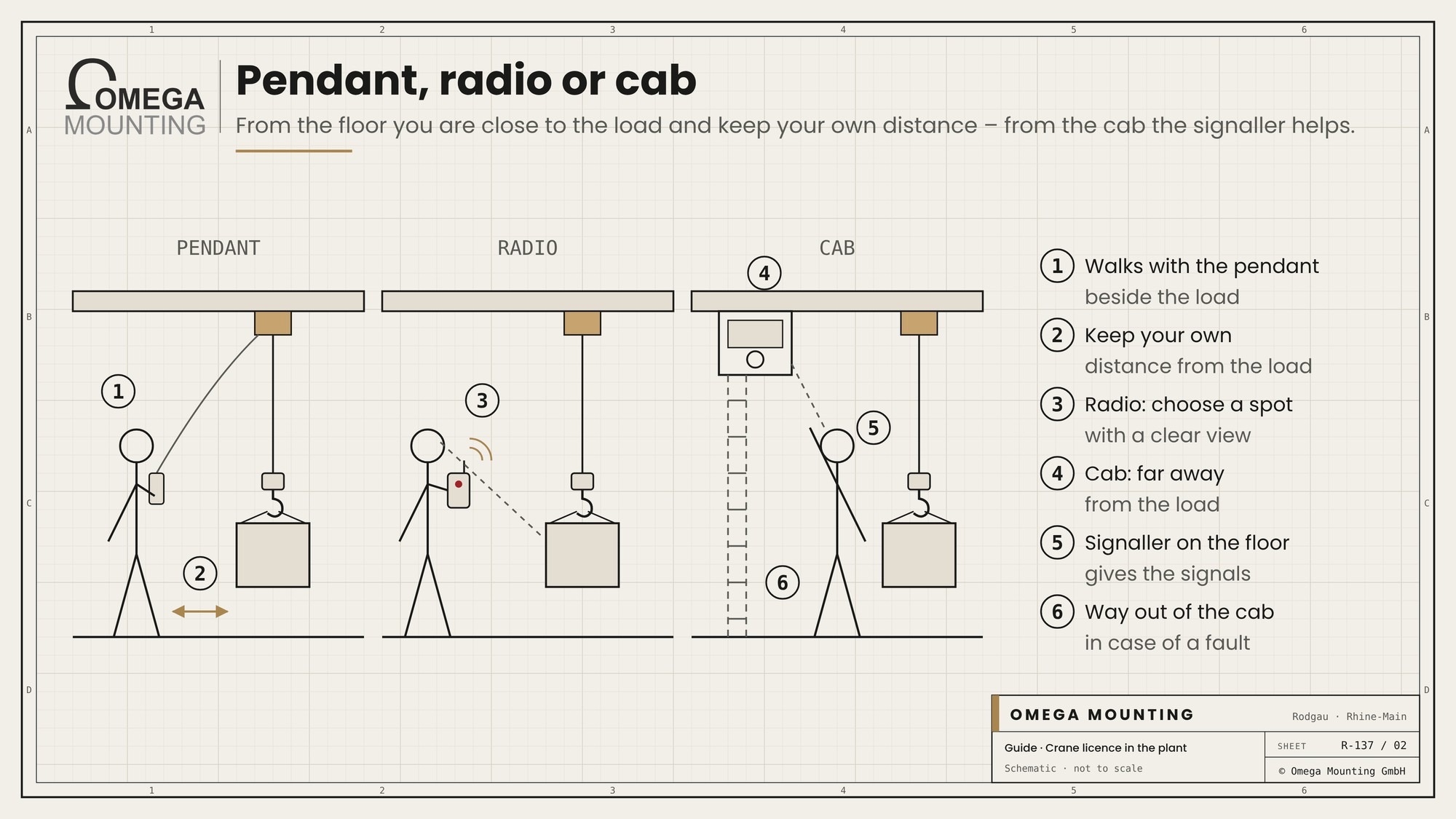
Most overhead cranes today are operated from the floor. The crane operator walks beside the load with a pendant or controls it by radio remote control. This is called floor-controlled. Cranes with a cab, from which the operator drives, are rarer.
Both need a competent, inducted and appointed crane operator. The difference lies in the scope of the training and in the induction. Anyone sitting in the cab is far from the load and depends on signallers. They also need a way out of the cab in case of a fault. Anyone controlling from the floor is close to the load and must watch their own distance.
Mobile crane and loader crane
Vehicle-mounted cranes are a topic of their own. Driving on the road also requires a driving licence, and the training is more extensive. Which crane types exist is set out in our article on the common crane types at a glance. This guide stays with the crane in the plant.
What the employer must do: select, train, induct, appoint
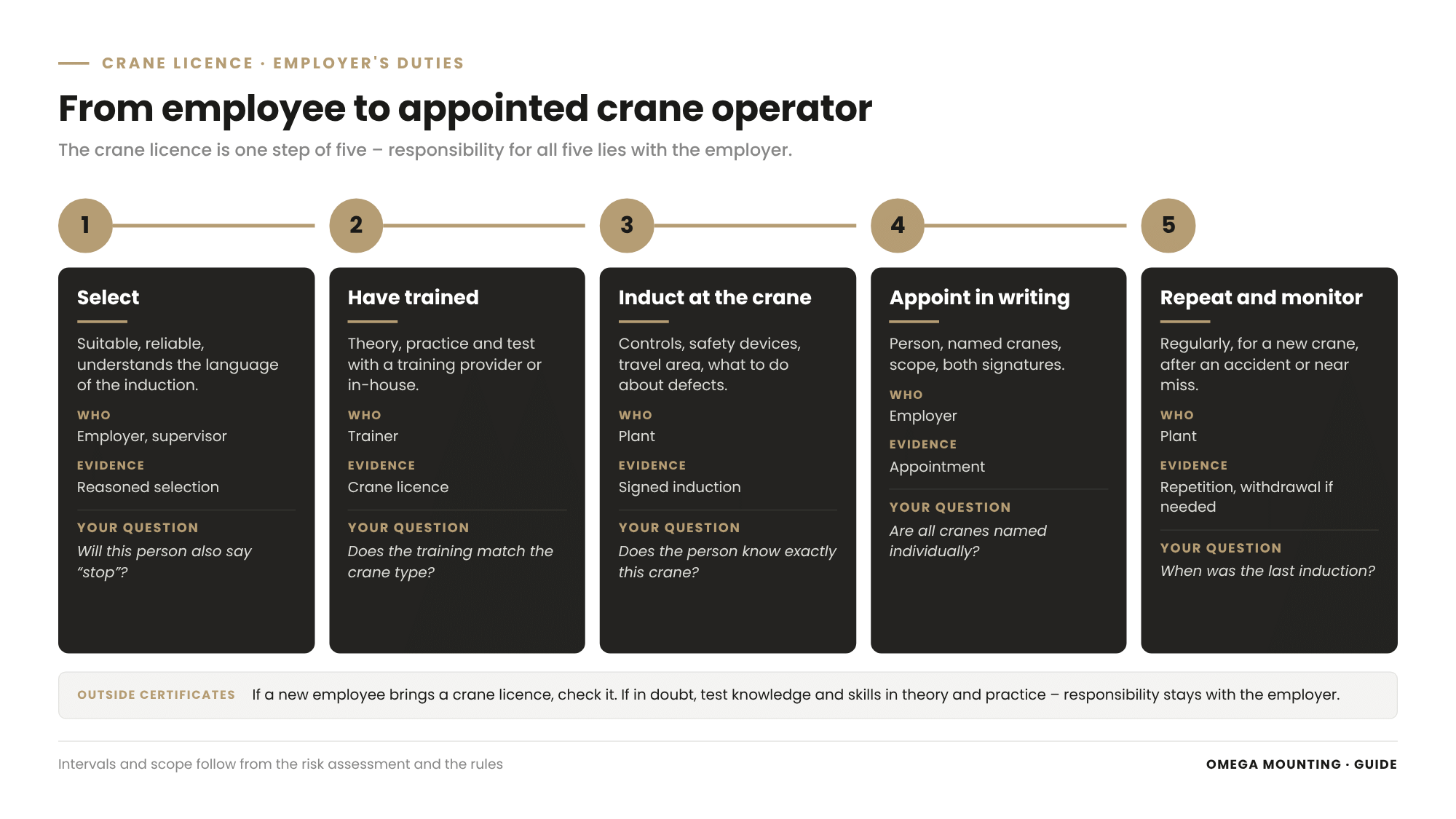
The employer must select suitable persons for each crane, have them trained, induct them on the specific crane and appoint them to operate it – and repeat the induction regularly. These duties stay with the employer even if training or induction take place externally.
The basis is the German Ordinance on Industrial Safety and Health. It requires that only appointed employees use certain work equipment such as cranes. The technical rule on qualification, induction and appointment describes how this works. Add the accident prevention regulation for cranes. It requires that only competent and inducted persons operate cranes independently.
Select a suitable person
It starts with selection. The crane operator must be physically and mentally suitable. They must be reliable and can be expected to perform their task safely. They must understand the language of the induction. Whether occupational health advice makes sense, clarify with your company doctor. The individual personal requirements are set out in the rules.
Not everyone who likes operating the crane is the right person. Look for calm, overview and the willingness to say “stop” when needed.
Have them trained
Next comes training with a training provider or in-house. At the end there is proof – the crane licence. Keep a copy in the personnel file or with the occupational safety records.
If a new employee brings a crane licence, check it. Does the training match the crane type in your plant? Is the proof traceable? For outside or foreign certificates: if anything is unclear, have knowledge and skills checked in theory and practice. Responsibility stays with you.
Induct on the specific crane
The crane licence shows that someone can operate cranes. It does not show that they know your crane. That is why the induction on the specific crane follows. It covers:
- Controls, transmitter and operating elements of this crane.
- Safety devices and how they work.
- Travel area, obstacles, exclusion zones and traffic routes in the hall.
- Load handling attachments and lifting accessories used here.
- The manufacturer's operating manual and the plant's operating instructions.
- What to do in case of defects, faults and accidents.
Record the induction in writing: when, who, what about, and that it was understood. A date, a content and two signatures are enough.
Appoint in writing
Then you appoint the person to operate the crane. For cranes the appointment is mandatory, for certain cranes explicitly in writing. In writing is the safe route in any case. The appointment contains the person, the cranes it applies to, the scope and the signatures.
The appointment applies only to the named cranes. If a new crane is added, a new induction and an addition to the appointment are needed. Which formalities apply in the individual case, clarify with your occupational safety specialist and your employers' liability insurance association. This guide is not legal advice.
Repeat and monitor
The induction is not a one-off appointment. It is repeated regularly as the risk assessment and the rules require. It is also needed for a new or converted crane, for changed procedures and after an accident or near miss.
Monitoring also includes withdrawal. Anyone who repeatedly breaks rules or has caused an accident can lose their appointment. Record that in writing too.
Crane licence and appointment: two different things
The crane licence shows that someone is competent; the appointment allows them to operate a particular crane in your plant independently. Only both together – with the induction at the crane – make an employee a crane operator.
This distinction is the heart of the matter. Many plants rely on the licence alone. Others appoint employees without any training. Both are mistakes.
The licence belongs to the person
An employee takes the crane licence with them when changing employer. It remains proof of their training. But it is not permission to operate every crane at the new employer.
The appointment belongs to the plant
The appointment is issued by the employer, for its cranes and its plant. If the employee leaves, it ends. If the crane changes, it is supplemented. It is the document with which the employer says: this person may operate this crane, and I have satisfied myself of that.
When contractors use your crane
If fitters from another company are to use your overhead crane, things get tricky. They are not your employees. Their own employer must qualify and appoint them. As operator you must decide whether you allow it. And you must brief them on the particulars of your crane and your hall.
Settle this in writing beforehand: who may use the crane, for which work, with which evidence. How this is organised overall is described in our guide on contractor management.
When maintenance moves the crane
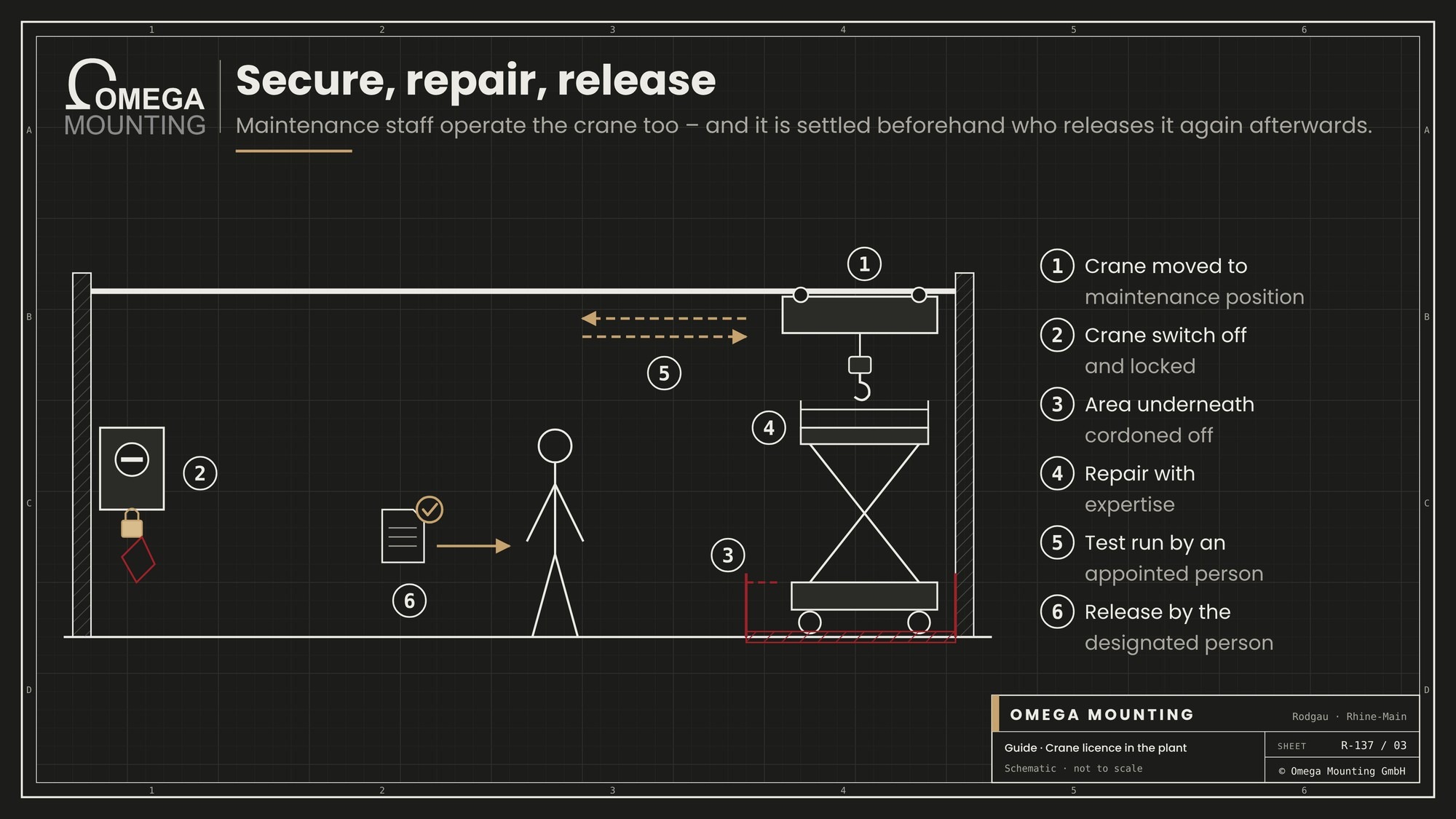
Maintenance staff operate the crane too, for example for a test run after a repair or to remove an assembly. Nothing different applies to them. Anyone moving the crane must be competent, inducted and appointed to do so. Then there is the maintenance itself: anyone working on the crane needs expertise for this work and a clear rule on how the crane is secured and isolated beforehand. Set who releases the crane again after a repair. Then the next crane operator knows they can rely on their crane.
Who is responsible for what in a lift
For special lifts another role is added: the responsible person who plans the lift, releases it and may stop it. They do not operate the crane themselves. How they differ from the crane operator is set out in our guide on the appointed person for lifting operations.
Before work: what a crane operator checks at the crane
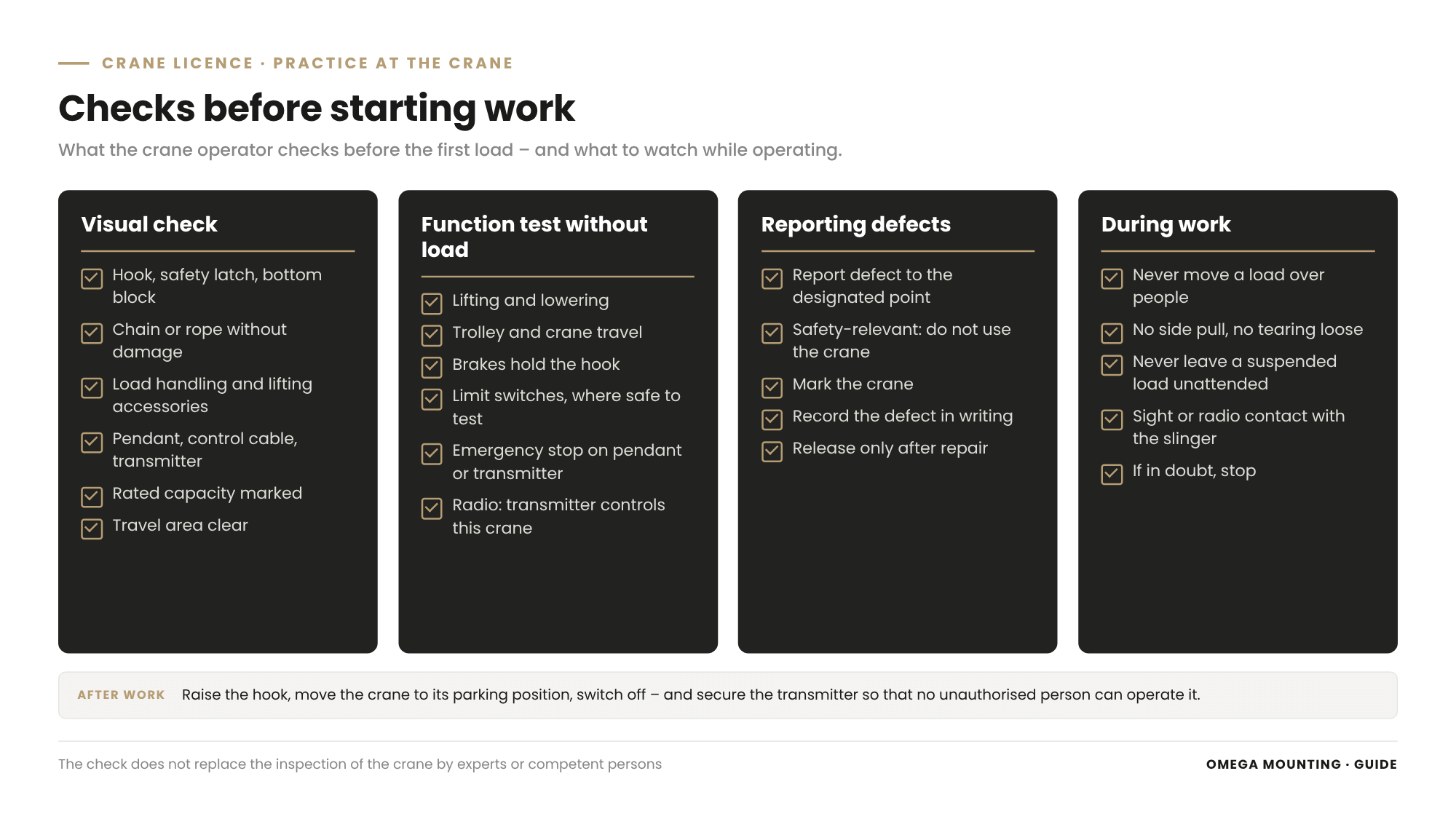
Before starting work, the crane operator checks the crane by a visual check and a function test without load, and reports every defect immediately. If a defect endangers safety, the crane stays out of operation until it is rectified.
This check is part of the training and part of the induction. It is not an inspection in the sense of the rules, but it finds many defects before anything happens.
Visual check
The crane operator looks at what can be seen without tools:
- Hook with safety latch, bottom block, chain or rope.
- Load handling attachments and lifting accessories they intend to use.
- Pendant, control cable and transmitter for damage.
- Signs with rated capacity and marking.
- Travel area: is the path clear, are ladders, racks or vehicles in the way?
Function test without load
Then they try the crane without load:
- Lifting and lowering, trolley travel and crane travel in all directions.
- Brakes: does the hook stay put when they let go?
- Limit switches for lifting and travel, as far as they can be reached safely.
- Emergency stop on the pendant or transmitter.
- Warning device, horn or light.
- With radio: does the transmitter really control this crane?
Reporting defects
If the crane operator finds a defect, they report it to the designated point – supervisor or maintenance. If the defect affects safety, they do not use the crane and mark it. How defects from inspections are then worked through in an orderly way is described in our guide on rectifying defects from statutory inspections.
During work
Simple rules apply while operating too. The load never hangs over people. It is not pulled at an angle and not torn loose. The crane operator does not leave a suspended load unattended. They keep sight or radio contact with the slinger.
After work
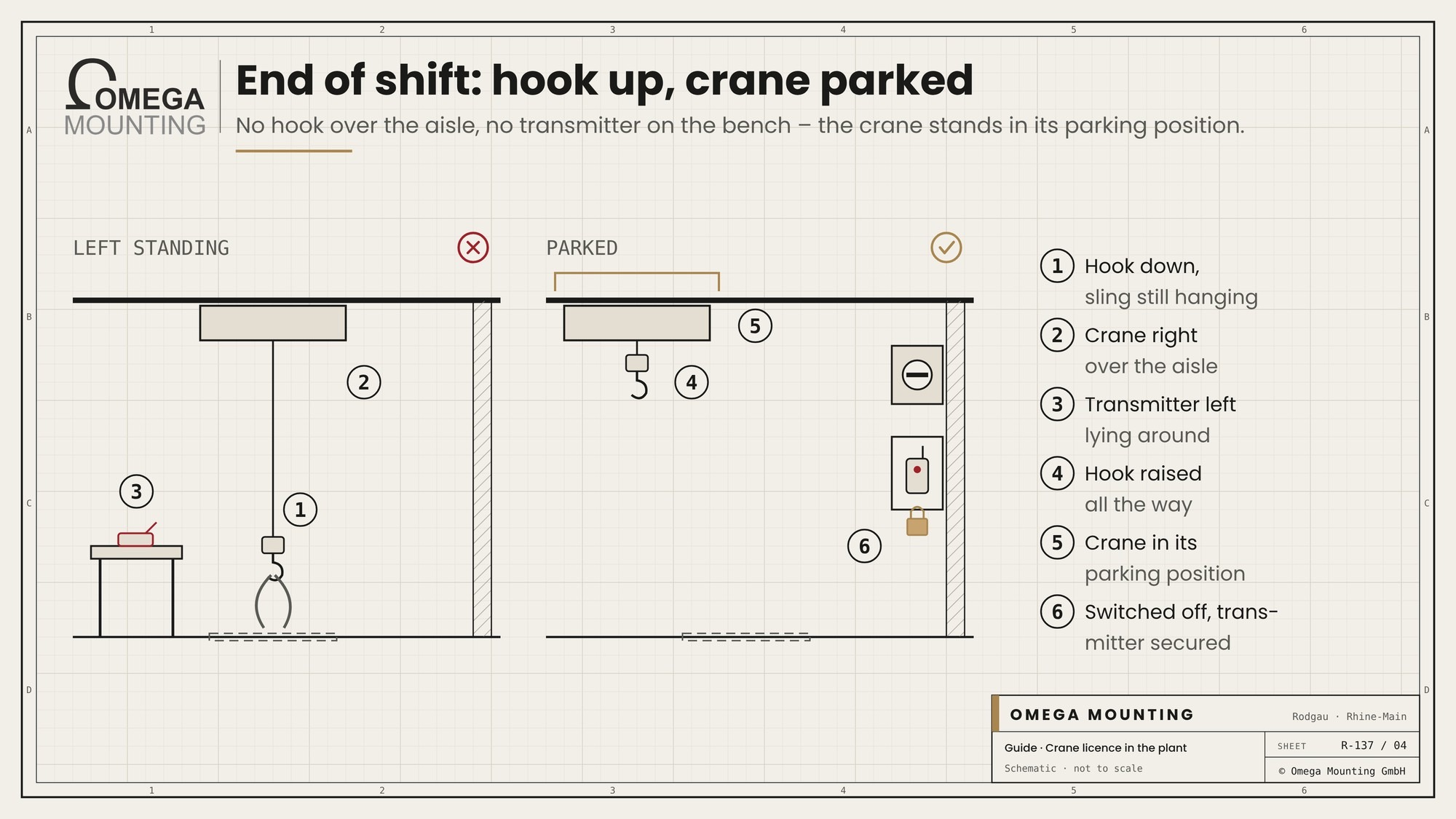
At the end the crane operator raises the hook, moves the crane to its parking position and switches it off. They do not leave the transmitter of a radio remote control lying around but secure it so that no unauthorised person can operate it.
Crane inspection is not a crane licence: who inspects the crane
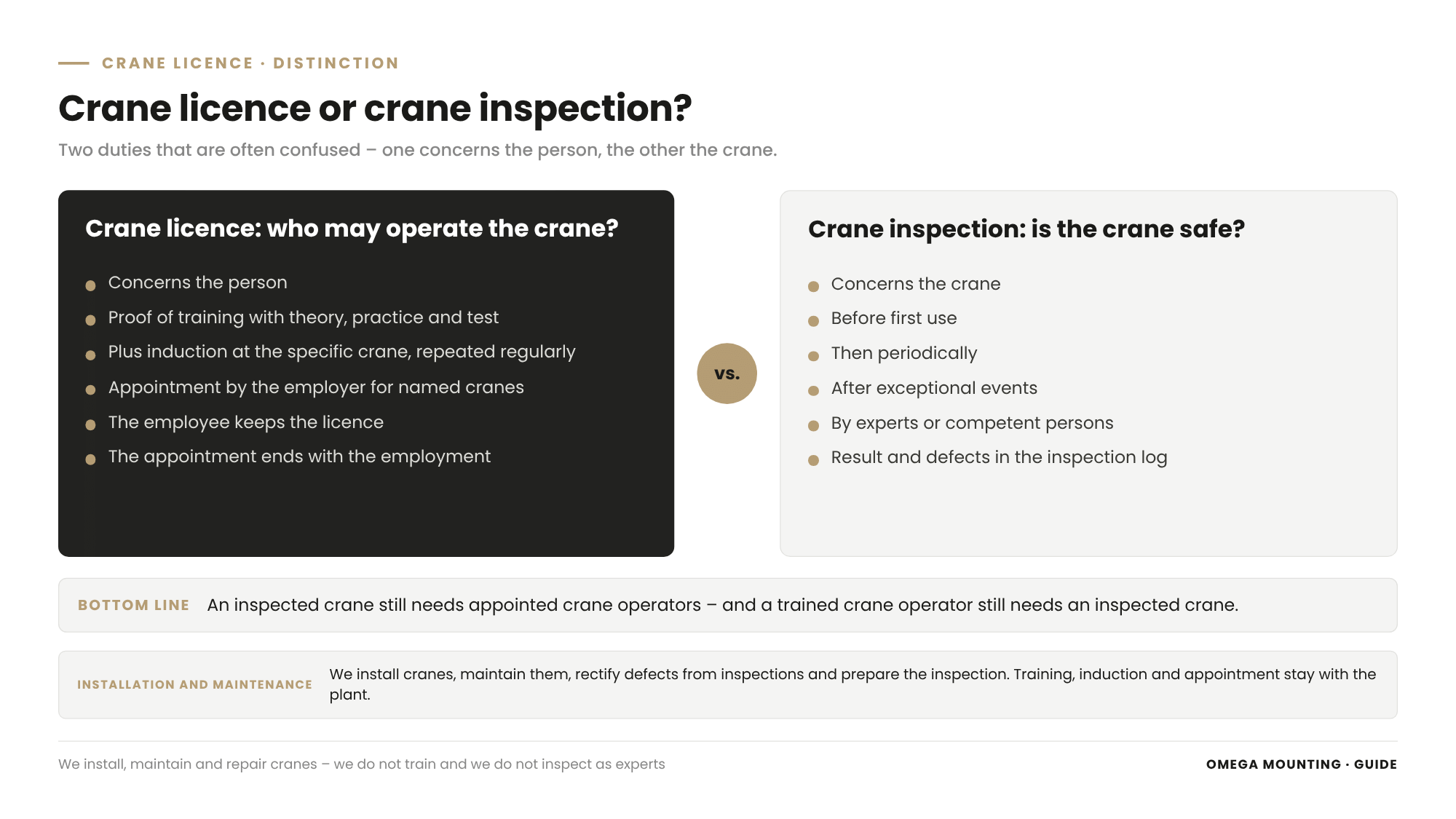
The crane licence concerns the person, the crane inspection concerns the crane. A crane is inspected before first use, then periodically and after exceptional events – depending on the crane by an expert or a person competent to inspect, with an entry in the inspection log.
These two things are often mixed up. A plant whose crane has just been inspected has not yet appointed a single crane operator. And a plant full of trained crane operators does not yet have an inspected crane.
Who inspects
Who carries out which inspection depends on the crane and the occasion. The difference between competent person, specialist and expert is explained in our article Competent person, specialist, expert. Which crane inspections are mandatory and what you do with them is set out in the parent guide on crane installations.
Inspection after installation
A new or retrofitted crane is inspected before first operation under load. Only then does work begin, and only then are the crane operators inducted on it and appointed. What happens up to the inspection when retrofitting a crane is described in our guide on retrofit an overhead crane.
What we do
We install cranes, maintain them, repair them and rectify defects from inspections. We prepare the inspection so that the inspector finds the crane in proper condition. The inspection itself is carried out by the expert or the competent person.
The inspection register
Every crane has an inspection log. It records the inspections, their results and the defects. It is a good tool for the induction: anyone who knows which defects were found last time looks more closely during the check.
Overview: crane type, operation, what the plant arranges
The same principle applies to every crane type in the plant – qualify, induct, appoint – but the focus differs. The table summarises it.
| Crane type | Operation | What the plant arranges |
|---|---|---|
| Overhead crane, floor-controlled. | Pendant or radio remote control from the floor. | Training, induction at the crane, appointment, travel area and exclusion zones. |
| Overhead crane with cab. | From the crane operator's cab. | More extensive training, communication with signaller and slinger, way out of the cab in case of a fault. |
| Pillar jib crane or wall jib crane. | Pendant, jib often slewed by hand. | Induction at the workstation, appointment, slewing area free of people. |
| Gantry crane. | Pendant or radio remote control. | As for the overhead crane, plus crush points at the legs and the travel path on the floor. |
| Crane with radio remote control. | Transmitter in the crane operator's hand. | Clear assignment of transmitter and crane, secure storage, appointed persons only. |
| Contractor on your own crane. | Depending on the crane. | Written agreement, evidence and appointment by their employer, briefing by the operator. |
| New or converted crane. | Depending on the crane. | Inspection before first use, new induction, addition to the appointment. |
Typical mistakes with crane licences in the plant
The typical mistakes with crane licences in the plant are a licence without appointment, an appointment without induction at the crane, an unchecked outside certificate and an induction that is never repeated.
- Licence instead of appointment. The employee has a crane licence, but nobody has appointed them for the crane.
- Appointment without training. The supervisor shows the crane briefly, and from then on anyone who has time operates it.
- “The jib crane isn't a real crane.” Everyone operates the pillar jib crane, nobody is inducted.
- Outside certificate unchecked. A new employee brings a certificate nobody understands, and nobody asks.
- Induction once and never again. The last induction was so long ago that nobody remembers it.
- New crane, old appointment. The crane was replaced, the induction on the new controls is missing.
- Transmitter left lying around. The radio remote control lies on the bench during the break, and an unauthorised person starts operating.
- Checks before starting work skipped. The crane is used although the safety latch is missing.
- Defects are not reported. Everyone knows the brake overruns, but nobody writes it down.
- Contractor operates without agreement. Fitters from another company use the overhead crane without anyone knowing their evidence.
- Crane inspection confused with crane licence. The crane has been inspected, so people think everything is done.
The mistake behind the mistakes
Behind most mistakes lies a confusion: people take the crane licence for permission. But it is only proof of training. Permission comes from the employer – with the appointment, after the induction, for a particular crane.
Crane licence in the Rhine-Main area: what we take on – and what not
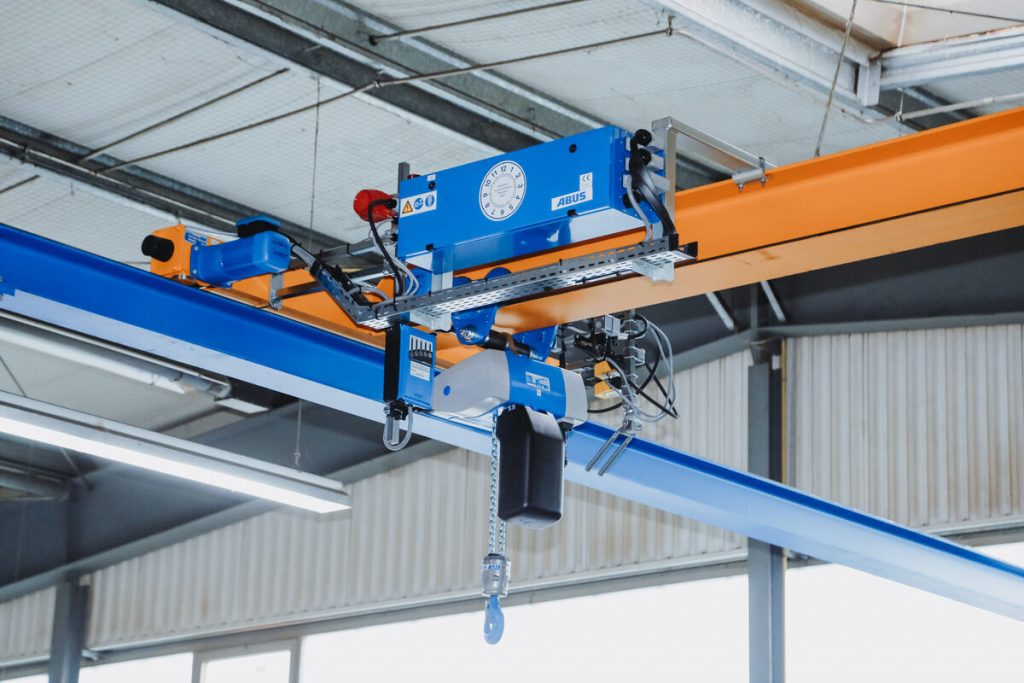
In the Rhine-Main area we install, maintain and repair cranes in halls and workshops; we do not take on the crane licence, the induction of your employees or the appointment – that stays with the employer and with trainers who offer it.
Around Frankfurt many overhead cranes, pillar jib cranes and gantry cranes work in production, metalworking, logistics and workshops. We are often called in when a crane is newly installed, retrofitted, relocated, maintained or repaired. What we do there is shown on our service page on Crane construction and crane systems.
When handing over a crane we often ask the same question: who in the plant will operate it, and has that been arranged yet? We help to ask the question early. The answer is yours.
What we don't take on, we say clearly:
- We do not train crane operators and do not issue crane licences.
- We do not induct or appoint your employees.
- We do not inspect the crane as an expert.
- We do not give legal advice on your duties as an employer.
From Rodgau, Frankfurt, Offenbach, Hanau, Darmstadt and Aschaffenburg are short distances. That helps when a defect turns up in the checks before starting work and the crane needs to run again.
Project examples
Four jobs from our project diary show how we install and hand over cranes. None of them is about training or appointment – that is not our part either. But they show at which point the question of the crane operator comes up.
Overhead travelling crane in the Aschaffenburg area: up to the main switch
With the installation of a double-girder overhead travelling crane in the Aschaffenburg area, the crane arrived by lorry at a new hall. We pre-assembled it on the ground, had the bridge lifted in, turned it into position using the diagonal measurement and set it down on the runway. Then we installed conductor rails, pre-limit and final limit switches and the controls with radio remote control, up to the main power switch. From there the plant's electrician took over.
For your plant this means: with the radio remote control a transmitter comes into the building. Who gets it is settled by the appointment.
Gantry crane in Babenhausen: freestanding, with warning light
During the installation of a gantry crane in Babenhausen, a steel construction company got a crane on its own gantry. The building carries no crane loads. We set up the gantry, checked height and diagonal with the laser and grouted the base plates. Then we pre-assembled the bridge on the ground and lifted it in. Conductor rail, pre-limit and final limit switches, warning light and controls were added.
For your plant this means: even a small crane in a workshop is a crane. Anyone operating it needs the same steps as on a large one.
Pillar jib cranes in a nuclear facility: handed over ready for operation
For a workshop fit-out with pillar jib cranes in a nuclear facility, we set two pillar jib cranes, one in the workshop and one in the test laboratory. The pillars stand on bonded anchors and were plumbed. Both cranes were handed over ready for operation, and the client accepted them.
For your plant this means: ready for operation means technically ready. Who may operate the crane at the workstation is then settled by the plant.
Crane runway for an overhead crane: with the plant's own maintenance team
For a crane runway for an overhead crane, we shortened the runway, aligned, levelled and anchored the columns and installed the runway. We supported the plant's maintenance team in doing so. After the maintenance team had surveyed it, the crane was set and connected.
For your plant this means: when something changes on the crane, the induction often changes too.
Getting a new crane or need one repaired?
Then get in touch with us. Send us photos of the crane, the rating plate and, if available, the latest entries in the inspection log. Together with you we clarify what needs to be installed, maintained or repaired.
What this means for your role
For operations and plant managers: Set for each crane who may operate it. Keep a simple list: crane, appointed persons, date of the last induction.
For maintenance managers: You know when something changes on the crane – new controls, new transmitter, conversion. Pass it on so that the induction is adapted. Take crane operators' defect reports seriously and document them.
For safety specialists: Check training records, inductions and appointments together. Pay attention to the small cranes that are easily forgotten. Clarify the rule for contractors.
For HR managers: Ask applicants about their crane licence, but do not confuse it with an appointment. Keep records in order. When employment ends, the appointment ends too.
For management: The duties lie with you as the employer. You can delegate tasks, but not the responsibility for ensuring that someone carries them out.
Crane operator appointment: template on request
The “Crane operator appointment” template is a one-page working document for your plant. It has five blocks: person, crane, evidence, scope and signatures. Each crane is entered individually with location and type of control. Plus fields for training, induction at the crane, repetition and withdrawal. Deadlines and numbers are deliberately not pre-filled, because they follow from your risk assessment. The template does not replace advice from your occupational safety specialist. Request it via our contact form – keyword “crane operator appointment”.
Why Omega Mounting?
We are based in Rodgau near Frankfurt, can be reached by phone and WhatsApp and work regularly on cranes and crane runways. We install overhead cranes, gantry cranes and pillar jib cranes, maintain them and repair them. We also tell you what we do not do: we do not train and do not issue crane licences. For you this means: a single point of contact for the crane itself – and an honest answer about who is responsible for the rest.
Conclusion
A crane licence is proof of training, not a driving licence and not permission. Anyone operating an overhead crane, pillar jib crane or gantry crane in the plant needs suitability, training, an induction on the specific crane and the appointment by the employer. The induction is repeated, the appointment applies to particular cranes and ends with the employment. The crane inspection is a separate topic and belongs to the crane, not the person. Those who keep crane licence, appointment and crane inspection apart have their crane operation under control. If your crane needs to be installed, maintained or repaired, send us photos and documents – we will come back with a date and an honest assessment.
Planning a move-in, installation or maintenance in the Rhine-Main region?
Tell us briefly what you need – we'll come back with an honest assessment.
Free, no-obligation callback
You may also be interested in these guides

About the author
Tobias Schott
Managing director of Omega Mounting GmbH, Rodgau · more than 20 years of hands-on experience in installation and maintenance
A trained mechatronics technician, working in maintenance, servicing and industrial installation since 2004 – first alongside his father, and with Omega Mounting since 2012: from overhead conveyors in Frankfurt to the crane system in a new-build hall. He plans and leads lifting operations as an appointed person (AP) in data centers and on industrial sites in the Rhine-Main region, trains and examines operators of cranes, mobile elevating work platforms and telehandlers, and is a qualified occupational safety specialist. On jobs abroad he is known as the “German Troubleshooter” – the person you call when a site gets stuck. He learned what quality means from his father, not from a manual: Made in Germany as a standard for his own work, not a label. That is why quality comes first at Omega Mounting – ahead of speed and price. He writes these guides from that practice: what works on our sites is in them – what exists only on paper is not.
Frequently asked questions
There is no state-issued crane licence. But anyone operating an overhead crane independently must be competent – usually proven by crane operator training, colloquially the crane licence. Add the induction on the specific crane and the appointment by the employer. Without appointment nobody may operate the crane, not even with a licence.
No. The crane licence proves training, often for certain crane types. For every crane in the plant there must be an induction on exactly that crane and an appointment that names it.
A power-driven pillar jib crane is a crane. Anyone operating it independently must be competent, inducted and appointed. The training is usually smaller in scope than for the overhead crane, but it is not zero.
The trainer – a training provider, a seminar of the accident insurance institutions, a crane manufacturer or the plant itself with a qualified trainer. No authority is involved. We do not issue crane licences.
The crane licence shows that someone is competent to operate cranes. The appointment allows them to operate a particular crane in your plant. The employee takes the licence with them, the appointment stays in the plant.
Before first use and then regularly, as the risk assessment and the rules require. Also for a new or converted crane, after changes in procedures and after accidents or near misses. Record every induction in writing.
Only if you allow it and it has been arranged beforehand. Their own employer must qualify and appoint them. You brief them on the particulars of your crane and your hall and set out in writing what they may use the crane for.
No. The crane inspection concerns the crane, the crane licence the person. The crane is inspected by experts or competent persons before first use, periodically and after special events. An inspected crane still needs appointed crane operators.
Clarify early who is to operate it, and plan training, induction and appointment before the first operation under load. For installation, maintenance and repair of the crane we are there. Your contact is Tobias Schott – reachable via our contact form.
 English
 German