
- Guide – Health & Safety
Impact protection: plastic or steel? Which guard goes where
By Tobias Schott · 23-minute read · Updated October 2026
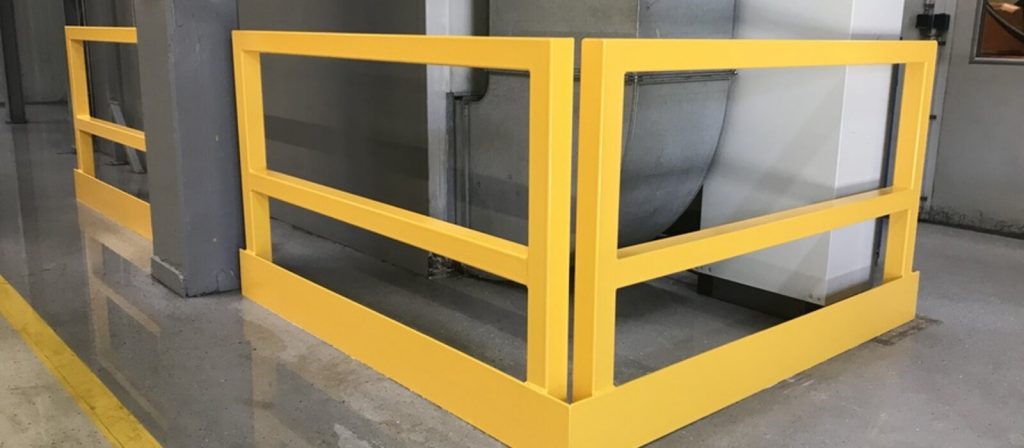
Whether plastic or steel impact protection is better is decided by the location: plastic absorbs impacts by deforming and spares vehicle and floor, steel holds rigidly against them and can be built to measure – the choice only becomes the right one with the type of impact, floor and clearance.
The question “plastic or steel impact protection?” usually comes up when something has already happened. A racking upright has a kink, a door frame is bent, a forklift has caught the corner of a plant. Now a guard is needed – and the catalogue shows yellow plastic barriers next to hoops made of steel tube.
Both materials protect. But they do it in completely different ways. Plastic gives way and springs back. Steel does not give way and pushes the forces into the anchoring and the floor. Anyone who does not know this puts a plastic post directly in front of a pipe or a steel hoop on thin screed.
This guide shows how both materials work, which questions to base the decision on and which guard belongs at racking, hall columns, doors, machines, pipework and walkways. On top of that come installation and what to do after an impact. When a standard part is enough and when made-to-measure impact protection is needed is explained in our guide to bespoke impact protection. It also covers load assumptions, designs and marking.
We write manufacturer-neutrally, from the point of view of an installation contractor from Rodgau near Frankfurt with its own steel workshop.
Key points at a glance
- Plastic (polymer) absorbs an impact through elastic deformation and then springs back within its design range.
- Steel stays rigid, transfers the forces into base plate, anchors and floor and shows a hit through permanent deformation.
- Plastic needs clearance behind it for the deformation path, steel needs a floor that takes up the forces.
- The decision is based on type of impact, floor and anchoring, clearance, geometry, environment and maintenance – not on the catalogue picture.
- Corners, overhangs, connections to steel components and heavy vehicles often speak for made-to-measure steel, walkways and frequent light hits often for plastic.
- Installation follows the manufacturer's instructions: anchors approved for the substrate, locating services before the first drill hole, no drilling into screed without verification.
- After every impact, the barrier, base plate and anchoring are checked – even if the plastic is standing straight again.
What is plastic impact protection, and what is steel impact protection?
Plastic impact protection is a protective barrier made of tough, usually through-coloured polymer that absorbs an impact by deforming. Steel impact protection is a rigid construction made of tube, section or plate that stops the impact and transfers the forces into the anchoring and the substrate.
In practice both are called guards, impact protection or crash protection. The goal is the same: the vehicle hits the barrier and not the racking upright, hall column, door, machine or people behind it.
Placing impact protection correctly
Anyone who wants to place impact protection correctly first needs the hierarchy of protective measures. A guard is a technical measure. It works without anyone having to think about it. But it does not replace good traffic routing, sufficiently wide routes or trained drivers. It stands where a hit remains possible despite good planning.
Polymer or plastic?
Polymer impact protection is impact protection made of plastic, usually tough, impact-resistant thermoplastic. This is about flexible systems: barriers that bend on impact and then spring back.
How plastic and steel absorb an impact
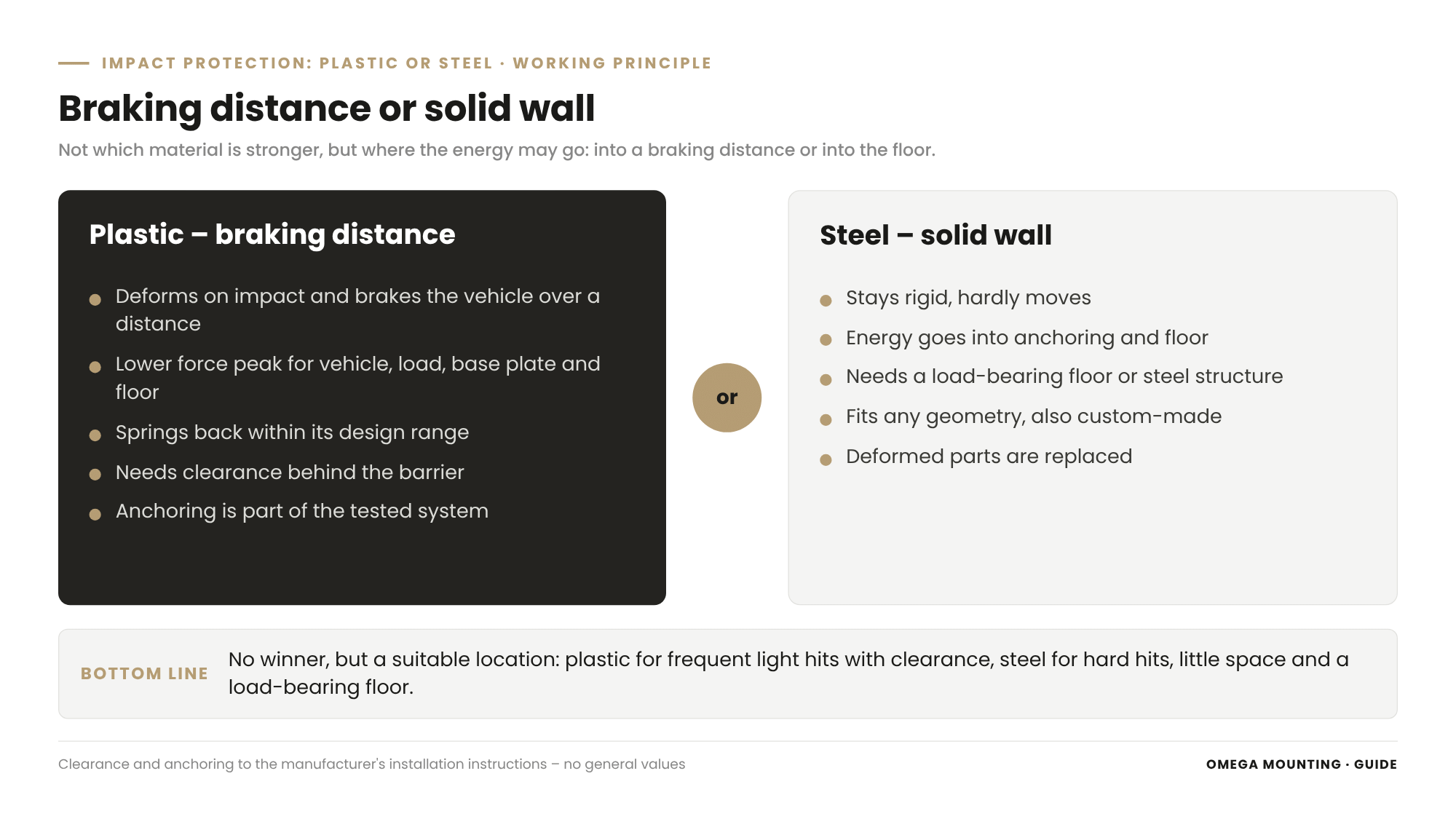
Plastic absorbs an impact by deforming and braking the vehicle's movement over a distance; steel absorbs it by holding against it and passing the forces almost entirely to the anchoring and floor.
So the question is not which material is stronger, but where the energy may go: into a braking distance or into the floor.
Plastic: braking distance instead of a solid wall
If a forklift hits a plastic post, the post bends. The vehicle slows down over this distance. The force peak is lower because it is spread over a longer time. Vehicle, load, base plate and floor all benefit. If the hit is within the range the system is designed for, the post then stands up again.
The price for this is space. Behind a plastic post there must be enough clearance for it to deform without touching the protected object. How much is stated in the manufacturer's installation instructions.
Steel: solid wall instead of braking distance
If a forklift hits a steel hoop, the hoop hardly moves. The energy goes into the vehicle, into the construction and via the base plate into anchors and floor. If the hit is too hard, the steel deforms permanently or the anchoring pulls out. That is why with steel the floor is at least as important as the tube.
The advantage: steel needs little space behind it. It can be brought into any geometry, bolted or welded to steel components and fabricated to measure.
Plastic impact protection: elastic, light, through-coloured
Plastic impact protection suits places where frequent light to medium hits are to be expected, vehicles and floor are to be spared and there is room for the deformation path behind the barrier.
The strengths
- Recovery. After a hit within the design range, the barrier stands again. Small bumps leave no damage.
- Gentleness. Forklifts, forks and loads suffer less damage than against a rigid steel edge.
- Through-coloured. The signal colour is in the material. Scratches stay yellow, there is no repainting.
- Corrosion-free. Moisture, cleaning agents and road salt attack plastic differently from painted steel.
- Light and modular. Posts, rails and railings come in a system grid and can be installed without welding.
The limits
Plastic systems have a design range. Anything above it deforms the barrier permanently or tears base plate and anchors. Heavy vehicles, high speeds and hard edges on the load reach this limit. For heavy impacts, manufacturers offer reinforced systems. What matters then is the manufacturer's documented impact test for exactly this case – not the data sheet of another model.
The environment also counts. For cold stores, outdoor areas with strong sun or areas with chemicals, the range of use stated by the manufacturer applies. And special shapes are only possible to a limited extent: a grid system does not always solve corners, offsets and connections to steel components neatly.
The hidden drawback
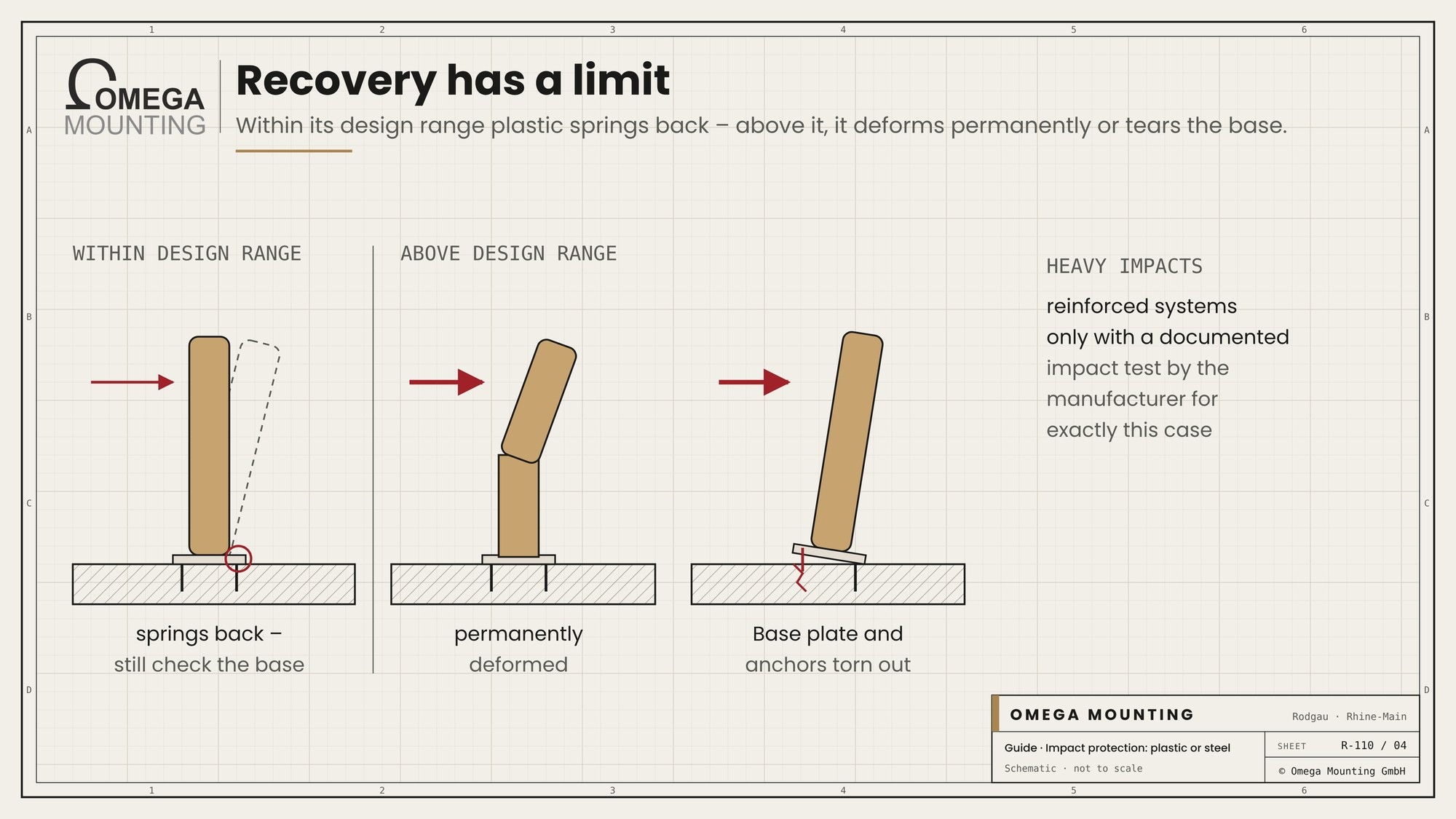
Plastic impact protection shows hits poorly. If the post is standing straight again, nobody sees that it was hit. The base plate can still be cracked, an anchor loosened. That is why plastic needs a regular check of the base area – not just a look at the barrier.
Steel impact protection: rigid, robust, made to measure
Steel impact protection suits places where heavy vehicles hit, there is little space behind the barrier, the geometry deviates from system dimensions or the barrier has to be connected to steel components.
The strengths
- Rigid and robust. Steel withstands even hard hits as long as anchoring and floor play along.
- Little clearance. The barrier can move close to the object because it hardly moves.
- Any geometry. Corners, overhangs, slopes and floor rails can be fabricated to measure.
- Connection to steel. On loading docks, platforms and plant frames, it is drilled and bolted or welded.
- Hits are visible. A bent hoop is a finding that anyone can see.
The limits
Steel passes the energy on. If the floor is weak or the anchoring too tight, the concrete around the anchor breaks out. Then the hoop still stands but no longer protects. Steel also spares neither vehicle nor load. And it needs corrosion protection: primer, topcoat and touch-ups after hits, outdoors often galvanising. In food areas the question of flaking paint is added – stainless steel is often chosen there.
When steel is built to measure
A catalogue steel guard fits in front of a straight wall. As soon as a plant with an overhang, a corner with two directions of travel or a connection to a steel structure comes into play, it is fabricated to measure. That is the strength of steel compared with any grid system. How we go about it is shown in the practice chapter further down.
Impact protection, plastic or steel: six questions for the decision
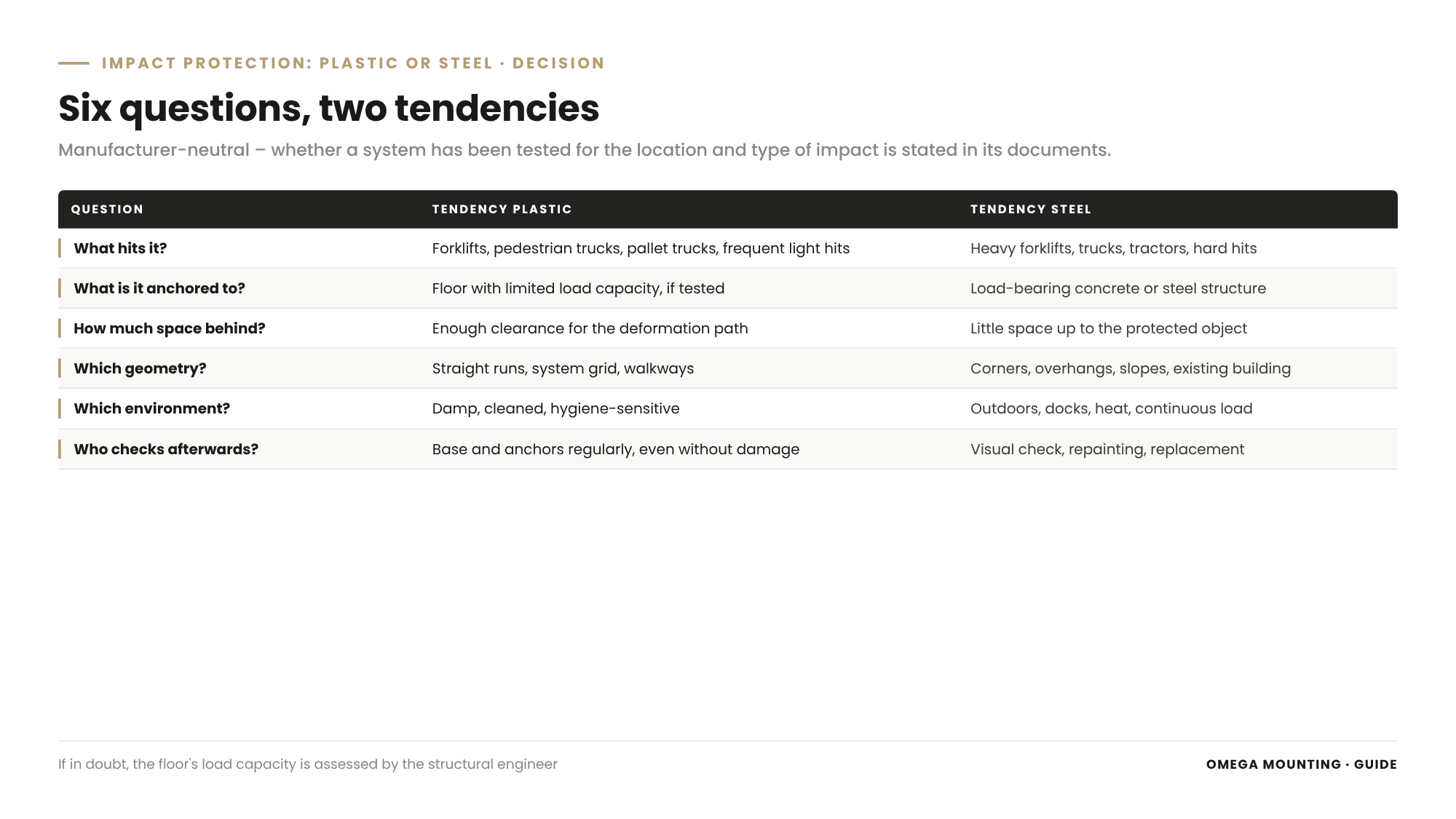
The decision comes down to six questions: what hits it, what is it anchored to, how much space is there behind the barrier, what geometry does the location have, what environment is it in and who checks it afterwards?
| Question | Tendency plastic | Tendency steel |
|---|---|---|
| What hits it? | Forklifts, pedestrian trucks, pallet trucks, frequent light hits. | Heavy forklifts, trucks, tractors, hard hits with load. |
| What is it anchored to? | Floor with limited load capacity, if the system has been tested for it. | Load-bearing concrete floor or steel structure. |
| How much space is there behind it? | Enough clearance for the deformation path. | Little space up to the protected object. |
| What geometry does the location have? | Straight runs, system grid, walkways. | Corners, overhangs, slopes, connection to existing structures. |
| What environment is it in? | Damp, cleaned, hygiene-sensitive areas as specified by the manufacturer. | Outdoors, docks, heat, hard continuous load. |
| Who checks it afterwards? | Regular check of base and anchors, even without visible damage. | Visual check, repainting, replacement of deformed parts. |
No single row decides on its own. If several rows point in the same direction, the choice is clear. If they point in different directions, a site visit helps. Often the answer is then a mix: plastic railing at the walkway, steel at the corner next to it.
The question behind all the questions
What happens if the barrier gives way? A scratch on the wall is something different from a bent racking upright or a torn-off gas pipe. The heavier the consequence, the less room there is for compromise on material and anchoring. How to translate the consequence of a hit into the load assumption is explained in our guide to bespoke impact protection compared with the standard product.
Costs over the service life
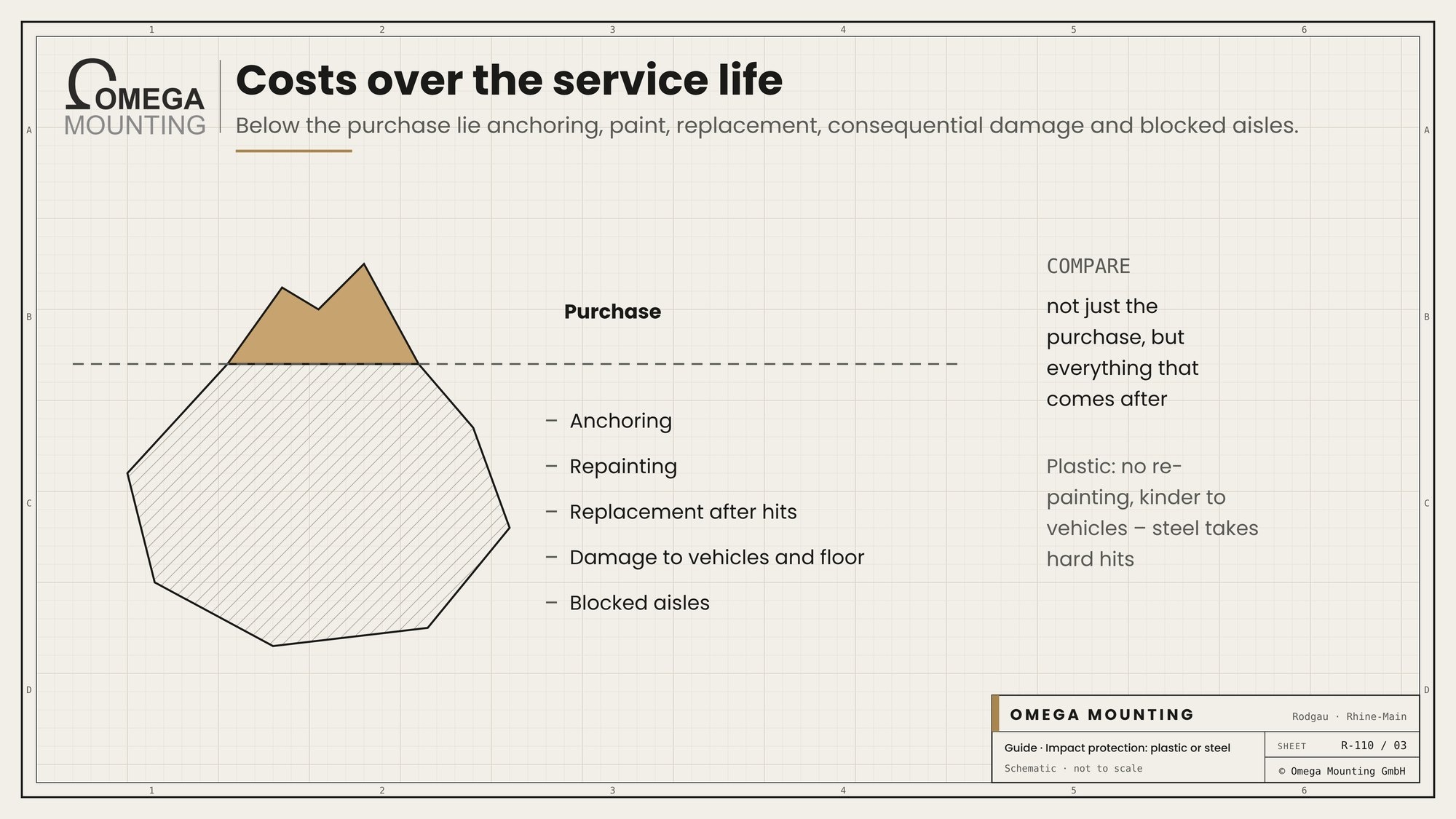
Do not just compare the purchase price. The cost factors include anchoring, repainting, replacement after hits, damage to vehicles and floor and blocked aisles.
Which guard goes where: six typical locations
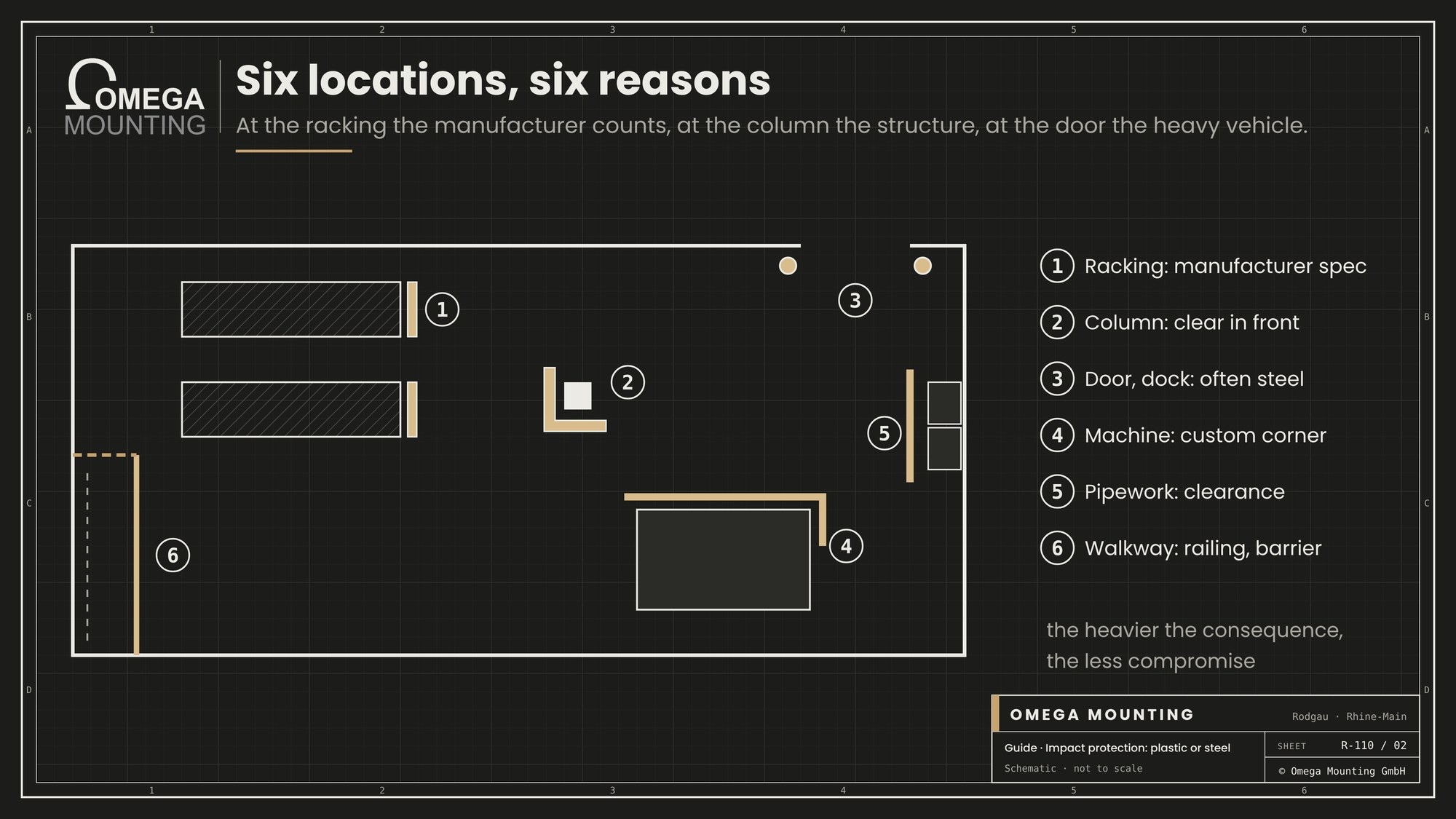
Which guard fits depends on the location: at racking the racking manufacturer's specification counts, at hall columns the structure, at doors and docks the heavy vehicle, at machines access, at pipework the consequence of a hit and at the walkway the person.
Racking end and racking upright
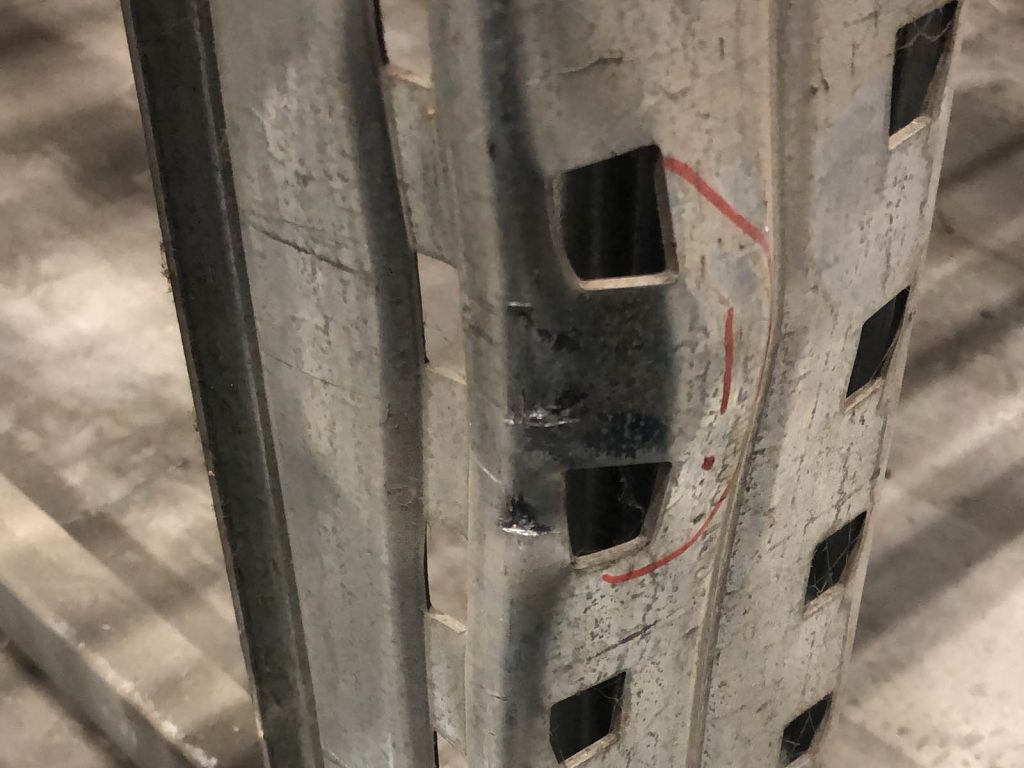
For racking impact protection, the racking manufacturer's specification applies first. For uprights in aisles and at aisle ends, the racking standard DIN EN 15512 sets minimum requirements for impact protection. Usual are upright protectors directly on the upright and frame end protection at the end of the rack. A guard bolted firmly to the upright transfers the impact into the upright – the manufacturer must allow for this. Plastic upright protectors spare the upright in light hits; at the end of the rack with heavy forklifts, steel on its own anchoring is often chosen. How racking inspection works is explained in our guide to racking inspection.
Hall column
A guard at a hall column protects not just concrete or steel, but the structure. What counts here is that the barrier stands clear in front of the column and is anchored independently in the floor. It must not touch the column when hit. Plastic needs distance for this, steel needs a load-bearing floor. If the column has already been hit, the structural engineer belongs at the column before the barrier.
Door and dock
Door impact protection usually has to stop heavy vehicles: trucks manoeuvring, forklifts with loads during loading and unloading. Typical are bollards in front of door frames, reveal protection and hoops at docks. Steel is often chosen here, outdoors hot-dip galvanised or coated. Plastic is an option if there is test evidence for this type of impact. How doors, docks and dock levellers are maintained is shown in our guide to maintenance of loading ramps.
Machine and plant
In front of machines and plants there is an extra question: how does the plant stay accessible? Inspection openings, control cabinet doors and maintenance routes must remain clear. Corners and overhangs often speak for made-to-measure steel here. On straight runs next to a roller conveyor, a plastic railing can be enough if there is room behind it to deform.
Pipework, control cabinets and gas supply
Where utilities run behind the barrier, the consequence of a hit is serious. Sprinkler pipes, gas pipes, compressed air manifolds and control cabinets tolerate no contact. Clearance counts twice here: plastic only with a safe distance for the deformation path, steel only with secure anchoring. In tight corners, steel is therefore often the only solution.
Walkways
At the walkway, the guard protects people. The German workplace rule for traffic routes (ASR A1.8) requires pedestrians and vehicle traffic to be separated wherever possible. Plastic railings and barriers are common here because they cushion hits and come with handrail and passage in the grid. At crossings and doors that lead onto a vehicle aisle, a barrier alone is not enough. Gates, turnstiles or staggered railings belong there so that nobody steps straight into the aisle.
Installing impact protection: floor, anchors and services
Installing impact protection starts with the floor: a guard is only as good as its anchoring, and the anchoring only as good as the substrate it sits in.
Know the floor
Before installation, clarify what is being anchored to. A load-bearing concrete industrial floor takes anchors differently from screed on insulation. Slopes, joints, edge distances and voids change the situation. If there are doubts about the load capacity of the floor slab, the structural engineer belongs at the table. How floor build-up and point loads are related is shown in our guide to rigging in with slab load and ground pressure.
Services in the floor
Before the first drill hole comes locating services. Underfloor heating, electrical cables, earthing strips and pipes often lie exactly where the post is meant to go. As-built plans help, but do not replace locating on site. A drilled-through heating pipe under a warehouse aisle is greater damage than any bump.
Anchors as specified by the manufacturer
Anchoring follows the impact protection manufacturer's specifications. That covers anchor type, approval for the substrate, drilling depth, edge distance and tightening torque. With plastic systems the anchoring is part of the tested system; a different anchor changes the behaviour on impact. With made-to-measure steel, the design determines which heavy-duty or bonded anchor is suitable. What fundamentally counts in anchoring is described in our guide Aligning and anchoring a machine.
Steel is not fixed with anchors
If the barrier stands on a loading dock, a platform or a plant frame, the steel is drilled, tapped or through-bolted. Where welding is done, a hot work permit and a fire watch are needed. Plastic systems usually have their own base plates for such substrates – here too, the manufacturer's specification applies.
Distance, height, alignment
Keep the distance to the protected object specified by the manufacturer or the design. Watch the height: a barrier that a fork can pass under only protects half the way. A floor rail or a low-set rail helps against this. Finally, everything is aligned, tightened and documented – with photos, anchor type and tightening torque.
After the impact: check, replace, inspect anchoring
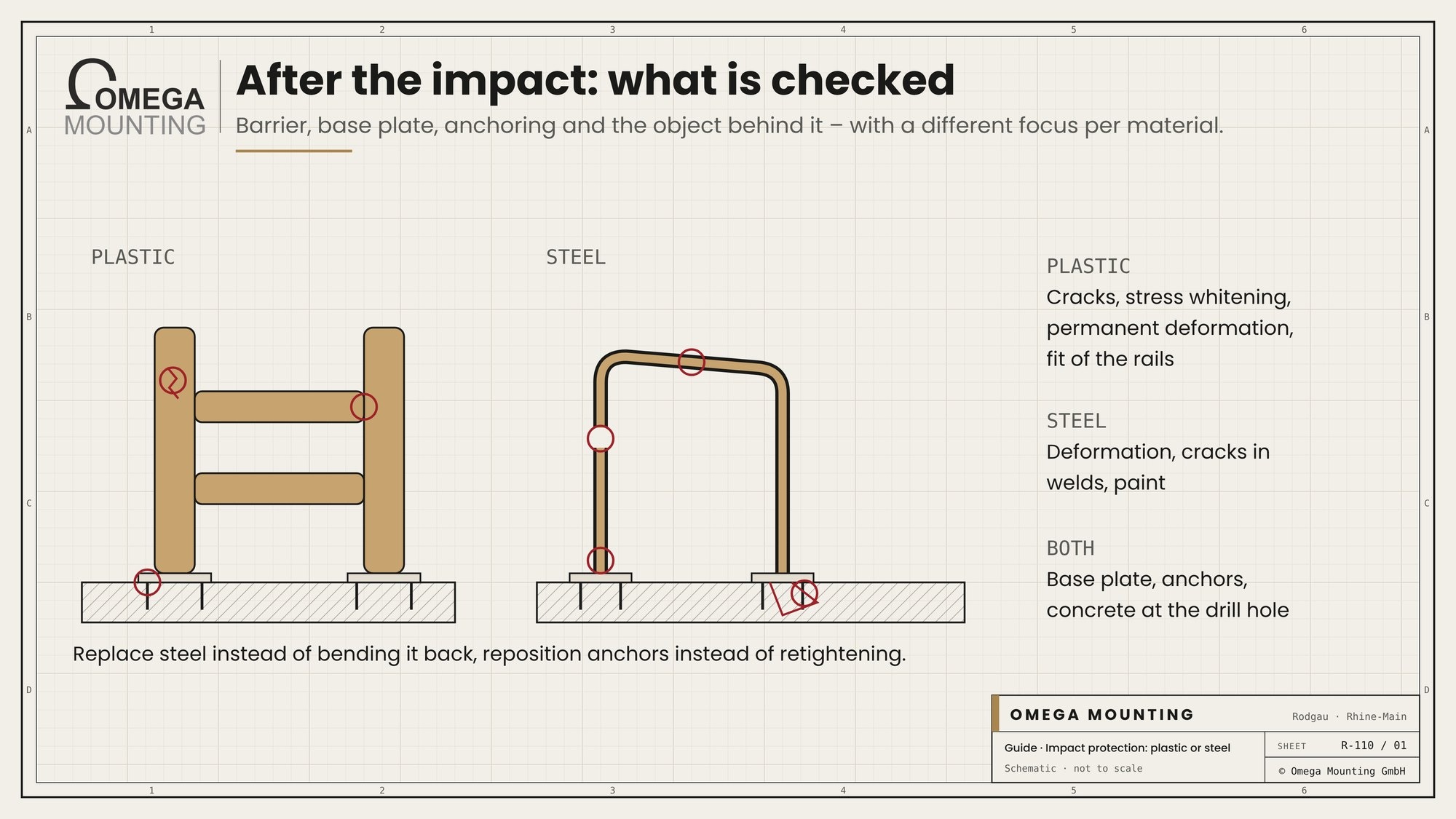
After an impact, check the barrier, base plate, anchoring and the object behind it; deformed parts are replaced, loosened or broken-out anchors reset and the hit is documented as a finding.
The sequence is similar for both materials. The focus differs.
- Secure. If the object behind it is damaged, the area is closed off. For a racking upright that means: unload and close off until the inspection has decided.
- Check the barrier. Steel: deformation, cracks in welds, flaked paint. Plastic: cracks, stress whitening, permanent deformation, fit of the rails.
- Check base and anchoring. Base plate, anchors and concrete around the drill hole. A breakout in the concrete is a finding with both materials.
- Replace. Deformed steel is replaced, not bent back. Plastic parts are replaced as specified by the manufacturer. Broken-out anchors are repositioned, not retightened in the old hole.
- Clarify the cause. If the same spot is hit again and again, the traffic routing is the problem, not the impact protection.
If racking stands behind it
If an impact has reached a racking upright, the new guard is not enough. The upright must be assessed by the competent person, and the repair follows the finding. How a finding becomes a proper repair is shown in our guide to racking repair after the racking inspection.
The hit as a finding
Document every hit, even without damage: location, date, vehicle, photo. After a year, this list shows where the barrier is too weak and where the routes do not suit the driving. Damage to a guard can show up as a defect in the periodic inspection. How to deal with it through to return to use is described in our guide to rectifying UVV defects.
Typical mistakes when choosing the material
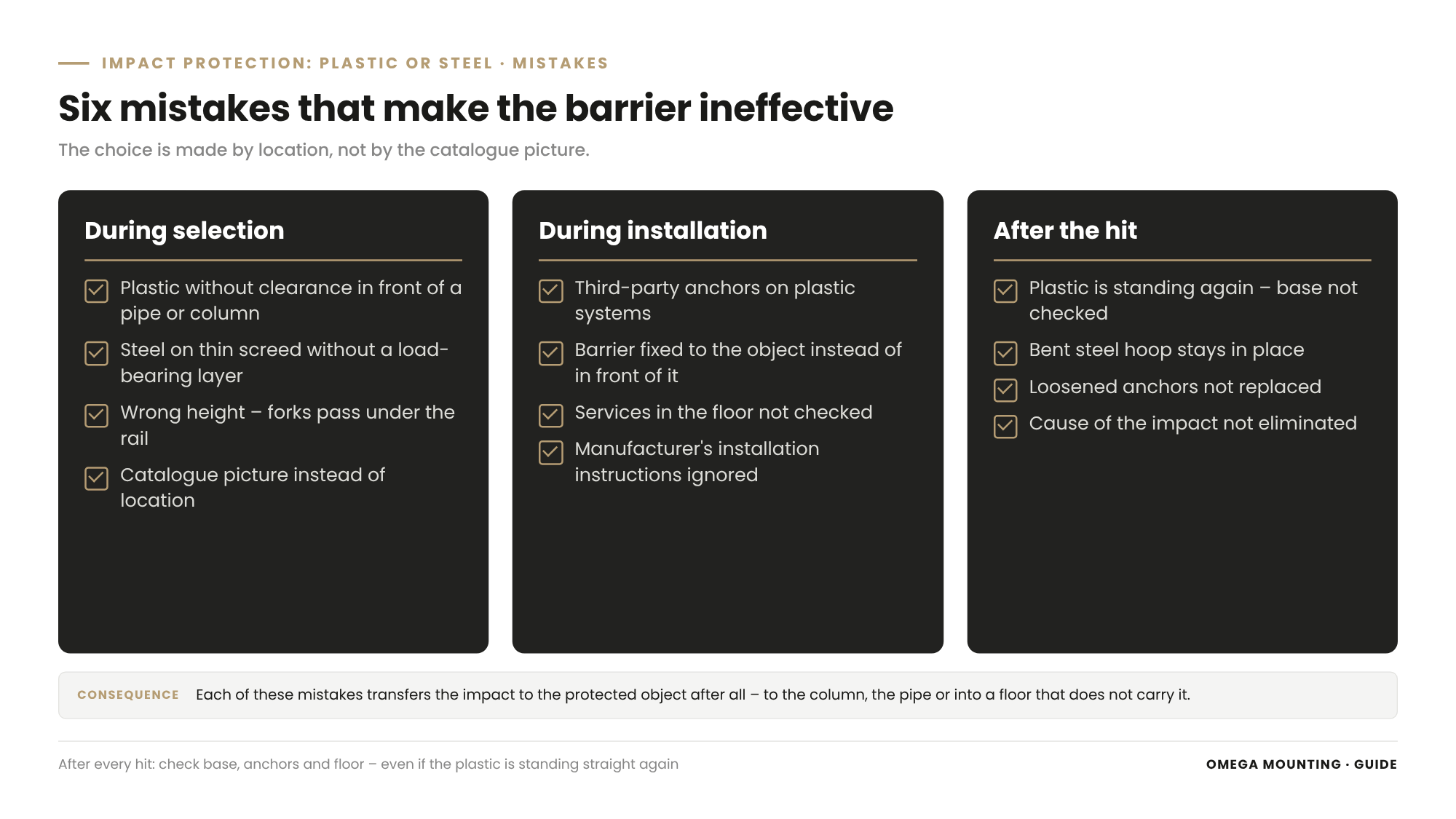
The typical mistakes when choosing the material are plastic without clearance, steel on a weak floor, the wrong anchors, a barrier at the wrong height and a hit that is not checked.
- Plastic without clearance. The barrier stands directly in front of a pipe or column. When hit, it bends up to the object – and transfers the impact exactly there.
- Steel on thin screed. The hoop stands, but the anchors sit in a layer that carries nothing. On the first hard hit the floor breaks out.
- Third-party anchors. A plastic system is fixed with any anchors. The tested behaviour then no longer applies.
- Wrong height. Forks or pallets pass under the rail and hit the object after all.
- Fixed to the object. The barrier is bolted to the column or the plant and passes on every impact.
- Catalogue picture instead of location. The choice is what looks good in the brochure, not what is needed at the location.
- No check after the hit. The plastic is standing straight again, nobody checks the base. The steel hoop is bent, nobody replaces it.
The most expensive mistake
It gets most expensive when impact protection only shifts the danger. A post that steers the forklift past the column into the aisle protects the component and endangers people. So check at every location where a deflected vehicle will go.
Impact protection, plastic or steel, in the Rhine-Main region: how it works with us
In the Rhine-Main region we start every impact protection job with a site visit: we look at the location, vehicles, floor and the traces of earlier hits and then say which material fits.
From Rodgau, Offenbach, Frankfurt, Hanau, Darmstadt and the logistics sites in Dietzenbach and Raunheim are short trips. We fabricate steel impact protection to measure in our workshop in Rodgau. Where the barrier has to be adapted to an existing plant, we build it on site. We install plastic systems according to their manufacturer's installation instructions. We are not tied to any manufacturer.
We say beforehand what we do not take on. The load capacity of a floor slab is assessed by the structural engineer. Inspection and release of a racking system are carried out by the competent person. Test evidence for plastic systems is supplied by their manufacturer. We install, anchor, document and replace after a hit. Beyond that, the scope of our Maintenance and servicing for industrial plants is set out on our service page.
For impact protection in the Rhine-Main region this means: one contact from site visit to installation, our own workshop for made-to-measure steel and short distances when a quick replacement is needed after a hit. Work at the airport involves access control and tool lists. What belongs to it is summarised in our guide to maintenance at Frankfurt Airport.
Project examples
Three jobs from our project diary show what counts in the choice. To be honest up front: both impact protection jobs were steel, and the third job was not about a guard at all. They show why steel was the answer at these locations – and what happens after racking damage.
Plant corner near Offenbach: steel, because of corner and overhang
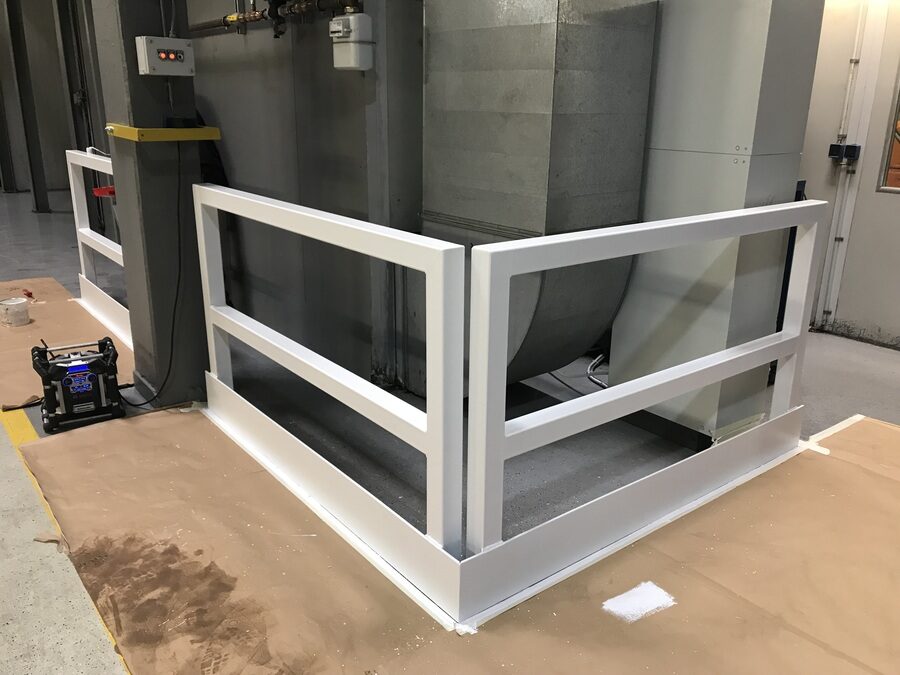
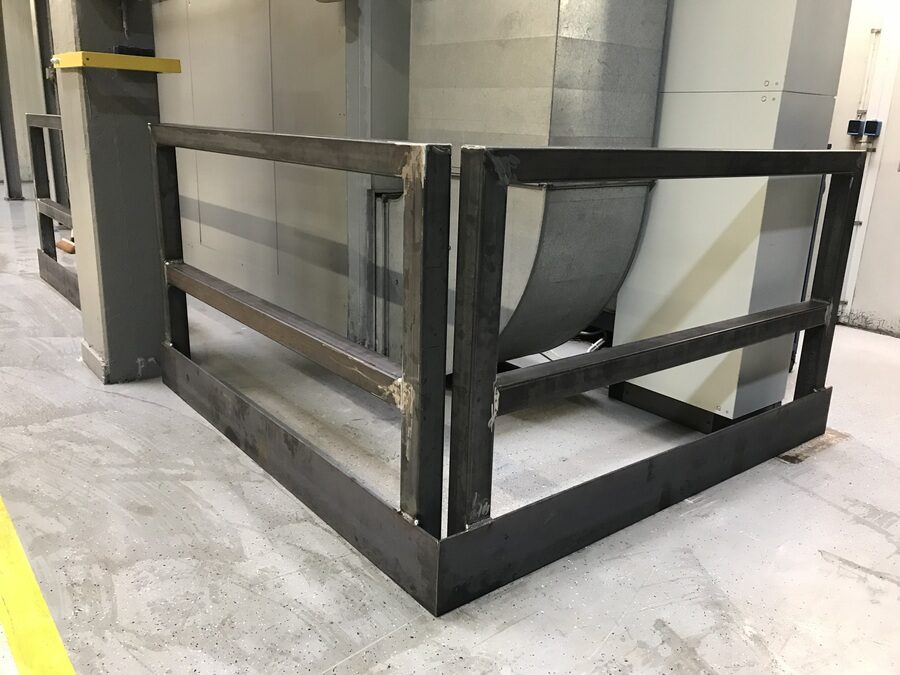
With the custom impact protection for a production company near Offenbach the task was to protect the ventilation equipment of a plant at a building column. Mesh boxes passed there in brisk forklift traffic. In our assessment a catalogue hoop was not enough. The solution: a floor rail of 200 × 100 × 10 mm steel angle, anchored in the hall floor with heavy-duty anchors, with a fully welded frame of 80 × 80 × 5 mm steel tube with two frame panels on top. Maintenance access remained clear. In the workshop in Rodgau two people worked on it for about one day. On site two fitters installed it in one working day, then primed and painted it in signal yellow over all seams and anchor points.
For your choice this means: a corner, an overhang and little distance to the plant speak for steel. The floor rail also stops forks at floor level.
Loading dock at Frankfurt Airport: steel, because of the connection to steel
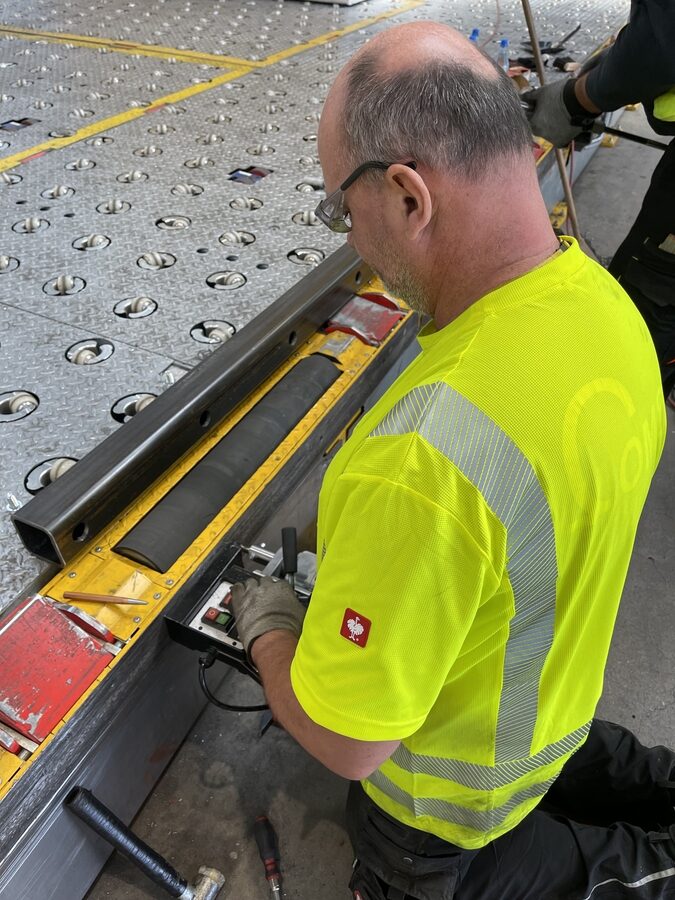
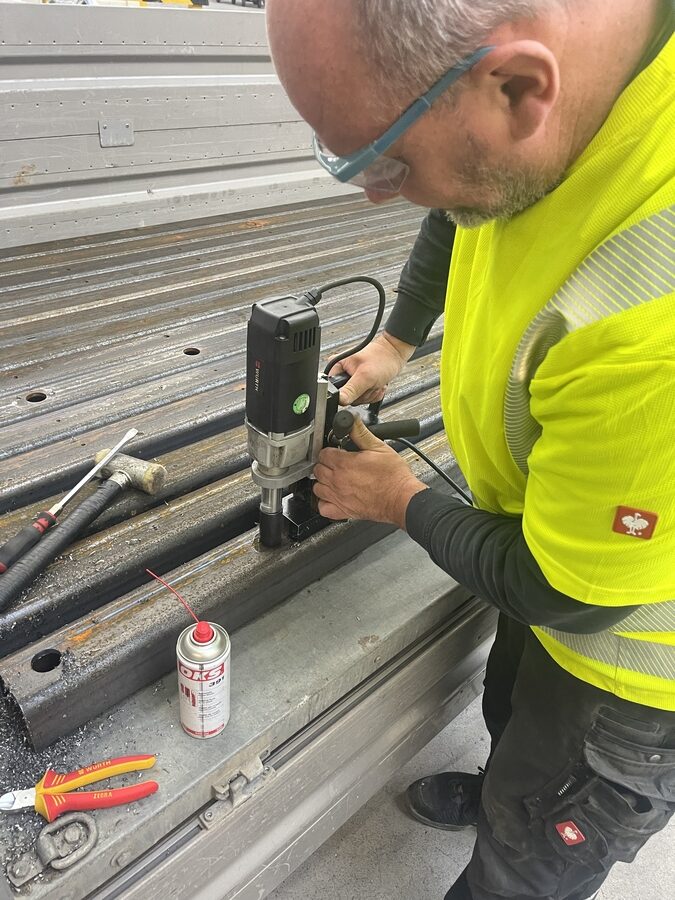
With the made-to-measure impact protection for a loading dock at Frankfurt Airport the take-off rollers of a roller deck were to be protected. Three fitters adapted the impact protection on site in four days. They pre-drilled square tubes with a 10 mm wall and the dock with the magnetic drill, tapped threads and bolted the segments together. The corners were chamfered and welded in so that they act as deflection ramps. The paint matched the colour of the plant.
For your choice this means: where the barrier sits on a steel structure, steel is the natural partner. Bolting makes it a wear part – a damaged segment is replaced without cutting or welding on the plant.
Racking repair in Fulda: what comes after the damage
With the Racking repair in Fulda the trigger was the defects list of an inspection. Inspection and maintenance had not been carried out properly for years. We replaced uprights, beams and bracing using a mobile elevating work platform, during live operation and with aisles closed off. Thanks to good preparation it took about two days. A new racking inspection followed. The report does not mention a guard.
For your choice this means: a repair eliminates the damage, not its cause. Anyone who thinks about impact protection at that point after replacing an upright prevents the next finding.
Choosing between plastic and steel?
Then get in touch with us. Send us photos of the location, the vehicle and what you know about the floor. During a site visit we will tell you which material belongs there – and which does not.
What this means for your role
For buyers: With plastic, ask for the documented impact test for your type of impact and for the prescribed anchoring. With steel, ask about material, anchoring concept and corrosion protection. Compare quotations over the service life: installation, replacement after hits and repainting are part of it.
For designers: Plan the guard together with the traffic routing, not afterwards. Keep the clearance for the deformation path free behind plastic barriers and specify the floor build-up for steel. Lay services in the floor so that posts and floor rails have room later.
For project managers and site managers: As a project manager, you clarify whether the barrier is installed before or after the floor covering – the anchoring depends on it. As a site manager, you take care of locating services, barriers and briefing the fitters. At acceptance you check distance, height, anchors and documentation.
For maintenance managers: Include the guards in your visual checks, plastic with a view to base and anchors. Keep spare parts for spots that are hit often. Record hits as findings with photos – that way you see where the material does not fit.
For warehouse and logistics managers: You know the spots where things regularly crash. Pass this knowledge on before the choice is made: vehicles, routes, hits in recent years. Make sure drivers report hits, even if the plastic is standing straight again.
Impact protection selection aid: template on request
The impact protection selection aid is a one-page working document. It lists the six locations from this article as rows: racking end and racking upright, hall column, door and dock, machine and plant, pipework and control cabinets, walkway. The columns show type of impact, material tendency, floor and anchoring and clearance behind the barrier. Below there is room for location, vehicle and photos. It deliberately contains no energy values or manufacturer names – it helps you classify every location in your hall before talking to a supplier. Request the template via our contact form – keyword “Impact protection selection aid”.
Why Omega Mounting?
We are based in Rodgau near Frankfurt, can be reached by phone (Mon–Fri 9 am–3 pm) and via WhatsApp, and fabricate steel in our own workshop. The linked jobs show how we work. Near Offenbach, a welded frame on an anchored floor rail was created, prepared in Rodgau and installed in one working day. At Frankfurt Airport, the barrier was adapted to the loading dock on site and bolted so that segments remain replaceable. In Fulda, racking was repaired after the inspection finding during live operation. For you this means: a single point of contact for advice, made-to-measure steel, installation to manufacturer's specifications and replacement after the hit – manufacturer-neutral and with short distances in the Rhine-Main region.
Conclusion
When it comes to plastic or steel impact protection, there is no winner, but a suitable location. Plastic cushions frequent hits, spares vehicle and floor and needs clearance. Steel withstands hard hits, fits any geometry and needs a floor that carries the forces. Decide by type of impact, floor, clearance, geometry, environment and checks, and check the base too after every hit. If you want to protect a spot, send us photos, vehicle data and your floor build-up – we will get back to you with an honest assessment of which material belongs there.
Planning a move-in, installation or maintenance in the Rhine-Main region?
Tell us briefly what you need – we'll come back with an honest assessment.
Free, no-obligation callback
You may also be interested in these guides
Maintenance & Servicing

About the author
Tobias Schott
Managing director of Omega Mounting GmbH, Rodgau · more than 20 years of hands-on experience in installation and maintenance
A trained mechatronics technician, working in maintenance, servicing and industrial installation since 2004 – first alongside his father, and with Omega Mounting since 2012: from overhead conveyors in Frankfurt to the crane system in a new-build hall. He plans and leads lifting operations as an appointed person (AP) in data centers and on industrial sites in the Rhine-Main region, trains and examines operators of cranes, mobile elevating work platforms and telehandlers, and is a qualified occupational safety specialist. On jobs abroad he is known as the “German Troubleshooter” – the person you call when a site gets stuck. He learned what quality means from his father, not from a manual: Made in Germany as a standard for his own work, not a label. That is why quality comes first at Omega Mounting – ahead of speed and price. He writes these guides from that practice: what works on our sites is in them – what exists only on paper is not.
Frequently asked questions
Neither is better in principle – when choosing plastic or steel impact protection, the location decides. Plastic suits frequent light to medium hits, walkways and floors that are to be spared, if there is clearance behind the barrier. Steel suits heavy vehicles, tight corners, connections to steel components and special shapes, if the floor takes up the forces.
There is no general obligation for specific locations. The German Occupational Safety and Health Act requires a risk assessment; if it shows a risk of collision for people, structure or plants, a protective measure follows – often a guard. For racking, the racking manufacturer's specifications also apply. This guide is not legal advice. How inspections and operator duties are related is shown in our guide to inspection obligations for operators.
No. Anchoring is done into a load-bearing substrate, with anchors approved for this substrate and specified by the impact protection manufacturer. Screed on insulation does not carry a guard – the anchoring must reach into the load-bearing slab, or a load-distributing base plate is needed. Locating services comes before drilling, and if there are doubts about the floor slab, the structural engineer.
Close off the area if the object behind it is damaged. Then check the barrier, base plate, anchors and the concrete around the drill hole. Deformed steel is replaced, plastic parts replaced as specified by the manufacturer, broken-out anchors repositioned. Document the hit with a photo. If it reached a racking upright, the competent person decides on the repair.
A standard part is enough on straight runs with a level concrete floor and known vehicles. A bespoke solution pays off for corners, overhangs, slopes, connections to steel structures or when a standard part has already failed. Plastic almost always comes as a system, steel can be built to measure. The criteria in detail are set out in the guide to bespoke impact protection.
At doors and docks heavy vehicles approach, often reversing and with a load. That is why steel is often chosen there: bollards in front of the door frame, reveal protection and hoops at the dock, outdoors galvanised or coated. Plastic is an option if the manufacturer supplies test evidence for exactly this type of impact and the floor allows the prescribed anchoring.
Yes, the six questions apply everywhere; only the weighting shifts. In food companies, cleaning and flaking paint count – plastic or stainless steel come into consideration there. In the data center, the guard protects equipment and services in the delivery area. At the airport and in logistics, heavy vehicles, loading docks and access rules are in the foreground.
For installation, anchoring and replacement after hits, installation contractors from the region are the shortest route. From Rodgau we install impact protection in Frankfurt, Offenbach, Hanau, Darmstadt and at the logistics sites around the airport – made-to-measure steel from our own workshop, plastic systems as specified by the manufacturer. Structural engineering and racking inspection stay with the responsible specialists.
Via a short enquiry with three details: photos of the location with what stands behind it, the vehicle with its usual load and what you know about the floor. We arrange a site visit, look at traces of earlier hits and send a written assessment with material, anchoring and installation sequence. Your contact is Tobias Schott – reachable via our contact form.
 English
 German