
- Guide – Maintenance
EMS rollers: inspecting and replacing load, guide and drive rollers
By Tobias Schott · Reading time approx. 23 minutes · Updated: November 2026
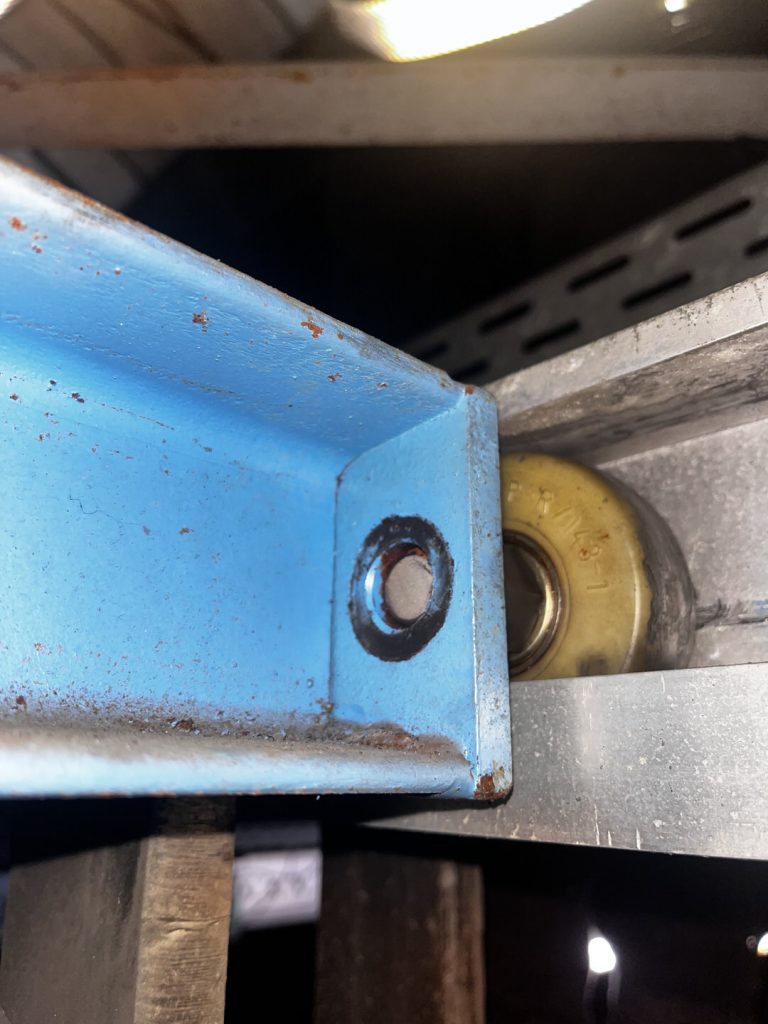
EMS running rollers carry every vehicle of an electrified monorail, guide rollers keep it on track and the drive roller sets it in motion. All three wear – and all three reveal early when something is wrong. Anyone who only replaces rollers without looking at rail, transitions and switches soon wears the new rollers down just like the old ones.
One vehicle knocks in the curve, another strikes at the same spot. There is abrasion below the track, and one vehicle gets stuck on an incline. This is how rollers on an electrified monorail announce themselves – long before failure, if someone listens.
This guide goes into depth on one component: the rollers on the trolley. It explains how running, guide and drive rollers work, which forces act on them and how they wear. It shows how to inspect, when to replace and how the replacement runs in the maintenance window. The overview of all assemblies is given in our guide to Overhead conveyor maintenance.
We are an installation and maintenance contractor from Rodgau near Frankfurt. We check and replace rollers mechanically, align rail transitions and re-make parts after approval. Drive motor and electrical tests are handled by a qualified electrician, from our team on request; the controls belong with the manufacturer.
Key points at a glance
- Running rollers carry vehicle and load on the running surface of the rail. Guide rollers keep the vehicle on track at the side. The drive roller transmits the traction via contact pressure and friction.
- Typical damage patterns are abrasion, scores, breakouts, flat spots after long standstill, detached tyres, bearing damage and broken rollers. The drive roller additionally shows smoothness and slip.
- The cause often lies outside the roller: offset rail joints, scored or soiled running surfaces, curve forces, misadjusted switches or overload.
- Inspection uses ear, eye and hand: noise in operation, visual check, turning on the jacked-up vehicle, comparison with a new part. Limits are given by the manufacturer.
- Replacement follows the manufacturer's data, usually in pairs or sets per trolley. Axles and bearings are checked too, and a test run comes at the end.
- All vehicles of a fleet age together. A sample often shows the condition of all.
- Isolation, drive motor and controls are handled by the qualified electrician. The inspection before return to service is determined by the operator in their risk assessment.
What is an EMS running roller – and how do running, guide and drive rollers work together?

An EMS running roller is a roller mounted on bearings on the trolley of an electrified monorail that rolls on the running surface of the rail and carries the weight of vehicle and load. Guide rollers run at the side of the profile and keep the track, the drive roller is pressed against the rail and drives the vehicle.
The electrified monorail is a discontinuous conveyor. Each vehicle runs individually, stops at stations, waits in buffer sections and is diverted via switches. Each vehicle therefore has its own trolley with its own rollers. How the whole system is built and how it runs is explained in our knowledge article on the electrified monorail.
Running rollers: they carry
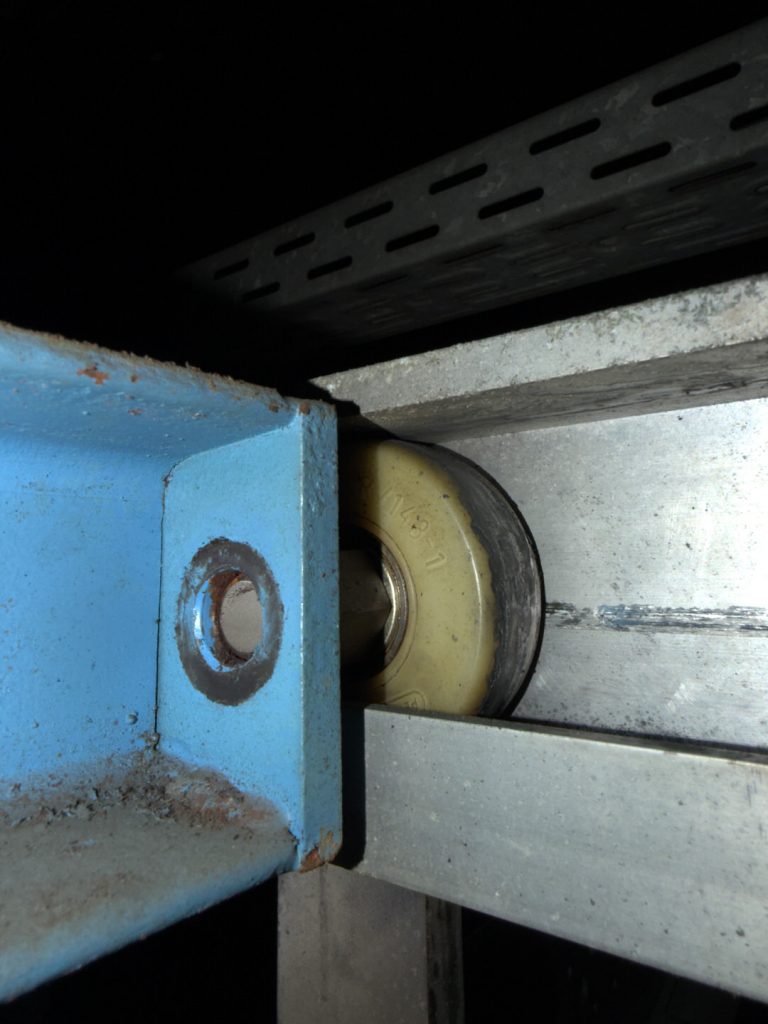
The running rollers sit in the trolley and roll on the running surface of the rail profile. The whole load flows up into the rail through them. Depending on the design they sit inside the profile or outside on a flange. An electrified monorail running roller usually consists of a wheel body, a tyre as running surface and a bearing.
Guide rollers: they keep the track
Guide rollers run across the direction of travel on the side faces of the profile. They prevent the vehicle from drifting sideways or swaying. They work hardest in curves and switches, because there they push the vehicle through the radius. EMS guide rollers need some clearance to the rail, but not too much.
Drive roller: it drives
The drive roller is turned by a geared motor and pressed against the rail by spring force. It transmits the traction through friction alone. For this to work, the contact pressure must be right and the running surface clean and grippy. The electrified monorail drive roller is therefore not a wheel that just rolls but a friction partner.
Tyres and bearings
The tyre touches the rail. Depending on the manufacturer it is made of plastic, often polyurethane, or of steel. A polyurethane running roller runs quietly and spares the rail but reacts to heat, chemicals and long standstills. Which tyre fits is set by the manufacturer. The wheel body holds an often lifetime-lubricated rolling bearing.
Which forces act on the rollers of an EMS trolley?
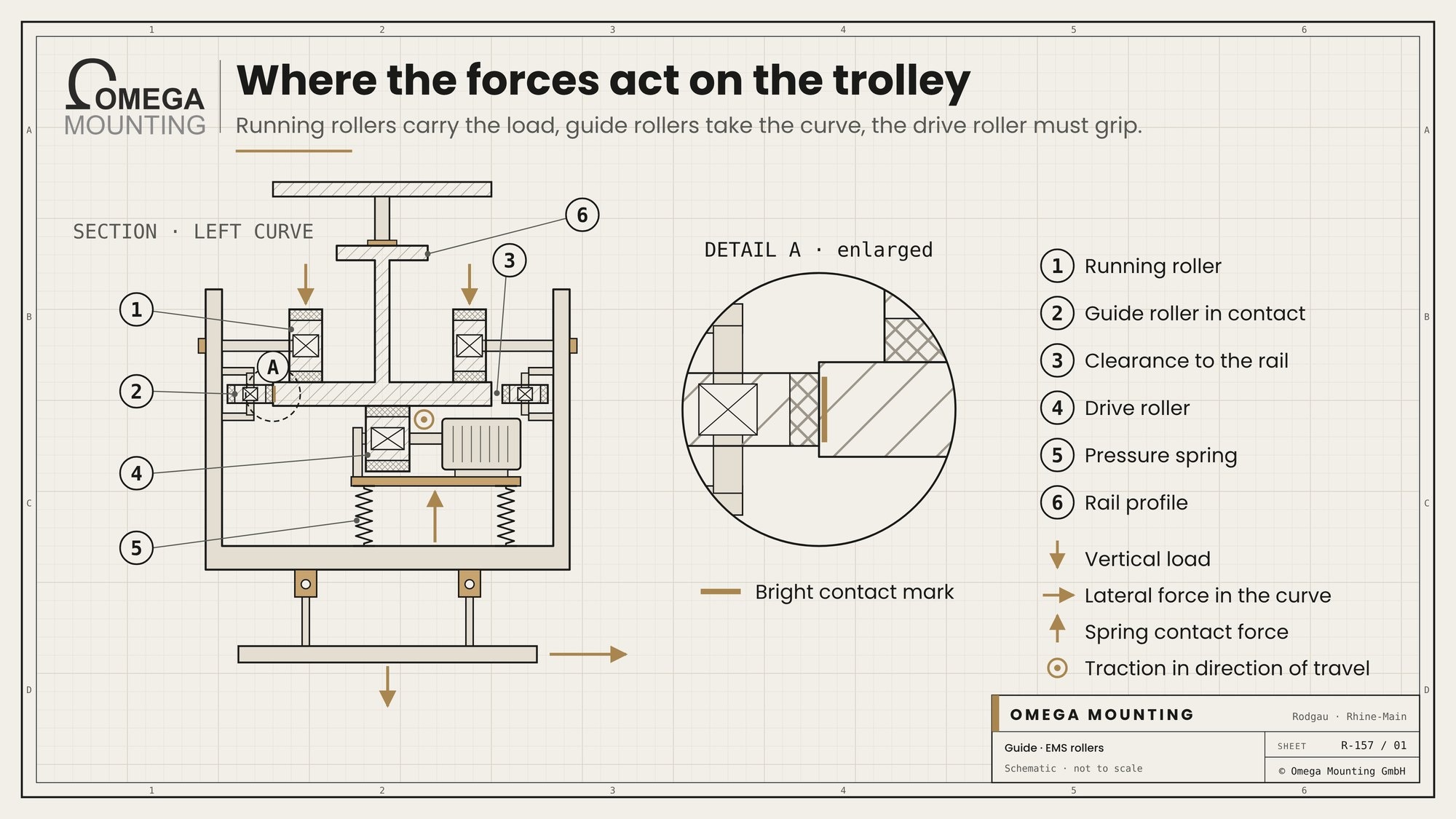
The rollers of an EMS trolley are acted on by the weight of vehicle and load vertically on the running rollers, lateral forces in curves and switches on the guide rollers, driving and braking forces on the drive roller and knocks at every rail transition – and that for years with every circuit.
Load from above
The running rollers carry the whole load. If it hangs askew, the carrier is worn or the trolley distorted, one roller carries more than the other. This roller wears first.
side forces in curves and switches
In every curve the vehicle wants to go straight on. The guide rollers force it into the radius. The tighter the curve and the faster the run, the greater the lateral force. At switches the transition between fixed and moving rail is added. That is why guide rollers wear most in curves and switches.
Driving and braking
The drive roller has to start the vehicle, hold it on inclines and brake it on declines. Every incline demands more friction force. If the contact pressure is not enough or the running surface is smooth, the roller slips. Slip creates heat and abrasion and polishes the running surface further.
Knocks and load cycles
At every rail joint and every switch the roller rolls over a transition. If it is cleanly aligned, the roller notices little. If it has offset in height or to the side, the roller knocks at every pass. This happens with every circuit, every day, for years. Small knocks become breakouts in the tyre and bearing damage.
How do EMS running rollers wear? The typical damage patterns
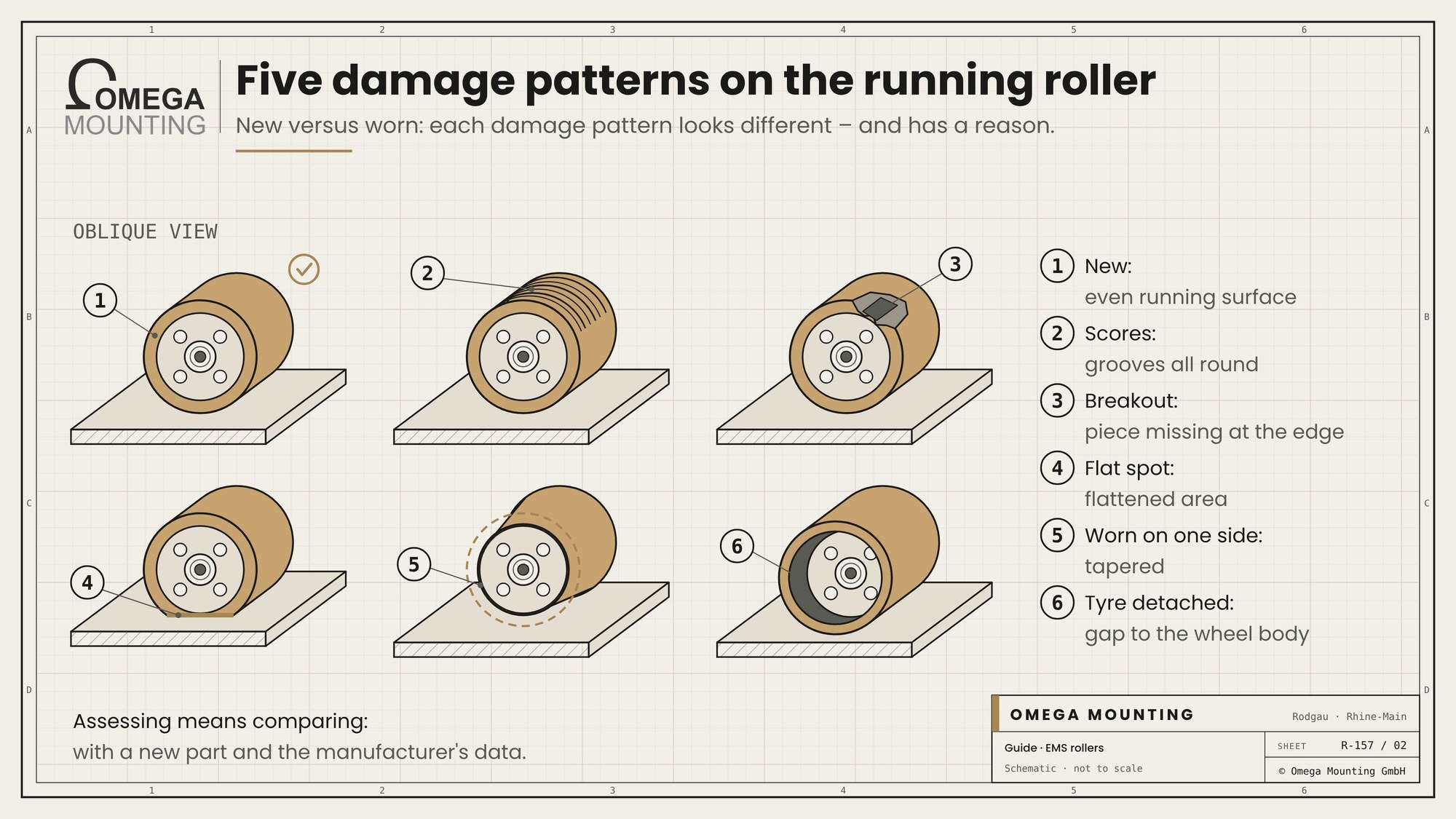
EMS running rollers wear through tyre abrasion, scores and breakouts, flat spots after long standstill, bearing damage, detached tyres and in the extreme case fracture. Drive rollers additionally show smoothness and slip, guide rollers one-sided wear and contact marks.
Abrasion and wear
Every roller loses material. As long as this happens evenly, it is planned wear. If a roller wears tapered or on one side, guidance or load are usually not right.
Scores, breakouts and cracks
Scores in the tyre arise when the running surface of the rail itself has scores or dirt gets between roller and rail. Breakouts come from knocks at transitions. Cracks in the tyre or wheel body are an alarm signal. A cracked roller does not keep running.
Flat spots after standstill
Plastic tyres can deform when a loaded vehicle stands at the same spot for a long time. After company holidays or a long shutdown the roller then knocks in the rhythm of rotation. With some materials slight flat spots run round again, severe ones do not. Whether a flat spot recovers is stated by the manufacturer.
Bearing damage
A worn bearing grinds, hums or has play. If it blocks, the roller drags over the rail. This creates a flat spot on the roller and a drag mark on the running surface.
Detached tyre and broken roller
If the tyre comes off the wheel body, it runs out of round or spins on the core. In the end there is a broken or torn-off roller. On a very old system in Frankfurt we found exactly that: worn, damaged and partly torn-off running and guide rollers. If a trolley carries on with a broken roller, it takes rail, switch and current collector with it.
Why do rollers break? Causes on rail, switch and vehicle
Rollers usually do not break by themselves but because the rail has scores or offset joints, switches do not sit cleanly in the end position, guides are wrongly adjusted, dirt lies on the running surface or the vehicle is overloaded. The roller shows the damage, the cause lies elsewhere.
Offset rail joints
A rail joint with offset knocks against the roller at every pass. The rollers of such a section wear faster than the rest. Anyone who only replaces rollers here has merely moved the problem. First the transition is aligned, then the roller replaced.
Scored or worn running surface
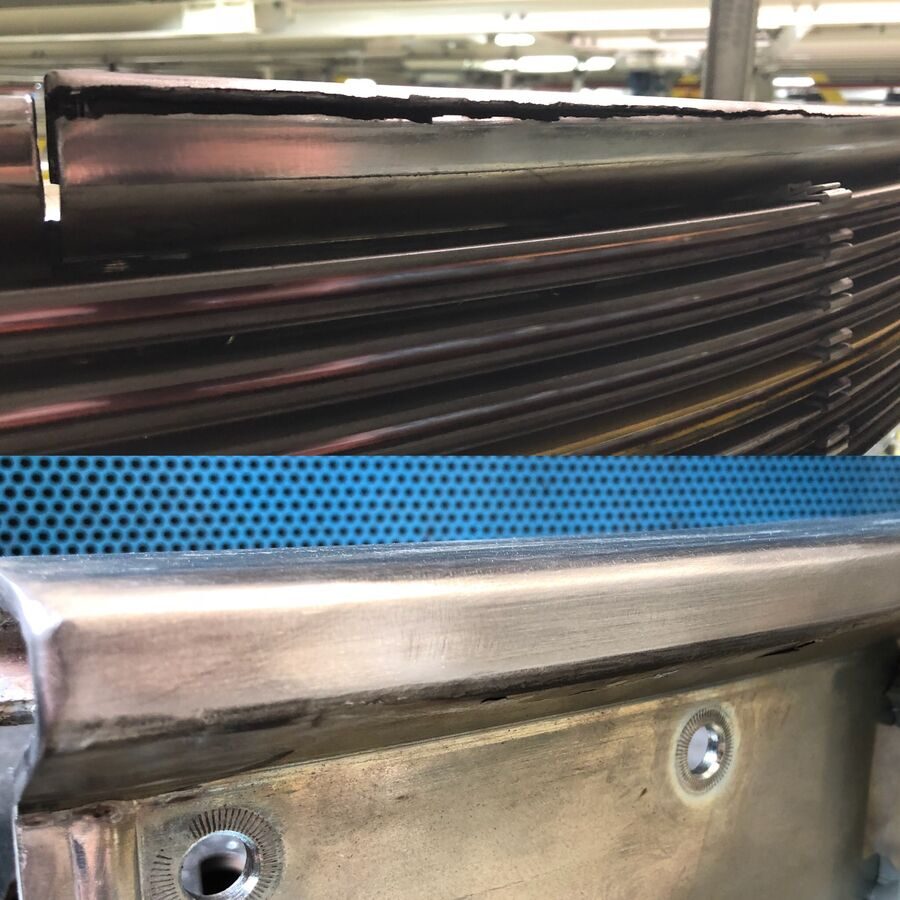
If the rail has scores, it transfers them to every new roller. In Frankfurt the rollers had worked their way into the running surfaces over the years. We shifted worn sections there a little so that the rollers run on unused surface again. A repair-welded rail must be ground cleanly to contour. Every edge knocks on the running rollers.
Switches and transitions
A switch that is not exactly in its end position forms an offset in the running surface. Every vehicle runs over it. Running rollers knock, guide rollers make contact. In systems with many switches this is often the main cause of roller damage.
Wrong adjustment of the guidance
Guide rollers with too much play let the vehicle sway. Guide rollers without clearance jam in the curve and wear on one side. Both can be adjusted according to the manufacturer's data.
Dirt, surroundings and overload
Dust, product residue and abrasion on the running surface act like an abrasive. Oil or sticky deposits take the grip away from the drive roller. Heat and cleaning agents attack plastic tyres. And overload flattens every tyre – what the vehicle may carry is stated by the manufacturer.
How do you inspect EMS running rollers? Listen, look, turn, compare
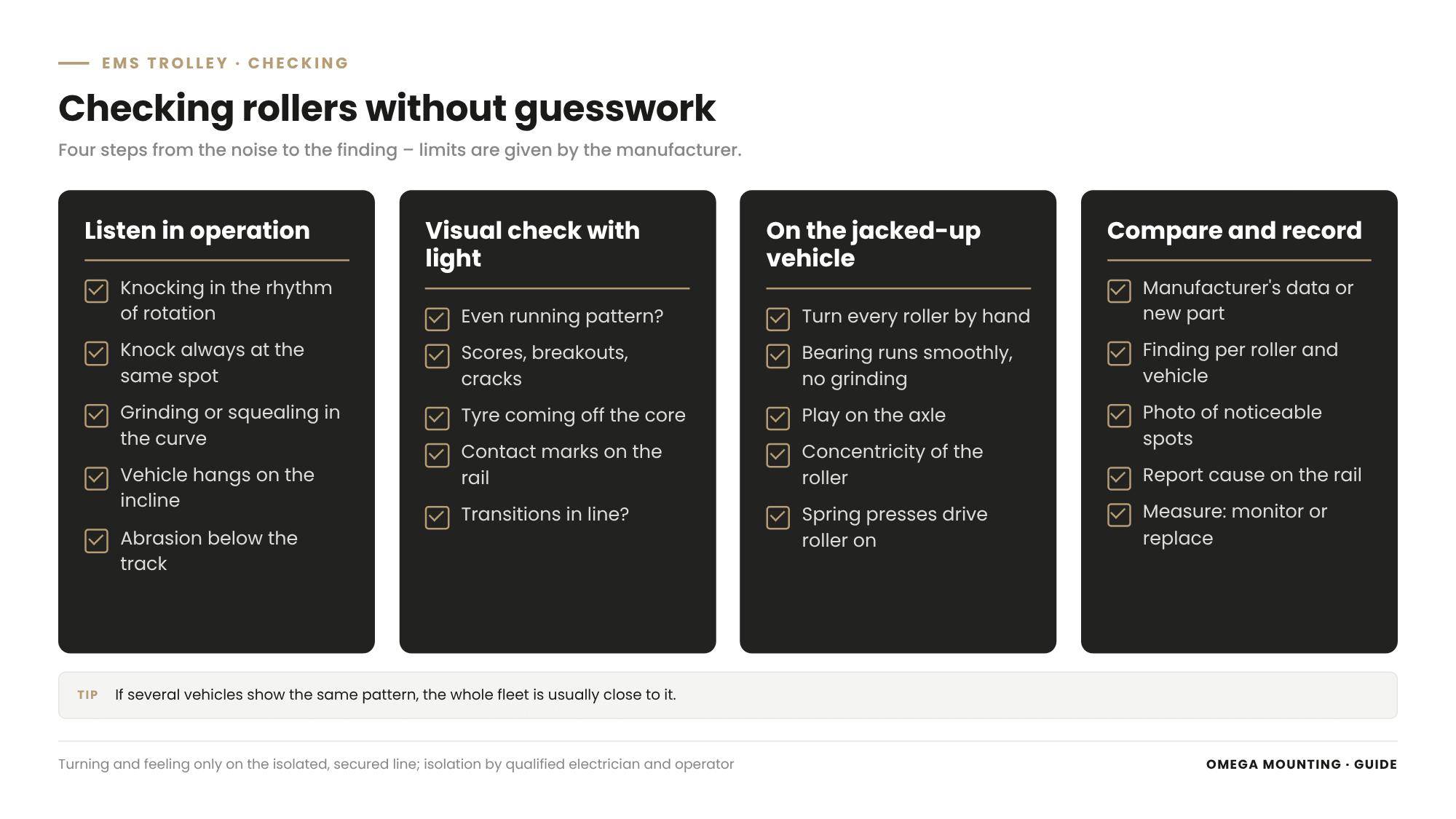
You inspect EMS running rollers in four steps: listen for noises in operation, look at the rollers from below or close up, turn them by hand on the jacked-up vehicle and check for play, then compare with a new part or the manufacturer's data and document the result.
Listen in operation
Many roller faults can be heard before they are seen. Knocking in the rhythm of rotation points to a flat spot or a breakout. A knock always at the same spot points to the transition, not the roller. Grinding or squealing in the curve points to guide rollers or a seized bearing. Operators hear this first. What a reporting route for this looks like is described in our guide on Spotting wear on machines.
Visual check
Up close, with light, you see the running pattern. Is the running surface even? Are there scores, breakouts or cracks? Is the tyre coming loose? Is there abrasion in the trolley? The rail belongs to it too: bright contact marks on the side faces show where guide rollers press.
Turn and feel
On the jacked-up vehicle, on the isolated line, every roller is turned by hand. Does it run easily and smoothly? Does the bearing grind? Does the roller have play on the axle? Does it run true? On the drive roller you also check whether the spring presses it on evenly.
Compare and document
Whether a roller may keep running is decided by comparison. Decisive are the manufacturer's data, a new part or the spare parts catalogue. Record per vehicle which roller has which finding, with a photo. A check sheet per vehicle turns observations into a decision. Which assemblies and intervals have proven themselves in practice is in our overhead conveyor maintenance checklist.
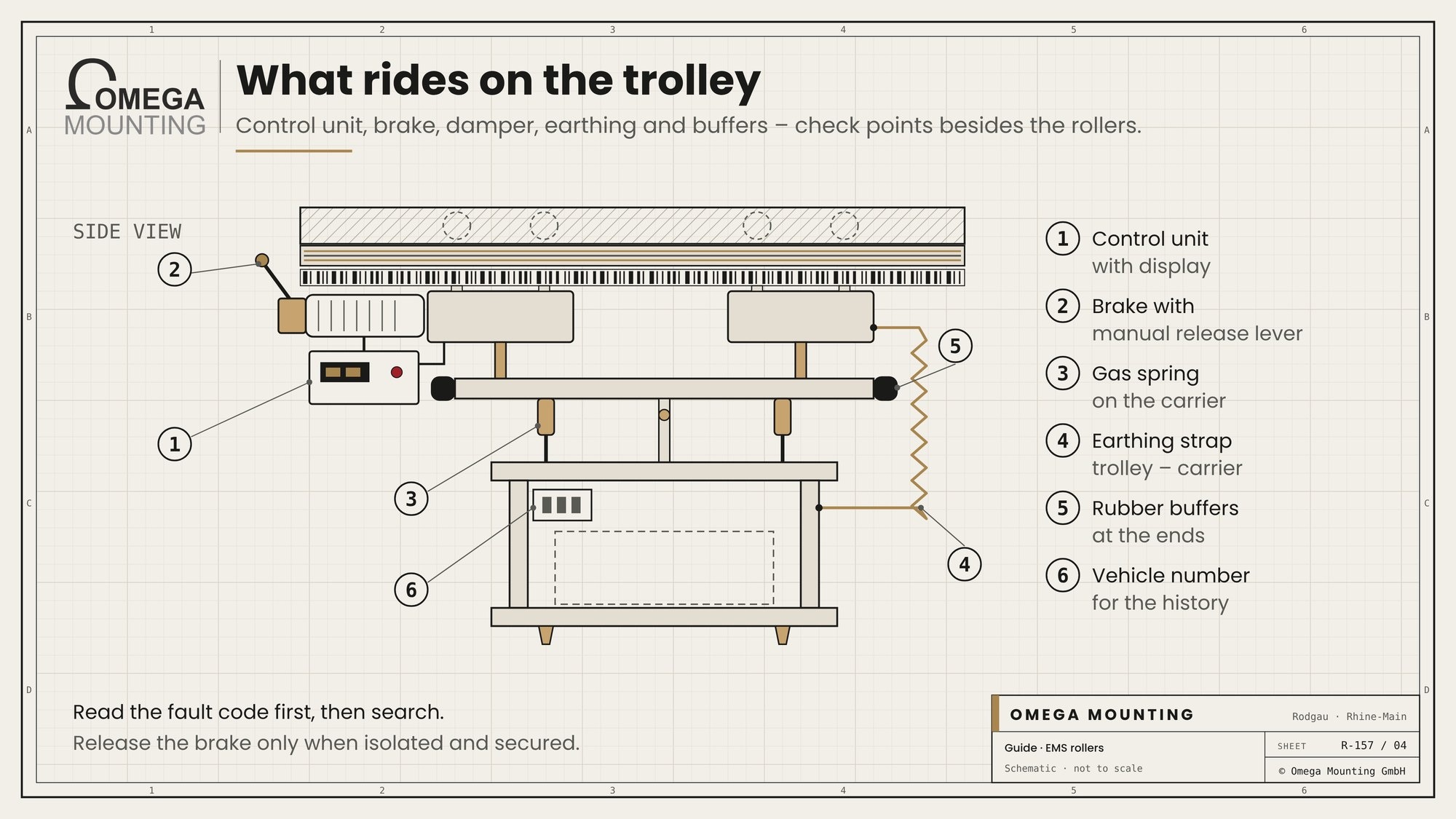
Read first, then search. Many trolleys carry their own control unit directly on the drive, often with a display or fault code. Note the message before work. It reveals whether the fault occurs when starting, on an incline or at a particular spot. Also look at cables and connectors: chafe marks, missing strain relief and loose connectors are findings for the qualified electrician.
The drive roller: slip, smoothness and contact pressure
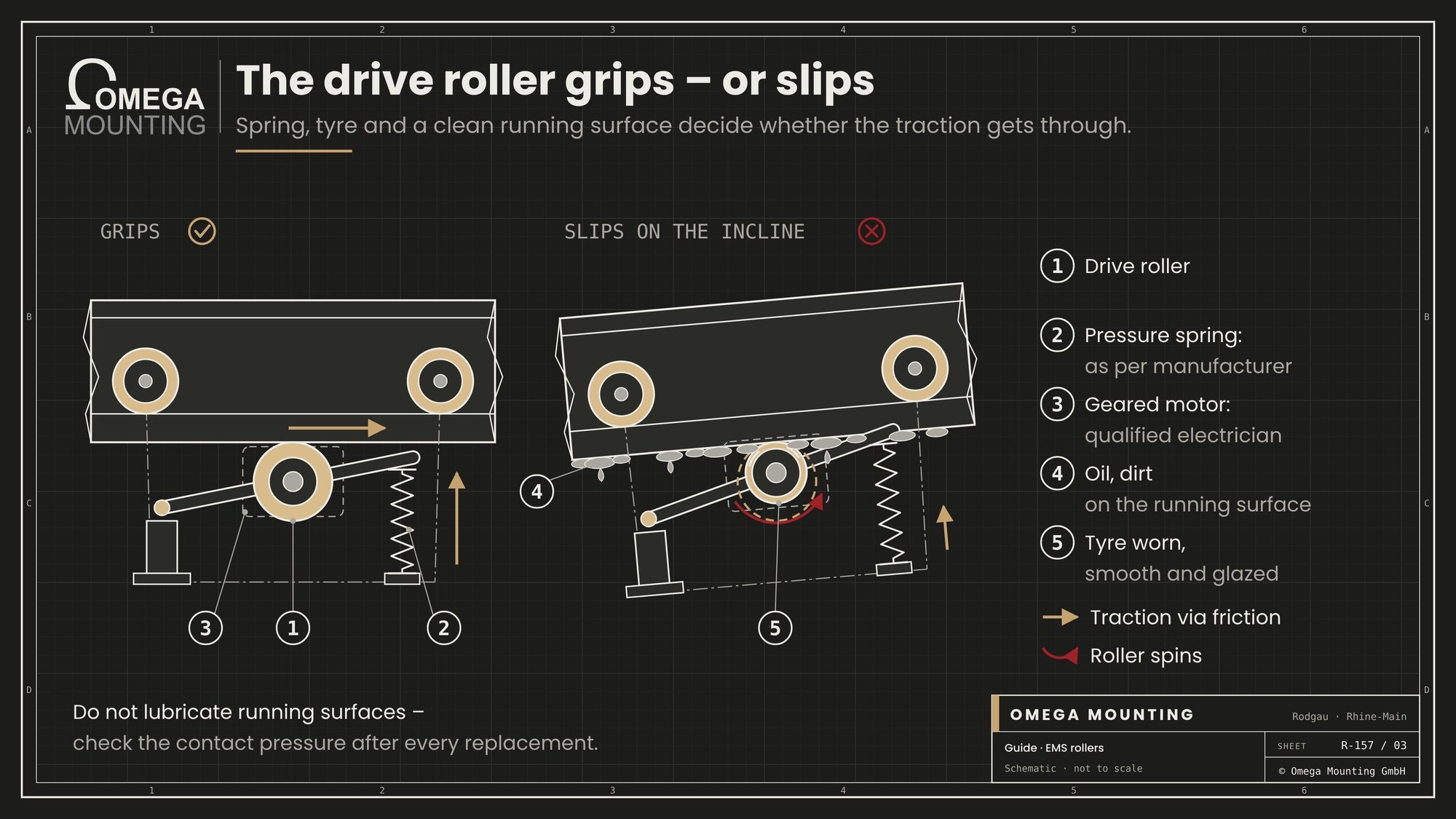
A drive roller is worn when it slips on inclines or when starting, its running surface shines and is glazed, or its tyre is worn so far that the spring no longer presses it on with the intended pressure. Drive roller slip is almost always the first sign.
How to recognise slip
The vehicle slows down on an incline or stops. When starting, the roller briefly spins. The controls report position errors. On the rail, polished spots shine in front of stations and on inclines.
Smoothness and glazing
If a plastic roller slips often, its running surface gets hot and smooth. It glazes. A glazed roller grips even worse, slips even more often and polishes itself further. Only replacement breaks this cycle – and the search for the reason.
Contact pressure as per manufacturer's data
The pressure spring decides whether the roller grips. If it is too weak, the roller slips. If it is too strong, roller, bearing and rail wear faster. The contact pressure is set according to the manufacturer's data. It is rechecked with every new roller, because a new tyre is thicker than a worn one.
No oil on the running surface
Running surfaces of rail and drive roller are not lubricated. Oil and grease take the grip away from the drive roller and bind dirt. Lubrication only where the manufacturer specifies it, for example at bearing points or joints of the trolley. These points belong in the Lubrication schedule of the system.
Tyre, support rollers, cooling fins. On many trolleys the drive wheel with plastic tyre sits above the rail and is pressed on from above. Support rollers run below it and take the counter-pressure. If they are worn, the drive wheel lacks contact pressure. Keep the cooling fins on motor and electronics free of dust, otherwise the drive gets too warm. And not every position error is slip: on systems with a barcode strip, strip or read head can also be the cause.
Repair or replace: what makes sense for rollers
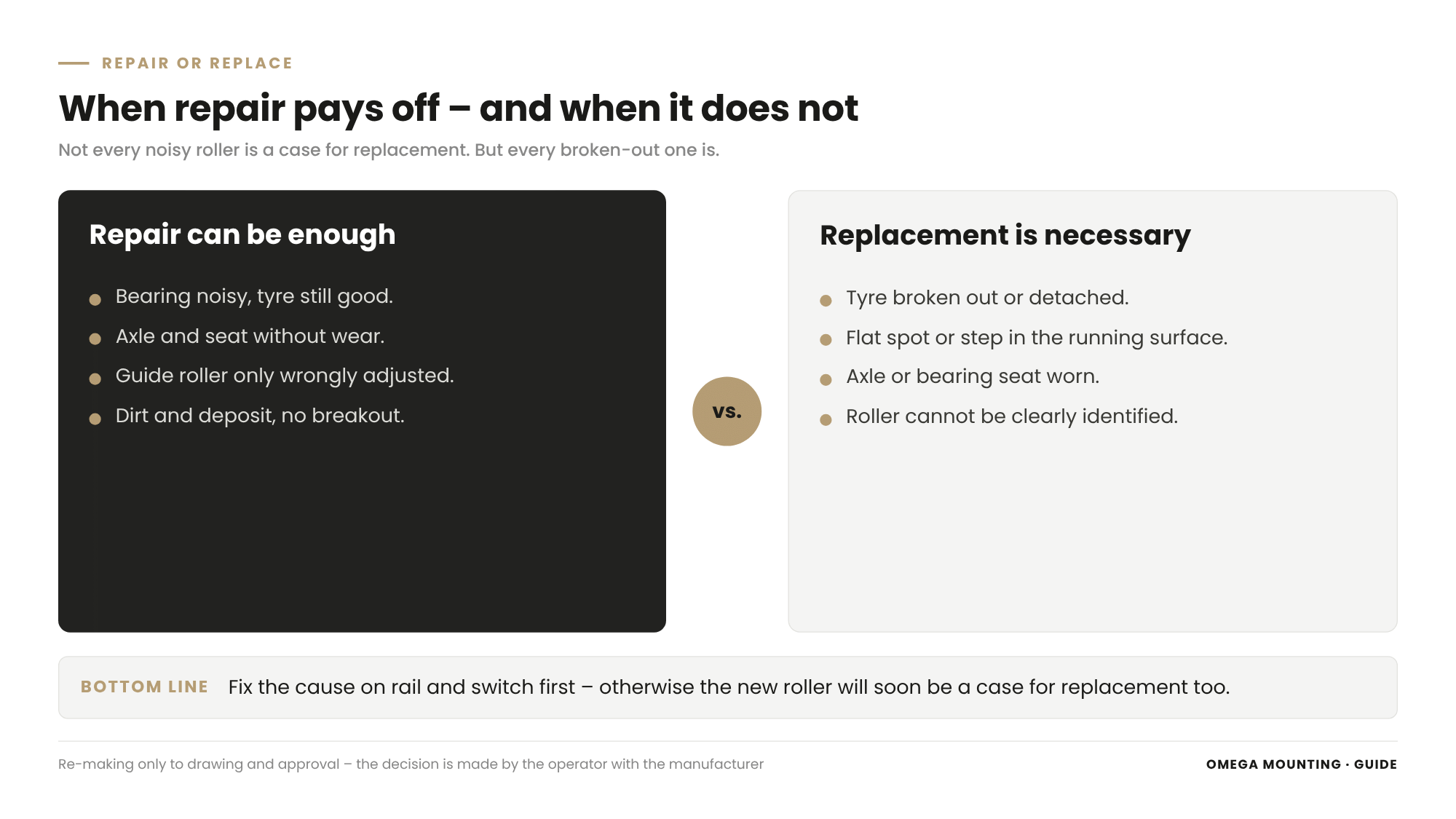
Rollers are wearing parts and are usually replaced, not repaired. Everything around the roller is repaired instead: rail transitions, switches, guidance and contact pressure. Where the manufacturer provides for it, individual tyres can be renewed.
Replace rather than patch
A worn tyre cannot sensibly be refurbished, and a cracked roller certainly not. Bearing damage is fixed by replacing the bearing or the roller, depending on the design. When repair and when replacement pays off on an EMS is explained in general in our guide on Wear on the electrified monorail.
Replacing in pairs and sets
The rollers of a trolley work together. A new running roller next to a worn one carries more load and wears faster. That is why replacing running rollers and guide rollers is usually planned in pairs or sets per trolley. What exactly is replaced together is set by the manufacturer. Axles, pins and bearing seats are checked at the same time.
The fleet ages together
All vehicles of an EMS run the same track, at the same rhythm, with similar loads. That is why their rollers wear at a similar rate. If one vehicle shows worn rollers, the others are usually close to it. A sample on several vehicles therefore allows conclusions about the whole fleet. There are exceptions, for example for vehicles with heavier loads or their own routes. They need a sample of their own.
The cause first
Before every replacement comes the question of why the roller is worn. If all rollers knock at the same spot, it is the transition. If guide rollers only wear in one curve, it is the curve or the switch before it. The roller is the symptom.
Replacing EMS rollers: the sequence in the maintenance window
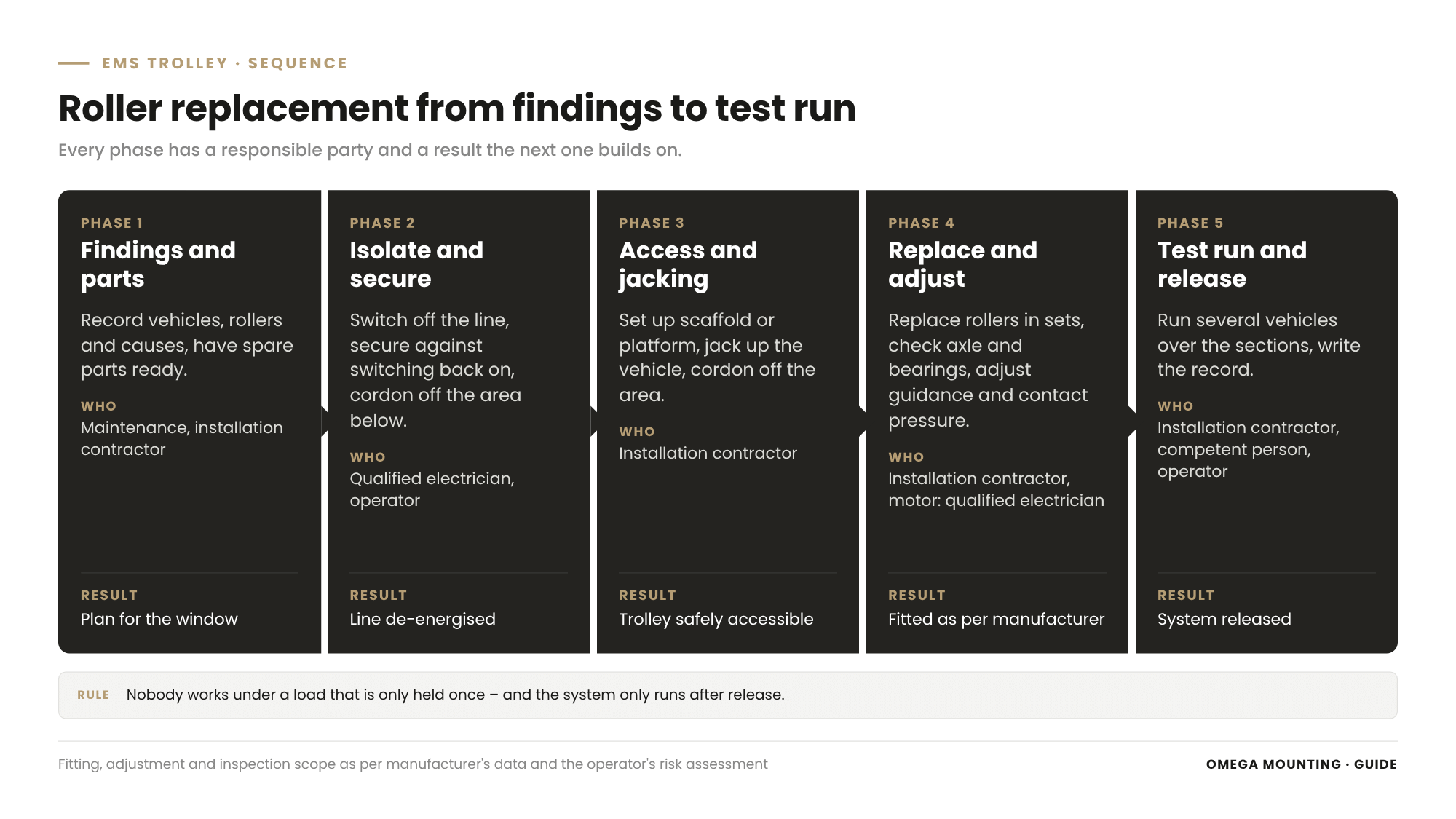
You replace EMS running rollers in five steps: record findings and have spare parts ready, have the line isolated and secured, reach and jack up the vehicle, replace and adjust rollers according to the manufacturer's data, then test run and release by the operator.
Preparation before the window
The findings are available before the window, not only during it. Spare parts, tools and sequence follow from them. Rollers, bearings, axles and retainers are ready, sorted by trolley type.
Isolating and securing
Work is done only on the isolated line secured against switching back on. Isolation is carried out by the qualified electrician and the operator. The key stays with whoever is working up top. How the procedure is organised is described in our guide to Lockout tagout in maintenance.
Access at height
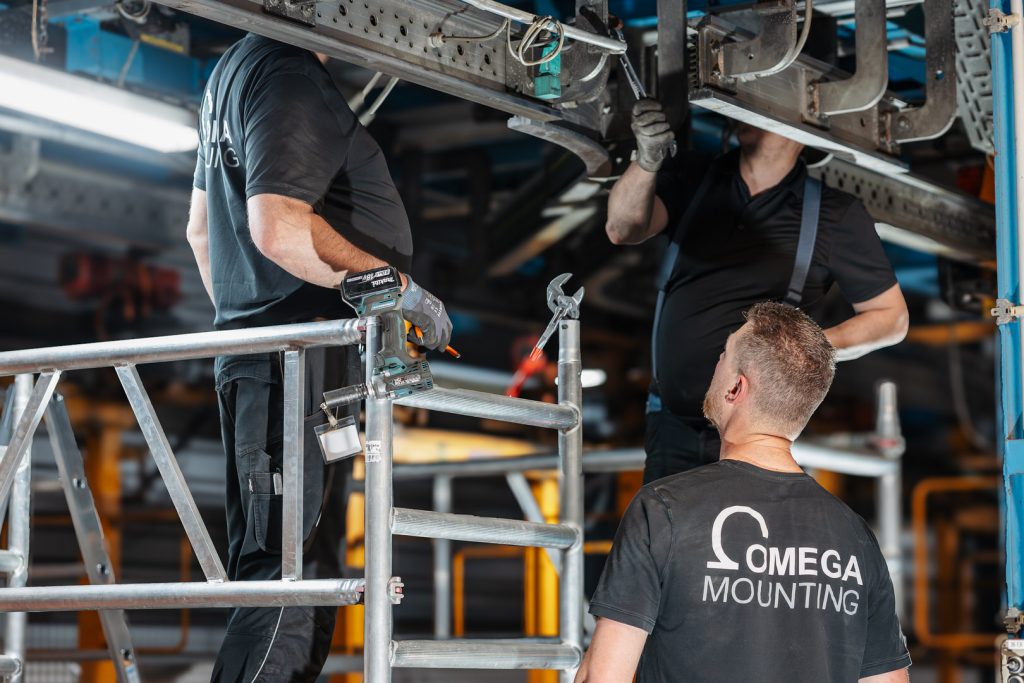
Work is done from mobile scaffolds or a mobile elevating work platform, with good lighting. The area below is cordoned off. What counts when working from the platform is described in our guide to installation work with a MEWP.
In the track or moved out
Some rollers can be replaced directly in the track. For others the vehicle has to move to a maintenance point or be taken out of the rail. Internal rollers in switches can sometimes only be reached if the switch is partly dismantled. The vehicle is jacked up, a lifted load additionally secured independently. Nobody works under a load that is only held once.
Replacing and adjusting
Remove old rollers, check and clean axle and bearing seat, fit new rollers according to the manufacturer's data, renew retainers. Guide rollers are set to clearance, the drive roller to contact pressure. If the drive motor has to be loosened for this, the qualified electrician disconnects and reconnects it.
Test run, inspection and release
At the end come test runs, if possible with several vehicles over the sections worked on. Do the rollers run evenly? Are there knocks or noises? Do guide rollers have clearance in curves and switches? Does the drive roller grip on inclines? Whether an inspection by a person qualified to inspect is necessary before return to service is determined by the operator under the German Ordinance on Industrial Safety and Health (BetrSichV) in their risk assessment, based on the manufacturer's specification. This is a practical classification, not legal advice. Then the operator releases.
Recovering a stranded vehicle. Many brake motors have a manual release lever. It can be used to release the brake and push the vehicle by hand into a maintenance position. This only happens when the section is isolated and secured and nobody is under the load. On a decline the brake is never released without securing the vehicle against rolling away. Afterwards the lever goes back to its rest position.
Rollers, rail, collectors: how the components are connected
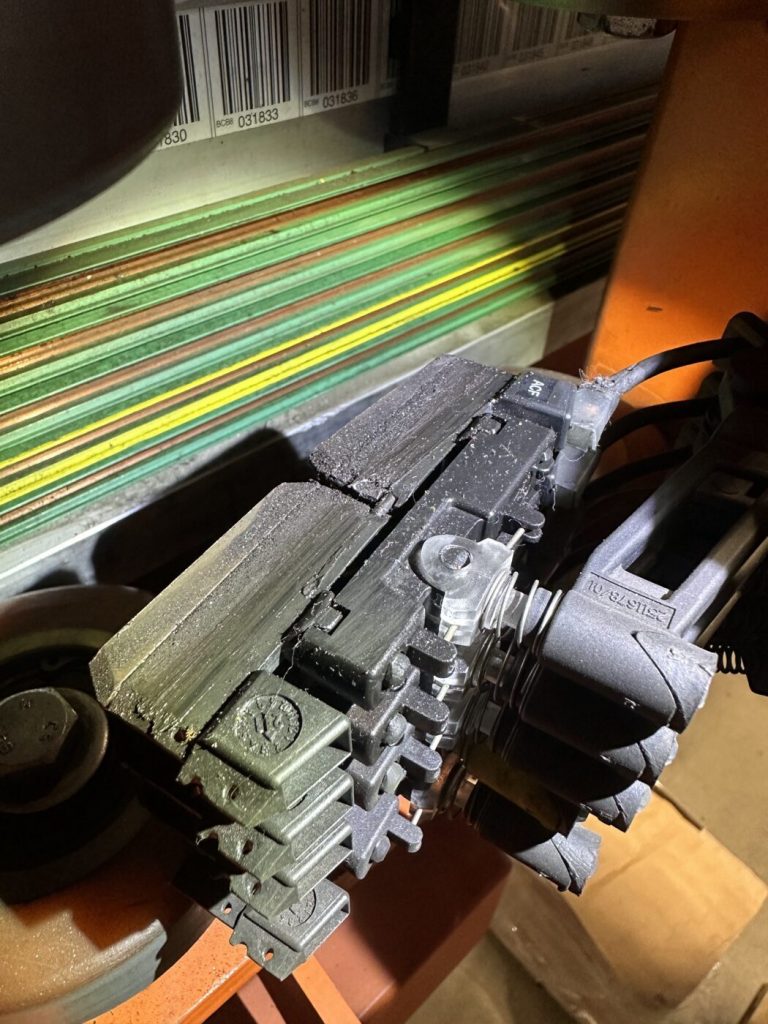
On the EMS, rollers, rail, switches and current collectors form a chain: an offset rail joint damages the rollers, worn rollers let the vehicle sway or run lower, and that strains current collectors, carbon brushes and data contacts. Anyone fixing a fault therefore always checks the neighbours too.
From joint to roller
A transition with offset knocks on every roller. That is why the alignment of the rail joints belongs in every roller inspection.
From roller to collector
Worn guide rollers let the vehicle sway sideways. Worn running rollers let it run lower in the profile. Both change the position of the current collector relative to the conductor rail. It knocks at transitions, the carbons wear faster, contact and data drop out. In Frankfurt, besides the roller damage, we also found wear on current collectors, drive rollers and data contacts.
From collector to fault message
In a beverage plant it became clear how closely this is connected. Poorly aligned transitions and misadjusted switches knocked on the collectors there and intensified communication faults. The controls report something like this as a data error. The cause is often mechanics. Electrical tests on conductor rail and data bus are done by a qualified electrician – from our team on request.
Spare parts: original, re-made, approved
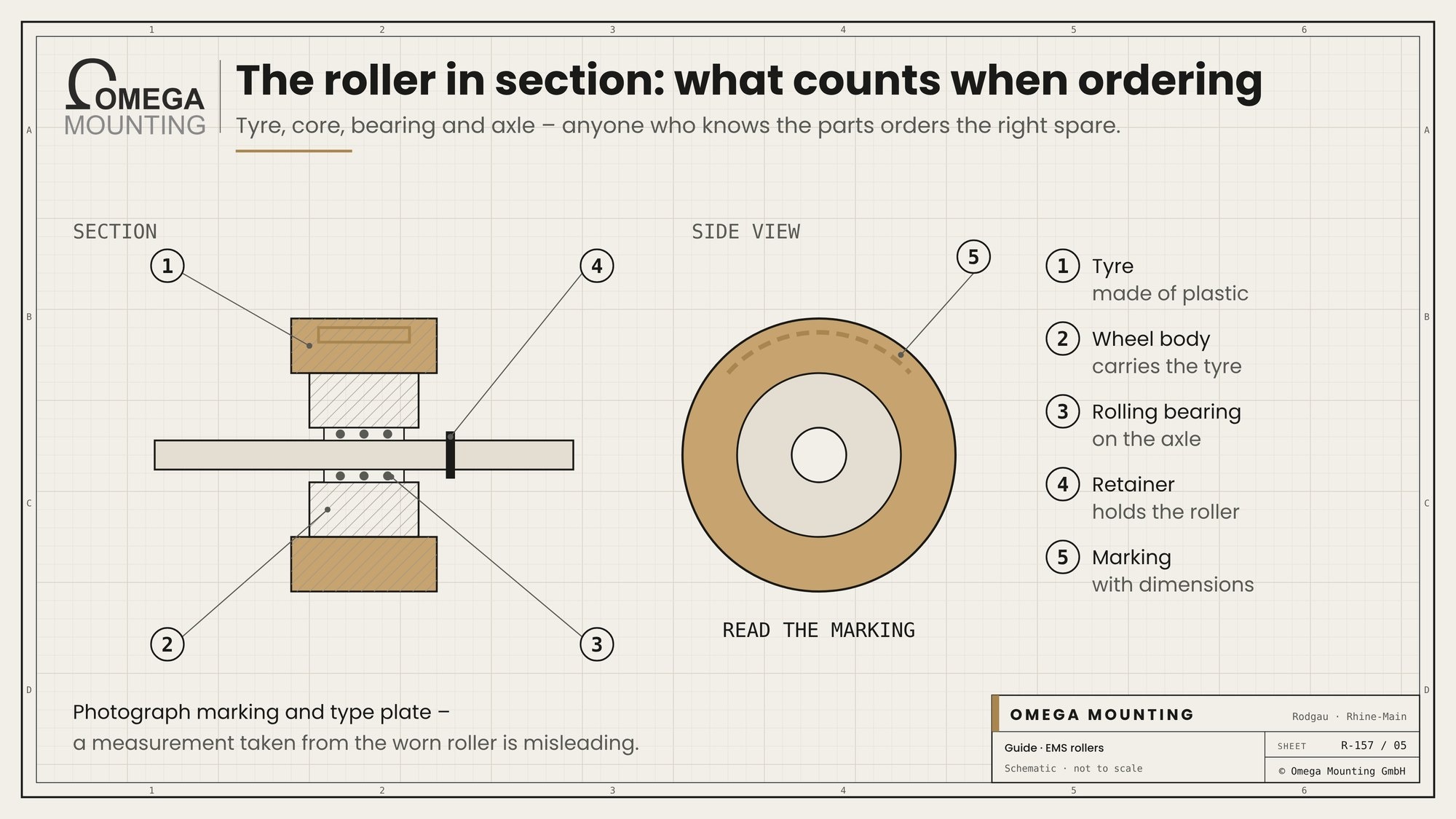
Replacement rollers are best obtained from the system manufacturer or to their specification. Re-making is only done to manufacturer's documents or with the operator's approval, because tyre, bearing, dimensions and load capacity must suit the trolley.
Original parts
The manufacturer knows tyre material, bearings, fits and permissible load. With the original part the trolley stays as it was designed. Order by trolley type and spare part number, not by eye.
When the manufacturer no longer supplies parts
For old systems some rollers no longer exist. Then equivalent parts to specification or re-making come into question. The basis is a drawing, manufacturer's documents or a survey that the operator approves. Measuring a worn old part only copies the wear. What helps with parts that are no longer available is described in our guide to spare parts that are no longer available.
Stockholding
Because the fleet ages together, a stock of rollers, bearings and retainers pays off. Store plastic rollers as specified by the manufacturer.
Read the marking instead of measuring. Many rollers and tyres have the dimensions stamped on them, and every geared motor has a type plate. Photograph both before removal. This allows the spare part to be requested unambiguously. A measurement taken from the worn roller easily leads to the wrong part.
Damage pattern, cause, measure: the overview
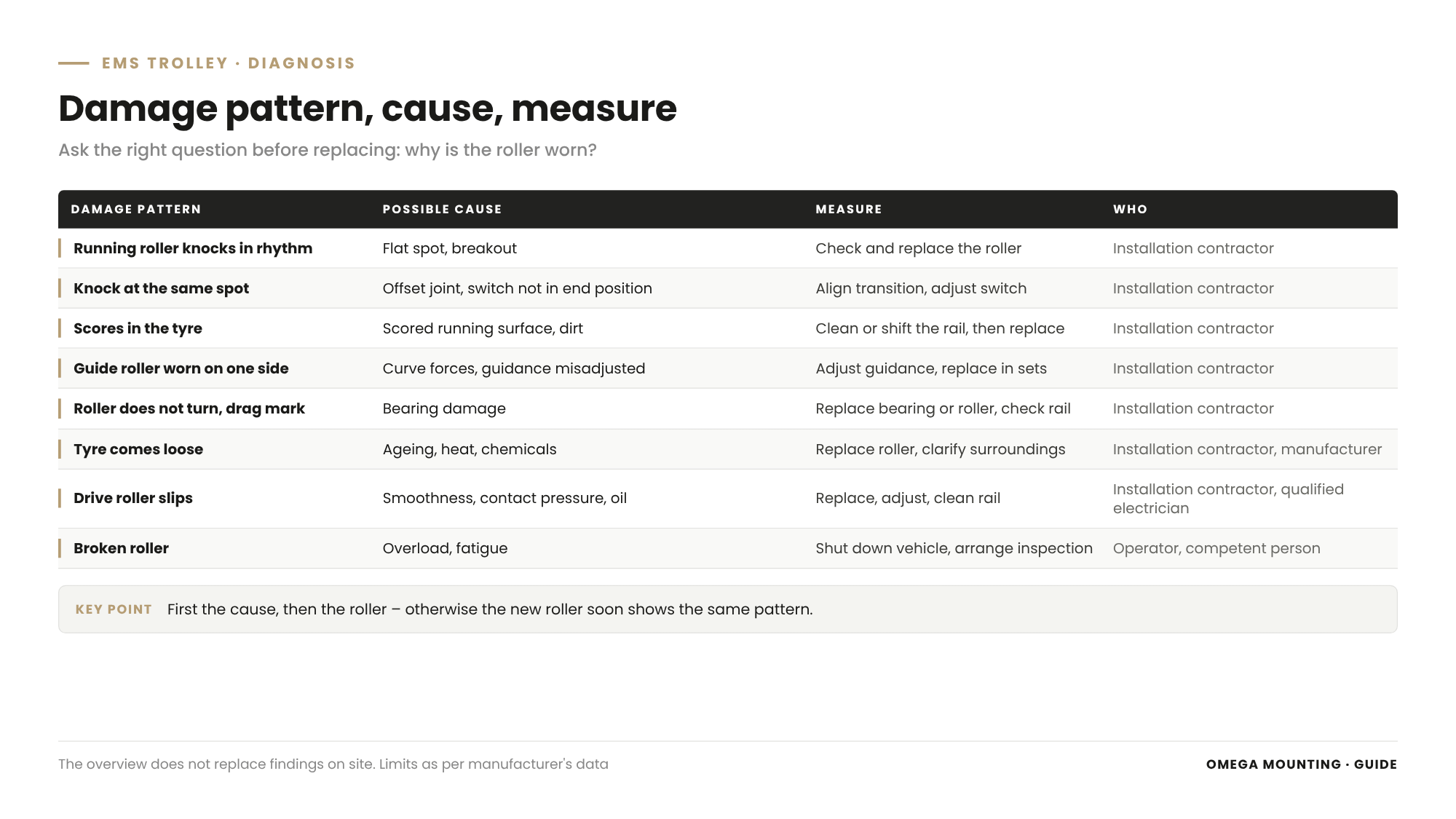
The overview assigns possible causes, the appropriate measure and the responsible party to every typical damage pattern on EMS rollers. It does not replace findings on site, but helps to ask the right question before replacing.
| Damage pattern | Possible cause | Action | Who |
|---|---|---|---|
| Running roller knocks in rhythm | Flat spot after standstill, breakout | Check roller, replace as per manufacturer's data | Installation contractor |
| Knock at the same spot | Offset rail joint, switch not in end position | Align transition, adjust switch, check rollers | Installation contractor |
| Scores in the tyre | Scored running surface, dirt | Clean or shift the rail, then replace rollers | Installation contractor |
| Guide roller worn on one side | Curve forces, guidance wrongly adjusted | Adjust guidance, replace rollers in sets | Installation contractor |
| Roller does not turn, drag mark | Bearing damage | Replace bearing or roller, check rail | Installation contractor |
| Tyre comes loose | Ageing, heat, chemicals | Replace roller, clarify surroundings with manufacturer | Installation contractor, manufacturer |
| Drive roller slips | Smoothness, too little contact pressure, oil on the rail | Replace roller, adjust contact pressure, clean rail | Installation contractor, qualified electrician for the motor |
| Broken roller | Overload, fatigue, consequential damage | Shut down vehicle, clarify cause, arrange inspection | Operator, competent person |
Typical mistakes when replacing EMS rollers
The typical mistakes when replacing EMS rollers are: replacing only the noticeable roller, not aligning the rail, fitting rollers without manufacturer's data, not readjusting the contact pressure of the drive roller, lubricating running surfaces and releasing without a test run.
- Replacing rollers, not aligning the rail. The offset joint remains, and the new rollers knock like the old ones.
- Only the one roller. The new roller carries more than its worn neighbours and wears faster.
- Replacement by eye. A roller that fits is not yet a roller that carries. Material, bearing and load capacity must be right.
- Contact pressure forgotten. The new drive roller is thicker than the old one, the spring presses differently. Without adjustment it slips or wears.
- Oil on the running surface. Well meant, but the drive roller loses its grip.
- Bearing and axle not checked. The new roller runs on a worn axle and immediately gets play.
- No test run. Whether the guide rollers run freely in the curve is only shown by the run.
Replacing EMS rollers in the Rhine-Main region: how we work
We check and replace running, guide and drive rollers on electrified monorails in the Rhine-Main region, align rail transitions, adjust switches mechanically and re-make parts after approval – from Rodgau in Frankfurt, Offenbach, Hanau, Darmstadt and Aschaffenburg.
Our core is the mechanics; disconnecting and reconnecting are handled on request by our own qualified electricians. We record the findings per vehicle and agree sequence and spare parts with you. In the weekend window we replace rollers, check axles and bearings, adjust guidance and contact pressure according to the manufacturer's data and align transitions. We bring scaffolding, lighting and cordoning off. Every window ends with a test run, a record and a list of open points.
Isolation according to your procedure and disconnecting and reconnecting the drive motor are handled by our own qualified electricians. Inverter parameters, controls and data bus stay with the manufacturer or controls engineer. The inspection before return to service is carried out by a person qualified to inspect. Our scope of services is described on the page Maintenance and servicing. How EMS rollers in the Rhine-Main region fit into the maintenance of the whole conveyor system is shown in our guide to Conveyor technology maintenance.
Project examples
Two jobs show what counts with rollers: findings before the window, the cause on the rail and the test run at the end.
Frankfurt: worn rollers on a very old EMS
With the maintenance of an overhead monorail system in Frankfurt we found worn, damaged and partly torn-off running and guide rollers on a very old system with many switches. The running surfaces of the rails had grooves and unevenness, rail transitions were out of line. Drive rollers, current collectors and data contacts were also worn.
Every switch was documented and assessed, the sequence agreed with the operator, parts prepared. Work was done at weekends, in the tight window between the end of production and restart, from mobile scaffolds with additional lighting. We replaced rollers, internal rollers partly with dismantling. Rail transitions were aligned, worn sections shifted a little instead of replaced.
For your system this means: rollers and rail belong in the same findings. An old EMS does not necessarily need new rails, but clean transitions and new rollers.
Curved rail: test run as proof
On an older EMS in a production plant we repair-welded cracked curve sections. The weld was ground completely to the rail contour because the running rollers run directly over it. Every edge would have meant knocks, vibration and roller wear. Then test runs with several vehicles followed: even running, no knocks, clearance for the guide rollers in the curve.
For your system this means: a repair on the rail is only finished when the rollers run smoothly over it.
Are your rollers no longer running true?
Then get in touch with us. Send us photos of the rollers and the noticeable spots, plus a short description of the noises. We will tell you what we would check and what belongs in your next maintenance window.
What this means for your role
For buyers: Separate findings, roller replacement per vehicle and work on the rail in the quotation. Ask who procures the spare parts and to which specification. Require the interface to the qualified electrician to be named.
For designers: Plan maintenance points where vehicles can be jacked up and rollers replaced. Record trolley types, rollers and manufacturer's data in the as-built documents.
For project managers and site managers: Set vehicles, rollers and sequence for each window. On site the site manager coordinates isolation, scaffolding, cordoning off and test runs. They only release once the record is complete.
For maintenance managers: Keep a check sheet per vehicle and check rollers and transitions together. Take samples from several vehicles and build up a stock of rollers. The trolley belongs in EMS trolley maintenance with points of its own.
For warehouse and logistics managers: Your operators hear roller damage first. Give them a reporting route for it.
For operations and plant managers: Rollers are inexpensive parts. It gets expensive when a broken roller takes rail, switch and current collector with it. Release the windows that inspection and replacement need.
EMS trolley roller check sheet: template on request
The EMS trolley roller check sheet is a one-page working document for your maintenance. Per vehicle you record location and anomaly in operation, the condition of running, guide and drive rollers, and finding and measure. Each point has fields for “OK”, “monitor”, “replace” and “photo available”. It deliberately contains no limits or intervals – those come from the manufacturer. Request the template via our contact form – keyword “EMS trolley roller check sheet”.
Why Omega Mounting?
We are based in Rodgau near Frankfurt and work with our own fitters, our own workshop and our own scaffolding. In Frankfurt we replaced rollers on a very old EMS, aligned transitions and shifted rails instead of replacing them – in a tight weekend window. We always look at roller and rail together. And we say beforehand where our service ends: controls and building electrics are handled by others. What this means for you: a single point of contact for your EMS, who fixes cause and symptom together.
Conclusion
EMS running rollers, guide rollers and drive rollers are wearing parts, but not stand-alone parts. They show early when rail, transitions, switches or adjustment are not right. Anyone who listens in operation, checks on the jacked-up vehicle and compares with the manufacturer's data recognises damage before failure. Replacement is in pairs or sets, after the search for the cause and with a test run at the end. Parameters, controls and inspection stay with those responsible. If your vehicles knock, strike or slip, send us photos and a short description – we will get back to you with an honest assessment.
Further reading: How to check joints and curves of the track: Electrified monorail track. How switches get cleanly into the end position: EMS switch. How current collectors and conductor rail interact: EMS conductor rail.
Planning a move-in, installation or maintenance in the Rhine-Main region?
Tell us briefly what you need – we'll come back with an honest assessment.
Free, no-obligation callback
You may also be interested in these guides
Maintenance & Servicing
Maintenance & Servicing

About the author
Tobias Schott
Managing director of Omega Mounting GmbH, Rodgau · more than 20 years of hands-on experience in installation and maintenance
A trained mechatronics technician, working in maintenance, servicing and industrial installation since 2004 – first alongside his father, and with Omega Mounting since 2012: from overhead conveyors in Frankfurt to the crane system in a new-build hall. He plans and leads lifting operations as an appointed person (AP) in data centers and on industrial sites in the Rhine-Main region, trains and examines operators of cranes, mobile elevating work platforms and telehandlers, and is a qualified occupational safety specialist. On jobs abroad he is known as the “German Troubleshooter” – the person you call when a site gets stuck. He learned what quality means from his father, not from a manual: Made in Germany as a standard for his own work, not a label. That is why quality comes first at Omega Mounting – ahead of speed and price. He writes these guides from that practice: what works on our sites is in them – what exists only on paper is not.
Frequently asked questions
When the tyre is worn to the manufacturer's wear limit, shows cracks, breakouts or severe flat spots, comes off the wheel body or the bearing has play or grinds. A cracked or broken roller is replaced immediately. Before replacement, clarify the cause so that the new EMS running rollers do not wear again straight away.
The running roller carries vehicle and load on the running surface of the rail. The guide roller runs at the side of the profile and keeps the vehicle on track, especially in curves and switches. The drive roller is turned by the geared motor and pressed against the rail by spring force. It transmits the traction through friction.
Usually yes. A new roller next to worn rollers carries more load and wears faster. That is why the rollers of a trolley are usually replaced together. What belongs together is set by the manufacturer.
Because the cause has remained. Offset rail joints, scored running surfaces, switches outside the end position or wrongly adjusted guidance damage every new roller. Too strong or too weak contact pressure on the drive roller also shortens its service life.
By slip: the vehicle spins when starting or gets stuck on inclines. The running surface shines and is glazed, bright spots are visible on the rail. Often the controls report position errors whose cause is mechanical.
That is set by the manufacturer. Polyurethane runs quietly and spares the rail but reacts to heat, chemicals and long standstills. Steel is robust but louder and harder on the rail. Changing the material is a change to the trolley and needs the approval of manufacturer and operator.
Yes, but only to manufacturer's documents, a drawing or a survey that the operator approves. Tyre, bearing, dimensions and load capacity must suit the trolley. Measuring a worn old part only copies the wear.
Whether an inspection by a person qualified to inspect is necessary is determined by the operator in their risk assessment, based on the manufacturer's specification. Test runs with several vehicles over the sections worked on are always part of it. Then the operator releases.
Send us photos of the rollers and the noticeable spots, a short description of the noises and your possible maintenance windows. We will then look at track and vehicles on site and tell you in writing what we take on and what belongs in which window. Your contact is Tobias Schott – reachable via our contact form.
 English
 German