
- Guide – Crane technology
Installing a gantry crane: align the gantry, grout the base plates, lift in the crane bridge, commission electrics and limit switching
By Tobias Schott · 20-minute read · As of November 2026
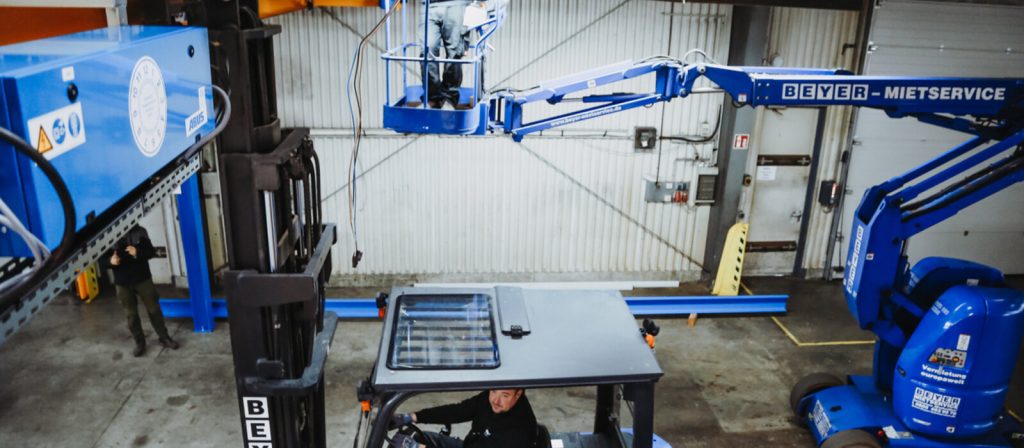
Installing a gantry crane means erecting the free-standing gantry and aligning height and diagonals with a laser, shimming, grouting and curing the base plates, pre-assembling the crane bridge on the ground, setting it on the runway in one lift and connecting the electrics with conductor rail and limit switching. A crane does not forgive a crooked runway.
Many companies would like a crane over their work area. Sheets, sections, assemblies or tools should be lifted at the push of a button, not manoeuvred with a forklift. But not every hall can carry a crane. If the roof structure was never designed for it, no amount of recalculation helps: a crane runway on the hall columns is then not possible.
The gantry crane solves this problem. It brings its own structure – columns, end frames and runway beams – and makes only one demand: a load-bearing hall floor for the base plates. Not a single hole is drilled into the building structure. Anyone having a gantry crane installed gets full crane performance over the work area – even in an existing hall.
This guide shows how to install a gantry crane – from aligning the gantry through grouting the base plates to lifting in the crane bridge and the electrics. It is written for owners and operations managers of steel construction, metalworking and manufacturing companies, technical and maintenance managers, project managers for hall conversions, planners, occupational safety specialists and buyers.
Key points at a glance
- Installing a gantry crane means: check documents, erect the gantry, align, grout the base plates, pre-assemble and lift in the crane bridge, connect the electrics, test and hand over.
- Its own structure. A gantry crane stands on its own feet and only needs a load-bearing hall floor.
- Alignment is the core task. Both runways must be at the same height, and the diagonals must be right.
- Grouting takes time. Grout under the base plates, let it cure, retighten – only then may the gantry be loaded.
- Pre-assembly on the ground. Whatever can be installed down below is installed down below – safer and more precise than overhead.
- Electrical work is part of it. Conductor rail, pre-limit and final limit switching, controls and warning light turn the bridge into a crane.
- Pre-commissioning inspection Before the crane goes to work, it is inspected as specified.
What does installing a gantry crane actually involve?
A gantry crane is a crane whose runway stands on its own columns. The columns carry the runway beams on which the crane bridge travels. The hoist, usually an electric chain hoist or wire rope hoist, hangs from the bridge. The whole crane stands freely in the hall and transfers its loads into the floor via base plates.
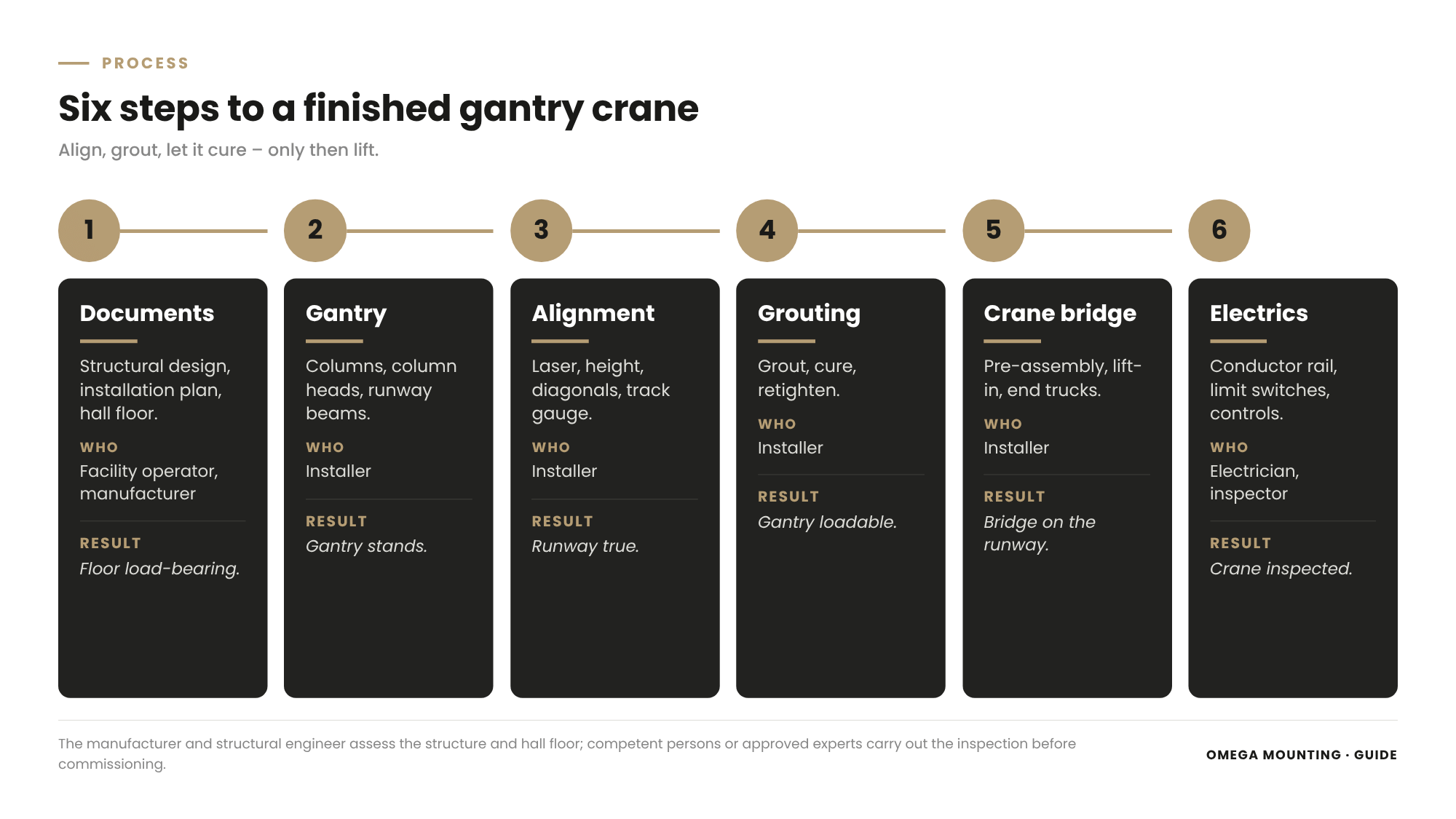
Anyone who wants to install a gantry crane goes through six steps. Check documents and hall floor. Erect the gantry. Align height and diagonals. Shim, grout and cure the base plates. Pre-assemble the crane bridge on the ground and lift it in. Connect the electrics, test and hand over.
Gantry crane and overhead crane
An overhead crane travels on runways fixed to the columns or structure of the hall. That only works if the hall is designed for it. A gantry crane does not need this. Which version fits when is described in the guide retrofit an overhead crane.
Why a crane on its own feet?
Many existing halls were planned without a crane. The roof carries snow and wind, but no crane loads. A gantry crane gets round this problem: it only needs the floor from the building. That saves structural work on the building, permit effort for the structure and often time as well.
Overhead crane, gantry crane or jib crane?

There are three typical routes to a crane in the hall. Which one fits depends on hall, work area and loads.
Overhead crane on the hall structure
It travels on runways on the hall columns and often covers the whole hall. It needs a structure designed for it.
Gantry crane on its own structure
It stands freely, covers a defined work area and only needs load-bearing floor. Ideal for existing halls without crane capacity.
Pillar jib crane
A jib crane stands on a pillar and slews its jib over a circular area. It is ideal for individual workstations, machines or loading points.
The choice
Anyone who has to cover a large area with many routes needs an overhead or gantry crane. Anyone who wants to serve a single workstation can manage with a jib crane. What always decides is what hall and floor can carry.
Checking documents and hall floor
Before the first component arrives, it is checked whether the crane fits in this location.
Structural design and installation plan
The manufacturer supplies the structural calculation, installation plan and specifications for bolts, anchors and grout. They state which forces go into the floor at each column.
Load-bearing capacity of the floor
The hall floor has to take these forces. Whether it can is assessed by the structural engineer – based on slab thickness, reinforcement and subgrade. Sometimes separate foundations are needed under the columns.
Space and height
The crane needs space for the columns, for the bridge to travel and for the hook. There must be enough height under the hall roof for runway, bridge and hoist. Luminaires, cables and roller doors must not be in the way.
Power supply
The crane needs power. Where the supply comes from and how it is protected is clarified before installation.
Erecting the gantry
The gantry is the steel structure: columns, end frames, runway beams and bracing.
Moving in components
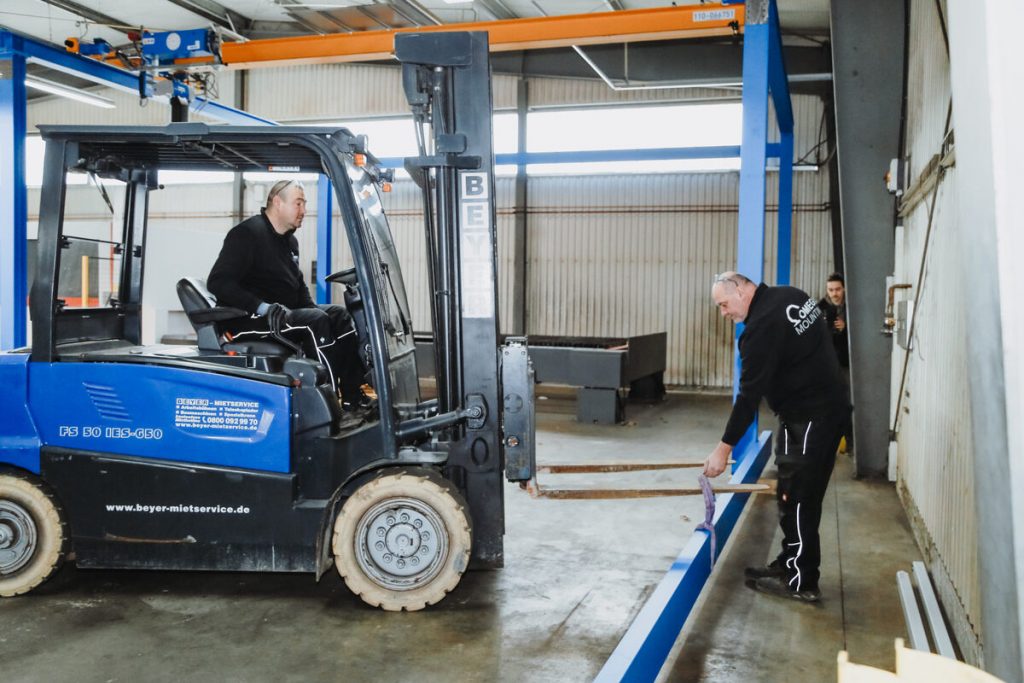
The components usually come into the hall by forklift. Long runway beams are balanced through the hall and guided by hand. That is teamwork between forklift driver and fitter.
Erecting columns
The columns are set up on their marked points. Where the floor is uneven, levelling screws or shims go under the base plates.
Bolting
End frames and bracing are bolted to the columns, at first only tight enough for the gantry still to be aligned.
Placing the runways
The runway beams are set on the columns and bolted. Now the gantry stands – but it is not finished yet. The real work starts now.
Aligning the gantry
The challenge in building the gantry lies not in assembly but in alignment. Aligning the crane runway is the heart of installation.
Why millimetres matter
If the gantry is not exact, the end carriages will later jam, the bridge will run askew, and drives and wheels will wear prematurely. An alignment error does not show on the first day, but over months and years.
Measuring with a laser
The entire steel structure is measured with a laser. It sets a reference plane against which heights and alignments are read.
Correcting
Where a column is too high or too low, it is readjusted with levelling screws or shims. Where a runway is not in line, the connections are loosened and realigned.
Checking height and diagonals

When aligning, two things count: the height of the runways and the diagonals of the gantry.
height
Both runways must be at the same level. Only then does the bridge travel horizontally and both end carriages carry evenly.
Diagonals
The gantry must stand square. The diagonals show this: if they are the same length, the gantry is square. If not, the runway is skewed and the crane bridge would bind while travelling.
Track gauge
The distance between the runways must stay the same along the entire length. A gauge that narrows or widens makes the wheels run against the flanges. How crane runways are surveyed is shown in the guide Surveying a crane runway.
Recording
The measurements are recorded. They are the basis for the inspection and for later checks. If the crane runs askew after a few years or wheels wear unevenly, comparing with the installation values shows whether something has changed in the gantry or the floor.
Shimming and grouting the base plates

Once the gantry is aligned, it is fixed. Grouting the base plates ensures that the load goes into the floor over the full area.
Why grouting is done
After alignment, a gap remains between base plate and hall floor. Without grout, the plate only bears at a few points – at the levelling screws or shims. The grout fills the gap and spreads the load over the whole area.
Preparing
The substrate is cleaned, often dampened, and formwork placed around the base plate. The grout is mixed according to the manufacturer's specifications.
Grouting
The grout is poured in from one side so that no air is trapped. It completely fills the gap under the plate.
Curing and retightening
Then it is a matter of waiting. The grout must cure fully before the gantry may be loaded. After that, the anchors are retightened as specified. Align, grout, cure, retighten: this sequence decides the service life of the installation.
Pre-assembling the crane bridge on the ground
While the grout cures, the crane bridge waits. It is prepared on the ground.
Whatever can be done below is done below
Hoist with electric chain hoist, end carriages, cable tray for routing and connection components are installed on the ground. At working height on trestles, this is faster, safer and more precise than overhead later.
Single or double girder
Smaller cranes usually have a single-girder bridge with the hoist under the girder. Larger ones have two girders with a trolley on top. A single-girder crane is lighter and easier to pre-assemble and lift in.
Checking before the lift
Before the lift, all connections on the bridge are checked, end carriages tested for free running and cables secured. Anything missing now is hard to add later up above.

Lifting in the crane bridge
The lift is the moment when gantry and bridge become a crane.
What is used to lift
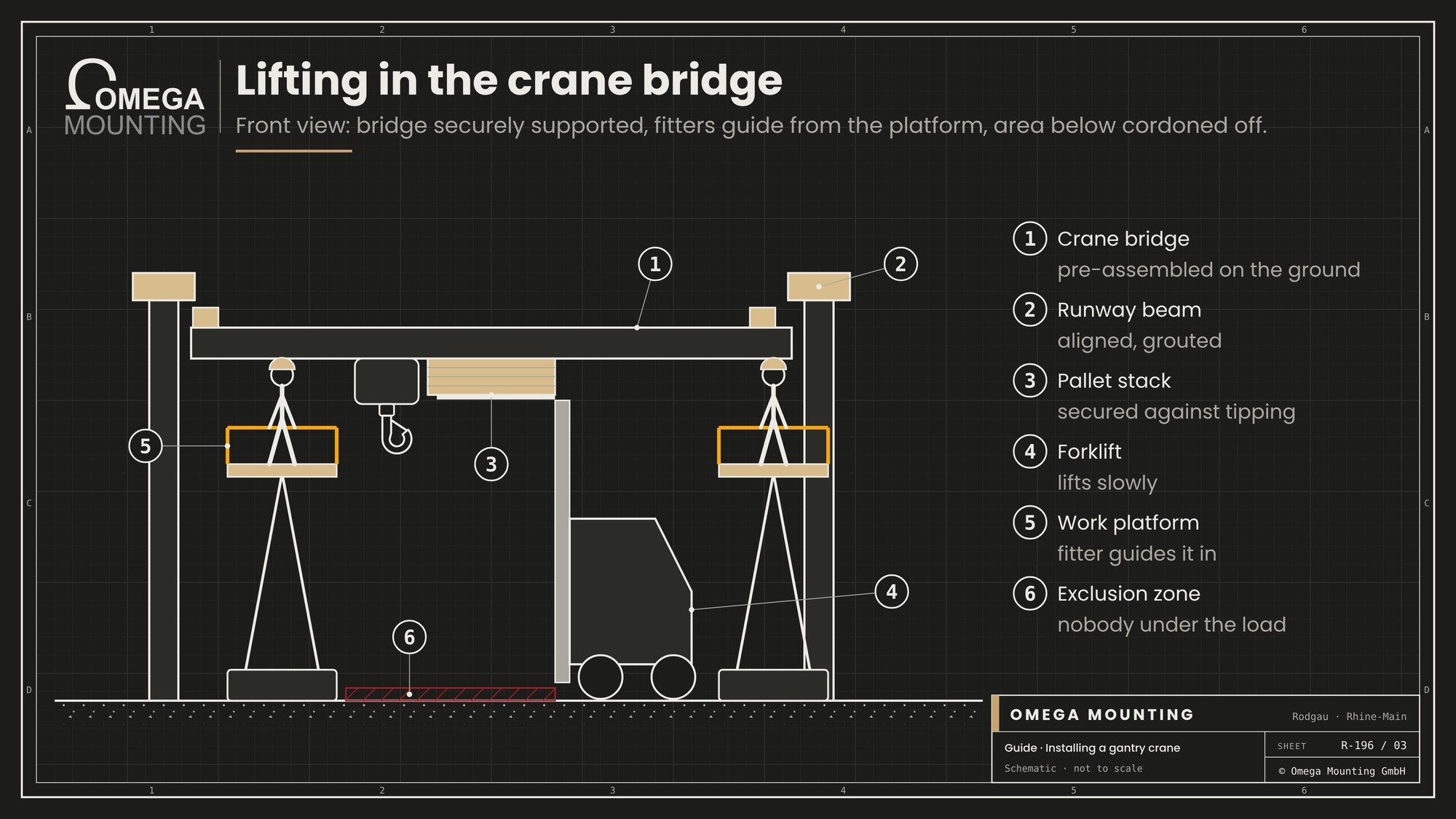
Depending on weight and hall, the bridge is lifted with a forklift, a mobile crane or a lifting device. For light single-girder bridges, a forklift with suitable capacity and lifting height is often enough if the bridge is securely supported.
Guiding from the work platforms
Fitters stand on work platforms on both sides. They guide the bridge and thread the end carriages onto the runway. How installations from a platform run safely is shown in the guide MEWPs in installation work.
Setting down under control
The bridge is slowly lowered until the end carriages stand on the runway. Then it is checked whether all wheels sit cleanly and the bridge is square to the runway.
Coordination
Forklift driver and fitters on the platform are in constant contact. Every move is agreed beforehand. No spectacle, just routine.
Working safely during the lift
During the lift, a heavy load hangs under the hall roof. That is the most dangerous moment of the installation.
Nobody under the load
The area under the bridge is cordoned off. Anyone not needed stays outside. Whoever guides stands on the platform next to the load, not underneath it.
Securely supported
If the bridge rests on a forklift or a support, it must be secured against tipping and slipping. The support is chosen so that the centre of gravity is in the middle.
Positioning work platforms correctly
The work platforms stand on firm ground, are stabilised and positioned so that the fitters do not have to reach over the guardrail.
Stop criteria
If the bridge does not thread in cleanly, it is lowered again and repositioned – not forced onto the runway. Whoever is responsible for the lift decides. What this role involves is shown in the guide Appointed person for lifting operations.
Conductor rail, limit switching and electrics
A bridge on the runway is not yet a crane. Now comes the electrical installation – with us, by our own electricians and mechatronics technicians.
conductor rail
A conductor rail is installed along the runway. It supplies the crane without interruption over its entire travel. Current collectors on the bridge pick up the power.
pre-limit and end-limit switches
Pre-limit switching slows the crane travel before the end of the runway, and final limit switching stops it safely – long before the mechanical buffers are reached. Crane limit switching is a safety device and is set carefully.
Hoist and travel drives
Hoist and travel drives are connected and the cables routed via the cable tray. The hoist limit switches on the chain hoist are also checked and set.
Controls and warning light
The controls – by pendant or radio – are connected and tested. A warning light shows when the crane is in operation.
Testing and handover
Before the crane goes to work, it is inspected.
Function test
All movements are tested without and with load: lifting, lowering, trolley travel, crane travel, emergency stop, final and pre-limit switching.
Inspection before first use
Cranes are inspected before first commissioning as specified – depending on the crane, by a competent person or an approved expert. Which inspections are due regularly after that is shown in the guide inspection obligations for operators.
Documentation
Installation record, measurements, tightening torques, limit switch settings and inspection report are handed over and filed in the crane log book.
Instruction
Anyone operating the crane is instructed and authorised by the operator. Which training is needed for this is shown in the guide Crane operator certificate.
Keeping the gantry crane in operation
A well-installed gantry crane runs for a long time. To keep it that way, it needs care.
Regular checks
End carriages, wheels, buffers, conductor rail and limit switches are checked regularly. Loose bolts on the gantry are retightened.
Load handling device
Hooks, chains and lifting accessories are inspected and replaced when worn. How lifting accessories are chosen is shown in the guide Lifting accessories for heavy loads.
Maintenance
Gearboxes, brakes and chain hoist need maintenance according to the manufacturer's specifications. What this involves is shown in the guide Maintaining and replacing crane systems.
Relocating or extending a gantry crane
A gantry crane is not permanently connected to the building. That makes it flexible.
Relocating
If the work area changes, a gantry crane can be dismantled and rebuilt elsewhere. There too, it is set out, aligned and grouted.
Extending
With additional columns and runway beams, the travel can be extended if structural design and manufacturer approve it.
New hall
When moving to a new hall, the gantry crane can come along – an advantage over a crane fixed to the hall structure.
Delivering and setting out components
A gantry crane comes in individual parts: columns, end frames, runway beams, bracing, crane bridge, hoist, end carriages and electrics.
Unloading and checking
During unloading, every part is checked for transport damage and compared with the delivery list. If something is missing or damaged, it is clarified before installation.
Setting down in installation order
The components are set down in the hall in the order in which they are needed: columns and runway beams first, the crane bridge where it will later be pre-assembled and lifted. That saves forklift trips and prevents parts from being moved several times.
Storing the bridge correctly
The crane bridge rests on trestles or pallet stacks so that it can be pre-assembled at working height and later picked up safely. The position is chosen so that the lifting equipment can later drive underneath without repositioning.
Forklift and work platforms: working together
When installing a gantry crane, forklift and work platforms work together almost constantly.
The forklift brings
The forklift brings runway beams and bridge into place and holds them until they are bolted or set down. It needs a clear route, suitable capacity and enough lifting height.
The platform guides
On the work platform stands the fitter who receives the component, aligns it and bolts it. He works at the height of the connection, not from a ladder.
Communication
Forklift driver and fitter on the platform communicate with clear signals or by radio. The fitter indicates when to lift, hold or lower. Nobody moves without the other knowing.
Gantry crane in a running hall
Installation often takes place while work continues in the hall.
Cordoning off the area
The installation area is cordoned off. Traffic routes for forklifts and pedestrians are diverted so that nobody enters the area where lifting takes place.
Using time windows
The lift of the crane bridge is scheduled for when as little work as possible is going on nearby – for example early in the morning or during a break. Noisy work such as drilling for the anchors is coordinated.
Protecting the grout
While the grout is curing, nobody may drive against the columns or put material down on the base plates. A short barrier around the columns protects the fresh grout.
What a gantry crane cannot do
A gantry crane is a good solution, but not for every task.
Space for the columns
The columns stand on the hall floor. They need space and can restrict traffic routes or storage areas. That is why their location is agreed early with the use of the hall.
Span and load
The larger the span and load, the heavier bridge and gantry become and the higher the forces in the floor. For very large areas, an overhead crane on a suitable structure is often the better solution.
Coverage
A gantry crane only covers the area between its columns. The hook cannot reach anything outside it. Anyone who wants to serve several areas needs several cranes or a different solution.
Choosing loads, hoist and hook correctly
Even before installation, the operator decides what the crane is to lift. That determines hoist, bridge and gantry.
Load-bearing capacity
The capacity is based on the heaviest loads that are lifted regularly – plus lifting accessories. A crane that is sized too tightly is constantly working at its limit.
Lifting height and hook travel
The hook must come low enough to pick up loads from the floor and travel high enough to lift them over machines and workpieces. Reserve is needed between hook and hall roof for the hoist.
Speeds
For fine work, such as placing components in fixtures, slow creep speeds are important. Two-speed or infinitely variable drives make lifting more precise and are gentler on load and crane.
Typical mistakes when installing a gantry crane
Most problems are avoidable.
- Floor not checked: the base plate sinks and the runway goes crooked.
- Not aligned: the bridge runs askew and the end carriages jam.
- Diagonals not checked: the gantry stands skewed.
- Loaded too early: the grout had not yet cured.
- Installed overhead: what could have been done below was done above – slower and less safely.
- Limit switches not set: the bridge runs into the buffer.
- Put into operation without inspection: the crane works before it has been inspected.
The mistake behind the mistakes
Almost all these mistakes come from time pressure. Anyone who saves time on alignment and curing pays for it twice later – with wear, faults and rework.
Safety rules during installation
A few rules apply to every crane installation.
The basic rules
- Structural calculation and hall floor checked, installation plan available.
- Gantry aligned and grouted before it is loaded.
- Nobody under the suspended load.
- Work platforms positioned safely, fall protection where necessary.
- Electrical work only by qualified electricians.
- Limit switches and emergency stop tested.
- Commissioning only after inspection.
Legal framework
The installation and operation of cranes are subject to, among other things, the German Occupational Safety Act (ArbSchG), the Industrial Safety Ordinance (BetrSichV), the accident insurance regulations on cranes and the manufacturer's requirements. This guide is not legal advice – which obligations apply in your case you should clarify with your occupational safety specialist and your approved expert.
Who does what when installing a gantry crane?

Several parties are involved.
Operator
The operator sets work area and loads, releases area and dates, draws up the risk assessment and authorises the crane operators.
Manufacturer and structural engineer
The manufacturer supplies crane, structural calculation and installation specifications. The structural engineer assesses the hall floor and decides whether foundations are needed.
Inspector
Competent persons or approved experts inspect the crane before first commissioning and regularly after that.
Omega Mounting
We erect the gantry, align it with a laser, grout the base plates, pre-assemble the crane bridge on the ground, lift it in and connect conductor rail, limit switching and controls with our own electricians. Structural design, inspection and authorisation of crane operators remain with those responsible.
Installing a gantry crane: what it means for your planning
Four questions help to prepare the installation early.
Can the floor take it?
Have the hall floor assessed. This determines whether foundations are needed.
Does the crane fit into the hall?
Check height, area and obstacles. This determines where the columns stand.
What will lift the parts?
Clarify whether a forklift is enough or other lifting equipment is needed. The sequence follows from this.
When may the floor be loaded?
Plan in the curing time of the grout. This determines how many days on site are needed.
Installing a gantry crane in the Rhine-Main region: how we do it
From Rodgau we quickly reach Frankfurt, Offenbach, Hanau, Darmstadt, Dieburg, Aschaffenburg and the industrial estates of the region – and we work throughout Germany. Anyone who wants a gantry crane installed, whether in Rhine-Main or elsewhere in Hesse, gets mechanical and electrical work from a single source with us.
We check documents and hall, coordinate with manufacturer and structural engineer and install with our own team. How else we work in installation is on our page on Industrial installation. How loads go safely into the floor is shown in the guide Aligning and anchoring a machine.
For you, that means a crane that stands on its own feet – even in a hall that cannot carry a crane.
Project examples
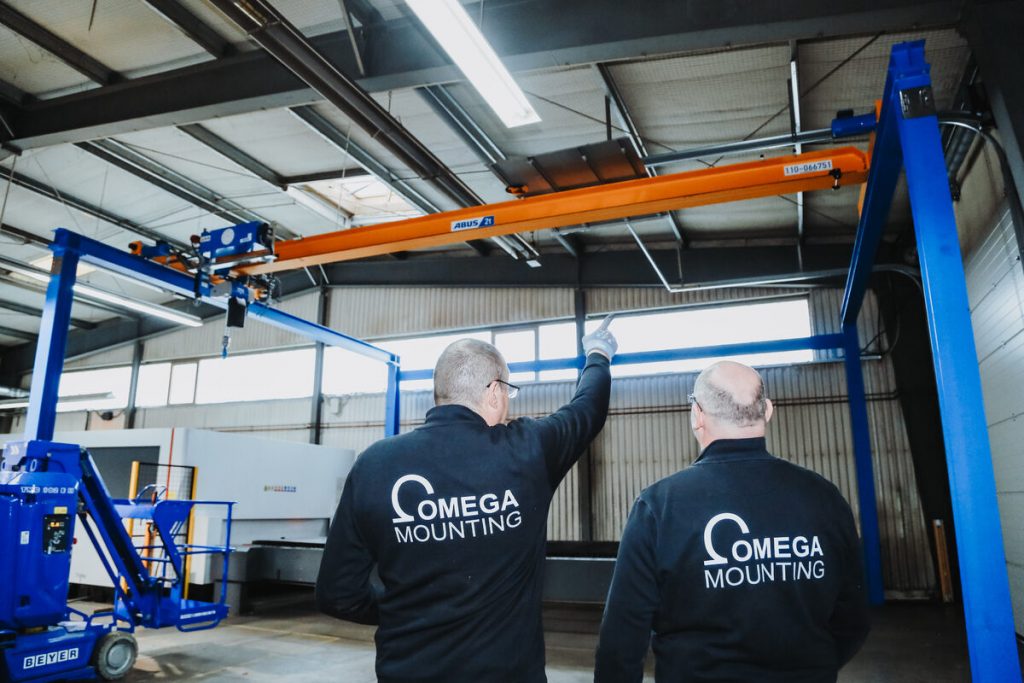
A job from our project diary shows how a gantry crane is built in two days.
gantry crane project for a steel fabricator in Babenhausen
A steel construction company in Babenhausen needed a crane over its work area, but the roof structure had never been designed for a crane. The solution was a free-standing gantry crane. Two of our fitters built it in two days on site. On the first day, the focus was on the steel structure: bringing in beams by forklift, erecting columns, bolting connections, placing runways. Then we aligned the gantry with a laser for height and diagonals and grouted the base plates; the grout cured overnight. On the second day we pre-assembled the single-girder crane bridge with electric chain hoist, end carriages and cable tray on the ground and set it on the gantry runway by forklift, while our fitters guided it from the work platforms. Finally, we installed conductor rail, pre-limit and final limit switching, cable routing, warning light and controls. The job is described in the report Installing a gantry crane in Babenhausen.
Are you planning a gantry crane?
Send us the hall plan, photos of the work area and the crane data – we will tell you how installation will run and what has to be clarified beforehand. Get in touch now.
What this means for your role
Buyers: Ask whether alignment, grouting, lifting in, electrics and support with the inspection are included in the quote.
Planners: Have the hall floor assessed early and fix column locations before ordering.
Project and site managers: Plan in the curing time and cordon off the area during the lift.
Maintenance managers: Arrange maintenance and inspection before the crane goes into operation.
Plant managers: Clarify who may operate the crane and have the crane operators instructed.
Gantry crane installation check: template on request
For your project, we have put together the gantry crane installation check. On one page it asks about documents, hall, gantry, crane bridge, electrics and handover. You fill it in, and we plan the installation without follow-up questions. Request the template via our contact form – keyword “Gantry crane installation check”.
Why Omega Mounting?
With over twenty years of experience in installation, crane technology and maintenance, we know that a crane is only as good as its runway. That is why we align every gantry with a laser, grout cleanly, let the grout cure and pre-assemble on the ground whatever can be done on the ground. Mechanical and electrical work come from a single source – our own electricians wire conductor rail, limit switching and controls. For you, that means a crane that runs true, stops safely and works for years. Talk to us about your project – get in touch.
Conclusion
Installing a gantry crane means aligning the gantry precisely in height and diagonals, grouting the base plates and letting them cure, pre-assembling the crane bridge on the ground and lifting it in safely. Conductor rail, pre-limit and final limit switching and controls turn it into a crane.
If you plan time for alignment and curing and have the crane inspected before commissioning, you get a crane that runs reliably for years – even in an existing hall without crane capacity. If you are planning a gantry crane, get in touch with us.
Planning a move-in, installation or maintenance in the Rhine-Main region?
Tell us briefly what you need – we'll come back with an honest assessment.
Free, no-obligation callback
You may also be interested in these guides

About the author
Tobias Schott
Managing director of Omega Mounting GmbH, Rodgau · more than 20 years of hands-on experience in installation and maintenance
A trained mechatronics technician, working in maintenance, servicing and industrial installation since 2004 – first alongside his father, and with Omega Mounting since 2012: from overhead conveyors in Frankfurt to the crane system in a new-build hall. He plans and leads lifting operations as an appointed person (AP) in data centers and on industrial sites in the Rhine-Main region, trains and examines operators of cranes, mobile elevating work platforms and telehandlers, and is a qualified occupational safety specialist. On jobs abroad he is known as the “German Troubleshooter” – the person you call when a site gets stuck. He learned what quality means from his father, not from a manual: Made in Germany as a standard for his own work, not a label. That is why quality comes first at Omega Mounting – ahead of speed and price. He writes these guides from that practice: what works on our sites is in them – what exists only on paper is not.
Frequently asked questions
A crane whose runway stands on its own columns. It needs no hall structure, only load-bearing floor.
When the hall cannot carry a crane or only a specific work area needs covering.
So that the load goes into the floor over the full area and not just at individual points. The grout must cure before loading.
Precisely enough that both runways are at the same height, the gauge stays constant and the diagonals match.
Because work at working height is faster, safer and more precise than overhead.
It slows and stops the crane travel before the end of the runway, before the buffers are reached.
Depending on the crane, a competent person or an approved expert, according to the specifications for cranes.
Yes. From Rodgau we are quickly on site throughout the Rhine-Main region and work throughout Germany.
Send us the hall plan, photos and the crane data. We will check the sequence and come back with a proposal. Go to the contact page.
 English
 German