
- Guide – Lift & Shift
Setting up a tank: delivery, crane lift and setting down through to approval for filling
By Tobias Schott · Reading time approx. 21 minutes · As of: November 2026
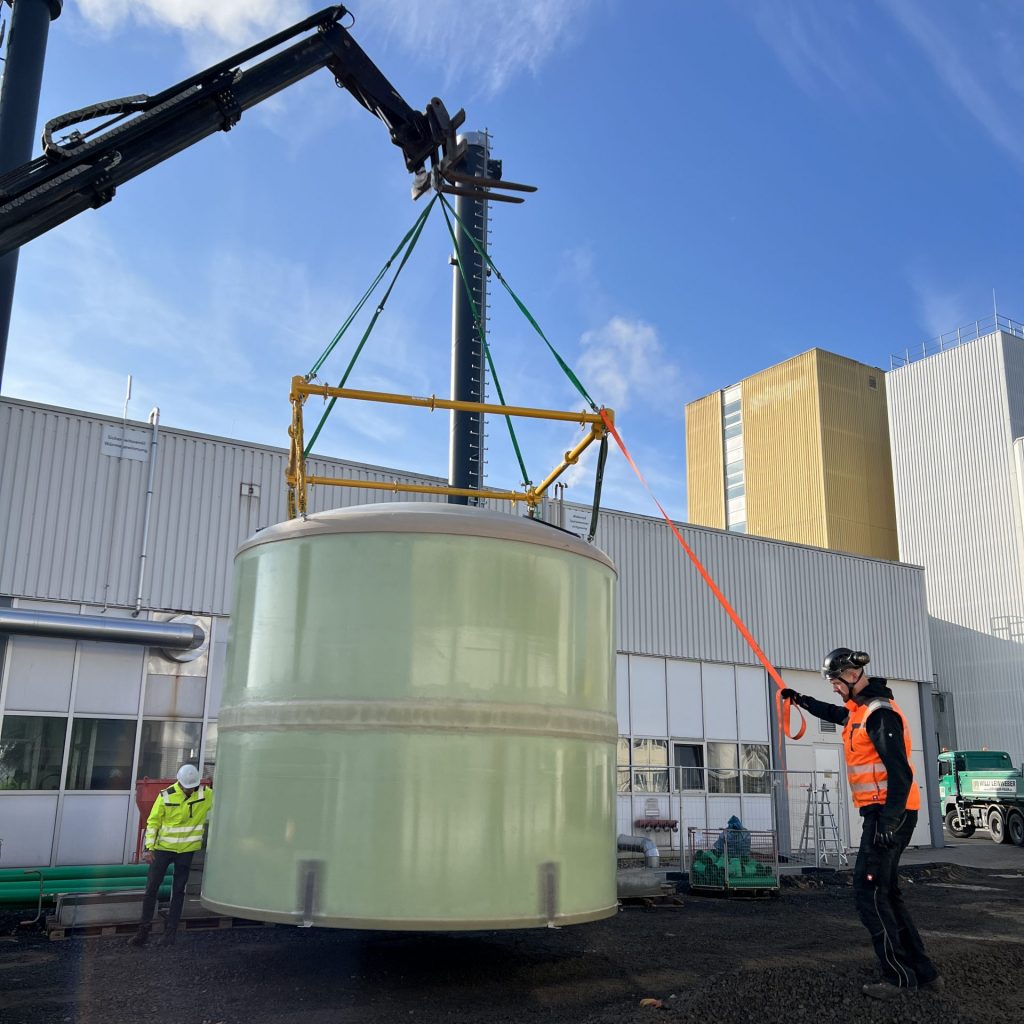
Setting up a tank means bringing a large, sensitive component along a narrow access route, slinging it safely on the crane, setting it down to the millimetre and anchoring it firmly. The lift itself often takes only minutes. What makes it safe happens beforehand – route, crane position, lifting points and target.
A storage tank looks robust. It is large, heavy and is meant to stay in place for decades. During installation, however, it is surprisingly sensitive. The wall is thin relative to the size, the coating does not tolerate a sling in the wrong place, and the lifting points are only made for one direction of pull. If you have a tank set up, you are therefore planning not just a crane lift but a small process with many interfaces.
If you search for setting up a tank, you find plenty of offers for tanks and few answers to the questions before. Can the low-loader get onto the site at all? Where may the crane stand? How do you sling a long tank without damaging it? And who takes over once the tank is in place? This guide answers these questions from the point of view of an installation contractor that lifts, sets down, aligns and anchors tanks.
It is written for project and site managers, planners, maintenance managers, buyers and plant engineers – in short, for anyone who has to get a diesel, heating oil, fuel or process tank into position.
Key points at a glance
- Setting up a tank is more than lifting: route, crane position, slinging, setting down, anchoring and handover belong together.
- The route decides first. Bends, gates, overhead and underground services and manholes decide whether low-loader and crane can reach the right spot at all.
- The tank only hangs from approved points. For most tanks, a sling around the shell is not an option.
- Lifting beam or sling set – either can be right. The lifting beam prevents side pull on sensitive lugs, the sling set spreads the load over several points.
- Setting down is the slowest part. The tank has to land exactly on its supports without touching coating, liner or wall.
- Foundation and anchorage must be ready before delivery day: clean, level, with a protective layer and suitable anchors.
- After setting down, others take over: pipework, gauges, filling and inspection belong to the tank installation contractor and the operator.
What does setting up a tank actually involve?
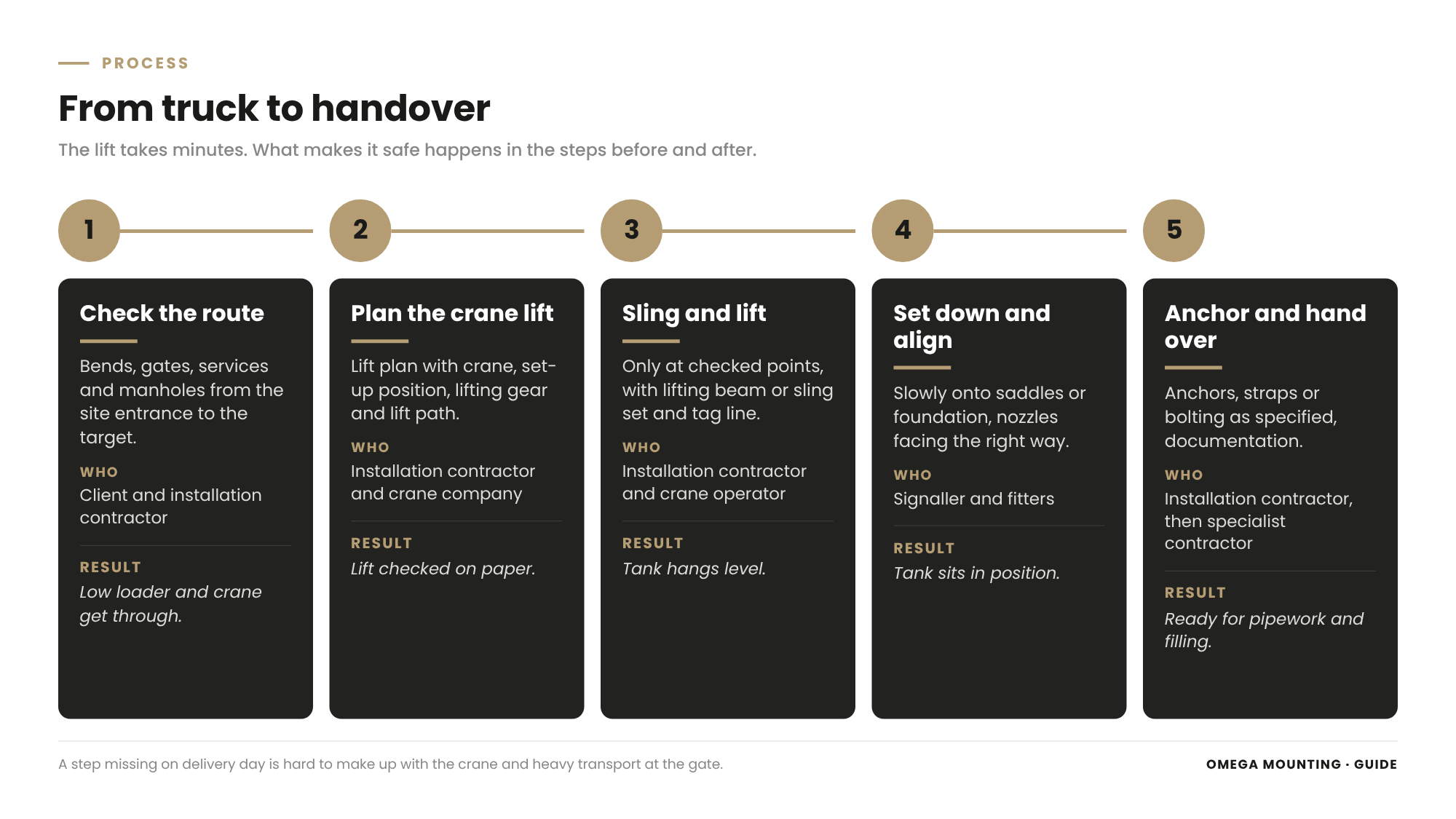
A tank arrives finished from the manufacturer. On site it is not built but brought into position. The work can be divided into five steps.
First, the route. From the site gate to the location, the low-loader with the tank has to get through. Then the crane has to reach a position from which it can reach both tank and target.
Second, crane planning. If you want to set up a tank, you need a lift plan. It sets out crane, crane position, outriggers, lifting accessories and lift path – based on the manufacturer's data.
Third, slinging and lifting. The tank is slung at its lifting points, lifted and guided along the lift path. A tag line keeps it in the right direction.
Fourth, setting down and aligning. The tank goes onto its supports or foundation. Nozzles, manhole and ladder must then point in the planned direction.
Fifth, anchoring and handover. The tank is fixed, the lifting accessories come off and the next contractor takes over.
What makes a tank different from a machine
A machine is usually a compact, rigid block. A tank is a long, thin-walled vessel. The load is spread over the whole length; the wall carries itself but not point loads. With plastic tanks, the lugs are often only bonded on and cannot take an angled load. With steel tanks, the coating is the weak spot.
Lift empty, operate full
A tank is always set up empty. That sounds obvious but has consequences. An empty tank is light for its size and reacts to wind like a sail. If it stands in a pit or outdoors, it must also be secured against buoyancy or tipping before it is filled.
Above ground, in a hall or in a pit: three locations
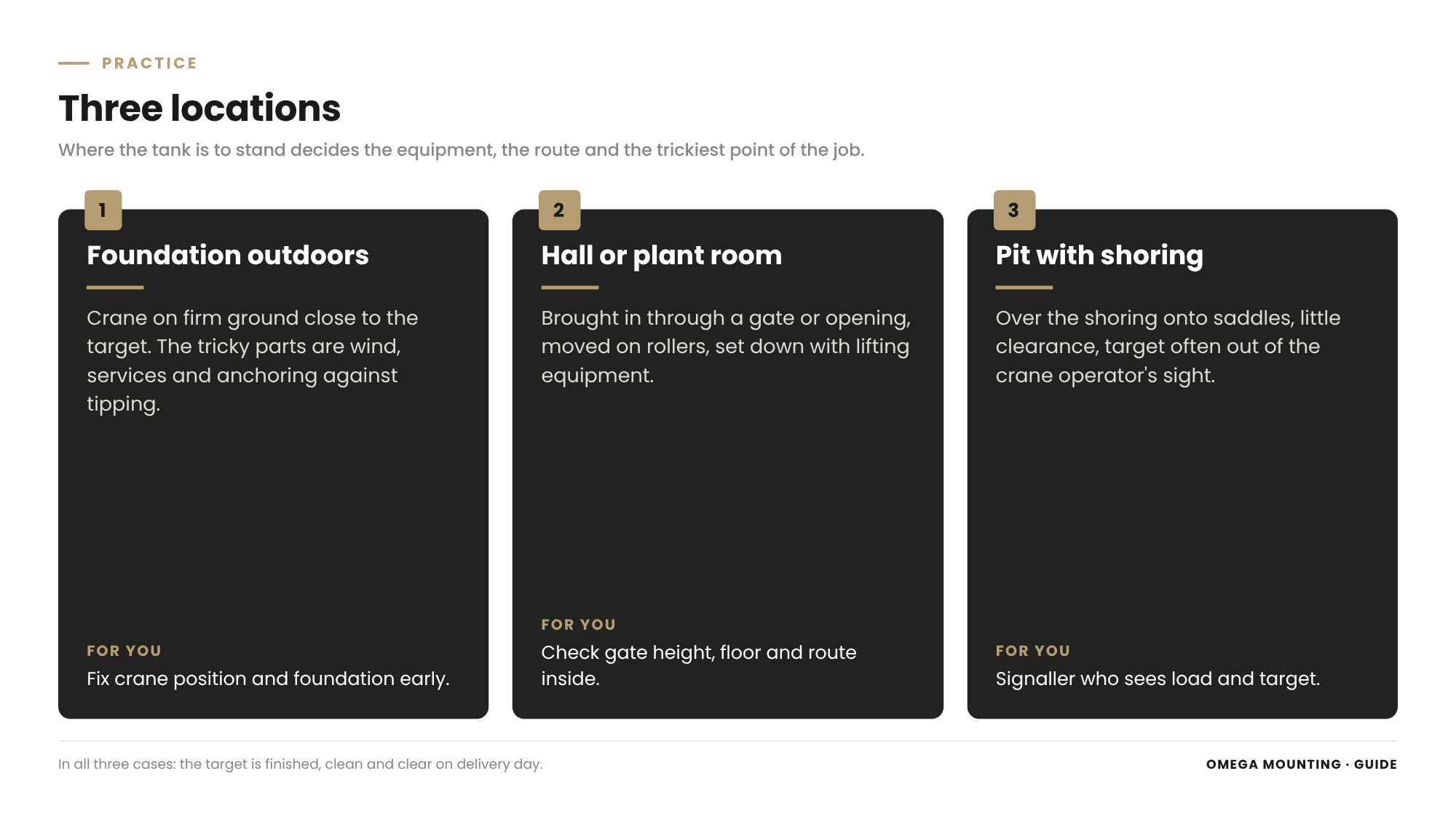
Where a tank stands decides almost everything about the process. Three cases come up most often for us.
On a foundation outdoors
The classic case: a storage tank next to the building, on a concrete slab, often with a bund or a double wall. The crane usually stands on firm ground nearby. The challenges are wind, overhead and underground services and anchoring against tipping.
In a hall or plant room
Here the tank rarely reaches its position by crane. It is moved in through a door or access opening, travelled on rollers and set down with lifting equipment. Door height, floor loading and the route through the building are decisive. In Fulda we set up tanks for the fuel supply in a production hall – space was tight and the alignment precise.
In a pit
Large diesel tanks for standby power systems often lie in an excavated pit secured with shoring, with a concrete base. The tank goes down over the shoring wall onto its supports. There is little clearance between tank and wall. The crane operator often cannot see the target, and everything depends on the signaller.
Single-walled, double-walled or with a bund
The design makes a difference when setting up. A double-walled tank is heavier and often has an interstitial space between the walls that must not be damaged during lifting. A single-walled tank usually stands in a concrete or steel bund. The tank then has to be lifted into this bund without hitting its coating or edges. We clarify with you and the manufacturer beforehand which design is coming and what it means for the lift.
Before delivery: access, crane position, ground
Most problems when setting up a tank arise not on the hook but before it. That is why we walk the route beforehand.
Will the low-loader get through?
A large tank comes as an oversize or heavy transport. The low-loader is long, and its swept path needs space. We check bends, passages, gates, kerbs and trees. Where it gets tight, we calculate the swept path, roughly first, then precisely. Sometimes the result is inconvenient: a gate has to go, a fence has to be opened. Better to know that beforehand than on the morning of delivery.
Services above and below the site
Above the site there are often overhead lines, cable bridges or pipe bridges. Below it are drains, manholes, tanks and cables. Both must be known before delivery day. We ask for as-built drawings and walk the areas with your plant engineer. Where drawings are missing or old, we have manhole covers lifted and look before a crane sets its outriggers on them.
Where may the crane stand?
A mobile crane needs a level, load-bearing surface for its outriggers. There must be no manholes, drains or sensitive services under this surface. Where the ground is not strong enough, Load spreading mats spread the pressure. On tight sites, the solution is often not the biggest crane but the one that just reaches from the permitted areas.
What is in the slewing area?
Trees, overhead lines, building edges, lighting columns, scaffolding: everything in the slewing area must be known. Then there are people. The area under the load is cordoned off, even if the load only passes over it briefly.
Is the target ready?
On delivery day the target must be ready. The foundation has cured and been cleaned, the pit is dry, the supports are in place, the anchors are ready. A tank waiting on the low-loader because the concrete is not ready costs crane and transport time.
Setting up a tank with a crane: how the lift is planned
The crane lift is the visible part. It is planned in the lift plan, agreed with the crane company and the tank manufacturer. How such a plan is drawn up is described in our guide on Planning a crane lift. Here we look at the points that matter particularly for tanks.
Weight and centre of gravity from the manufacturer's data
The empty weight comes from the manufacturer. We do not take it on trust but check whether it matches the component and whether fittings, residues or accessories add to it. On an empty, symmetrical tank, the centre of gravity is in the middle. On tanks with a manhole, internals or several compartments, it can shift.
The height of the sling set counts too
A sling set on a long tank is tall. For the leg angle to be right, the slings meet far above the tank. This height adds to the lifting height. If you only calculate to the edge of the pit, you plan too tight.
Wind and an empty load
An empty tank offers a large surface with little weight. Even moderate wind turns it on the hook. That is why every tank lift has a tag line, and the lift plan sets the point at which lifting stops.
Lifting beam or sling set: how the tank hangs on the hook
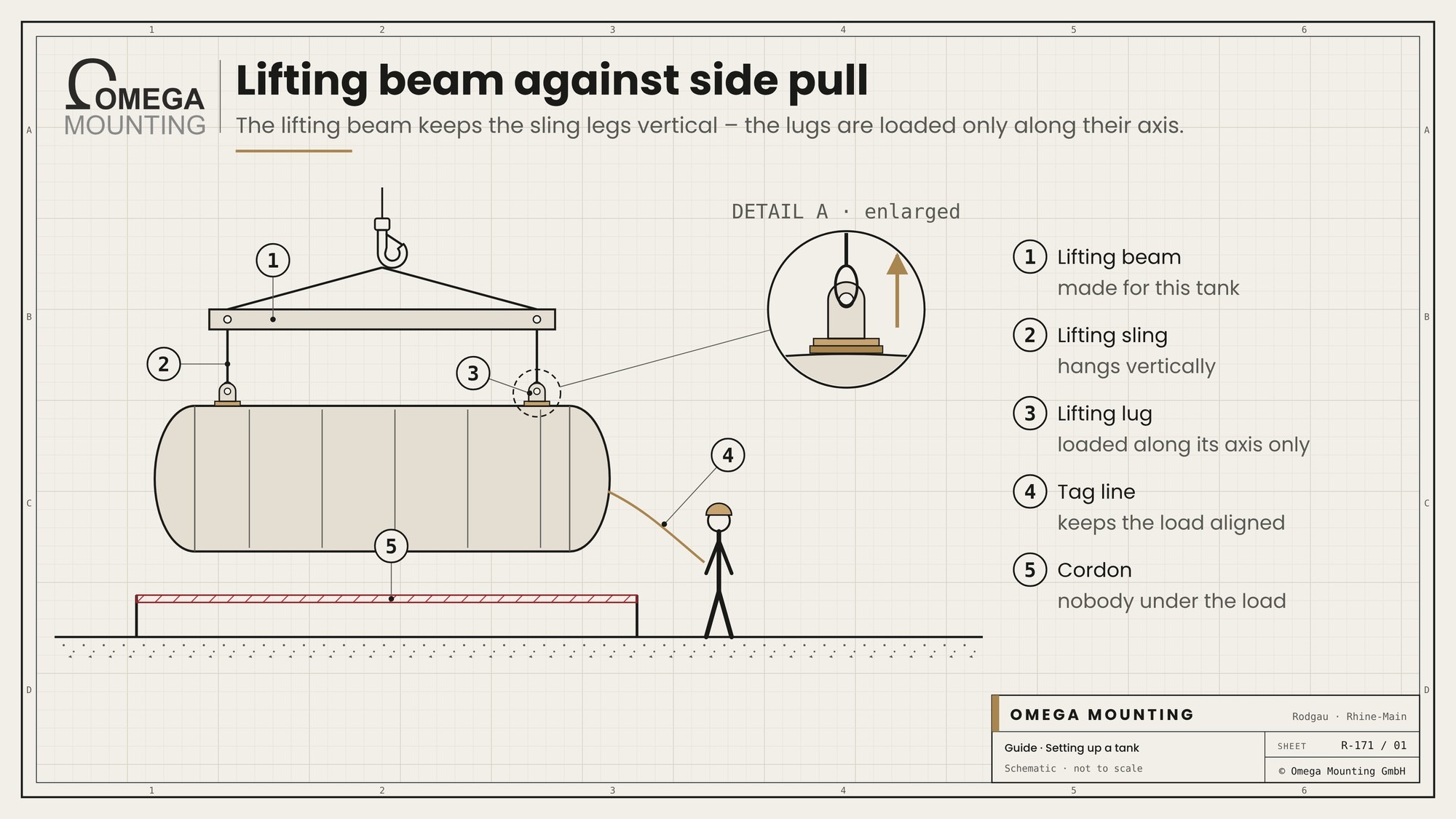
The key question when lifting in a tank is: how does the load get from the hook into the tank without damaging it? There are two proven ways.
The lifting beam: vertical legs, no side pull
An Spreader beam is a beam between hook and load. From it, the legs run vertically down to the lugs. The lugs are only loaded along their axis, and there is no side pull. With plastic tanks with bonded lugs, this is decisive. A side pull could tear the lug out of the wall. In Fulda we used a purpose-made lifting beam for this.
The sling set: load spread over several points
On large steel tanks with lifting points welded onto the crown, a sling set of round slings and shackles is often used. It spreads the load over all points and keeps the tank level. The leg angle is a deliberate compromise: the flatter the legs, the greater the force in each leg. The steeper they are, the taller the sling set.
What never works: a sling around the shell
An Round sling around the shell is not an option for most tanks. It loads the wall at points, damages the coating and can deform the tank. Where the manufacturer provides no lugs, we clarify with them before delivery day how the tank will be lifted.
Lifting points: bonded, welded, always checked
The lugs on the tank were fitted by the manufacturer. Even so, checking them is part of lift planning. That is not mistrust but procedure.
Visual check before every slinging
A tank has been transported, often over long distances. Before slinging, we inspect every Lifting point : bond or weld, cracks, deformation, damage around it. A suspicious point is not loaded until it is clear whether it will hold.
Recalculating the data
Do the points suit the planned angle? Are the forces per leg right? Is the centre of gravity such that the tank hangs level? The manufacturer's data is the basis. Whoever pulls on someone else's component with the hook is responsible for that pull – that is why we recalculate.
Agreeing lifting points with the manufacturer
For custom-built tanks or unusual installations, we agree lifting points and lifting equipment with the manufacturer beforehand. That way the lifting beam suits the lugs and the sling set suits the tank.
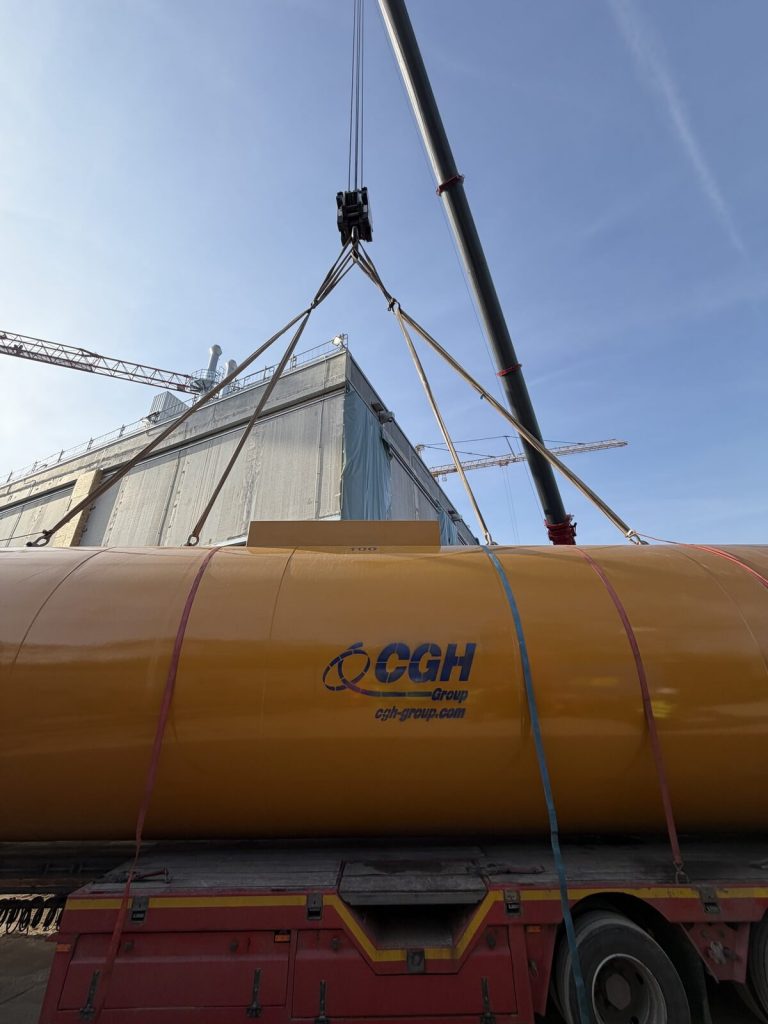
Lowering into a pit: little clearance between wall and base
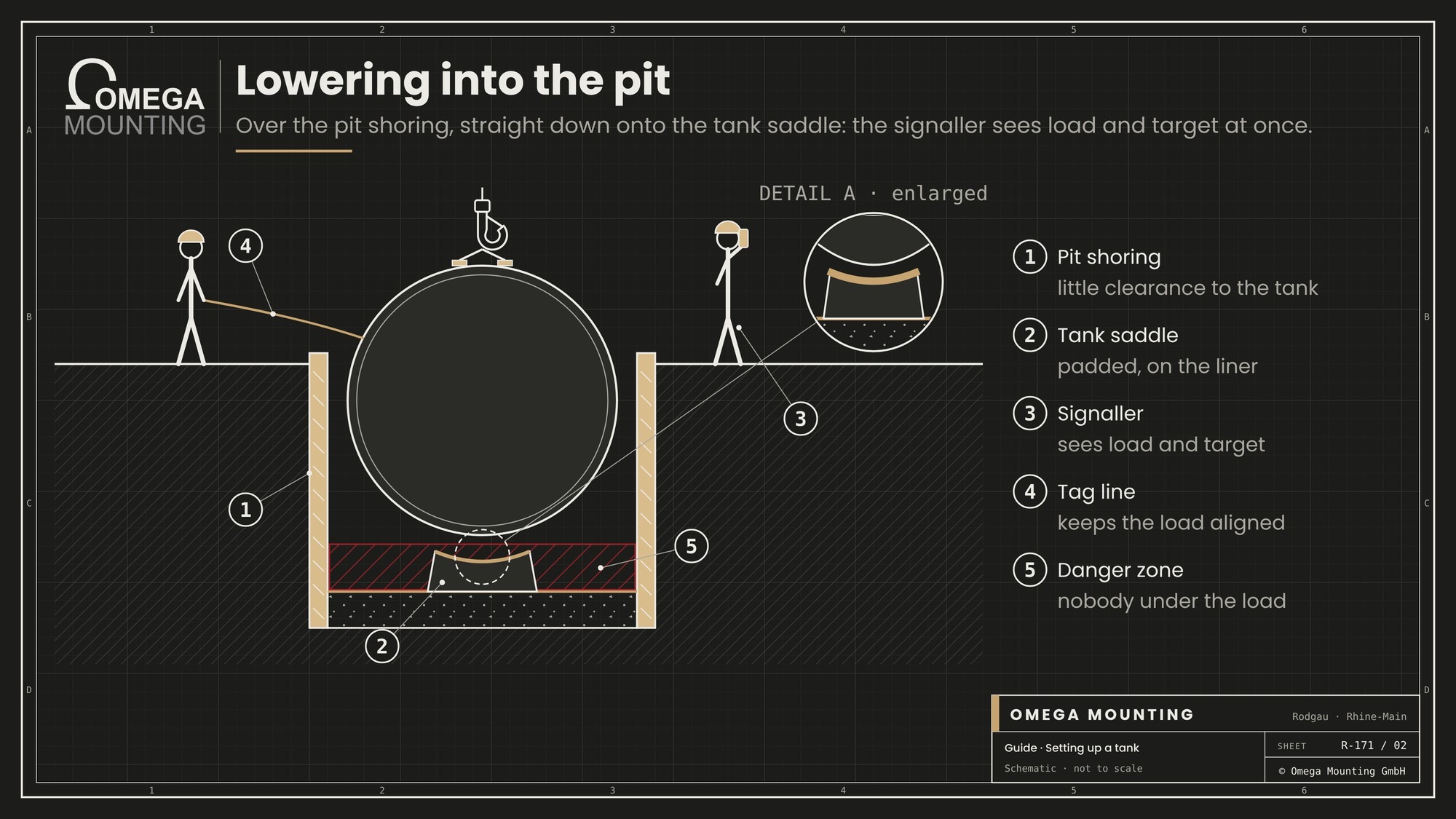
Lifting into a pit is the most demanding way of setting up a tank. The tank has to go over the shoring wall, then straight down onto its supports.
The crane operator cannot see the target
From his position, the crane operator rarely sees the whole pit. Everything that happens below happens on instruction. That is why the signaller stands where he can see load and target at the same time and directs the final movements.
Slowly onto the supports
A long tank has to land exactly on its supports. It must neither touch the shoring wall nor damage the liner or sealing in the pit. Tag lines at both ends keep it aligned. Setting down therefore takes longer than lifting, and that is how it should be.
Protecting coating and sealing
Many pits are lined or coated so that leaking fuel does not reach the soil. This layer is sensitive. A shackle hitting the base during lowering or a dropped tool can damage it. We therefore put protection under the contact points, keep tools secured and inspect the base and supports again after setting down.
Nobody in the pit under the load
As long as the tank is suspended, nobody stands in the pit below it. Only when it has landed and the sling set is slack do the fitters go down, check the position and release the lifting accessories.
Thinking about the sequence
With several tanks in one pit, the sequence matters. In Raunheim, part of the crane standing area later became a tank area itself. The crane therefore stood on a surface that was removed after the lift so that the next tank could lie there. Every lift had to work on its own and make the next one possible.
Aligning and anchoring on the foundation
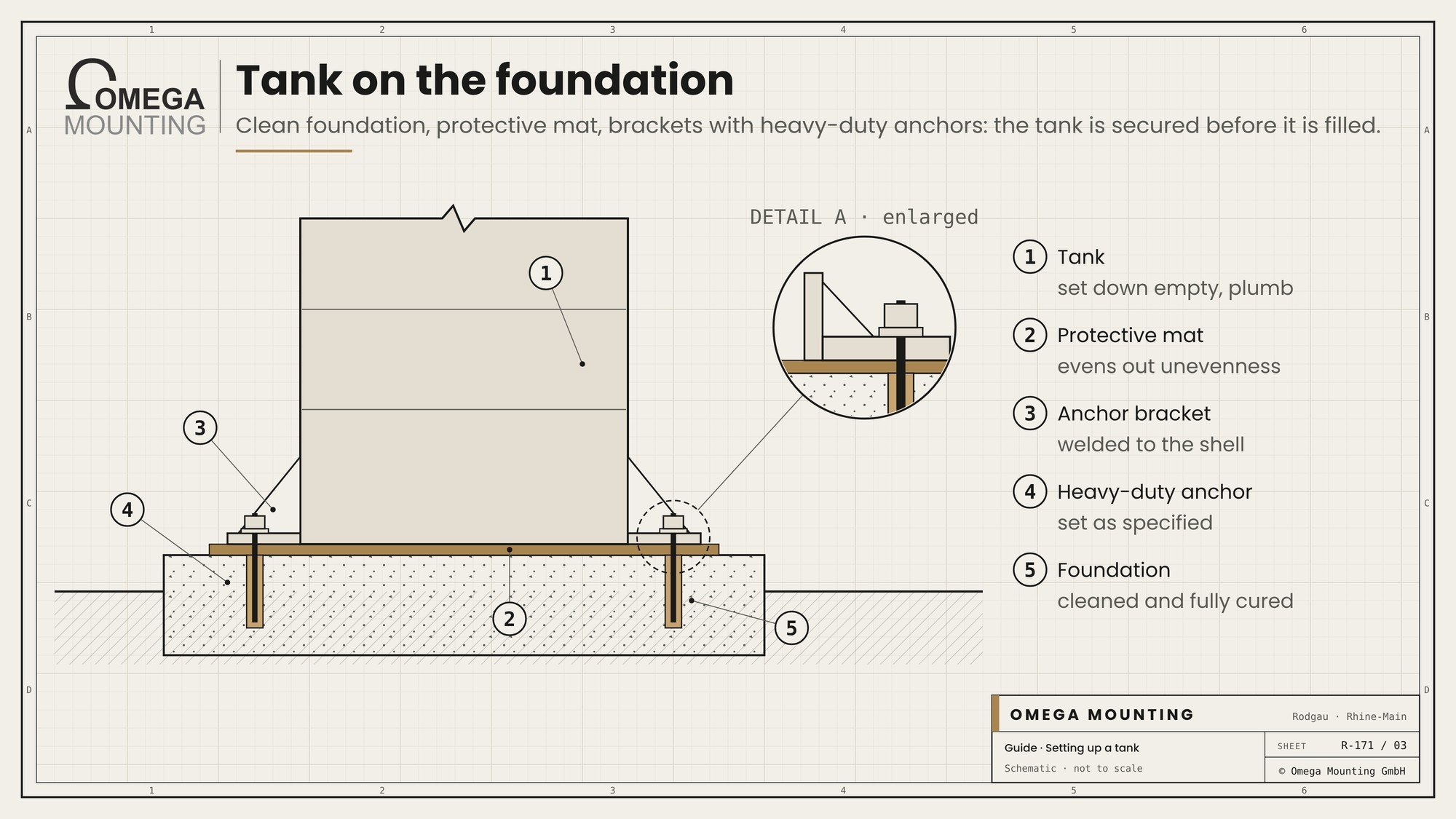
If the tank stands on a foundation, the fine work begins after setting down.
A clean foundation
Before setting down, the foundation is cleaned. Stones, mortar residues or bolts under the tank base become point loads. A protective mat between tank and concrete evens out small irregularities and protects the base. In Fulda we set the tanks on their foundations in exactly this way.
Aligning by nozzles and plumb
The tank is turned so that nozzles, manhole and ladder point in the planned direction. Upright tanks are brought plumb. This is easiest while the tank is still hanging lightly on the hook – which is why it is aligned before the sling set is fully slack.
Anchoring against tipping and buoyancy
An empty tank outdoors can tip or slide; a tank in a pit can float if water gets in. That is why it is fixed – with heavy-duty anchors. through brackets in the foundation, with tensioning straps or with bolted connections at the supports. Which solution fits is decided by the manufacturer or the structural engineer. We install it to their specifications.
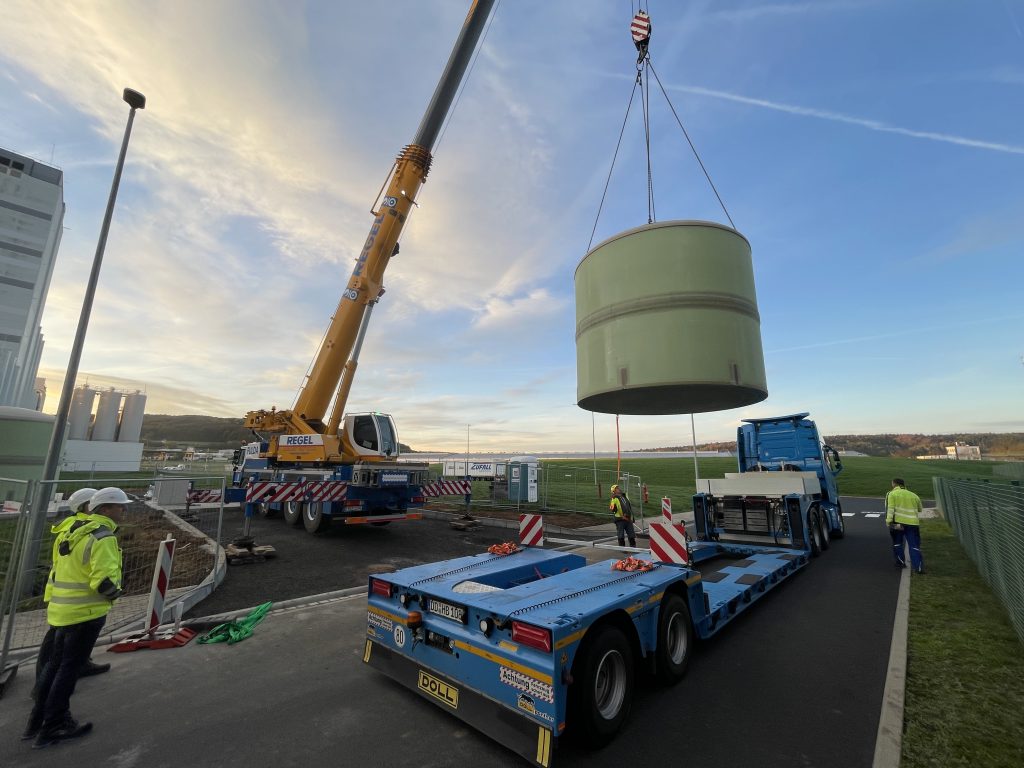
Signaller, radio and hand signals
During a tank lift, the signaller talks to the crane operator. Without clear communication, no tank is set down safely.
One person speaks
There is exactly one signaller who gives commands. Everyone else reports to him what they see. That way the crane operator always knows whose instruction counts.
Radio and hand signals
We work with radio and agreed hand signals. Radio carries where there is no line of sight, for example into the pit. Hand signals work when the radio fails. Both are briefly agreed before the first lift.
Stop always applies
Anyone who sees a hazard may give a stop signal. The crane operator then stops at once. This is stated explicitly before the lift so that nobody hesitates.
Before the first lift: a short briefing
Before the first tank is lifted, everyone involved meets briefly: crane operator, signaller, fitters on the tag lines and the client's supervisor. We go through the lift path, show the cordon, decide who stands where and repeat the signals. It takes a few minutes and prevents misunderstandings at the moment the load is in the air.
What comes after setting down: pipework, filling, inspection
Once the tank is in place and anchored, our part is largely done. To turn the tank into a working installation, further trades are needed.
Pipework, gauges and safety devices
Pipework, level gauge, leak detector, overfill protection and venting belong to the tank installation. They are installed and connected by a tank installation contractor. We coordinate with them beforehand so that the nozzles sit where their pipes arrive. On request, our electricians run the power to the connection point at the same time.
Water law: what applies to installations with water-polluting substances
Diesel, heating oil and many process media are hazardous to water. Such installations are subject to German water law and the ordinance on installations handling substances hazardous to water (AwSV). Depending on size and substance, certain work must be carried out by an approved specialist contractor and the installation must be inspected by an expert before commissioning. What applies in each case is clarified by the operator with the specialist contractor and the authority.
Handover for filling
We hand over a tank that is in the correct position, aligned and anchored, with no damage to wall or coating. In Raunheim, the tanks were finally set down, bolted and approved for filling. Filling was then done by the operator and its suppliers.
What we document at handover
Handover includes brief documentation: photos of the tank set down and anchored, the position of the nozzles, the anchors used and any anomalies, if there were any. If something was found on a lifting point or the coating, it is recorded there too. The next contractor then knows what to expect, and the operator has a record for its files.
Who does what when setting up a tank?
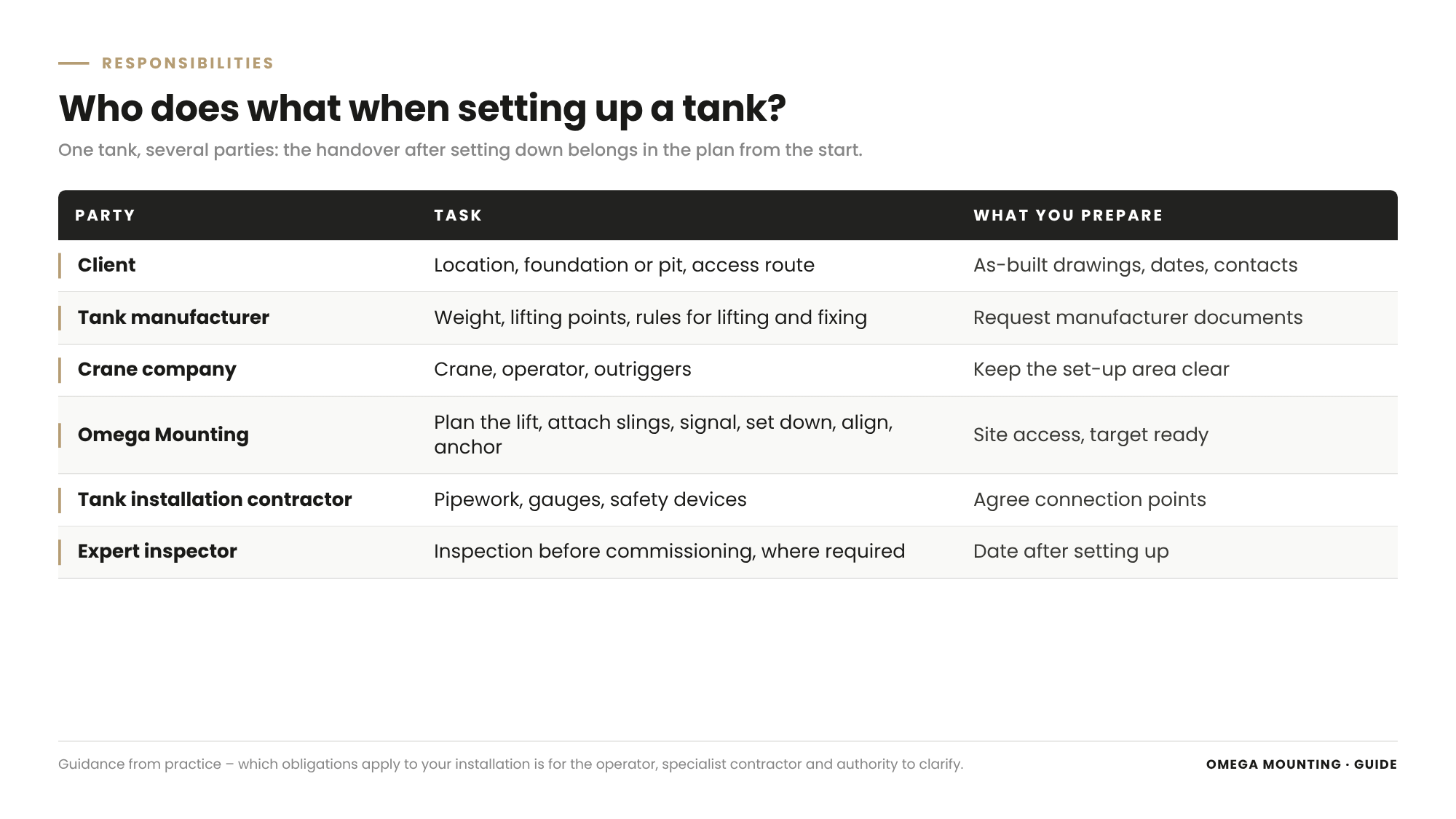
Several parties work together when setting up a tank. Clear responsibilities avoid gaps.
Client
You decide where the tank will stand and make sure the foundation or pit is ready in time. You clarify access across the site and name the contacts for tank installation, filling and inspection.
Tank manufacturer
Supplies the tank with weight, centre of gravity, lifting points and requirements for lifting and fixing. In case of deviations, they are the first point of contact.
Crane company
Provides crane and crane operator, checks the crane position and outriggers and carries out the lift according to the lift plan. We measure crane positions together with them.
Omega Mounting
We plan the lift, check route and lifting points, sling, signal, set down, align and anchor. On request, we take on the role of the appointed person for lifting operations.
Tank installation contractor and expert inspector
The specialist contractor installs pipework, gauges and safety devices. The expert inspects the installation where this is required. This guide is not legal advice – which obligations apply to your installation you should clarify with your specialist contractor and the competent authority.
Setting up a tank: what it means for your planning
If you have a tank set up, much is decided at the planning stage. Four points make delivery day easier.
Plan the route
Plan access for low-loader and crane from the start. Where a gate or fence is in the way, it should be possible to open it. Services and manholes under traffic routes belong in the plan.
Keep the crane position free
Keep a load-bearing area free for the crane, as close to the target as possible. If this area is built on later, plan the sequence so that the tank is in place first.
Finish the target
Foundation or pit must be ready on delivery day: cured, clean, dry, with supports and anchors. A date with crane and heavy transport is hard to move.
Settle the handover
Clarify beforehand who takes over after setting up. The clearer the handover, the faster the tank becomes a working installation.
Typical mistakes when setting up a tank
- Access is only checked on delivery day. Then the low-loader stands in front of a gate that does not open.
- The crane position is over a manhole. The outriggers find no support, and the lift is cancelled.
- The tank is lifted with a sling around the shell. Coating and wall are damaged.
- Bonded lugs are loaded at an angle. Without a lifting beam, side pull can tear out the lug.
- The height of the sling set is missing from the planning. The hook does not reach high enough to clear the shoring wall.
- The foundation is not clean. Stones and residues under the tank base become point loads.
- The handover is open. The tank is in place, but nobody knows who takes over pipework, gauges and inspection.
The mistake behind the mistakes
Almost all these mistakes have one cause: the tank is seen as a delivery, not as a lift with lead time. If you plan route, crane, slinging and target beforehand, delivery day holds few surprises.
Setting up a tank in the Rhine-Main region: how we do it
From Rodgau we quickly reach Frankfurt, Offenbach, Darmstadt, Hanau, Aschaffenburg and Wiesbaden. In the Rhine-Main region, many tanks stand in confined spaces: next to data centers, at production halls, workshops and logistics areas. The location is often in the middle of town, and access runs along an ordinary street.
Before delivery day, we walk the route with you, measure the crane position with the crane company and clarify lifting points and target. On delivery day we sling, signal, set down, align and anchor. Then we hand over to the tank installation contractor. How else we work is on our page on Industrial installation.
On our sites nobody works alone. A tank lift always involves several people: one signals, others guide the tag lines and secure the area.
Project examples
Two jobs from our project diary show how different setting up a tank can be.
Plastic tanks in Fulda: lifting beam against side pull
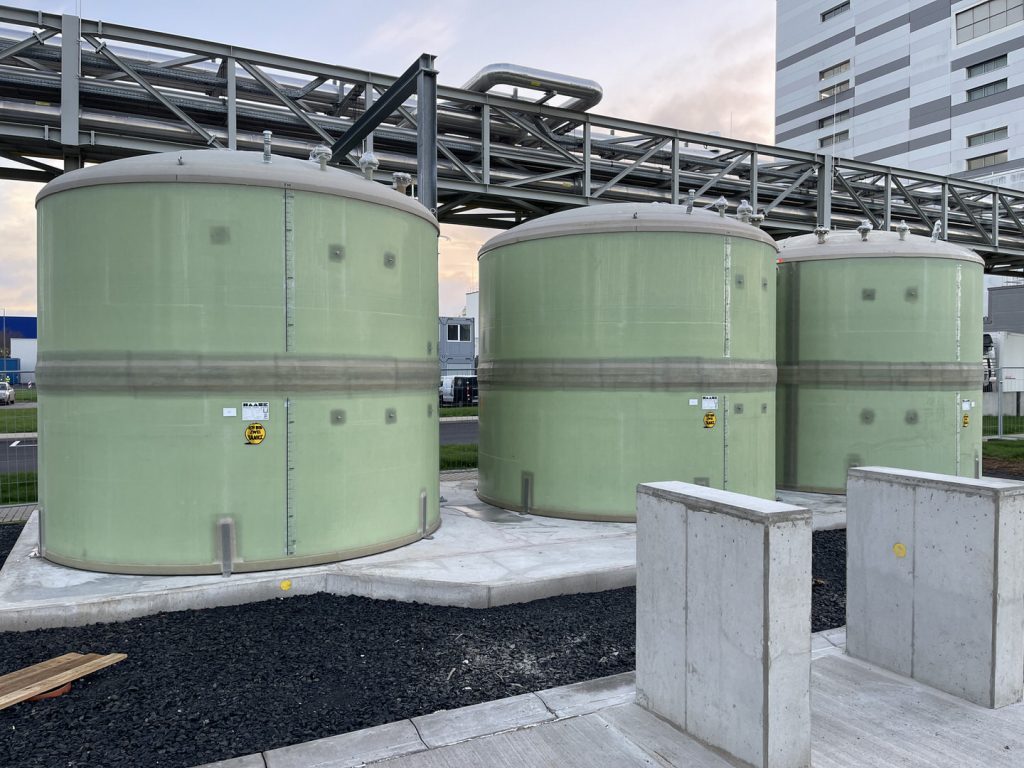
In Fulda we set up glass-fibre reinforced plastic tanks for the fuel supply of an industrial plant. The site was tight, and the tanks were moved with a telehandler and a mobile crane. Because the lugs were bonded to the tanks, there must be no side pull. A purpose-made lifting beam kept the legs vertical. There was a lift plan in advance, the lifting points were agreed with the manufacturer, and a tag line stopped the tank from turning. The tanks were set down on cleaned concrete foundations with a protective mat and fixed with heavy-duty anchors.
Diesel tanks in Raunheim: a lift in the middle of town
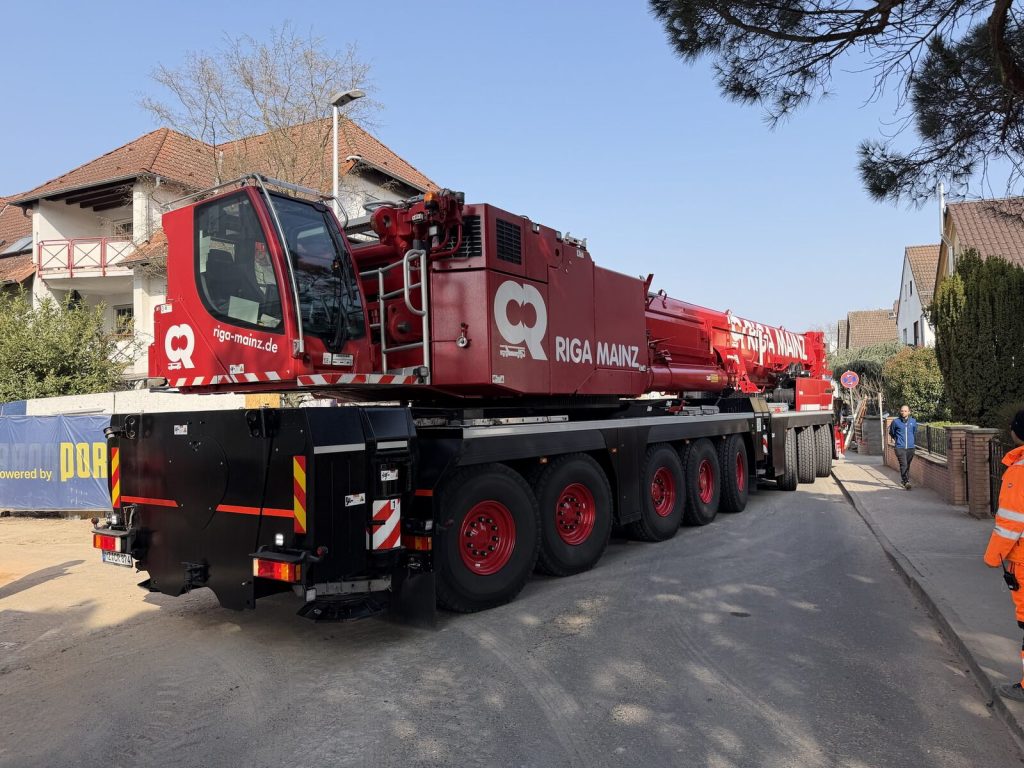
At a data center in Raunheim, we were booked as appointed person for lifting operations. Several large diesel tanks for the Standby power system had to go into their prepared pit. Access ran along a residential street, and there were manholes and drains below the site. We drew up the lift plan, specified the lifting equipment and measured the crane positions with the crane company. The gates had to be removed for crane access. We inspected and recalculated the welded lifting points. In the end, all tanks lay in the correct position in the pit, bolted and approved for filling.
Do you have a tank to set up?
Send us a short note on which tank needs to go where – we will tell you what information we need for route, crane and slinging. Get in touch now.
What this means for your role
Project and site managers: Coordinate the delivery date with the completion date of the foundation or pit. Clarify beforehand who takes over after setting up.
Planners: Plan access, crane position and slewing area. Decide how the tank will be fixed and agree this with the manufacturer and structural engineer.
Maintenance managers: Record how the tank was slung and fixed. For a later replacement, that saves you the search.
Buyers: Compare quotes not only by the crane. Ask whether lift plan, inspection of lifting points, signalling, aligning and anchoring are included.
Plant engineers: Report services, manholes and obstacles along the route that are not on any drawing. Your knowledge of the site is often more accurate than any drawing.
Tank set-up plan: template on request
For your next tank, we have put together the tank set-up plan. On one page it asks about the tank, the route, the crane position, the target and the handover. You fill it in before the date, and we plan the lift without follow-up questions. Request the template via our contact form – keyword “Tank set-up plan”.
Why Omega Mounting?
With over twenty years of experience in installation, move-in and maintenance, we know that with a tank, preparation counts more than the lift. That is why we walk the route beforehand, check the lifting points ourselves and stand where we can see load and target when setting down. On request, we take on the complete lift planning as appointed person for lifting operations. For you, that means one point of contact from delivery day to the anchored tank. Talk to us about your project – get in touch.
Conclusion
Setting up a tank is done quickly if everything is right beforehand. The route must be clear, the crane needs a load-bearing position, and the tank may only hang from checked points – with a lifting beam or sling set, never with a sling around the shell. When setting down, patience counts, along with a signaller who can see load and target.
Whether a plastic tank in a hall, a storage tank on a foundation or a diesel tank in a pit: if you plan the tank as a lift with lead time, you avoid surprises on delivery day. If you have a tank coming up, get in touch with us.
Planning a move-in, installation or maintenance in the Rhine-Main region?
Tell us briefly what you need – we'll come back with an honest assessment.
Free, no-obligation callback
You may also be interested in these guides

About the author
Tobias Schott
Managing director of Omega Mounting GmbH, Rodgau · more than 20 years of hands-on experience in installation and maintenance
A trained mechatronics technician, working in maintenance, servicing and industrial installation since 2004 – first alongside his father, and with Omega Mounting since 2012: from overhead conveyors in Frankfurt to the crane system in a new-build hall. He plans and leads lifting operations as an appointed person (AP) in data centers and on industrial sites in the Rhine-Main region, trains and examines operators of cranes, mobile elevating work platforms and telehandlers, and is a qualified occupational safety specialist. On jobs abroad he is known as the “German Troubleshooter” – the person you call when a site gets stuck. He learned what quality means from his father, not from a manual: Made in Germany as a standard for his own work, not a label. That is why quality comes first at Omega Mounting – ahead of speed and price. He writes these guides from that practice: what works on our sites is in them – what exists only on paper is not.
Frequently asked questions
Outdoors and in pits, almost always. In halls and plant rooms, a tank is often moved in through a door, travelled on rollers and set down with lifting equipment. What fits depends on size, route and target.
For most tanks, no. The sling loads the wall at points and damages the coating. The tank is lifted at the lifting points provided by the manufacturer.
Whenever the lugs cannot take side pull – for example bonded lugs on plastic tanks. The lifting beam keeps the legs vertical.
The manufacturer fits them and states their ratings. Before every slinging, we check their condition and recalculate the data for the planned lift.
Yes. It must be cured, level and clean. Supports, protective layer and anchors should be ready so that the tank can be set down and fixed straight away.
With anchors through brackets in the foundation, with tensioning straps or with bolted connections at the supports. Which solution applies is decided by the manufacturer or structural engineer.
Pipework, gauges and safety devices are installed by the tank installation contractor. We coordinate with them beforehand, and on request our electricians run the power to the connection point.
Yes. From Rodgau we quickly reach the whole Rhine-Main region – Frankfurt, Offenbach, Darmstadt, Hanau, Aschaffenburg and Wiesbaden. We also take on jobs outside the region, as in Fulda.
Send us the tank data, location, access and any drawings. We will come back with our questions on crane and lifting points and an assessment. Go to the contact form.
 English
 German