
- Guide – Lift & Shift
Crane on the road: permit, closure and sequence
By Tobias Schott · 21-minute read · Updated October 2026
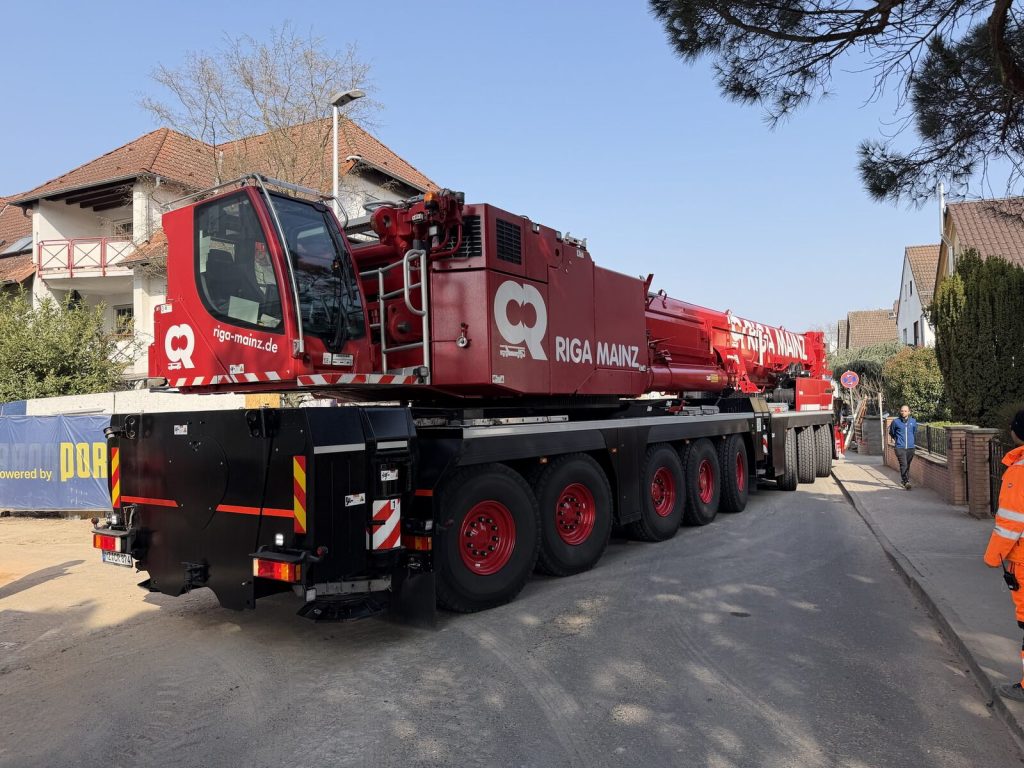
If a crane stands wholly or partly on the road, pavement or parking lane, it needs a permit to use the road and an order on how the area is closed and signed. Both are usually applied for by the crane company or a traffic management service – with details provided by the client and the lift planning.
A yard is too small, the hall stands right on the boundary, the roof faces the street. Then there is only one place left for the crane: the road. For many clients this raises a question they rarely ask. Who may allow it, and what has to happen for that?
This guide explains what a road closure for a crane involves. It shows which permits exist, who applies for them and which details the application needs. Plus the sequence on the lifting day, an overview of responsibilities and typical mistakes.
We are an installation and rigging company from Rodgau near Frankfurt. We plan lifts, coordinate them with the crane company and provide the lift data for the application. We do not submit the application ourselves. What has to be settled before every lift is described in our guide on Planning a crane lift.
Key points at a glance
- A crane on the road uses public traffic space beyond normal use. That is special use and needs a permit.
- The special use permit is issued by the highway authority, for local roads usually the municipality.
- How the road is closed, signed and diverted is set by the road traffic authority in a traffic management order. This often needs a traffic sign plan.
- Driving the crane or the load to the site is a separate topic with its own permit.
- The application is usually made by the crane company or a traffic management service. Client and lift planning provide place, time window, standing area, outriggers and barrier zone.
- On the lifting day what counts is the no-stopping zone, barriers, marshals, checked ground and the weather.
- The rules differ locally. Plan early and with an alternative date.
What does “crane on the road” mean?
A crane stands on the road when it, its outriggers, its ballast or its slewing area reaches wholly or partly into public traffic space – that is, onto the road, pavement, cycle lane or parking lane.
That is more common than many think. Often the crane has only one outrigger on the pavement. Or it stands on your own property, but its boom slews the load over the pavement. Public space is affected then too, because nobody may walk under a suspended load.
When the crane has to go on the road
These cases are typical:
- No space on the property. Yard, access or car park are too small or cannot carry the load.
- Building on the street. The target is on the roof or behind the facade on the street side.
- Radius. From the property the distance to the set-down point would be too far. From the road it becomes shorter, and a smaller crane is enough.
- Access. The load arrives on the vehicle and has to be lifted directly from the road.
Why the distance between crane and load determines so much is set out in our article on load moment and radius.
Public space and private land
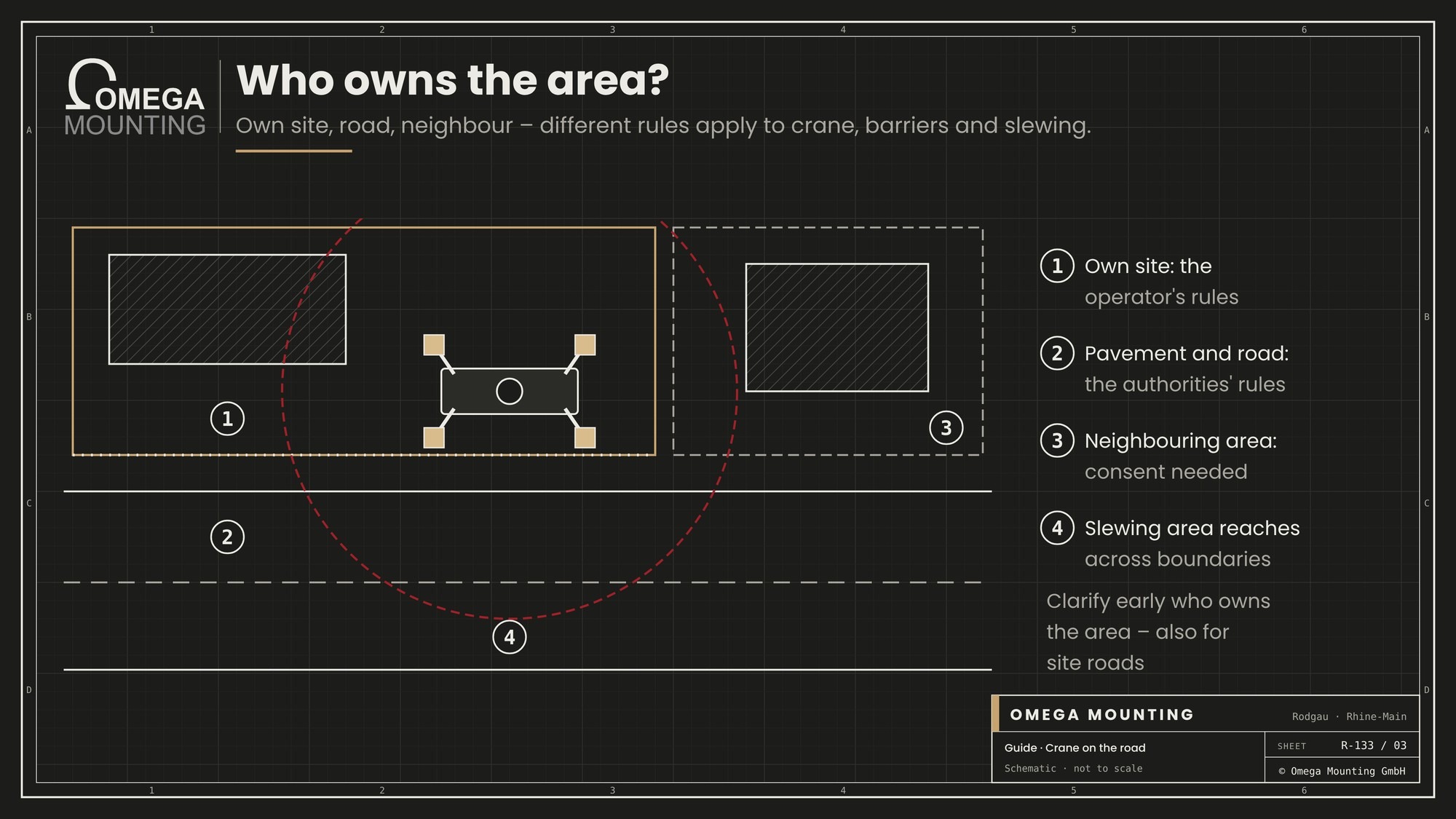
On your own site the owner's or operator's rules apply. On the public road the authorities' rules apply. In between there are mixed forms: private roads with public traffic, site roads, neighbours' land. Clarify early who owns the area where crane and barriers are to stand.
Partial or full closure
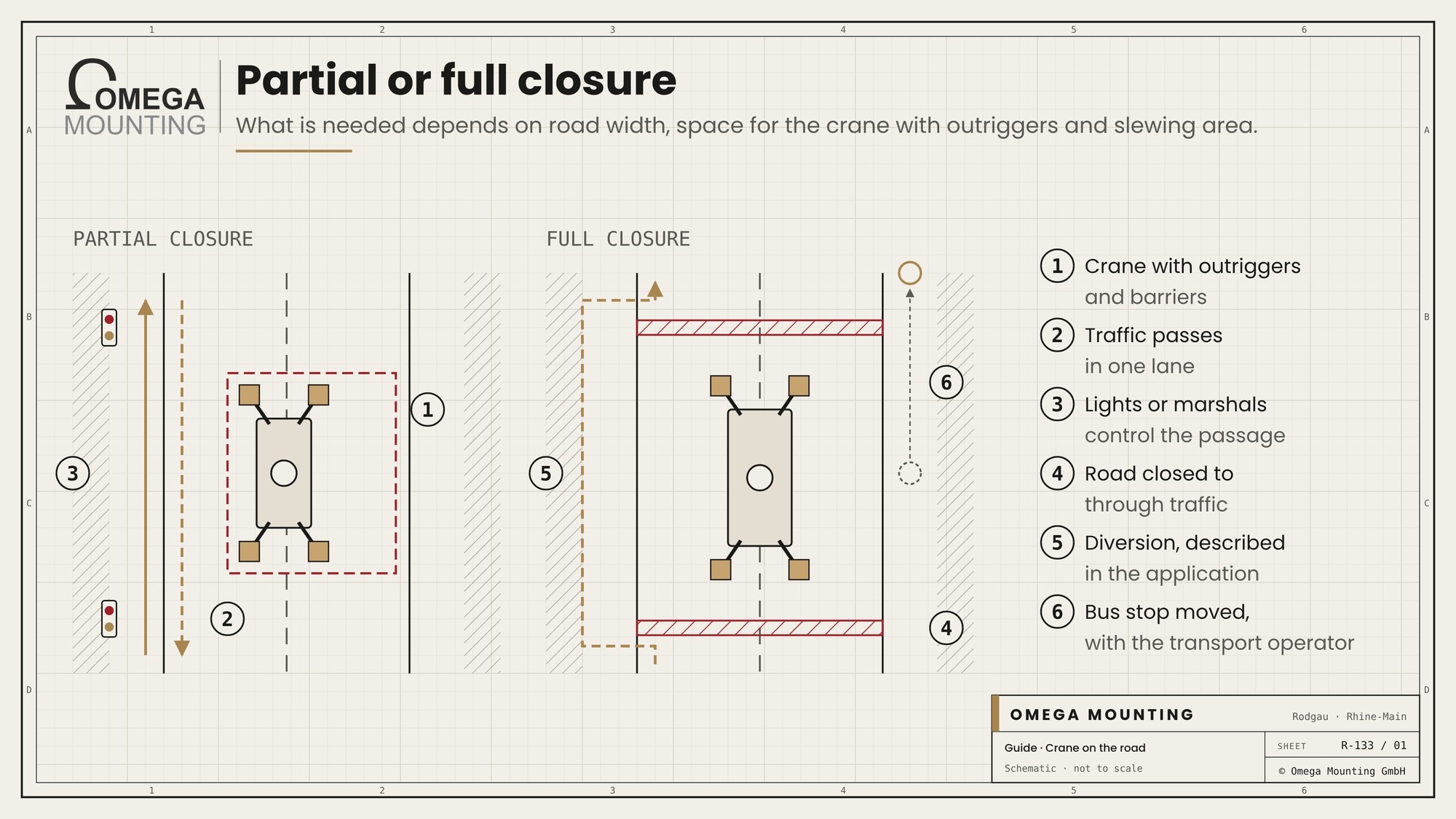
Not every crane on the road closes the whole road. Often a partial closure is enough: one lane or the parking lane is occupied, and traffic passes in one lane, sometimes with lights or marshals. With a full closure the road is closed to through traffic, and a diversion is needed.
What is needed depends on the width of the road, the space the crane needs with outriggers and the slewing area. The smaller the occupied area, the simpler the procedure usually is. That is why it pays to choose the crane position in lift planning so that as little traffic space as possible is occupied.
Day, night, weekend
Many lifts on the road take place at quiet times: early in the morning, at weekends or at night. That relieves traffic but brings its own questions. Night work can come with noise conditions, and residents need more consideration. Lighting and reliable communication must be planned. Which times the local office allows is stated in the order.
Which permits a crane on the road needs
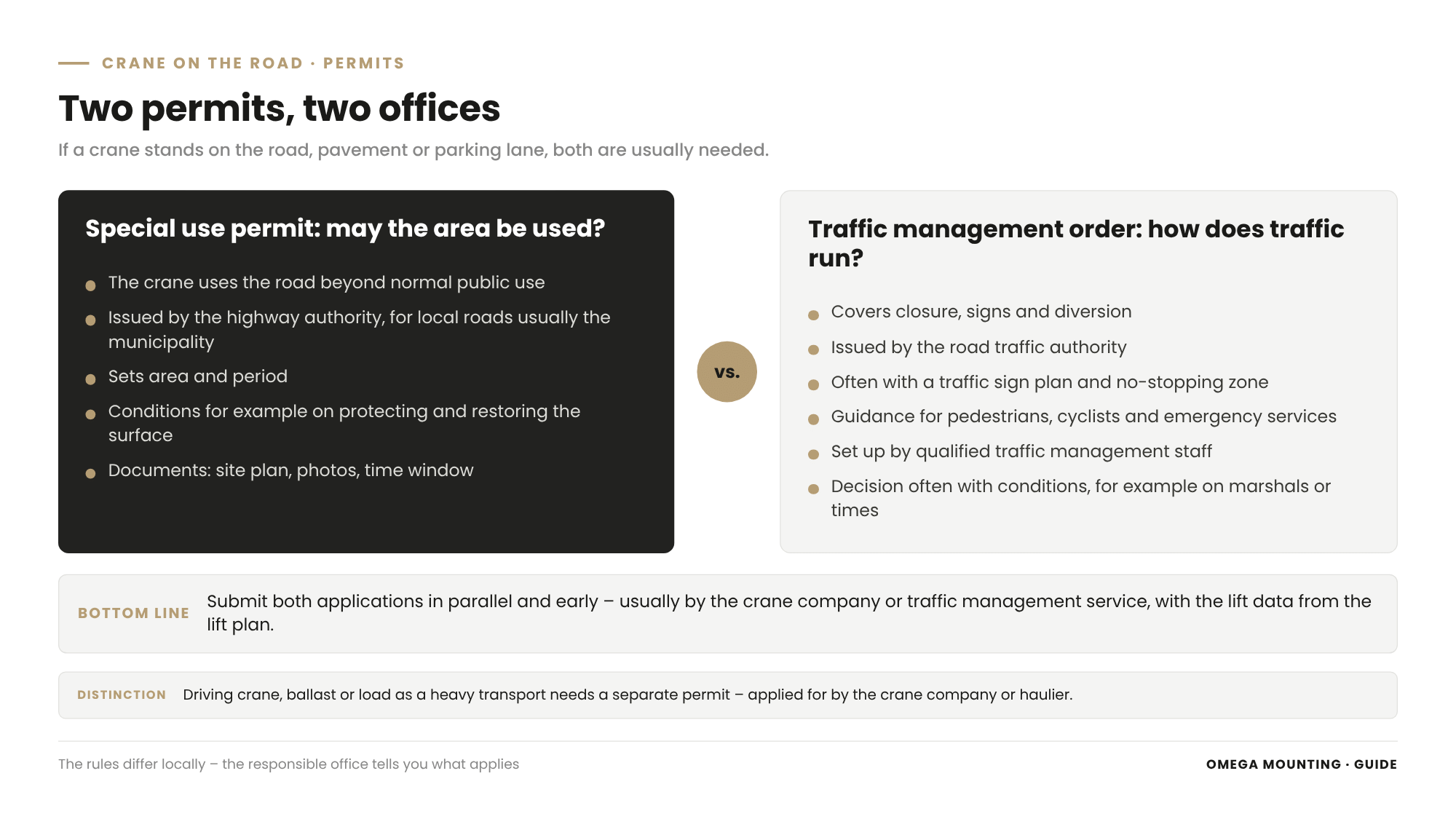
A crane on the road usually needs two permits from two offices: the special use permit for using the area and the traffic management order for closure, signs and diversion.
Both are usually applied for in parallel. One office decides whether the area may be used. The other decides how traffic runs during this time.
The special use permit
Everyone may use a public road within normal public use: drive, walk, park. A crane that stands there on outriggers goes beyond that. This is called special use. The same applies to skips, scaffolding or parked construction machinery.
The permit is issued by the highway authority. For local roads that is usually the municipality, for other roads another office. It can set conditions, for example on protecting the surface or restoring it afterwards.
The traffic management order
The road traffic authority sets how traffic is managed during the job. It orders which area is closed, which signs are put up and how cars, cyclists and pedestrians are diverted. It often involves other offices, for example the police.
It is often based on a traffic sign plan. This shows on a site plan where barriers, signs, guidance elements and diversions are placed. The signs are put up by staff qualified in traffic management.
No-stopping zone
So that the crane finds its place clear on the day, a temporary no-stopping zone is usually ordered. The signs must be up in good time beforehand. Only then may vehicles that still park there be removed. Whoever puts them up usually documents it.
Other consents
Depending on the location, others are involved:
- Network operators, if there are lines underground or overhead lines nearby.
- Transport operators, if buses or trams are affected.
- Neighbours, if the load slews over their property.
- Operators of airports or railway facilities, if the crane stands near them.
What the permit and order contain
Permit and order are not mere stamps. They set which area may be occupied for which period. Conditions are often added: how the surface is to be protected, how pedestrians are guided, who must be reachable on the day and in what condition the area is returned. The papers belong on site on the day. Anyone who is checked must be able to show them. Read the conditions beforehand with everyone involved so that nobody is surprised on the day.
Different locally
How the application works, which documents are required and how much lead time it needs is set by each municipality itself. Some crane companies have a standing permit and only register the individual job. Elsewhere a separate application is needed for every job. This guide is not legal advice. What applies in the individual case is something the responsible local office will tell you.
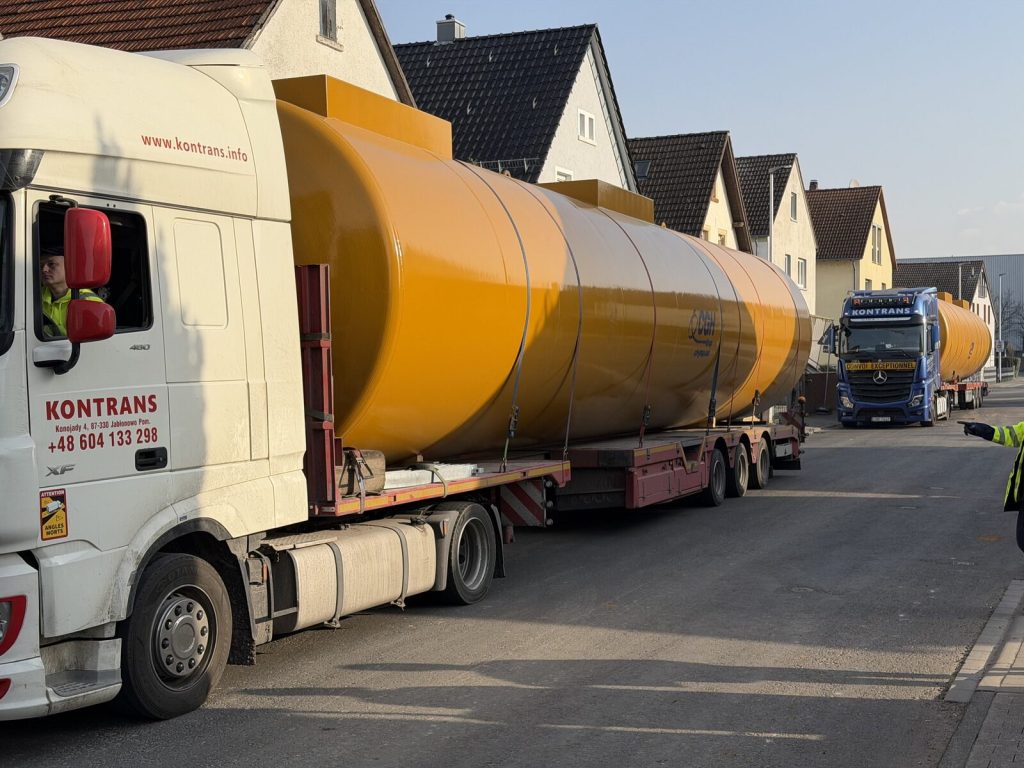
Crane on the road or heavy transport: two different permits
The permit for the crane position on the road and the permit for driving a crane or a heavy load to the site are two different things – they are applied for separately and by different parties.
Driving the crane
Large cranes are often so heavy or so wide on the road that they need a permit to travel. Ballast and accessories often come on separate vehicles. These trips are planned and applied for by the crane company. For you one thing counts above all: do crane, ballast vehicles and load get through the streets to the crane position?
Driving the load
If the load itself comes as a heavy transport, it needs a permit too. The haulier applies for it. When loading turns into a heavy transport is explained in our guide on Load securing for heavy goods.
Why coordination counts
Crane, ballast, transport and closure must fit together in time. If the crane is up but the transport may only travel later, the whole crew waits. That is why you set a common date covered by all permits. Which crane types exist and how much space they need is described in our article on the common crane types at a glance.
Who applies for what in a road closure for a crane
For a road closure for a crane, the applications are usually made by the crane company or a traffic management service it appoints; the client provides place, date and approvals, and the lift planning provides the technical data of the lift.
This split is typical; in the individual case the contract decides. What matters is that it is settled beforehand.
The crane company
It knows its cranes, their outriggers and the space they need. It determines the outrigger forces and the area the crane needs including outriggers. Many crane companies apply for special use and closure themselves or have a partner do it.
The traffic management service
It prepares the traffic sign plan, applies for the traffic management order and puts up signs, barriers and the no-stopping zone. On the day it provides marshals if needed.
The client or building owner
They name place, reason and preferred date. They provide site plans and as-built drawings of lines and clarify who owns the areas. They inform residents, tenants and neighbours or make sure someone does. In some cases they have to sign themselves as building owner.
Lift planning
The lift planning provides what describes the lift: crane position, outriggers, load path, slewing area, barrier zone and time window. That is our part. We coordinate this data with the crane company and pass it on to the applicant. Who has which role on the lifting day is described in our guide on the appointed person for lifting operations.
The structural engineer
They assess whether the ground can take the outrigger forces – especially over ducts, basements, underground car parks or yard slabs. Without their statement nobody sets a crane over a void.
What the contract should say
So that no gap arises, the contract should settle these points:
- Who applies for special use, who for the traffic management order?
- Who prepares the traffic sign plan?
- Who puts up the no-stopping zone, barriers and signs, and who removes them again?
- Who provides marshals on the day?
- Who provides the lift data, and by when?
- Who informs residents and neighbours?
- Who takes care of the alternative date if no lift takes place because of the weather?
This list does not replace a contract. But it shows where questions most often remain open for crane jobs on the road.
What the application for the road closure needs
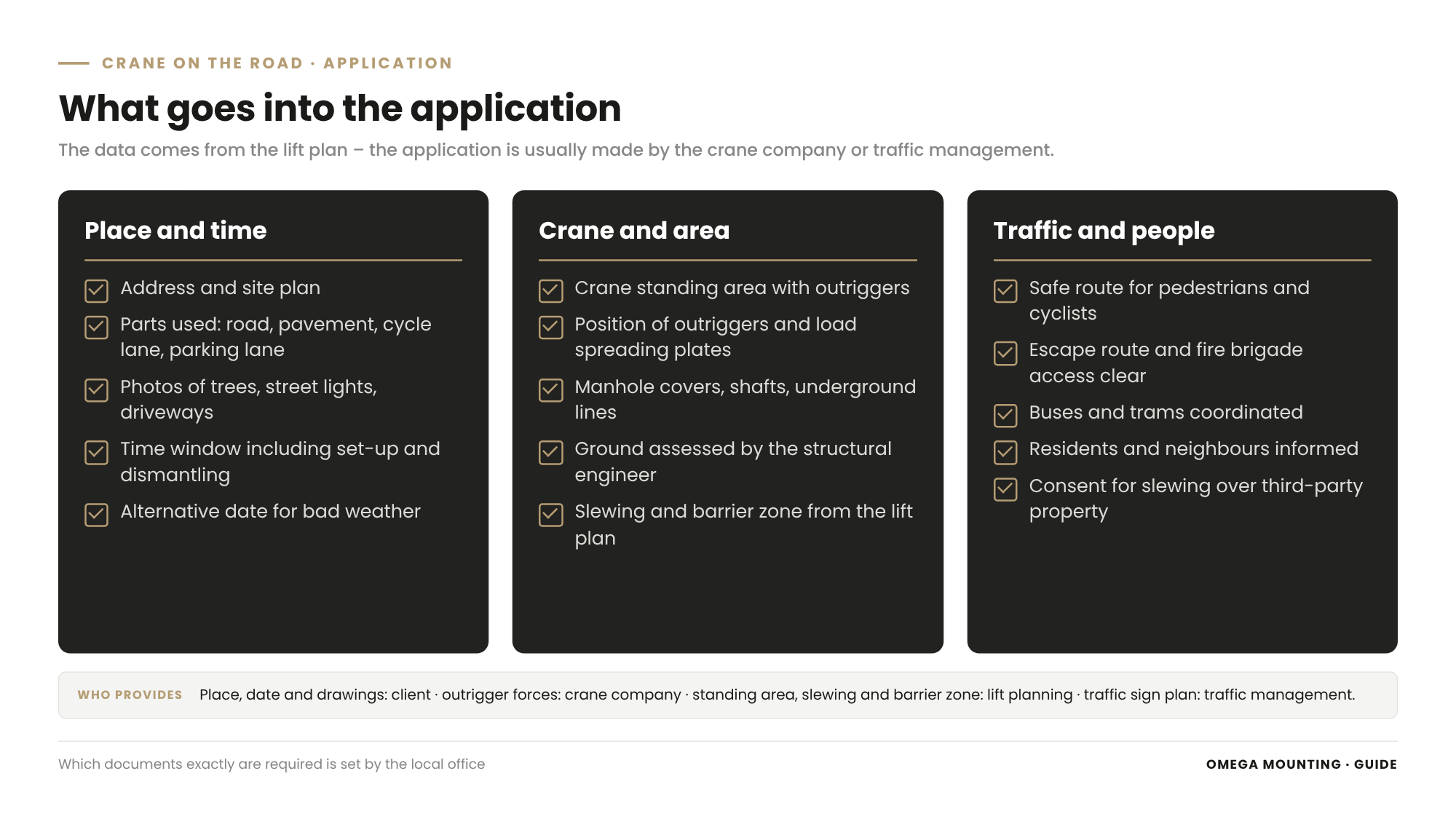
The application for a road closure with a crane needs place and time window, the crane standing area with outriggers, the barrier zone, guidance for pedestrians and cyclists, access for emergency services and fire brigade, and a plan for residents.
The more complete the details, the fewer queries there are. Which documents exactly are required is set by the local office.
Place and area
The exact address is not enough. A site plan is needed that shows which parts of the road are occupied: road, pavement, cycle lane, parking lane. Photos help, especially of trees, street lights, signs and driveways.
Time window
When is the lift to take place, and how long is the area occupied? This includes setting up and dismantling the crane, not just the lift itself. An alternative date for bad weather belongs in the application straight away if the office allows it.
Crane standing area and outriggers
The crane needs a level, load-bearing area for itself and its outriggers. Under each outrigger a large force acts on a small area. Load spreading plates spread it. How that works is explained in our article on load spreading mats and ground pressure.
What matters for the application is where the outriggers stand. If there are manhole covers, valve caps, shafts or lines there, the crane position has to be moved or the ground checked. How loads on slabs and yard basements are taken into account in planning is described in our guide on move-in planning with slab loads in mind.
Barrier zone and slewing area
It is not just the crane itself that is cordoned off. The area over which the load slews must also be free of people. The barrier zone is therefore often larger than the standing area. It is set in the lift plan and carried over into the traffic sign plan.
Pedestrians and cyclists
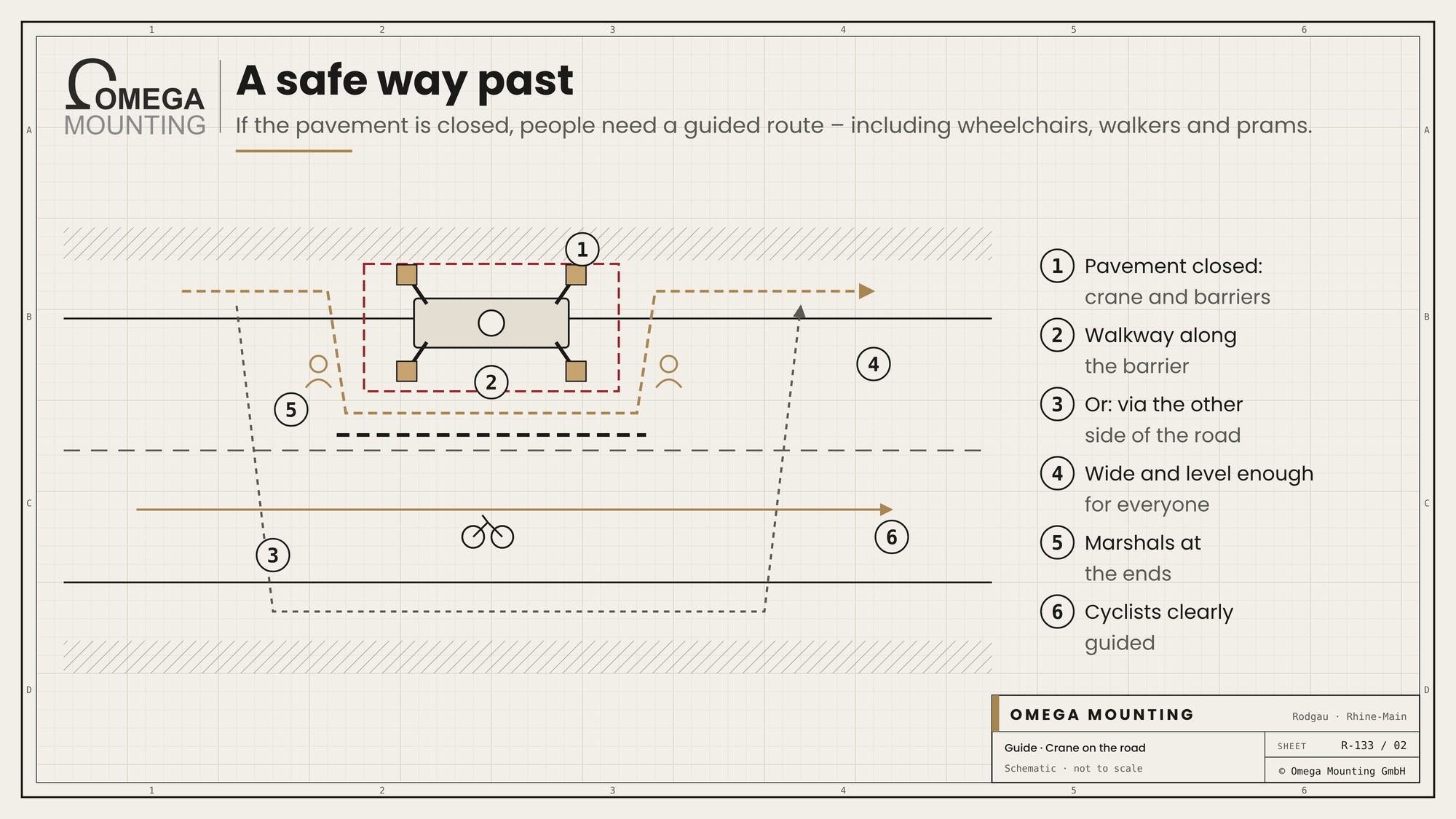
If the pavement is closed, a safe way past is needed: on the other side of the road, through a protected walkway or along the barrier. This also applies to people with wheelchairs, walkers or prams. Cyclists need clear guidance.
Emergency services and fire brigade
Escape routes and fire brigade access must stay clear – including to the neighbouring buildings. If the road cannot be driven through, a diversion is needed and is described in the application.
Buses and trams
If a bus or tram runs through the street, the transport operator must know early. Stops may be moved, routes diverted or overhead lines affected. That needs its own coordination and often more lead time than the closure itself.
Residents and neighbours
Residents need to know when they cannot get into their driveway. Shops need their delivery times. A notice or a letter beforehand prevents trouble on the day. If the load slews over a neighbouring plot, the neighbour's consent is needed.
The lifting day: from the no-stopping zone to a clear road
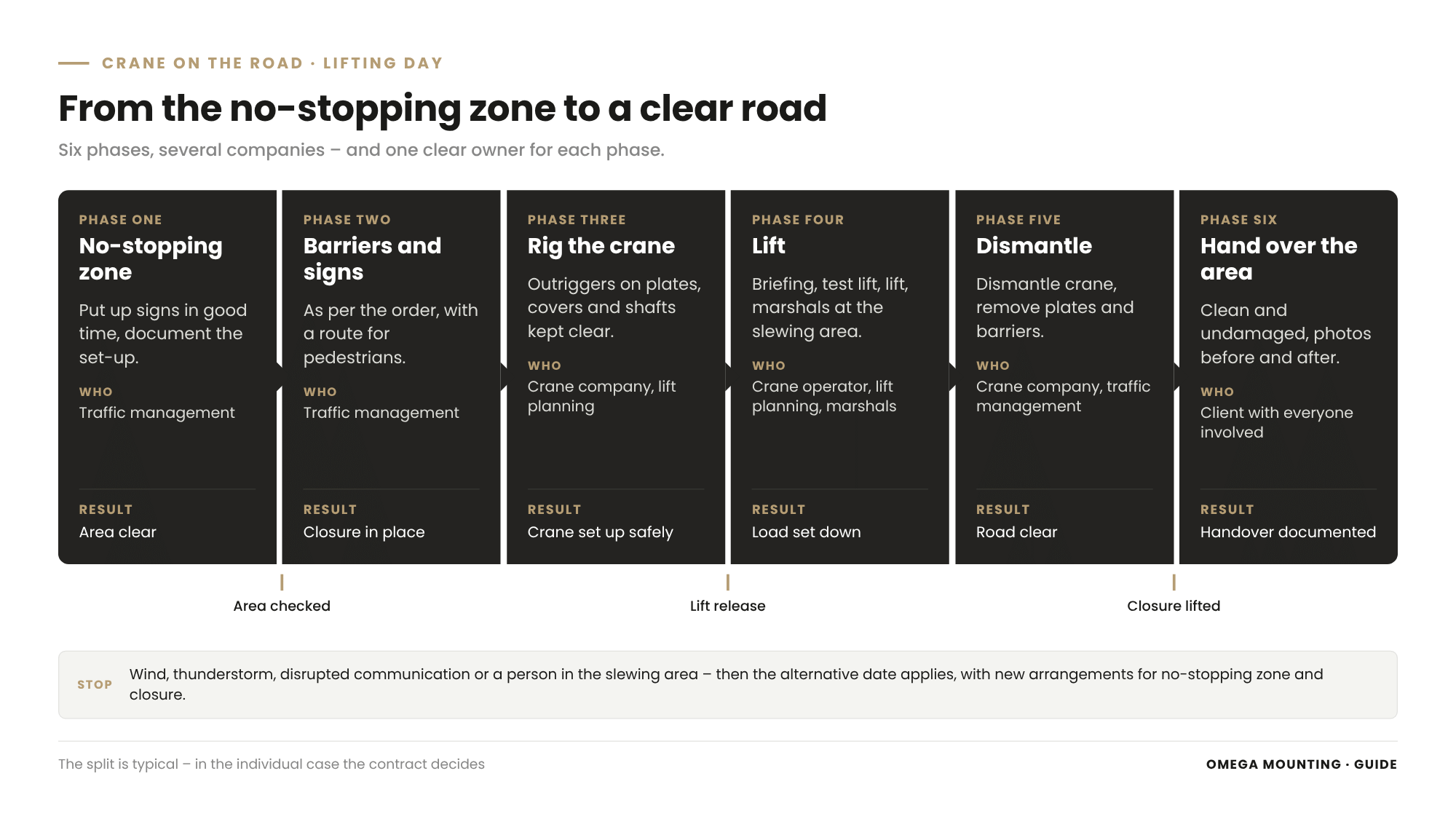
On the lifting day the no-stopping zone is already in place, the area is cordoned off and signed, the crane is rigged on checked ground, lifting only takes place in suitable weather – and at the end the road is handed back in the condition it was in.
Check the no-stopping zone
Before set-up someone checks whether the area is clear. If vehicles are still parked there despite the no-stopping zone, the responsible office decides whether they are removed. That takes time. Plan reserve for it.
Cordon off and sign
The traffic management service puts up barriers and signs as the order specifies. Only when everything is in place does the crane move into position.
Marshals
Where pedestrians, cyclists or residents have to get past the crane, marshals are often posted. They keep people out of the slewing area and let them pass at quiet moments. They are in contact with the signaller or the responsible person.
Lines and manhole covers under the outriggers
The outriggers go exactly where the lift plan intends. Load spreading plates go underneath. Manhole covers, shaft covers and gullies stay clear. If a cover under an outrigger is only noticed during set-up, there is no improvising. Then the crane position is reassessed.
Wind and stop criteria
Wind, thunderstorms, poor visibility or disrupted communication can prevent the lift. Which limits apply follows from the crane's documents and the crane operator's assessment. The stop criteria are in the lift plan beforehand. If the lift is stopped, the alternative date applies – with new arrangements for the no-stopping zone and closure.
Dismantle and hand over the area
After the lift the crane is dismantled, the plates are picked up and the barriers are removed. The area is handed over clean and undamaged. Photos before and after help if someone asks about damage later.
If something changes
If the delivery is postponed, the lift is stopped or the crane needs a different position, the permit often no longer applies. Then period or area have to be adjusted. Pass changes on to the applicant immediately. They know whether an adjustment is enough or a new application is needed.
Who decides on the lifting day
The lifting day needs a clear order. The crane operator decides about the crane. The responsible person releases the lift and gives the commands. The traffic management service is responsible for barriers and traffic. The client is reachable if residents or authorities have questions. Anyone involved may stop if people are put at risk.
Overview: detail, what it is needed for, who provides it
For every detail in the application and on the lifting day there is a purpose and a responsible party – the table summarises this.
| Detail | Used for | Who provides it |
|---|---|---|
| Place, site plan, photos. | Application and traffic sign plan. | Client; survey by lift planning. |
| Time window with alternative date. | Special use, order, no-stopping zone. | Client with crane company and lift planning. |
| Crane standing area and outriggers. | Size of the occupied area, position of the outriggers. | Crane company with the lift planning. |
| Outrigger forces. | Checking the ground. | Crane company. |
| Ground, lines, shafts. | Stable footing, no damage in the ground. | Structural engineer; as-built drawings from the client or network operator. |
| Slewing and barrier zone. | Traffic sign plan, protection of people. | Lift planning |
| Guidance for pedestrians and cyclists. | Safe route past the closure. | Traffic management service. |
| Escape route and fire brigade access. | Access to all buildings. | Traffic management service with the client. |
| Informing residents. | Driveways, deliveries, calm on the day. | Client. |
| Applications for special use and order. | Permit for area and closure. | Usually crane company or traffic management service. |
Typical mistakes in a road closure for a crane
The typical mistakes in a road closure for a crane are an application made too late, a forgotten slewing area, manhole covers under the outriggers, unclear responsibilities and a date without an alternative.
- Application too late. The lift date is fixed, but the order does not arrive in time. The crane may not set up.
- Only the standing area applied for. The slewing area over the pavement is missing from the plan, the barrier zone is too small.
- Ground not checked. There is a duct or a line under an outrigger, and nobody knew beforehand.
- Responsibility open. Client and crane company both assume that the other is making the application.
- No-stopping zone too late. The signs are not up in time, and cars are parked on the area on the day.
- Pedestrians forgotten. The pavement is closed, and there is no safe way past.
- Residents not informed. A driveway is blocked, a delivery van cannot get through, and the lift has to pause.
- Bus or tram overlooked. The route runs through the closure, and the transport operator finds out too late.
- Crane travel not considered. The crane position is approved, but crane or ballast cannot get through the streets to it.
- No back-up date. Wind picks up, and the permit is valid for one day only.
The mistake behind the mistakes
Behind many mistakes lies the same assumption: that the permit is a formality that takes care of itself. But it is part of the lift planning. The data for the application comes from the lift plan – and without an application there is no lift.
Crane on the road in the Rhine-Main area: how we do it
In the Rhine-Main area cranes for move-ins often stand on the road because plots are tight and buildings densely packed; we plan the lift, coordinate it with the crane company and provide the data for the road closure.
Around Frankfurt, business parks lie close to residential streets, railway lines and the airport. Data centers and factory halls often stand in the middle of towns. Yards are small, accesses narrow, bends tight. Then the road is often the only place for the crane.
Every municipality in the region has its own procedure. That is why it matters that the crane company or traffic management service knows the local processes. Our job is to provide the lift data early and in full.
From Rodgau, Frankfurt, Offenbach, Hanau, Darmstadt and Aschaffenburg are short distances. That helps when surveying the street and when a lift has to be postponed because of wind. What we offer in Lift & Shift and heavy-load installation overall is set out on our service page.
What we don't take on, we say clearly beforehand. The crane is provided by the crane company, the applications are made by the crane company or traffic management service, the ground is assessed by the structural engineer.
Project examples
Three jobs from our project diary show how street, access and standing area determine a lift – and how we prepare the data for it.
Data center in Raunheim: the crane in a residential street
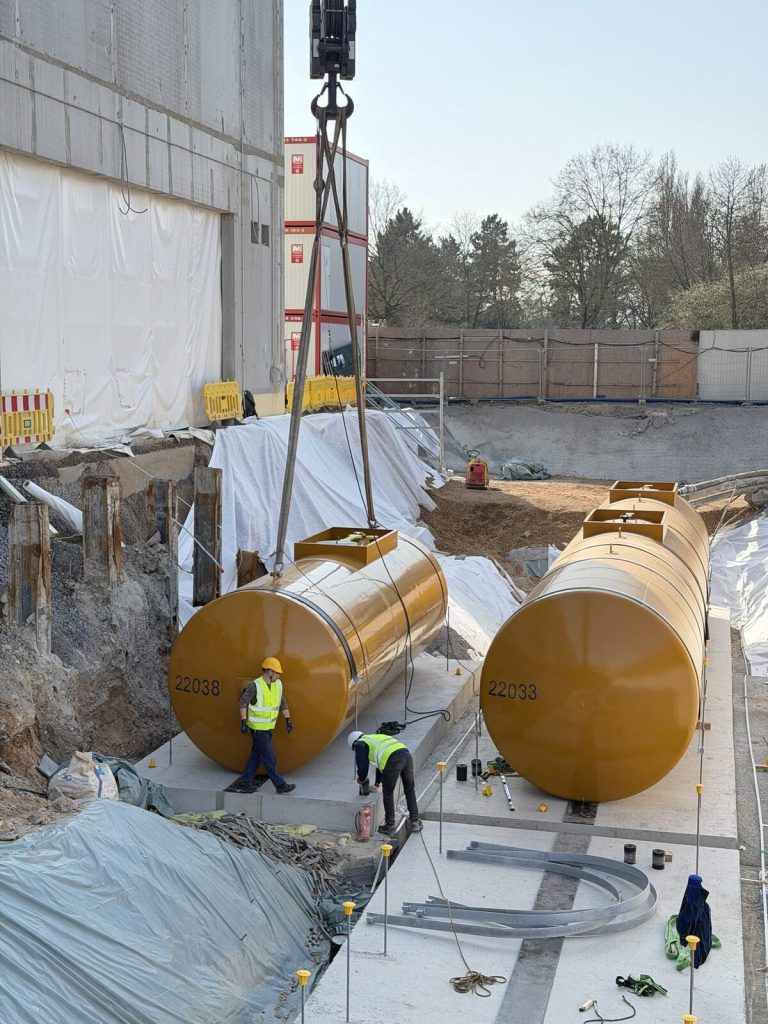
During the placement of diesel tanks at a data center in Raunheim, the site was in the middle of the town. Access was via a residential street with trees and pavements. The routes around the building were still a construction site themselves. The turn from the street onto the site was too tight for the crane, so gate systems were removed.
Each tank came separately as a heavy transport. Whether the low-loaders would fit into the access was checked beforehand by sketch and on the computer. Suitable standing areas for the crane existed in only a few places. Under the ground there were shafts, ducts and basement shafts that cannot take point loads. We measured and calculated the crane positions together with the crane company. The crane chosen was the one that just reaches from the permitted areas.
For your job this means: crane position and access are the first question, not the last.
Data center in the Frankfurt area: check the standing area, approve the lift plan
During the installation of standby power systems in a data center, the generator stood on the low-loader in front of the building after delivery. Each lift followed a lift plan with load assumptions, rigging geometry, crane position, radius, ground pressure and sequence. The crane's standing area was checked, the outrigger forces calculated against the load capacity of the ground. The plan was approved by the general contractor, and the whole crew was briefed.
For your job this means: the data from the lift plan is the same data the application for the road needs.
Data center construction site in Frankfurt: from the kerb
With the move-in of load banks and generators on a data center construction site in Frankfurt, our scope began at the kerb. Manoeuvring and standing areas for transports and crane were scarce. Crane position and set-up areas were already fixed at planning stage in a move-in drawing. Every lift was calculated in advance and approved in the operator's system. Deliveries were scheduled, every vehicle was unloaded immediately. Slewing and danger zones were cordoned off, and communication between crane operator, riggers and site management ran without a break.
For your job this means: scheduled deliveries keep the occupied area small.
Does your crane have to go on the road?
Then get in touch with us. Send us photos of the street, the target and, if available, the load's data sheet. Together with you and the crane company we clarify which lift data the application needs.
What this means for your role
For buyers: Do not just ask about crane and crane operator, ask about applications, traffic management and no-stopping zone too. Set in the contract who makes which application and who puts up the signs.
For designers: Record possible crane standing areas in the documents – on the road too. Check early whether lines, shafts or trees are in the way.
For project managers and site managers: As project manager you keep the date with lead time and an alternative date and collect the details for the application. As site manager you make sure that area, barriers and residents are prepared on the day.
For technical managers and facility managers: You know driveways, delivery times and neighbours. Provide as-built drawings and name a contact for the lifting day.
For management and building owners: Give the project the lead time that permits need. A lift that fails because of a missing order costs more than early planning.
Road check for crane jobs: template on request
The road check for crane jobs is a one-page working document for the first coordination round. It has four blocks: place and area, time, traffic and people, and responsibilities. Each point has a field for the source of the detail and the status “clarified” or “open”. Deadlines and number fields are deliberately not pre-filled – the check shows you what is still missing before the application and who provides it. Request the template via our contact form – keyword “road check”.
Why Omega Mounting?
We are based in Rodgau near Frankfurt, can be reached by phone and WhatsApp and plan lifts for move-ins in industry and data centers. The linked jobs show how we approach street and crane position. In Raunheim the residential street, shafts and access determined the crane. In the Frankfurt area every standing area was checked before lifting. For you this means: a single point of contact for site visit, lift plan and lift data – coordinated with crane company, traffic management and structural engineer.
Conclusion
A crane on the road needs two permits: special use for the area and the traffic management order for closure and signs. Driving crane and load is a separate topic. The applications are usually made by the crane company or traffic management service, but the data comes from the lift plan. Settling standing area, outriggers, barrier zone and time window early makes the road closure for a crane plannable. No-stopping zone, marshals, checked ground and an alternative date make the lifting day calm. If your crane has to go on the road, send us photos and documents – we will get back to you with a date for the site visit and an honest assessment.
Planning a move-in, installation or maintenance in the Rhine-Main region?
Tell us briefly what you need – we'll come back with an honest assessment.
Free, no-obligation callback
You may also be interested in these guides

About the author
Tobias Schott
Managing director of Omega Mounting GmbH, Rodgau · more than 20 years of hands-on experience in installation and maintenance
A trained mechatronics technician, working in maintenance, servicing and industrial installation since 2004 – first alongside his father, and with Omega Mounting since 2012: from overhead conveyors in Frankfurt to the crane system in a new-build hall. He plans and leads lifting operations as an appointed person (AP) in data centers and on industrial sites in the Rhine-Main region, trains and examines operators of cranes, mobile elevating work platforms and telehandlers, and is a qualified occupational safety specialist. On jobs abroad he is known as the “German Troubleshooter” – the person you call when a site gets stuck. He learned what quality means from his father, not from a manual: Made in Germany as a standard for his own work, not a label. That is why quality comes first at Omega Mounting – ahead of speed and price. He writes these guides from that practice: what works on our sites is in them – what exists only on paper is not.
Frequently asked questions
Yes, as a rule. If the crane stands on the road, pavement or parking lane, that is special use of the road. This needs a permit from the highway authority, usually the municipality. For closure and signs a traffic management order from the road traffic authority is added. The details differ locally.
Usually the crane company or a traffic management service. The client provides place, date and drawings. The lift planning provides standing area, outriggers, slewing and barrier zone. Who exactly applies for what should be in the contract.
The special use permit governs whether the road area may be used for the crane. The traffic management order governs how traffic is managed during this time: closure, signs, diversion. Usually two different offices are responsible.
Each municipality sets that itself. Plan generously, because order, no-stopping zone and coordination with other parties take time. Ask the crane company or traffic management service as soon as the date is roughly fixed.
Often yes. Large cranes and their ballast are often so heavy or wide on the road that the trip needs its own permit. The crane company applies for it. If the load comes as a heavy transport, the haulier applies for the permit for that.
They need a safe way past the closure, for example on the other side of the road or through a protected walkway. Nobody may walk under a suspended load. Marshals keep the slewing area clear.
It is strongly recommended. Residents need to know when driveways are blocked, shops need their delivery times. If the load slews over a neighbouring plot, the neighbour's consent is needed.
No, manhole covers, shaft covers and gullies stay clear. Whether the ground over lines, ducts or basements can take the outrigger forces is assessed by the structural engineer. The outrigger forces are calculated by the crane company, load spreading plates spread them.
A short enquiry with three details: what is being lifted, where it is to go and where the crane could stand. Photos of the street and a site plan help. Together with you and the crane company we clarify which data the application needs. Your contact is Tobias Schott – reachable via our contact form.
 English
 German