
- Guide – Lift & Shift
Industrial dismantling: dismantling plant professionally, separating recyclables, keeping records
By Tobias Schott · Reading time approx. 23 minutes · Last updated: October 2026
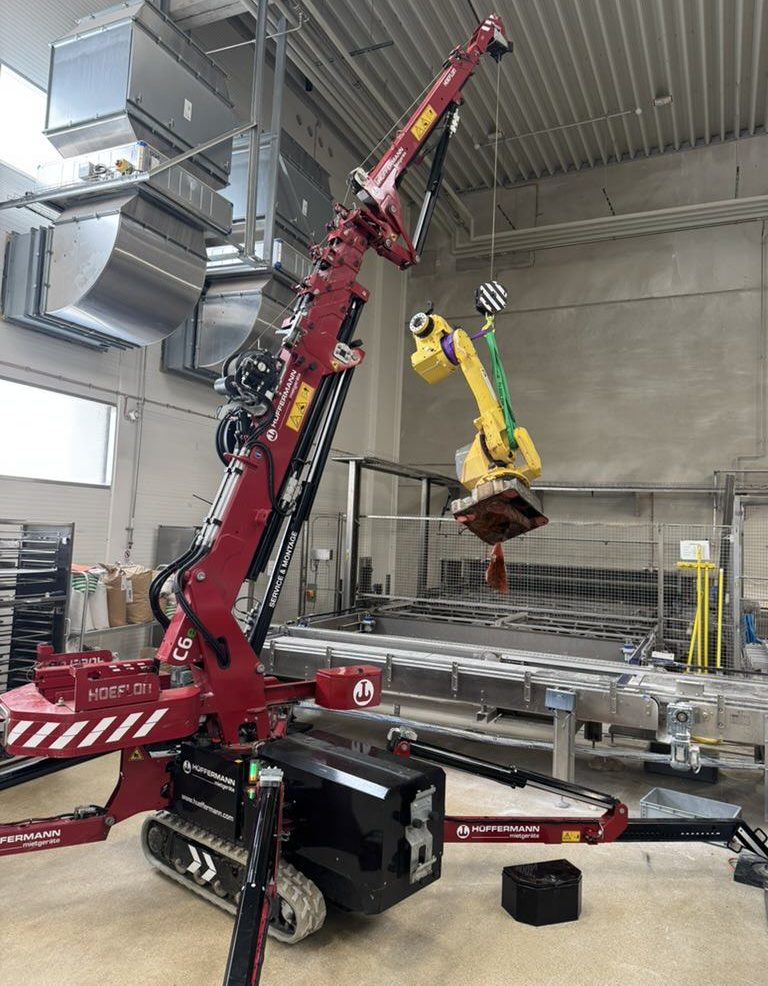
Industrial dismantling is not demolition but installation in reverse – with isolation, sequence, lifting equipment and labelling. At the end, the disposal records show where every kilogram has gone.
A production line is shut down, a machine is replaced, a hall is repurposed, a site is closed. What remains is a plant that has to go – an industrial dismantling job. And a series of questions nobody wants to answer in day-to-day business: Who isolates the plant? What is inside it in terms of oil, refrigerant, old gaskets? Is the plant going to a buyer or to the next site, or should someone dismantle the machine and dispose of it? And who signs at the end to confirm that everything was disposed of properly?
This article is the in-depth companion to our guide Machinery relocation for your company: from dismantling to commissioning. There, dismantling stands at the start of a relocation; here it is the actual service. We show you how to define the objective of the dismantling, disconnect utilities and isolate the plant, hand hazardous substances to specialist trades, plan the sequence and lifting equipment, separate recyclables and keep records. With examples from a bakery near Fulda, a manufacturing plant with a container office and an office tower in Frankfurt.
Key points at a glance
- The objective of the dismantling – reassembly, sale or recycling – determines the degree of disassembly, labelling, packaging and records, and must be settled before the first quotation.
- Before the first bolt is loosened, the plant is isolated: electricity according to the five safety rules, compressed air, hydraulics, water and gas drained, stored energy released, condition documented.
- Hazardous substances such as oils, refrigerants, cutting fluids or asbestos-containing gaskets must be recorded before mechanical dismantling and handed to the responsible specialist trade.
- The dismantling sequence is the installation sequence in reverse: loads are separated so that at no point does a component tip or fall uncontrolled.
- Lifting equipment is chosen according to space, weight and floor – mini crane, overhead crane, forklift with jib or dollies – and recorded in the lift plan.
- Recyclables are collected separately – steel, stainless steel, aluminium, cables, electronics, operating fluids – and their disposal is documented with weighbridge tickets and disposal records.
- Dismantling during ongoing operations needs barriers, maintenance windows, dust and fire protection and a handover of the area that the business can use immediately.
What is industrial dismantling?
Industrial dismantling is the planned, professional disassembly and removal of machines, plant or operating equipment from a building. The aim is to reassemble the plant, sell it or recycle its components separately, without endangering the building, neighbouring plant or people.
The German term Rückbau (deconstruction) emphasises the result: an area handed over in the condition the business needs – clear, clean, with sealed utility connections and no remains in the floor. The difference from demolition lies in how the substance is treated: in demolition, what has to go is destroyed; in dismantling, what can be recycled or reused is separated. Whether machine dismantling, plant dismantling or the removal of a whole line – the procedure is the same. What Omega Mounting provides here is described on our page Industrial dismantling and deconstruction.
Three objectives, three routes
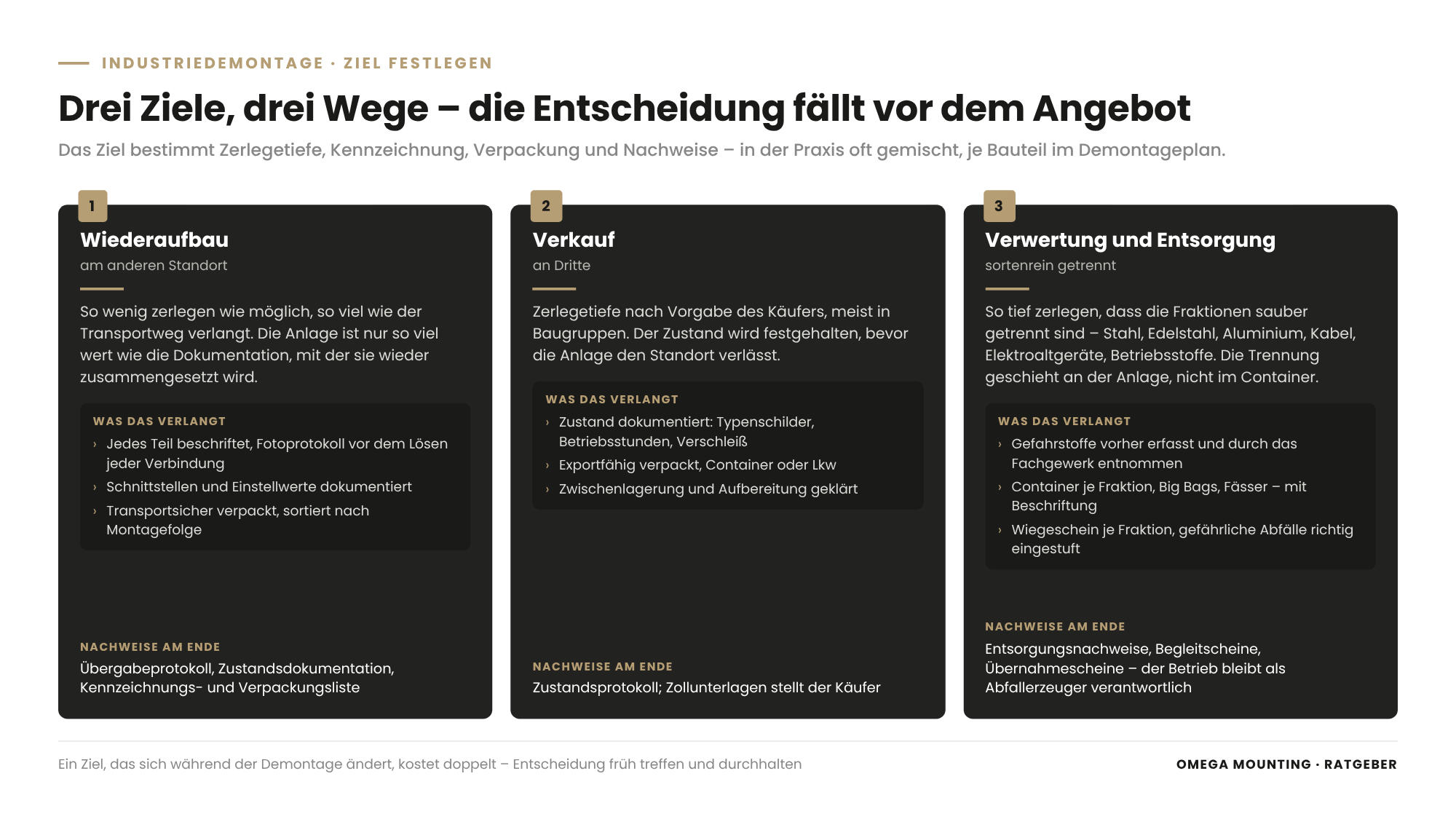
The most important decision is made before the quotation: what is to become of the plant?
| Objective | Degree of disassembly | Labelling and documentation | Packaging and transport | Records |
|---|---|---|---|---|
| Reassembly at another site. | As little as possible, as much as the transport route requires. | Every part labelled, photo log, interfaces documented. | Secured for transport, protected, sorted by installation sequence. | Handover report, condition documentation. |
| Sale to third parties. | As specified by the buyer, usually as assemblies. | Condition documented, nameplates, operating hours. | Packed for export, container or lorry. | Condition report, customs documents by the buyer. |
| Recycling and disposal. | Deep enough for the fractions to be cleanly separated. | Weighbridge tickets per fraction, hazardous substances recorded. | Container per fraction, big bags, drums. | Disposal records, consignment notes, acceptance notes. |
In practice the objectives are mixed – the control system is sold, the steel frame scrapped, the conveyor belts go to another site. The dismantling plan records the route of every component.
How do you disconnect utilities and isolate the plant?
Before mechanical dismantling, every energy and utility supply to the plant is disconnected, secured and documented. That means: electrical installations according to the five safety rules, compressed air and hydraulics depressurised, water, gas and refrigeration circuits drained, stored energy released.
Isolation means: disconnect all poles, secure against reconnection, verify absence of voltage, earth and short-circuit, cover adjacent live parts. These are the five safety rules of electrical engineering, laid down in DGUV Regulation 3 and DIN VDE 0105-100. They are carried out by a qualified electrician, and only their clearance releases the plant for mechanical work. Securing against reconnection – lockout/tagout in international usage – is done with a padlock and tag, the key of which stays with the person working on the plant.
We therefore plan a dismantling job like maintenance work according to the German technical rule TRBS 1112 (Maintenance). That means: with a defined release procedure and with personalised padlocks, which the rule explicitly calls lockout-tagout systems. Add to this personnel who are qualified, appointed and briefed. For you this means: clarify before the first working day who releases the plant, who signs the clearance and who carries the keys.
Stored energy
The plant is not safe just because the main switch is off. Compressed-air reservoirs hold pressure, hydraulic cylinders are under load, springs are tensioned, counterweights hang, lifting axes are in the raised position, capacitors in frequency inverters carry a charge. Each of these energies must be released or mechanically secured before a component is loosened. The risk assessment under Section 5 of the ArbSchG (German Occupational Safety Act) that precedes the dismantling lists them individually for each plant – a template from the folder is not enough.
Disconnecting without affecting the neighbours
Often only part of a plant is dismantled while the rest keeps running. In that case, disconnection and bypassing are done so that the remaining line continues to work without the removed section. Utility disconnection includes documentation: which line came from where, how was it sealed? Open utility connections in the wall are sealed, labelled and listed in the area handover.
Which hazardous substances must be recorded before dismantling?
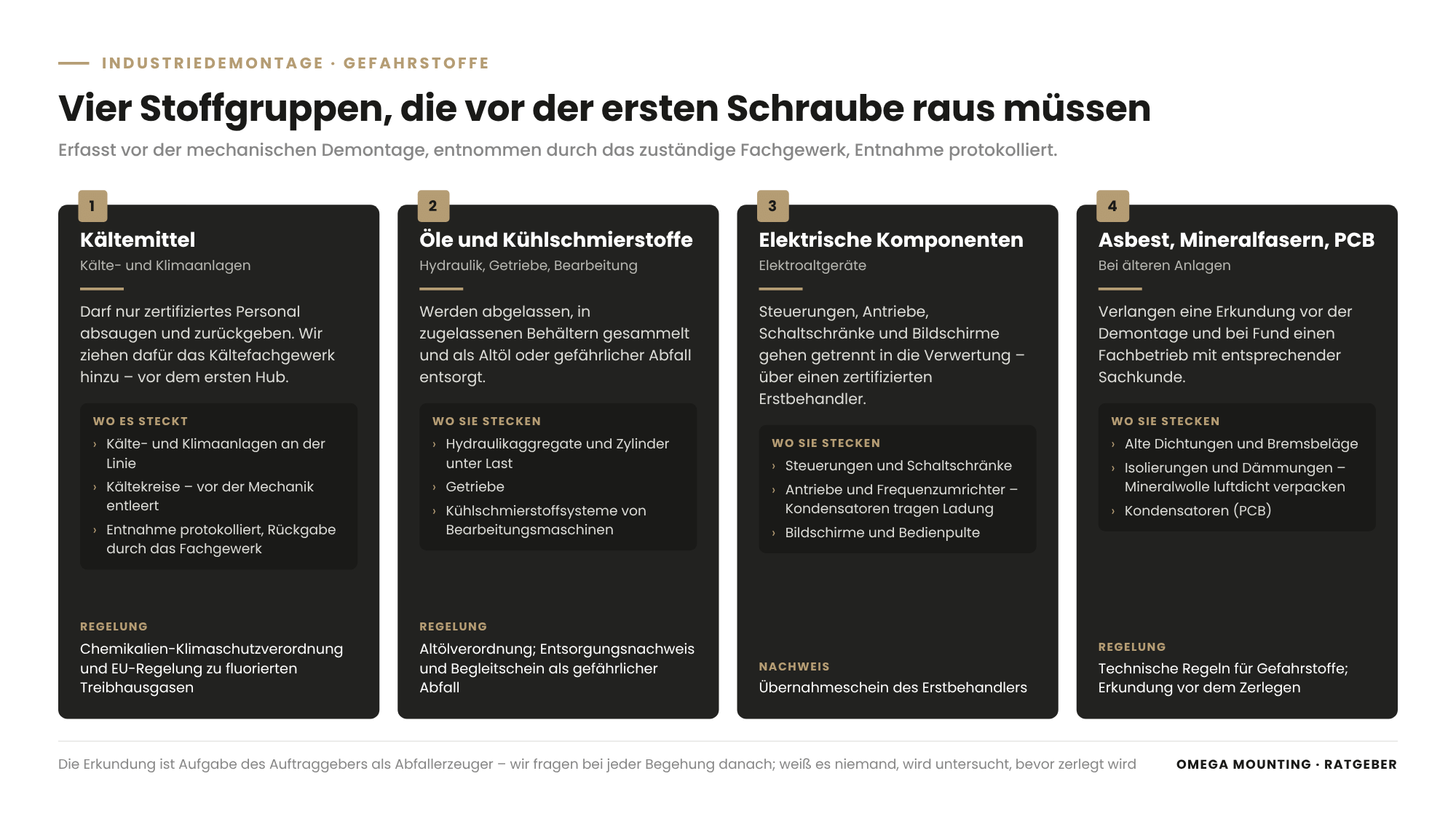
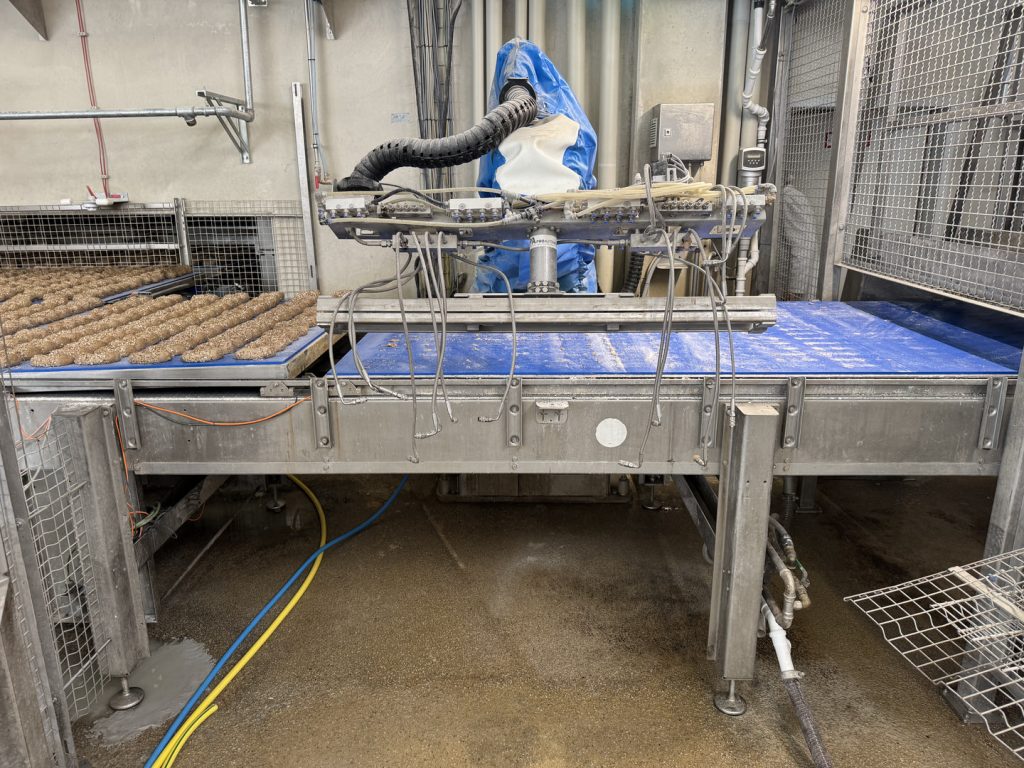
Before dismantling, all operating fluids and hazardous substances in the plant must be recorded and removed by the responsible specialist trade: hydraulic and gear oils, cutting fluids, refrigerants, cleaning agents, gases, batteries. Older plant may also contain components with asbestos, man-made mineral fibres or PCBs.
Who may do what
- Refrigerants from refrigeration and air-conditioning systems may only be recovered and returned by certified personnel; the German Chemicals Climate Protection Ordinance and the European F-gas regulation require this. We bring in the refrigeration trade here.
- Oils and cutting fluids are drained, collected in approved containers and disposed of as waste oil or hazardous waste; the German Waste Oil Ordinance governs the route.
- Electrical components – control systems, drives, switchgear cabinets, screens – are waste electrical equipment and go separately for recycling.
- Asbestos, mineral fibres, PCBs in old gaskets, brake linings, insulation or capacitors require investigation before dismantling and, if found, a specialist company with the appropriate expertise. The German technical rules for hazardous substances (TRGS) set the framework here.
The investigation is the task of the client as the waste producer – they know their plant. We ask about it at every site visit, and if nobody knows, it is examined before anything is taken apart.
In what sequence does industrial dismantling proceed?
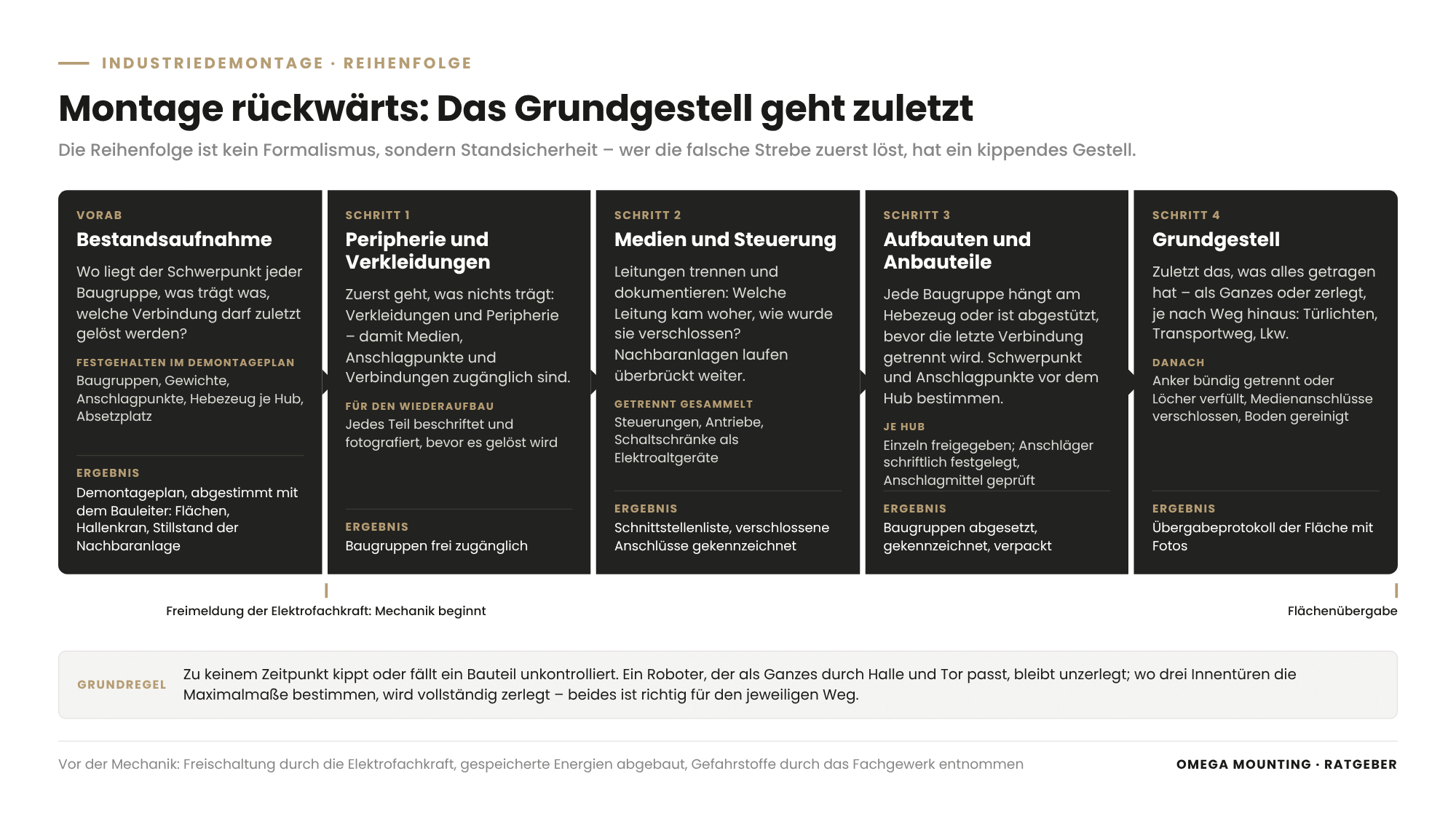
Industrial dismantling proceeds in reverse installation sequence: first peripherals and cladding, then utilities and controls, then superstructures and attachments, finally the base frame. Every loosened component is already hanging on the lifting gear or safely supported before the last connection is separated.
The sequence is not a formality but a matter of stability: loosen the wrong brace first and you have a tipping frame. That is why every dismantling job begins with a survey: where is the centre of gravity of each assembly, what carries what, which connection may be released last?
The dismantling plan
For larger plant we write the sequence down – as a dismantling plan with assemblies, weights, lifting points, lifting gear per lift and set-down area. It is coordinated with the client's site manager: which area may be occupied when, when is the overhead crane available, when is the neighbouring plant at a standstill?
In one piece or disassembled?
The degree of disassembly follows the transport route and the objective. A robot that fits through the hall and onto the lorry in one piece is removed without disassembly – like the robot weighing around 600 kilograms in Fulda. Six storage lifts in a Frankfurt office tower, on the other hand, had to be completely disassembled because three interior doors defined the maximum dimensions of every component.
Which lifting equipment suits dismantling inside the hall?
The lifting equipment for a dismantling job is chosen according to the weight and centre of gravity of the components, the space available between neighbouring plant, the load-bearing capacity of the floor and the transport route to the set-down area. The range extends from the mini crane through overhead crane and forklift with jib to machine skates and dollies.
Unlike moving into an empty building, the hall is full during dismantling. Neighbouring plant is running, conveyor belts are in the way, overhead cranes cannot reach the machine because it stands in a recess. Which lifting method suits which conditions is described in our guide Spider crane or mobile crane: which lifting method for moving in – the logic applies just as well in reverse.
The mini crane in the cell
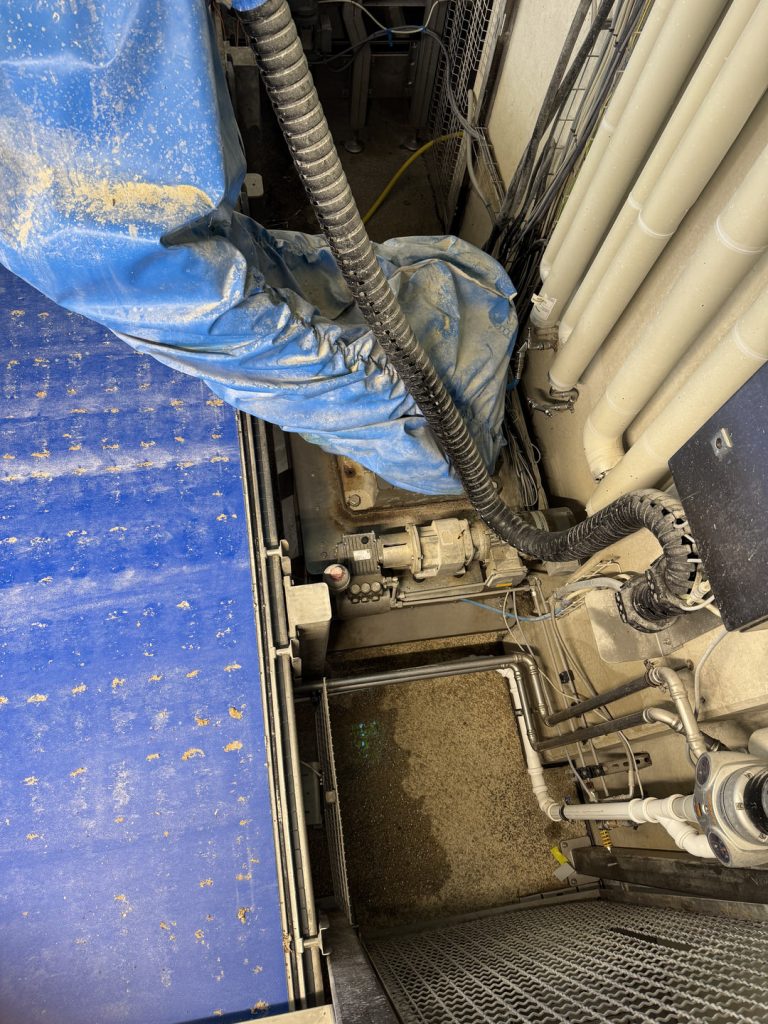
A mini crane – a compact crawler crane that fits through a door and extends its outriggers individually – is the machine for dismantling between existing plant inside the hall. In Fulda it lifted the robot in one piece over the production belt; between the conveyor belts it came down to centimetres. The lift plan defined in advance where the crane stands, how the load path runs and where the load is set down.
When no machine is allowed into the hall
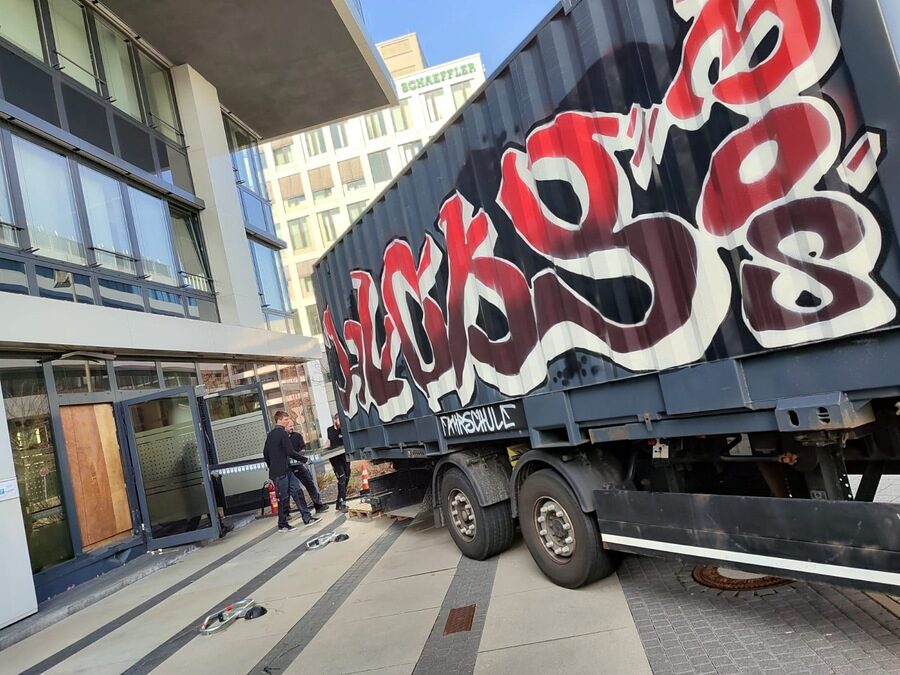
In the Frankfurt office tower no machinery could be used – parquet flooring worth protecting, narrow doors. The disassembled storage lifts were moved on dollies, with the load spread across the floor.
Slinging a plant that was never designed for it
Plant has lifting points for installation, rarely for the dismantling of assemblies. That is why the centre of gravity and lifting points of each assembly are determined before the lift, round slings and chains are selected according to load capacity and sling angle, and sharp edges are protected. DGUV Rule 100-500 describes the safe operation of load-handling equipment – and every lift is released individually.
Who is allowed to sling loads is not decided by shouting across the hall. The German technical rule TRBS 2111 (Mechanical hazards) requires that the group of people who sling loads is clearly defined and recorded in writing. Defective lifting accessories must be made visibly unusable. For you this means: before the first lift, have them show you who is slinging on your dismantling job and with which inspected equipment.
How do you label, pack and document for reassembly?
For reassembly, every dismantled component is uniquely labelled, and its position and connections are photographed and recorded. Small parts are packed and labelled by assembly, and the packaging protects against transport, moisture and mix-ups.
A plant that arrives disassembled in crates is worth only as much as the documentation that allows it to be put back together. When the six storage lifts were relocated from Frankfurt to Rodgau, the labelling was the actual service. During reassembly, racks, guides and sensors had to be aligned to the millimetre; a height offset would have led to misalignment and jamming.
What belongs in the documentation
- Labelling of every component with plant, assembly and position number, durable and legible – not chalk on bare steel.
- Photo log before each connection is released: position, orientation, cable routes, hose routing, setting dimensions.
- Interface list: which line, which connector, which flange belongs where, with labelling on both sides.
- Setting valuesneeded for reassembly: levelling, preload, reference positions, software versions.
- Packing list per crate and pallet, so that nobody has to search during reassembly.
- Condition documentation: wear, damage, missing parts – recorded before transport, so that it is clear later what the condition was beforehand.
Who recommissions the plant?
During reassembly, the installation contractor's work often ends at the control system – sensors, software and final acceptance are frequently taken over by the plant manufacturer. Clarify before dismantling who is involved and when; some manufacturers insist on being present so that the warranty remains valid.
How do you separate recyclables and keep records?
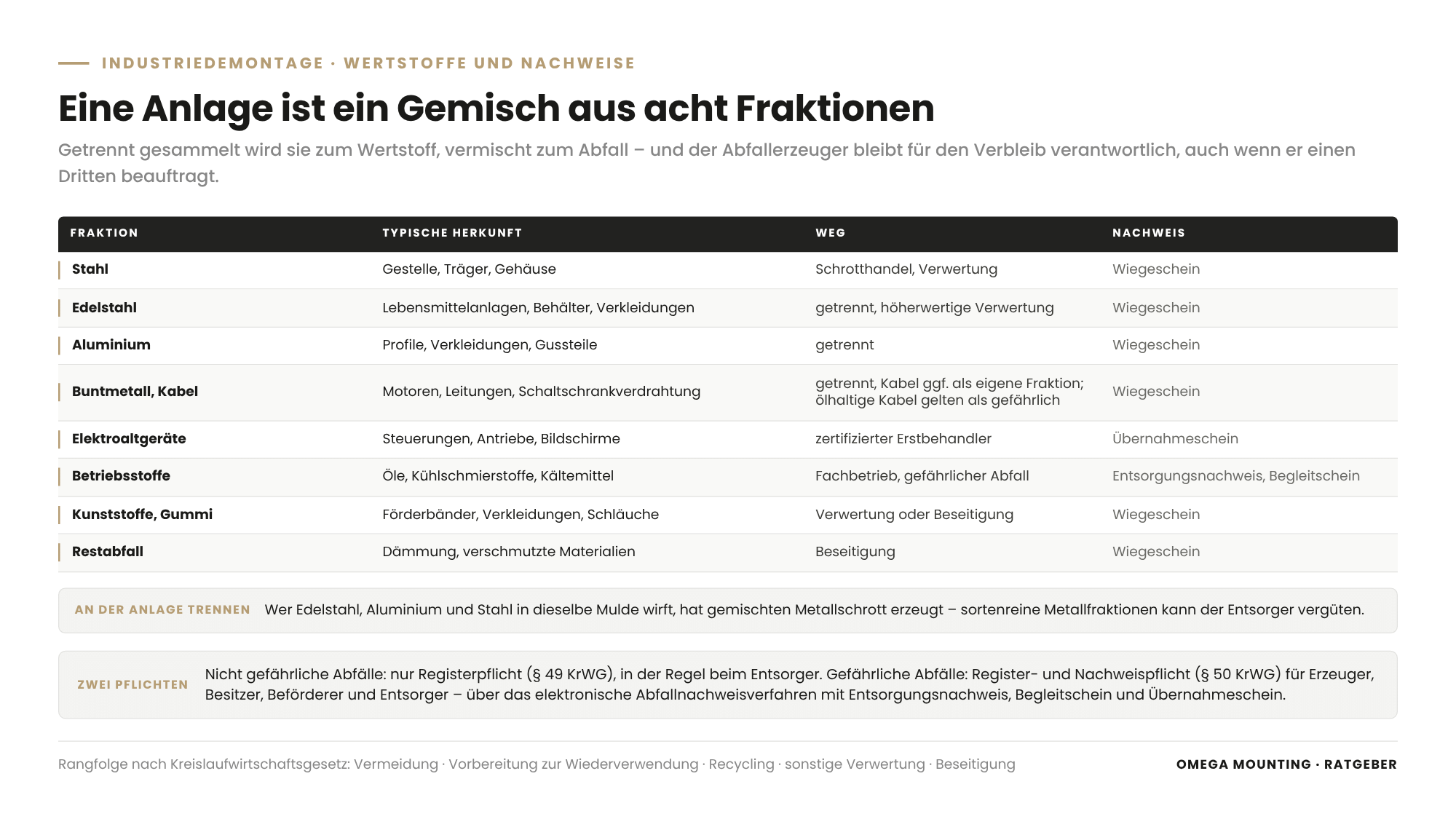
During dismantling, recyclables are collected separately by fraction – steel, stainless steel, aluminium, non-ferrous metals and cables, waste electrical equipment, operating fluids, plastics, residual waste. Their whereabouts are documented with weighbridge tickets, acceptance notes and, for hazardous waste, with disposal records and consignment notes.
The German Circular Economy Act (KrWG) sets out the hierarchy: prevention before preparation for reuse before recycling before other recovery before disposal. It also distinguishes waste for recovery, which any licensed waste contractor may accept, from waste for disposal, which under certain circumstances must be handed to the public waste disposal authority – i.e. the municipality. And it separates hazardous from non-hazardous waste. Which type of waste counts as hazardous is defined by the German Waste Catalogue Ordinance: it assigns a six-digit waste code to every type of waste and marks hazardous types with an asterisk. Metals from construction and demolition waste are listed there under 17 04 – one code each for iron and steel, aluminium, copper, mixed metals and cables. Oil-containing cables and contaminated metals count as hazardous.
For a dismantling job this means: what can be reused is not scrapped; what is scrapped is separated by type and correctly classified. The German Commercial Waste Ordinance requires separate collection and documentation – and the waste producer, i.e. your business, remains responsible for proper disposal even when it commissions a third party.
Fractions of a plant
| Fraction | Typical origin | Route | Record |
|---|---|---|---|
| Steel. | Frames, beams, housings. | Scrap dealer, recycling. | Weighbridge ticket. |
| Stainless steel. | Food-processing plant, vessels, cladding. | Separate, higher-value recycling. | Weighbridge ticket. |
| Aluminium. | Profiles, cladding, castings. | Separate. | Weighbridge ticket. |
| Non-ferrous metal, cables. | Motors, cables, switchgear cabinet wiring. | Separate, cables as a fraction of their own where appropriate. | Weighbridge ticket. |
| Waste electrical equipment. | Control systems, drives, screens. | Certified primary treatment facility. | Acceptance note. |
| Operating fluids. | Oils, cutting fluids, refrigerants. | Specialist company, hazardous waste. | Disposal record, consignment note. |
| Plastics, rubber. | Conveyor belts, cladding, hoses. | Recovery or disposal. | Weighbridge ticket. |
| Residual waste. | Insulation, contaminated materials. | Disposal. | Weighbridge ticket. |
Separation happens at the plant, not in the container. Separating recyclables means: anyone who throws stainless steel, aluminium and steel into the same skip has produced mixed scrap metal and given away the higher-value recycling. Single-type metal fractions can be credited by the waste contractor and should therefore always be handed over separately.
Register obligation and record-keeping obligation
The German Circular Economy Act has two documentation obligations that the BG BAU/BAuA module “Site set-up – waste separation and waste disposal” keeps cleanly apart: the register obligation under Section 49 and the record-keeping obligation under Section 50. For non-hazardous waste only the register obligation applies, and as a rule it falls on the waste contractor alone. For hazardous waste both obligations apply – equally to producers, holders, collectors, carriers and disposers. Record-keeping runs through the electronic waste verification procedure with disposal record, consignment note and acceptance note under the German Waste Verification Ordinance.
For you as the client this means: as soon as oils, PCB-containing capacitors or asbestos-containing gaskets leave the plant, you as the producer are subject to the record-keeping obligation. An installation contractor that transports or temporarily stores this waste becomes subject to it as the holder. That is why, before dismantling, we define who the producer is, who provides the containers, who transports and who signs the consignment notes. Which documents you should have in hand at the end is summarised in the FAQ at the end of this article.
How do you plan the disposal concept and container locations?
Before a dismantling job with significant quantities of waste, a disposal concept is drawn up that records the types and quantities of waste with waste codes, possible contaminants, necessary sampling and the disposal routes. At the same time it defines where on the site which containers stand, who fills them and who is responsible for them.
What site practice for demolition and refurbishment work knows as a waste disposal concept is part of the dismantling plan for us: a waste inventory per plant with estimated quantity, waste code and disposal route per fraction. Where contamination is suspected, sampling is added before anything is taken apart.
Containers: first the location, then the size
Containers should be accessible to fitters and transport vehicles and stand close to where the waste arises. In a full hall this often means stackable small containers at the dismantling area rather than a skip in the yard. Type and size follow the volume, the degree of separation and the space available; as sizes common in practice, the module names containers of 5.5 and 7 cubic metres and small containers of 1 to 2 cubic metres.
One point regularly overlooked in dismantling jobs with a crane: ordinary skips are not approved for crane handling. If a container is to be moved with an overhead crane or mini crane, crane-liftable containers with a continuous rim and their own lifting points are needed – and that goes into the lift plan.
Labelling, responsibility, escape routes
Incorrect filling turns a single-type recyclable into mixed waste. That is why every container carries durable, quickly legible labelling, and hazardous waste is handed over only at a marked collection point in the presence of the responsible person, whom we appoint for every dismantling area. If containers are used by several companies, this belongs in the contract – otherwise at the end it is unclear who is liable for incorrect filling and disposal. And: waste must not restrict work areas or escape routes.
What is different about dismantling during ongoing operations?
When dismantling during ongoing operations, the dismantling area and the business are separated – by barriers, dust and noise protection and coordinated maintenance windows for lifts and hot work. At the end there is an area handover after which the business can carry on working immediately.
Production does not stop because dismantling is happening next door. That is why the dismantling area becomes a construction site within the business: cordoned off, with its own access, with protection for neighbouring plant against dust, swarf and falling parts. Lifts over running plant and cutting work with flying sparks are placed in maintenance windows – night shift, weekend, shift changeover.
Dust: extract rather than sweep
Abrasive cutting, drilling into foundations and removing old insulation release dust – with mineral material usually with a proportion of respirable crystalline silica, which is classified as carcinogenic. The GefStoffV (German Hazardous Substances Ordinance) and the BAuA information “Site set-up – low-dust working” require the STOP principle: avoid dust, otherwise extract at the point of origin or work wet, enclose dust sources, route contaminated air through air cleaners. Only when that is not enough is respiratory protection added. Dry sweeping and blowing off with compressed air are not permitted. Dust deposits are bound with moisture or picked up with dust extractors of at least dust class M; old mineral wool goes into the container in airtight packaging. Standing areas for air cleaners and partitions therefore belong in the area planning from the outset.
Hot work during dismantling
Abrasive cutting, flame cutting and welding during a cell conversion are hot work: they need a hot work permit, a fire watch, removed or covered combustible materials and extraction. What to observe when welding within a running business is described in our guide to repair welding on industrial plant.
The area handover
Dismantling does not end when the plant is gone, but when the area has been handed over. That means: utility connections sealed and labelled, anchor holes filled or anchors cut flush, floor cleaned, foundation remains removed or documented, lighting and escape routes clear again. A handover report with photos records the condition – for the business that needs the area immediately, and for the landlord when the hall is returned.
How we do it in the Rhine-Main region
Industrial dismantling in the Rhine-Main region means for us above all: existing businesses that keep running. Manufacturing plants in Hanau and Aschaffenburg, logistics centres near Frankfurt, office buildings with technical equipment that was never planned for removal, businesses in Offenbach and Darmstadt that are restructuring.
Our dismantling jobs begin with a site visit at which we clarify three things: the objective of the dismantling, the utilities and hazardous substances in the plant and the route out. From this we produce a quotation that names the interfaces – who isolates, who removes refrigerant, who provides containers, who hands over the area. Where several companies meet – your electrician, the refrigeration trade, our team – we define the coordination in advance, as TRBS 1112 requires for maintenance work with several parties involved. We bring in subcontractors only with the evidence you are entitled to demand from us too; which that is, is described in our guide to subcontractor evidence for installation work.
Our own workshop in Rodgau is the place where components are stored temporarily, cleaned, preserved or prepared for sale. There we also manufacture transport frames and slinging aids for assemblies without lifting points. The short distances in the Rhine-Main region make it possible to schedule a dismantling job over a weekend and leave the business with a handed-over area on Monday.
How we do it in practice
Three projects from our project diary show the range of industrial dismantling. It extends from the robot on the mini crane through the dismantling of a container office to complete disassembly for reassembly.
Robot removed from its cell in one piece – bakery near Fulda
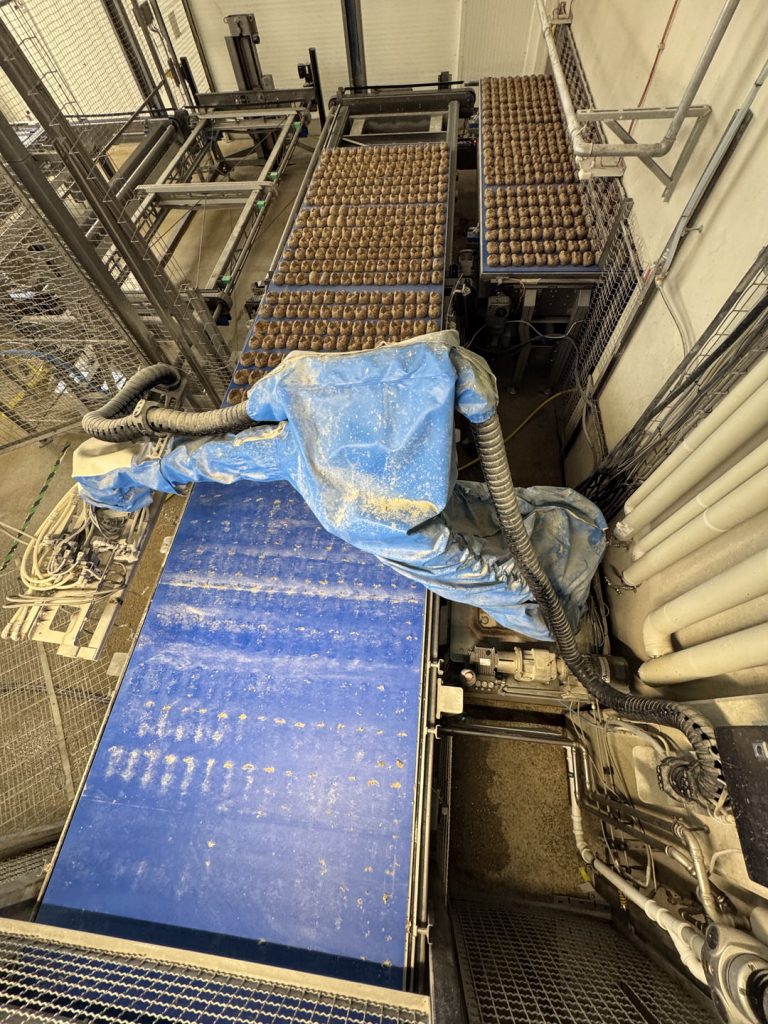
In one piece, from a cell between running conveyor belts. At an industrial organic bakery near Fulda we dismantled an industrial robot weighing around 600 kilograms with the mini crane. Supply lines for electricity, water and compressed air were checked and disconnected, the bus system bypassed, and the risk assessment and lift plan were in place before the lift. The robot was lifted over the production belt on inspected round slings and set down under control; the robot base was then removed. The removal took one day; in the following days, while production was at a standstill, the team converted the robot cell – including TIG welding on stainless steel. Deployed: one appointed person for the lifting operations, one crane operator and two mechatronics technicians.
Container office dismantled and relocated – manufacturing plant
A manufacturing plant needed space to restructure its machines; in the way stood a production office made of container modules. We dismantled the container office and reassembled it elsewhere. Electrics removed, floor completely dismantled, supply lines and air conditioning removed, roof of sandwich panels taken off, system partition walls taken down. Everything was moved within the production site and set up again. A dismantling job in which nothing went into the container – because the objective from the outset was reassembly.
Six storage lifts disassembled – Frankfurt to Rodgau
From a Frankfurt office tower near the airport we dismantled six paternoster storage lifts and reassembled them in Rodgau. Three interior doors defined the maximum dimensions of every component, and the parquet flooring had to be preserved – no machinery. The storage lifts were disassembled with a trained eye into transportable individual parts, each part documented, labelled and photographed. They went through the building on dollies and into containers; six fitters were deployed for loading. During reassembly, racks and guides were levelled before the sensors were fitted.
Do you have a plant due for removal? Then get in touch with us – a site visit usually clarifies within an hour whether the plant goes out in one piece or is disassembled, and who takes on which interface.
What this means for your role
For buyers: Write the objective of the dismantling into the scope of works – reassembly, sale or recycling. Demand quotations that list isolation, hazardous substance removal, lifting equipment, separation and records as separate items. A lump-sum quotation for “dismantling and disposal” without an interface list generates change orders. Regulate in the contract who provides the waste containers and whether several companies share them.
For designers: If you are replanning an area, plan the route out at the same time – door clearances, transport routes, crane set-up areas, floor loads for lifting gear – plus the standing areas for containers, air cleaners and partitions. Define what happens to foundations, utility connections and floor openings after dismantling, and draw the handover condition of the area so that the following trade can build on it.
For project managers and site managers: As project manager, you coordinate the timing of maintenance windows, overhead crane, container locations and specialist trades, and make sure the hazardous substance investigation is available before dismantling. As site manager, you brief the crew, define the barriers and access, and release isolation, lifts and hot work. You appoint the responsible person for disposal matters and accept the area with a report.
For maintenance managers: You know the plant best – its utilities, its quirks, its stored energy. Provide circuit diagrams, utility plans and operating manuals, name the qualified electrician for isolation and secure spare parts that can be recovered from the plant before they end up in the container.
For operations and plant managers: Decide early what is to become of the plant and stick to the decision – an objective that changes during dismantling costs double. Release the maintenance windows that safe dismantling needs. Your business is the waste producer – and for hazardous waste therefore subject to register and record-keeping obligations – and the records of the plant's whereabouts belong in your waste register.
For safety officers and HSE coordinators: Demand a plant-specific risk assessment with isolation concept, stored energy, hazardous substances and lift plan – not a template. Check the separation between dismantling area and business, the hot work permit, the rescue chain and low-dust cleaning. The clearance after isolation and the release of each lift are the two points where you should take a close look.
Dismantling and deconstruction checklist on request
The dismantling and deconstruction checklist summarises on two pages what must be clarified from the survey to the area handover. It ranges from the objective of the dismantling through isolation, hazardous substances, lifting equipment and labelling to recyclable fractions and records. Request the checklist via our Contact form – keyword “dismantling checklist”.
Why Omega Mounting?
From Rodgau near Frankfurt, Omega Mounting dismantles machines, plant and operating equipment in the Rhine-Main region and beyond. We work with a mini crane, our own workshop for transport frames and preparation, and teams of mechatronics technicians who understand a plant before they take it apart. The linked projects show what dismantling means for us: isolate, plan, lift, label, separate, hand over. Via our 24-hour hotline you can also reach us when a damaged plant has to be removed at short notice. For you this means: a single point of contact for isolation, lifting equipment, separation and records, plus short distances in the Rhine-Main region. And a workshop in which your plant is stored temporarily or prepared for sale instead of standing in the yard.
Conclusion
Industrial dismantling succeeds when, before the first bolt is loosened, it is settled what is to become of the plant. Isolation, hazardous substances, sequence, lifting equipment, labelling and disposal are planned like an installation – only in reverse. Anyone who separates recyclables at the plant and demands records ends up not only with a clear area but with proof of where every kilogram has gone. Send us your plant list, floor plan with the route out and your preferred date – we will get back to you with an honest assessment before the container is ordered.
Further reading: If the plant is to run again after dismantling, different rules apply than for deconstruction: Dismantling and reassembly of a plant: labelling, photos, packaging.
Planning maintenance, moving in or installation in the Rhine-Main region?
Tell us briefly what it is about – we will come back to you with an honest assessment.
100% free and without obligation
You may also be interested in these guides

About the author
Tobias Schott
Managing director of Omega Mounting GmbH, Rodgau · more than 20 years of hands-on experience in installation and maintenance
A trained mechatronics technician, at home in maintenance, servicing and industrial installation since 2004 – first at his father's side, since 2012 with Omega Mounting: from the overhead conveyor in Frankfurt to the crane system in a new-build hall. Plans and leads lifting operations as appointed person in data centers and on industrial sites in the Rhine-Main region, is an instructor and examiner for cranes, mobile elevating work platforms and telehandlers, and a safety officer. On jobs abroad he is known as the “German Troubleshooter” – the one you call when things get stuck on site. He learned what quality means not from a manual but from his father: Made in Germany as a standard for his own work, not as a label. That is why it comes first at Omega Mounting – before speed and before price. He writes these guides from that practice: what works on our sites is in them – what only exists in the standard is not.
Frequently asked questions
In demolition, what has to go is destroyed. In industrial dismantling, a plant is taken apart so that it can be reassembled, sold or recycled by type – and the building remains undamaged. Dismantling follows the reverse installation sequence, with isolation, lift plan, labelling and separation of fractions. Demolition is the right choice when nothing is to be preserved and the building goes too.
The waste producer – i.e. the business that owns the plant – remains responsible under the German Circular Economy Act for proper disposal, even when it commissions an installation contractor or waste contractor. For non-hazardous waste only the register obligation applies, which is usually fulfilled by the waste contractor; for hazardous waste, producers, holders, carriers and disposers are all subject to register and record-keeping obligations. So demand the records and file them in your waste register.
Yes. Decommissioned does not mean de-energised or free of stored energy. Electrical installations are isolated by a qualified electrician according to the five safety rules and secured against reconnection; compressed air, hydraulics, springs, counterweights and capacitors are discharged or mechanically secured. Only the clearance releases the plant for mechanical work.
Both are removed before mechanical dismantling by the responsible specialist trade: refrigerant only by certified personnel, oils and cutting fluids into approved containers and disposed of as waste oil or hazardous waste. The removal is recorded and the disposal documented with records.
Yes, if the dismantling area is cordoned off, neighbouring plant is protected against dust and falling parts, dust is extracted rather than swept, and lifts and hot work are placed in maintenance windows. In Fulda we lifted a robot out of a cell between running conveyor belts after the bus system had been bypassed so that the rest of the line kept running.
Weighbridge tickets per recyclable fraction with quantity, date and recipient, acceptance notes for waste electrical equipment, and for hazardous waste the disposal record and consignment notes. Plus the record of hazardous substance removal by the specialist trade and a handover report of the area with photos. For reassembly, additionally the labelling list, photo log and condition documentation of the plant.
From Rodgau, Omega Mounting dismantles machines, plant and operating equipment in Frankfurt, Offenbach, Hanau, Darmstadt, Aschaffenburg and throughout the Rhine-Main region – with a mini crane, our own workshop and teams of mechatronics technicians. We take on lifting equipment, labelling and separation of fractions and coordinate your qualified electrician and the specialist trades for hazardous substances.
The basis is the ArbSchG (German Occupational Safety Act) with the risk assessment under Section 5 and the BetrSichV (Industrial Safety Ordinance) with the technical rules TRBS 1112 (release and coordination) and TRBS 2111 (slinging of loads). Added to this are DGUV Regulation 3 with the five safety rules for isolation and DGUV Rule 100-500 for the operation of load-handling equipment. The technical rules for hazardous substances (TRGS) apply where asbestos or other hazardous substances are present. For disposal, the German Circular Economy Act, Commercial Waste Ordinance and Waste Verification Ordinance apply.
Via a short enquiry with three details: what is to become of the plant (reassembly, sale or recycling), a plant list or photos with approximate weights, and a floor plan with the route out. We arrange a site visit, clarify utilities, hazardous substances and lifting equipment on site and send you a written assessment with the interfaces to your specialist trades. Your contact is Tobias Schott – reachable via our Contact form.
 English
 German