
- Guide – Lift & Shift
Planning a tandem lift: two cranes, one load – what matters
By Tobias Schott · 21-minute read · Updated October 2026
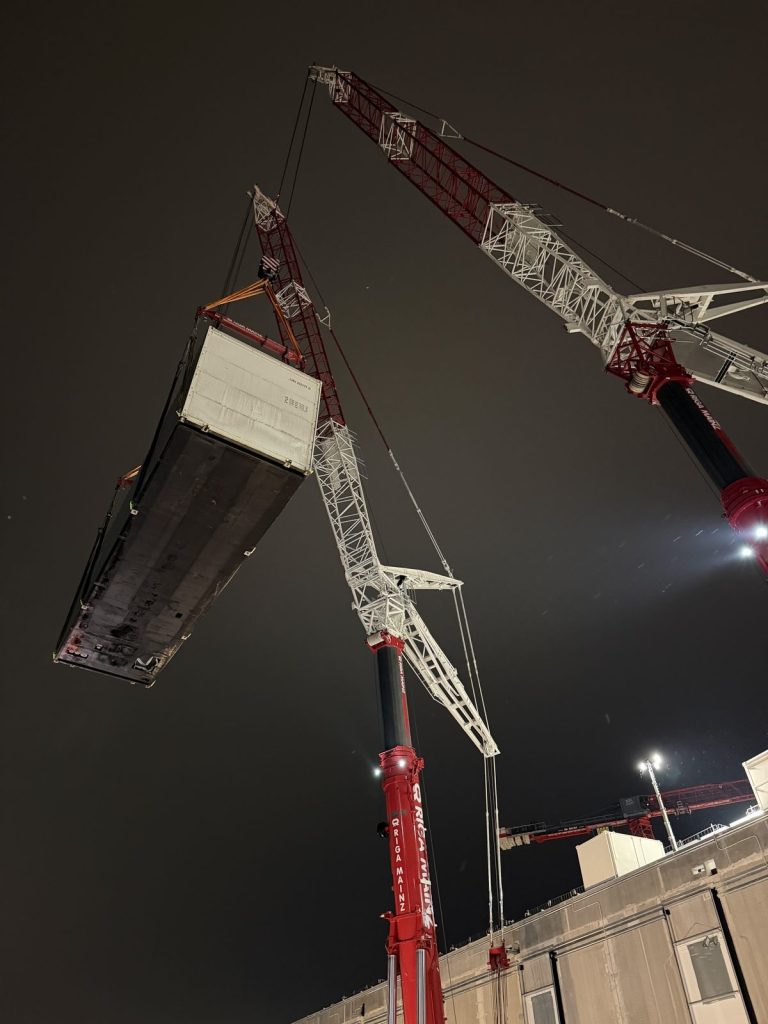
In a tandem lift two cranes lift one load together. It is needed when one crane alone cannot manage the load at that point, when it is too long or has to arrive in a particular position. Because the load can shift between the cranes, a tandem lift needs more planning, more reserve and a single voice giving the commands.
Sometimes one crane is not enough. The load is too long, the set-down point is too far behind the building, or there is no position for the one large crane that could do it all alone. Then one word often comes up: tandem lift.
This guide explains what a tandem lift is and when it becomes necessary. It shows why a lift with two cranes is more demanding than one with a single crane. And it describes what has to be settled in planning and execution: lift plan for both cranes, rigging, roles, communication, test lift and stop criteria.
We are an installation and rigging company from Rodgau near Frankfurt. We plan lifts, rig loads and signal. Cranes and crane operators are provided by the crane company, which also calculates crane selection and load sharing. What has to be settled before every lift is described in our guide on Planning a crane lift.
Key points at a glance
- In a tandem lift two cranes lift the same load at the same time. Both carry part of the weight.
- It becomes necessary when one crane cannot manage the load at the required radius, the load is too long or has to arrive in a particular position.
- The load distribution does not stay put. If the load tilts or one crane lags, weight moves to the other.
- That is why each crane needs reserve. How much is calculated by the crane company.
- A lift plan sets both cranes, both crane positions, rigging, load sharing and the order of movements.
- Exactly one person gives the commands. Everyone else carries them out.
- A test lift checks whether the load behaves as planned. Stop criteria are settled beforehand.
What is a tandem lift?
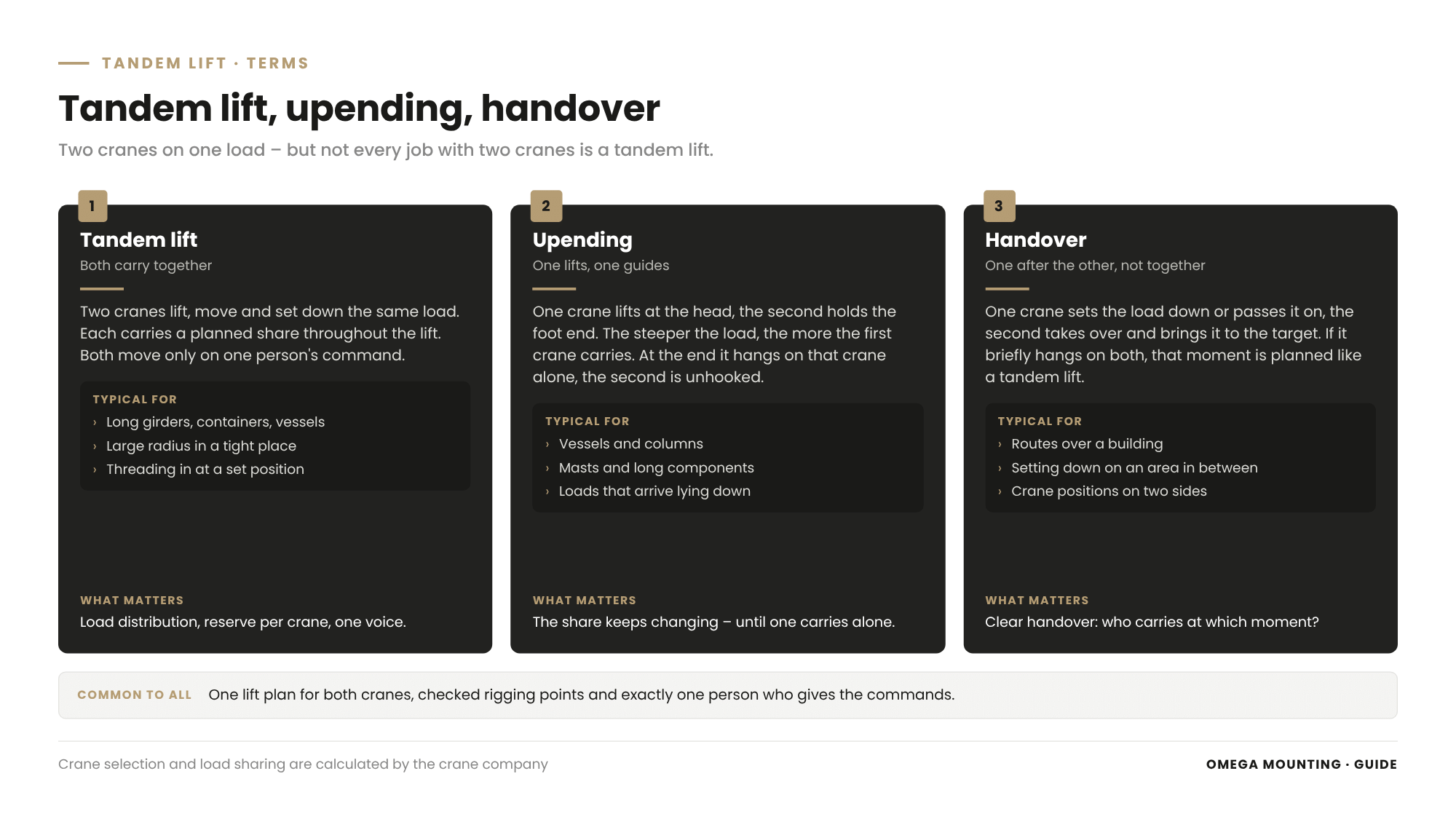
A tandem lift is a lift in which two cranes lift, move and set down the same load at the same time – each carries a planned share of the weight, and both move in coordination on the commands of one person.
It is also called a dual crane lift. In practice you also hear “a lift with two cranes”. It always means the same: one load, two hooks, one shared sequence. If more than two cranes lift, the same principles apply, only more strictly.
What a tandem lift is not
Not every job with two cranes is a tandem lift in the strict sense. Two procedures are often confused with it.
Upending with two cranes. A long load lies horizontally and is to stand vertically, for example a vessel, a mast or a column. One crane lifts at the head, the second holds the foot end above the ground. As the load rises, the first crane takes more and more weight. At the end everything hangs on it, and the second is unhooked. That is a lift with two cranes, but with a constantly changing share.
Handing over or transferring. One crane lifts the load and sets it down, a second picks it up there and takes it further. Or the load passes in the air from one hook to the other. Both cranes work one after the other, not together.
In a tandem lift, by contrast, both cranes carry the load together throughout the lift. The planning is similarly demanding, but the questions are different.
The building blocks of a tandem lift
Every tandem lift includes:
- two cranes each with a crane position, outriggers and a crane operator,
- one load with known rigging points and a known centre of gravity,
- Lifting accessory on each hook, often with a spreader beam,
- a lift plan, which describes both cranes, the load sharing and the movements,
- a responsible person, who gives the commands,
- a means of communication, which connects everyone involved.
When a tandem lift is needed
A tandem lift is needed when a single crane cannot lift the load safely at that point, when the load is too long or too flexible for one hook, when it has to be turned or threaded in at a particular position – or when there is no room for the one large crane.
The load is too heavy for one crane at this point
What a crane may lift depends not only on its size but on the radius. The further the load is from the crane, the less may hang on the hook. If the only possible crane position is far from the set-down point, one crane may not be enough. Two cranes then share the load so that each has enough reserve at its radius. How radius and permitted load are related is explained in our article on load moment and radius.
The load is too long
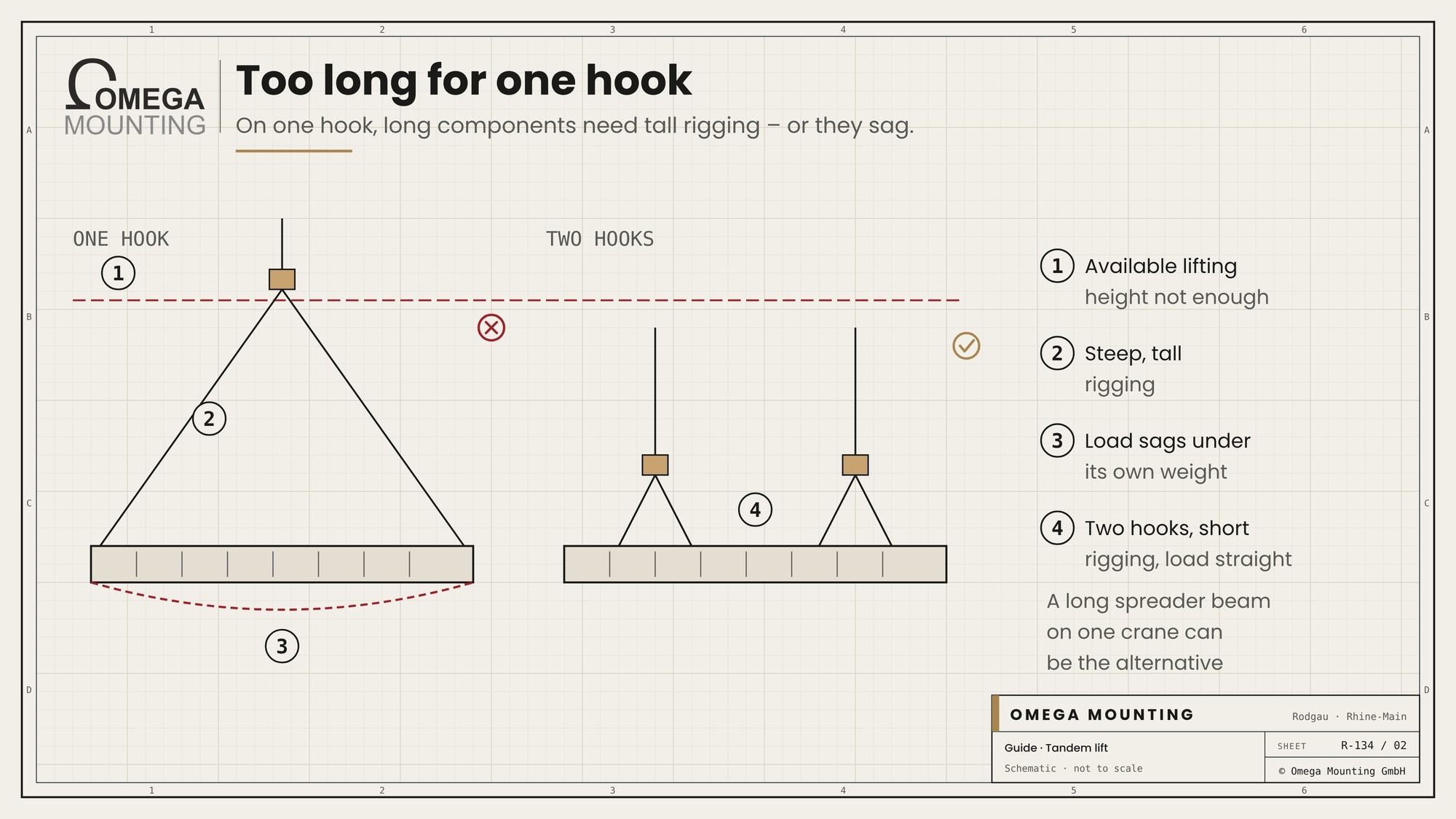
Long components such as girders, pipes, vessels or containers hang on one hook only with steep, tall rigging or a long spreader beam. Sometimes the lifting height is not enough for that. Sometimes the load would bend too much under its own weight. With two cranes it is carried at both ends.
The load has to arrive in a particular position
Some loads have to be tilted, turned or threaded in at an angle – for example through an opening in the facade or under a canopy. With two cranes the tilt can be controlled precisely: one hook lifts, the other lowers. That does, however, need particularly careful planning.
There is not enough space for one large crane
A large crane needs a lot of standing area, a lot of outrigger space and often ballast vehicles. On tight plots or in narrow streets there is no such space. Two smaller cranes sometimes fit in two places where one large crane could not stand. If one of the positions is on the road, a permit and a closure are needed. What that involves is described in our guide on the crane on the road.
When a tandem lift is not the best solution
A tandem lift is not the way out of every difficult situation. Before planning one, it pays to look at alternatives:
- A larger crane, if there is a position for it.
- A better crane position, which shortens the radius.
- Dismantling the load into assemblies, if the manufacturer allows it.
- Another method, for example skidding, skates or a lifting gantry.
Which lifting methods are possible for a move-in is shown in our guide on choosing the lifting method for a move-in. The decision is made together with the crane company, which calculates the options.
Why a tandem lift is more demanding than a lift with one crane
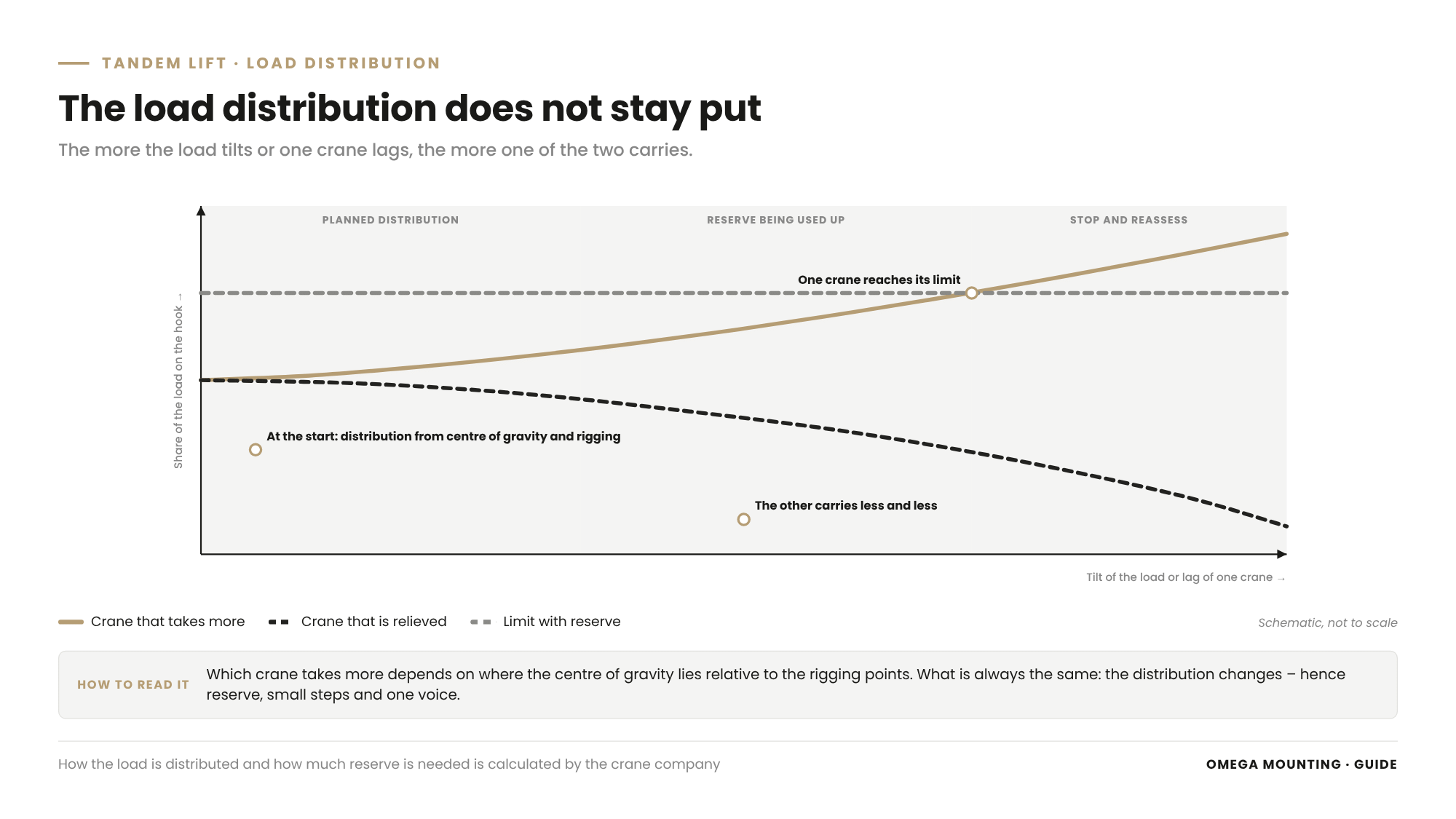
A tandem lift is more demanding because the load distribution between the cranes shifts with every tilt and every uneven movement, because both cranes have to work in sync and because each crane therefore needs reserve – two cranes are not twice as safe as one, but twice as complicated.
The load distribution changes
At the start it is clear who carries how much. That follows from the load's centre of gravity and the position of the rigging points. If the centre of gravity is not in the middle, one crane carries more than the other.
But this distribution does not stay put. If the load tilts, the centre of gravity shifts relative to the hooks. Then one crane carries more, the other less. Which crane takes more depends on where the centre of gravity lies relative to the rigging points. The crane company calculates this for the planned sequence.
Both cranes must work in sync
If one crane lifts faster than the other, the load tilts. If one crane falls behind when slewing, the load pulls at an angle on its rope. In both cases weight moves to the other crane, and the planned distribution no longer holds.
That is why in a tandem lift both cranes move slowly, in small steps and on command. Large movements such as slewing, luffing or telescoping are avoided where possible or carried out only one after the other and coordinated.
Side pull on the rope
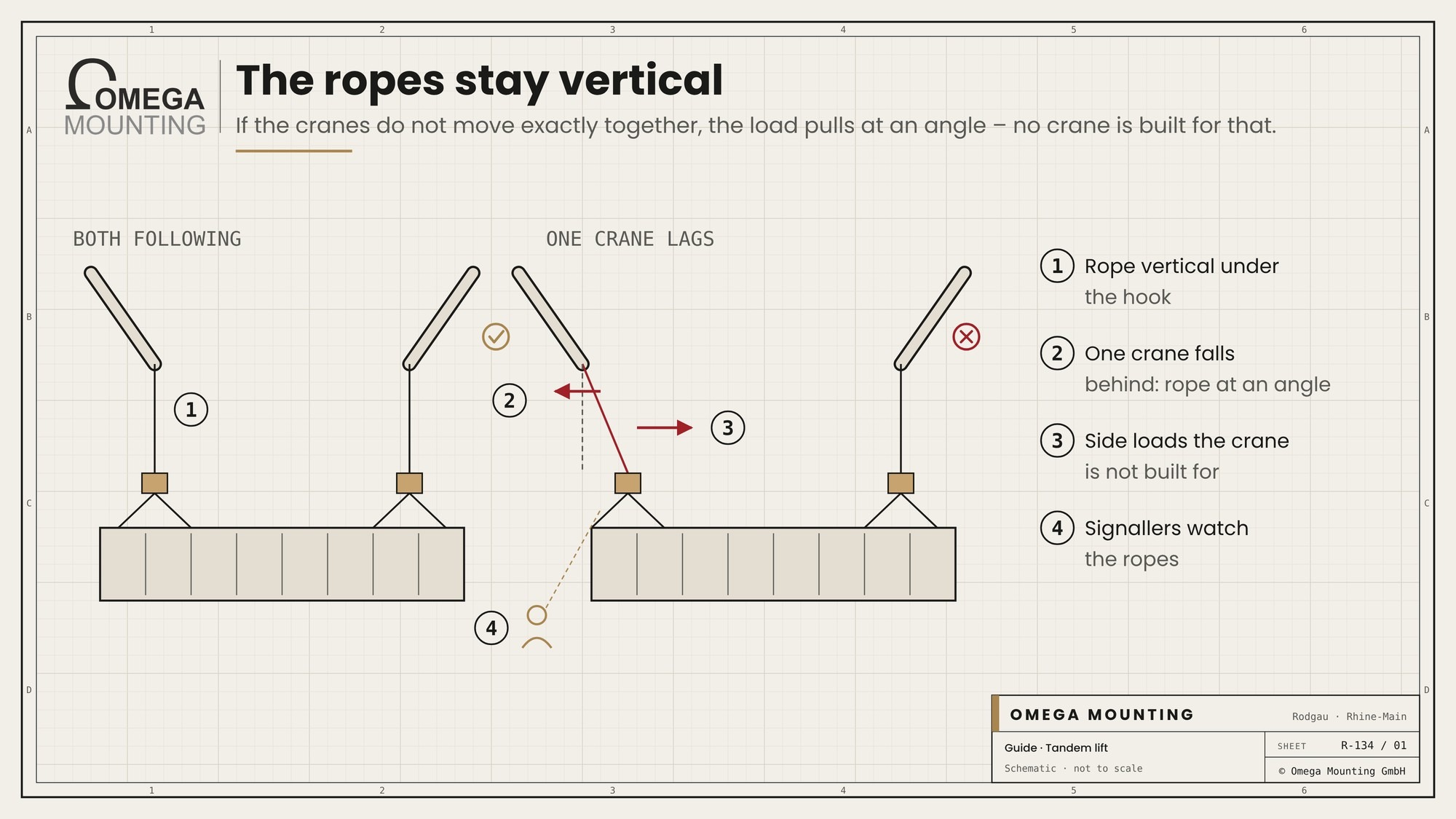
A crane is built to lift loads vertically under the hook. If the load pulls at an angle on the rope, forces arise that the crane is not designed for. In a tandem lift this happens quickly if the cranes do not move exactly together. The ropes must therefore stay as vertical as possible throughout the lift. Signallers watch exactly that.
Reserve in utilisation
Because the load distribution can change, no crane in a tandem lift is planned up to its limit. Each needs a reserve in case it has to carry more than intended. How large this reserve must be is set by the crane company based on the cranes' documents and the planned sequence. We deliberately give no values here, because they depend on crane, load and sequence.
Two cranes in a tight space
Two cranes need two positions, two sets of outriggers and two slewing areas. Booms and ropes must not touch. Both crane operators must know where the other crane is. In tight spaces this becomes a planning topic of its own.
Wind
Two different cranes
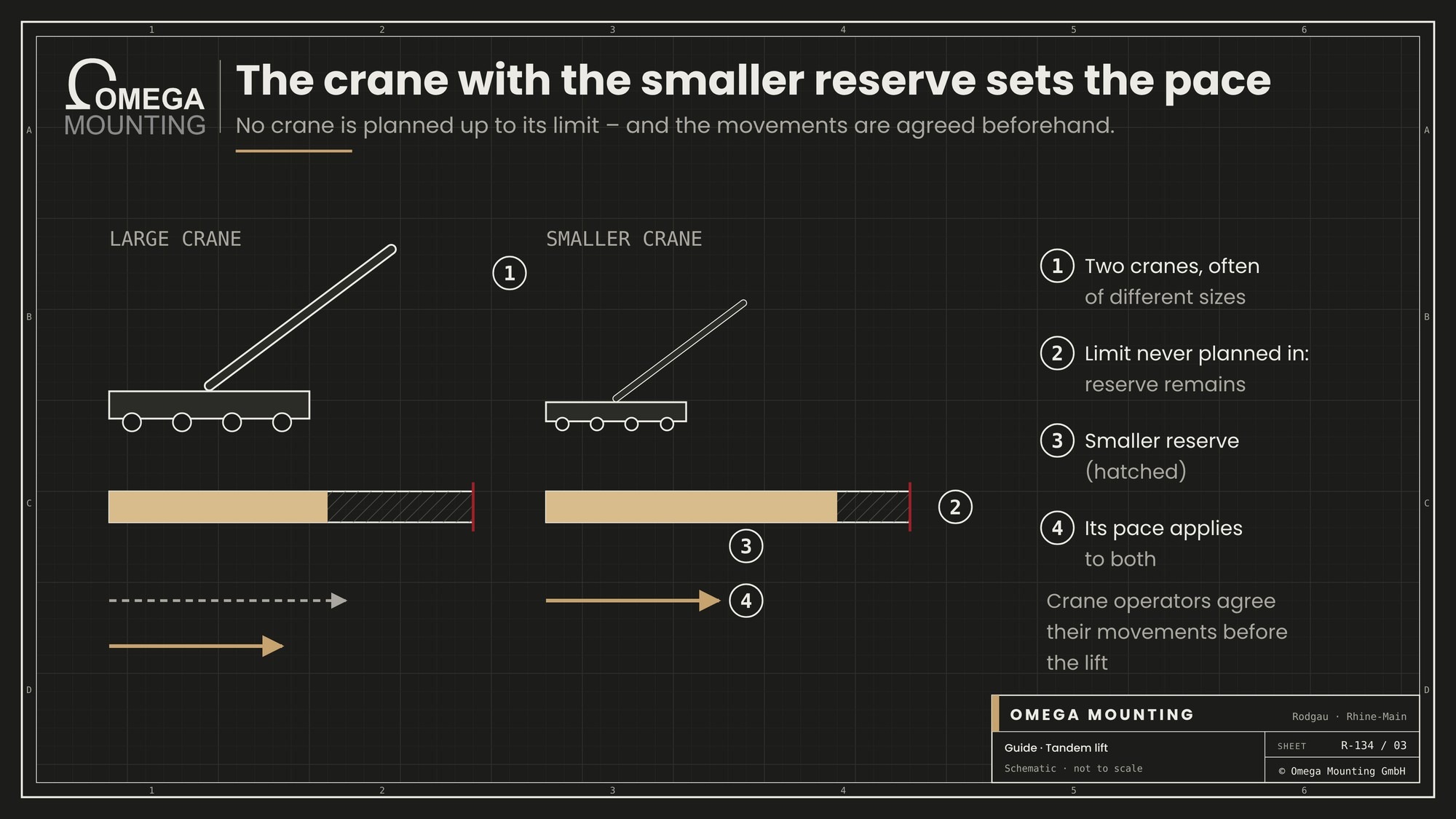
Often the two cranes are not the same size. They then lift, lower and slew at different speeds and have different amounts of reserve. Even two identical cranes do not always react exactly the same. The lift plan takes this into account: the crane with the smaller reserve sets the pace, and the crane operators agree their movements before the lift.
Wind
Wind acts on load and cranes. A long, flat load catches a lot of wind. If it turns, the ropes pull at an angle and the distribution shifts. In a tandem lift wind is therefore even more critical than in a lift with one crane. The limits are in the cranes' documents; the decision is made jointly by the crane operators and the responsible person.
Planning a tandem lift: lift plan, rigging, roles, test lift
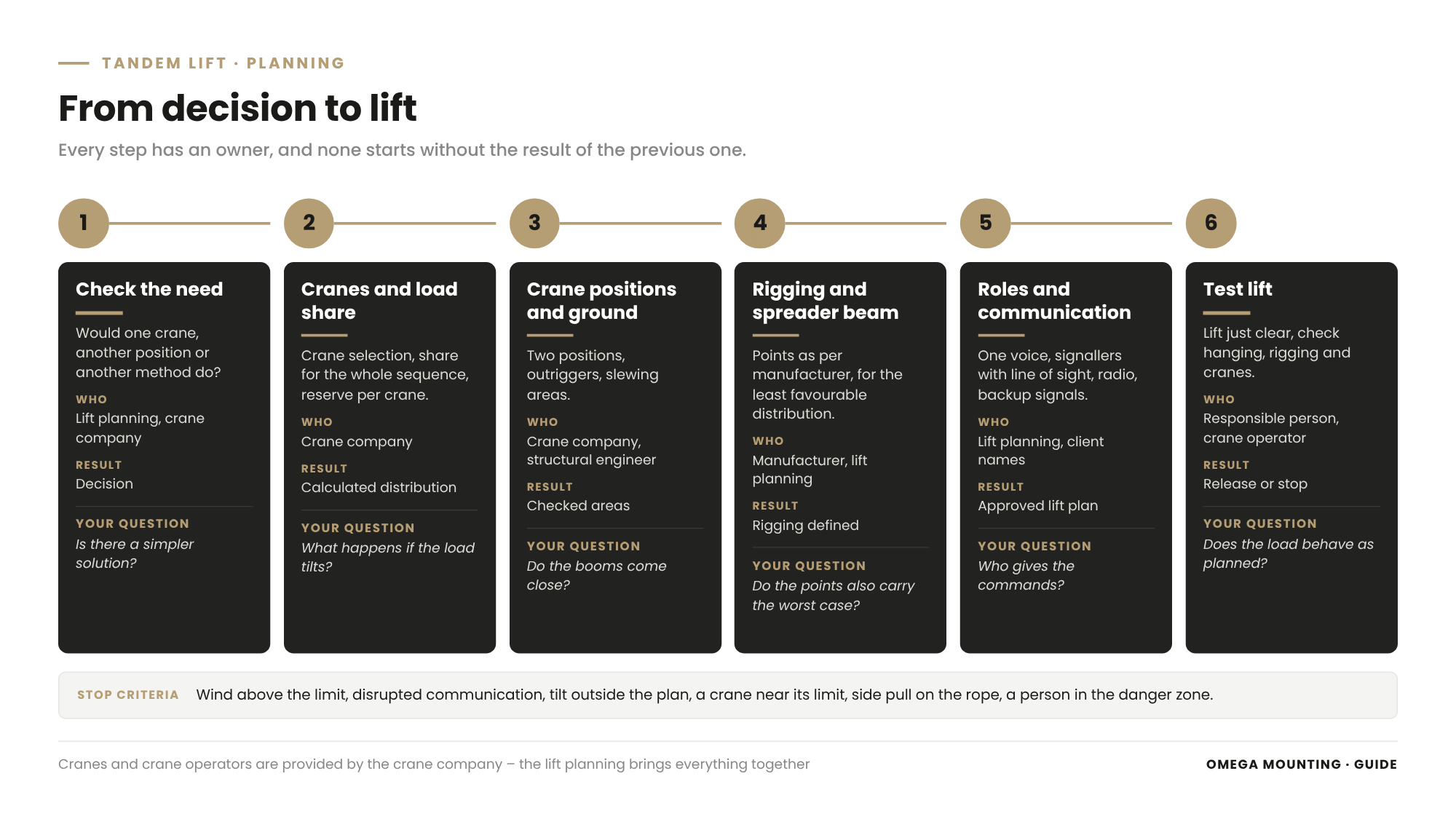
Planning a tandem lift means drawing up a lift plan for both cranes, having the crane company calculate the load sharing, fixing both crane positions and the rigging, naming exactly one responsible person, arranging communication and providing for a test lift.
Lift plan for both cranes
The lift plan contains everything a lift plan for one crane contains, plus the questions only a tandem lift raises:
- weight of the load with all lifting accessories and the spreader beam,
- centre of gravity in lifting state,
- load sharing between both cranes at the start, on the way and at the end,
- reserve of each crane,
- position, outriggers and radius of both cranes,
- order of movements: who lifts, who slews, who waits,
- hold points at which the lift stops and is checked,
- stop criteria and alternative date.
The load distribution between both cranes belongs in the lift plan, as does the order of movements. The calculation is done by the crane company. We bring the details together and coordinate the plan with everyone involved until it is approved.
Crane positions and ground
Each crane needs its own checked position. The outrigger forces are determined by the crane company. Whether the ground can take them is assessed by the structural engineer. Because the load can shift during the lift, the outrigger forces are considered for the least favourable case, not just for the planned distribution.
Rigging points and spreader beam
The rigging points are specified by the load's manufacturer. In a tandem lift each point must carry the force that comes onto it in the least favourable distribution. The direction of the force also changes when the load tilts.
Often a spreader beam hangs on each hook. It keeps the legs vertical and takes compressive forces out of the load. Why a spreader beam can often do more than two legs is explained in our article on the Spreader beam. Which lifting accessories suit which load is set out in the guide on lifting accessories for heavy loads.
One responsible person
In a tandem lift exactly one person gives the commands. They know the lift plan, see the load or have signallers with line of sight, and they decide when to continue and when to stop. This role is named beforehand, ideally in writing. What it involves and how the person is appointed is described in our guide on the appointed person for lifting operations.
Set the communication
It is settled beforehand how everyone communicates. Usually this is by radio on a shared channel, supplemented by hand signals. Everyone knows which words and signals apply. There is a plan for the case that radio fails: then the lift stops immediately.
Plan the test lift
The test lift belongs in the plan, not just on site. It is set how far the load is lifted, what is checked and who decides whether to continue.
What the client has to provide
Without reliable data on the load nobody can calculate a tandem lift. The client therefore provides, usually via the manufacturer:
- the weight of the load in lifting state, with fillings and add-on parts,
- the position of the centre of gravity, not just “roughly in the middle”,
- the approved rigging points and how they may be loaded,
- the position of the load at the start and at the end, for example lying, standing or tilted,
- drawings of the site, lines and set-down point.
If any of this is missing, the crane company plans with assumptions. In a tandem lift assumptions cost particularly much reserve, because every error affects both cranes.
Carrying out the tandem lift: one voice, slowly, with line of sight
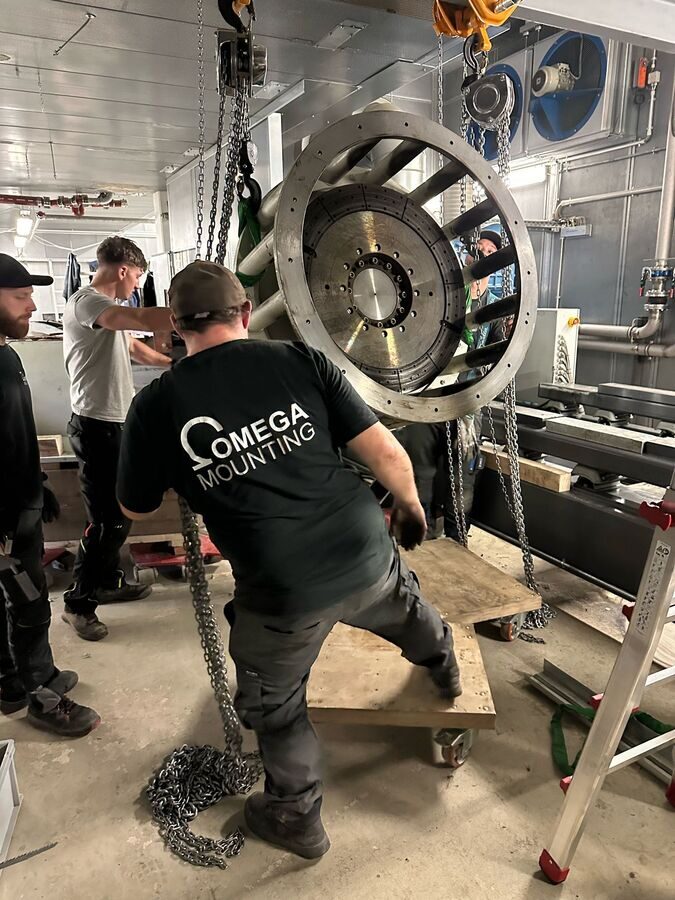
On the lifting day a tandem lift starts with a briefing for everyone involved, followed by the test lift; after that both cranes move only on the command of one person, slowly, with a view of the load and with clear stop criteria.
Briefing the whole crew
Before the lift the whole crew is briefed, not just crane operators and slingers. Everyone who moves in the area that day knows the sequence, their task, the commands and the stop criteria. Anyone who joins later is briefed too.
The test lift
The load is lifted only just clear. Then it is checked: does it hang as planned? Are the lifting accessories correctly loaded? Do the cranes' displays match the planned distribution? Do both cranes stand securely? Only when everything is right does the responsible person release the rest of the lift. If something is wrong, the load is set down and reassessed.
One voice
During the lift one voice speaks. Crane operators, slingers and signallers report what they see, but they give no commands of their own. Only a stop may be called by anyone who sees a danger.
Radio and line of sight
Crane operators do not always see the load, especially when it is set down behind a building. Then signallers are needed who see the load and the set-down point and report by radio. The responsible person stands where they have an overview, or receives the signallers' reports.
Slowly and step by step
Both cranes move slowly and as far as possible in small, coordinated steps. Between steps it is checked whether the load still hangs correctly. Setting down also happens step by step. First the load touches down, then the ropes are slowly relieved. Only when it stands securely is it unhooked.
Stop criteria
Stop criteria are in the lift plan. Typical for a tandem lift are: wind above the permitted limit, disrupted communication, a tilt of the load outside the planned range, a crane approaching its limit, side pull on the rope, a person in the danger zone. Then the lift stops, the load is brought into a safe position and a new decision is made.
After the lift
After the lift we record what was lifted how and where there were deviations. Lift plan, photos and observations go to the client. If a similar lift is due later at the same place, much has already been clarified.
Overview: risk, countermeasure, who
For every typical risk in a tandem lift there is a countermeasure and a responsible party – the table summarises this.
| Risk | Countermeasure | Who |
|---|---|---|
| Load distribution shifts. | Distribution calculated for the whole sequence, reserve per crane. | Crane company. |
| Cranes not in sync. | Slow, small steps, movements one after the other. | Crane operators on the command of the responsible person. |
| Side pull on the rope. | Keep ropes vertical, signallers watch. | Signallers, responsible person. |
| Centre of gravity wrongly assumed. | Manufacturer's data in lifting state, test lift. | Manufacturer via the client; lift planning checks. |
| Rigging point overloaded. | Check points for the least favourable distribution, spreader beam. | Manufacturer; lift planning. |
| Ground gives way. | Outrigger forces for the least favourable case, ground checked. | Crane company, structural engineer. |
| Contradictory commands. | One responsible person, fixed words and signals. | Lift planning; client names. |
| Radio fails. | Immediate stop, backup communication agreed. | Everyone involved after briefing. |
| Booms come too close. | Slewing areas planned, clearances monitored. | Lift planning with crane company. |
| Wind turns the load. | Limits set, alternative date. | Crane operator and appointed person |
Typical mistakes in a tandem lift
The typical mistakes in a tandem lift are a load distribution calculated only for the start, cranes without reserve, several voices on the radio, a skipped test lift and rigging points checked only for the planned distribution.
- Distribution calculated only for the start. On the way the load tilts, and nobody knows what then hangs on the hooks.
- No reserve. One crane is already at its limit with the planned distribution.
- Several voices. Crane operators, slingers and site management give commands at the same time.
- No test lift. The load goes straight up without checking how it hangs.
- Rigging points too tight. They carry the planned load, but not the least favourable one.
- Movements at the same time. Both cranes slew and lift at once, and the ropes pull at an angle.
- Signallers without line of sight. Nobody sees load and set-down point at the same time.
- No back-up date. Wind picks up, and two cranes with crew are booked for one day only.
The mistake behind the mistakes
Behind many mistakes lies the same assumption: that two cranes are twice as strong as one. But they are not simply twice as strong, they are twice as complicated. A tandem lift is not a lift with more power, but a lift with more coordination.
Tandem lifts in the Rhine-Main area: how we do it
In the Rhine-Main area we plan tandem lifts for move-ins in industry and data centers: with the crane company we check whether a tandem lift is needed, draw up the lift plan, rig, brief and, on request, give the commands.
Many sites in the region are tight. Data centers and factory halls stand close to roads and neighbouring buildings. Plant often goes into place on upper floors or behind the building. Then the radius is large and the space for a single large crane is scarce. That is exactly where a tandem lift becomes an option.
From Rodgau, Frankfurt, Offenbach, Hanau, Darmstadt and Aschaffenburg are short distances. That helps with site visits and when a lift has to be postponed because of wind. What we offer in Lift & Shift and heavy-load installation overall is set out on our service page.
What we don't take on, we say clearly beforehand. Cranes and crane operators are provided by the crane company, which also calculates crane selection, load sharing and reserve. The ground is assessed by the structural engineer. Which crane types exist and what they can do is described in our article on the common crane types at a glance.
Project examples
Three jobs from our project diary show how we plan and lead lifts – one of them as a tandem lift, two with one crane or several hoists and the same discipline in commands and rigging.
Data center in the Frankfurt area: tandem lift with one voice
During the installation of standby power systems in a data center in the Frankfurt area, tandem lifts were used. The reason: one crane could not manage the load at the required radius, or the component had to be threaded in at a particular position. This is how generator rooms on upper floors were served, partly at night.
The load distribution between both cranes was in the lift plan, as was the order of movements. Both cranes had to travel in sync. If one lags, the load moves to the other. Every tilt changes the forces at both hooks. A named lifting supervisor had been appointed in writing and was on site. They gave all commands, the others carried them out. The whole crew was briefed beforehand. The lift plan was approved by the general contractor.
For your lift this means: two cranes are not twice as safe as one, but twice as complicated – plan accordingly.
Data center in Raunheim: check rigging points, line of sight to the target
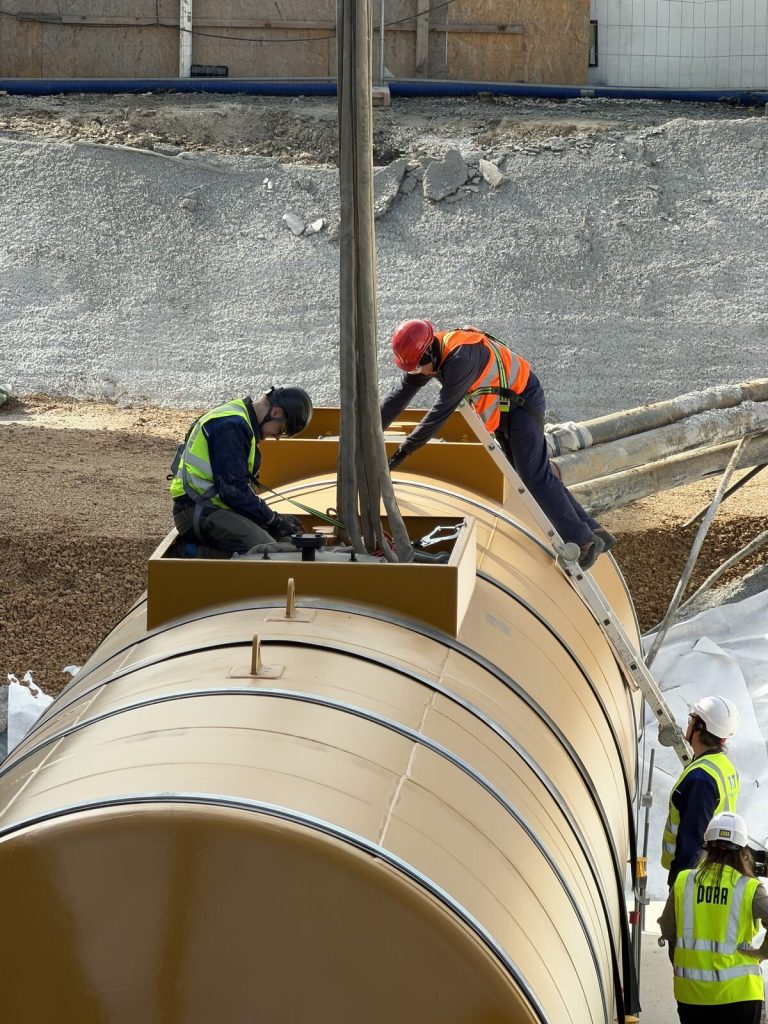
During the placement of diesel tanks at a data center in Raunheim, we were commissioned as the responsible person for lift planning. One crane was used. The rigging points had been welded on by the manufacturer. We checked the welds on site and recalculated the hanging geometry. Because the crane operator could not fully see the pit, the responsible person stood where load and target were visible at the same time and directed the set-down.
For your lift this means: whoever gives the commands needs the best view – all the more in a tandem lift.
Standby power plant in the Rhine-Main area: several hoists, one voice
With the maintenance of the generator of a standby power system a crane lifted the assemblies vertically out of the basement. Before the job there were lift plans that also checked the load capacity of the suspension points. When separating it from the engine, the generator hung on several chain hoists. At times the crane operator could not see the load. Every movement therefore ran on the command of a fixed contact.
For your lift this means: as soon as several hoists hang on one load, the same rule applies as in a tandem lift – one voice, coordinated movements.
Does your load need two cranes?
Then get in touch with us. Send us photos of the site, the set-down point and, if available, the load's data sheet with centre of gravity and rigging points. Together with you and the crane company we clarify whether a tandem lift is needed and what the lift plan requires.
What this means for your role
For buyers: For a tandem lift, do not just ask for two cranes, ask for a shared lift plan and a named responsible person. Clarify who calculates the load sharing and who gives the commands.
For designers: Record centre of gravity, rigging points and the position of the load at the start and end of the lift in the documents. Check early whether there are two suitable crane positions.
For project managers and site managers: As project manager you collect the details from manufacturer, crane company and structural engineer and keep date and alternative date. As site manager you make sure that both crane positions, the barriers and the briefing are in place on the lifting day.
For safety specialists: Make sure that stop criteria, communication and briefing are in the plan and that exactly one person gives the commands.
For management and operators: Give the project the lead time that calculation, coordination and an alternative date need. A tandem lift is not a lift that can be improvised under time pressure.
Tandem lift check: template on request
The tandem lift check is a one-page working document for the first coordination round. It has four blocks: load, cranes and positions, sequence, and roles. Each point has a field for the source of the detail and the status “clarified” or “open”. Number fields are deliberately not pre-filled – the check shows you what is still missing before the lifting day and who provides it. Request the template via our contact form – keyword “tandem lift check”.
Why Omega Mounting?
We are based in Rodgau near Frankfurt, can be reached by phone and WhatsApp and plan lifts for move-ins in industry and data centers. The linked jobs show how we approach a lift. In the Frankfurt area tandem lifts brought standby power systems into place, with one lifting supervisor for all commands. In Raunheim the responsible person stood where they could see load and target. For you this means: a single point of contact for lift plan, rigging, signalling and commands – coordinated with crane company and structural engineer.
Conclusion
A tandem lift is the solution when one crane alone cannot manage the load at that point, when it is too long or has to arrive in a particular position. But it is not a lift with double the power, it is one with double the coordination. The load distribution shifts with every tilt, so each crane needs reserve. A lift plan for both cranes, checked rigging points, a single voice, a test lift and clear stop criteria make the tandem lift safe. If you are planning a tandem lift, send us photos and documents – we will get back to you with a date for the site visit and an honest assessment.
Planning a move-in, installation or maintenance in the Rhine-Main region?
Tell us briefly what you need – we'll come back with an honest assessment.
Free, no-obligation callback
You may also be interested in these guides

About the author
Tobias Schott
Managing director of Omega Mounting GmbH, Rodgau · more than 20 years of hands-on experience in installation and maintenance
A trained mechatronics technician, working in maintenance, servicing and industrial installation since 2004 – first alongside his father, and with Omega Mounting since 2012: from overhead conveyors in Frankfurt to the crane system in a new-build hall. He plans and leads lifting operations as an appointed person (AP) in data centers and on industrial sites in the Rhine-Main region, trains and examines operators of cranes, mobile elevating work platforms and telehandlers, and is a qualified occupational safety specialist. On jobs abroad he is known as the “German Troubleshooter” – the person you call when a site gets stuck. He learned what quality means from his father, not from a manual: Made in Germany as a standard for his own work, not a label. That is why quality comes first at Omega Mounting – ahead of speed and price. He writes these guides from that practice: what works on our sites is in them – what exists only on paper is not.
Frequently asked questions
A tandem lift is a lift in which two cranes lift, move and set down the same load at the same time. Each carries a planned share of the weight. Both cranes move in coordination on the commands of one person.
When one crane cannot lift the load safely at the required radius, when the load is too long or has to be threaded in at a particular position. Even when there is no room for a large crane, two smaller ones can be the solution.
Not by itself. Two cranes are not twice as safe as one, but twice as complicated. The load distribution can shift, and both cranes have to work in sync. With a good plan, reserve and one voice it is safe – but where one crane is enough, that is usually the simpler solution.
The crane company. From weight, centre of gravity, rigging points and sequence it calculates how much each crane carries and how much reserve it needs. The lift planning provides the details and takes the result into the lift plan.
Exactly one person, usually the responsible person for lifting operations. Crane operators, slingers and signallers report what they see, but give no commands of their own. Anyone may call a stop if they see a danger.
Not always, but often. A spreader beam on each hook keeps the legs vertical and protects the load from compressive forces. Whether and which spreader beam is needed follows from load, rigging points and lift plan.
In a test lift the load is lifted only just clear. Then it is checked whether it hangs as planned, whether the lifting accessories are correctly loaded and whether both cranes stand securely. Only then does the responsible person release the rest of the lift.
In a tandem lift both cranes carry the load together throughout the lift. In upending one crane lifts at the head, the second holds the foot end. The further the load rises, the more the first crane carries, until the second is unhooked.
A short enquiry with three details: what is being lifted, where it is to go and where cranes could stand. Photos, a site plan and the load's data sheet help. With the crane company we check whether a tandem lift is needed and tell you what is still missing for the lift plan. Your contact is Tobias Schott – reachable via our contact form.
 English
 German