
- Guide – Logistics
Welding a folding dock leveller: grind off zinc, weld cleanly, restore corrosion protection
By Tobias Schott · Reading time approx. 21 minutes · As of: November 2026
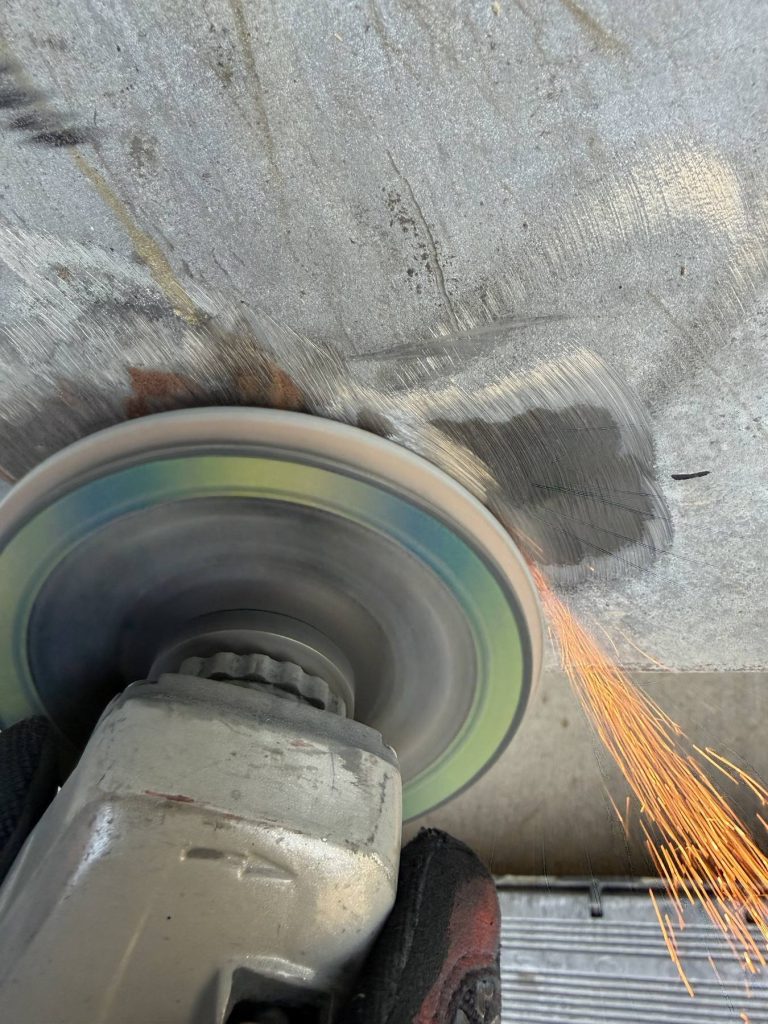
Welding a folding dock leveller means: aligning the leveller on the hot-dip galvanised frame of the dock edge, grinding the zinc off exactly in the weld area down to bare metal, welding cleanly with extraction and respiratory protection, checking the weld and then restoring corrosion protection. Anyone who welds over the zinc gets pores, cracks and toxic fume.
A folding dock leveller is not bolted on. It is welded to the frame in the dock edge – and that frame is almost always hot-dip galvanised. That is good against rust but bad for the weld. Zinc vaporises during welding long before steel melts. The vapour disturbs the arc, ends up as pores in the weld and as fume in the welder's lungs.
That is why every good weld on a folding dock leveller starts with grinding. The zinc has to come off exactly where the weld goes – no more and no less. Then the welding is done with extraction and respiratory protection, the weld is checked and the bare area is protected against rust again. Anyone having a folding dock leveller welded in should pay close attention to these steps. Anyone searching for “welding galvanised steel”, “welding hot-dip galvanised steel” or “welding in a dock leveller” usually means the same problem: how do I get a durable weld on a galvanised component?
This guide shows the process step by step – from marking out and grinding through welding to corrosion protection. It is written for logistics and site managers, maintenance and technical managers, occupational safety specialists, planners, project and site managers and buyers.
Key points at a glance
- Welding a folding dock leveller means: align, grind off zinc in the weld area, weld with extraction and respiratory protection, check, restore corrosion protection.
- Zinc disturbs the weld. It vaporises before the steel, causes pores and spatter and can trigger cracks.
- Zinc harms the lungs. Zinc fume can cause metal fume fever. Extraction at source comes first; respiratory protection supplements it.
- Down to bare metal. You can see the layers: bright zinc, darker alloy layers, then steel.
- Only as much as necessary. The weld area is ground with a small margin – every extra bit of surface has to be protected again afterwards.
- V-groove where it is flush. If the leveller and the frame sit flush against each other, a V-groove is ground in – so the weld penetrates deeply.
- Fire protection at the dock. Sparks fly into the pit and the hall. A hot work permit, covers and a fire watch are part of the job.
- Protect after welding. The bare area is touched up with an overlapping zinc-rich coating or thermal zinc spraying.
- In pairs. One welds, the other holds, secures and watches for sparks.
What does welding a folding dock leveller actually involve?

A folding dock leveller – also called a dock plate or dock leveller – sits at the dock edge and connects the hall with the lorry. When it is installed or replaced, it is welded to the frame in the dock edge. This frame is usually a hot-dip galvanised steel angle cast into the concrete.
Anyone welding a folding dock leveller works through six steps. Prepare: release, hot work permit, fire protection. Mark out: position and length of the welds according to the manufacturer's specification. Grind: zinc in the weld area down to bare metal. Align and tack: height, flushness, gap. Weld: with extraction, respiratory protection and a correctly placed earth clamp. Finish: check the weld, grind it smooth, restore corrosion protection.
Why it is welded
The folding dock leveller must transfer the forces from lorries and loaded forklifts safely into the frame. A welded joint withstands this permanently if it is done correctly. How many welds, how long and of what type is set out in the manufacturer's installation instructions.
Why the zinc is the problem
Hot-dip galvanising protects steel against rust for decades. During welding it becomes a problem: it vaporises before the steel melts. How welds are built up in principle is explained in the article Weld types.
Understanding hot-dip galvanising: how the zinc coating is built up
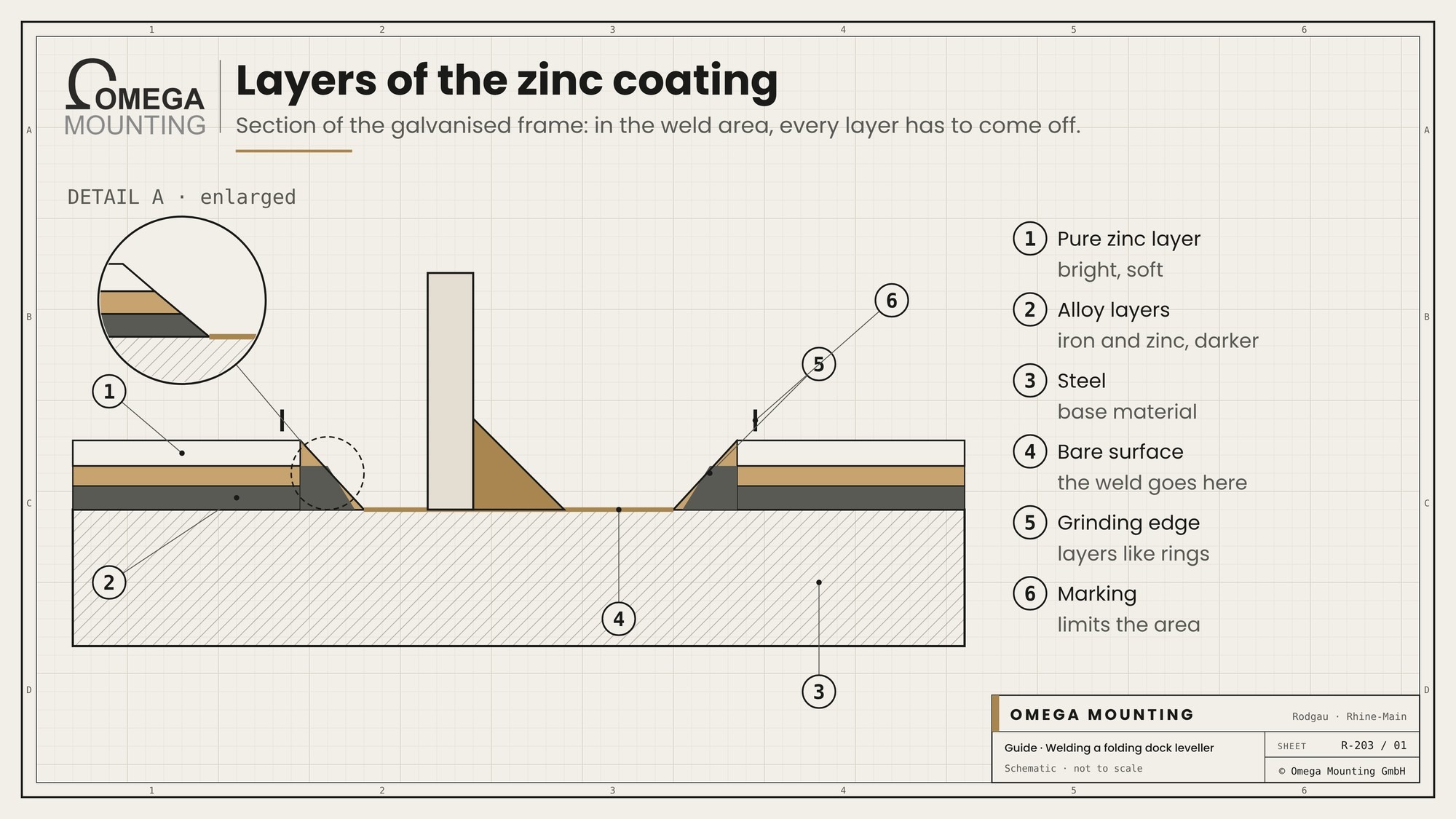
Anyone who knows how the coating is formed also understands why it gets in the way during welding – and why the layers are so easy to see when grinding.
How the coating is formed
In hot-dip galvanising, the finished steel part is dipped into molten zinc. Zinc and steel react with each other. The result is not just a coat of paint but a coating firmly bonded to the steel.
The layers
Directly on the steel there are several alloy layers of iron and zinc. They are hard and darker. On the outside there is a layer of pure zinc, bright and softer. Grinding removes these layers one after the other – which is why you see rings in different shades of grey at the edge of the ground area.
Why the zinc protects
The coating protects in two ways. It shields the steel from water and air. And at small defects the zinc sacrifices itself before the steel rusts. That is why a galvanised frame at the dock lasts so long – as long as large areas of the coating are not missing.
What this means for welding
It is exactly this firmly bonded coating that has to be removed completely in the weld area. It is not enough just to scratch the bright outer layer. Only when the darker alloy layers have also been removed is bare steel exposed.
Galvanised and painted
Many folding dock levellers and frames are galvanised and also have a coloured coating. With this duplex protection, both have to come off in the weld area: first the paint, then the zinc. Burning paint produces its own fume and has no more place in the weld than the zinc. After welding, the protection is rebuilt in the same order: first a zinc-rich coating, then a top coat.
How a folding dock leveller sits on the frame
Anyone who knows where the weld goes also knows where to grind.
The frame in the dock edge
In the dock edge there is a steel angle or frame that was cast in and hot-dip galvanised during construction. It protects the concrete edge and carries the leveller.
The folding dock leveller
The folding dock leveller has its own base part with a main hinge. It is placed on or against the frame, aligned and welded. How the leveller is built and serviced is shown in the guide Servicing a folding dock leveller.
The welds
Welding usually runs along the edge, often as an intermittent weld at defined points. These points are marked out beforehand – the zinc is removed only there. Depending on how the parts meet, a V-groove is prepared or the parts are welded as a butt joint.
What happens when welding over zinc
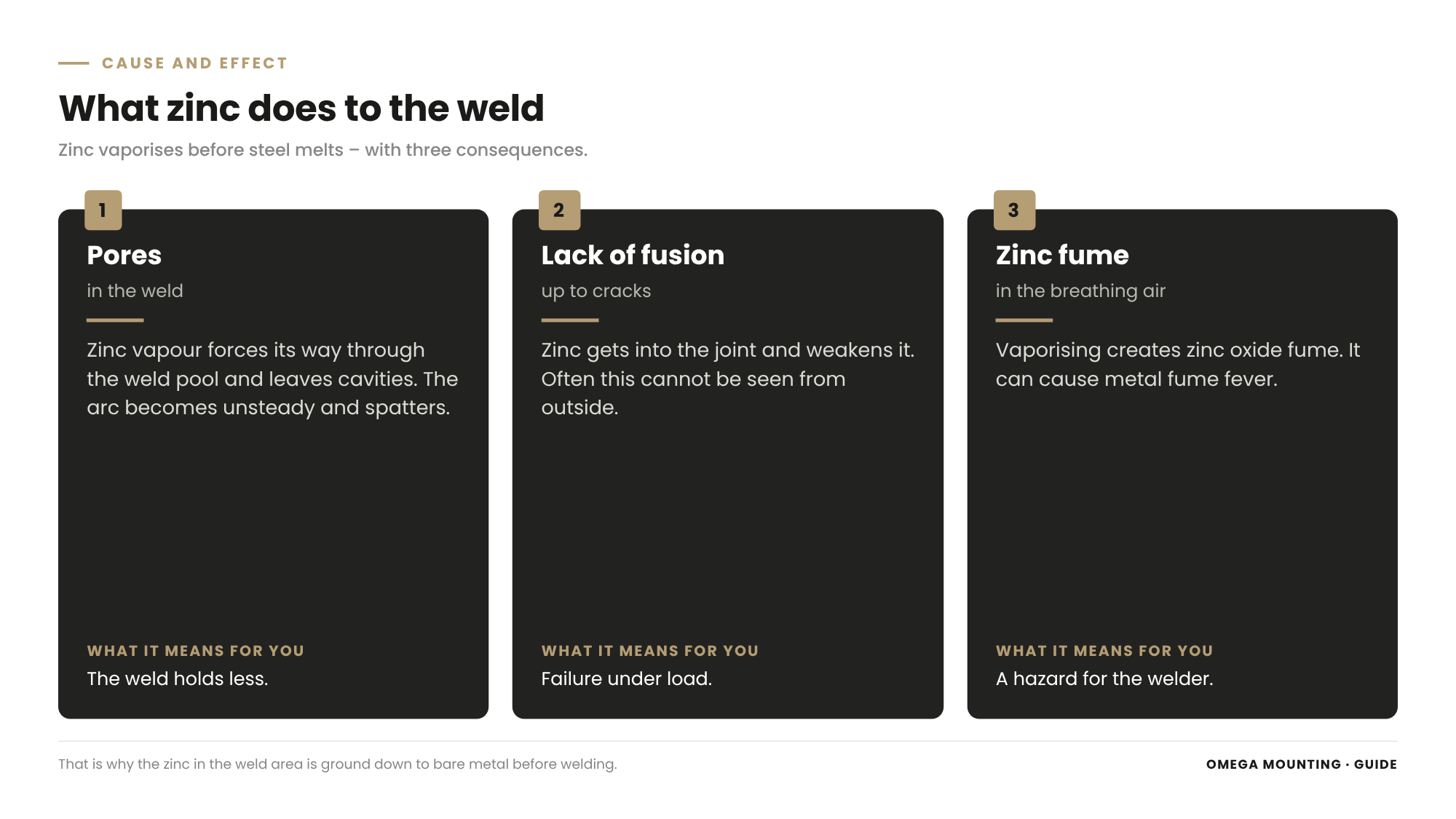
Anyone who welds over the zinc saves a few minutes of grinding – and pays for it with the weld.
Pores and spatter
The zinc vaporises under the arc. The vapour forces its way through the molten weld metal and leaves pores behind. The arc becomes unstable and there is more spatter.
Lack of fusion and cracks
Zinc can get into the weld and weaken the joint. This causes lack of fusion and, in the worst case, cracks. From the outside you often cannot see it.
Fume
Vaporising zinc produces zinc oxide fume. It is dense and white and does not belong in the breathing air. More on this in the chapter on occupational safety.
Rust at the weld
After welding, the galvanising around the weld is burnt off. If the area is not protected, it rusts – first at the weld, then underneath.
Preparation: release, fire protection and securing
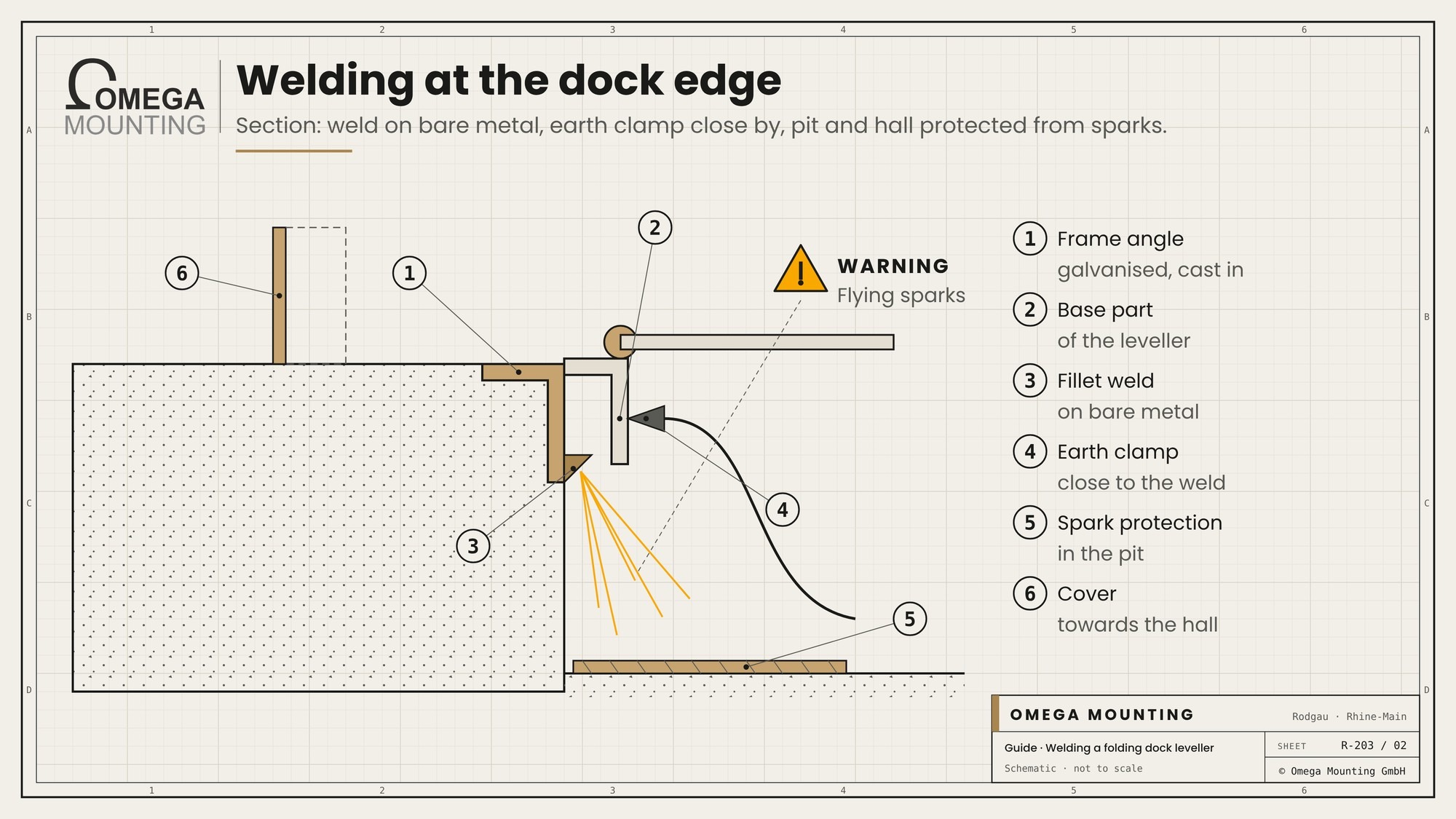
Welding at the dock is hot work during ongoing operations. Before the first spark flies, everything is arranged.
Release and hot work permit
Together with the operator we agree which door is free and when. For the welding work there is a hot work permit with fire protection measures. How such a permit procedure is structured is explained in the article Permit to Work.
Fire protection at the dock
The pit in front of the dock often contains leaves, scraps of film and paper. They are removed. The pit and the hall behind the door are covered against flying sparks. A fire extinguisher is ready, and a fire watch remains after the work.
Closing off the loading bay
The area in front of the door is cordoned off and the door secured on the inside. No lorry and no forklift while welding is under way.
In a live building
Usually the neighbouring doors keep running while one door is being welded. Spark protection, barriers and coordination with the shift supervisor protect people and goods next door. What matters here is shown in the guide Welding during live operations.
Working in pairs
We never weld alone. One person welds, the other holds and aligns, watches the flying sparks and is there immediately in an emergency. What applies to lone working is shown in the guide Lone working on construction sites.
Cutting out the old folding dock leveller and preparing the frame
In a replacement, the old leveller is often still welded to the frame. Before the new one goes in, the old one has to come off cleanly.
Cutting out
The old welds are separated with an angle grinder or cutting torch. Here too: a galvanised frame produces zinc fume, so work with extraction and respiratory protection. Which cutting methods are suitable for what is explained in the article Cutting methods in dismantling.
Grinding off residues
Residues of the old welds are ground flush. The new leveller should sit on a flat, clean surface.
Checking the frame
Now you can see the frame without a leveller. It is checked for cracks, deformation and rust, especially at old weld points. If it is badly damaged, it is repaired first.
Taking measurements
Width, height and position are recorded and compared with the new leveller. If something does not fit, it is clarified now – not during tacking.
Grinding off zinc in the weld area: how much has to come off
Grinding is the most important step. This is where it is decided whether the weld will hold.
Marking out
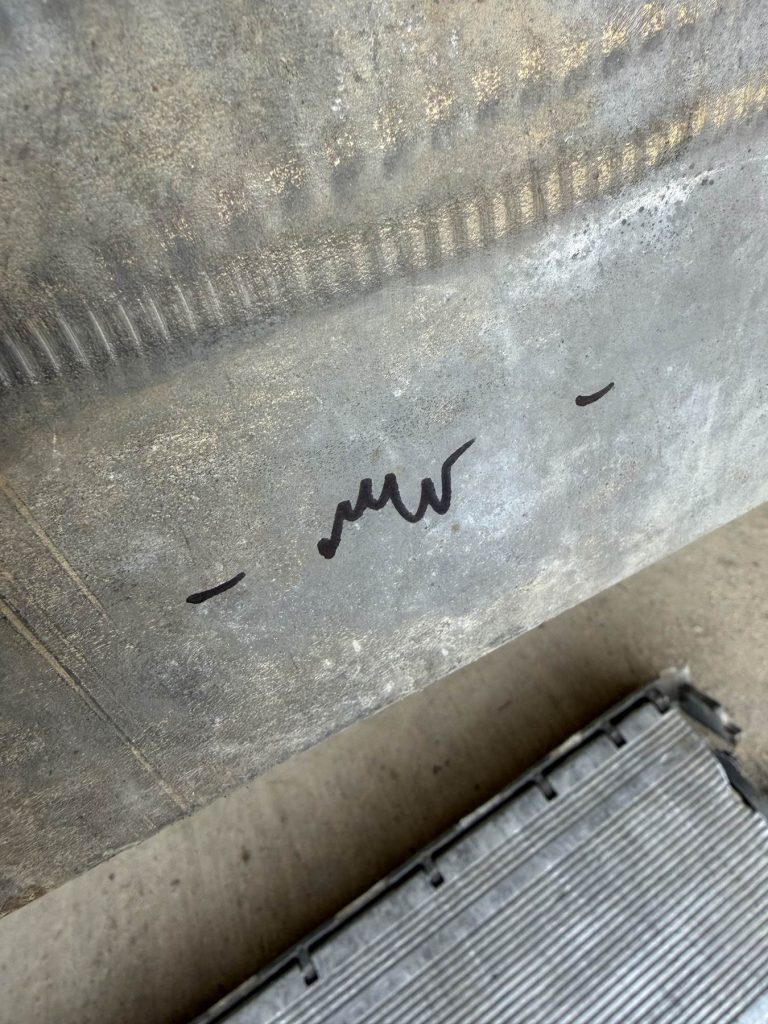
First, the position of the weld is marked out. The marking limits the area: the weld area is ground with a small margin, not the whole frame.
Grinding
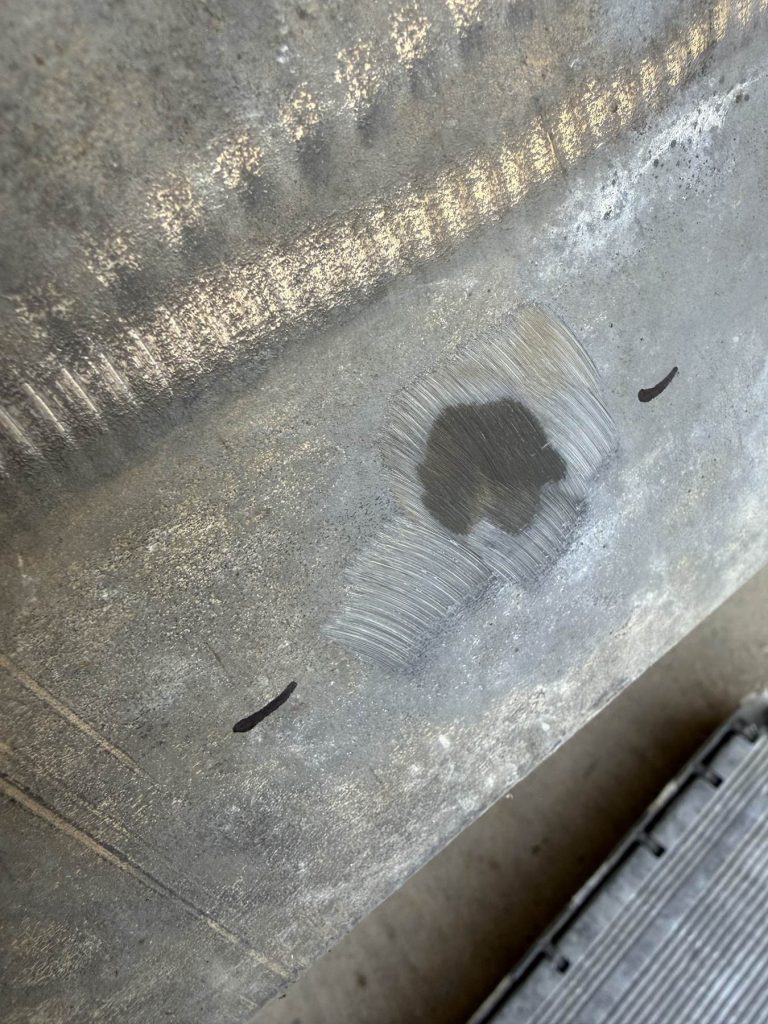
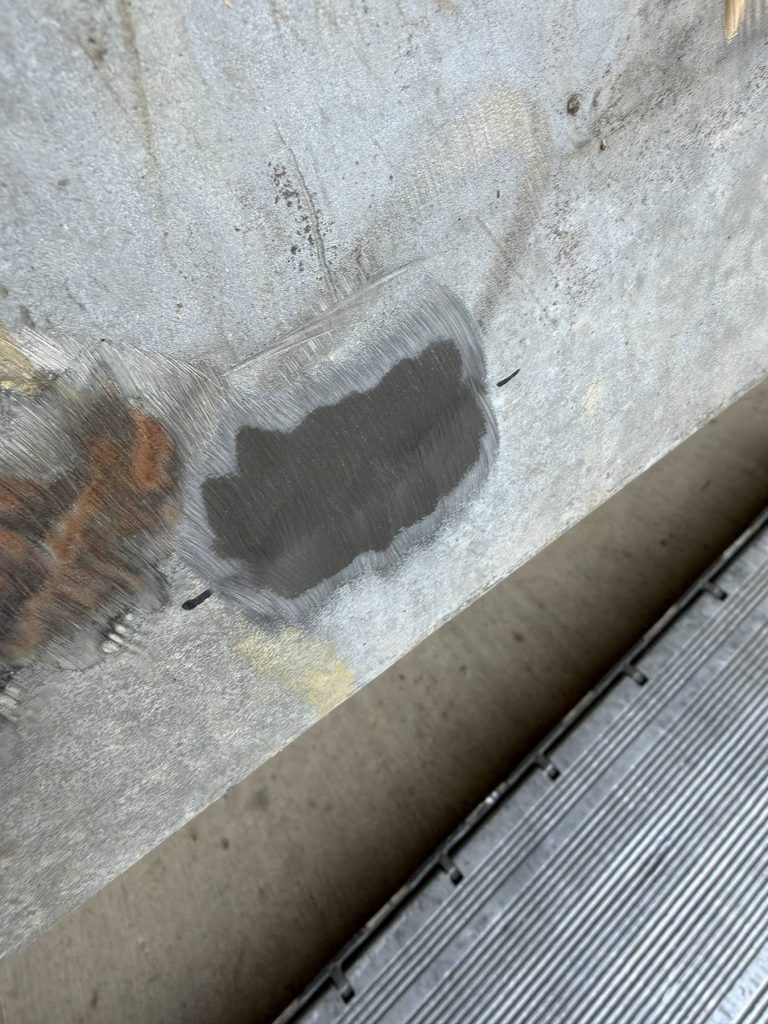
The zinc is removed with a flap disc or grinding disc. You can see the layers: on the outside the bright, shiny zinc, below it darker layers of iron and zinc, in the middle the steel.
Think of both sides
The mating part is prepared as well. If the base part of the folding dock leveller is galvanised or coated, the coating comes off there in the weld area too.
Dust and sparks
Grinding produces zinc dust. Here too: extract or remove dust, wear respiratory protection, direct the flying sparks.
How to tell that bare metal has been reached
Many people grind too little. A few signs help.
Colour
Bare metal is evenly dark grey to bright metallic, with no whitish or shiny silvery islands. As long as bright spots are visible, there is still zinc.
Edges
At the edge of the ground area you can see the layers like rings. That is a good thing: it shows that the steel has been reached in the middle and the zinc remains at the edge.
Area
The bare area is large enough for the weld to fit on it with some clearance. It does not need to be larger – every bare area has to be protected later.
Old weld points
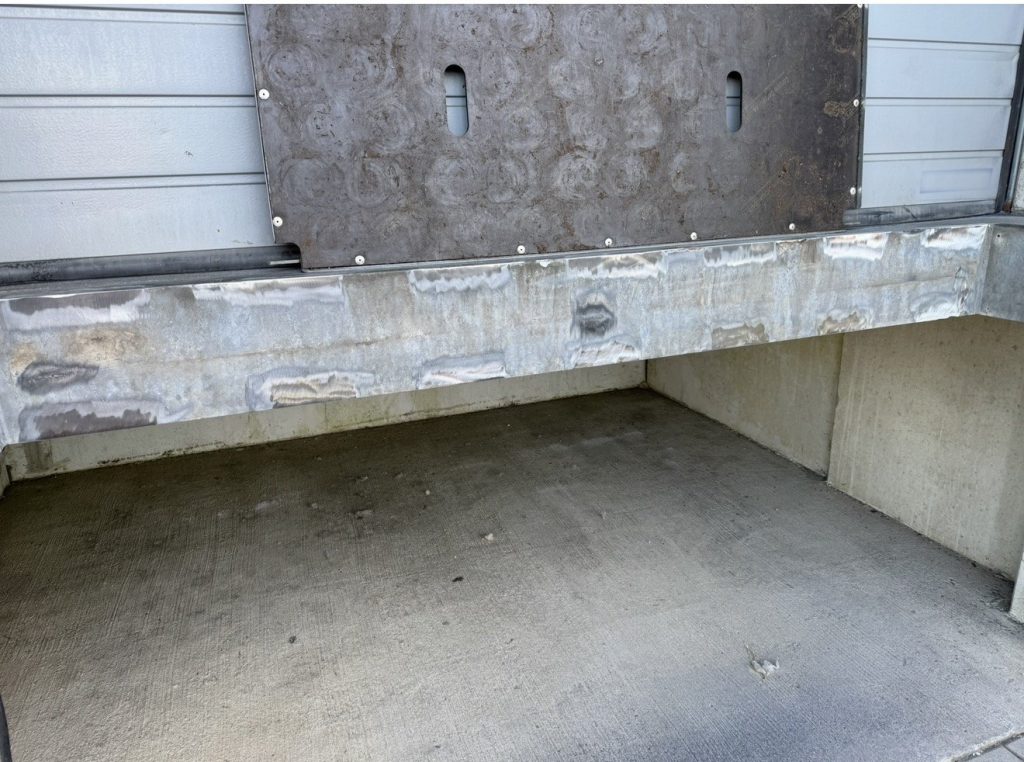
Next to the new weld there are often old weld points with rust. There, corrosion protection was missing after welding. They are prepared as well and protected at the end.
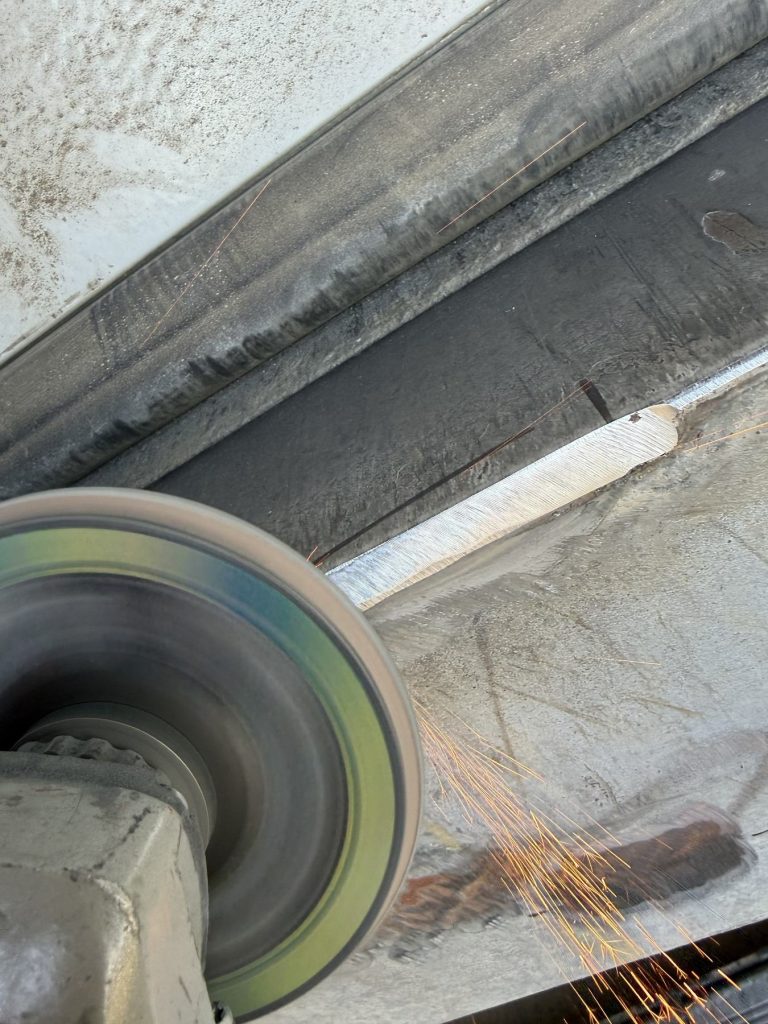
Weld preparation: V-groove or butt joint?
Not every weld on a folding dock leveller is prepared in the same way. What matters is how the parts meet.
Where the parts sit flush
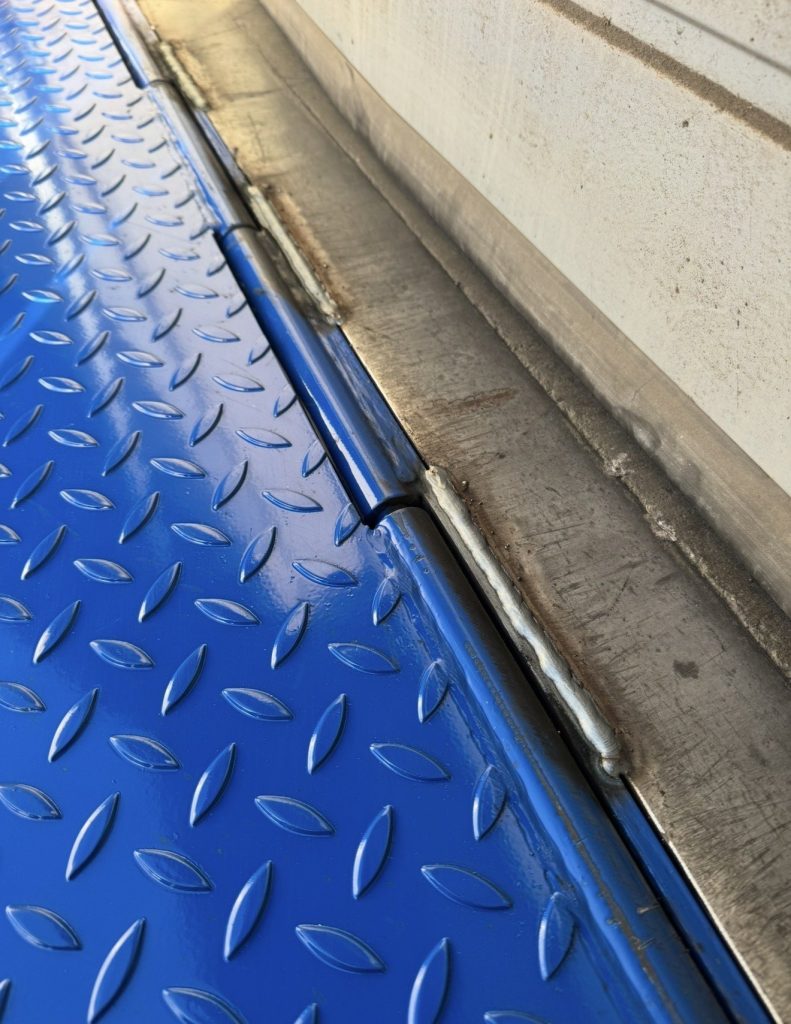
At the top of the dock, the folding dock leveller often sits flush against the steel frame of the door. There is then no gap between the parts. A weld simply laid on top would hardly penetrate there. That is why we prepare a V-groove at these points: the edges are ground at an angle with the angle grinder so that a channel forms from above.
Why the V-groove
In the V-groove, the arc reaches right down to the root. The weld penetrates deeply and joins the parts across the cross-section, not just at the surface. That way it withstands the impacts of lorries and forklifts. How deep and at what angle the edges are ground depends on the material thickness and the manufacturer's specification. Which types of weld there are is explained in the article Weld types.
Where a butt joint is welded
At other points, the welding face of the folding dock leveller butts against the steel structure of the dock. There we lay the bead on top of the joint. Here too, the surfaces to the left and right of the weld must be bare.
The groove must be bare too
The flanks of a V-groove are ground down to bare metal just like the surface next to it. If zinc remains in the groove, the pores sit exactly where the weld has to carry the most.
Welding: aligning, tacking, laying the weld
Welding only starts once the surfaces are bare.
Aligning
The folding dock leveller is aligned for height, flushness with the dock edge and gap. It must sit so that it swings cleanly and merges evenly into the dock.
Tacking
Short tack welds secure the position. Then height and gap are checked once more.
Placing the earth clamp correctly
The earth clamp goes close to the weld point, on bare metal. The welding current must not flow through hinges, pins or bearings – that can damage them.
Laying the weld
The weld is laid as specified, section by section at the marked points. Welding evenly distributed keeps distortion low. How preheating helps with thick material is shown in the article Welding and preheating.
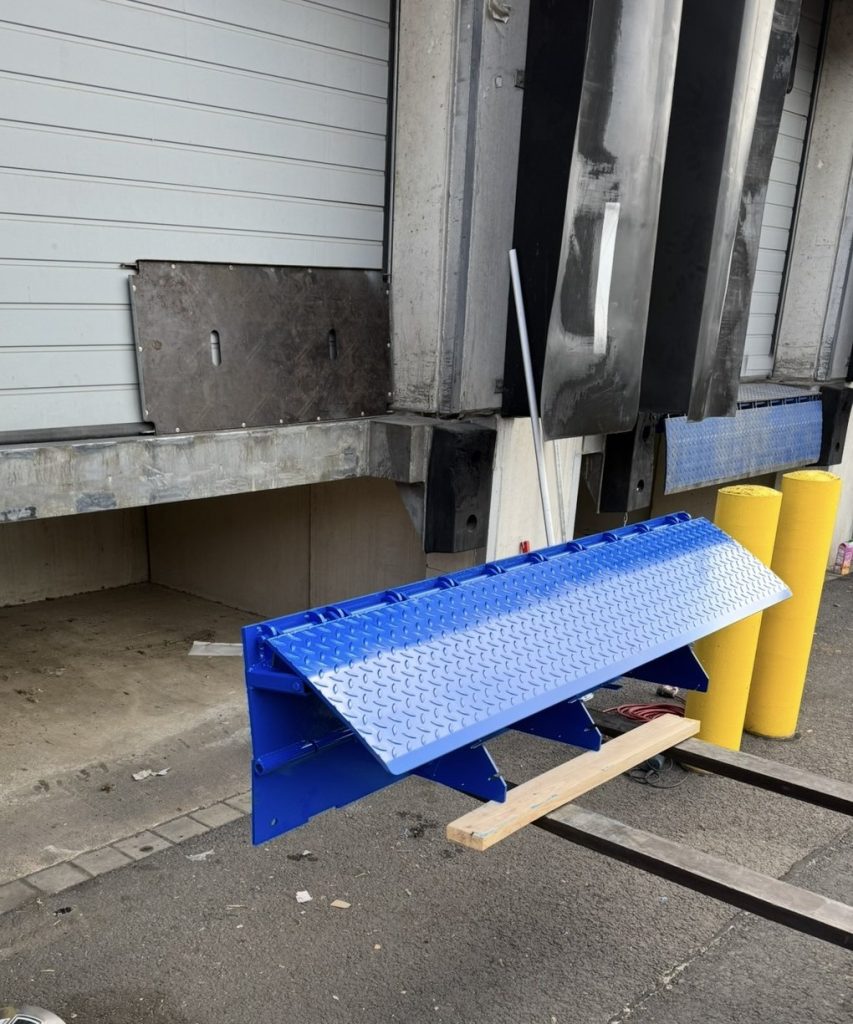
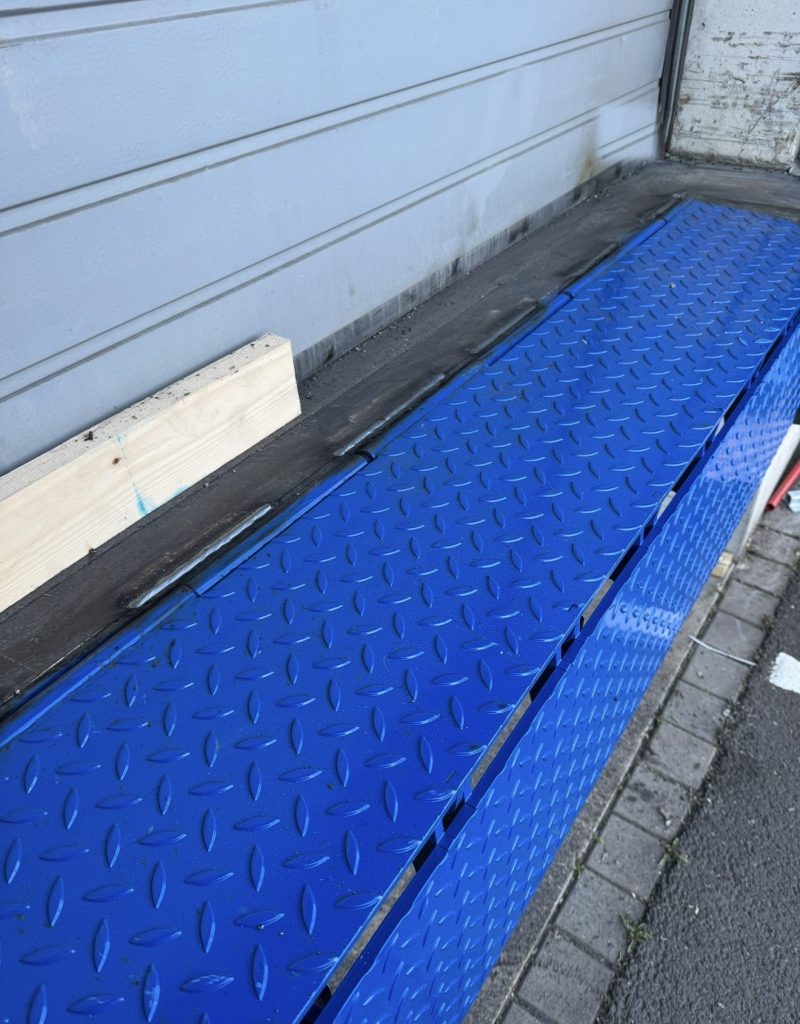
Welding process and weather: what matters outdoors at the dock
At the dock, welding takes place outdoors, not in the workshop. That has consequences for the process and the preparation.
Method
Welding is usually done with shielding gas or with stick electrodes. Which process is suitable depends on material, weld position, accessibility and weather. The filler metal is chosen to match the base material.
Wind
Shielding gas is blown away by the wind. Then the weld pool is unprotected and pores form. At an open dock, wind protection is needed – or a process that is less sensitive.
Wet and cold
A wet or cold frame is bad for the weld. Moisture is removed before welding; in cold weather the weld point is dried and warmed.
Access
Welding is often done overhead or in a constrained position, half in the pit. That takes experience – and a second person who holds and secures.
Zinc fume and occupational safety: extraction and respiratory protection
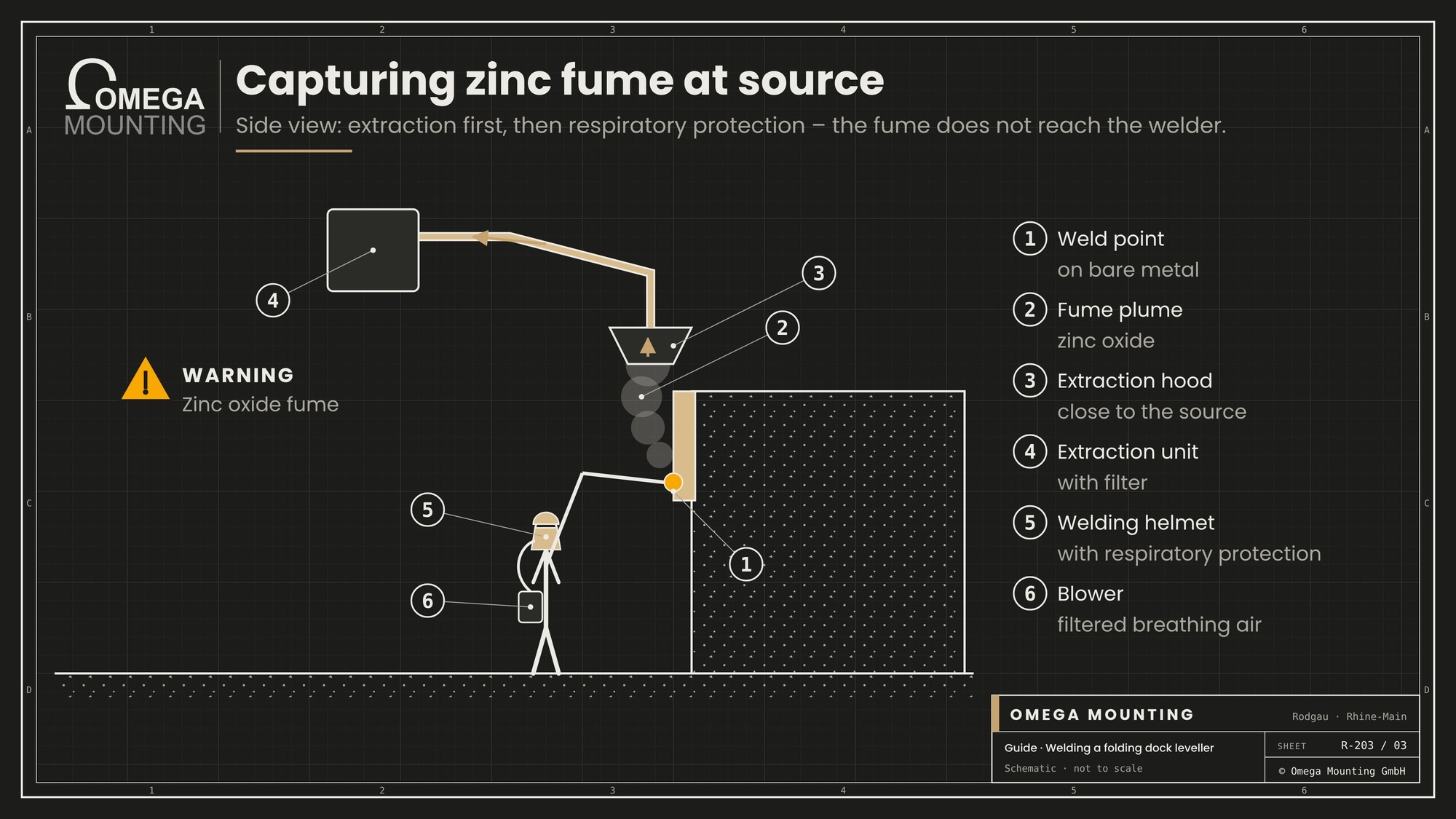
Welding zinc is no fun for the lungs. Vaporising zinc produces zinc oxide fume, which can cause metal fume fever – with flu-like symptoms after work.
Order of measures
First, the source of the fume is kept small: grind off the zinc in the weld area. Then the fume is extracted at source. Ventilation is added. Respiratory protection supplements these measures – it does not replace them. How welding fume is captured properly is shown in the article Welding fume extraction.
Helmet with extraction
On galvanised components we weld with a welding helmet with extraction and filtered breathing air. The welder breathes clean air, even when the fume passes close to the face.
Protective clothing
Welding protective clothing, gloves and safety shoes are mandatory. When grinding, safety goggles and hearing protection are added.
Regulations
Which measures apply follows from the risk assessment under German hazardous substances law and the technical rule for welding work.
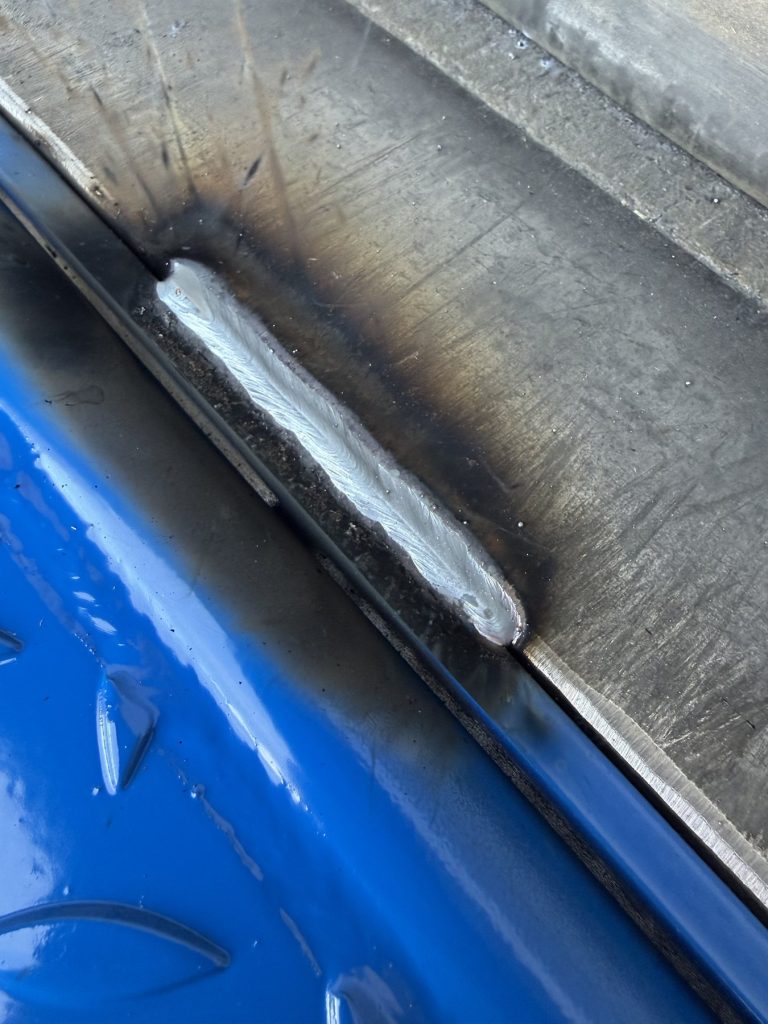
Finishing: checking, grinding, protecting the weld
The weld is only finished once it has been checked and protected.
Visual check
The weld is checked for pores, cracks, lack of fusion, undercuts and full length. Defective points are ground out and rewelded.
Grinding smooth
Where forklifts and pallets pass over the edge, protruding welds and sharp edges are ground smooth. Slag and spatter are removed.
Corrosion protection after welding: what really protects
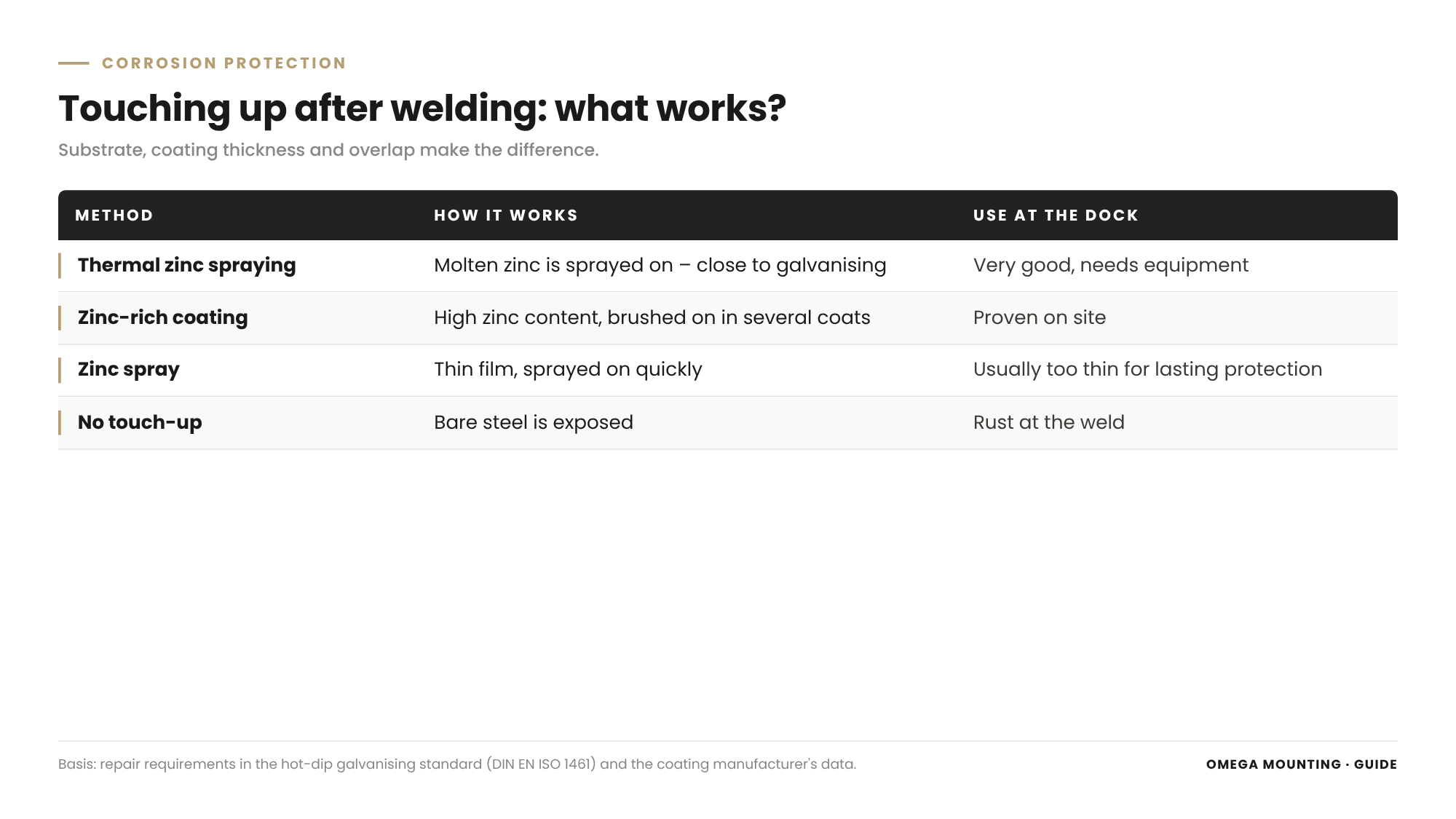
After welding, the zinc around the weld is gone or burnt. Without a touch-up, rust starts there.
Preparing the substrate
Slag, spatter, rust and dirt are removed and the area is roughened. The touch-up only adheres to a clean, dry surface.
Zinc-rich coating
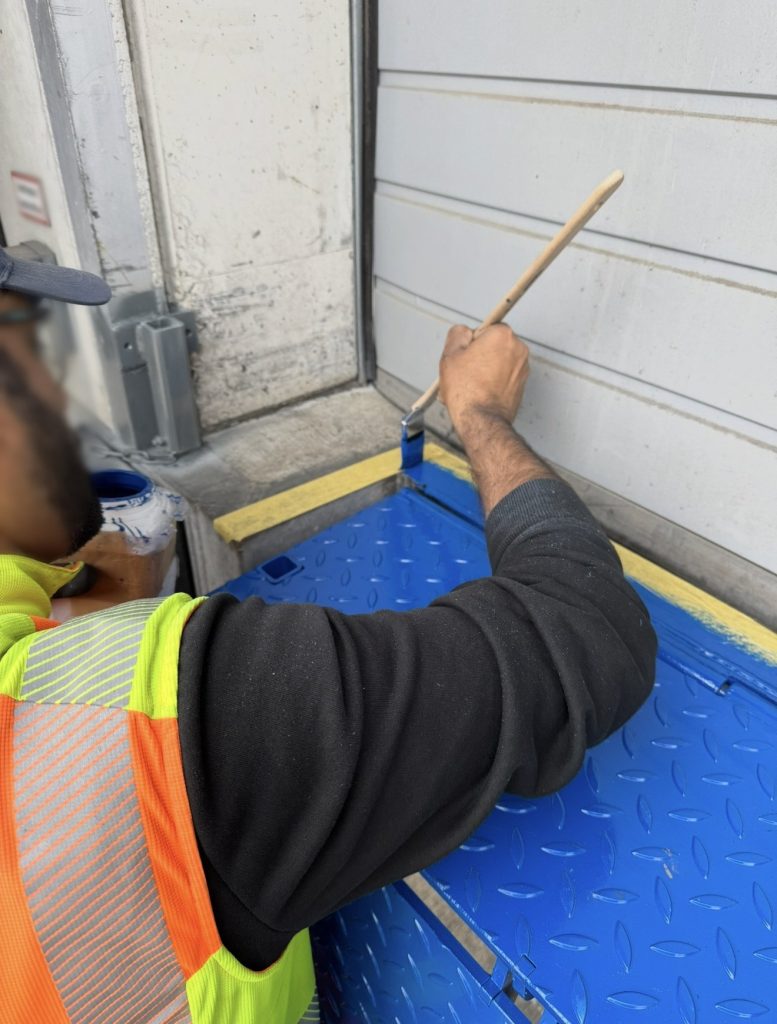
A zinc-rich coating applied by brush has proven itself on site. It contains a lot of zinc and protects much like the original coating. A sufficient coating thickness is important – preferably in several coats.
Thermal zinc spraying
Even closer to galvanising is thermal zinc spraying: zinc is melted and sprayed on. It needs more equipment but protects particularly well.
Zinc spray
Zinc spray is convenient but goes on too thin. As a permanent touch-up it is generally not enough.
Overlapping
The touch-up extends beyond the bare area onto the intact zinc. That way no gap remains at the edge.
Top coat
If the leveller has a coloured coating, the top coat follows the corrosion protection. Grease nipples and hinge joints are kept free.
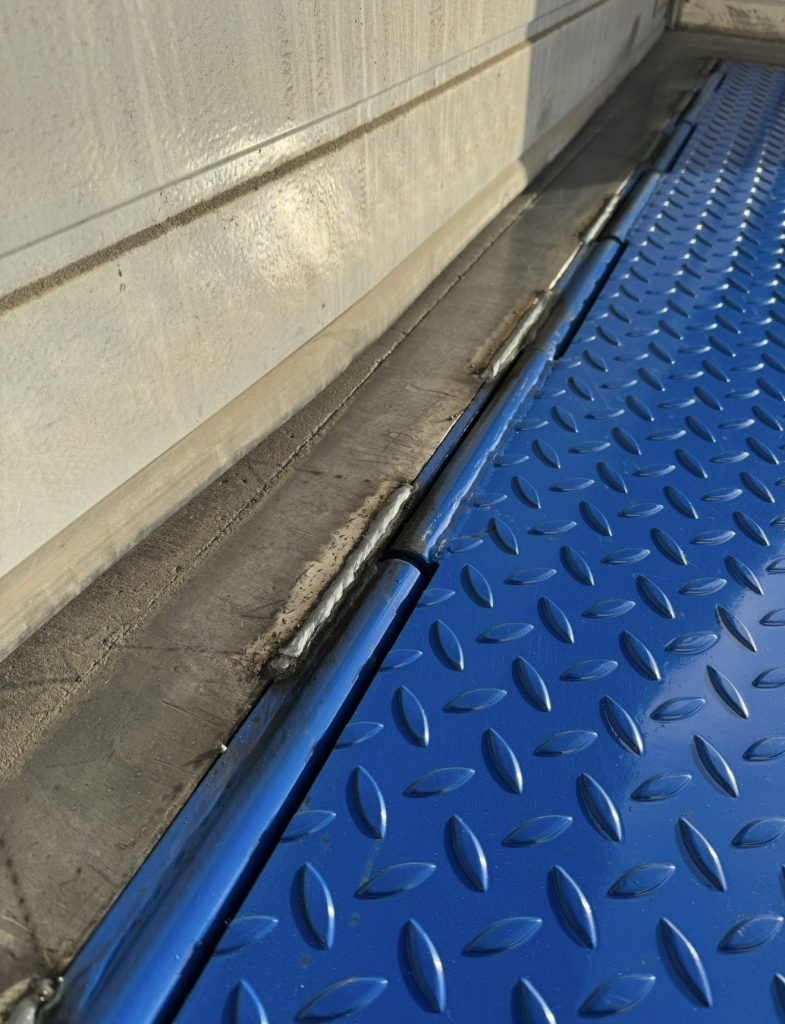
Function test and release
After welding, the folding dock leveller is tested as if it were new.
Swinging
The leveller is lowered fully and folded up several times. It must swing freely, rest cleanly and stay put in the parked position.
Transition
There must be no trip edge between leveller and dock edge. The transition must be level.
Fire watch
After welding, the surroundings are checked for smouldering embers. The area is released only once the fire watch has ended.
Inspection before commissioning
A newly installed dock leveller is inspected by a competent person before it is first put into service. We prepare the leveller for this and provide a record and photos of the ground area, the weld and the touch-up. That way the inspector can also see what later lies under the paint.
Documentation
Every loading bay gets a record: weld position, visual inspection, corrosion protection, function test, date and inspector.
Safety rules for welding at the dock
A few rules apply to every welding job on galvanised frames.
- Release and hot work permit before the first spark.
- Pit cleared, hall and pit covered against flying sparks.
- Fire extinguisher ready, fire watch after the work.
- Grind off zinc in the weld area, do not weld over it.
- Extract fume at source, wear respiratory protection in addition.
- Earth clamp close to the weld, never via hinges and bearings.
- Always in pairs: one welds, the other holds and secures.
Keeping materials at hand
Suitable filler metal, flap and grinding discs, filters for the helmet, an approved zinc-rich coating and brushes belong in the van on site. If any of these are missing, people improvise – and that is exactly when the weld suffers.
Typical mistakes when welding on galvanised frames
We see a few mistakes again and again.
- Welded over the zinc: pores, lack of fusion, a lot of fume.
- Ground too little: bright zinc islands in the ground area.
- Ground too much: large bare areas that rust later.
- Welded flush to flush: without a V-groove, the weld does not penetrate deeply enough.
- Earth clamp on the hinge: current flows through bearings and pins.
- Welded without extraction: zinc fume in the breathing air.
- Corrosion protection forgotten: rust at the weld after a short time.
- Pit not cleared: sparks in the leaves, fire risk.
- Paint not removed: burning coating in the weld and in the air.
The mistake behind the mistakes
Almost all of these mistakes happen under time pressure. Grinding, extracting and touching up take minutes. A repaired crack or a rusted weld costs far more.
Who does what when welding a folding dock leveller?
Several parties are involved.
Operator
They release the door and time window, arrange the hot work with a permit and fire watch, commission the inspection of the dock leveller and instruct their staff.
Manufacturer
They supply the leveller and installation instructions with weld position, weld type and corrosion protection requirements and provide the warranty for the leveller.
Qualified inspector
They inspect the dock leveller for safe condition before it is first put into service – that is, after installation and before loading resumes.
Omega Mounting
We cut out old levellers, grind off the zinc in the weld area, align, weld with extraction and respiratory protection, check the welds, restore corrosion protection and document every loading bay – with our own fitters and welders.
Old weld points on docks: what inspectors often find
Not every leveller is newly welded in. Many have been in place for years – and their welds tell you how the work was done back then.
Rust at the weld
Rust streaks at old weld points show that no touch-up was done after welding. The rust eats its way under the galvanising and slowly weakens the frame.
Pores and holes
Small holes in the weld suggest that it was welded over the zinc. Such welds often hold less than they appear to.
Cracks
Cracks at weld ends and transitions are caused by lorry impacts and the load of forklifts. They grow with every docking.
What to do then
Conspicuous welds are ground out, assessed and professionally rewelded – with the same preparation as during installation. How we repair cracked welds on docks is shown in the guide repair welding on industrial plant.
Welding a folding dock leveller: what it means for your planning
Four questions help to set up the installation well.
What do the installation instructions say?
Weld position, weld length and weld type are stated there. The effort follows from that.
When is the door free?
Set time windows. For grinding, welding and finishing, a door is out of service longer than for servicing.
Who releases the hot work?
Clarify the hot work permit, fire protection and fire watch beforehand.
How will it be protected?
Decide how the weld will be protected against rust and whether it will be given a coloured coating.
What belongs in the order when welding a folding dock leveller
A good quotation names each of these points explicitly.
Service
Aligning, grinding off the galvanising in the weld area, welding to the manufacturer's specification, visual inspection, grinding smooth, corrosion protection, function test.
Occupational safety
Extraction, respiratory protection, hot work permit, fire protection, fire watch.
Record
Record per loading bay with photos of the ground area, weld and touch-up.
Legal framework
Welding work on galvanised components is subject to, among other things, the German Occupational Safety Act, the Hazardous Substances Ordinance with the technical rule for welding work, the accident insurance rules on fire protection during hot work and the standard for hot-dip galvanising with its requirements for touch-up. This guide is not legal advice – clarify which obligations apply in your case with your occupational safety specialist.
Welding a folding dock leveller in the Rhine-Main region and throughout Germany: how we do it
From Rodgau we quickly reach Frankfurt, Offenbach, Hanau, Darmstadt, Aschaffenburg and the logistics areas of the region – and we work throughout Germany with our own teams. Anyone who wants their folding dock leveller welded in, whether in Rhine-Main or elsewhere in Germany, gets installation, welding and corrosion protection from a single source.
We survey the loading bay, clarify installation instructions, time window and release and work with two fitters per door. How we work in logistics in general can be found on the page on Logistics.
For you, that means welds that hold, frames that do not rust and welders who stay healthy.
Project examples
Two jobs show how we weld on galvanised docks.
Folding dock levellers welded to the galvanised frame
At a row of loading bays in a logistics centre, we welded folding dock levellers to the hot-dip galvanised frame of the dock edge. Every weld point was marked out and the zinc ground off down to bare metal exactly there – the layers of bright zinc and darker alloy layers were clearly visible at the edge of the ground area. We welded with a welding helmet with extraction and filtered breathing air. Afterwards, edges were ground smooth and the welds protected against rust. How we then serviced the same levellers is shown in the guide Servicing a folding dock leveller.
Folding dock levellers cut out and welded in
In a logistics centre in Frankfurt, we cut out two old manual levellers and welded in hydraulic folding dock levellers – in a single day, with mechanics, hydraulics and electrics from a single source. The job is described in the report Replacing a folding dock leveller: from manual to hydraulic. How cracked welds on docks are repaired is shown in the report Loading dock: repairing welds.
Shall we weld in your folding dock levellers?
Send us the number and position of your loading bays and the installation instructions for the levellers – we will tell you what the installation could look like. Get in touch now.
What this means for your role
Buyers: Ask whether grinding, extraction, respiratory protection, corrosion protection and a record are included in the quotation.
Planners: For new loading bays, plan where and how the levellers will be welded in and how the welds will be protected later.
Project and site managers: Plan a time window, hot work permit and fire watch for each door.
Maintenance managers: Check old weld points for rust and have missing corrosion protection made good.
Logistics managers: Expect a door to be closed longer for welding than for servicing.
Occupational safety specialists: Check whether extraction, respiratory protection and fire protection are specified for welding work on galvanised parts.
Folding dock leveller welding sheet: template on request
For your loading bays, we have put together the folding dock leveller welding sheet. For each door it asks about preparation and fire protection, weld area and grinding, welding with extraction and respiratory protection, finishing and corrosion protection, and the release. Request the template via our contact form – keyword “Folding dock leveller welding sheet”.
Why Omega Mounting?
With over twenty years of experience in installation and maintenance – and from many loading bays where we have welded – we know that a weld on a galvanised frame is only as good as the surface beneath it. That is why we grind off the zinc exactly where the weld goes, weld with extraction and respiratory protection, check every weld and restore corrosion protection. We always work in pairs and to the manufacturer's installation instructions. For you, that means folding dock levellers that sit firmly and do not rust at the weld even after years. Talk to us about your loading bays – get in touch.
Conclusion
Welding a folding dock leveller means grinding the zinc off in the weld area down to bare metal, welding cleanly with extraction and respiratory protection, checking the weld and restoring corrosion protection. Anyone who welds over the zinc saves minutes and loses the weld.
With marked weld points, bare surfaces, two fitters per door and an overlapping touch-up, folding dock levellers hold securely and do not rust at the weld. If you want your folding dock leveller welded in, get in touch with us.
Planning a move-in, installation or maintenance in the Rhine-Main region?
Tell us briefly what you need – we'll come back with an honest assessment.
Free, no-obligation callback
You may also be interested in these guides
Maintenance & Servicing

About the author
Tobias Schott
Managing director of Omega Mounting GmbH, Rodgau · more than 20 years of hands-on experience in installation and maintenance
A trained mechatronics technician, working in maintenance, servicing and industrial installation since 2004 – first alongside his father, and with Omega Mounting since 2012: from overhead conveyors in Frankfurt to the crane system in a new-build hall. He plans and leads lifting operations as an appointed person (AP) in data centers and on industrial sites in the Rhine-Main region, trains and examines operators of cranes, mobile elevating work platforms and telehandlers, and is a qualified occupational safety specialist. On jobs abroad he is known as the “German Troubleshooter” – the person you call when a site gets stuck. He learned what quality means from his father, not from a manual: Made in Germany as a standard for his own work, not a label. That is why quality comes first at Omega Mounting – ahead of speed and price. He writes these guides from that practice: what works on our sites is in them – what exists only on paper is not.
Frequently asked questions
Not well. The zinc vaporises, causes pores and fume and weakens the weld. It is first ground off in the weld area down to bare metal.
Enough that no bright zinc islands are visible in the weld area and the steel is evenly bare – with a small margin, but no more than necessary.
Yes. Zinc oxide fume can cause metal fume fever. The fume is extracted at source, and in addition we weld with a helmet with extraction and filtered breathing air.
The bare area is cleaned and touched up with a zinc-rich coating or by thermal zinc spraying, overlapping onto the intact zinc. Zinc spray is generally not enough for this, because it goes on too thin.
Welding at the dock is hot work. The operator arranges the release; a hot work permit with fire protection measures and a fire watch is usual.
Because one welds and the other holds, aligns and watches for flying sparks. Alone, it would be neither safe nor clean.
Because the leveller and the steel frame often sit flush against each other at the top. Without a groove, the weld would only lie on the surface. In the V-groove it penetrates deeply and carries across the whole cross-section.
Yes. From Rodgau we are quickly on site in the region, and we work throughout Germany with our own teams.
Send us the number and position of your loading bays and the installation instructions. We will assess the effort and come back to you with a proposal. Go to the contact page.
 English
 German