
- Guide – Crane technology
Replacing a crane wheel: spotting wear, replacing, signing off
By Tobias Schott · Reading time approx. 23 minutes · Updated: November 2026
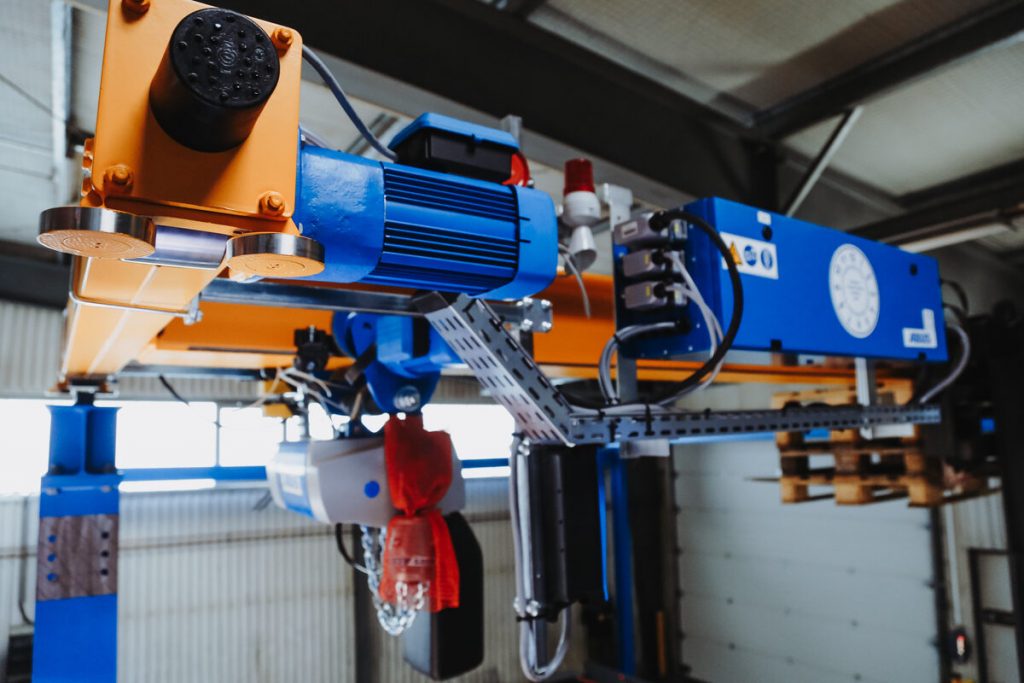
Replacing a crane wheel means: spotting wear on the wheel in good time, finding its cause, isolating and securing the crane, lifting the end carriage, replacing the wheel or wheel block to the manufacturer's data and only releasing the crane after a test run and inspection. Anyone who only swaps the wheel and overlooks the cause will soon face the same finding again.
The overhead crane has been running slightly skewed for weeks. It squeals when starting, there is a shiny track on the rail flank, and the crane inspection report says: “Wheel flange worn on one side.” By now at the latest the question is whether you need to replace the crane wheel – and how to do it without taking the crane out of service longer than necessary.
This guide is aimed at maintenance managers, plant managers, buyers and planners in companies with overhead cranes, bridge cranes and gantry cranes. It explains what a crane wheel is and how to recognise wear. It shows why the cause often lies in the crane runway, how the change runs safely and who gives the release at the end.
We are an installation and maintenance company from Rodgau near Frankfurt. We replace wear parts on travel gear, lift and support, install and document. Isolation is carried out by the qualified electrician, the inspection by the competent person or the expert inspector. How maintenance, inspection and replacement of a whole crane system fit together is described in our guide: maintenance and replacement of crane systems.
Key points at a glance
- A crane wheel carries the crane on the crane runway and guides it on the rail with its wheel flange.
- Typical warning signs are a wheel flange worn on one side, grooves or spalling on the tread, noises, skewed running and shiny tracks on the rail.
- Whether a wheel has to be replaced is decided by you with the inspector based on the manufacturer's limits – not by eye.
- One-sided wheel flange wear usually has a cause outside the wheel: a crane runway out of tolerance, a distorted bridge or unequal drive wheels.
- A qualified electrician isolates the crane. It is then secured, the end carriage lifted and supported, and the wheel is replaced to the manufacturer's data.
- Spare parts come from the manufacturer or are only reproduced to the manufacturer's drawing or with approval.
- Before the first lift after the change come a test run, inspection by the competent person or the expert inspector and release by the operator.
What is a crane wheel?
A crane wheel is the wheel on which a crane or its trolley runs on the rail – on a bridge crane it sits in the end carriage at each end of the bridge, often as part of a compact wheel block with bearing and shaft.
The end carriage is the cross girder at the end of the crane bridge. It holds the wheels on which the whole crane travels along the crane runway. The crane runway itself consists of two parallel runway girders with rails. Whether it is a wheel on an overhead crane, on an outdoor bridge crane or on a gantry crane – the principle is the same. How overhead crane and crane runway are built is explained in our article: overhead cranes and crane runways.
Drive wheel and idler wheel
Each end carriage has two kinds of wheels. The drive wheel is driven by the travel drive via a gearbox and moves the crane. The idler wheel runs along without a drive and only carries load. Both wear, but often at different rates. Drive wheels also transmit the forces when starting and braking.
Wheel flange and running surface
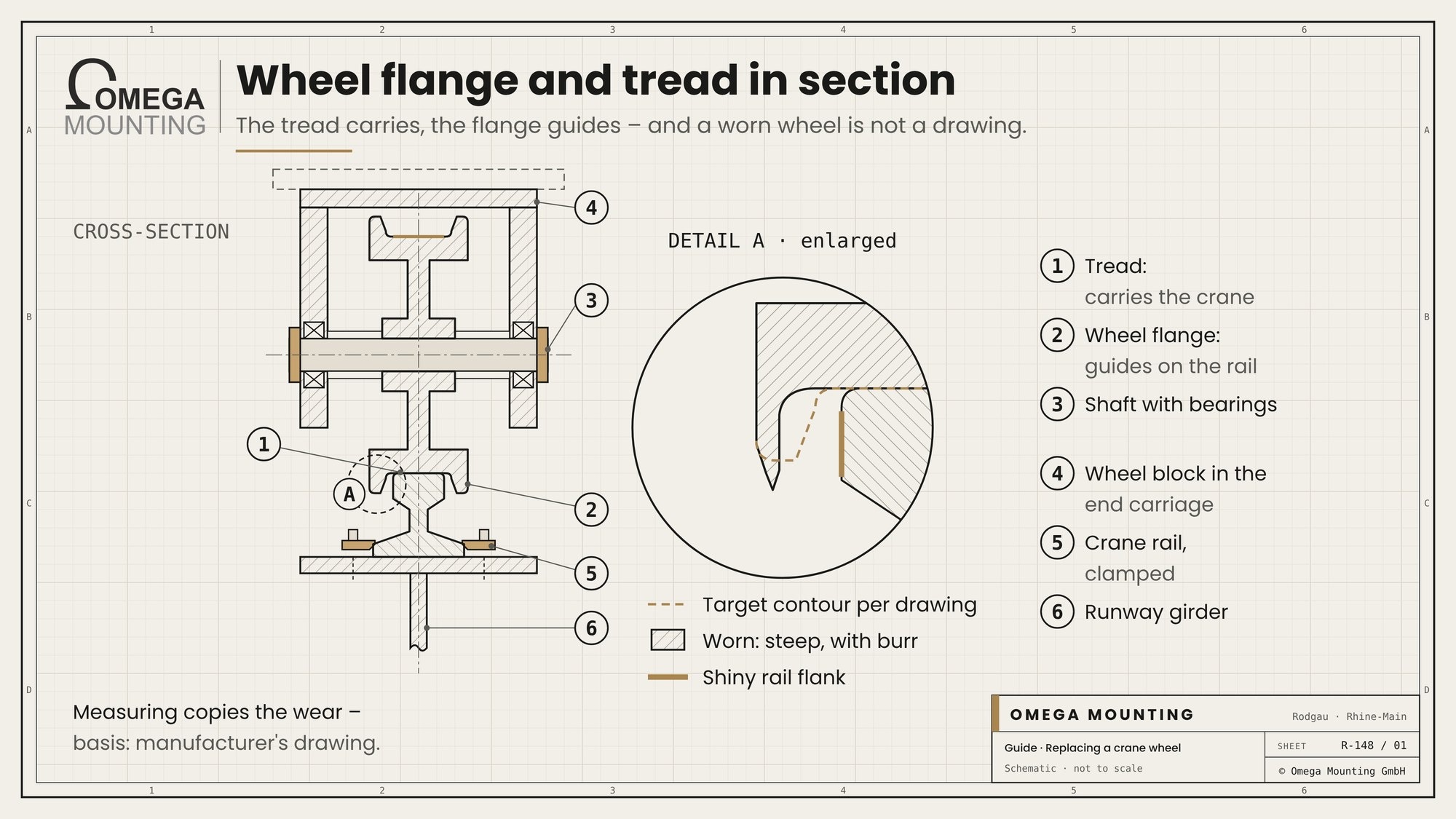
The tread is the part of the wheel that rolls on the rail head. The wheel flange is the collar at the side of the wheel. It guides the crane on the rail and prevents the wheel from running off sideways. If the crane runs cleanly straight ahead, the flange hardly touches the rail. If it runs skewed, the flange presses constantly against the rail flank – and wears.
There are also wheels without a flange, where lateral guide rollers guide the crane. Which design your crane has is stated in the manufacturer's documents.
Wheel block or single wheel
On many newer cranes the wheel sits in a wheel block. This is a closed unit of housing, wheel, shaft and bearings that is bolted into the end carriage as a whole. Then the complete wheel block is often replaced. On older cranes, wheel, shaft and bearings are mounted individually in the end carriage. Then the wheel is removed, the bearing arrangement checked and the new wheel fitted.
Trolleys and suspension cranes also have wheels
The trolley that carries the hoist also travels across the crane bridge on wheels. Suspension cranes run with their wheels on the bottom flange of a girder. Most of what is said here applies to these wheels accordingly. The procedure changes mainly in lifting and access.
How do you recognise wear on a crane wheel?
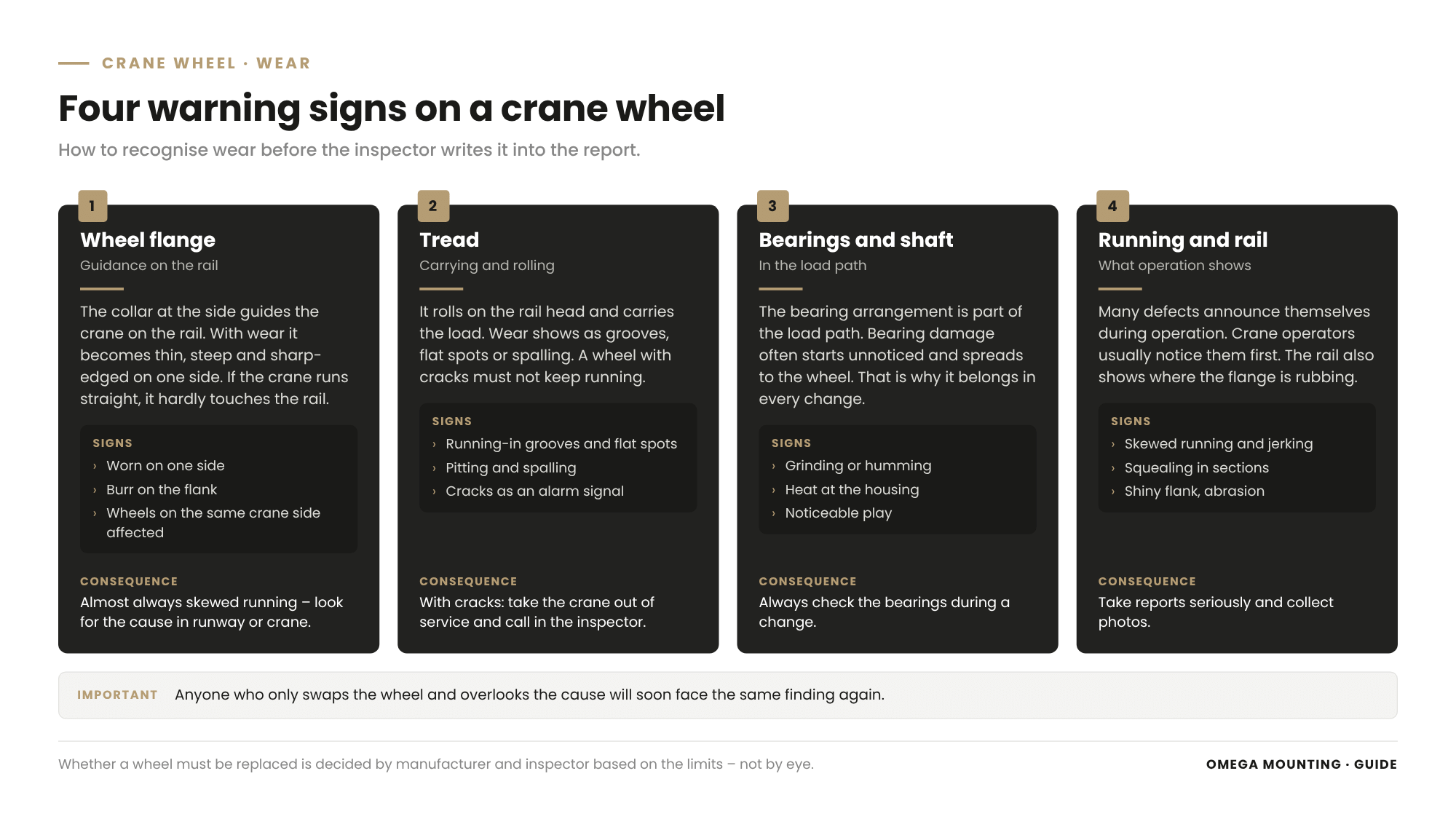
You recognise wear on a crane wheel by a worn or sharp-edged wheel flange, by grooves, flat spots or spalling on the tread, by noise and heat at the bearings, by skewed running and by shiny tracks or abrasion on the rail.
Whether the wheel has to be replaced depends on the manufacturer's limits. It is measured with gauges or templates and assessed by the inspector. A wheel that “still looks fine” can nevertheless be beyond the limit. And a wheel with visible marks can still run for a while. How to spot wear on machines early in general is described in our guide: Spotting wear on machines.
Wheel flange wear
A healthy wheel flange has an even, rounded shape. With wear it becomes thinner on one side, the flank becomes steep and a sharp burr often forms. One-sided flange wear on wheels on the same side of the crane is typical. It almost always shows that the crane runs skewed. A badly worn flange can no longer guide the crane safely.
Tread: grooves, flat spots, spalling
On the tread you see running-in grooves, flat spots or an uneven diameter. Small spalls and pitting also occur when the material fatigues under load. Cracks are an alarm signal. A wheel with cracks belongs in the hands of the inspector immediately.
Bearings and shaft
The bearings of every wheel are part of the load path. Bearing damage shows itself through grinding, humming, heat at the housing or noticeable play. Damage often starts at the bearing and is transferred to the wheel. That is why the bearing arrangement is always checked during a change.
Running behaviour and noises
Many defects announce themselves during operation. The crane runs skewed, jerks when starting or knocks at rail joints. It squeals in certain sections of the crane runway. A drive wheel slips when starting. Crane operators usually notice such changes first – take their reports seriously.
Marks on the rail
The rail also reveals a lot. A bright, shiny flank shows that the flange is rubbing there. Abrasion, fine chips or metal dust on the runway girder point to wear. A burr on the rail head or battered rail joints affect wheel and crane runway alike.
When does a crane wheel have to be replaced?
A crane wheel is replaced when the wheel flange or tread has reached the manufacturer's wear limit, when there are cracks or spalling, or when the inspector requires it in the report. Until then, observing is often the right answer – with photos, notes and a look at the cause.
Fix causes instead of just swapping: crane runway, track and alignment
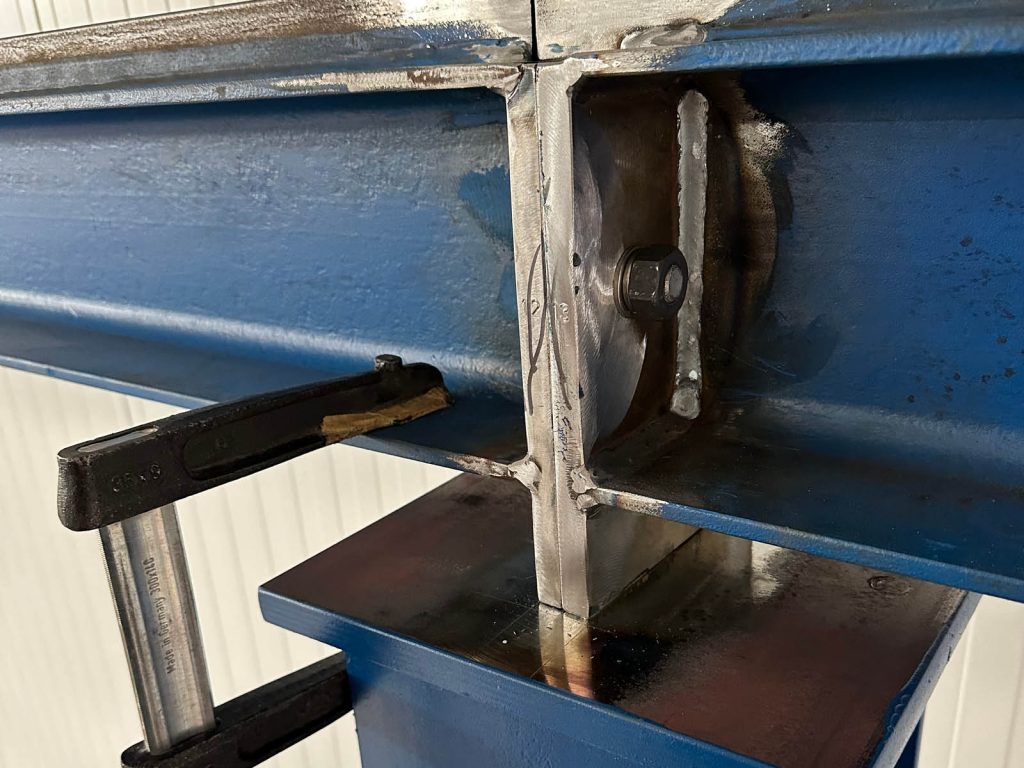
Fixing causes means clarifying before the wheel change why the wheel is worn – usually it is due to a crane runway out of tolerance, a distorted crane, unequal drive wheels or problems with the travel drive, not the wheel itself.
A new wheel on a crooked runway wears just like the old one. Anyone who only swaps will soon swap again. That is why the search for the cause belongs before every wheel change.
The crane runway
The most common cause of one-sided wheel flange wear is a crane runway out of tolerance. The gauge is not right along the whole length, the rails have a height offset, or they do not run straight. Halls settle, columns move, fixings come loose. How a crane runway is measured and corrected is described in our guide: Surveying a crane runway.
If more than adjustment is needed on the crane runway, for instance on brackets, girders or columns, it becomes a question of load capacity. That is assessed by the structural engineer.
The crane itself
The crane can also be distorted. If the diagonal of the bridge is not right, the wheels do not run parallel to the rail. The same applies if a wheel block sits askew or has been displaced after an impact. The alignment of the wheels on the crane is checked to the manufacturer's data.
Unequal drive wheels
If the drive wheels on both sides have different diameters, they travel different distances per revolution. One side runs ahead and the crane skews. This happens readily when a new wheel is fitted on one side only. That is why the question of the partner wheel matters.
Travel drive and brakes
If one travel drive brakes earlier or harder than the other, the crane twists a little at every stop. This also leads to skewed crane running and flange wear. Whether brakes and drives work equally is checked mechanically by maintenance. Settings on the control system or frequency converter are made by the qualified electrician.
Operation and environment
Operation plays a role too. Short travels with many starts put more strain on drive wheels. Dirt on the rail, such as dust, chips or moisture, changes the friction. Talk to the inspector about whether a change in use still matches the crane's design.

Replacing a crane wheel: the procedure step by step
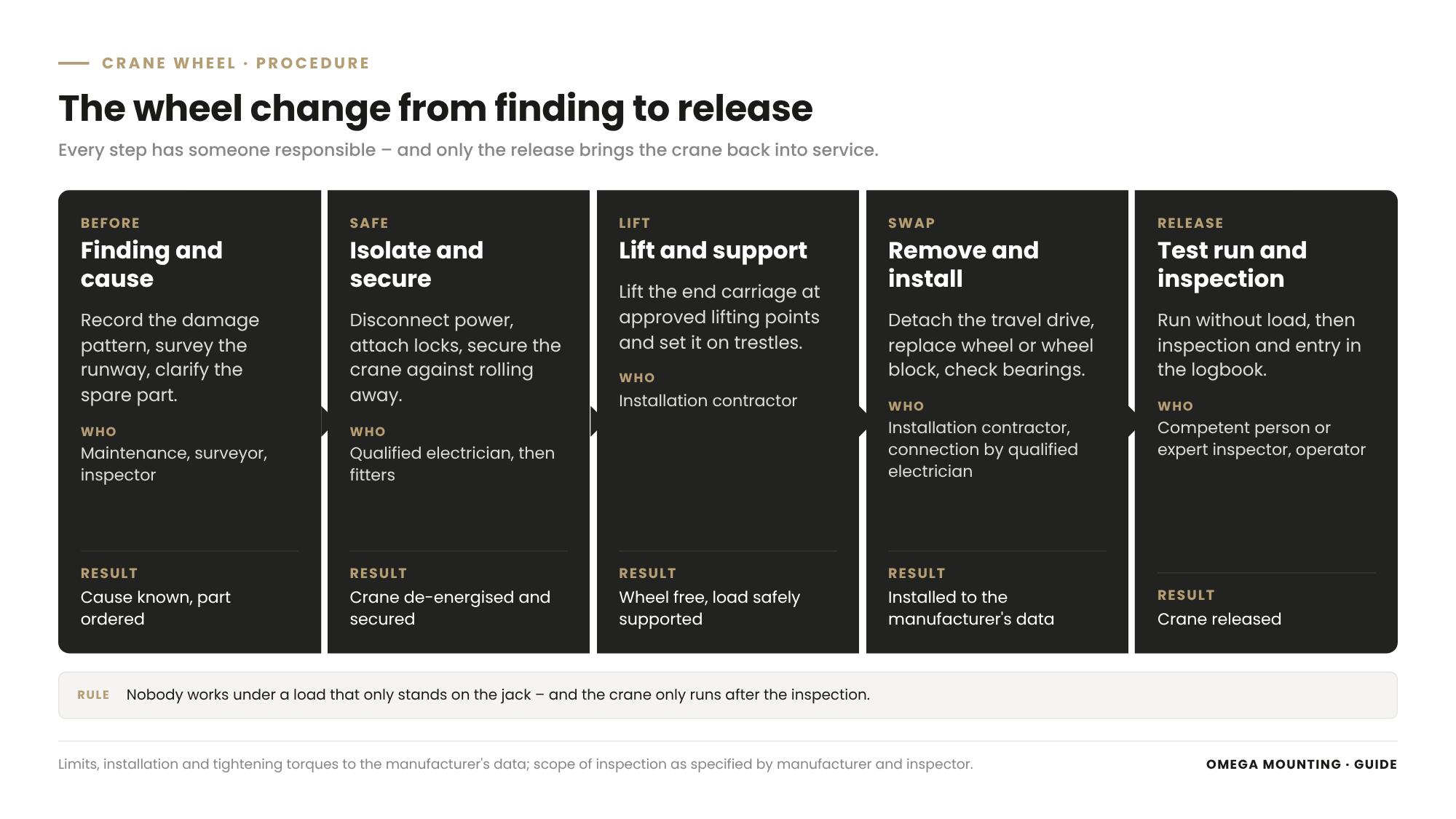
Replacing a crane wheel runs in clear steps: clarify finding and cause, plan spare part and date, have the crane isolated and secured by a qualified electrician, lift and support the end carriage, remove wheel or wheel block, install to the manufacturer's data, have the travel drive connected and release the crane after a test run and inspection.
Preparation
Before the date, the finding, the cause and the right spare part are available. The crane's type designation, the inspection logbook and the manufacturer's documents help with ordering. Access, the work position at height, the cordon below and who isolates are also clarified. The risk assessment covers work at height, lifting and stored energy.
Isolating and securing
A qualified electrician isolates the crane. They disconnect the power supply, secure against reconnection and verify the absence of voltage. Every person working on the crane hangs their lock and tag on the main switch. How this procedure is set up is explained in our guide: Lockout tagout in maintenance.
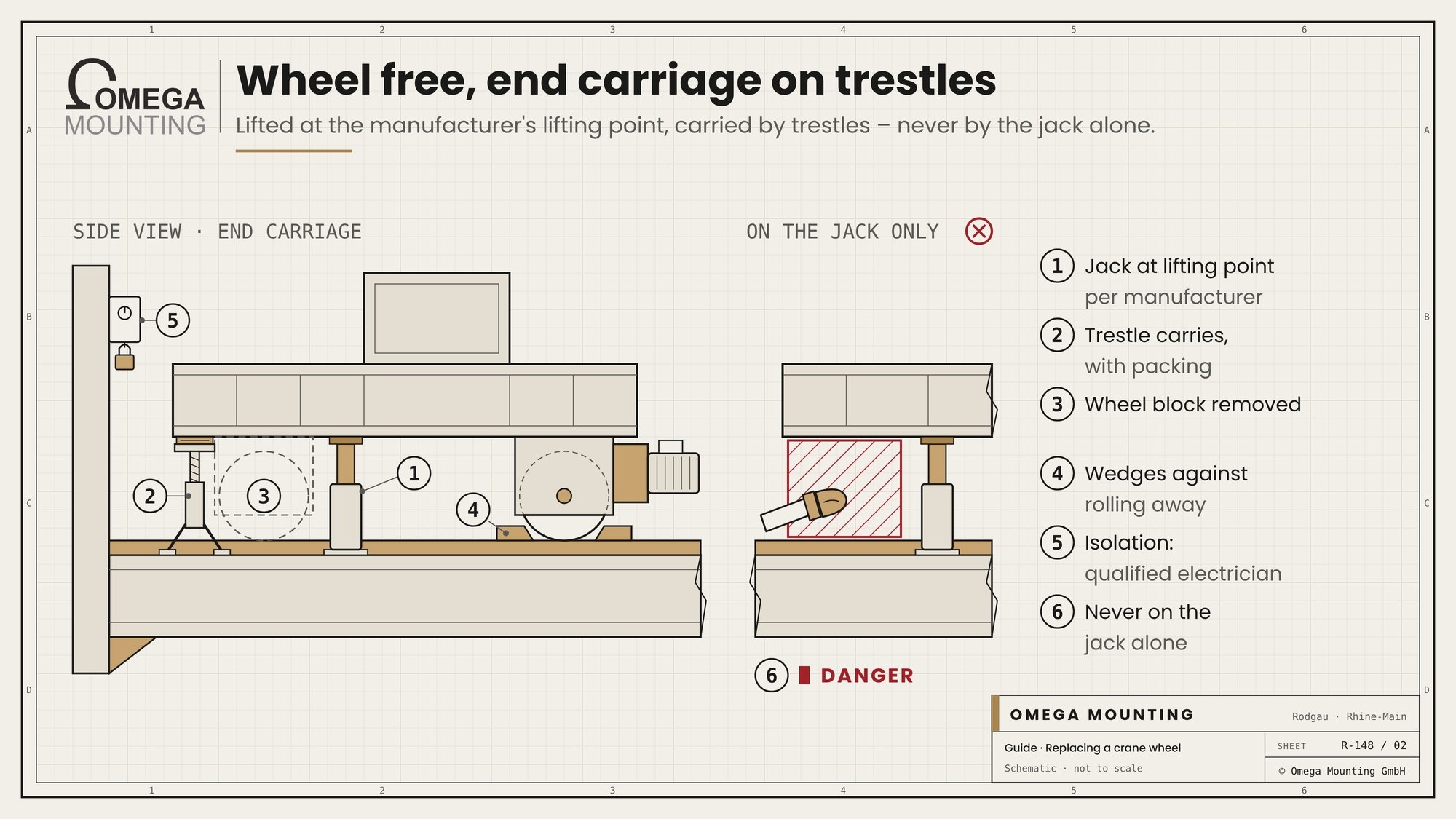
Mechanically, the crane is secured against rolling away, for instance with wedges or rail clamps. No load hangs on the hook. The area below the work position is cordoned off. If other cranes run on the same runway, they are also secured so that none travels into the work area.
Work position at height
The end carriage is usually high up under the hall roof. Work is done from a mobile elevating work platform, a walkway on the crane or a scaffold. Where no guardrail protects, personal fall protection equipment with a suitable anchor point and a rescue plan are needed.
Lifting and supporting the end carriage
To free the wheel, the end carriage has to be lifted. Hydraulic jacks or hoists are used at the lifting points provided by the manufacturer. If there is no specification, the lifting point is agreed with the manufacturer or a structural engineer. After lifting, the end carriage is supported on trestles or packing. Nobody works under a load that is only standing on the jack. How to lift loads without a crane and support them safely is described in our guide: hydraulic jacks.
Removing the wheel or wheel block
If the drive wheel is affected, the travel drive is detached first. The qualified electrician disconnects the electrical connections. Mechanically, the geared motor is removed and set down. Then the wheel block or bearing housing is unfastened and the wheel taken out. Heavy parts hang on a chain hoist or lie on a support, never loose on the girder.
Checking bearings and seat
After removal the bearing arrangement is checked. Seat, shaft, mating surfaces and fixings must be in order. Bearings are replaced to the manufacturer's data, usually together with the wheel. Damage to the end carriage itself is a matter for the inspector.
Installation to the manufacturer's data
The new wheel or wheel block is fitted to the manufacturer's data. This covers position, alignment, play, tightening torques and locking devices. Then the travel drive is mounted. The qualified electrician reconnects it and checks the direction of rotation. Only then is the end carriage lowered and the support removed.
Replace in pairs?
Whether you replace a single wheel or a pair is decided by manufacturer and inspector. For drive wheels there is a lot to be said for replacing both wheels of a drive axle or both sides together. Otherwise a new and a worn wheel with different diameters run side by side, and the crane runs skewed. For pure idler wheels a single replacement may be enough.
Spare parts: original, reproduction and approval
A crane wheel spare part is safest from the crane manufacturer; reproduction in a workshop is possible, but only to the manufacturer's drawing or with approval from the manufacturer or the inspector – because material, heat treatment and tolerances determine load capacity and service life.
Original part from the manufacturer
The original part matches the crane in dimensions, material and bearing arrangement. To order it you need the crane's type designation, often the serial number on the rating plate as well. Clarify early whether the part is available. Lead times for travel gear parts can determine the downtime.
Reproduction only to drawing or with approval
Sometimes the original part is no longer available, or the manufacturer no longer exists. Then a wheel can be reproduced in a workshop. The basis is the manufacturer's drawing with material, tread hardness, heat treatment and tolerances. Without a drawing, approval by the manufacturer or an assessment by the inspector or expert inspector is required.
An old, worn wheel is not a drawing. Anyone who simply measures it copies the wear. You cannot see the material and hardness by looking at it. A wheel that has to carry safely needs a sound basis.
Different design, different inspection
If a wheel is replaced by a different design, for instance with a different material, diameter or bearing arrangement, this is more than a swap. Clarify beforehand with the inspector whether this triggers a more extensive inspection.
Documenting the spare part
Record which part was installed: origin, drawing or approval, location on the crane, date. This information belongs in the inspection logbook. At the next inspection and the next replacement it saves searching and queries.
Return to service: test run, inspection and release
After the wheel change the crane only goes back into operation once a test run has passed without findings, the competent person or the expert inspector has inspected the crane to the manufacturer's specification and the operator has released it.
Test run
In the test run the crane first travels without load along the whole crane runway. Attention is paid to tracking, noises, starting and braking, limit switches and buffers. If the crane runs smoothly and straight, a run with load follows as specified by the inspector. Anything unusual is noted and clarified before release.
Inspection by the competent person or approved expert
A wheel change is a repair to a load-bearing and guiding component. Afterwards the crane is inspected before it works again. Who inspects depends on the crane type, the scope of the work and the manufacturer's specification. As a rule it is the competent person, in certain cases an expert inspector. What distinguishes the two is explained in our article: competent person.
The inspection is not the task of the fitters who made the change. But they supply what the inspector needs: which part, to which drawing, how it was installed, what was changed about the cause.
Inspection book and sign-off
The result of the inspection goes into the crane's inspection logbook. It also records which finding has been closed. At the end, the operator is the one who may release the crane for operation. He ensures that the crane is safe after the repair and that the inspection is on record.
This chapter is an assessment from practice. This is not legal advice. Clarify which inspection applies to your crane with your inspector and your occupational safety specialist.
Follow-up check
New wheels bed in. Plan a visual check of wheel flange, tread and rail after a short period of operation. If one-sided contact shows up again, the cause has not yet been fixed.
Damage pattern, cause, measure: the overview

The overview assigns typical damage patterns on the crane wheel to their possible causes and measures; it does not replace an inspection report, but helps to ask the right questions before the replacement.
| Damage pattern | Possible cause | Action | Who |
|---|---|---|---|
| Wheel flange worn on one side. | Crane runway out of tolerance, crane distorted, skewed running. | Survey the crane runway, fix the cause, then replace the wheel. | Surveyor and maintenance, inspector assesses. |
| Wheel flange sharp-edged with burr. | Constant contact with the rail flank. | Replace the wheel according to the finding, check tracking. | Installation contractor, inspector. |
| Tread grooved or flattened. | Wear, dirt, slipping drive wheel. | Replace the wheel, clean the rail, check the drive. | Installation contractor, maintenance. |
| Spalling or cracks on the tread. | Material fatigue, overload, unsuitable material. | Take the crane out of service, call in the inspector, replace the wheel. | Operator, inspector, installation contractor. |
| Grinding, humming, heat at the wheel. | Bearing damage, lack of lubrication. | Check and replace bearings, inspect the seat. | Maintenance, installation contractor. |
| Crane runs skewed after a single replacement. | Unequal diameters of the drive wheels. | Check the partner wheel, replace drive wheels together. | Installation company to manufacturer specifications. |
| Crane twists when stopping. | Brakes or drives work unequally. | Check brakes mechanically, have the drive adjusted. | Maintenance, qualified electrician. |
| Shiny flank, abrasion on the rail. | Wheel flange in constant contact. | Survey the crane runway, check the rail for wear. | Surveyor, inspector, structural engineer if needed. |
Typical mistakes in a wheel change
The typical mistakes in a wheel change are swapping without looking for the cause, a single replacement of drive wheels without considering the partner wheel, a reproduced wheel without a drawing, an end carriage on the jack instead of on trestles, isolation without a qualified electrician and a crane that runs again before the inspection.
- Only swapped, cause not investigated. After a short time the new wheel shows the same damage pattern.
- One drive wheel replaced on its own. New and old wheel have different diameters, the crane runs skewed.
- Wheel measured off the old wheel. Material and hardness are wrong, the wheel wears quickly or spalls.
- Worked under the jack. The end carriage stood only on the hydraulic cylinder, not on trestles.
- Isolated it yourself. Without a qualified electrician, without a lock, without verifying the absence of voltage.
- Neighbouring crane forgotten. A second crane on the same runway travels into the work area.
- Bearings not checked. The new wheel turns in a worn bearing arrangement.
- Back into operation without inspection. Production is pressing, and the inspector comes later.
- Nothing documented. At the next finding nobody knows which wheel was installed when and to which drawing.
The mistake behind the mistakes
Behind most mistakes lies time pressure. The crane is needed, so it has to be quick. But a wheel change without cause, isolation and inspection only shifts the problem – often to a less convenient moment.
Replacing crane wheels in the Rhine-Main region: how we work
In the Rhine-Main region we take over the mechanical part when you have a crane wheel replaced: site visit and recording of findings, lifting and supporting the end carriage, removal and installation of wheel or wheel block to the manufacturer's data, mounting the travel drive, reproduction in our workshop to drawing or approval, and documentation for the inspector.
We plan every overhead crane repair on the travel gear with you in advance. We are neither a crane manufacturer nor an inspector. The crane is isolated according to your procedure. Our own qualified electricians disconnect and reconnect the travel drive – up to the crane's main switch. The inspection before the return to service is carried out by the competent person or the expert inspector. Whether the crane runway carries the load is assessed by the structural engineer.
What we take on:
- Recording findings: damage pattern, marks on the rail, partner wheel, photos for manufacturer and inspector.
- Supporting the search for the cause: pointers on crane runway and alignment, coordination with the surveyor.
- Lifting and supporting: hydraulic jacks, trestles, packing, work position at height.
- Mechanical replacement: detaching and refitting the travel drive, replacing wheel or wheel block, checking bearings.
- Workshop in Rodgau: reproduction only to the manufacturer's drawing or with approval.
- Documentation: installed part, installation, photos – as a record for inspector and inspection logbook.
What we do in crane construction overall, from installation to the repair of trolleys and travel gear, is shown on our page: crane installation and crane construction.
From Rodgau we reach companies in Frankfurt, Offenbach, Hanau, Darmstadt and Aschaffenburg on short routes. That helps with recording findings and when a crane has to run again quickly. For companies looking for a crane repair in the Rhine-Main region this means: one point of contact for mechanical work and crane electrics, coordinated with your inspector.
If, on the other hand, you are planning an additional crane in an existing hall, that is a project of its own. More on this in the guide: retrofit an overhead crane.
Project examples
Our project diary does not yet document a wheel change – the linked jobs show crane installation, and they make visible what also matters in a change: a crane runway on track, travel gear at the end of the bridge, clean lifting at great height.
Crane runway for an overhead crane: track, height and survey
With the Installing a crane runway for an overhead crane – we aligned the columns by position and diagonal dimensions. The height was levelled with a rotating laser via adjusting screws on the base plates. The base plates were fixed with anchors bonded in beforehand and grouted. Then the crane runway went onto the columns, was aligned with the laser and brought to the correct gauge. Our welders fixed it. Only after the customer's maintenance team had surveyed the runway was the crane placed on it.
For your wheel change this means: the track of the crane runway determines how long a wheel lasts. Surveying comes before the crane.
Overhead travelling crane near Aschaffenburg: end carriage, travel gear and diagonal
With the installation of a double-girder overhead travelling crane in the Aschaffenburg area, – the bridge was pre-assembled on the ground and then set down on the crane runway. Turning it into the hall was critical. The diagonal dimension determined whether the crane would fit through. The longer travel gear at the ends of the bridge increased this diagonal. The photos show the end carriage with its travel drive. At the end, the customer's plant electrician took care of the electrics.
For your wheel change this means: mechanical and electrical work meet at the end carriage. The handover to the qualified electrician belongs in the plan.
Gantry crane in Babenhausen: aligned in height and diagonal
During the installation of a free-standing gantry crane in Babenhausen – we aligned the gantry in height and diagonal with the laser and grouted the base plates. The crane bridge was pre-assembled on the ground, lifted onto the runway with a forklift and guided from work platforms. Because the gantry crane carries its own steel structure, the hall building remained unloaded.
For your wheel change this means: travel gear and runway are one system. Anyone working on one part checks the other as well.
Crane at great height: lift plan, permit to work, exclusion zones
With the Installing a crane at great height – our fitters worked on the hall girder while other trades were active on the site at the same time. Every lift was coordinated via the lift plan and the site's permit-to-work system. The appointed person defined the sequence and exclusion zones in advance with the site management.
For your wheel change this means: work on the end carriage is work at height. Access, cordoning off and releases are clarified beforehand, not at the crane.
Do you have a wheel change coming up?
Then get in touch with us. Send us the finding, photos of the wheel and the rail and the type designation of your crane. We tell you what we take over mechanically, what should be clarified beforehand and who else you need.
What this means for your role
For buyers: For the spare part, ask about origin and basis: original part, manufacturer's drawing or approval. Commission replacement, isolation and inspection so that the dates fit together.
For designers: If the crane runway is the reason for the wear, it lands on your desk. Clarify whether adjustment is enough or whether girders, brackets or columns need a structural review.
For project managers and site managers: You coordinate qualified electrician, installation contractor and inspector. Arrange cordoning off, access at height and a permit to work. Keep production informed about when the crane will be released again.
For maintenance managers: Document damage patterns early with photos and notes. Have the crane runway surveyed before the first wheel is replaced. Record in the inspection logbook which wheel was installed when.
For safety specialists: Make sure that isolation, securing against rolling away and supporting the end carriage are in the risk assessment. Check whether neighbouring cranes on the same runway are secured.
For operations and plant managers: A wheel change can be planned if the finding is available early. Plan it into a maintenance window instead of waiting for the failure.
Wheel change checklist: request the template
The wheel change checklist is a one-page working document for maintenance and operators. It has five blocks: finding, cause, preparation, change and release. Each item has fields for “responsible”, “done” and “open”. There are deliberately no limits or number fields – manufacturer and inspector provide those. The checklist shows you what is still missing before the date. Request the template via our contact form – keyword “Wheel change checklist”.
Why Omega Mounting?
We are based in Rodgau near Frankfurt, can be reached around the clock and work with our own fitters and our own workshop. The linked jobs show how we bring crane runways onto track, set cranes on the runway and work in a coordinated way at great height. In a wheel change we take over mechanical work and electrics up to the crane's main switch and say in advance where that ends: the supply line stays with your electricians, the inspection with the inspector. For you this means: one point of contact for lifting, replacement and documentation, coordinated with your inspector.
Conclusion
You do not replace a crane wheel by eye, but according to the finding and the manufacturer's limit. Look for the cause first, because one-sided flange wear usually comes from the crane runway or the crane itself. Have the crane isolated by a qualified electrician, support the end carriage safely and only install parts made to the manufacturer's drawing or with approval. The crane only runs again after a test run, inspection and release. If you have a finding on the travel gear, send us the finding and photos – we will get back to you with an honest assessment.
Planning a move-in, installation or maintenance in the Rhine-Main region?
Tell us briefly what you need – we'll come back with an honest assessment.
Free, no-obligation callback
You may also be interested in these guides

About the author
Tobias Schott
Managing director of Omega Mounting GmbH, Rodgau · more than 20 years of hands-on experience in installation and maintenance
A trained mechatronics technician, working in maintenance, servicing and industrial installation since 2004 – first alongside his father, and with Omega Mounting since 2012: from overhead conveyors in Frankfurt to the crane system in a new-build hall. He plans and leads lifting operations as an appointed person (AP) in data centers and on industrial sites in the Rhine-Main region, trains and examines operators of cranes, mobile elevating work platforms and telehandlers, and is a qualified occupational safety specialist. On jobs abroad he is known as the “German Troubleshooter” – the person you call when a site gets stuck. He learned what quality means from his father, not from a manual: Made in Germany as a standard for his own work, not a label. That is why quality comes first at Omega Mounting – ahead of speed and price. He writes these guides from that practice: what works on our sites is in them – what exists only on paper is not.
Frequently asked questions
You replace a crane wheel when the wheel flange or tread has reached the manufacturer's wear limit, when there are cracks or spalling, or when the inspector requires the replacement in the report. The limits are in the manufacturer's documents. Before the replacement, the cause of the wear should be clarified.
A worn wheel flange is thinner on one side, has a steep flank and often a sharp burr. A shiny track shows on the rail. One-sided wear on wheels on the same side of the crane points to skewed running, usually caused by the crane runway or the crane.
That is decided by manufacturer and inspector. For drive wheels there is a lot to be said for replacing them together, because different diameters make the crane run skewed. For pure idler wheels a single replacement may be enough. Check the partner wheel in any case.
Isolation, disconnection and reconnection of the travel drive are carried out by a qualified electrician – in our case from our own team. They disconnect the power supply, secure against reconnection and verify the absence of voltage. Every person working on the crane attaches their own lock. The fitters also secure the crane mechanically.
Yes, but only to the manufacturer's drawing or with approval from the manufacturer or the inspector. Material, tread hardness, heat treatment and tolerances must be right. Simply measuring an old wheel is not enough, because you copy the wear and do not know the material.
Yes. After the repair, the competent person or, in certain cases, the expert inspector inspects the crane to the manufacturer's specification before it works again. The result goes into the inspection logbook. Release for operation is given by the operator.
Usually because the cause was not fixed. A crane runway out of tolerance, a distorted bridge, unequal drive wheels or unequally acting brakes also make the new wheel run skewed. That is why surveying the crane runway belongs before the replacement.
In principle, yes. Gantry cranes, suspension cranes and trolleys also run on wheels with a tread and usually a flange. Wear patterns, cause analysis, isolation, inspection and release follow the same logic. There are differences in lifting, access and wheel design.
Send us the inspection report, photos of the wheel and the rail and the type designation of your crane. For companies in the Rhine-Main region we are happy to look at the crane on site. Then we tell you what we take over and who else you need. Your contact is Tobias Schott – reachable via our contact form.
 English
 German