
- Guide – Lift & Shift
Hydraulic jacks: lifting machines and heavy loads without a crane
By Tobias Schott · 21-minute read · Updated October 2026
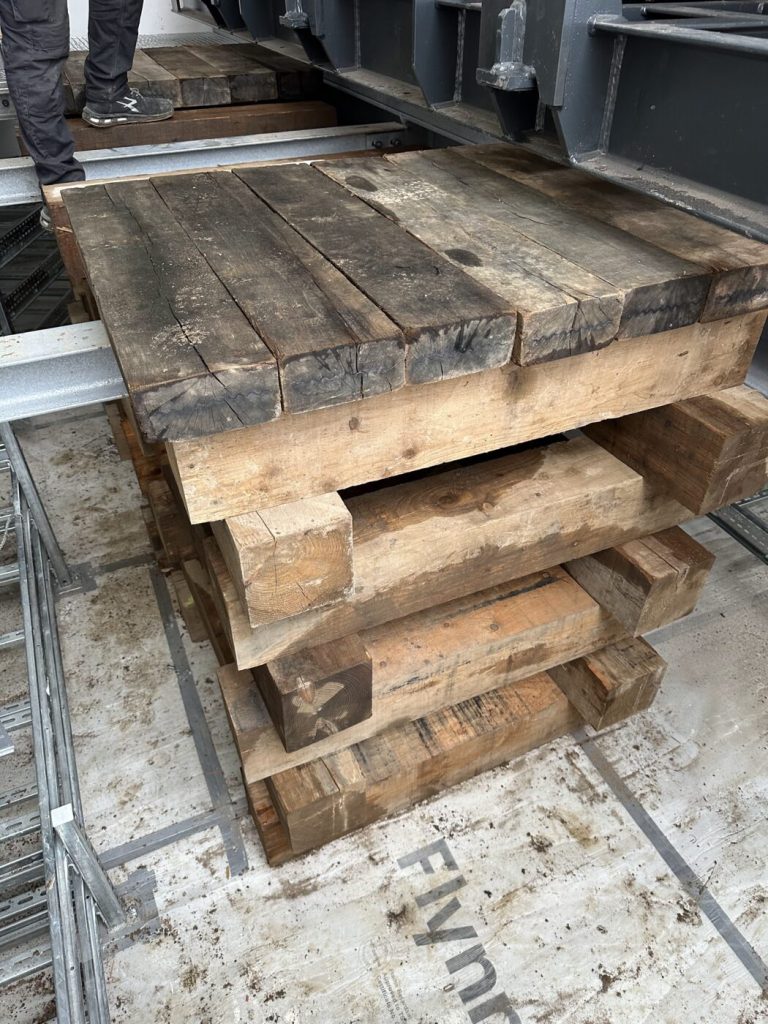
Hydraulic jacks lift a machine where no crane can reach – to place skates underneath, set a load on a track or lower it onto its foundation. It only becomes safe when lifting points, cribbing and approvals are settled beforehand.
Many halls have no crane, and many rooms are out of a crane's reach. Still the machine has to go up: far enough for skates to fit underneath. Or far enough for a track to come out. Or far enough for it to stand level on the foundation. That is what hydraulic jacks are for.
This guide shows which types exist, what they are used for and the principle behind lifting safely. Above all it shows what you as the client have to prepare: lifting points, floor, space under the load, disconnected services and a clear release. Plus inspection, typical mistakes and responsibilities.
We are an installation and rigging company from Rodgau near Frankfurt. We lift, crib, move and set down – as an installation service with our own team. How a machine is relocated within a hall overall is described in our guide on relocating a machine.
Key points at a glance
- Hydraulic jacks are lifting cylinders, jack stands, flat jacks and hydraulic blocks that lift a load a short distance with oil pressure.
- They lift a machine without a crane to place skates underneath, set it on a track, set it down or align it.
- Lifting is done evenly at several points. The load never stands on the jack but is cribbed up step by step.
- Where the jacks may be placed, how heavy the load is and where its centre of gravity lies is specified by the machine manufacturer.
- Whether the floor under the jacks carries the load is assessed by the structural engineer. Services are disconnected beforehand by the specialist contractor, electrics following your procedure by our qualified electrician or yours.
- Jacks and hydraulic hoses are work equipment. They are inspected before they are used.
- We do not hire out or sell jacks. We lift with team, plan and release.
What are hydraulic jacks?
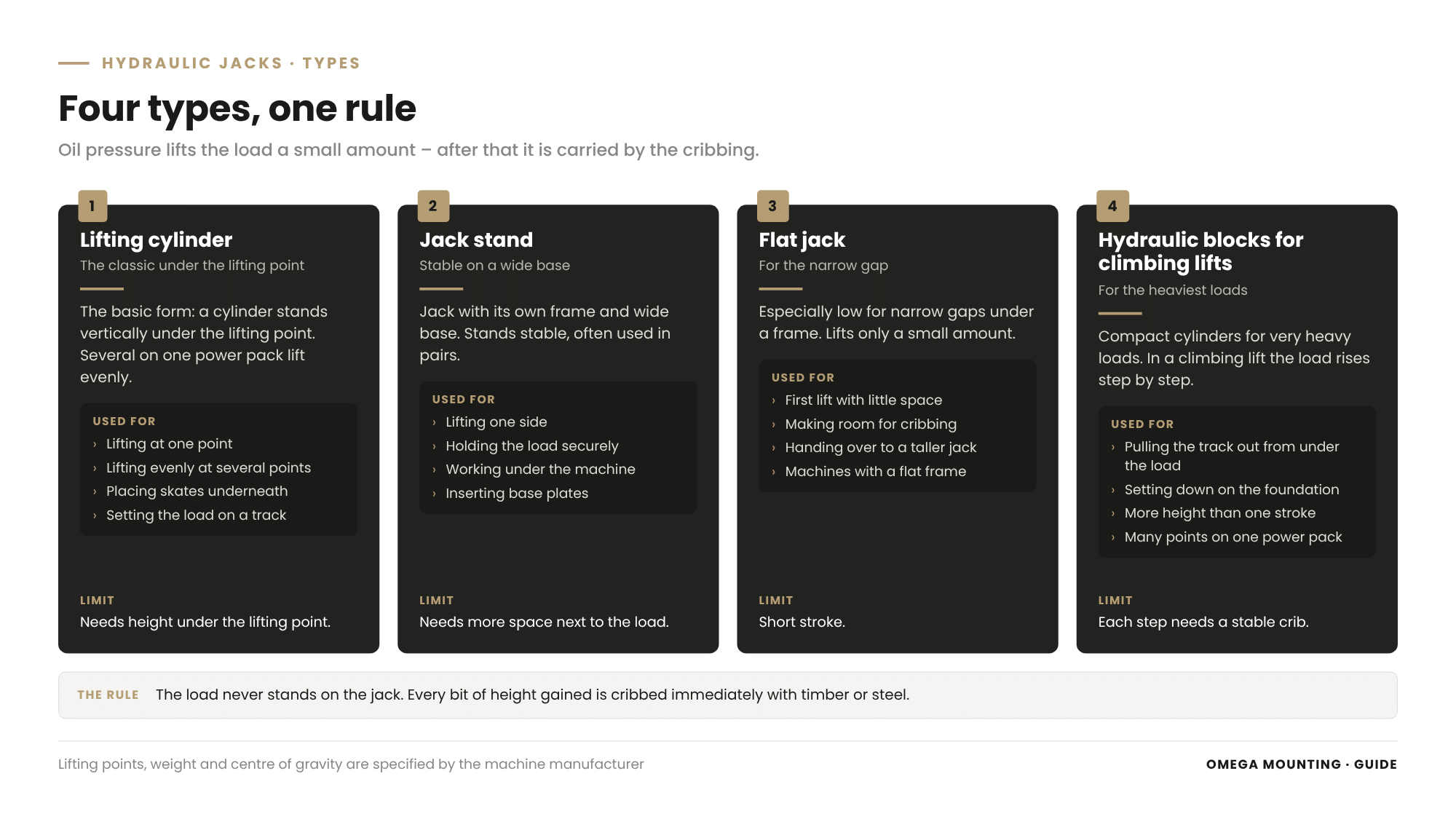
Hydraulic jacks are lifting devices that raise a load with oil pressure from a cylinder – compact, powerful and without a crane runway, but only over a short distance. A pump forces oil into the cylinder, the piston extends and lifts the load. When the oil is allowed to flow back, the load lowers.
Which type fits depends on the load, the space under it and the purpose. We come across four types most often.
Lifting cylinder
The lifting cylinder, also called a hydraulic cylinder, is the basic form. It stands vertically under the lifting point and is operated by a hand pump or a power pack. Several lifting cylinders on one power pack lift a load at several points at once.
Jack stand
A jack stand is a jack with its own frame and wide base. It stands stable and is often used in pairs, for example to lift a machine on one side or to hold a load securely for longer. Here too: in the end the load stands on the cribbing, not on the stand.
Flat jack
Flat jacks are especially low jacks for little space under the load. They fit into narrow gaps under a machine frame but lift only a small amount. Then the load is cribbed, and a taller jack takes over.
Hydraulic blocks and climbing lift
Hydraulic blocks are compact lifting cylinders that lift a very heavy load, for example to pull a skidding track out from under it. If a load has to go higher than a cylinder can travel, a climbing lift is used: lift, crib, set down, raise the jack, lift again. This way the load “climbs” step by step on a growing stack of timber or steel.
Hand pump or power pack
Small strokes at one point can be done with a hand pump. That is slow and easy to control. If several jacks are to work at once, a power pack supplies them via hoses and a manifold. Controls with a pressure gauge show how much force each jack is applying. If pressure rises more than expected at one point, that is a warning sign: the load is heavier there, or something is jammed.
What hydraulic jacks are not
A hydraulic gantry is not a jack but a lifting device with four legs and header beams from which the load hangs – how it works is explained in our article on gantry cranes and hydraulic gantries. A workshop car jack is built for vehicles, not machines. It has no suitable saddle, no reserve and no safeguard for a load standing on it. For machines it is off limits.
What hydraulic jacks are needed for
Hydraulic jacks are needed whenever a heavy load has to be lifted a small amount and no crane can hold it: to place skates underneath, to set it on a track, to lower it onto a foundation, to align it and for work under the machine.
Placing skates underneath
If a machine is to move through the hall, it first has to go onto heavy-duty skates. For this it is lifted just far enough for the skates to fit underneath. How skates are built and which jacks are used to get under the load is explained in our article on machine skates and heavy-duty skates.
Setting on and taking off the track
In skidding the load runs on a track. At the target, jacks lift it, the track elements are pulled out and the load is lowered. How such skidding is planned is described in our guide on heavy-load skidding.
Setting down on the foundation
When a machine arrives at its place on skates or a transport frame, it has to come down. The jacks take the load, the skates or frame come out, and the load is lowered onto the foundation in small steps.
Aligning and shimming
Once the machine stands, height and position have to be right. Jacks lift it at individual points so that shims, wedges or anti-vibration mounts can be fitted. How alignment works overall is explained in our guide on aligning and anchoring machines.
Work under the machine
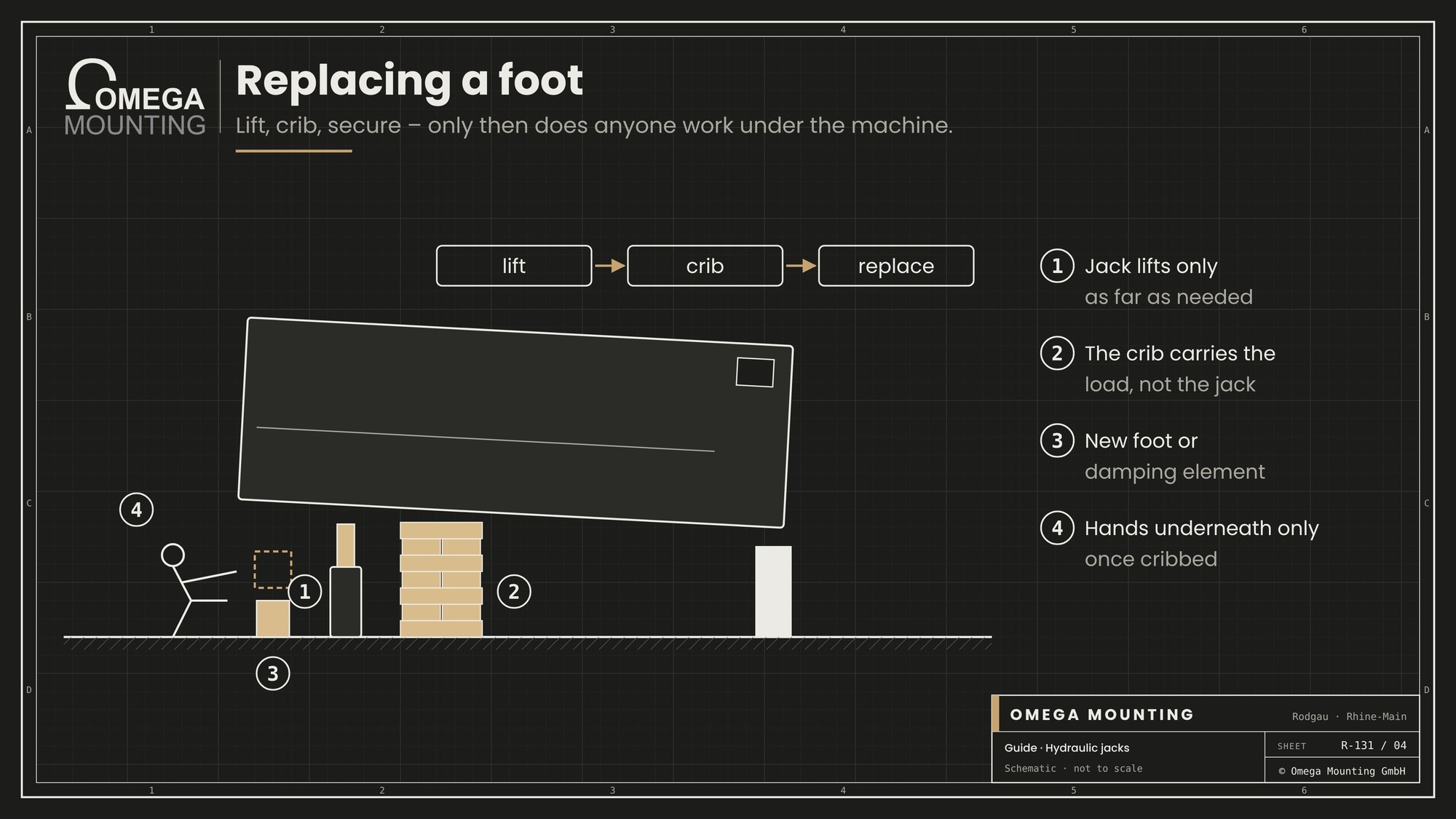
Sometimes only one part has to go up: to replace a bearing, a foot or a damping element. Then the machine is lifted, secured and cribbed before anyone works underneath. Working with your hands under a load that stands only on the jack is not an option.
Lifting safely with hydraulic jacks: the principle
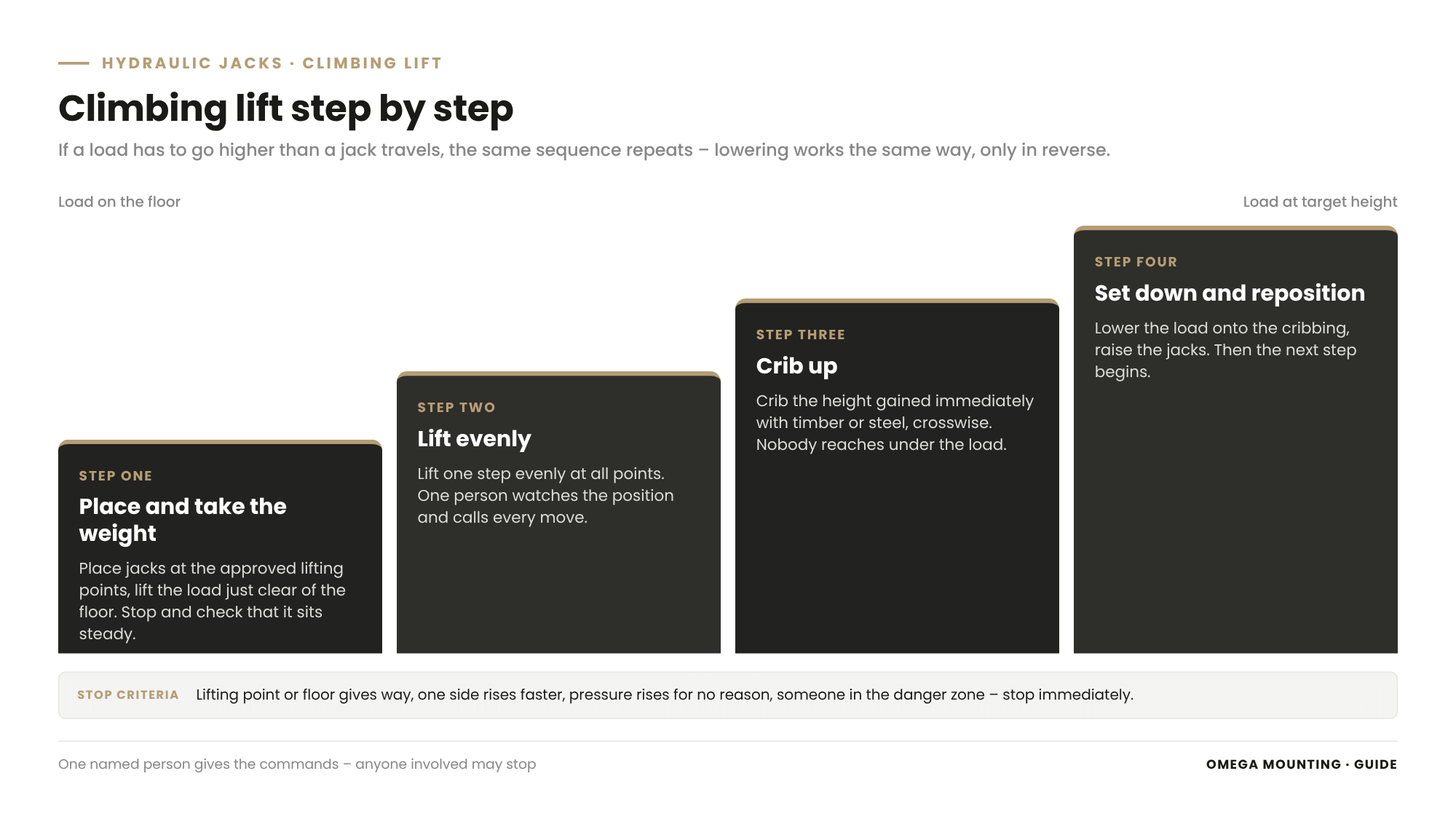
Lifting safely with hydraulic jacks means: placing them at the approved points, lifting evenly, cribbing up step by step and never leaving the load standing on the cylinder.
The load never stands on the jack
A jack holds a load as long as the oil stays in the cylinder. A leaking hose, an open valve or a slipped base – and the load sinks. That is why every bit of height gained is cribbed immediately. The load rests on timber or steel, the jack only follows. Anyone who would have to reach under a load that is standing only on the jack has found a fault in the sequence.
Evenly at several points
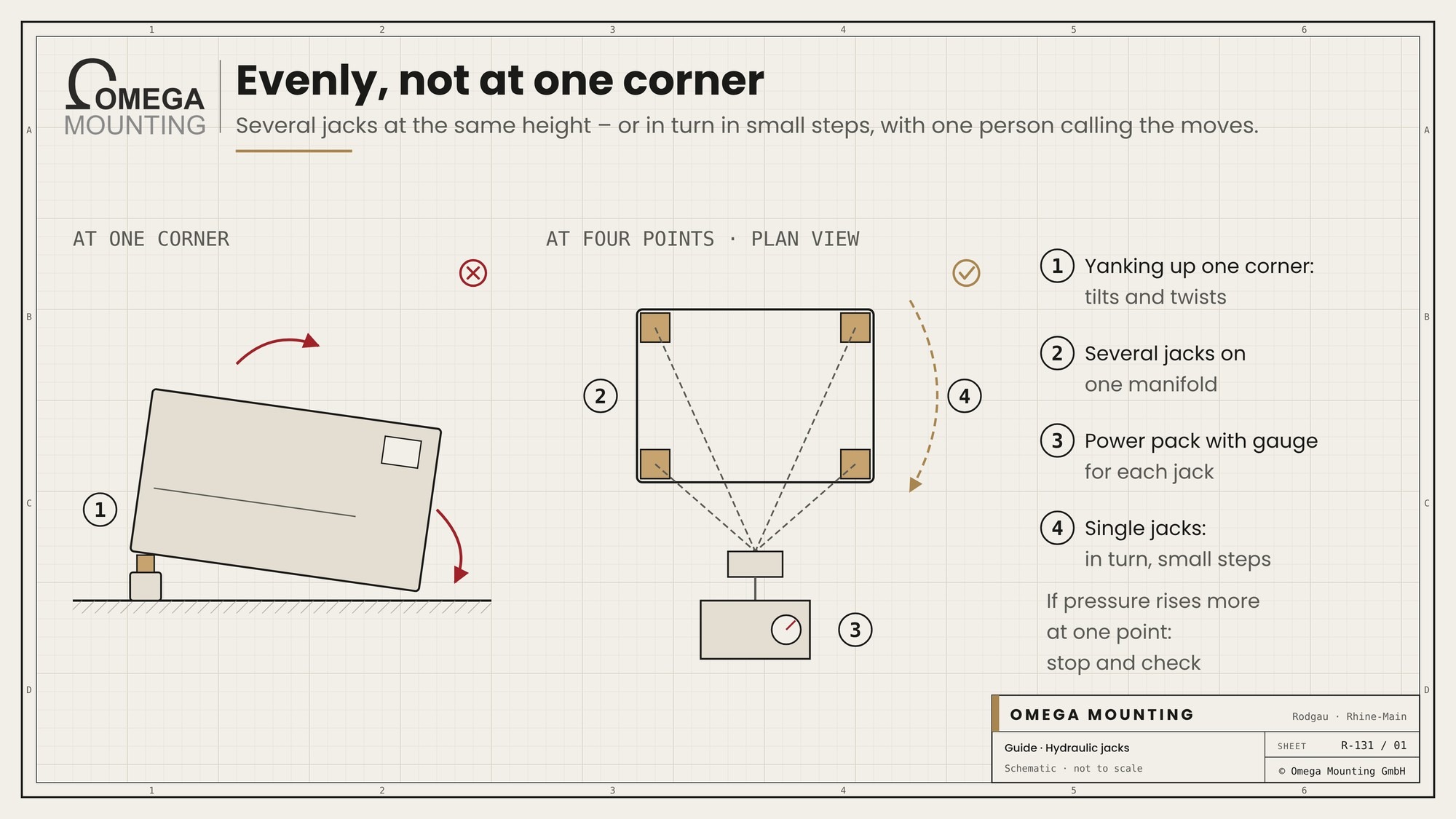
A machine is not yanked up at one corner. It is lifted evenly at several points so that it does not tilt, twist or slip off a jack. If several jacks are operated from one power pack, the controls keep them at the same height. With single jacks, you lift in turn in small steps. One person keeps an eye on the position of the load and calls every move.
Climbing lift step by step
If a load has to go higher than a jack can travel, a climbing lift is used. The steps repeat: place and take the weight, lift one step, crib up, set down on the cribbing, raise the jack. Then the next step begins. The stack under the load grows crosswise so that it stands stable. Lowering works the same way in reverse.
Lifting points as specified by the manufacturer
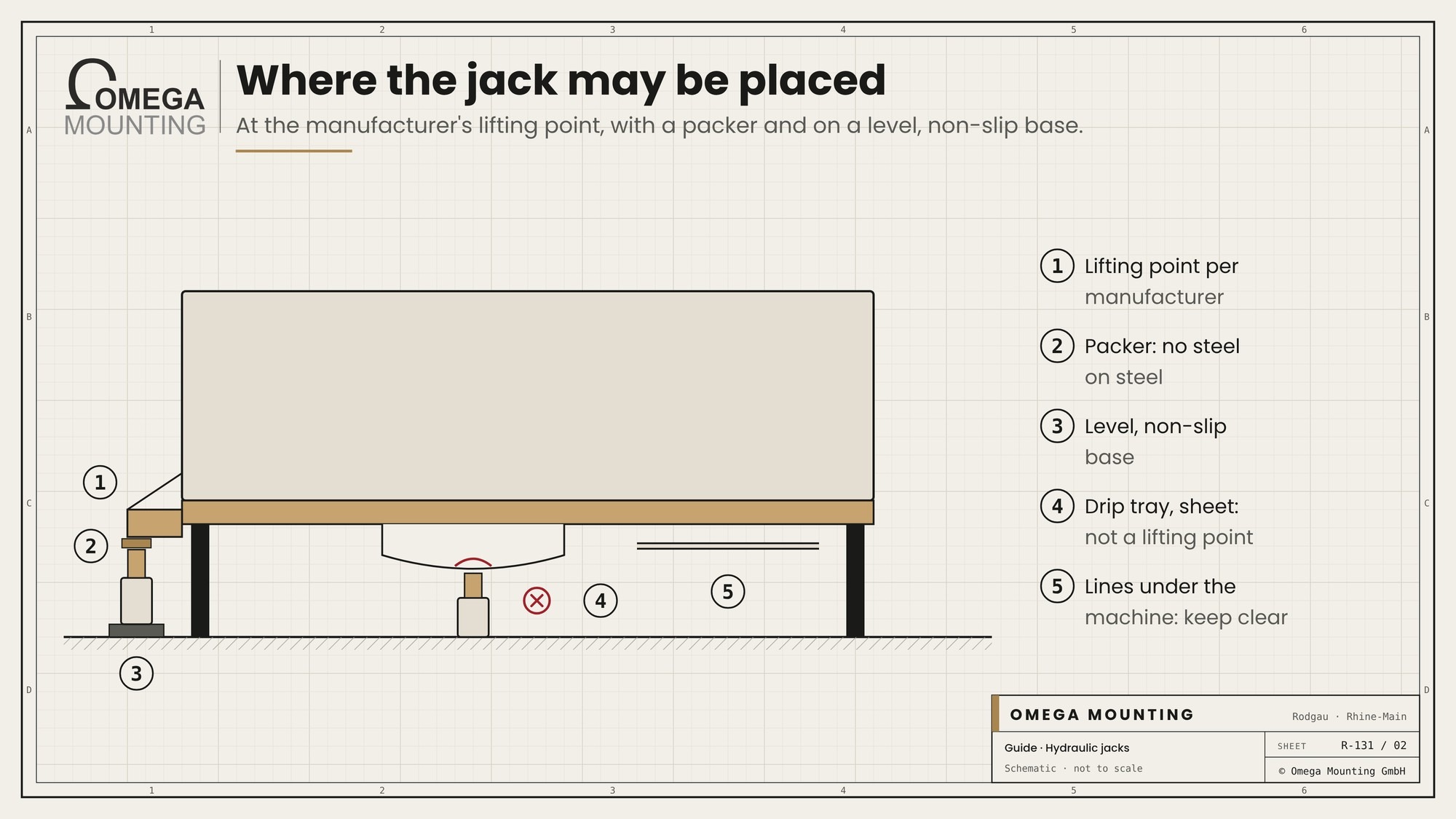
Where a jack may be placed is not decided by eye. Machine frames are built for loads in some places, not in others. The manufacturer names the lifting points, the weight and the centre of gravity. If there are no such points, the lift is made via a beam or an auxiliary frame approved by the manufacturer.
First take the weight, then lift
Before the load goes up, the weight is only taken. The jacks take up the load until it is just clear of the floor. Then the team stops and looks: is the load steady? Are lifting points or floor giving way? Is one side rising faster than the other? Only when everything is right does it continue. This short pause shows better than any calculation whether the assumptions about weight and centre of gravity are correct.
Commands and fixed roles
When lifting with several jacks, each person has a fixed task. One operates pump or power pack, one watches the position of the load, one adds the cribbing. One named person gives the commands, and only they do. Anyone involved may stop if they notice something. Work only continues once the cause has been clarified.
Securing against slipping
On a smooth floor or a sloping surface a raised load can drift sideways. That is why jacks stand on level, non-slip bases, and the load is secured against shifting. Packers between jack head and machine also stop steel sliding on steel.
What you need to prepare before lifting
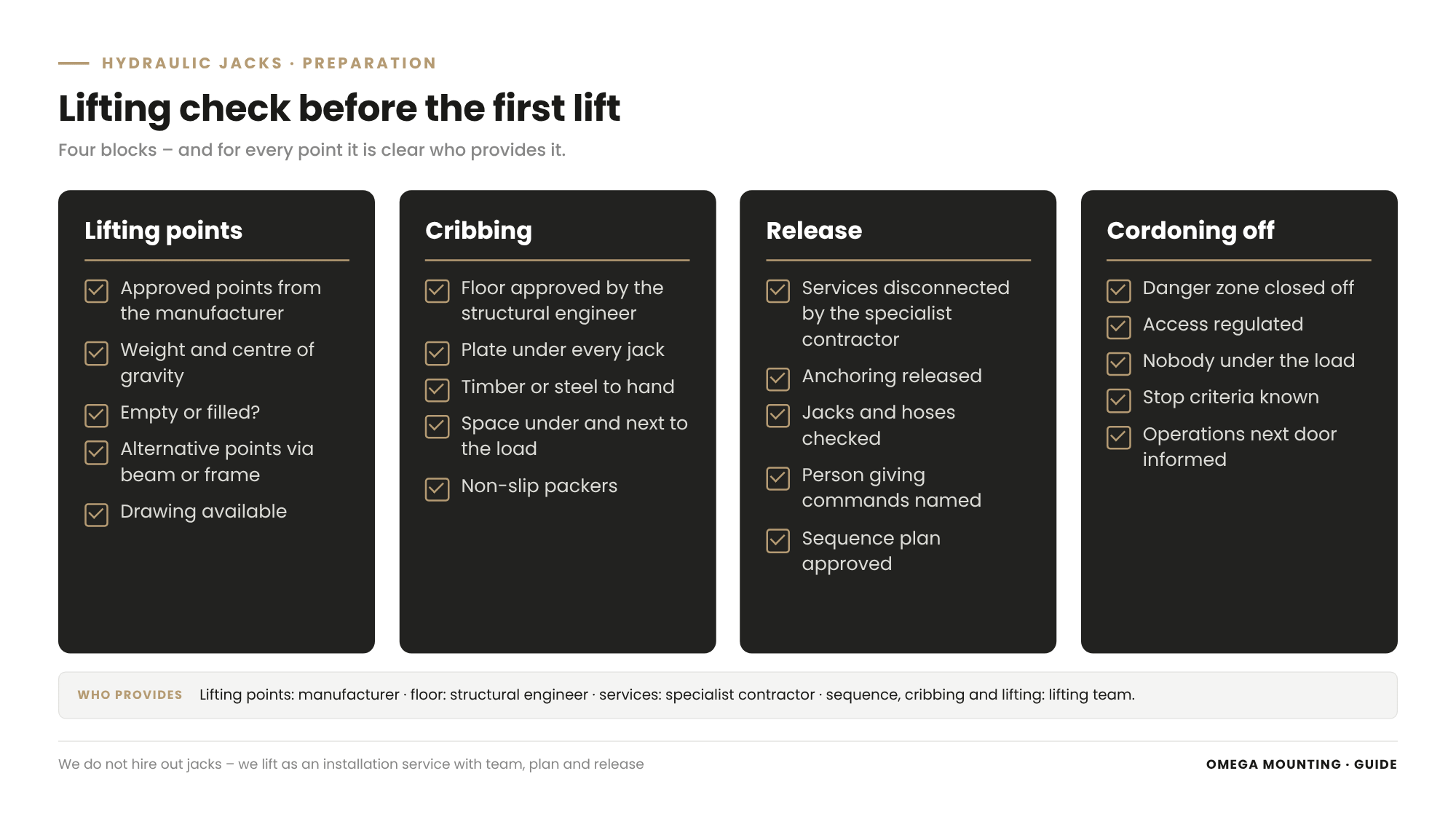
Before lifting with hydraulic jacks, four things are settled: lifting points, weight and centre of gravity from the manufacturer, a load-bearing floor under each jack, space under the load and services disconnected by the specialist contractor.
Lifting points, weight and centre of gravity
Ask the machine manufacturer for drawing, weight, centre of gravity and approved lifting points. Clarify whether the machine is moved empty or filled. Oil, coolant and workpieces change weight and centre of gravity. For older machines the documents are often missing – tell us early, and we will plan with alternative points and reserve.
Floor under the jacks
A jack puts the load onto a small area. Beneath it acts a high point load. Whether hall floor, slab or screed can take it is assessed by the structural engineer. A load spreading plate or timber cribbing goes under every jack. How plates spread the force is explained in our article on load spreading mats and ground pressure. How slab loads are taken into account in design is set out in the guide on move-in planning with slab loads in mind.
Space under and next to the load
The jack has to fit under the lifting point. Nothing may be in the way under the machine: no lines, no covers, no dirt in the pit. Next to the load the team needs space for cribbing, power pack and its own position with a view of the load. Clear this area before the appointment.
Services and power disconnected
A machine is connected to power, compressed air, cooling water, hydraulics or extraction. Before it is lifted, these connections must be disconnected and secured. Services are handled by the responsible specialist contractor; electrical isolation follows your procedure – by our qualified electrician or yours. How isolation and securing are organised is described in our guide on lockout and tagout in maintenance. Anchors and grouted joints must also be released, otherwise the jack lifts against the floor.
Time window and operations next door
Lifting needs calm. Plan a time window in which nobody else works around the machine and no forklifts drive. If production continues in the same hall, clear routes and arrangements with the shift supervisors are needed. Plan in reserve, because cribbing often takes longer than the lifting itself.
Release and cordoning off
Before lifting there is a release: who checked the sequence, who gives the commands, who cordons off? The area around the load is closed off. Nobody reaches or steps under the raised load. What the role of the responsible person looks like is described in our guide on the appointed person for lifting operations.
The sequence from the client's perspective
From the client's perspective, lifting with hydraulic jacks runs in six steps: enquiry, site visit, sequence plan, preparation on site, lifting day and handover.
Step one: enquiry
You send us what you have: photos of the machine and its surroundings, manufacturer's data, the purpose of the lift and the desired period. If something is missing, mark it as open.
Step two: site visit
We look at machine, floor and surroundings. We check where jacks can be placed, how much space there is under and next to the load and where lines and connections run. We ask about floor build-up and slabs.
Step three: sequence plan
The site visit and manufacturer's data produce a sequence plan. It sets lifting points, jacks, cribbing, order, people, commands and stop criteria. The structural engineer approves the floor where needed. You approve the plan.
Step four: preparation on site
Before the appointment, services and power are disconnected and anchors are released. The area around the machine is cleared and cordoned off. Cribbing, plates and jacks are ready.
Step five: lifting day
The team places the jacks, takes the weight, checks and then lifts in small steps. Every bit of height gained is cribbed. Depending on the purpose, skates go underneath, a track comes out or shims go in. Then the load is set down.
Step six: handover
Once the machine stands in its place, it is aligned and secured as specified by the manufacturer. Services are reconnected by the specialist contractor. You receive photos, notes on open points and documentation of the sequence.
When hydraulic jacks reach their limits
Hydraulic jacks reach their limits when the load has to go very high, when there is no space under it, when the floor cannot carry the point loads or when a load cannot be held safely in one piece.
The load has to go far up
Jacks work over a short distance. A climbing lift gains more height, but every step takes time and needs a stable stack. If a load has to be lifted over an obstacle or brought to another floor, a crane or another lifting method is better. Which one fits is shown in our guide on choosing the lifting method for a move-in.
No space under the load
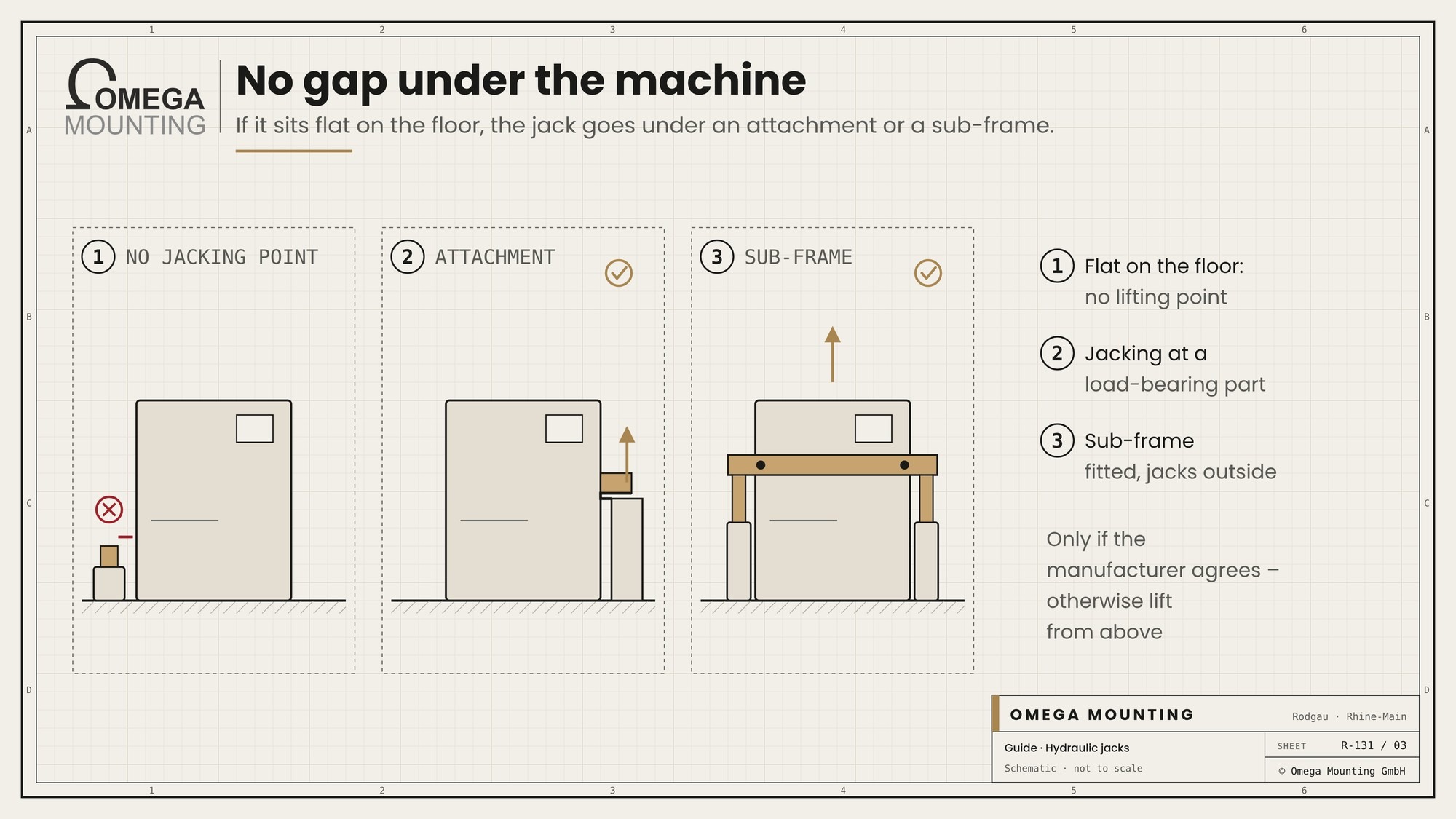
Some machines sit flat on the floor, without a frame and without a gap. Then there is no point where a jack can be placed. Here the lift is made via attachments, an auxiliary frame or from above – with the manufacturer's approval.
Floor without reserve
Under every jack acts a high point load. If the floor cannot carry it even with load spreading, the lift has to be done differently. Then a gantry, for example, carries the load over several legs, or the structural engineer specifies how it is supported.
Load not safe in one piece
Very tall, narrow or unevenly heavy loads can tip when lifted. Then it is often safer to remove attachments or dismantle the machine into assemblies. How that works in a relocation overall is described in our guide on Machinery relocation.
Inspecting jacks and hydraulic hoses: work equipment like any other
Hydraulic jacks, pumps, power packs and hydraulic hoses are work equipment and are inspected before they are used – periodically by a competent person and by a visual check before each use.
Who inspects and how often
The framework comes from the German Ordinance on Industrial Safety and Health. Type, scope and intervals of inspection are set by the employer in the risk assessment, based on the manufacturer's information. The inspection is carried out by a competent person. Who that can be is explained in our article on the competent person. The inspection duties operators have in general are described in our guide on inspection obligations for operators. This guide is not legal advice.
What is checked before each use
Before each use the team looks at the equipment: is the cylinder tight, the piston undamaged, the jack head clean? Are hoses free of cracks, kinks and chafing? Are couplings tight, and does the pressure gauge read correctly? Is the inspection sticker current? A device with a defect is not used.
Hydraulic hoses age
Hoses age even when they lie on the shelf. Heat, light and kinks wear them down. A hose that bursts under load lets the load sink and can injure people. That is why hoses are not laid kinked, not driven over and not run over sharp edges.
After use
After use, jacks are retracted, cleaned and checked for damage. Couplings get their protective caps so that no dirt gets into the oil. Anything noticed during use is noted and clarified before the next use. How hydraulic systems are maintained in general is described in our guide on hydraulic maintenance on presses.
Overview: jack type, used for, limit
Every type of jack has its purpose and its limit – the table summarises this.
| Jack type | Used for | Limit |
|---|---|---|
| Lifting cylinder. | Lifting at one point, several cylinders on one power pack for even lifting. | Needs height under the lifting point; stroke limited. |
| Jack stand. | Stable lifting on one side, secure holding during work. | Needs more space; the load still rests on the cribbing. |
| Flat jack. | Placing in narrow gaps under a frame. | Short stroke; then a taller jack takes over. |
| Hydraulic blocks. | Lifting very heavy loads, for example to pull out a track. | Need load-bearing ground and approved lifting points. |
| Climbing lift. | Bringing a load higher step by step than a cylinder travels. | Time-consuming; the stack must be stable at every step. |
| Hydraulic gantry. | Lifting and moving a load on header beams when it cannot be held from below. | Not a jack in the strict sense; needs space around the load and height. |
| Car jack. | Vehicles. | Not for machines; no saddle, no reserve. |
Typical mistakes when lifting with hydraulic jacks
The typical mistakes when lifting with hydraulic jacks are a load without cribbing, jacks at the wrong points, uneven lifting, a floor without approval and services not disconnected.
- Load left standing on the jack. The cribbing is missing, and someone works under the load.
- Lifting point guessed. The jack is placed on sheet metal or cladding not built for loads.
- Lifted on one side. One side goes up, the other does not, and the load twists or slips.
- Floor not checked. The jack presses into the screed, or there is a void under the floor.
- Services forgotten. A line is still connected, an anchor has not been released.
- Uninspected equipment. A hose is brittle, the inspection sticker has expired.
- Workshop jack for machines. A car jack is supposed to lift a load it was never intended for.
The mistake behind the mistakes
Behind most mistakes lies the same assumption: that lifting is the difficult part. The lifting takes only a moment. Safety lies in the cribbing, the right points and the release beforehand.
Hydraulic jacks in the Rhine-Main area: how we work
In the Rhine-Main area we use hydraulic jacks where machines and heavy plant have to be lifted, moved or set down without a crane – in factory halls, plant rooms and data centers.
Many halls in the region are older than the machines in them. Crane runways are missing, ceilings are low, access is tight. Data centers are often already closed when the heaviest plant arrives. Then the work is done with jacks, skates and track instead of a crane.
From Rodgau, Frankfurt, Offenbach, Hanau, Darmstadt and Aschaffenburg are short distances. What we offer in Lift & Shift and heavy-load installation overall is set out on our service page.
What we don't offer, we say clearly beforehand. We do not hire out or sell jacks, not even for single days. We lift as an installation service, with our own team, plan and release. Lifting points and weight are specified by the manufacturer, the floor is assessed by the structural engineer, services are disconnected by the specialist contractor.
Project examples
Three jobs from our project diary show how we lift and set down loads without a crane – and when we deliberately take a different approach.
Data center in the Frankfurt area: setting down with hydraulic blocks
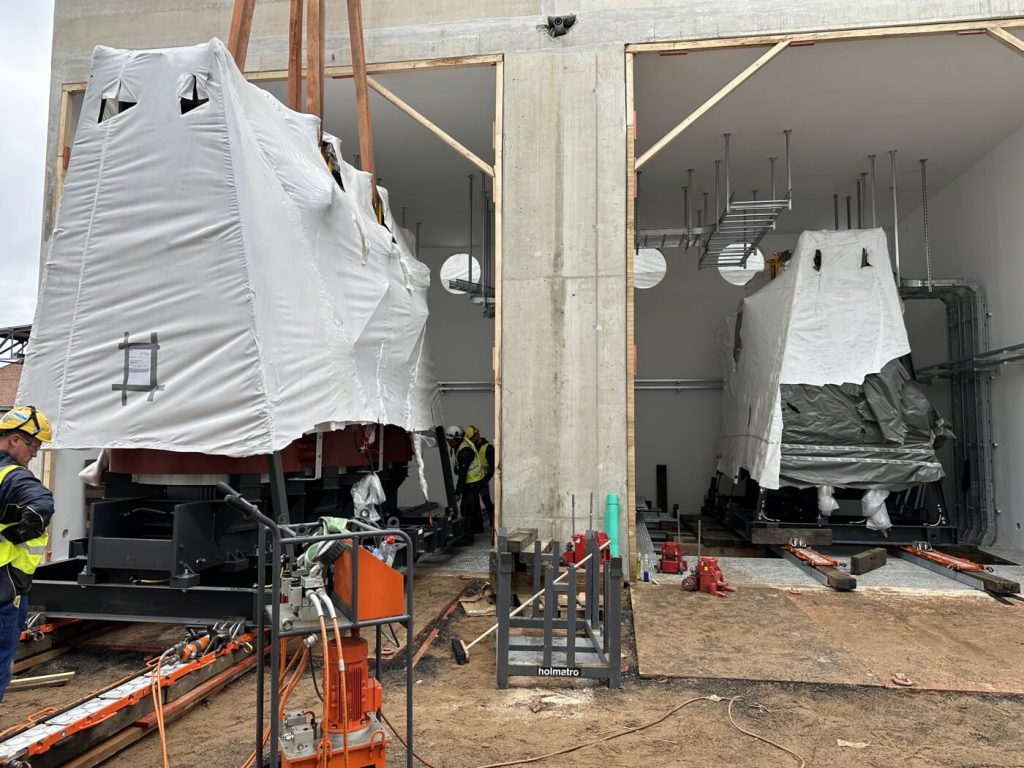
During the bringing in transformers via a skidding track in a data center in the Frankfurt area, each transformer came into its cell on a track. At the target, hydraulic blocks lifted the load far enough for the rail elements to be pulled out. Then the transformer was lowered onto stacked timber blocks in the pit that had been prepared beforehand. The pressure at the hydraulic controls was checked continuously. Nobody stood under the load, and every lifting movement was released.
For your project this means: the cribbing is in place before the jack is placed.
Standby power plant in the Rhine-Main area: lifting in controlled steps
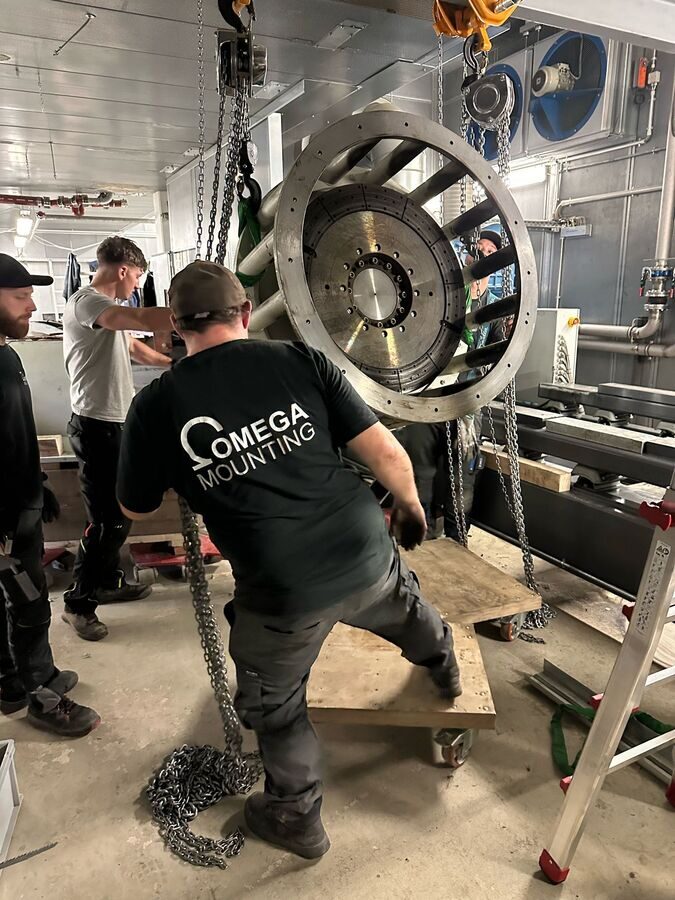
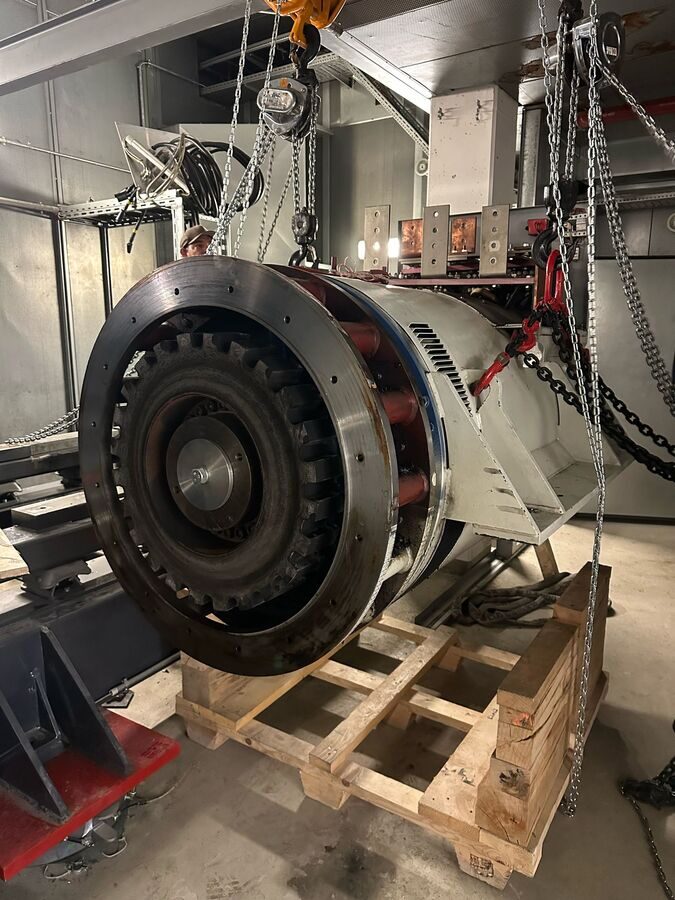
With the maintenance of the generator of a standby power system no hydraulic jacks were used. The heavy assemblies were lifted and lowered in controlled steps with chain hoists on a support structure. Beforehand the suspension points were checked for their load capacity. For transport the team built timber frames on which the assemblies rested securely. After reinstallation the generator was positioned, coupled, aligned and fixed.
For your project this means: not every load needs hydraulics – but every load needs checked points and secure support.
Injection moulding machine: dismantling instead of lifting in one piece
During the Relocation of an injection molding machine the machine was dismantled into transportable parts. Many parts went by crane inside the hall and by forklift out of it, the heaviest with a partner's special lifting equipment. Production in the same hall continued.
For your project this means: if a load cannot be lifted safely in one piece, dismantling is often the better way.
Want to have a machine lifted without a crane?
Then get in touch with us. Send us photos of the machine, the floor and the surroundings and, if available, the manufacturer's data on weight and lifting points. During a site visit we clarify what is still missing.
What this means for your role
For buyers: Ask for a service, not a device. A quote with site visit, sequence, cribbing and release is more reliable than equipment hire.
For designers: Record lifting points, floor loads and space under the machine in the documents. Bring in the structural engineer early if lifting takes place on slabs.
For project managers and site managers: As project manager you obtain the manufacturer's data and coordinate disconnecting the services with the specialist contractors. As site manager you make sure that the area under and next to the load is clear on the day.
For maintenance managers and facility managers: You know lines, connections and floor build-up best. Name a contact who accompanies isolation and release on site.
For safety specialists: Check whether risk assessment, equipment inspection and cordoning off fit the sequence. Pay particular attention to work under raised loads.
For management and operators: Give the project the lead time that manufacturer's data, floor approval and disconnecting services need. An appointment without these points is not an appointment.
Hydraulic lifting check: template on request
The hydraulic lifting check is a one-page working document before every lift without a crane. It has four blocks: lifting points, cribbing, release and cordoning off. Each point has a field for the source of the detail and the status “clarified” or “open”. Number fields are deliberately not pre-filled – the check shows you what is still missing before the first lift. Request the template via our contact form – keyword “hydraulic lifting check”.
Why Omega Mounting?
We are based in Rodgau near Frankfurt, can be reached by phone and WhatsApp and lift heavy loads where no crane can reach. The linked jobs show how we work. In Frankfurt hydraulic blocks brought transformers onto prepared set-down points. At the standby power plant lifting was done in controlled steps at checked points, and the injection moulding machine was dismantled where lifting in one piece did not fit. For you this means: a single point of contact for site visit, sequence, cribbing, lifting, setting down and aligning – coordinated with manufacturer, structural engineer and specialist contractors.
Conclusion
Hydraulic jacks make it possible to lift a machine without a crane. What makes it safe is what happens beforehand: lifting points and weight from the manufacturer, a floor with approval, space under the load, disconnected services and inspected equipment. Then lifting is even, cribbing follows step by step, and the load never stands on the cylinder. If you want to have a machine lifted, moved or set down, send us photos and documents – we will get back to you with a date for the site visit and an honest assessment.
Planning a move-in, installation or maintenance in the Rhine-Main region?
Tell us briefly what you need – we'll come back with an honest assessment.
Free, no-obligation callback
You may also be interested in these guides

About the author
Tobias Schott
Managing director of Omega Mounting GmbH, Rodgau · more than 20 years of hands-on experience in installation and maintenance
A trained mechatronics technician, working in maintenance, servicing and industrial installation since 2004 – first alongside his father, and with Omega Mounting since 2012: from overhead conveyors in Frankfurt to the crane system in a new-build hall. He plans and leads lifting operations as an appointed person (AP) in data centers and on industrial sites in the Rhine-Main region, trains and examines operators of cranes, mobile elevating work platforms and telehandlers, and is a qualified occupational safety specialist. On jobs abroad he is known as the “German Troubleshooter” – the person you call when a site gets stuck. He learned what quality means from his father, not from a manual: Made in Germany as a standard for his own work, not a label. That is why quality comes first at Omega Mounting – ahead of speed and price. He writes these guides from that practice: what works on our sites is in them – what exists only on paper is not.
Frequently asked questions
With hydraulic jacks at the lifting points approved by the manufacturer. The machine is lifted evenly at several points, and every bit of height gained is cribbed immediately with timber or steel. Beforehand services are disconnected, the floor is checked and the area is cordoned off. If it has to go higher, a climbing lift is used step by step.
A hydraulic jack pushes the load up from below at one point. A hydraulic gantry stands on four legs and lifts the load on header beams from which it hangs. The gantry needs more space but can also move the load.
No. A jack only holds the load as long as the oil stays in the cylinder. That is why every bit of height gained is cribbed immediately, and the load rests on timber or steel. Nobody works under a load that stands only on the jack.
At the lifting points named by the machine manufacturer. If there are none, the lift is made via a beam or an auxiliary frame approved by the manufacturer. Sheet metal, cladding and add-on parts are not lifting points.
A climbing lift raises a load higher than a jack can travel. You lift one step, crib, set down, raise the jack and lift again. The stack under the load grows crosswise so that it stays stable.
Jacks, pumps and hydraulic hoses are work equipment. They are inspected periodically by a competent person; type and intervals are set in the risk assessment. Before each use there is also a visual check by the team.
No. A car jack is built for vehicles. It has no suitable saddle, no reserve and no safeguard for a machine load. Machines need suitable jacks, approved lifting points and cribbing.
No, we do not hire out or sell jacks. We lift as an installation service with our own team: site visit, sequence, cribbing, lifting, setting down and aligning.
A short enquiry with three details: what is being lifted, what for and where it stands. Photos and manufacturer's data help. We arrange a site visit and tell you what is still missing for the sequence. Your contact is Tobias Schott – reachable via our contact form.
 English
 German