
- Guide – Data Center
Fitting a silencer to a generator: retrofitting turbo silencers, base frame, pipework and measurement at full load
By Tobias Schott · 20-minute read · As of November 2026
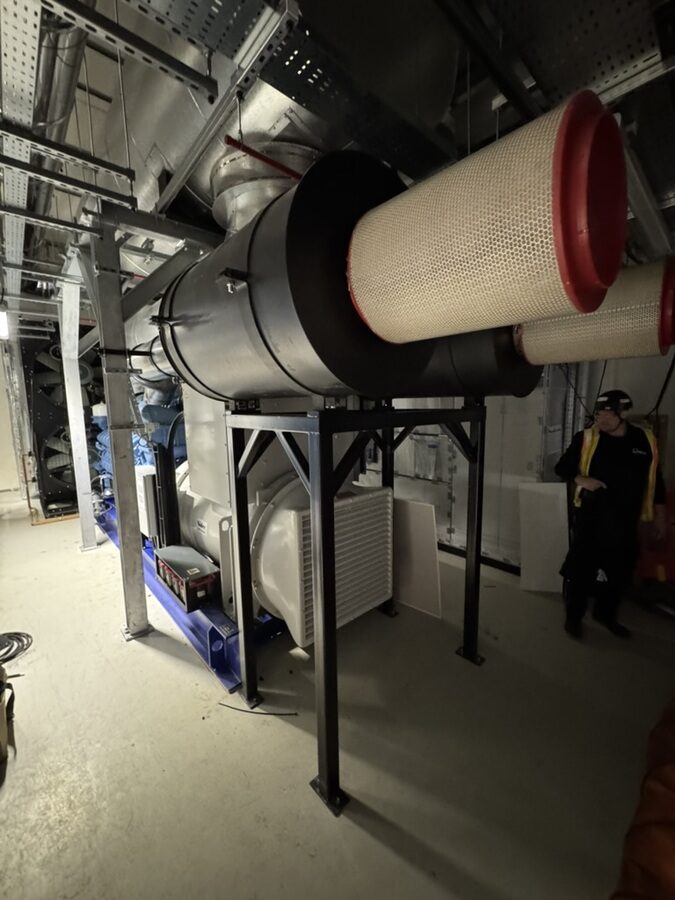
Fitting a silencer to a generator means first finding the noise source, then choosing the right silencer and installing it so that the engine can still breathe freely. With turbo silencers on the intake side, what matters is a stable frame, decoupled pipework and a measurement at full load.
A standby generator should run in an emergency – and at every test run too. What bothers nobody on an industrial estate quickly becomes a problem in the city. When several large generators run at full load, they can be heard a long way off. A high-pitched whistle is particularly unpleasant. It often does not come from the exhaust but from the turbochargers.
Anyone who wants to fit a silencer to a generator usually has a specific reason: complaints from the neighbourhood, conditions imposed by the authority or a new building in the middle of the city. The solution is rarely a single component. It starts with the question of where the noise comes from and ends with a measurement that shows whether it has worked.
This guide shows how silencers are retrofitted to standby generators – from the turbo silencer on the intake side to pipework with rubber sleeves. It is written for technical managers and facility managers in data centers and hospitals, project managers for standby power supply, generator service companies, acoustic consultants and buyers.
Key points at a glance
- Fitting a silencer to a generator means: find the noise source, choose the silencer, move it in, build the frame, connect, test at full load.
- Three noise sources. Exhaust, turbocharger intake and radiator air each need their own solution.
- Whistling often comes from the turbocharger. A turbo silencer between intake filter and turbocharger helps against it.
- The engine must breathe freely. A silencer must not throttle the air flow. The design comes from the manufacturer.
- Decoupling is a must. Rubber sleeves separate the vibrating engine from the silencer.
- It works without a crane too. In a finished building, goods lifts and winch lifters are used.
- Measure, don't hope. Only a measurement at full load shows whether it is quieter outside.
What does fitting a silencer to a generator actually involve?
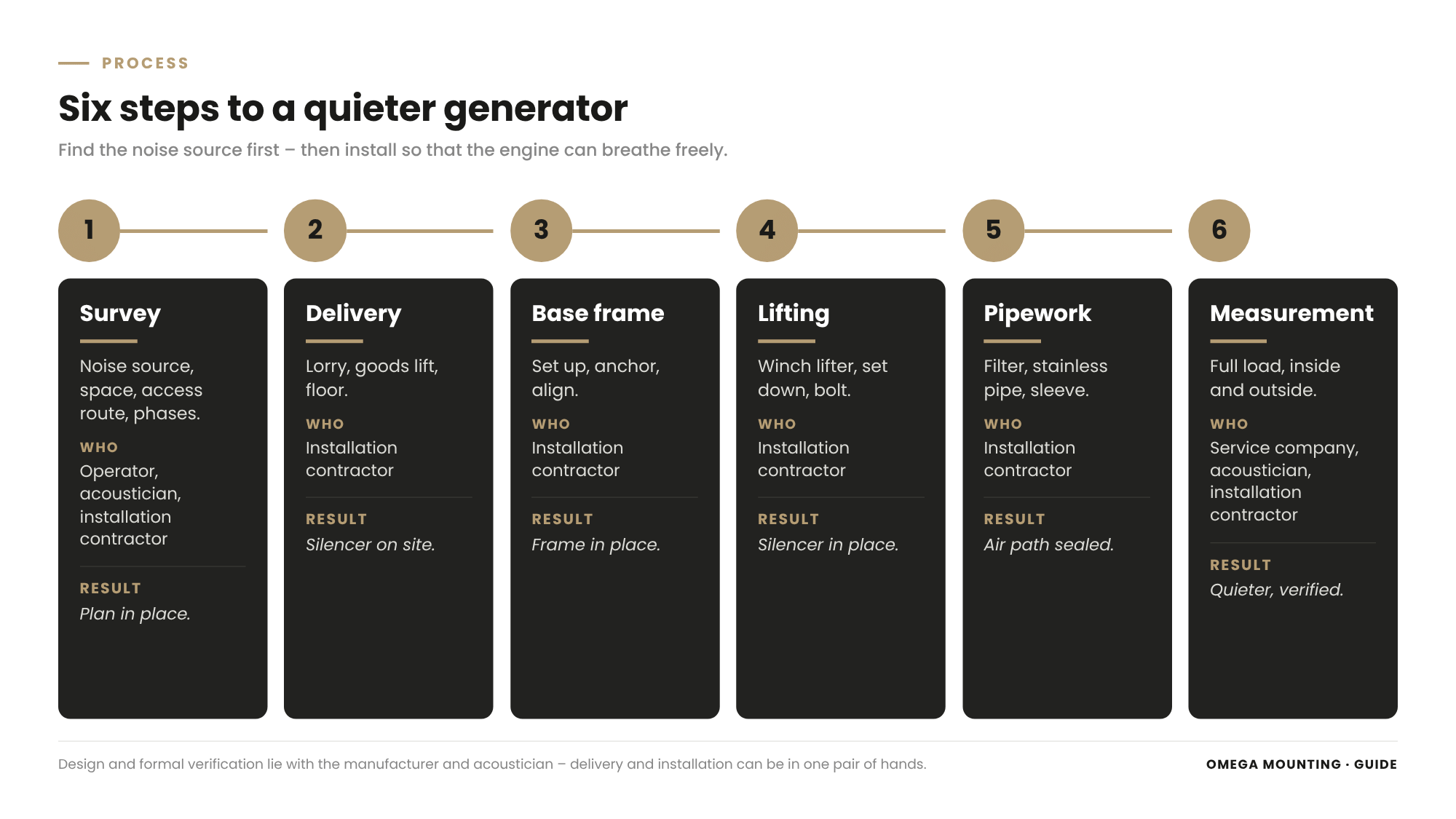
A generator is a chain of noise sources. The diesel engine hums, the exhaust booms, the radiator fan roars and the turbocharger whistles. Which silencer helps depends on which source is causing the disturbance. That is why the survey comes first.
Six steps follow. First, the survey: noise source, space and route into the building. Second, moving in from the lorry to the right floor. Third, the base frame on which the silencer sits. Fourth, lifting, aligning and bolting. Fifth, intake filter and pipework with decoupling. And sixth, the test run with measurement at full load.
Retrofit or plan in from the start?
The easiest way is to plan noise control in from the start. Then there is space above the generator, the routes in are known and the pipework fits. Often, though, the problem only shows up in operation – at the first full-load test with open windows opposite. Then the retrofit happens in a finished building, next to running equipment.
Why in data centers in particular?
Data centers have many large generators. They are tested under load regularly. And they are increasingly built in cities, close to offices and homes. How installation work in a data center works in general is described in our guide installation in data centers.
Where the noise at the generator comes from
Before a silencer is ordered, it must be clear which noise is the problem. Otherwise the damping is done in the wrong place.
Exhaust
The exhaust leaves the engine in pressure pulses. That creates a deep boom. The exhaust silencer, which is already fitted to almost every generator set, helps against it. Sometimes it is not enough, and a second one is added.
Turbocharger intake
The turbocharger spins very fast and draws in large amounts of air. That produces a high-pitched whistle. It carries far and is perceived as particularly disturbing. A normal intake filter hardly dampens it.
Radiator air
The radiator fan moves large amounts of air through the room. That creates a rushing noise. Splitter attenuators in the air inlet and outlet openings of the generator room help against it.
Engine and structure-borne noise
The engine itself hums, and its vibrations pass into floor and walls. Anti-vibration mounts under the generator set and a decoupled design of all connections help against this.
Listening and measuring
If you listen closely, you can often identify the source by the sound alone: a boom points to the exhaust, a whistle to the turbocharger, a rush to air. Certainty comes from a measurement that shows frequencies and directions. That is the job of an acoustician.
Which silencer for which noise?
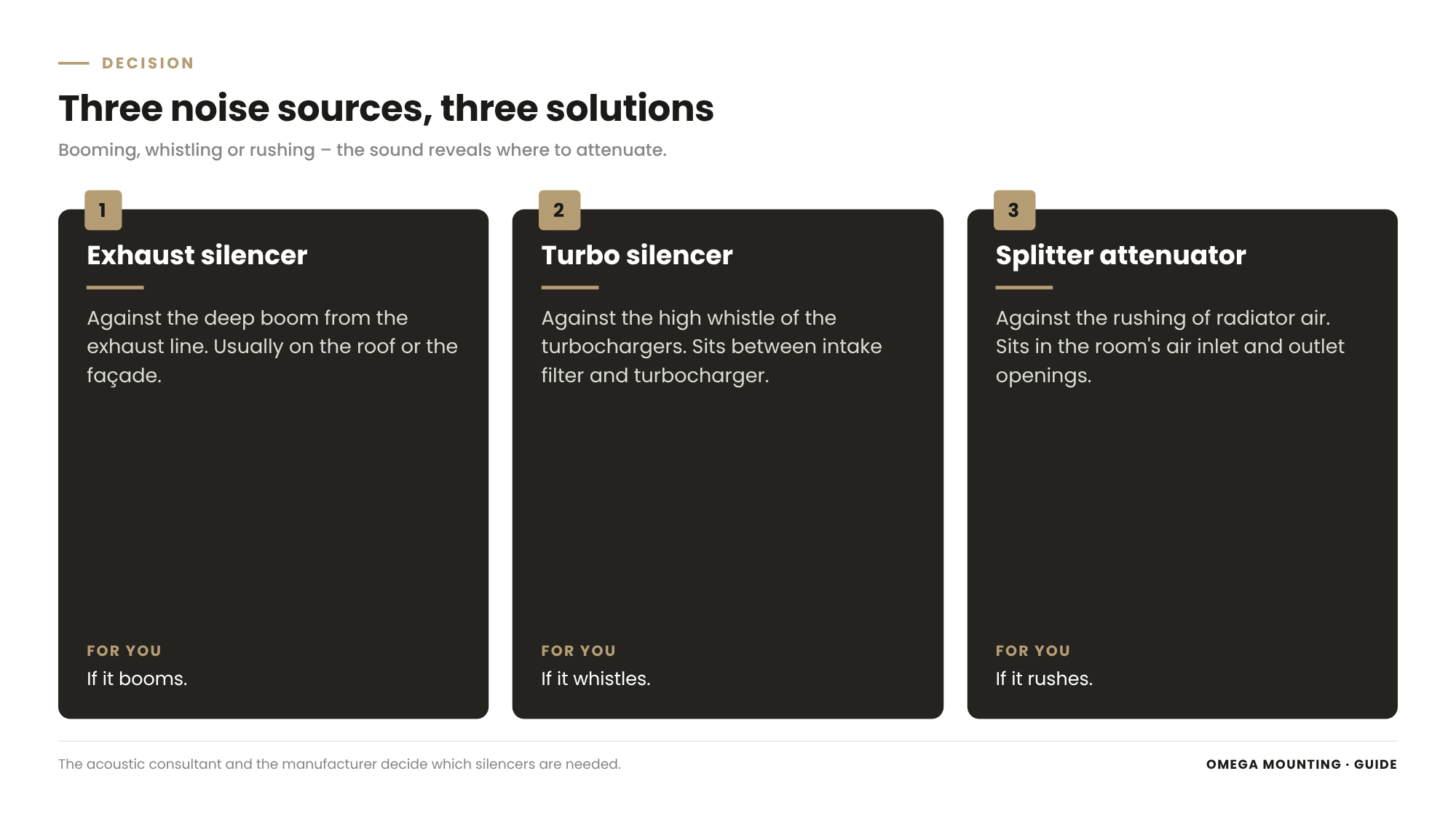
There is a separate solution for every noise source. Often several are combined.
Exhaust silencer
It sits in the exhaust line, usually on the roof or the façade. It dampens the deep boom. It is important that the exhaust back pressure does not become too high – otherwise the engine loses power.
Turbo silencer
It sits between intake filter and turbocharger. It swallows the high-pitched whistle without throttling the air flow. For large generators in the city, it is often the decisive component.
Splitter attenuator
It sits in the ventilation openings of the generator room. It dampens the rushing of the radiator air and the sound that escapes outside through the openings.
Combination
In practice, all three work together. If you only dampen the exhaust, you hear the turbocharger all the more clearly afterwards. That is why an overall assessment belongs at the start – ideally by an acoustic consultant.
How a turbo silencer is constructed
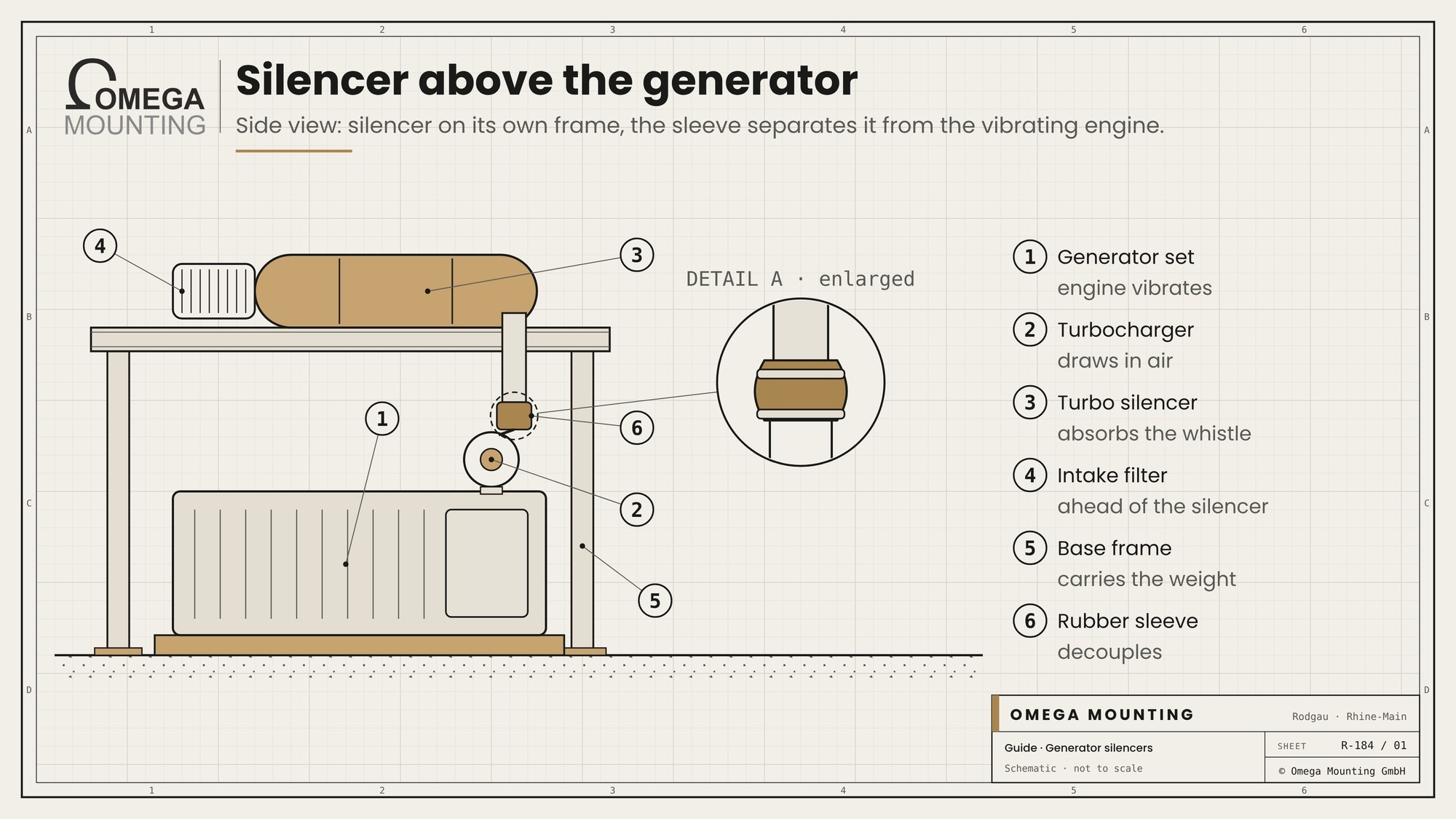
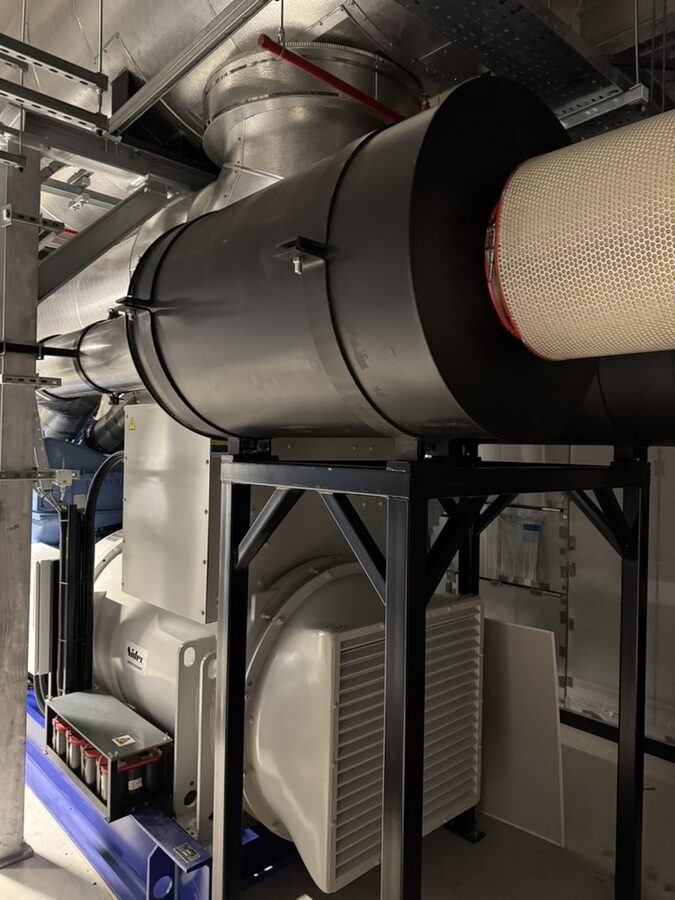
A turbo silencer is an intake silencer for turbochargers on large diesel engines. It looks like a large pipe or a box with connection spigots.
Inside
Inside, chambers and insulation guide the air so that the high frequencies are absorbed. The air path stays wide enough for the engine to get enough air.
Double silencers
Large engines often have two turbochargers. Then there are double silencers with two connections. They are large and heavy – one reason why they do not simply hang on the engine but sit on their own frame.
Intake filter
The intake filter sits in front of the silencer. It keeps dust away from the engine. When retrofitting, new, larger filters that match the silencer are often supplied.
Connection to the turbocharger
Pipework, usually made of stainless steel, runs between silencer and turbocharger. A rubber sleeve sits at the turbocharger. It seals and decouples at the same time.
On-site survey
The survey decides whether installation later goes smoothly.
Space above the generator
Is there enough room above the generator for frame, silencer and filter? Does anything clash with the exhaust line, cable trays, ventilation ducts or lighting? Do maintenance areas stay clear?
The route into the building
How do the silencers get to the generator? Is there a delivery zone, a goods lift, wide doors? How heavy may a load in the lift be, and do the dimensions fit? Especially in finished buildings, the route is often the real bottleneck.
Load-bearing capacity
Frame and silencer put point loads on the floor slab. Whether the floor can take it is clarified by the structural engineer. More on loads and routes in is in the guide Planning moving in: floor load.
Ongoing operations
In a data center, the standby power supply never stops completely. Which generator sets may go out of service when is decided by the operator. The construction phases follow from this.
Moving in: from the lorry to the floor
Silencers usually arrive packed on a lorry or trailer. From there, the actual logistics begins.
Unloading
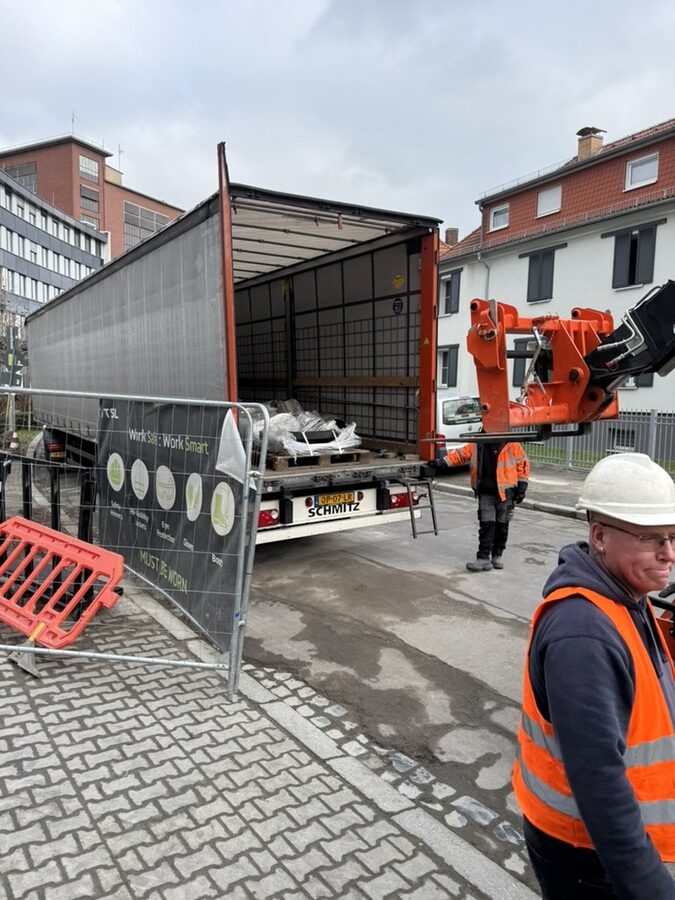
Unloading takes place in front of the building – often in a confined space, on the street, with a forklift or pallet truck. The silencers are secured against tipping and are not handled by the spigots.
Goods lift
In finished buildings, the goods lift is often the only way up. Dimensions and permitted load are checked beforehand. The silencers are transferred onto trolleys and distributed floor by floor.
No crane in the generator room
Many generator rooms have no crane and no crane runway. Then the work is done with material lifts – hand-crank winch lifters that raise loads to height. How a moving-in day is planned as a whole is described in the guide Moving in a machine: procedure.
Protecting the surroundings
Along the route there are floors, doors and equipment that must not be damaged. Floor protection, edge protection and an agreed route are part of it.
Installing the base frame
The silencer sits above the generator. To stand securely there, it needs its own frame.
Why its own frame?
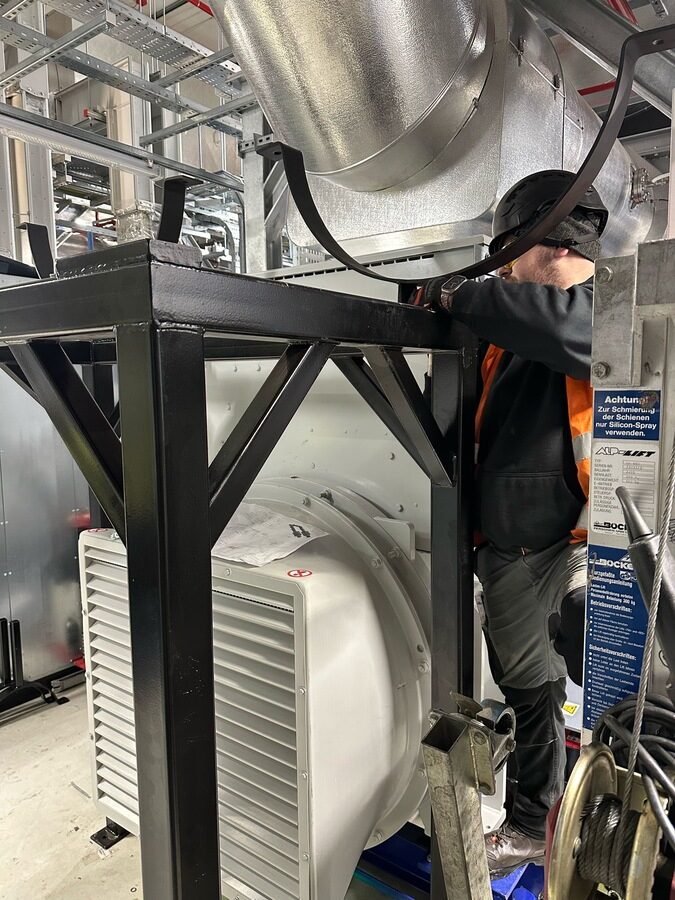
The engine vibrates. If the heavy silencer hung directly on the engine, vibration and weight would act on the turbocharger. Its own frame takes the weight and keeps the silencer steady.
Design
The frame consists of steel sections anchored to the floor. It stands next to or around the generator and carries the silencer at the right height. It is often taller than a person.
Anchoring and aligning
The feet are anchored to the floor and the frame aligned vertically. Only then will the silencer later sit in the right position relative to the turbocharger. How anchoring and alignment succeed is set out in the guide Aligning and anchoring a machine.
Thinking of maintenance
The frame must not block access to the generator. Filter changes, oil service and repairs must still be possible. Good planning leaves maintenance aisles clear.
Lifting and bolting the silencer

Once the frame is finished, the silencer goes up.
Lifting with the winch lifter
The silencer is placed on the forks of the lifter and secured. Then it is slowly raised with the crank until it is above the frame. Nobody stands under the load. One colleague cranks, the other guides and watches.
Transfer onto the frame
At height, the silencer is carefully pushed or set down onto the frame. Only when it is resting securely are the forks lowered.
Aligning
The silencer is aligned so that its spigots line up with the turbocharger. Small deviations are later taken up by the sleeve, large ones are not.
Bolting
Finally, the silencer is bolted firmly to the frame. All connections are made so that they do not come loose even under vibration.
Intake filter and pipework
Now the air path is closed – from the filter via the silencer to the turbocharger.
Fitting the filters
The intake filters are fixed to the silencer. They must remain accessible for maintenance, because filters are changed regularly.
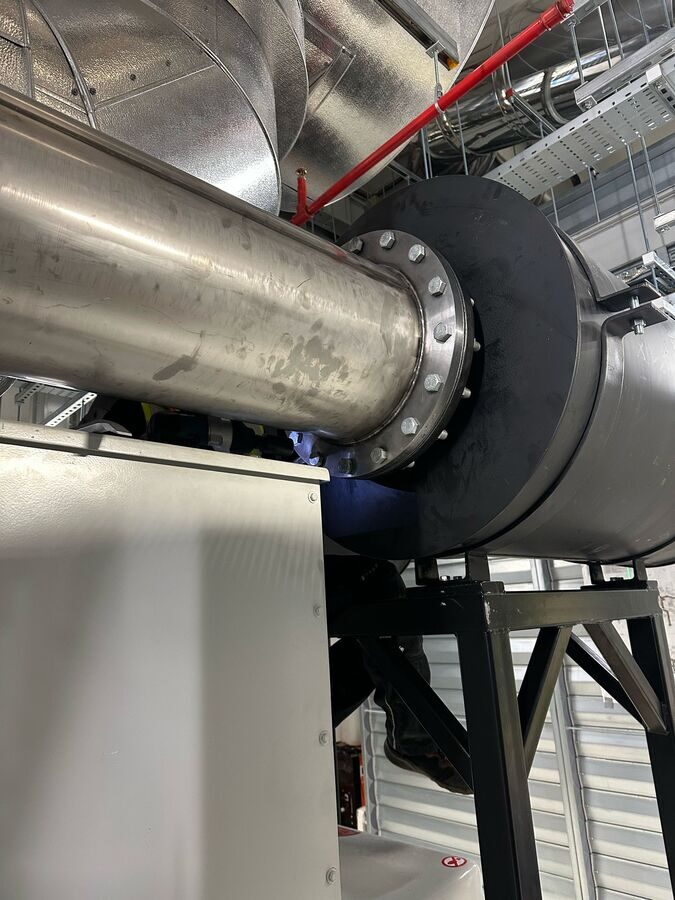
Stainless steel pipework
Stainless steel pipework runs between silencer and turbocharger. It is made to fit, often adapted and welded on site. Welding is done only with a hot work permit and in a secured area. More on this is in the guide repair welding on industrial plant.
Flanges and seals
Pipe and silencer are connected via flanges. The seals must sit cleanly. Every leaking point lets unfiltered air into the engine.
Ensuring air flow
The pipework must be designed so that the engine gets enough air at full load. Tight bends and cross-sections that are too small throttle the air. Whether the design is right is confirmed by the generator manufacturer.
Decoupling: why the sleeve matters
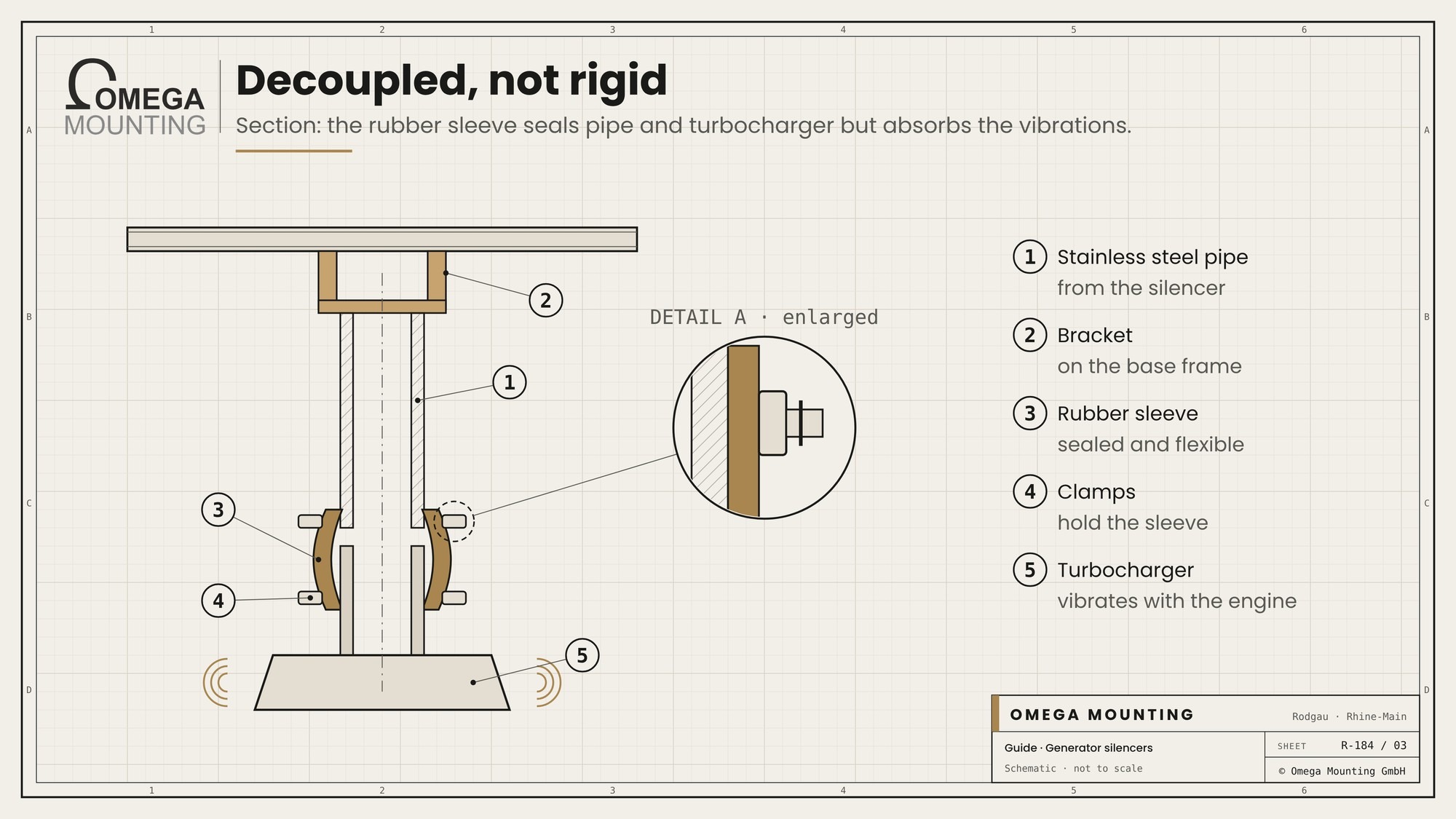
The most inconspicuous part is often the most important: the rubber sleeve between pipe and turbocharger.
The engine vibrates
A large diesel engine vibrates noticeably at full load. The turbocharger sits on the engine and vibrates with it. The silencer on the frame stays still.
Rigid does not work
If turbocharger and silencer were rigidly connected, the vibrations would pass directly into pipe, silencer and frame. Bolts come loose, welds crack and, in the worst case, the turbocharger is damaged.
The sleeve separates
The rubber sleeve connects pipe and turbocharger tightly but flexibly. It absorbs the vibrations before they reach the pipe. Two clamps hold it in place.
Regular testing
Rubber ages. At every service, the sleeve is checked for cracks and a firm fit. A torn sleeve lets unfiltered air into the engine.
Test run and measurement at full load
Only the generator under load shows whether the installation has worked.
Performance test
The generator is run up and brought to full load. This checks whether it delivers its power and whether the intake path is clear. Often this is done with a load bank. How such a test is prepared is described in the guide commissioning in the data center.
Checking the installation
During the run, we check: are all connections tight? Does the frame vibrate? Is the pipework leak-free? After the run, the bolts are retightened.
Measuring inside and outside
It stays loud in the generator room – that is in the nature of things. What matters is the outside area. There we measure and listen to whether the whistle has gone. The formal proof to the authorities is the job of an acoustician or approved expert.
Material and tools for installation
Installation without a crane needs the right aids.
Material lifts
Hand-crank winch lifters raise loads to height without power and without a crane. They can be dismantled and fit into goods lifts. For heavy silencers, two lifters are used at the same time.
Transport aids
Trolleys, pallet trucks and heavy-duty skates move the silencers on level floors. Edge protection and straps secure them on the way.
Installation material
Bolts, anchors, seals, clamps and sleeves are counted out beforehand. If a seal is missing on installation day, the generator set stays out of service longer than planned.
Maintaining silencers: so it stays quiet
A silencer is not a component you fit and forget. It belongs in the generator's maintenance plan.
Changing filters
Intake filters clog over time. A full filter throttles the air, the engine loses power and the turbocharger works under vacuum. The change intervals are set by the manufacturer. In dusty surroundings, for example during construction work nearby, they are changed more often.
Checking sleeves and clamps
Rubber sleeves age through heat, oil and vibration. At every service they are checked for cracks, hardening and a firm fit. Clamps are retightened. A torn sleeve is a small part with a big effect.
Checking bolted connections
Even firmly bolted connections can work loose under vibration. A quick look at frame, flanges and fixings after every full-load test is worthwhile.
Keeping an eye on insulation
Silencers contain insulation inside. If it is soaked or damaged, the effect decreases. If it gets louder again after some years, that is a sign to have the silencer checked.
Construction phases during operation
In a data center, silencers are rarely fitted to all generators at the same time.
One generator set after another
The redundancy of the standby power supply must be maintained. That is why the work is done one generator set at a time, after release by the operator.
Spread over weeks
So a project extends over several construction phases and weeks. That is not a drawback but intentional: each phase is completed before the next one begins.
Small team, well-practised routines
This work does not need a large team, but a well-practised one. Anyone who knows the routines repeats them safely and quickly on every generator set. In our practical example, three fitters converted all generator sets one after the other. Each new generator set went faster than the previous one because frame, lifting and pipework became routine. At the same time, there was time to complete each phase cleanly and have it accepted by the operator before the next generator set went out of service.
Retrofitting exhaust silencers and splitter attenuators
The turbocharger is not always the cause. The other silencers are also retrofitted – with their own challenges.
Exhaust silencers on the roof
Exhaust silencers often sit on the roof or the façade. They are long and heavy. Moving them in usually needs a crane, scaffolding or a mobile elevating work platform. The exhaust line is separated, the new silencer inserted and connected with expansion joints that take up thermal expansion. More on working at height is in the guide Mobile elevating work platform installation.
Splitters in ventilation openings
Splitter attenuators are fitted into the air inlet and outlet openings of the generator room. They consist of a frame and individual splitters pushed into the opening. It is important that the air path for the radiator stays clear enough. Otherwise the generator gets too hot at full load.
Looking at everything together
Anyone retrofitting a silencer changes the overall system. A splitter attenuator increases the air resistance for the radiator, an exhaust silencer the back pressure for the engine. That is why the generator manufacturer approves every change.
Noise, neighbours and authorities
Noise control is not only technology but also communication.
Taking complaints seriously
Neighbours often report the problem first. A quick, open answer and a plan build trust. Showing that something is happening buys time for a proper solution.
Announcing test runs
As long as the silencers are missing, announced test runs at fixed times help. Neighbours then know what to expect.
Knowing the conditions
Standby power systems are subject to noise control conditions, often separately for day and night. The values to be met are stated in the permit. Whether they are met is demonstrated by the acoustician.
Noise control when planning new installations
If you build new, you can avoid a lot of effort.
Thinking about noise early
If the data center is in the city, noise control for the generators belongs in the very first planning. An acoustic consultant calculates which silencers are needed.
Providing space
Space for silencers, filters and frames is planned above and next to the generators. Routes in are dimensioned so that large components fit through too.
Planning in maintenance
All silencers need maintenance. Access to filters, sleeves and bolts belongs in the planning. More on this is in the guide Maintenance-friendly installation.
Safety during installation
Heavy loads at height, hot work, work next to running equipment: the rules are clear.
The basic rules
- Generator set out of service and secured against starting while work is done on the intake path.
- Lift loads only with suitable lifters; nobody under the load.
- Load the frame only when it is anchored and bolted.
- Hot work only with a permit, fire extinguisher within reach, follow-up check.
- Hearing protection at every test run.
- Work at height only from safe standing positions.
Legal framework
Lifting operations, hot work and noise control are subject to the German Occupational Safety Act (ArbSchG), the Industrial Safety Ordinance (BetrSichV), the authority's noise control requirements and the operator's rules. This guide is not legal advice – which obligations apply in your case you should clarify with your occupational safety specialist and your acoustic consultant.
Who does what in generator noise control?
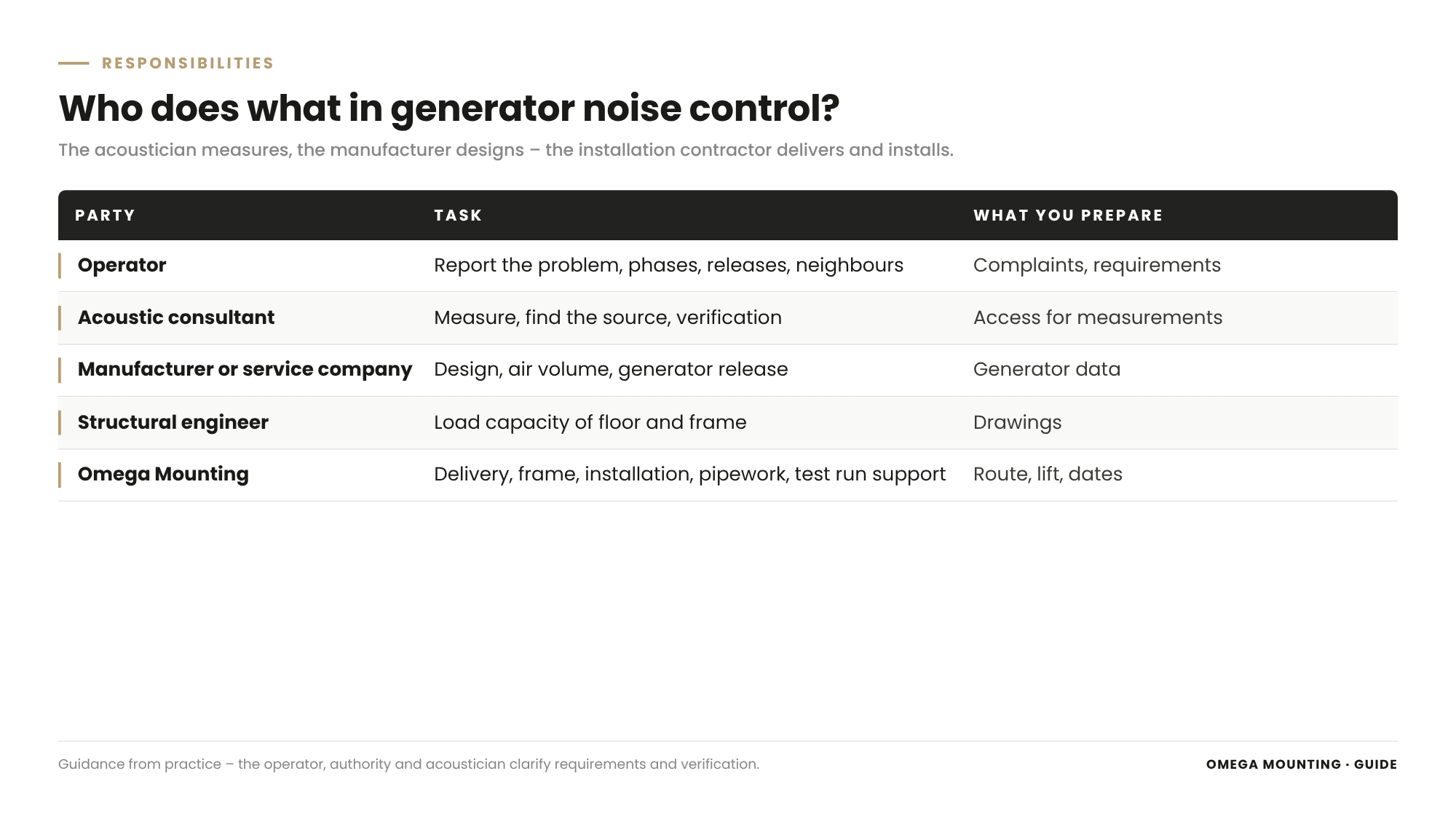
Several specialists contribute to the noise control of a generator.
Operator
The operator reports the problem, sets construction phases and approvals and coordinates with neighbours and authorities.
Acoustic consultant or acoustician
They measure, find the noise source and specify which silencers are needed. They produce the formal proof.
Generator manufacturer or service company
They design the silencers, confirm that the engine gets enough air and release the generator set after installation.
Structural engineer
They check whether floor slab and frame can carry the load.
Omega Mounting
We take care of moving in, building the frame, installing silencers and filters, the pipework with decoupling, accompany the test run and carry out a check measurement. Design, release and formal proof remain with manufacturer, service company and acoustician.
Fitting a silencer to a generator: what it means for your planning
Four questions help to estimate the effort early.
Which source is the problem?
Whistle, boom or rush? Have the source identified before you order silencers.
Is there space?
Check the room above the generator and the maintenance areas.
How does everything get in?
Measure doors, lift and routes. Clarify the permitted loads.
When can work be done?
Set construction phases in which individual generator sets may go out of service.
Typical mistakes when retrofitting silencers
Most problems arise from wrong assumptions.
- Wrong source dampened: the exhaust is quieter, but the turbocharger keeps whistling.
- Air path throttled: the engine no longer delivers its power at full load.
- Rigidly connected: vibrations loosen bolts and crack welds.
- No frame of its own: the weight hangs on the turbocharger.
- Route not checked: the silencer does not fit in the lift.
- Maintenance blocked: the filter can no longer be changed.
- Not measured: nobody knows whether it is quieter outside.
The mistake behind the mistakes
Almost all these mistakes happen when the silencer is seen as just a component. It is part of a system of engine, air path, frame and building. If you look at the system, you build once and build right.
Fitting a silencer to a generator in the Rhine-Main region: how we do it
From Rodgau we quickly reach Frankfurt, Offenbach, Hanau, Eschborn and the region's other data center locations. Many of these data centers are in the middle of the city – and each has generators that run under load regularly.
We look at the generator room, routes and space on site, coordinate with manufacturer and acoustician and plan the construction phases with the operator. How else we work in data centers is on our page on Data Center. How the generator sets are maintained between jobs is described in the guide Standby Generator Maintenance.
For you, that means one point of contact for moving in, installation and coordination.
Project examples
A job from our project diary shows how a data center in the city became quieter.
Turbo silencers at a data center in Offenbach
A data center in Offenbach is in the middle of the city – only a street separates the generator rooms from an old industrial building full of offices. During full-load tests, the turbochargers whistled so loudly that it was unacceptable for the neighbourhood. We fitted twelve double turbo silencers: delivered by lorry, unloaded in front of the building, distributed to the floors via the goods lifts. There was no crane in the generator room, so hand-crank winch lifters were used. At each generator we first installed a base frame, then lifted the silencers onto it, aligned and bolted them, fitted intake filters and connected the stainless steel pipework to the turbochargers with rubber sleeves. At the end, the generators ran at full load, and measurements were taken inside and outside. The whistle had disappeared from the neighbourhood. The full job is described in the report Turbo silencers at a data center in Offenbach.
Is your generator too loud?
Send us photos of the generator room, a description of the noise and your timeframe – we will tell you what needs planning for moving in and installation. Get in touch now.
What this means for your role
Buyers: Ask whether moving in, frame, pipework and test run are included in the quote. The silencer alone is only part of it.
Planners: For data centers in the city, provide space and routes in for silencers from the start.
Project and site managers: Plan construction phases so that redundancy is maintained, and book the goods lift.
Maintenance managers: Include sleeves, filters and bolted connections in the maintenance plan.
Facility managers: Stay in touch with the neighbours. An announced test run is less disturbing than a surprise one.
Generator noise control survey form: template on request
For your project, we have put together the generator noise control survey form. On one page it asks about generator sets, noise, route, space and dates. You fill it in, and we plan moving in and installation without follow-up questions. Request the template via our contact form – keyword “Generator noise control survey form”.
Why Omega Mounting?
With over twenty years of experience in installation, moving equipment in and maintenance – including in data centers – we know that noise control rarely fails because of the silencer, but because of the route to it and the connection. That is why we check routes and space beforehand, build stable frames, connect with decoupling and only leave once the test run at full load has shown that everything is in place. We leave design and proof to the specialists for them. For you, that means a generator that no longer whistles outside. Talk to us about your project – get in touch.
Conclusion
Fitting a silencer to a generator starts with the right question: where does the noise come from? A turbo silencer helps against the whistle of the turbochargers, an exhaust silencer against booming, a splitter attenuator against rushing air.
When retrofitting, route, frame and connection decide. The silencer needs its own frame, the pipework a decoupling sleeve, and at the end a measurement at full load. If your generator is too loud, get in touch with us.
Planning a move-in, installation or maintenance in the Rhine-Main region?
Tell us briefly what you need – we'll come back with an honest assessment.
Free, no-obligation callback
You may also be interested in these guides

About the author
Tobias Schott
Managing director of Omega Mounting GmbH, Rodgau · more than 20 years of hands-on experience in installation and maintenance
A trained mechatronics technician, working in maintenance, servicing and industrial installation since 2004 – first alongside his father, and with Omega Mounting since 2012: from overhead conveyors in Frankfurt to the crane system in a new-build hall. He plans and leads lifting operations as an appointed person (AP) in data centers and on industrial sites in the Rhine-Main region, trains and examines operators of cranes, mobile elevating work platforms and telehandlers, and is a qualified occupational safety specialist. On jobs abroad he is known as the “German Troubleshooter” – the person you call when a site gets stuck. He learned what quality means from his father, not from a manual: Made in Germany as a standard for his own work, not a label. That is why quality comes first at Omega Mounting – ahead of speed and price. He writes these guides from that practice: what works on our sites is in them – what exists only on paper is not.
Frequently asked questions
A silencer for the intake side of the turbocharger on large diesel engines. It sits between intake filter and turbocharger and swallows the high-pitched whistle without throttling the air flow.
The whistle usually comes from the turbocharger. It spins very fast and draws in large amounts of air. A normal intake filter hardly dampens this.
Yes, including in finished buildings and alongside ongoing operations. What matters is space above the generator, a route into the building and the manufacturer's approval.
Because it is heavy and the engine vibrates. The frame carries the weight, the sleeve separates the vibrations. That way the turbocharger is not loaded.
They connect pipe and turbocharger tightly but flexibly. They absorb the engine's vibrations so that they do not pass into pipe, silencer and frame.
With a test run at full load and a measurement inside and outside. The formal proof is produced by an acoustician or approved expert.
Not necessarily. In finished buildings, the silencers often come up via the goods lift and are lifted onto the frame with hand-crank winch lifters.
Yes. From Rodgau we are quickly on site at all data center locations in the Rhine-Main region, including Frankfurt, Offenbach, Eschborn and Hanau.
Send us photos of the generator room, a description of the noise and your timeframe. We will check routes, space and procedure and come back with a proposal. Go to the contact page.
 English
 German