
- Guide – Data Center
Replacing UPS batteries: moving in, raised floor and process
By Tobias Schott · Reading time approx. 21 minutes · As of: November 2026
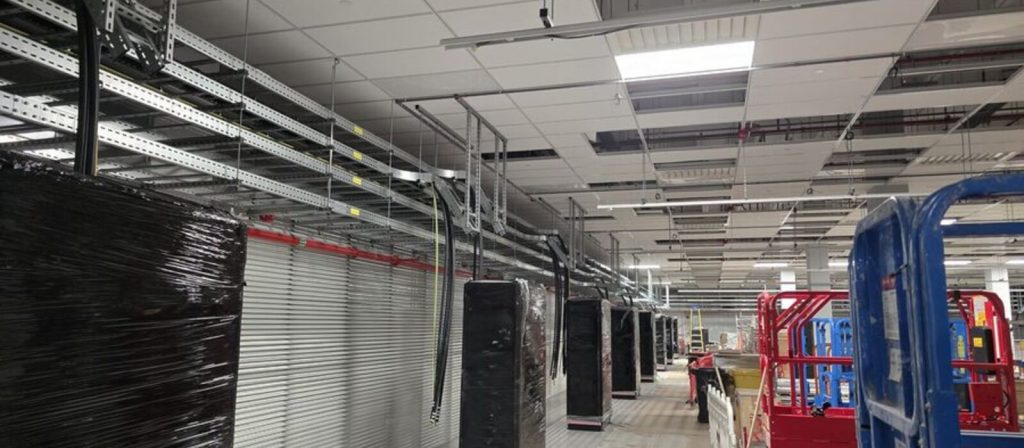
Anyone replacing UPS batteries plans three things together: electrical isolation by the UPS service provider or a qualified electrician, the route of the heavy cabinets through the building and the load capacity of raised floor and slab. The mechanical part in between decides whether a replacement during operation stays calm.
The UPS batteries are old. The UPS service provider reported weak values at the last test. Or the decision has been made to switch to lithium. Then one question comes up quickly: how do the old cabinets get out and the new ones in while the servers keep running next to them?
A UPS battery replacement sounds like electrical work. It is. But battery cabinets and battery racks are among the heaviest components in a plant room. Their route leads through lifts, corridors, doors and often across a raised floor. Underestimate that, and on replacement day you stand with an isolated system in front of a lift that cannot take the load.
This guide explains when a replacement is due, who is responsible for which step and how the mechanical part runs cleanly. We are an installation and moving-in contractor from Rodgau near Frankfurt. We do not disconnect or connect anything electrically. We move out, move in, set up and secure. How installation in a data center works in general is described in our guide to installation in data centers.
Key points at a glance
- A UPS battery system consists of battery cabinets or battery racks that carry the load during a mains failure until the grid returns or the standby power system takes over.
- Whether and when to replace is decided by the operator – based on ageing, the capacity test by the UPS service provider and, for a change of technology, on the manufacturer and the specialist planner.
- Only the UPS service provider or a qualified electrician may disconnect and reconnect batteries, because batteries remain live even after disconnection.
- Weight is the core mechanical problem: whether raised floor and slab can carry transport and installation is assessed by the structural engineer or the raised floor manufacturer.
- The moving-in route from the lorry to the battery room is walked beforehand, including lift, stairs, doors and floor protection.
- With lithium, fire protection and room requirements change; the fire protection engineer assesses this based on the manufacturer's data.
- Used batteries go back through the manufacturer's take-back scheme or a certified disposal company, packed to their specification.
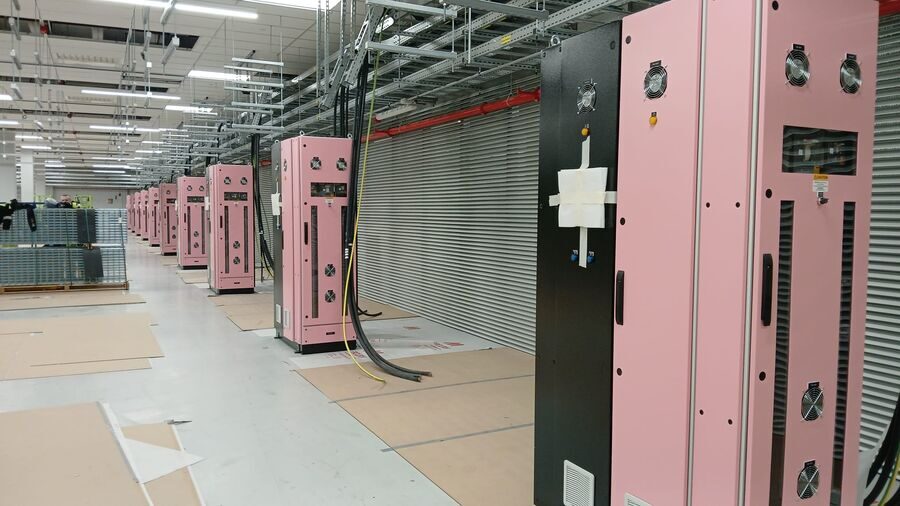
What is a UPS battery system?
A UPS battery system is the energy store of an uninterruptible power supply: batteries in cabinets or on racks that keep supplying the connected loads without interruption during a mains failure until the grid returns or a standby power system starts.
The UPS itself is the unit with rectifier, inverter and controls. The battery system usually stands next to it or in a separate battery room. In data centers, control rooms, hospitals and production plants it is part of the critical infrastructure. If it fails, the bridge to the generator is missing when it matters.
How long the battery has to bridge is called bridging time or autonomy time. The operator sets it with his planner. It determines how many batteries are needed – and therefore how much weight stands in the room. Large systems are divided into several battery strings – rows of blocks that are connected to the UPS together.
Battery cabinet and battery rack
There are two designs. The battery cabinet is a closed housing in which the battery blocks sit on drawers or shelves. The battery rack is an open steel shelf on which the blocks stand in rows, usually in an enclosed battery room. Both are heavy, and both put their load on small feet or narrow profiles.
Lead or lithium
For a long time lead was the standard, usually as a sealed lead-acid battery that needs little maintenance. Today many operators rely on lithium-ion batteries. For comparable performance they are often more compact and lighter and last longer. In return they need a battery management system, a suitable UPS and a separate look at fire protection. Which technology fits is decided by the operator with the UPS manufacturer and the specialist planner.
When is a UPS battery replacement due?
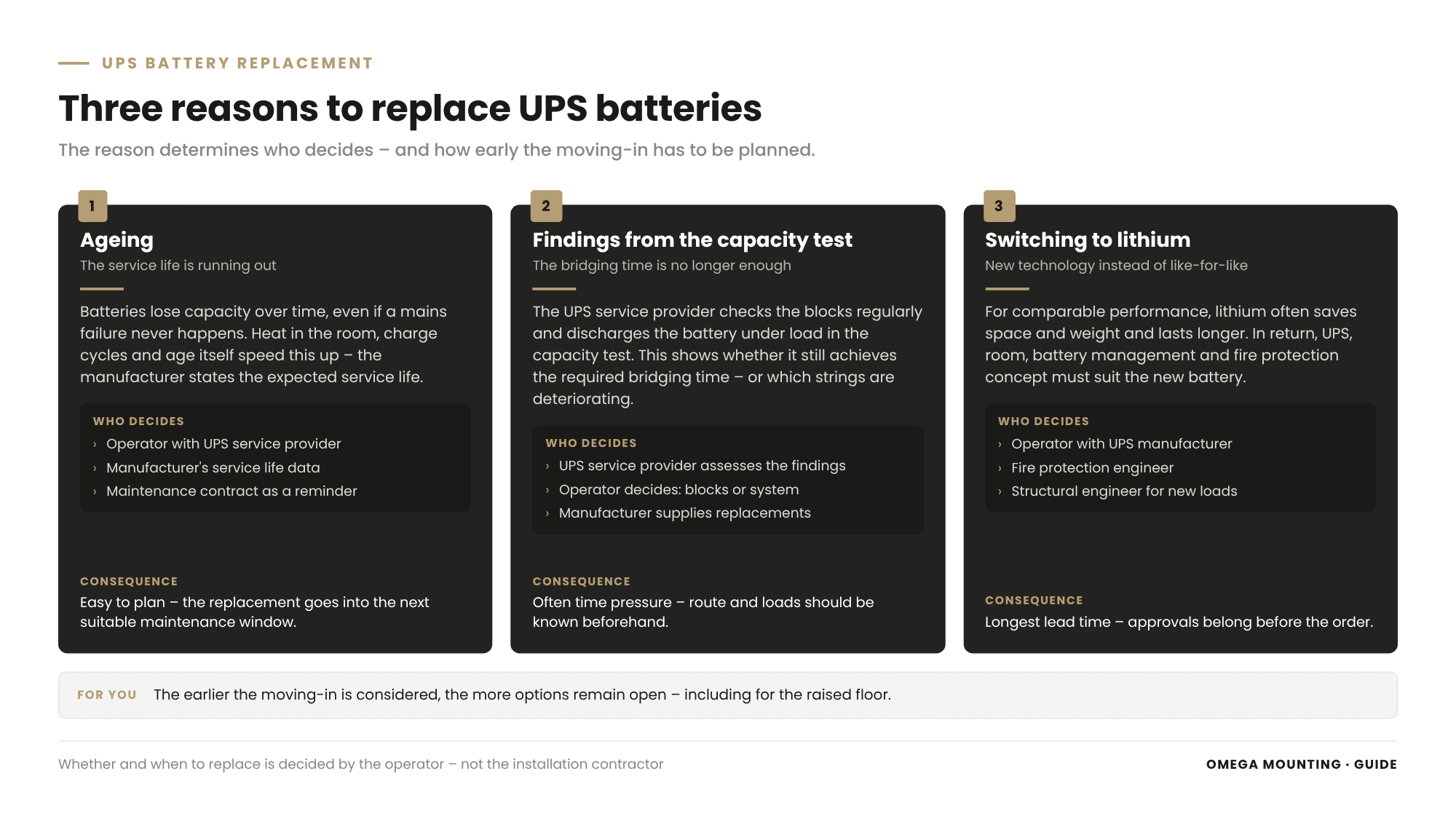
A UPS battery replacement is due when the batteries reach the end of their planned service life, when the capacity test by the UPS service provider shows that the bridging time is no longer reliably achieved, or when the operator switches to another technology such as lithium.
Ageing
Batteries age even if a mains failure never happens. Heat in the room, frequent charge cycles and age itself cost capacity. Manufacturers state a service life under certain conditions. If you know it, you can plan the replacement instead of being forced into it after a failure. That is why a good maintenance contract for the data center also includes a look at the batteries.
Findings from the capacity test
The UPS service provider checks the batteries regularly and measures voltages, internal resistances and temperatures of the blocks. In the capacity test the battery is discharged under load. This shows whether it still achieves the required time. Individual weak blocks can sometimes be replaced. If many blocks deteriorate, the whole string or the whole system is usually renewed.
Switching to lithium
Some operators want to retrofit lithium to gain space, save weight or replace less often. That is not a simple swap. The UPS must be approved for the new battery. The fire protection concept must fit. The room must meet the manufacturer's requirements. The operator makes this decision with manufacturer and specialist planner before the first enquiry for the moving-in goes out.
Plan instead of react
Anyone who has to replace the battery system is rarely under pressure overnight – unless the finding comes as a surprise. New batteries have lead times, planners need documents, maintenance windows are scarce. The earlier the moving-in is considered, the more options remain open. An installation contractor can say at the decision stage whether the planned cabinet will reach its position at all.
The weight problem: raised floor, slab load and point loads
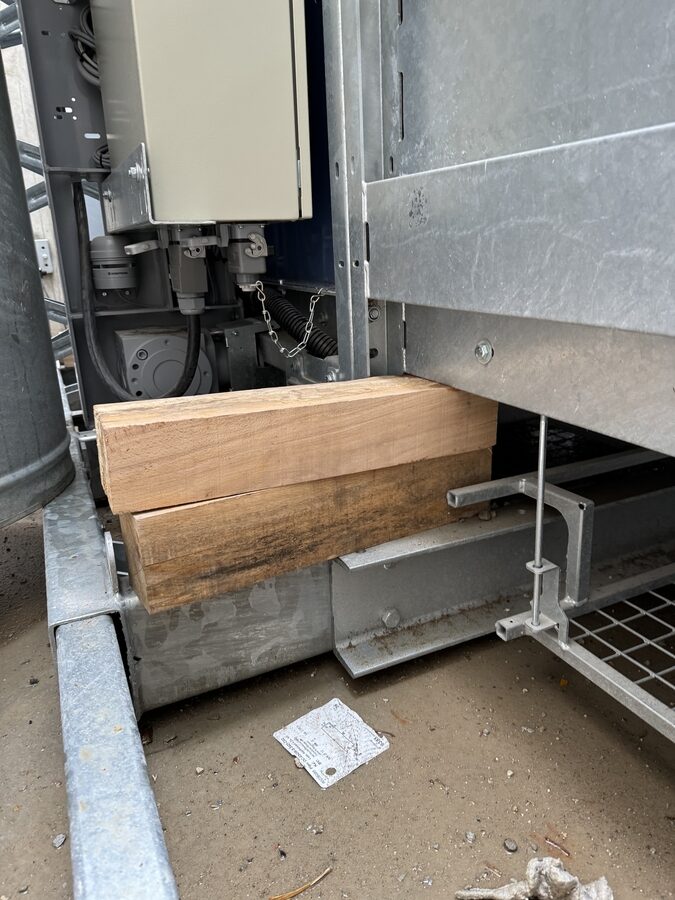
In a UPS battery replacement, weight is the core mechanical problem: battery cabinets and battery racks put a large load on a small area, and whether raised floor, slab and transport route can carry it must be assessed by the structural engineer or the raised floor manufacturer before the replacement.
Point load instead of distributed load
A battery does not spread its weight evenly across the room. A cabinet stands on four feet or a narrow plinth. During transport it stands on small castors. The result: Point load, a high load on a few square centimetres. For a slab or floor panel this is a completely different stress than the same load on a large area.
UPS battery, weight and raised floor
Many battery rooms sit on a raised floor, an elevated panel system above the structural slab. Its panels and pedestals are designed for certain point and distributed loads. With UPS battery, weight and raised floor, it is not only the final installation position that counts but also the route to it. What a raised floor is and how it carries loads is explained in our article: Raised floor.
For heavy cabinets there are usually three options. The floor under the installation position is reinforced or relieved by a substructure. The transport route is bridged with load spreading plates. Or the panels are removed section by section and transport runs on the structural slab. Which option is permissible is defined by the structural engineer or the raised floor manufacturer – not by the fitter on replacement day.
Slab, lift and load spreading
Beneath the raised floor there is a slab. It too has a permissible imposed load. The same applies to corridors, anterooms and the lift platform. Load spreading plates made of steel or timber boards turn point loads into distributed loads. But they are no substitute for a structural verification. How to check slab loads and openings in principle is described in our guide Planning a move-in operation: floor loads, openings and crane standing areas.
Switching to lithium can ease the weight problem. But it does not solve it automatically, because more compact cabinets can put their load on an even smaller area. The manufacturer's data on weight and footprint therefore belong in the planning from the start.

The moving-in route: from the lorry to the battery room
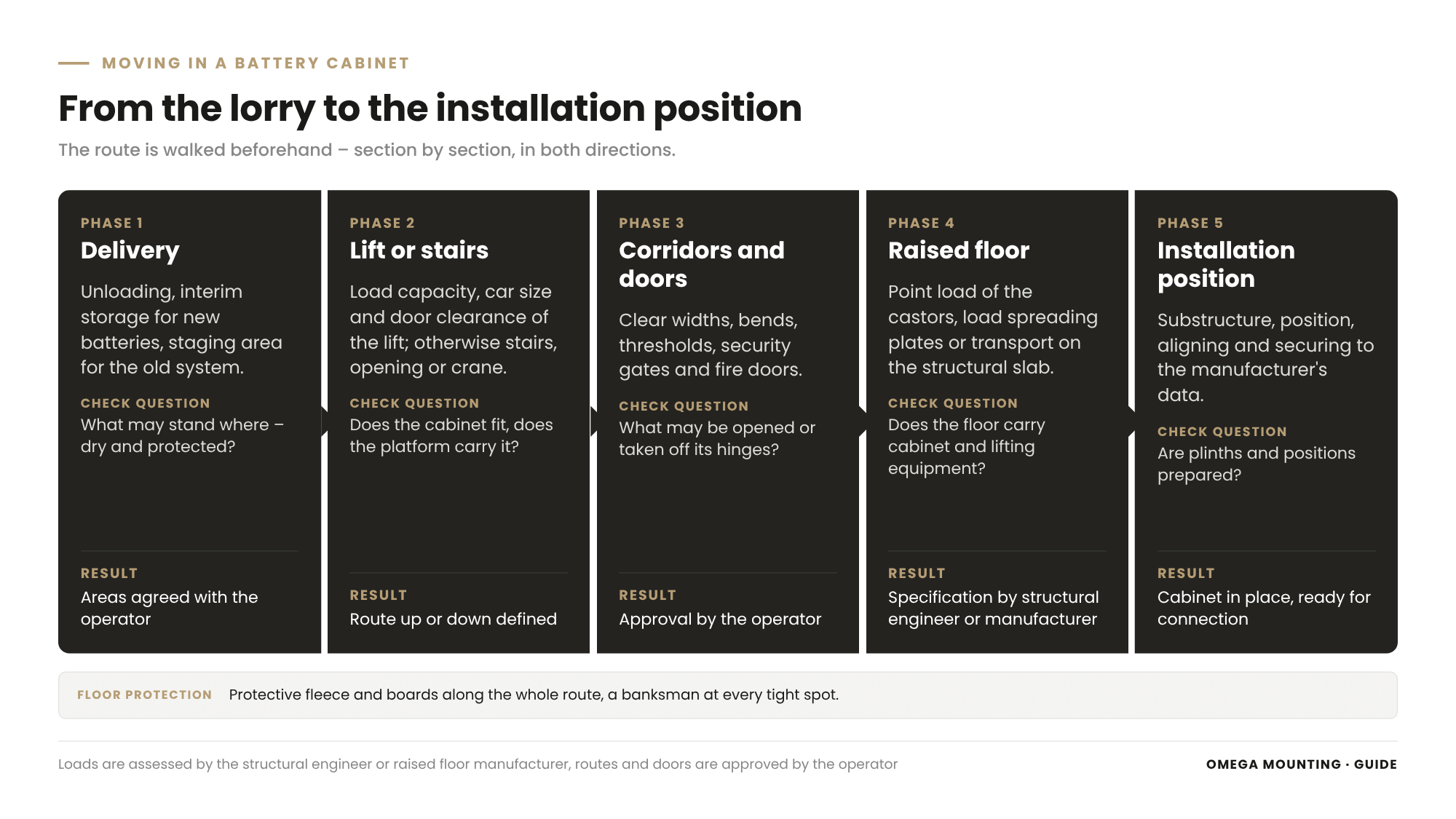
The moving-in route for a battery cabinet runs from delivery via lift or stairs, corridors, doors and security gates to the installation position, and each section must fit in dimensions, load capacity and approval before the first cabinet arrives.
Site visit before the quotation
Every battery cabinet we move in starts with a site visit. We walk the route, measure doors, bends and clear heights and look at thresholds, ramps and floor coverings. We clarify where the cabinets are delivered and where they may be stored temporarily. And we ask for the manufacturer's data on weight, dimensions and lifting points.
Lift or stairs
The simplest route leads via a goods lift. Then load capacity, car dimensions and door clearance count. A lift is no use if the cabinet does not fit inside or the load exceeds the capacity. If there is no suitable lift, another route is needed: stairs with suitable lifting equipment, an installation opening or a crane from outside. Each of these is a separate piece of planning.
Corridors, doors and security gates
In data centers, routes often lead through security gates and security doors. Some doors can only be held open briefly, others are too narrow. Fire doors must not simply be taken off their hinges. What may be opened, removed or held open is approved by the operator.
Lifting equipment for tight spaces
No large crane is used inside the building. We work with pallet trucks, machine skates, jacks, gantries with chain hoists or a mini crane, depending on route and load. What matters is that the lifting equipment suits the bearing area. A device that puts its own weight plus the cabinet on a few points can load the raised floor more than the cabinet alone. This too belongs in the coordination with the structural engineer.
Delivery and interim storage
New batteries often arrive packed on pallets. They need a dry, protected place until they are moved in. The manufacturer specifies how long and under which conditions they may stand. The old system needs a second area where the disposal company takes over. We clarify both areas with the operator during the site visit.
Floor protection
Along the route there are finished floors, raised floor panels and sometimes freshly accepted surfaces. We lay out driving and walking routes with protective fleece and protective boards and tape them down. We check the transport equipment for suitable wheels. At tight spots the load only moves with a banksman.
Who may do what in a UPS battery replacement?

In a UPS battery replacement the operator decides, the UPS service provider or a qualified electrician disconnects and connects electrically, the structural engineer or raised floor manufacturer assesses the loads, the fire protection engineer assesses room and technology, and an installation contractor takes over the mechanical moving out, moving in and setting up.
This division is not a formality. Batteries cannot simply be switched off. Even after disconnection from the UPS there is voltage at the terminals, and a short circuit can cause an arc. That is why all work on terminals, connectors, fuses and battery switches belongs in the hands of specialists with suitable qualifications.
- Operator: decides on timing, technology and maintenance window, approves routes and access.
- UPS service provider or qualified electrician: switches over, disconnects the batteries, defines how blocks and connectors are secured, reconnects and tests.
- Structural engineer or raised floor manufacturer: assesses loads on route and installation position and defines load spreading or reinforcement.
- Fire protection engineer: assesses room, separation, detection and suppression for a change of technology.
- Installation contractor: moves released cabinets and racks out, moves new ones in, sets up, aligns and secures.
- Manufacturer or disposal company: takes back used batteries and specifies the packaging.
Sequence: replacing UPS batteries during operation
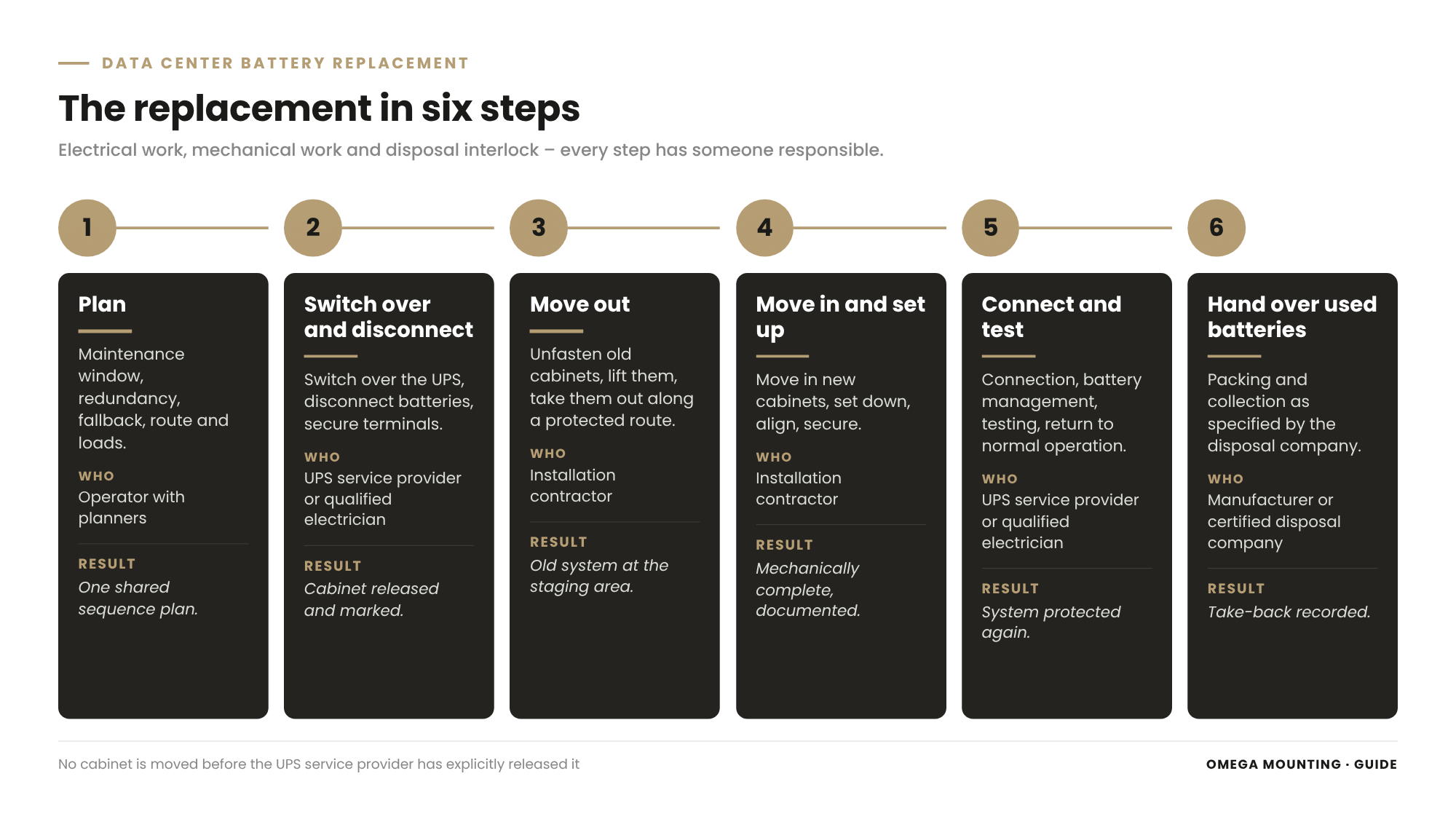
Anyone having UPS batteries replaced while operation continues plans the replacement in a maintenance window: first the UPS service provider switches over and disconnects the batteries, then the old cabinets are moved out mechanically and the new ones moved in, set up, aligned and secured, and finally the qualified electrician connects and tests.
Redundancy and maintenance window
Many UPS systems are built redundantly. Several modules or systems share the load. Then one battery string after another can be replaced while the others provide the backup. If there is no redundancy, the load runs without a battery during the replacement or via the bypass directly on the grid. The operator must carry this risk consciously and schedule it well. One more item for the plan: Standby power system – whether it is reliably available during this time belongs in the same planning.
Switching over and disconnecting
On replacement day the UPS service provider switches the system into the intended operating mode. Then he disconnects the affected batteries and secures them. Whether individual blocks come out of the cabinet before transport and how terminals are covered is defined by him. Only when he explicitly releases the cabinet or rack does the mechanical part begin.
Moving out
The old cabinets are unfastened, lifted and placed on transport equipment. Racks are dismantled as specified. Then they go back along the planned route to the staging area where the disposal company takes over. Every movement at tight spots runs with a banksman.
Moving in, setting up, aligning, securing
The new cabinets come in the same way. At the installation position they are placed on the substructure or floor and aligned. Then they are secured against tipping and shifting, bolted or anchored as specified by the manufacturer. If needed, we fabricate a substructure in our workshop in Rodgau to the structural engineer's specification. How to replace a heavy unit in an operating plant room is also shown in our guide on Replacing a CRAH unit.
Marking and documenting
With several strings, order matters. Every old cabinet is visibly marked after release so that nobody moves a cabinet that is still connected. For the new cabinets we mark the installation positions on the floor in advance. Photos of the route, the floor protection and the finished installation position belong in the handover.
Connecting and testing
Once the cabinets are in place, we hand them over mechanically complete to the UPS service provider or the qualified electrician. They connect, commission the battery management and test the system. Only then does the UPS return to normal operation.
Distinction from outdoor battery storage
This sequence applies to battery systems inside buildings. How large outdoor battery storage systems are placed on foundations and lifted by crane is described in our guide: Installing battery storage.
Fire protection and lithium: what changes with the switch
When switching from lead to lithium, the requirements for room and fire protection change, so a fire protection engineer assesses, based on the manufacturer's data, whether room, separation, detection and suppression fit before the new cabinets are ordered.
Lead batteries can release hydrogen during charging. That is why a battery room for lead needs adequate ventilation. Lithium batteries release no gas in normal operation. But they have a different risk: a damaged or overloaded block can keep heating itself up. This thermal runaway can spread to neighbouring blocks. The battery management system monitors the cells to prevent this.
For the operator this means: a change of technology is a matter for the fire protection concept. The specialist planner checks whether the existing room, the fire detection system and any existing suppression system suit the new battery. Often the insurer has a say too. We do not answer these questions. We implement what planners and manufacturers specify for installation and clearances.
There is also a mechanical difference. Lithium cabinets are sensitive to impacts and damage. Transport, storage before installation and unpacking therefore follow the manufacturer's data strictly.
Used batteries: take-back, packaging and disposal
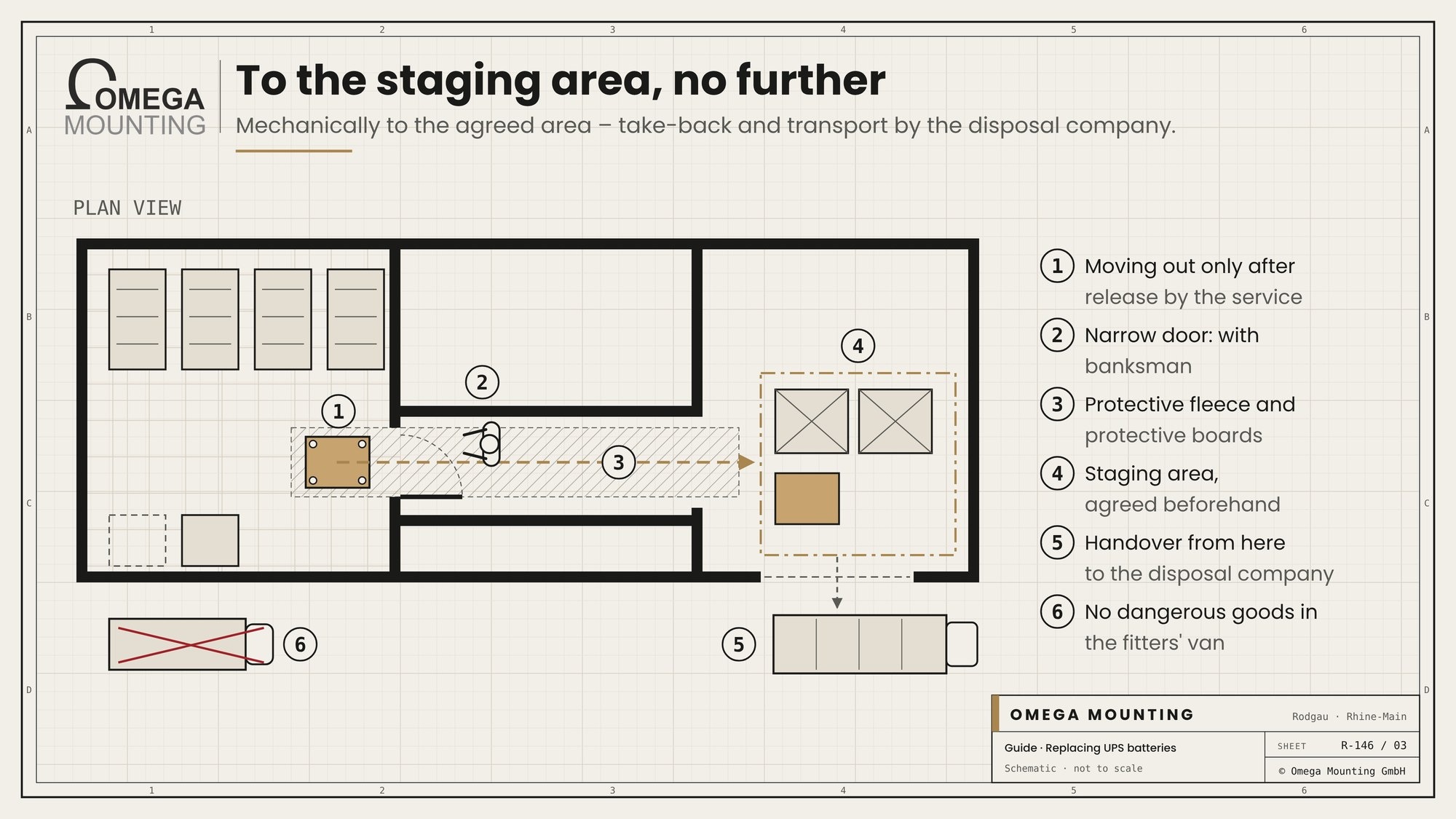
Used batteries from a UPS go back through the manufacturer's take-back scheme or a certified disposal company, packed and labelled to their specification, because they count as dangerous goods in transport and must not simply be taken along in an installation vehicle.
Manufacturers of industrial batteries are obliged to take them back. Often the supplier of the new batteries organises collection of the old ones at the same time. The disposal company specifies how they are packed, whether the blocks go on pallets and how terminals are protected. It also handles transport as dangerous goods.
Omega does not transport dangerous goods. After release by the UPS service provider, we move the old cabinets and racks mechanically to the agreed staging area in or at the building. There the disposal company takes over. Clarify beforehand with the disposal company who keeps which record. This section is an assessment from practice. This is not legal advice. For your obligations as holder of the used batteries, consult the disposal company or your environmental protection officer.
Overview: step, who, record
The table shows a typical division in a UPS battery replacement. In each case it is defined in the quotation, the sequence plan and the approvals.
| Step | Who | Record |
|---|---|---|
| Decision on replacement and technology | Operator with UPS service provider, manufacturer, specialist planner | Test report, manufacturer approval |
| Loads on route and installation position | Structural engineer or raised floor manufacturer | Statement, load spreading plan |
| Fire protection for a change of technology | Fire protection engineer | Update of the fire protection concept |
| Site visit and moving-in route | Installation contractor with operator | Site visit report, photos |
| Maintenance window and fallback plan | Operator | Approval, sequence plan |
| Switching over and disconnecting | UPS service provider or qualified electrician | Release of the cabinet |
| Moving out the old system | Installation contractor | Handover at the staging area |
| Moving in, setting up, securing | Installation contractor | Photos, alignment record |
| Connecting and testing | UPS service provider or qualified electrician | Test record |
| Take-back of used batteries | Manufacturer or certified disposal company | Acceptance or disposal record |
Typical mistakes in a UPS battery replacement
The typical mistakes in a UPS battery replacement are an unchecked route, missing load verifications for raised floor and slab, a switch to lithium without a specialist planner, unclear releases between electrical and mechanical work, and disposal that is only organised on replacement day.
- Route not walked. The lift is too small, the door too narrow, and the system is already isolated.
- Load only estimated. Nobody checked whether raised floor and slab can carry the cabinet on transport castors.
- Lithium as a one-to-one swap. The new battery fits in the cabinet, but not the UPS or the fire protection concept.
- Release not clear. A fitter moves a cabinet that the service provider has not yet released.
- No fallback. The system runs without a battery, and nobody checked whether the standby power system is ready.
- Disposal forgotten. The used batteries stand in the corridor because no collection has been ordered.
- Skimping on floor protection. Raised floor panels and coverings are damaged after the replacement.
The mistake behind the mistakes
Behind almost all mistakes lies the same assumption: the battery replacement is an electrical matter, the rest will sort itself out. In fact three trades depend on each other. Bring them into one shared sequence plan and replacement day holds no surprises.
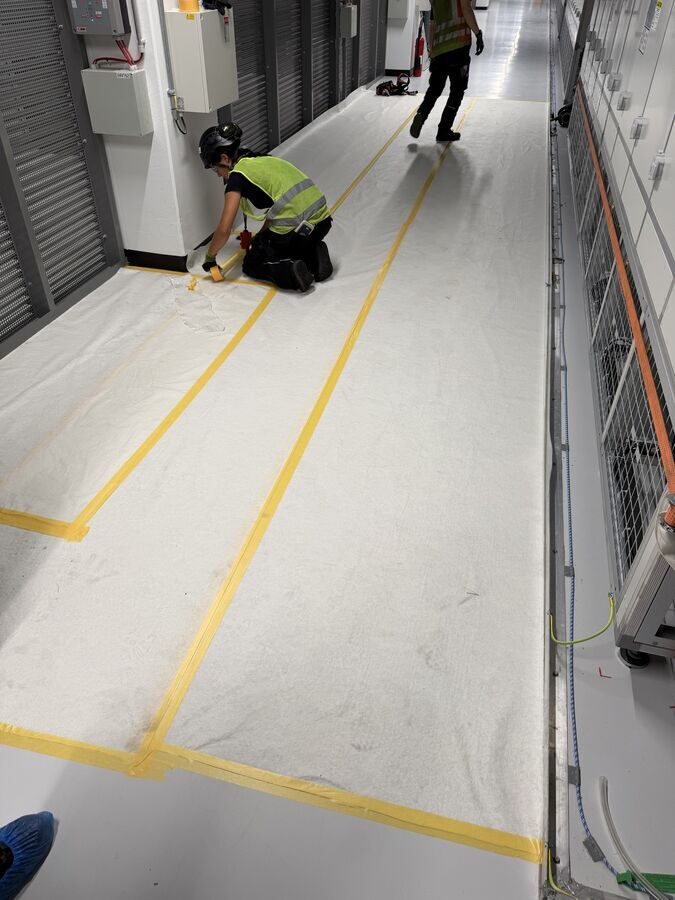
Replacing UPS batteries in the Rhine-Main region: how we work
If you have UPS batteries replaced in the Rhine-Main region, we take over the mechanical part: site visit, route planning, floor protection, moving out the old and moving in the new cabinets and racks, setting up, aligning and securing – coordinated with your UPS service provider and your qualified electrician.
We do not disconnect or connect batteries and we do not switch over a UPS. We leave the capacity test and the choice of battery technology to the service provider and the manufacturer. Loads are assessed by the structural engineer, fire protection by the specialist planner, and the used batteries are taken by the disposal company. We make sure the mechanical part fits all of this.
From Rodgau, Frankfurt, Offenbach, Hanau, Darmstadt and Raunheim are short trips. That helps with site visits and when a maintenance window is postponed at short notice. What we do in data centers overall is shown on our page on data center installation and lifting. For UPS maintenance in the Rhine-Main region your service provider remains the first point of contact – we complement it with lifting equipment and installation.
Project examples
We have not yet documented a UPS battery replacement in our project diary. But four jobs show exactly the way of working that matters here: work in operating data centers, heavy cabinets via lifts and protected routes, tight extraction from a basement and installation next to electrical test stations.
Data center in Frankfurt: replacement during operation
During the replacement of a CRAH unit in a data center in Frankfurt – the building was fully operational. Access led through secured areas with security gates and locked doors. Because the routes had already been accepted, all walking and driving routes were covered with protective fleece and taped down. At critical points every machine moved only under the guidance of our supervisor.
Weight, centre of gravity, floor load capacity and lifting points were analysed in advance. There was a lift plan for every lift. While one unit was being replaced, the others took over the cooling – in tightly coordinated maintenance windows. For your battery replacement this means: redundancy and maintenance windows are what make a replacement during operation possible.
Data center in the Rhine-Main region: cabinets via the heavy-duty lift
During the installation of PDCs in a data center in the Rhine-Main area – we moved heavy distribution cabinets via a heavy-duty lift to several levels. Driving and working routes were covered with protective boards and fleece. Before a cabinet reached its position, the hall was laser-surveyed and the set-down positions were marked. The electrical trade then took care of the connection. The job report records not a single damage. As a basis for a quotation, the page also lists the permissible raised floor loads.
Data center in Raunheim: extraction from the basement
With the retrieval of a spider crane from the basement of a data center in Raunheim – heavy equipment had to come back out through the basement and shaft. The route was measured and a lift plan drawn up. We supported the construction hoist with timber baulks to spread the load. In the very tight shaft, banksmen directed the load. For your battery replacement this means: moving out the old system also needs a planned route.
Battery test station: installation next to electrical test stations
For a Battery test station – we built partition walls that electrically shield the test stations from each other. We were almost the last trade in the room. Floor and folding walls must not be damaged. The doors were designed so that they can only be opened after release. Work took place during ongoing production. For your battery replacement this means: in a finished room every move counts.
Do you have a battery replacement coming up?
Then get in touch with us. Send us the manufacturer's data on old and new cabinets, a floor plan showing the route and the planned period. During a site visit we clarify what is needed mechanically and what you need from planner and service provider.

What this means for your role
For buyers: In the quotation, separate clearly between battery, electrical, mechanical work and disposal. Ask who provides the floor protection and who supplies the load spreading. A clear scope boundary prevents change orders on replacement day.
For designers: Obtain the manufacturer's data on weight and footprint of the new cabinets early. Involve the structural engineer, raised floor manufacturer and, for lithium, the fire protection engineer before ordering.
For project managers and site managers: Bring electrical, mechanical work and disposal together in one sequence plan. Define who releases each cabinet and how the release becomes visible on site.
For maintenance managers: Keep an eye on the age and test reports of the batteries so that the replacement is planned and not forced. Plan the maintenance window with a fallback.
For facility managers and operators: You carry the risk of the replacement window. Check redundancy, standby power system and access before you approve the date, and clarify the take-back of the used batteries early.
For occupational safety specialists and HSE coordinators: Make sure that electrical and mechanical work have a joint risk assessment. Clarify how the release of a cabinet becomes visible on site and who closes off the routes.
UPS battery replacement check: request the template
The UPS battery replacement check is a one-page working document for planning. It has five blocks: decision, loads and route, electrical and operation, mechanical work and used batteries. Each item has fields for “responsible”, “record available” and “clarified” or “open”. There are deliberately no number fields. The check shows you at a glance what is still missing before replacement day. Request the template via our contact form – keyword “UPS battery replacement check”.
Why Omega Mounting?
We are based in Rodgau near Frankfurt, can be reached around the clock and work with our own fitters and our own lifting equipment. The linked jobs show how we work in operating data centers: with floor protection, lift plan, banksmen and coordinated releases. We say in advance where our scope ends: we do not disconnect or connect batteries. For you this means: one partner for the mechanical part of your battery replacement, coordinated with service provider, planner and disposal company.
Conclusion
Anyone replacing UPS batteries plans electrical work, mechanical work and disposal as one project. The UPS service provider disconnects and connects, the structural engineer assesses raised floor and slab, the specialist planner assesses fire protection for lithium. In between lies the mechanical part: route, floor protection, moving out, moving in, setting up and securing. If this coordination works, the replacement stays calm during operation. If you have a replacement coming up, send us manufacturer's data, a floor plan and your preferred time frame – we will get back to you with an honest assessment.
Planning a move-in, installation or maintenance in the Rhine-Main region?
Tell us briefly what you need – we'll come back with an honest assessment.
Free, no-obligation callback
You may also be interested in these guides

About the author
Tobias Schott
Managing director of Omega Mounting GmbH, Rodgau · more than 20 years of hands-on experience in installation and maintenance
A trained mechatronics technician, working in maintenance, servicing and industrial installation since 2004 – first alongside his father, and with Omega Mounting since 2012: from overhead conveyors in Frankfurt to the crane system in a new-build hall. He plans and leads lifting operations as an appointed person (AP) in data centers and on industrial sites in the Rhine-Main region, trains and examines operators of cranes, mobile elevating work platforms and telehandlers, and is a qualified occupational safety specialist. On jobs abroad he is known as the “German Troubleshooter” – the person you call when a site gets stuck. He learned what quality means from his father, not from a manual: Made in Germany as a standard for his own work, not a label. That is why quality comes first at Omega Mounting – ahead of speed and price. He writes these guides from that practice: what works on our sites is in them – what exists only on paper is not.
Frequently asked questions
Only the UPS service provider or a qualified electrician with suitable qualifications may disconnect and connect electrically, because batteries remain live even after disconnection. The mechanical part – moving out, moving in, setting up, securing – can be taken over by an installation contractor once the service provider has released the cabinet.
Yes, if the system is redundant or the operator consciously approves bypass operation. Then one string after another is replaced in a maintenance window. Without redundancy the load runs without battery protection during the replacement, which is why a tested fallback is part of it.
Only the structural engineer or the raised floor manufacturer can assess that. They check the installation position and the transport route, because a cabinet on castors creates high point loads. Often load spreading plates, a substructure or transport on the structural slab are needed.
For comparable performance usually yes, because lithium is more compact. Even so, the point load can remain high if the weight stands on a smaller area. The manufacturer's data on weight and footprint are decisive.
The UPS must be approved for the new battery, and the fire protection concept must fit. A fire protection engineer checks room, separation, fire detection and suppression system based on the manufacturer's data. This clarification belongs before the order.
The manufacturer through its take-back scheme or a certified disposal company. It specifies packaging and labelling and transports the used batteries as dangerous goods. An installation contractor only moves the cabinets to the agreed staging area.
Work on batteries requires a risk assessment, qualified electricians and suitable protective equipment. For the mechanical part, lifting equipment, banksmen and closed-off routes are added. In a data center the operator's access rules and permits to work also apply.
Yes, the mechanical part is similar everywhere: in control rooms, hospitals, production plants and office buildings. We work mainly in the Rhine-Main region around Frankfurt, Offenbach and Darmstadt and coordinate with the existing UPS service provider in each case.
Send us the manufacturer's data on old and new cabinets, a floor plan with the route from the lorry to the battery room and your preferred time frame. After a site visit you receive a written assessment of the mechanical part. Your contact is Tobias Schott – reachable via our contact form.
 English
 German