
- Guide – Lift & Shift
Installing a battery energy storage system: foundation, crane lift and anchoring before grid connection
By Tobias Schott · 21-minute read · Updated October 2026
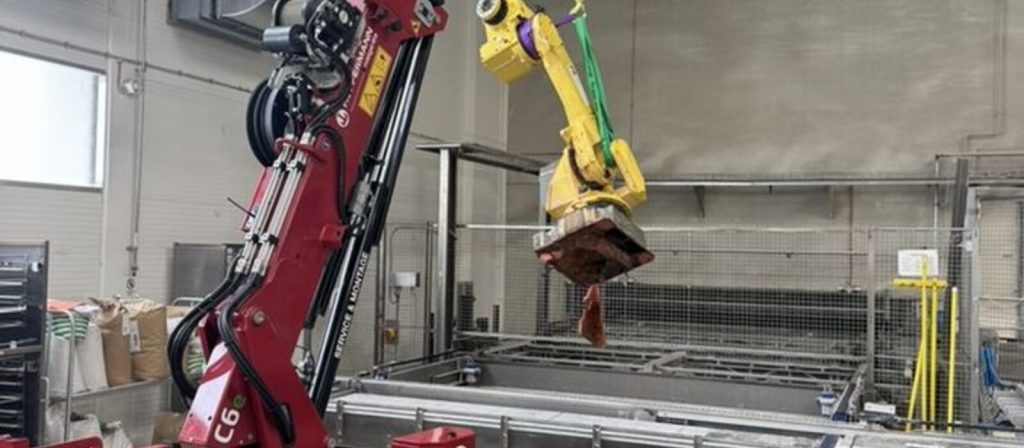
Before a battery energy storage system takes any power, it has to stand safely: on an approved foundation, lifted at the right points, set down level and anchored. This mechanical part helps decide whether the electrical work and commissioning run smoothly afterwards.
If you plan a battery energy storage system (BESS), you think first about the grid connection, inverters and funding. That is right, but it is not everything. A storage container is a heavy, sensitive load. It needs access for the abnormal-load transport, a crane standing area, a level foundation and a lift to the manufacturer’s instructions. If any of this goes wrong, the project stops before the first electrician arrives.
This guide covers the mechanical work before grid connection: from the site and the delivery day through the lift to anchoring and handover to the electrical contractor. How container facilities are set up in general is covered in our overview guide Installing a container facility. Here we focus on what is different with battery storage.
We write as a mechanical installation and move-in contractor from Rodgau near Frankfurt. To be clear from the start: we have not yet documented a battery storage system in our project diary. We have, however, installed heavy container modules, tanks and generator sets – the steps are comparable, and for battery storage the requirements come from the manufacturer.
Key points at a glance
- Installing a battery storage system means: prepare the site, deliver, lift, set down, align, anchor and hand over to the electrical contractor.
- The foundation is designed by the structural engineer – not by the installation contractor and not by the crane operator.
- Clearances and fire protection are set by the manufacturer and the specialist designers – they fix the location before the foundation is built.
- Slinging only at the points and with the lifting gear the manufacturer specifies.
- On delivery, the unit is checked for transport damage before it is lifted.
- Earthing, equipotential bonding, grid connection and commissioning are done by the electrical contractor with the grid operator and the manufacturer.
- Mechanical scope also covers cable routes, impact protection, access and maintenance areas.
What is a battery energy storage system?
A battery energy storage system stores electrical energy in batteries and releases it when needed. In commerce, industry and on the grid it is usually a container or cabinet solution with batteries, inverters, air conditioning and safety systems.
In the trade it is often called a BESS, short for “battery energy storage system”. In German it is a “Batteriespeicher” – the meaning is the same.
Container systems and cabinet systems
A containerised battery storage system is usually a unit fitted out at the factory. It holds battery racks, often already loaded with modules, plus air conditioning, fire detection and, depending on the manufacturer, a suppression system. Depending on the system, the inverter and transformer sit in the same container or next to it. The container is delivered and lifted as one unit.
A cabinet system consists of individual cabinets that stand in a building, a plant room or outdoors under an enclosure. It is intended more for smaller commercial capacities. The cabinets are moved in one by one and connected on site.
What battery storage is used for
- Commerce and industry. Peak shaving, storing your own solar power, securing supply.
- Data centers and logistics. Supplementing the standby power or the uninterruptible power supply (UPS), depending on the concept.
- On the grid. Utility-scale battery storage balances fluctuations and supports the grid.
Battery storage in industry does not automatically replace a standby power system. How standby generators are maintained is covered in our guide to the maintenance of standby generators.
Single unit or storage park
A single container on a commercial site is usually a manageable lift with a clear sequence. A utility-scale storage park is different: you are planning a small construction site with many containers, inverter and transformer stations, cable routes and access roads. Laydown areas for the low-loaders, crane set-up positions, the order of the units and site facilities that last over several delivery dates all matter. The mechanical questions stay the same, but they repeat – and every repeat has to be right.
How a storage unit differs from a site office container
A battery container is not a welfare unit. It holds equipment that is sensitive to impact, tilting and moisture, and energy that can be stored even without a grid connection. That is why tighter requirements apply to transport, lifting and storage. They are set out in the manufacturer’s installation and transport instructions – and they take precedence over any general rule.
Who does what on a battery storage project
Many trades work in sequence: designers and the authority settle location and permits, the structural engineer designs the foundation, the installation contractor lifts and anchors, the electrical contractor earths and connects, and the manufacturer and grid operator commission the system.
Clear responsibilities close the most common gap: everyone thinks someone else has sorted it.
- Project developer or designer. Select the system and location, coordinate with the authority, grid operator and manufacturer.
- Fire safety engineer. Uses the manufacturer’s data to set clearances, protective measures and fire brigade access.
- Structural engineer Designs the foundation, cast-in items and anchoring.
- Groundworks. Build the foundation, ducts and access road to the drawings.
- Installation contractor Plans the lift, slings, lifts, sets down, aligns, anchors and prepares mechanical cable routes.
- Electrical contractor Carries out earthing, equipotential bonding, cabling, connection and electrical testing.
- Manufacturer and grid operator. Support commissioning, software and grid connection.
One coordinator for the site
With so many parties involved, the site needs a coordinator. That can be the operator’s project manager, the general contractor or the project developer. The coordinator collects manufacturer documents, foundation sign-off, lift plan and dates, and makes sure each trade knows what the previous one handed over. Without this role, the gaps open up exactly between the trades.
Manufacturer’s instructions before everything else
A battery storage system is a system the manufacturer is responsible for. Lifting points, permitted tilt, storage before installation, foundation flatness and anchoring are all in the manufacturer’s documents. Ask for them early. Without them, nobody can write a proper lift plan.
Before delivery: location, foundation, access
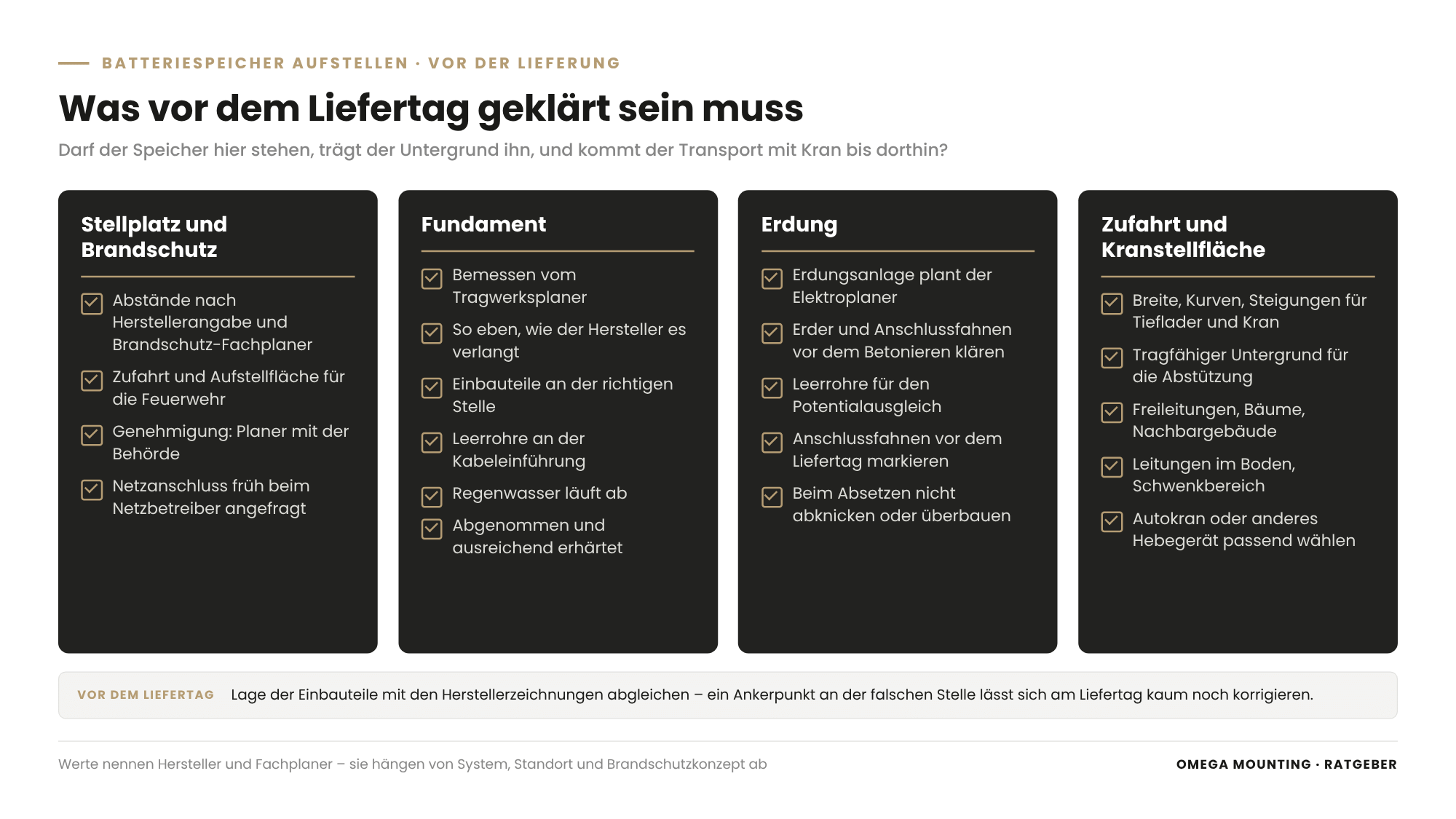
Before delivery, three questions need answers: may the unit stand here, will the ground carry it, and can the transport and crane get there?
Location, clearances and fire protection
The location follows the requirements, not the free space in the yard. Clearances to buildings, boundaries, escape routes and other plant are set by the manufacturer and the fire safety engineer. Fire brigade access and a standing area come on top. We deliberately give no figures here – they depend on the system, the site and the fire strategy.
Settle permits and grid connection early
Whether the unit needs building permission depends on location, size and the law of the German federal state. The designer clarifies this with the authority. This guide is not legal advice. The grid connection is also requested early from the grid operator, because it often determines where the cables arrive and where the unit should stand.
The battery storage foundation
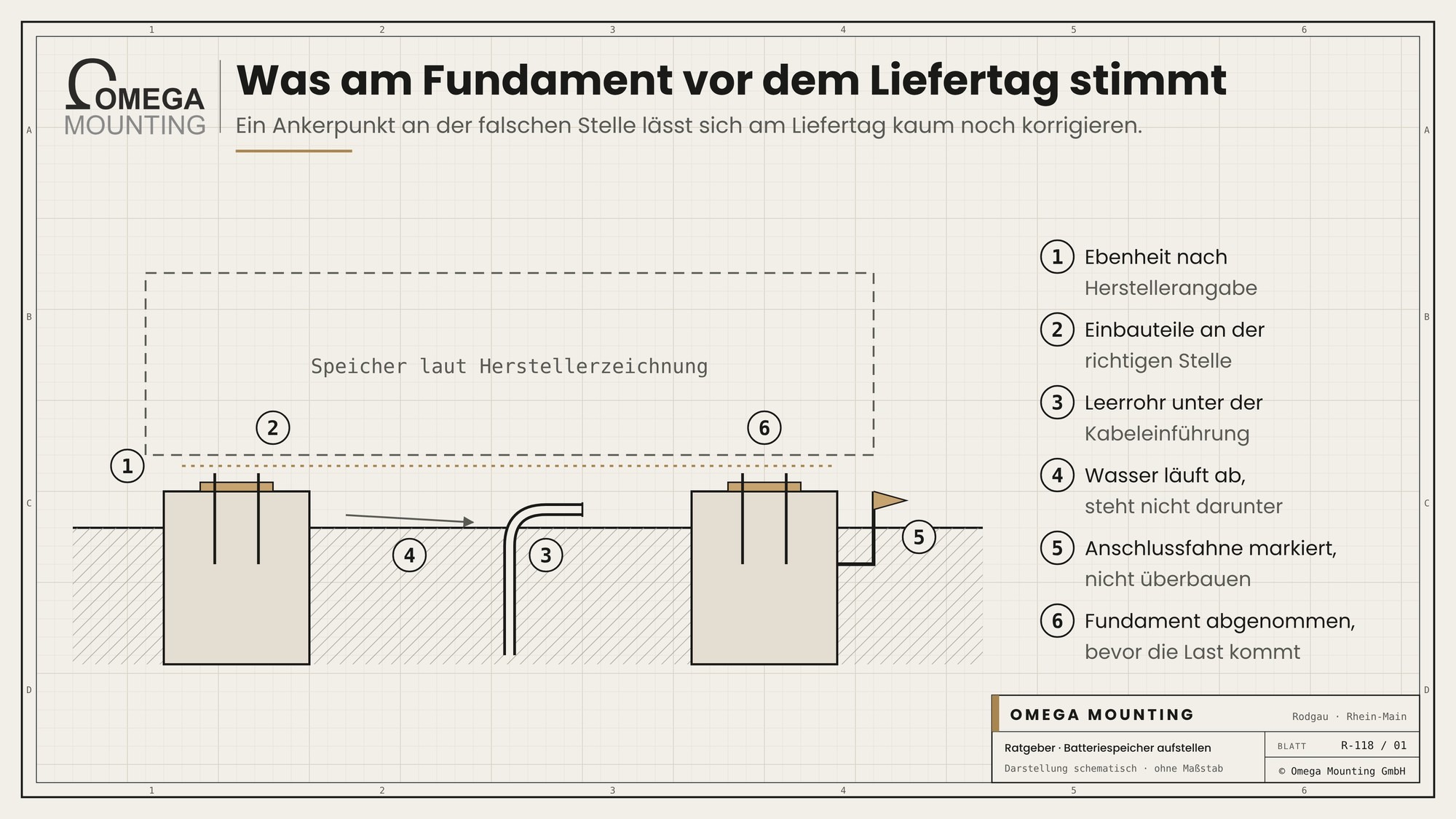
The structural engineer designs the foundation from the manufacturer’s loads and the ground conditions. Depending on the system, strip foundations, a slab or pad foundations are usual. For the installation contractor, these points matter most:
- Flatness. Is the foundation as flat as the manufacturer requires? A container that sits out of level distorts its frame. Doors bind, seals work loose and racks are under stress.
- Cast-in items. Are anchor plates, anchor channels or drilling zones in the right place and accessible?
- Ducts and penetrations. Do the cable ducts come up where the unit’s cable entry is?
- Drainage. Can rainwater run off instead of standing under the unit?
- Sign-off. Has the foundation been accepted and cured sufficiently before the load arrives?
Check the position of the cast-in items against the manufacturer’s drawings before delivery day. An anchor point in the wrong place can hardly be corrected on the day.
Earthing starts at the foundation
The electrical designer plans the earthing system and the electrical contractor installs it. Part of it, however, is often built in with the foundation, before the concrete is poured. Clarify early whether earth electrodes, earthing tails or ducts for equipotential bonding belong in the foundation and where they come out. This matters for the lift: earthing tails must not be bent or covered when the unit is set down. Mark them before delivery day and include them in the lift plan.
Access and crane standing area
A storage container usually arrives as an abnormal load. The access route must offer the width, bends, gradients and bearing capacity for the low-loader and crane. The crane standing area needs ground that carries the outrigger loads. Check overhead lines, trees, neighbouring buildings, buried services and the slewing area. Whether a mobile crane or other lifting equipment suits the site is covered in our guide Spider crane or mobile crane.
Cabinet systems inside a building
If the unit stands inside a building, other questions arise: does the installation route fit through doors and corridors? Will the floor carry the load? How to check installation routes and floor loads is covered in our guide Planning the move-in and checking floor loads. The structural engineer assesses the load-bearing capacity of the floor.
Delivery day: unloading, incoming inspection, temporary storage
On delivery day, the unit is first checked for transport damage and then lifted – or stored temporarily to the manufacturer’s instructions if the location is not ready yet.
Lithium batteries are dangerous goods
Most storage systems today use lithium-ion cells. In transport they count as dangerous goods. Packaging, marking and carriage are handled by the manufacturer and the haulier. On site this means: the transport is notified, the accompanying documents are available, and the team knows the manufacturer’s emergency instructions.
Incoming inspection before the lift
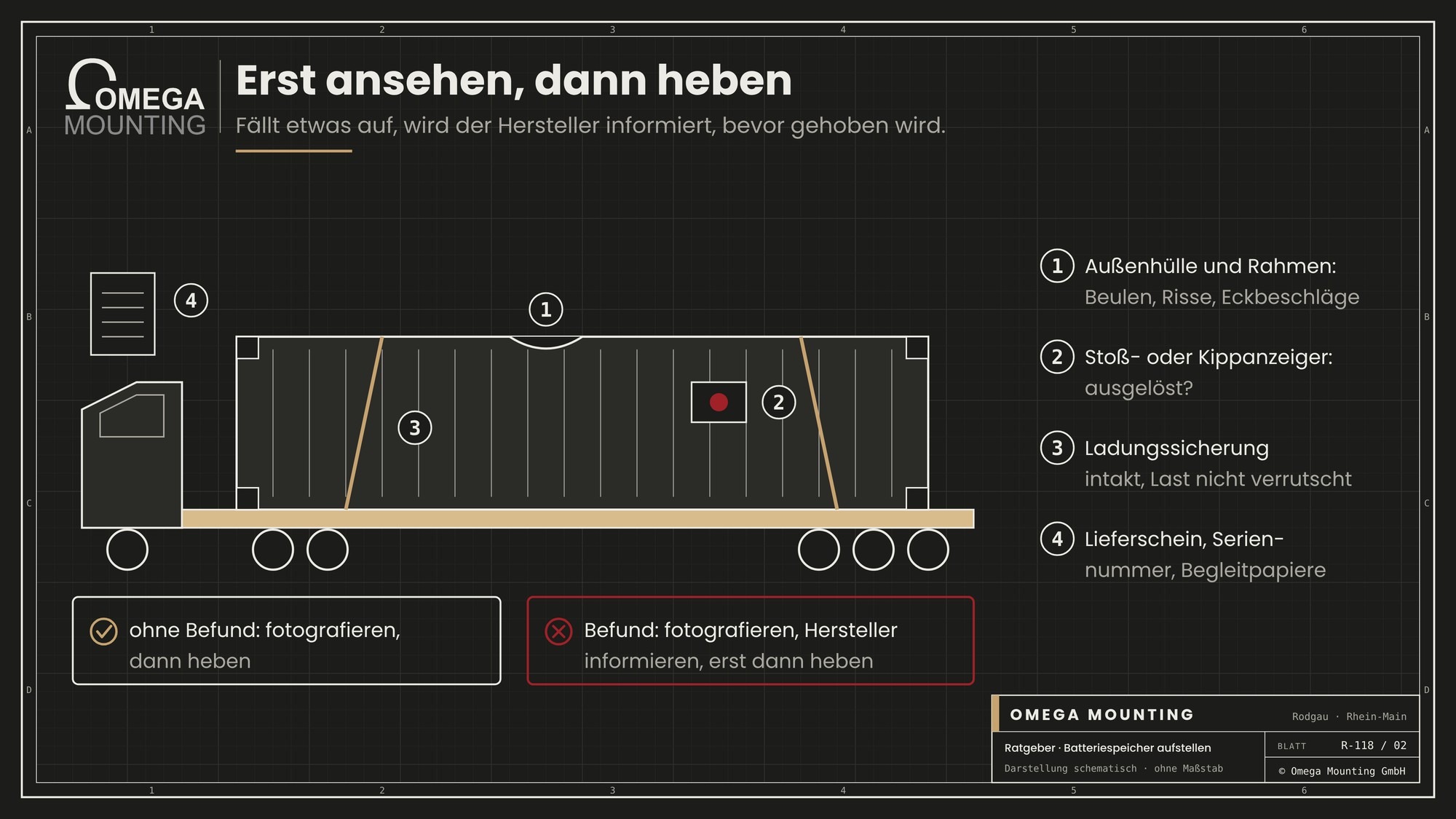
Before the unit is lifted, inspect it together:
- Shell and frame. Dents, cracks, bent corner castings, damaged doors.
- Transport indicators. Some manufacturers fit shock or tilt indicators. Have they been triggered?
- Load securing. Is the load securing on the vehicle intact, or has the load moved?
- Paperwork. Do the delivery note, serial number and accompanying documents match the system ordered?
Photograph the condition before the lift. If anything stands out, inform the manufacturer before lifting. A damaged unit is not installed “for now”.
Temporary storage
If the location is not ready, the unit must not simply stand in the yard. The manufacturer specifies conditions for storage, ground, weather protection and state of charge. Keep to them and record it.
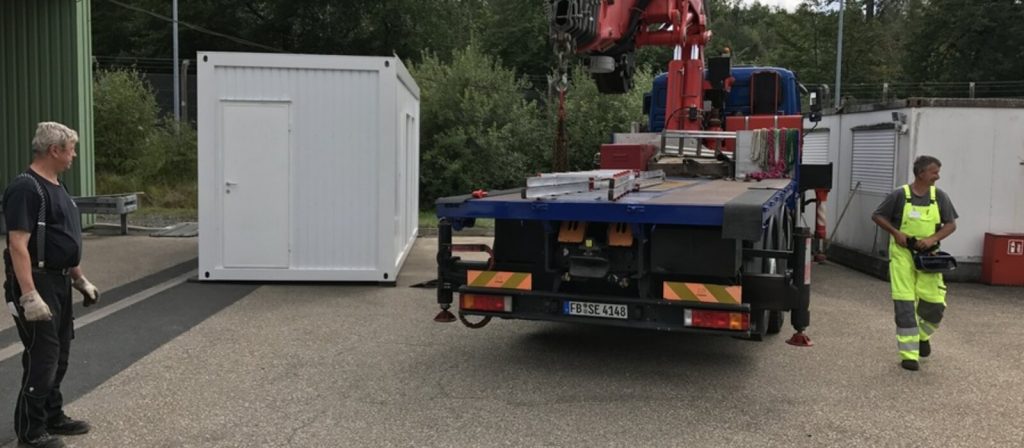
The lift: lifting points, spreader beam, wind
The battery storage unit is slung only at the manufacturer’s designated points with the specified lifting gear, lifted level, guided and set down without impact.
Lifting points and lifting gear
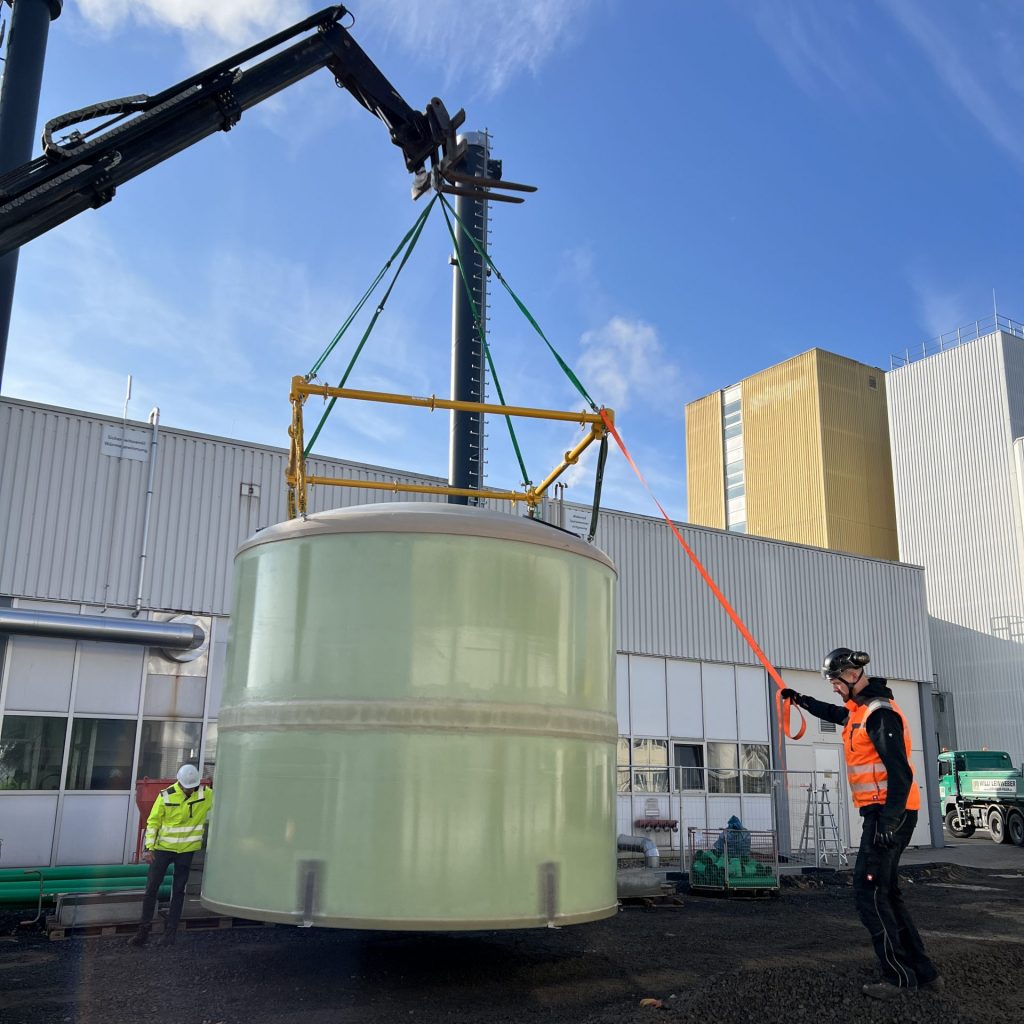
Battery containers often have corner castings like a shipping container. That does not mean every slinging method is allowed. The manufacturer specifies whether slinging is from the top or the bottom, whether a spreader beam or spreader frame is needed and what tilt is permitted. A spreader beam prevents angled pull that would put extra load on the frame and lifting points. Which lifting accessories suit heavy loads is covered in our guide to lifting accessories for heavy loads.
The lift plan
Every lift gets a lift plan: load weight from the manufacturer, crane position, radius, lifting accessories, slewing area, exclusion zone and sequence. The plan is agreed before delivery day and approved by the client. Crane, lifting accessories and lifting gear must have been inspected – the German Industrial Safety Ordinance (BetrSichV) requires periodic inspection by a competent person (befähigte Person). UK readers: lift planning under LOLER 1998 reg. 8 and BS 7121-1 is broadly comparable. Who is responsible for the lift and who gives the signals is set by the appointed person for lifting operations. More in our guide to the appointed person for lifting operations.
Wind and weather
A container presents a large surface to the wind. Whether lifting may go ahead is decided by the crane operator, based on the crane’s limits and the manufacturer’s requirements. Plan the lift so that a windy day is not a problem: with a fallback date and without time pressure. In rain, protect open cable entries and doors.
Exclusion zone and communication
During the lift, the slewing area is closed off. If operations continue on site, agree vehicle routes, forklift traffic and other companies’ deliveries in advance. Crane operator, signaller and slingers communicate by radio and agreed hand signals. Where visibility is restricted, only one person gives signals. Anyone not involved in the lift stays outside the exclusion zone – including the curious colleague from the office.
Guiding and setting down
Tag lines keep the load steady and away from people. Nobody stands under the load or between the load and fixed objects. The unit is lowered slowly and set down without impact. A signaller with a view of the bearing points gives the final signals.
Set down, align, anchor
After the lift, the unit is set down on its bearing points, aligned to the manufacturer’s instructions and secured against wind, impact and displacement with the anchoring specified by the structural engineer.
Aligning
Aligning means bringing the unit to the position and height the manufacturer requires. Shims, packers or protective mats go only where they are specified. Then check the doors and hatches: if they open and close easily, the frame is not distorted. How alignment and anchoring work in general is shown in our guide Aligning and anchoring a machine.
Anchoring
The structural engineer specifies the anchoring with the manufacturer’s data: anchors, anchor plates, welded connections to cast-in items or clamped connections. The installation contractor installs them to the drawings, tightens them to the specified torque and records it. Do not drill into areas with ducts or reinforcement.
Several units
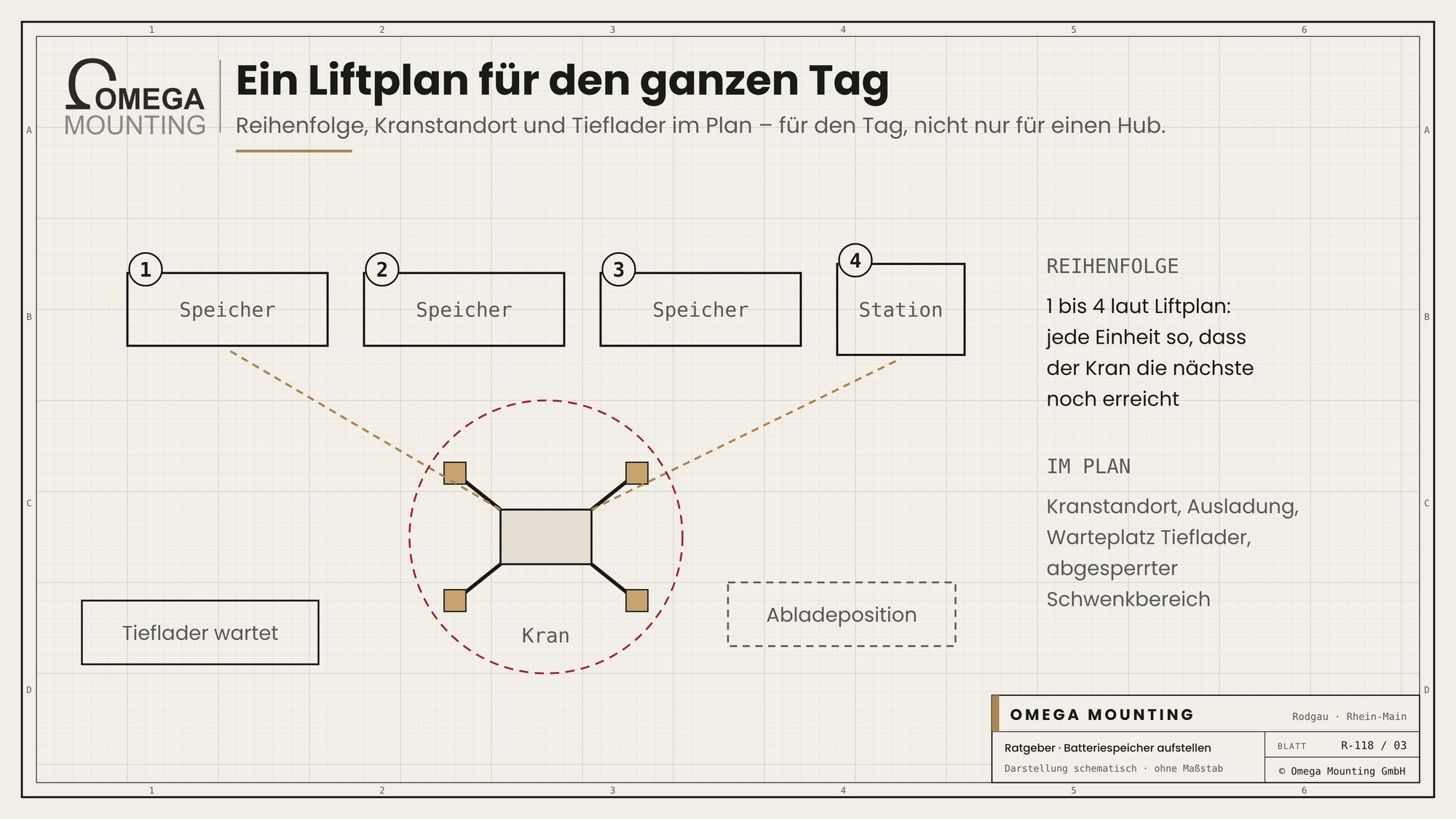
Utility-scale storage often consists of several containers plus inverter and transformer stations. Then the sequence matters: which unit goes first so that the crane can still reach the next one? Where do the low-loaders wait during lifting? The lift plan answers these questions for the whole day, not just for a single lift.
Earthing and grid connection: handover to the electrical contractor
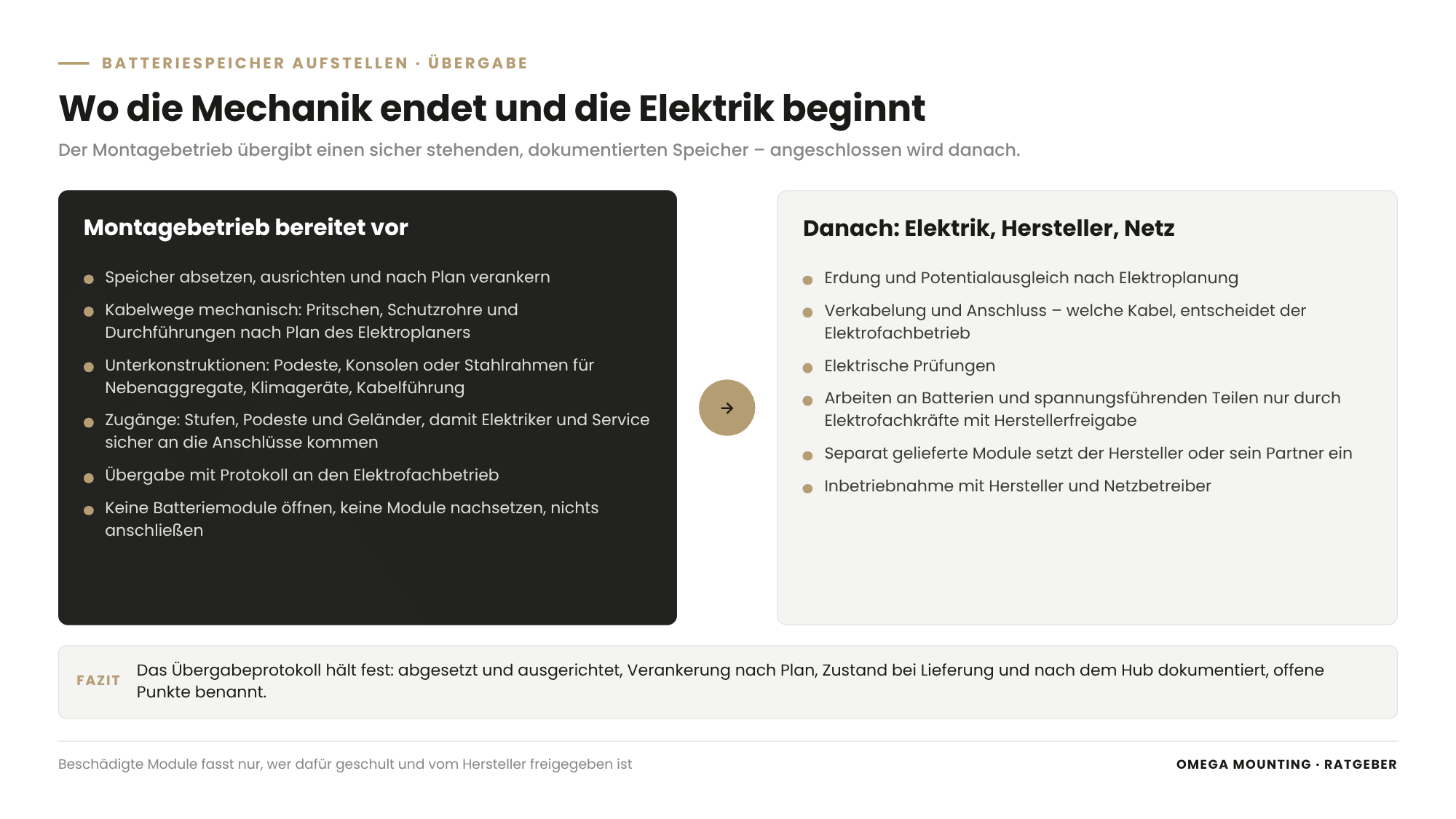
Earthing, equipotential bonding, cabling and grid connection of a battery storage system are done by the electrical contractor, and the manufacturer and grid operator support commissioning. The installation contractor hands over a unit that stands safely and is documented.
What the installation contractor can prepare
- Mechanical cable routes. Cable trays, protective ducts, support frames and penetrations to the electrical designer’s drawings.
- Support frames. Platforms, brackets or steel frames for auxiliary units, air-conditioning units or cable routing.
- Access. Steps, platforms and handrails so that electricians and service staff can reach the connections safely.
Which cables are pulled and how they are connected is decided by the electrical contractor. Work on batteries and live parts is reserved for qualified electricians approved by the manufacturer.
Battery storage grid connection: what the handover record contains
Before the grid connection work starts, the installation contractor hands over with a record. It states: unit set down and aligned, anchoring installed to the drawings, condition on delivery and after the lift documented, open items listed. How handovers work in general is covered in our guide to commissioning and handover of a plant.
What we do not do
We do not open battery modules, install modules or connect anything. If modules are delivered separately, the manufacturer or its partner installs them. Damaged modules are handled only by people trained for it and approved by the manufacturer.
Afterwards: impact protection, access and maintenance areas
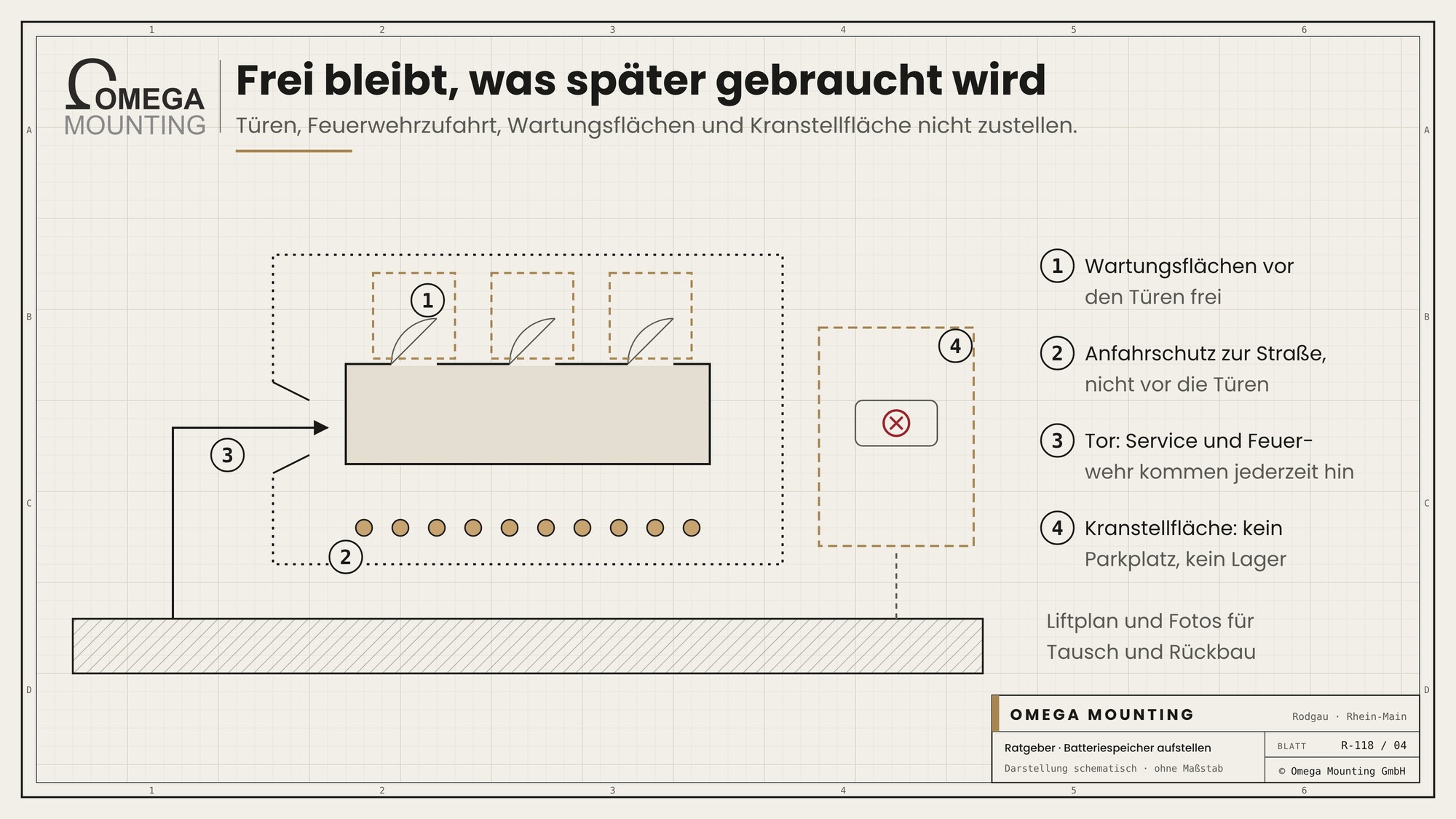
Once installed, the unit needs protection against impact, controlled access and clear areas for maintenance and the fire brigade – this belongs in the plan, not in the rework.
Impact protection
If the unit stands next to a road, in a yard with forklift traffic or beside a car park, it needs impact protection. Which material suits which location is covered in our guide Impact protection: plastic or steel. Make sure the impact protection does not block the doors, the fire brigade access or the maintenance areas.
Access and fencing
A fence with a gate keeps out unauthorised people. Keys, access rules and signage are set by the operator. Plan the fencing so that service staff and the fire brigade can reach the unit at any time.
Documentation for operation
Give the operator the mechanical documentation: lift plan, photos of the incoming inspection and the condition after the lift, the anchoring record and the handover to the electrical contractor. These documents help later when a container is replaced, moved or removed at the end of its life. If you know where the crane stood and how the unit was slung, you do not have to plan from scratch.
Keep the lifting route clear for later
A battery storage system does not stay forever. Individual units are replaced, extended or removed. Keep the crane standing area and the access route clear, even if the space is tempting for parking or storage. New buildings, trees or services on this area make the next lift costly and difficult.
Keep maintenance areas clear
Air-conditioning units, filters and doors need space. Do not block the areas in front of the doors with material, containers or impact protection. What is clear today is often blocked by the next alteration.
From location to handover at a glance

The table shows the phases of a battery storage installation, the main task in each phase and who carries it out.
| Phase | Task | Who |
|---|---|---|
| Planning. | Location, clearances, fire protection, permits, grid connection request | Designer, specialist designers, authority, grid operator |
| Foundation. | Design, cast-in items, ducts, drainage, sign-off | Structural engineer and groundworks |
| Lift planning | Manufacturer documents, lift plan, crane standing area, access, approval | Installation contractor with the client |
| Delivery day | Incoming inspection, photos, paperwork, temporary storage if needed | Installation contractor, haulier, manufacturer |
| Lift | Slinging to the manufacturer’s instructions, lifting, guiding, setting down | Installation contractor with the crane hire company |
| Anchoring | Aligning and anchoring to the drawings, recording | Installation contractor to the structural engineer’s design |
| Mechanical work afterwards | Cable routes, support frames, access, impact protection | Installation contractor to the electrical design |
| Electrics. | Earthing, equipotential bonding, cabling, connection, testing | Electrical contractor |
| Commissioning | Commissioning, software, grid connection | Manufacturer, electrical contractor, grid operator |
Where the interfaces are
The risky points are the transitions. Between foundation and lift, the check of the cast-in items is often missing. Between lift and electrical work, the handover record is often missing. For each transition, decide who checks and who signs.
Typical mistakes when installing a battery storage system
The typical mistakes are a location without agreed clearances, a foundation without matching cast-in items, a lift without manufacturer documents, no incoming inspection and a handover without a record.
- Location chosen by free space. Clearances and fire brigade access are checked only once the foundation is built.
- Cast-in items in the wrong place. Anchor plates or ducts do not match the manufacturer’s drawing.
- Lift without manufacturer’s instructions. The unit is slung “like a shipping container”, although the manufacturer specifies otherwise.
- No incoming inspection. Transport damage is noticed only once the unit is anchored.
- Improvised temporary storage. The unit stands unprotected on uneven ground.
- Crane standing area not checked. The ground does not carry the outrigger loads, and buried services are unknown.
- Handover without a record. Nobody knows who answers for the condition after the lift.
The mistake behind the mistakes
Almost all of these mistakes come from the same assumption: that a battery storage unit is “just a container”. Mechanically it resembles one, but the requirements come from the manufacturer of a technical system. If you read the manufacturer’s documents early and pass them to the designer, structural engineer and installation contractor, you avoid most of these mistakes.
Battery storage installation in the Rhine-Main region: how we work
In the Rhine-Main region we take on the mechanical part of a battery storage project: site visit, lift planning to the manufacturer’s instructions, slinging, lifting, setting down, aligning, anchoring and mechanical cable routes.
It starts with a site visit. We look at access, crane standing area, foundation and surroundings and compare them with the manufacturer’s documents. We then prepare the lift plan and agree it with you. On delivery day we inspect the unit with you, lift it, set it down and anchor it to the drawings. Finally, we hand over to the electrical contractor with a record.
From Rodgau, Frankfurt, Offenbach, Hanau, Darmstadt and Aschaffenburg are short trips. What we deliver for standby power systems, container modules and load banks is set out on our service page for industrial installation for energy and standby power.
We say up front what we do not take on. The structural engineer designs the foundation and anchoring. Clearances and fire protection are set by the manufacturer and the specialist designers. Earthing, grid connection and commissioning are done by the electrical contractor, the manufacturer and the grid operator. The designer clarifies permits with the authority. We do not open or replace battery modules.
Project examples
We have not yet documented a battery storage system in our project diary. To put it honestly, the following jobs show comparable work: lifting heavy container modules, setting containers on prepared ground, and aligning and anchoring loads on foundations.
Data center in Frankfurt: heavy container modules with a lift plan
With the load bank and generator installation at a data center in Frankfurt we lifted heavy container modules as part of testing and expansion work on the standby power supply. Set-down areas and crane positions were fixed in a move-in drawing. Every lift was covered by a lift plan with load weight, radius, crane position and exclusion zones. The operator approved the plans before the first lift, and proof of the crane’s periodic inspection was available. The final positions were tight, between the tank installation, generators and existing plant. The low-loaders arrived in a timed sequence and were unloaded directly; the loads were slung with chain slings and guided with tag lines.
For your storage project: a move-in drawing, a lift plan and approval before the first lift make delivery day predictable.
Taunus: containers on levelled ground
With the container facility for a site security service in the Taunus we worked on a military site, with access only after a security check. Before delivery, precisely levelled ground was prepared from concrete slabs and steel plates, with all bearing points at the same height. The report gives the reason: modules that sit out of level distort their frames, doors bind and joints leak. A lorry-mounted crane lifted the containers straight from the vehicle into position, slung at the corner castings with container hooks. The modules were then bolted and connected.
For your storage project: the flatness of the bearing surface decides whether the frame stands free of stress.
Fulda: aligning and anchoring on a foundation
During the tank installation in Fulda glass-fibre reinforced plastic tanks were installed on a tight industrial site. Our fitters guided the vehicles across the site. The tanks were set on cleaned concrete foundations with a protective mat in between against point loads. A purpose-made lifting beam prevented angled pull. Every lift followed a lift plan with lifting points and lifting gear agreed with the manufacturer; a tag line damped the swing and a signaller gave the signals. Finally, the tanks were fixed to the foundation with heavy-duty anchors – against wind, filling loads and continuous operation.
For your storage project: agree the lifting points with the manufacturer, use a spreader beam against angled pull, anchor to the drawings.
Planning a battery storage system?
Then get in touch with us. Send us the site plan, the manufacturer’s documents and the planned delivery date. During a site visit we show you what is still missing at the location for the lift.
What this means for your role
For buyers: Order the manufacturer’s documents for transport, lifting and anchoring together with the unit – not afterwards. Award the lift and anchoring to a contractor that delivers a lift plan and a handover record.
For designers: Settle clearances, fire protection and grid connection before you fix the location. Give the structural engineer and the installation contractor the manufacturer’s drawings with loads, bearing points and lifting points.
For project managers and site managers: As project manager, you set the order of the trades and the handovers. As site manager, you check foundation, cast-in items, access and crane standing area before delivery day – and on the day you make sure of the exclusion zone and the incoming inspection.
For technical managers and facility managers: You operate the unit afterwards. Keep maintenance areas clear, provide impact protection and access rules, and ask for the handover records of all trades.
For senior management: A battery storage system is an energy project, but it is also a heavy-lifting project. Plan the mechanical part in from the start so that the project does not stall on delivery day.
Battery storage site check: template on request
The battery storage site check is a one-page working document with tick boxes: foundation approved, flatness and cast-in items checked against the manufacturer’s data, access and crane standing area agreed, clearances and fire protection confirmed, lifting points as specified by the manufacturer, lift plan approved, incoming inspection, cable routes prepared, electrical contractor booked, handover with a record. It deliberately contains no dimensions or limit values – those come from the manufacturer and the specialist designers. Request the template via our contact form and quote “site check”.
Why Omega Mounting?
We are based in Rodgau near Frankfurt, have our own lifting equipment and regularly lift heavy container modules, generator sets and tanks. We have not yet documented a battery storage system, and we say so openly. The linked jobs show how we handle loads like these: with a move-in drawing, lift plan and approval, levelled ground, agreed lifting points and anchoring to the drawings. What you get: a single point of contact for lifting, installation and anchoring – with short distances in the Rhine-Main region and clear handovers to the electrical contractor and the manufacturer.
Conclusion
Installing a battery storage system means placing a heavy, sensitive load safely on a prepared location. Settle clearances, fire protection and permits before the foundation is built. Have the foundation and anchoring designed by a structural engineer and check the cast-in items before delivery day. Lift only to the manufacturer’s instructions, inspect the unit on delivery and hand over to the electrical contractor with a record. When your storage project comes up, send us the site plan and the manufacturer’s documents – we'll come back with a site visit date and an honest assessment.
Planning a move-in, installation or maintenance in the Rhine-Main region?
Tell us briefly what you need – we'll come back with an honest assessment.
Free, no-obligation callback
You may also be interested in these guides

About the author
Tobias Schott
Managing director of Omega Mounting GmbH, Rodgau · more than 20 years of hands-on experience in installation and maintenance
A trained mechatronics technician, working in maintenance, servicing and industrial installation since 2004 – first alongside his father, and with Omega Mounting since 2012: from overhead conveyors in Frankfurt to the crane system in a new-build hall. He plans and leads lifting operations as an appointed person (AP) in data centers and on industrial sites in the Rhine-Main region, trains and examines operators of cranes, mobile elevating work platforms and telehandlers, and is a qualified occupational safety specialist. On jobs abroad he is known as the “German Troubleshooter” – the person you call when a site gets stuck. He learned what quality means from his father, not from a manual: Made in Germany as a standard for his own work, not a label. That is why quality comes first at Omega Mounting – ahead of speed and price. He writes these guides from that practice: what works on our sites is in them – what exists only on paper is not.
Frequently asked questions
Above all, the sequence and the responsibilities. Clearances and fire protection are set by the manufacturer and the specialist designers, and the structural engineer designs the foundation. Lifting is done only at the specified lifting points, after an incoming inspection and with a lift plan. The unit is then aligned, anchored and handed over to the electrical contractor with a record.
That depends on the system, the loads and the ground. Strip foundations, a slab or pad foundations are usual. The structural engineer designs it from the manufacturer’s data. For installation, what matters is flatness, matching cast-in items, ducts in the right place and sign-off before delivery day.
That follows from the weight given by the manufacturer, the radius, the standing area and the surroundings. Usually a mobile crane is used, and for smaller units a lorry-mounted crane. The installation contractor chooses the crane in the lift plan together with the crane hire company. Crane and lifting accessories must have been inspected.
Not without the manufacturer’s approval. Many battery containers have corner castings, but the manufacturer specifies how they are slung, whether a spreader beam is needed and what tilt is permitted. These requirements take precedence over any general container rule.
The electrical contractor, in coordination with the manufacturer and the grid operator. The electrical contractor carries out earthing, equipotential bonding, cabling, connection and electrical testing. The installation contractor prepares mechanical cable routes, support frames and access and hands over a unit that stands safely.
That depends on location, size and the law of the German federal state. Whether permission is needed and which conditions apply is clarified by the designer with the responsible authority. Raise this question early, because it can affect the location.
Then it is not lifted. Record the damage with photos, inform the manufacturer and the haulier and wait for their decision. Damaged battery modules are handled only by trained staff approved by the manufacturer.
For the mechanical part, installation and move-in contractors from the region are the shortest route. From Rodgau, we cover site visit, lift plan, lift, alignment and anchoring in Frankfurt, Offenbach, Hanau, Darmstadt and Aschaffenburg. Foundation, electrical work and fire protection stay with the responsible specialists.
A short enquiry with the site plan, the manufacturer’s documents for transport and lifting, and the planned delivery date. We arrange a site visit, check access, crane standing area and foundation, and send a written assessment with a draft lift plan. Your contact is Tobias Schott – via our contact form.
 English
 German