
- Guide – Data Center
Data Center Maintenance Contracts: Maintenance Windows, Redundancy, Access
By Tobias Schott · 21-minute read · Updated October 2026
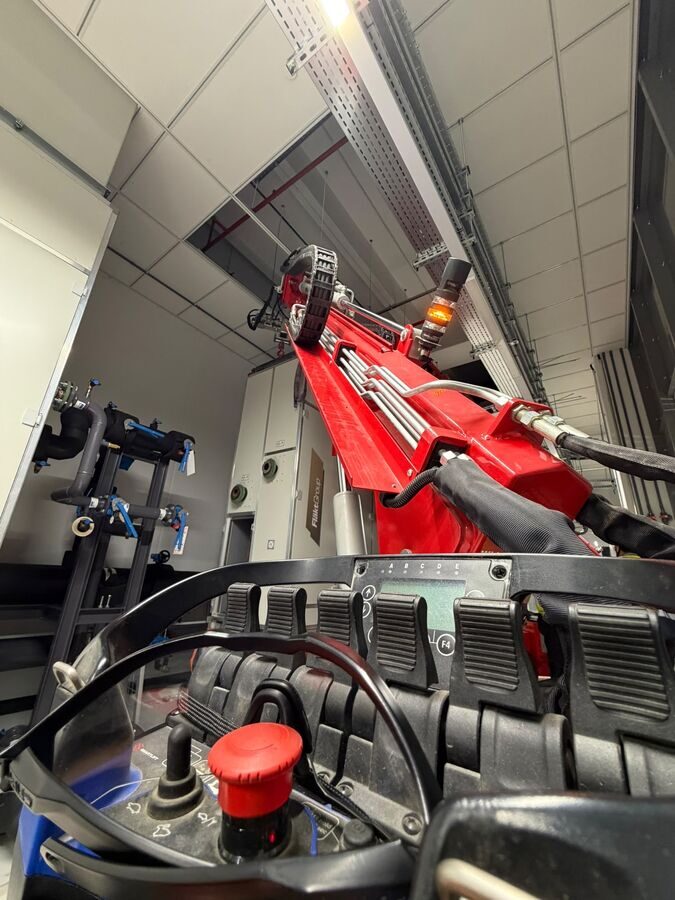
A data center maintenance contract has to cover more than intervals and parts: when a unit may go offline, how the work is approved, who gets access and which trade maintains which part of the plant.
In a factory, the line stops at the weekend and maintenance begins. In a data center, nothing stops. Cooling, power supply and the standby generator set run every day of the year. Every maintenance job takes place on a plant whose neighbour is carrying the load at that moment. Anyone who drafts or reviews a data center maintenance contract therefore mainly sets out the route to the work: maintenance windows, redundancy, change process, access and records.
This guide shows what sets such a contract apart from a contract for a machine fleet and how maintenance windows and redundancy are linked. It explains how a date becomes an approval, what has to be settled on access and permits to work before the first visit and which trade belongs to which partner. The basics of working in a live data center – access, cleanliness, floor loads, lifting equipment – are covered in our guide to installation in data centers. They are not repeated here.
We write from the point of view of an installation and maintenance contractor from Rodgau near Frankfurt. Our part of the contract is the mechanical one: rigging in, replacement, lifting equipment, rigging and repair after approval. Electrics, UPS and controls lie with the electrical contractor or the manufacturer. These are exactly the interfaces the contract has to draw clearly.
Key points at a glance
- Besides services and intervals, a maintenance contract for a data center mainly sets out the route to the work: maintenance windows, redundancy, change process, access and records.
- Maintenance is done unit by unit – a unit only goes offline when the others carry the load and the operator has approved the work.
- Every planned job needs lead time for the change request, method statement and access list; this lead time belongs in the contract as a rule.
- During the change freeze planned maintenance is suspended, so the contract names the freeze dates and the route for breakdowns.
- Cooling, standby generator set, load bank tests, transformer, UPS and extinguishing system have different responsibilities – a table trade by trade prevents gaps.
- Documentation includes the service record, photos, findings list and the link to commissioning, in the data center often in English.
What is a maintenance contract for a data center?
A maintenance contract for a data center is an agreement in which a service provider takes on recurring servicing, inspection and repair of a data center's building services – with rules on when, how and with whose approval it may work on a live plant.
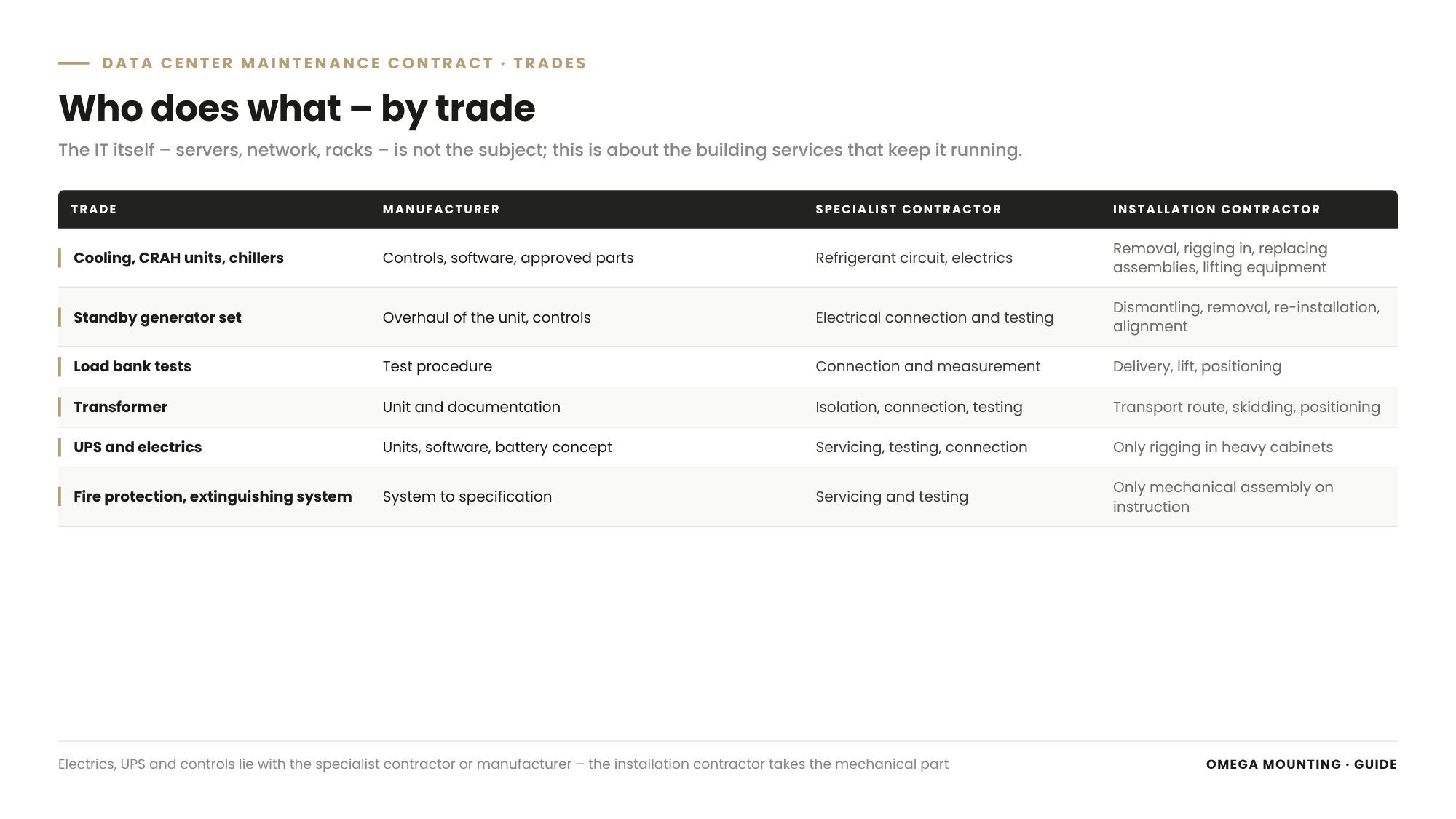
This means the equipment that keeps the IT running. It includes CRAH units (which cool the data hall), chillers and dry coolers. Then there are standby generator sets – emergency power units made up of a diesel engine and a generator –, transformers, UPS systems (uninterruptible power supply) and extinguishing systems. The IT itself, meaning servers, network and racks, is not the subject of this guide.
How it differs from a general maintenance contract
The basic questions of every maintenance contract are answered in our basic article on the maintenance contract in industrial maintenance: contract model, scope of services, response times, spare parts and the operator's responsibility. Which contents a contract needs for each plant is shown in the guide to the maintenance contract for machinery. This one is about what the data center demands on top. Anyone searching for data center maintenance or a data center maintenance contract almost always ends up with the same four topics: windows, approval, access and interfaces.
What this guide does not do
How such a contract is to be classified legally is something to clarify with your legal department or your lawyer – this guide is not legal advice. It describes what an operator should set out: subject, scope, interfaces and records. You will deliberately not find wording for the contract text here.
Data center maintenance contract: what is different from the factory
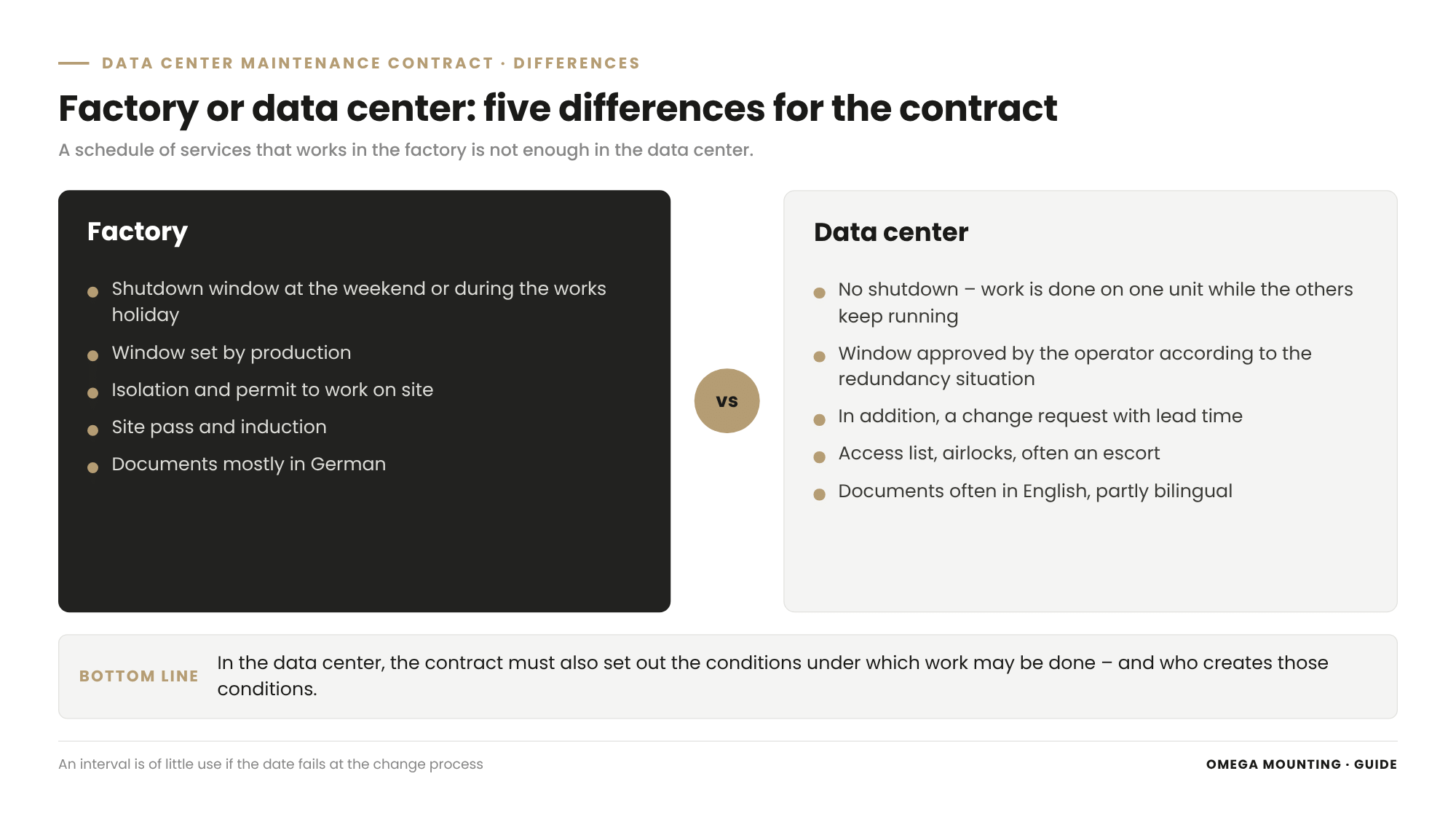
A maintenance contract for a data center differs from a contract for a factory in five points: operation never stops, redundancy replaces the shutdown, every job goes through a change process, access is controlled, and the documents are often in English.
| Point | Factory | Data center |
|---|---|---|
| Operation. | Shutdown window at the weekend or during the works holiday. | No shutdown; work is done on one unit while the others keep running. |
| Window | Set by production. | Approved by the operator according to the redundancy situation. |
| Sign-off. | Isolation and permit to work on site. | In addition, a change request with lead time. |
| Access. | Site pass and induction. | Access list, airlocks, often an escort. |
| Documents. | Mostly in German. | Often in English, partly bilingual. |
For the contract this means: a schedule of services that works in the factory is not enough in the data center. It describes what is done. In the data center it must also state under which conditions it may be done and who creates those conditions. An interval is of little use if the date fails at the change process.
The second difference lies in the risk. In the factory, a failed job costs production time. In the data center, it can put at risk the availability of the systems running in these halls. That is why the operator checks every job in advance – and why the contract has to plan for this check instead of treating it as a disruption.
What the contract adds
The five differences lead to contents that rarely appear in a contract for the factory:
- An asset list that assigns each unit to its redundancy group.
- A rule for maintenance windows: who approves them, at which times, with which fallback.
- The lead time for change request, access list and method statement.
- A table of trades with responsibilities of manufacturer, specialist contractor and installation contractor.
- The freeze dates of the year and the route for breakdowns.
- Language, format and filing of the documents.
Typical gaps
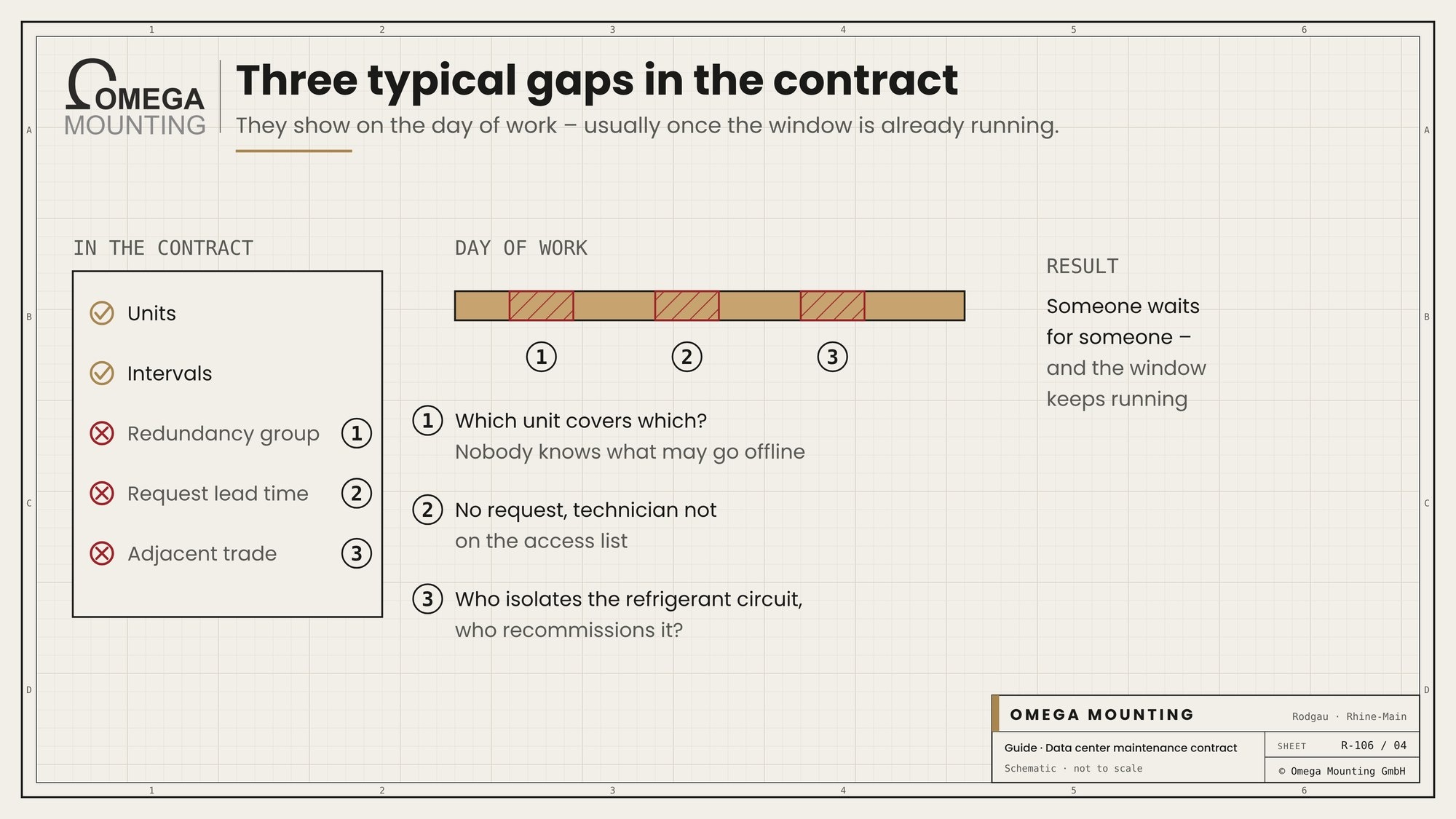
Existing contracts most often lack three things. First, the redundancy group: the contract names units, but not which of them cover for each other. Second, the lead time: intervals are in it, the time for request and registration is not. Third, the interface to the adjacent trade: who isolates the refrigerant circuit, who switches off, who recommissions? Each of these gaps shows on the day of work – usually once the window is already running.
Maintenance windows and redundancy: unit by unit
In the data center maintenance is done unit by unit: a unit only goes offline when the others safely take over its load – that is the core of every maintenance window.
Redundancy means that more units are installed than operation needs. The industry speaks of N+1 when there is one unit more than necessary, and of 2N when everything is there twice. This reserve is what makes maintenance during live operation possible in the first place. But it shrinks as soon as a unit is under maintenance. If a second unit fails at that moment, things get tight. Redundancy and maintenance therefore belong together in the contract.
What the contract should set out on the maintenance window
For a maintenance window in the data center, the contract should record five things:
- Which units belong to a redundancy group and how many of them may go offline at the same time.
- Who confirms the redundancy situation before the work – usually the operator.
- At which times windows are possible, for example at night, at the weekend or outside load peaks.
- How long a unit may be offline and what happens if the window is not long enough.
- Which fallback is ready if an unexpected finding turns up during the work.
Many underestimate the last point. An inspection reveals damage that is bigger than expected. Then a rule is needed: temporarily return the unit to service, extend the window or set a second date? How a cooling unit is replaced during live operation is described in our guide to CRAH unit replacement. How replaceability is already considered at the planning stage is shown in the guide to chiller replacement in data centers.
Maintenance windows in the annual plan
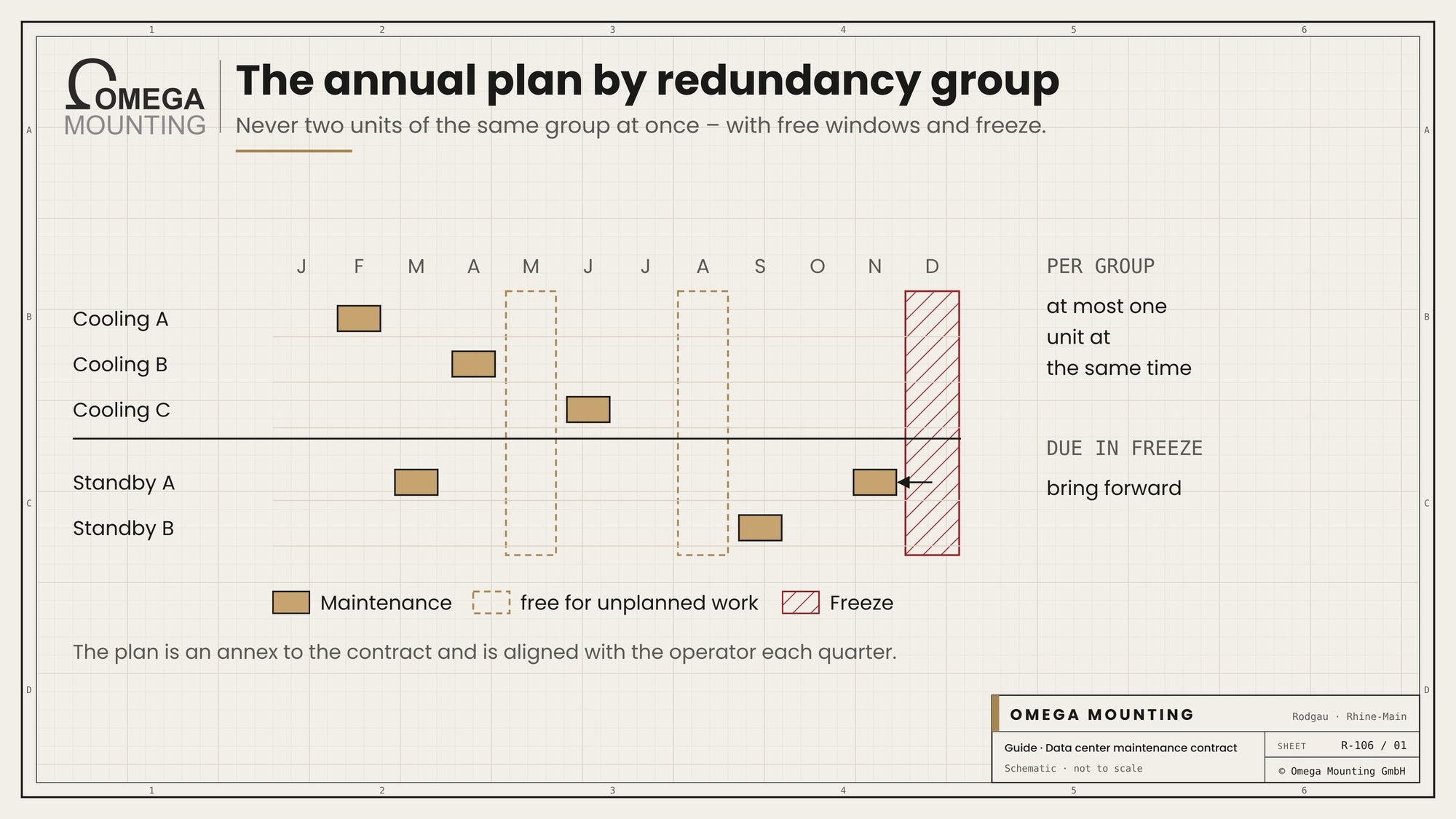
Maintenance windows in the data center can rarely be found at short notice. So set at the start of the year which unit is due in which month. Spread the jobs so that two units of the same redundancy group are never due at the same time. Plan free windows for unplanned work. Such an annual plan belongs in the contract as an annex and is aligned with the operator each quarter.
Change freeze in the contract
Many data centers freeze planned changes at the end of the year. During this change freeze planned maintenance is suspended too; only breakdown repair with an exception approval is allowed. For the contract this means: the freeze dates are written in, maintenance due during the freeze is brought forward, and the route for emergencies is described. How to prepare plants for this phase is shown in our guide to change freeze in maintenance.
Change process: how a maintenance date becomes an approval
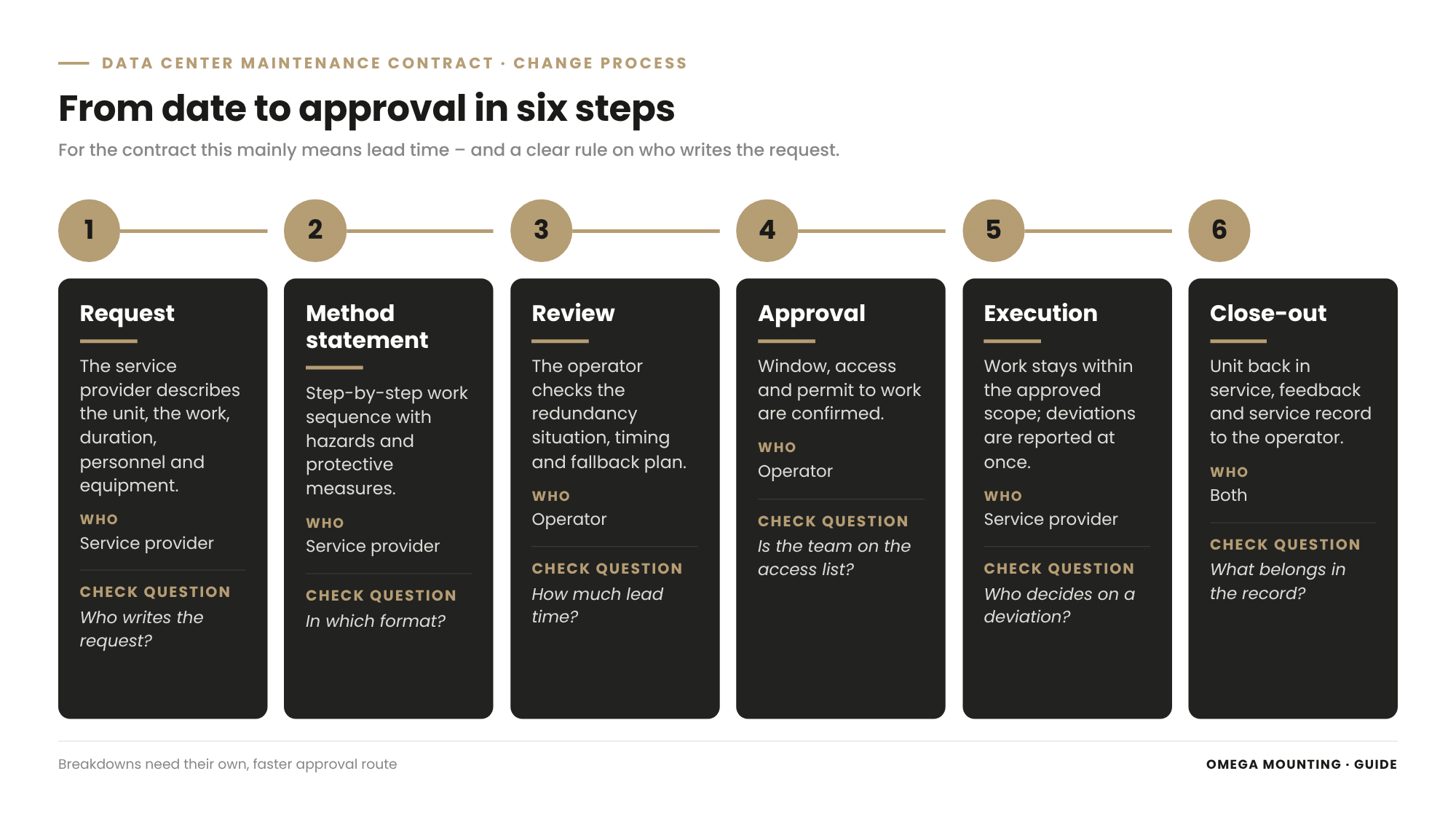
A maintenance date in the data center only becomes an approval through the change process: the service provider describes the work, the operator checks risk and redundancy and approves a window.
The term comes from IT change management. Every change to a live system is submitted as a change request, checked and approved. Data centers also apply this to building services – that is, to every maintenance job that takes a unit offline. The process usually has six steps:
- Request. The service provider describes the unit, the work, duration, personnel and equipment.
- Method statement. The step-by-step work sequence with hazards and protective measures is attached.
- Review. The operator checks the redundancy situation, timing and fallback plan.
- Sign-off. Window, access and permit to work are confirmed.
- Execution. Work stays within the approved scope; deviations are reported at once.
- Close-out. The unit goes back into service, and the operator receives feedback and the service record.
For the contract, the change process in maintenance means one thing above all: lead time. If a request has to be submitted a few days in advance, the service provider needs the dates early. So agree an annual plan of maintenance windows and a clear rule on who writes the request. Also clarify how waiting times at the approval are handled. Otherwise they turn up again later as a variation.
When the finding is bigger than the request
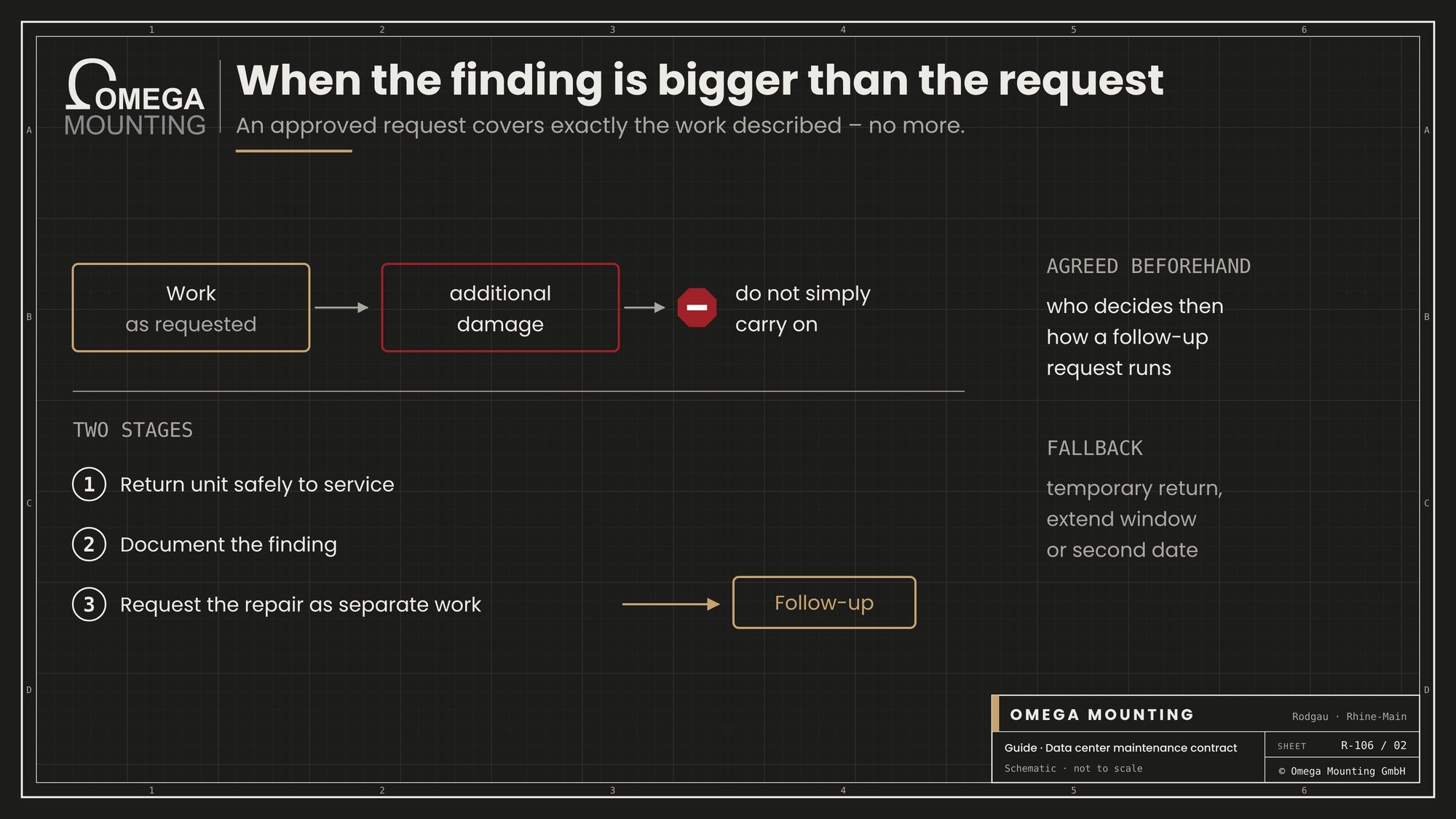
An approved request covers exactly the work described. If additional damage shows up along the way, work must not simply carry on. The contract should therefore say who decides then and how a follow-up request runs. A two-stage procedure has proven itself: return the unit safely to service, document the finding, request the repair as separate work.
Access, instruction, permit to work: what comes before the first visit
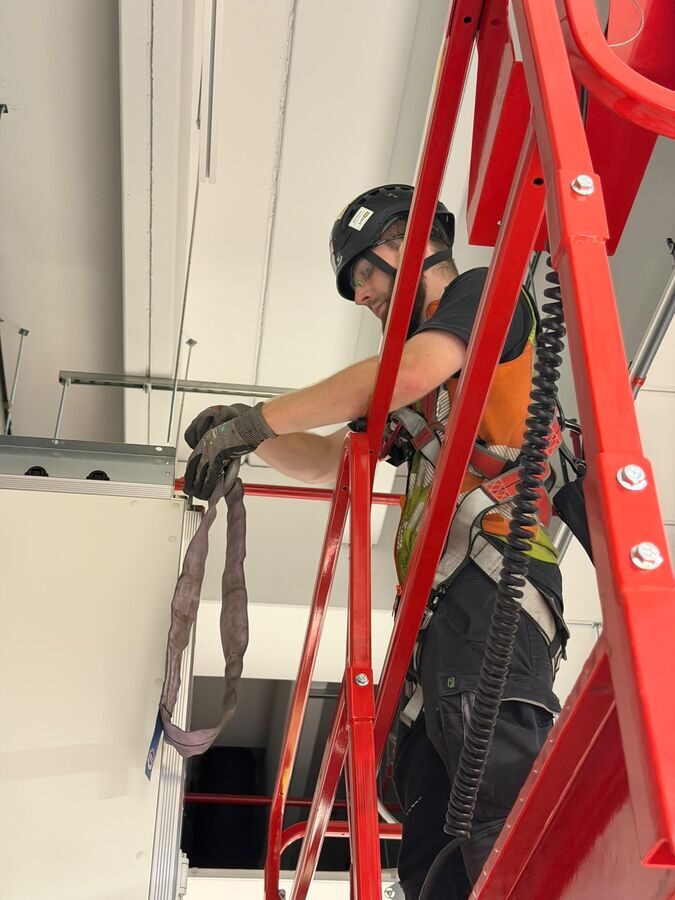
Before the first visit, the access list, instruction, permit to work and the documents on the work sequence must be settled – in the data center they belong in the contract as annexes.
Access and escort
Technicians are on the access list in advance with their names and ID details. The route to the plant leads through airlocks and locked doors, in some areas only with an escort from the operator. For the maintenance contract this means: name a fixed team with deputies. Every change in the team means a new registration. Also set out who provides the escort and how a technician gets onto the list quickly in the event of a breakdown.
Instruction and permit
The operator's safety induction does not replace instruction by the technician's own employer – both must be documented. The basis is the German Occupational Safety and Health Act with risk assessment and instruction. Hoists and lifting accessories must be inspected under the German Ordinance on Industrial Safety and Health, with the record available before the job. Every job has a permit to work, and work with sparks or flames needs a hot work permit. How to manage contractors on site as a whole is described in our guide to contractor management.
RAMS and method statement as a contract annex
In the data center the RAMS is widespread – risk assessment and method statement in one document. For recurring maintenance, a base document per plant type is worthwhile, which is only adapted before each job. Lift plans for heavy assemblies are part of it. What a sound RAMS for the data center contains is explained in our guide to RAMS and risk assessment. The contract states who prepares it, who approves it and in which language it is provided.
Keeping records up to date
Records have an expiry date. Inspections of hoists and lifting accessories fall due regularly, so does instruction, and teams change. So set out in the contract who maintains the documents and how the operator learns of changes. A shared folder in which the service provider keeps its records up to date has proven itself. That way nobody stands at the airlock on the day of work with an expired inspection record.
Which trades belong in a data center maintenance contract?
A maintenance contract for a data center covers cooling, standby generator set, load bank tests, transformers, UPS and electrics as well as fire protection as an interface – each with a clear responsibility, because no single partner covers everything properly.
| Trade | Manufacturer | Specialist contractor | Installation contractor |
|---|---|---|---|
| Cooling, CRAH units, chillers. | Controls, software, approved parts. | Refrigerant circuit with refrigeration expertise, electrics. | Removal, rigging in, replacing assemblies, bearings, fans, lifting equipment. |
| Standby generator set. | Overhaul of the unit to specification, controls. | Electrical connection and testing. | Dismantling, removal, re-installation, alignment, mechanical repair. |
| Load bank tests. | Test procedure of the plant. | Connection and measurement. | Delivery, lifting and positioning of the load banks. |
| Transformer. | Unit and documentation. | Isolation, connection, testing. | Transport route, skidding, positioning, removal of the old unit. |
| UPS and electrics. | Units, software, battery concept. | Servicing, testing, connection. | Only rigging in heavy cabinets. |
| Fire protection, extinguishing system. | System to specification. | Servicing and testing by the specialist company. | Interface only: mechanical assembly on instruction. |
A load bank is an artificial load used to test a standby generator set under load without loading the IT. The test is run by the manufacturer or specialist contractor. Lifting and positioning the load banks is installation work. How a transformer is replaced in an existing building is described in our guide on replacing a transformer.
Manufacturer, specialist contractor or installation contractor?
Whether cooling and standby power lie with the manufacturer or an independent maintenance contractor is not a question of principle but a question for each trade. How to weigh this up is shown in our guide Manufacturer's service or independent maintenance contractor. Whether the manufacturer's conditions require a particular maintenance is stated in your documents; ask in writing before switching. In the data center the mixed model is the rule: controls and software with the manufacturer, electrics and refrigerant circuit with the specialist contractor, mechanics and lifting equipment with the installation contractor.
Drawing the interfaces in writing
For each trade the contract should answer four questions. Who switches off and secures against switching back on? Who confirms the redundancy situation? Who does the test run? Who signs the report? For CRAH maintenance, for example, this means: the specialist contractor isolates the refrigerant circuit, we remove and refit the assembly, and the specialist contractor recommissions the circuit. If one of these answers is missing, someone waits for someone on the day of work.
Standby generator set: the heaviest item in the contract
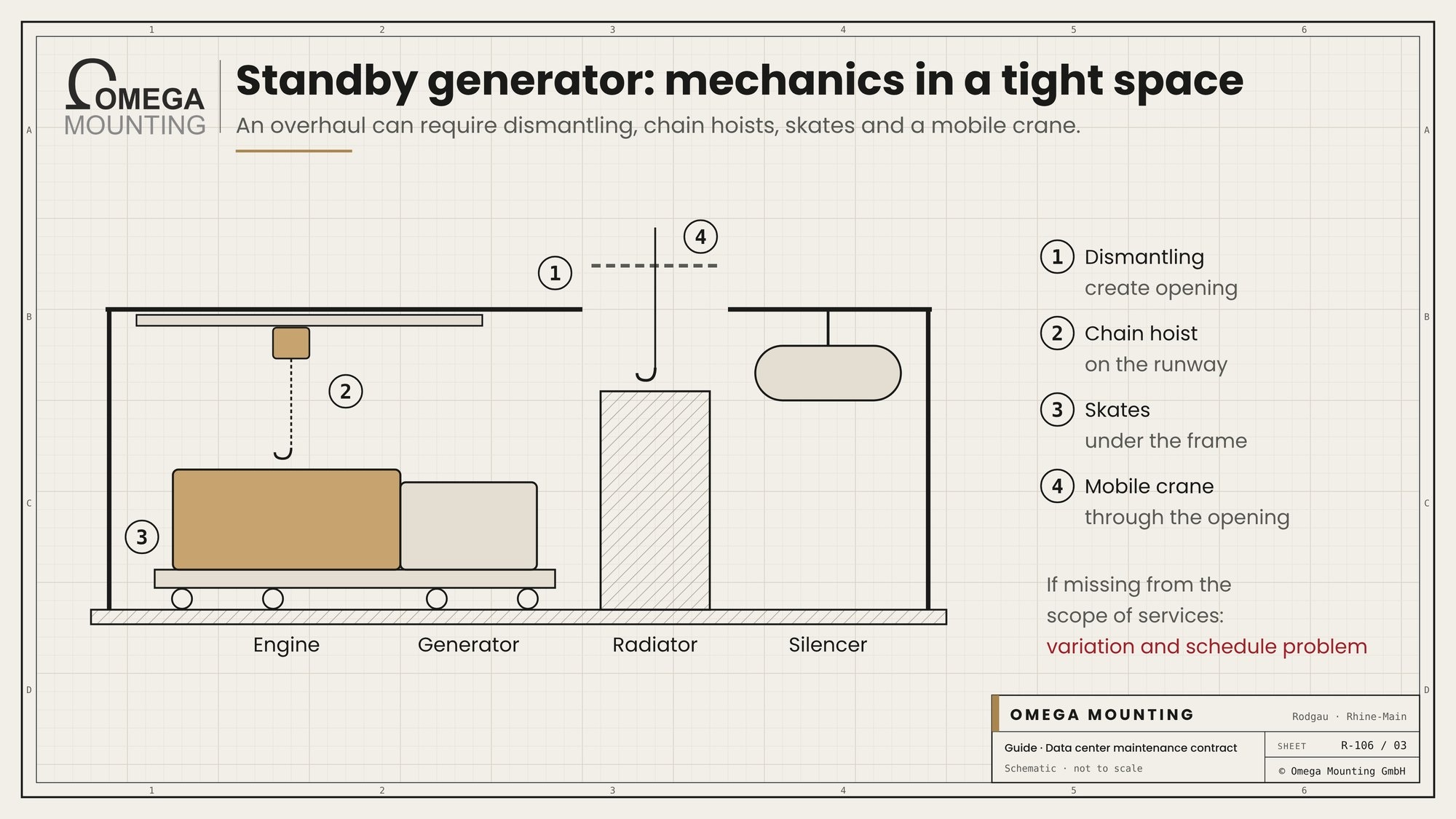
The standby generator set deserves special care in the contract. It rarely runs, but has to carry the load immediately in an emergency. Test runs, load bank tests and overhauls follow the manufacturer's specifications and the operator's inspection duties. For the mechanics something else counts: generator, radiator and silencer often sit tightly in plant rooms or containers. An overhaul can therefore require dismantling, chain hoists, skates and a mobile crane. If this is not in the scope of services, plannable maintenance turns into a variation with a schedule problem.
Response and escalation: briefly set out, well referenced
In the data center, response and escalation are usually set out in a service level agreement alongside the maintenance contract – with times for feedback, arrival and restoration. What belongs in it is described in our guide to SLA in maintenance.
Two points are special in the data center. First, every response depends on access: a technician who is not on the list does not get through the airlock. Second, breakdowns need their own approval route that is faster than the normal change request. Both belong in the contract – together with the escalation chain on both sides.
Documentation: service record, photos and the link to commissioning
Documentation in the data center includes, for each job, a service record, photos before and after the work, the findings list and the link to the plant's commissioning.
- Service record. Date, unit, reference to the change request, activities, parts fitted and findings.
- Photos. Condition before the work, every interface released, condition afterwards.
- Findings list Open items with assessment and proposal, including for temporary repairs.
- Inspection records. Hoists and lifting accessories used on the job.
- Transfer. Who returned the unit to service and when.
The link to commissioning matters more in the data center than elsewhere. New plants go through commissioning, a staged start-up with documented tests. If a unit is replaced later, the manufacturer or specialist contractor repeats parts of these tests – and the installation documents have to match. What this looks like during installation is described in our guide to commissioning in the data center. What an audit wants to see in maintenance records is set out in our guide to maintenance documentation for audits.
Documentation in English
In many data centers the language of the documents is English, because designers, operators and service providers are international teams. We can prepare RAMS, lift plans and reports in English. What is delivered in each case is set out in the contract – language, format and filing.

Data center maintenance contract in the Rhine-Main region: how it works with us
In the Rhine-Main region we take on the mechanical part in maintenance contracts for data centers: replacing and rigging in cooling and power engineering, lifting equipment, rigging and mechanical repair after approval.
Frankfurt, Offenbach, Raunheim and Hanau are close to Rodgau. That matters for site visits, for short-notice maintenance windows and in the event of a breakdown. With us, the starting point is a conversation with a site visit: which units belong to which redundancy group, which trades lie where, which documents does the operator require? From this comes a proposal for the scope of services, interfaces and documentation.
We say beforehand what we do not take on. Electrics, UPS and controls lie with the electrical contractor or the manufacturer, the refrigerant circuit with the refrigeration contractor, extinguishing systems with the fire protection company. We coordinate dates, isolation and documentation with these partners. The scope of our Maintenance and servicing for industrial plants is set out on our service page. For data center maintenance in Frankfurt and the region this means: one partner for the mechanics who knows the rules of live operation.
Project examples
Four jobs from our project diary show what work on data center and standby power equipment looks like. None of them was a maintenance contract. They are ways of working that a contract should pick up: the replacement with a permit to work, the overhaul with lifting equipment, the lift to an approved lift plan and the temporary repair with a planned permanent solution.
CRAH unit in Frankfurt: replacement with permits to work
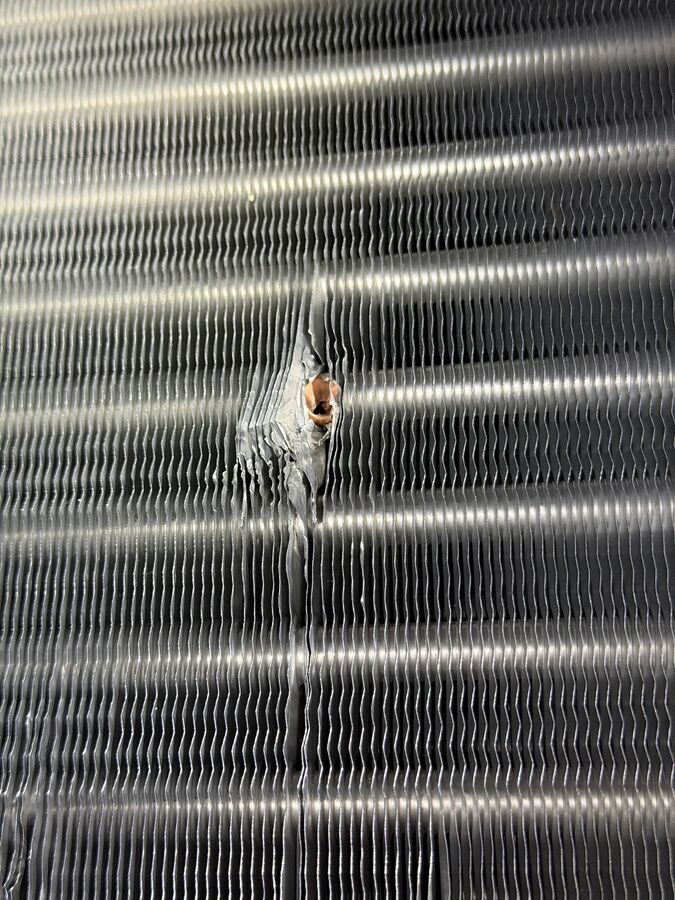
During the replacement of a CRAH unit in a data center in Frankfurt the fin pack of the heat exchanger was found torn open down to the copper pipe. It could not be repaired economically on site. A supervisor and three riggers brought the new unit up to the second floor in two working days. In the narrow gallery there was no room for a forklift or overhead crane, so two compact lifting devices worked in sync. Access led through airlocks and locked doors, and every step ran with an agreed permit to work. RAMS and lift plans were in place beforehand, hoists and lifting accessories were inspected and documented.
For your contract this means: approvals, access and inspected lifting equipment are part of the service, not its prelude.
Standby generator set in the Rhine-Main region: overhaul with lifting equipment
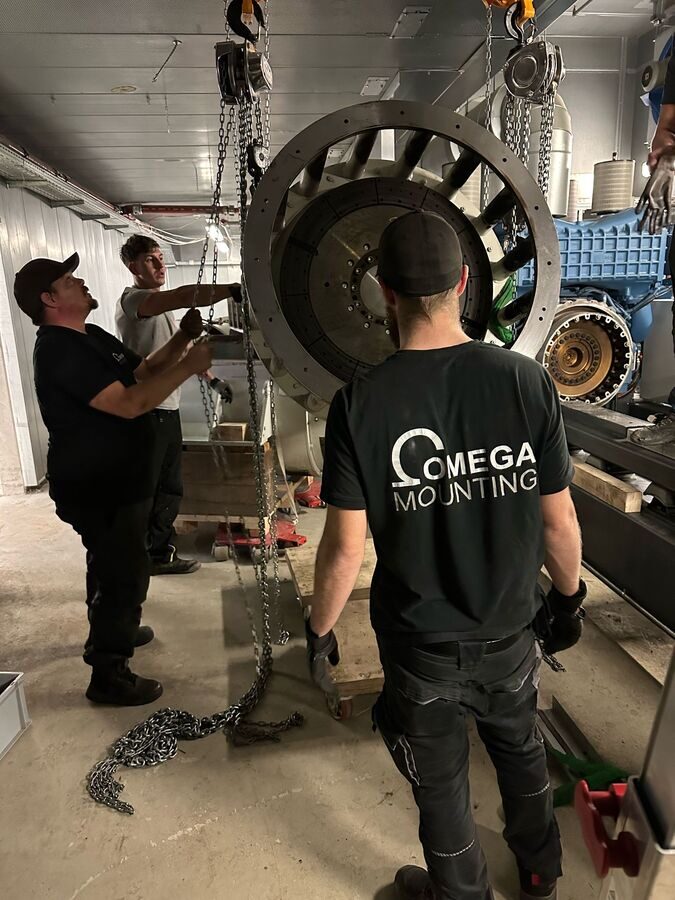
With the maintenance of the generator of a standby power system in a larger building complex in the Rhine-Main region, the generator had to be separated from the drive engine and removed. The only way out was the installation shaft. The lift plans were in place before the first hand was laid on anything. The enclosure was dismantled, chain hoists lifted the generator, skates brought the parts to the shaft. A mobile crane lifted them out vertically. The lifting contact gave every movement by command, because the crane operator could not see the load. After the overhaul everything went back the same way: position, connect to the engine, align, fix.
For your contract this means: dismantling, lifting equipment and re-installation belong in the scope of services for standby generator maintenance in the data center – otherwise they become a variation.
Load banks and generators in Frankfurt: lift to an approved lift plan
At a data center in Frankfurt we lifted in generators and load banks. The container modules arrived on five scheduled heavy transports and were set into a multi-storey steel structure with a 220-tonne class mobile crane. Nine people worked a long shift. Every lift plan was stored digitally and approved before the first lift; proof of the periodic crane inspection was required.
For your contract this means: for load bank tests and unit replacement, the approved lift plan is a contract document.
Standby generator set in Offenbach: temporary repair before commissioning
In a data center in Offenbach, the radiator of a standby generator set was leaking – shortly before commissioning. Between the radiator, louvre and silencer there was only a narrow gap; removal would have taken weeks. Together with a specialist air-conditioning contractor, the leak was brazed on site under a hot work permit. Approval only came after a pressure test. The generator was ready for operation the same day. The repair was deliberately a temporary one; the permanent solution with a crane is planned for later.
For your contract this means: temporary repairs need a rule – who approves them, how long they stay and when the permanent solution comes.
Does your data center need a partner for the mechanics?
Then get in touch with us. Send us your asset list with redundancy groups and the existing contracts. During a site visit we clarify which trades lie where and where the mechanical part is missing.

What this means for your role
For buyers: Do not award data center maintenance as a flat fee, but trade by trade with clear responsibilities. Ask every bidder how they handle change requests, access lists and documents in English. Set out how waiting times at the airlock and at approval are handled.
For designers: Every plant you design will later be maintained during live operation. Design redundancy so that one unit can go offline. Also plan removal routes, lifting points and space for lifting equipment – they later decide the effort involved.
For project managers and site managers: As a project manager, you hand over with commissioning the documents on which the maintenance contract is based. As a site manager, you make sure during conversions that new units are added to the redundancy groups and asset list.
For maintenance managers: You keep the asset list with redundancy groups up to date and plan the maintenance windows for the year. Decide who writes change requests, who approves temporary repairs and who keeps the file.
For facility managers and operators: You set the conditions under which maintenance is done – window, approval route, access, language. Write these conditions into the contract instead of explaining them again at every date. Name a contact person who gives approvals and can be reached in the event of a breakdown.
For occupational safety specialists and HSE coordinators: Check whether the base document per plant type reflects the particulars of maintenance: work next to running units, hot work, lifting equipment in the plant room. Align the service provider's induction and instruction so that no technician hears two sets of rules.
Interface sheet for DC maintenance: template on request
The interface sheet for DC maintenance is a one-page working document. At the top is a table with the trades cooling, standby generator set, load bank tests, transformer, UPS and electrics, and fire protection – each with empty fields for manufacturer, specialist contractor, installation contractor and operator. Below follow fields for access, maintenance windows and documentation. It deliberately contains no contract wording, amounts or deadlines. Request the sheet via our contact form – keyword “Interface sheet DC maintenance”.
Why Omega Mounting?
We are based in Rodgau near Frankfurt, can be reached by phone (Mon–Fri 9 am–3 pm) and via WhatsApp, and have our own workshop for transport frames and brackets. The linked jobs show how we work: replacing a cooling unit with permits to work in Frankfurt, overhauling a standby generator set with lifting equipment, a lift to an approved lift plan, a temporary repair with a pressure test in Offenbach. For you this means: a single point of contact for the mechanics in the data center – coordinated with manufacturer and specialist contractor and with short distances in the Rhine-Main region.
Conclusion
A data center maintenance contract sets out not only what is maintained, but how the work becomes possible at all. Redundancy groups, maintenance windows, change process, access and documents belong in it, as does a table showing which trade lies with the manufacturer, specialist contractor or installation contractor. Anyone who clarifies this before the first date can maintain during live operation without surprises. If you want to put your contract in order, send us your asset list, redundancy concept and existing contracts – we will get back to you with an honest assessment of the mechanical part.
Planning a move-in, installation or maintenance in the Rhine-Main region?
Tell us briefly what you need – we'll come back with an honest assessment.
Free, no-obligation callback
You may also be interested in these guides
Maintenance & Servicing
Maintenance & Servicing

About the author
Tobias Schott
Managing director of Omega Mounting GmbH, Rodgau · more than 20 years of hands-on experience in installation and maintenance
A trained mechatronics technician, working in maintenance, servicing and industrial installation since 2004 – first alongside his father, and with Omega Mounting since 2012: from overhead conveyors in Frankfurt to the crane system in a new-build hall. He plans and leads lifting operations as an appointed person (AP) in data centers and on industrial sites in the Rhine-Main region, trains and examines operators of cranes, mobile elevating work platforms and telehandlers, and is a qualified occupational safety specialist. On jobs abroad he is known as the “German Troubleshooter” – the person you call when a site gets stuck. He learned what quality means from his father, not from a manual: Made in Germany as a standard for his own work, not a label. That is why quality comes first at Omega Mounting – ahead of speed and price. He writes these guides from that practice: what works on our sites is in them – what exists only on paper is not.
Frequently asked questions
Besides the usual contents – asset list, scope of services, intervals, parts, documentation – a maintenance contract for a data center needs five additions. These include redundancy groups and maintenance windows, the change process with lead time and access with instruction and permit. On top of that come a responsibility for each trade and rules for freeze periods and temporary repairs.
Unit by unit. A unit only goes offline when the others carry its load and the operator has confirmed the redundancy situation. Every job runs via a change request with method statement and fallback plan. If a bigger finding turns up, the unit goes safely back into service and the repair is requested as separate work.
Usually both, depending on the part of the plant. Controls, software and overhaul to specification often lie with the manufacturer, refrigerant circuit and electrics with the specialist contractor. Removal, rigging in, replacing assemblies and lifting equipment are taken on by an installation contractor. For CRAH maintenance and the standby generator set the rule is therefore: the contract has to name the interfaces.
As a rule, a risk assessment with work instructions, in the data center often as a RAMS. Then there are lift plans for heavy assemblies, inspection records for hoists and lifting accessories and proof of qualifications. On top of that come the team's access details, proof of instruction and attendance at the operator's safety induction.
Yes, we can do that. RAMS, lift plans and reports can be prepared in English, because many data centers work internationally. What is delivered in each case – language, format, filing – is set out in the contract. What matters is that every team member understands the contents, even if the document is in English.
Planned maintenance is suspended during the freeze; only breakdowns are repaired with an exception approval. Maintenance due during the freeze is therefore brought forward. The contract should name the freeze dates, describe the exception route and provide a window for catching up afterwards.
In principle yes, just smaller. A server room also has cooling, UPS and often a standby generator set that should not fail. Redundancy, approval before the work and a clear responsibility for each trade make just as much sense there – the change process is usually leaner.
For the mechanical part, installation and maintenance contractors from the region. From Rodgau we work at data centers in Frankfurt, Offenbach, Raunheim and Hanau: replacing cooling units, overhauls with lifting equipment, rigging in power engineering. Electrics, controls and refrigerant circuit stay with the responsible partners; we coordinate with them.
Via a short enquiry with three details: your asset list with redundancy groups, the existing maintenance contracts and the rules of your change process. We arrange a site visit, sort the trades and send a written assessment of the mechanical part. Your contact is Tobias Schott – reachable via our contact form.
 English
 German