
- Guide – Maintenance & Servicing
Change Freeze: when nothing on the plant may be touched any more
By Tobias Schott · Reading time approx. 24 minutes · Last updated: October 2026
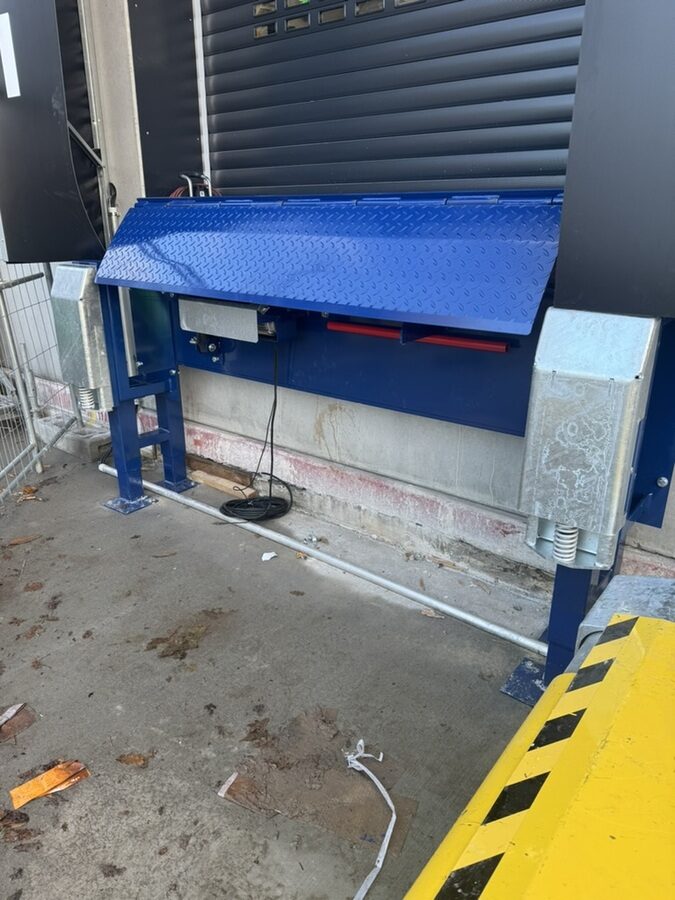
A Change Freeze prohibits any planned change to productive plant during the highest-revenue period of the year. For maintenance, this does not mean “do nothing” but “do everything beforehand”: bring forward inspections and repairs, replace wearing parts, stock spare parts, build fallback plans and define the exception route before the freeze begins.
You know the announcement from October: “From mid-November, nothing on the plant will be changed any more.” In logistics centres this is called Peak Season, in data centers Change Freeze or Freeze Period. The meaning is the same: from a cut-off date, conversions, planned repairs and maintenance interventions on productive plant are prohibited. The only thing still allowed is whatever rectifies a fault – and only with an exception approval.
For maintenance managers, logistics managers and facility managers, this is a double burden. Before the freeze, everything that would otherwise be spread across the winter has to be finished. During the freeze, nothing may be touched, even though the plant is running harder than ever. Afterwards, the rework from December is waiting.
This guide explains what the freeze is, why operators impose it and what it means for loading bays, sorters, conveyor technology, cooling and standby power. It describes the four phases – lead-up, freeze, Emergency Change, thaw – and the core principle: everything that could fail during the freeze is done beforehand. It belongs to our fundamentals article on Maintenance during live operations and complements the guides on maintenance at Frankfurt Airport and installation in data centers. Written from the perspective of an installation contractor from Rodgau near Frankfurt.
Key points at a glance
- A Change Freeze is a defined period in which no planned changes, repairs or conversions take place on productive plant – only fault rectification with exception approval.
- Data centers usually freeze from mid-November to early January; logistics knows the same principle as Peak Season from Black Friday to Christmas.
- Operators impose the freeze because in these weeks revenue and availability coincide and every change is a risk nobody wants to carry.
- Maintenance counts backwards from the start of the freeze: bring forward inspections and repairs, replace wearing parts, stock spare parts, build fallback plans, walk the plant.
- A breakdown during the freeze is handled as an Emergency Change: secure, report, narrow down, obtain approval, emergency repair instead of permanent solution, document, put on the rework list.
- After the freeze comes the thaw: replace temporary fixes with permanent solutions, catch up on postponed inspections, carry findings from the season into the maintenance plan.
What is a Change Freeze?
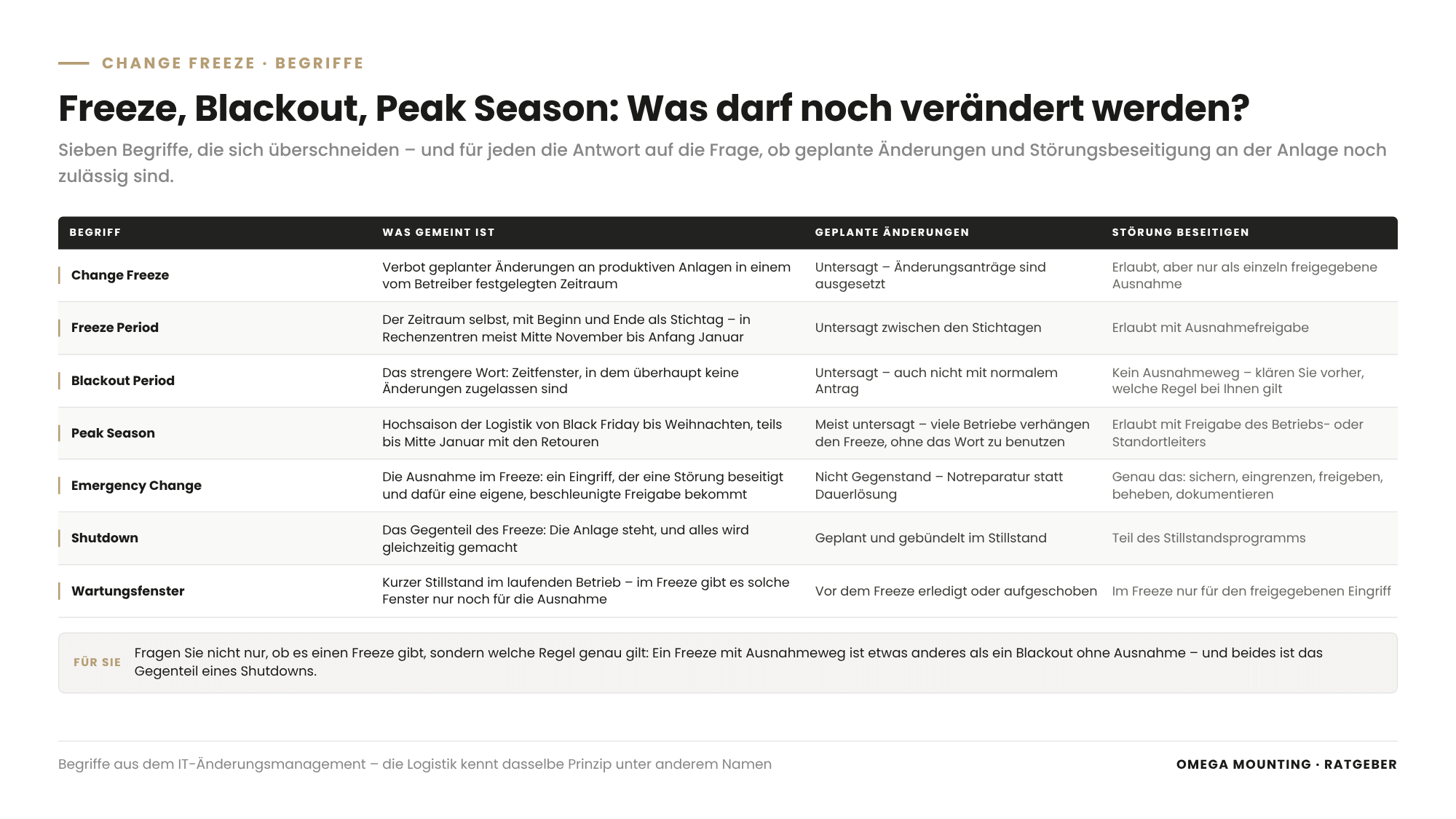
A Change Freeze is a period defined by the operator in which no planned changes are carried out on productive plant and systems. The term comes from IT change management, where every change to a running system is requested, reviewed and approved as a “change”. During the freeze, these requests are suspended; only the rectification of a fault remains permissible as an individually approved exception.
Data centers have transferred this practice to building services: cooling, power supply, standby power systems, fire suppression systems and access control count as frozen during the freeze. Logistics centres know the same principle under a different name: Peak, Peak Season or Christmas trade. Anyone searching for “Peak Season maintenance”, “Black Friday logistics maintenance” or “maintenance during the Christmas trade” is asking the same question: how do sorters, conveyor technology, loading bays and doors get through the season without anyone making changes to them?
Freeze Period, Blackout Period, Peak Season – the terms
The terms overlap but do not mean quite the same thing:
- Change Freeze is the prohibition of planned changes within a defined period, with an exception route for faults.
- Freeze Period is the period itself – in data centers usually mid-November to early January, with a start and end cut-off date.
- Blackout Period is the stricter term from IT change management: time windows in which no changes whatsoever are permitted, not even with a normal request.
- Peak Season or Peak is the logistics term for the high season from Black Friday and Cyber Week to Christmas, sometimes until mid-January with the returns.
- Emergency Change is the exception: an intervention that rectifies a fault and receives its own, accelerated approval for it.
For you this means: do not just ask whether there is a freeze, but exactly which rule applies. A freeze with an exception route is something different from a blackout without exception.
Distinction: freeze, shutdown, maintenance window
The freeze is the opposite of a shutdown. In a shutdown, the plant stands still and everything is done at the same time – as we describe in the guide on shutdown planning . In a freeze, the plant runs and nothing is done. The maintenance window lies in between: a short standstill during live operation. During the freeze, such windows exist only for the exception. Whatever would otherwise run in the weekend window is done beforehand or postponed.
Why do operators impose a Change Freeze?
Operators impose a Change Freeze because three things coincide in these weeks: the revenue peak of the year, the highest demand on availability and the lowest tolerance for risks arising from changes. Every change to a running plant can trigger a fault – an incorrectly set limit switch, a drive with a different speed, a new controller version. In February that is annoying; in December it costs the ability to deliver.
For large mail-order retailers and parcel services in the Christmas trade, every hour a sorter stands still is an hour in which parcels are not delivered. For data centers at year-end, the same applies to cooling and power: their customers have their own Christmas trade, and their systems run on these floors. A freeze therefore protects the supply chain behind the plant.
There is also an organisational reason. During the season, staffing is different: more temporary workers in the hall, fewer maintenance staff, manufacturers and external companies partly on company holidays. A change that goes wrong meets an organisation that cannot absorb it. The freeze is the honest answer to that.
Which plant does the Change Freeze affect – and what does “touch nothing” mean?
The Change Freeze affects all plant whose failure directly limits the site's performance during the season. In logistics, that is loading bays, sorters, conveyor technology and doors. In the data center, it is cooling, power supply, standby power system and fire suppression system. “Touch nothing” does not mean that maintenance leaves the hall. It means that it observes, lubricates, cleans and reports – but does not change anything.
| Plant | What rests during the freeze | What continues | Fallback plan |
|---|---|---|---|
| Loading bays, ramps, doors | Conversion, ramp replacement, retrofitting of controls. | Visual check, cleaning, lubrication, fault rectification. | Spare ramp, diversion to neighbouring door. |
| Sorters, sorting systems | Extension, control change, replacement of assemblies without a fault. | Inspection while running, cleaning of scanners, replacement in case of fault. | Second sorter line, manual sorting. |
| Conveyor technology, roller conveyors, overhead conveyors | Retrofit, switch overhaul, rail offset. | Lubrication, roller and sensor checks, replacement in case of failure. | Bypass section, forklift traffic. |
| Cooling, CRAH units, dry coolers | Unit replacement, modification of the control system, cleaning with shutdown. | Filters, visual check, measured values, use of redundancy. | Redundant unit (N+1). |
| Standby power, standby power system, UPS | Overhaul, conversion, load bank test with mains disconnection. | Scheduled no-load test run, fill levels, batteries. | Second line, mobile generator. |
| Racking, high-bay warehouses, storage technology | Conversion, extension, racking repair without safety relevance. | Racking check, securing collision damage, fault rectification. | Relocating stock, closing off individual bays. |
Two things stand out. Safety-relevant action remains unaffected by the freeze: racking with load-bearing damage is closed off, a ramp with a defective safety device is taken out of service. And the fallback plan is the key: the better it is, the less often the exception is needed. Which plant deserves the most thorough preparation is shown by the method in our guide on risk-based maintenance.
Do not freeze everything
A common mistake is to apply the freeze to the entire site. It then also blocks plant that is not critical during the season – workshop, storage areas for slow movers, outdoor facilities. Apply the freeze to the plant that carries the season. Everything else stays open and relieves January.
The four phases: lead-up, freeze, Emergency Change, thaw
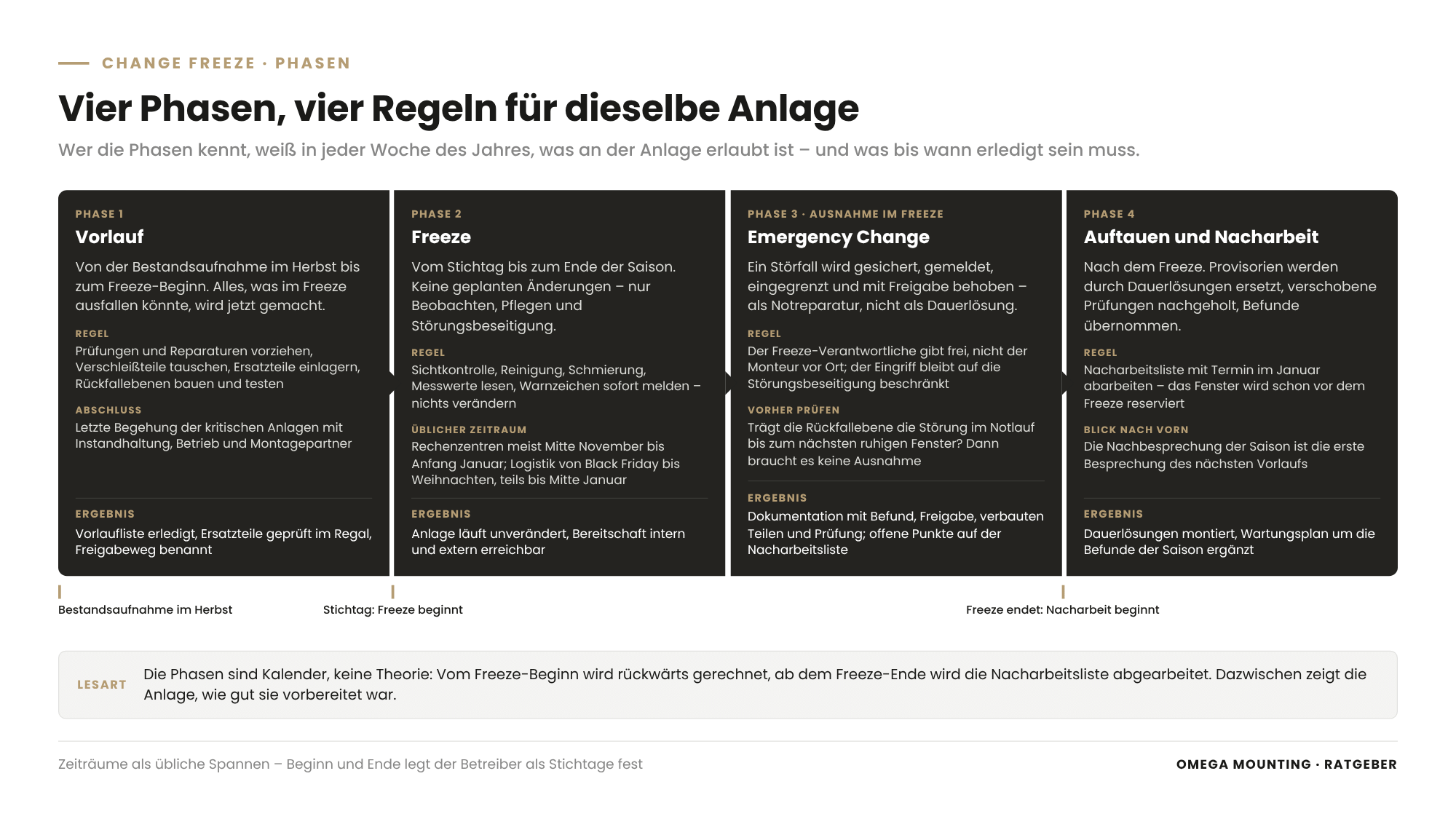
A freeze has four phases in which different rules apply to the same plant. Anyone who knows them knows in every week of the year what is allowed.
- Lead-up: From the condition survey in autumn to the start of the freeze. Everything that could fail during the freeze is done now.
- Freeze: From the cut-off date to the end of the season. No planned changes, only observing, care and fault rectification.
- Emergency Change: The exception within the freeze. A breakdown is secured, reported, narrowed down and rectified with approval – as an emergency repair, not as a permanent solution.
- Thaw and rework: After the freeze. Temporary fixes are replaced with permanent solutions, postponed inspections are caught up on, findings are carried into the maintenance plan.
The phases are a calendar, not theory. From the start of the freeze you count backwards; from the end of the freeze the rework list is worked through. In between, the plant shows how well it was prepared.
How do you prepare the plant for the Change Freeze?
You prepare the plant for the Change Freeze by counting backwards from the start of the freeze and placing every measure that could fail during the freeze before it. Four blocks belong to this: bring forward inspections and repairs, replace wearing parts and stock spare parts, build fallback plans, walk the plant.
Bringing forward inspections and repairs
All periodic inspections whose due date falls within the freeze are brought forward. Doors, ramps, cranes, racking, standby power system: whatever would be due in December is inspected in October. That way, no inspection triggers an intervention during the freeze. Which inspection is due for which plant is shown in our overview of the inspection obligations for plant operators. The same applies to findings: a crack in a ramp frame that has been “under observation” since the summer belongs before the cut-off date.
Replacing wearing parts, stocking spare parts
Wearing parts with a foreseeable end are replaced before the freeze, even if they would still run. A drive belt that would be due in January is renewed in October. A roller with play is replaced before it jams. That is preventive maintenance with a fixed end date – and it spares you the exception in December, where rush parts, night work and downtime come together.
In parallel, the spare parts store for the season is built up: drives, rollers, sensors, chains, gears, hydraulic components, filters – for every critical plant whatever is needed immediately in a fault. During the freeze, nothing is delivered that was not there beforehand; manufacturers and dealers are on company holidays themselves. You identify parts that are no longer available now. The ways to deal with that are described in our guide No more spare parts?.
Building fallback plans: spare ramp, diversion, bypass
Every critical plant gets a fallback plan before the freeze that works without intervention. In logistics this means: spare ramp or a neighbouring door kept free, diversion to the second sorter line, bypass on the conveyor technology, forklift route for the emergency. In the data center it means redundancy – second cooling unit, second power line, reserve generator. It is tested before the freeze, not invented during the breakdown.
Site walk before the freeze
The last site walk before the cut-off date concludes the lead-up. Maintenance, operations and installation partner walk the critical plant together: has every measure been completed? Is every spare part on the shelf, checked? Does every fallback plan work? Who is on call, who approves the exception? Whatever remains open goes deliberately onto the rework list. How to use the longest maintenance window of the year directly after the freeze is shown in our guide on maintenance between Christmas and New Year.
Breakdown during the Change Freeze: how does an Emergency Change run?
A breakdown during the Change Freeze runs as an Emergency Change: the fault is secured, reported and narrowed down. Then the person responsible for the freeze decides on the exception approval, the intervention remains limited to fault rectification, and everything is documented and put on the rework list. The difference from a normal breakdown lies not in the technology but in the approval route and in the limit of what is done.
The approval route
During the freeze, it is not the fitter on site who decides whether to intervene, but a person named in advance – in data centers usually the person responsible for change management, in logistics the operations or site manager. The route to that person is fixed before the freeze: who reports, who assesses, who signs, including at night and at weekends. An exception approval in maintenance is nothing bureaucratic. It is the decision as to whether the intervention is the smaller risk compared with continued operation with the fault.
The German technical rule TRBS 1112 (Maintenance) requires in any case that release, isolation and coordination are regulated before maintenance work. For you this means: the approval route during the freeze is the same release as always, just with one more step. How isolation and lockout against re-energising work is shown in our guide on Lockout tagout in maintenance.
Secure, report, narrow down, degraded operation
The first steps are the same as for every standstill: secure, read the fault message, narrow the fault pattern down to mechanics, drive, sensors, controller or safety circuit. We describe the procedure in the guide Conveyor system stopped: fault-finding. During the freeze, one more question is added: is degraded operation enough? A roller conveyor at half speed, a manually operated ramp, an open door – often the fallback plan carries the fault until the next quiet window. Then no exception is needed.
Emergency repair instead of permanent solution
If approval is given, the intervention remains limited to fault rectification. The worn gear is replaced, the drive unit is not modernised. The defective sensor is replaced, the sensors on the section are not renewed. The emergency repair during the freeze restores operation and keeps the change so small that it creates no new risks. Whatever remains temporary is marked and given a date after the freeze.
Documentation and rework list
Every Emergency Change is documented: fault, findings, approval with name and time, intervention, parts installed, inspection, open points for the rework list. The Industrial Safety Ordinance (BetrSichV) requires that work equipment is inspected before reuse after repairs that could affect safety. During the freeze, that is the evidence that the exception was handled properly. Anyone working alone in the hall during the freeze also needs the rules from our guide on lone working in maintenance.
What happens after the freeze: thaw and rework?
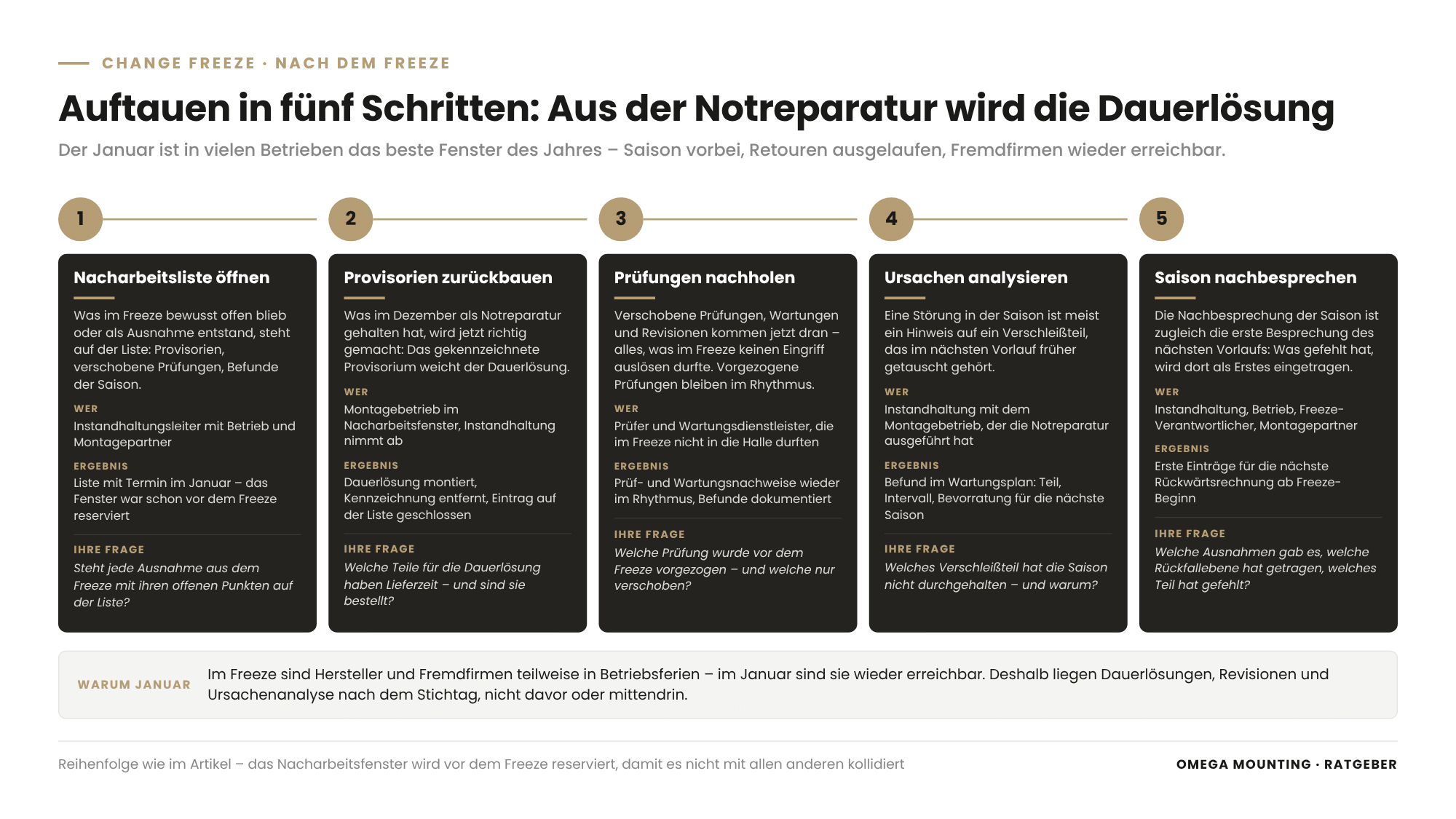
After the freeze, the rework list is worked through: replace temporary fixes with permanent solutions, catch up on postponed inspections and maintenance, carry findings from the season into the maintenance plan. The thaw is a phase of its own with its own date.
In many companies, January is the best window of the year for this. The season is over, the returns are tailing off, manufacturers and external companies can be reached again. Whatever held as an emergency repair in December is now done properly – with root cause analysis. Because a fault during the season is usually an indication of a wearing part that should be replaced earlier in the next lead-up. The review of the season is at the same time the first meeting of the next lead-up: which exceptions were there, which fallback plan held, which part was missing?
Which companies run through Christmas and New Year's Eve and how on-call service is organised there is described in our guide on maintenance on public holidays.
What does the installation contractor do before, during and after the freeze?
Before the freeze, the installation contractor provides capacity; during the freeze, availability; and after the freeze, the rework window. All three belong in the freeze planning.
Before the freeze: capacity. In October and November, many companies want to finish at the same time. Replace ramps, retrofit sorters, overhaul switches, replace cooling units, set up power distribution cabinets – all with the same end date. Anyone who only approaches their installation partner in November competes with everyone else for the same weeks. We plan the months before the freeze with our customers from late summer: which measures, which windows, which parts with lead times. Mechanical, electrical and lifting technology from a single source shortens the chain because no interface has to wait for a window.
During the freeze: availability. Our 24-hour emergency hotline is staffed during the freeze too. What we do in a breakdown follows the operator's approval route: we turn out by arrangement with our own installation supervision, narrow down the fault, carry out the emergency repair within the approved scope and document it. We do not give guarantees on arrival times – but we are based in Rodgau, and Frankfurt, Offenbach, Hanau and Raunheim are short distances. More on this in the guide on the installation contractor in the Rhine-Main region.
After the freeze: rework window. In January, we work through the rework list with the customer – dismantle temporary fixes, install permanent solutions, catch up on postponed overhauls. We reserve this window before the freeze, so that it does not collide with everything else.
What do buyers regulate in the framework agreement before the freeze?
Before the freeze, buyers regulate three things in the framework agreement: the freeze dates, the service provider's on-call service during the freeze and the stocking of spare parts – in autumn, not in December.
Freeze dates. The framework agreement names the start and end of the freeze as dates both sides can prepare for. The service provider knows by when the lead-up measures must be finished and from when the rework window begins. The company knows which capacity is reserved before the freeze. How response times and on-call service are described contractually is explained in our guide on service level agreements in maintenance.
On-call service. For the freeze, it is agreed how the service provider can be reached, who decides on their side and how a call-out runs by arrangement. This includes access and documents for the fitters, so that nobody has to apply for ID passes first in a breakdown. What external companies need before their first job is described in our guide on contractor management.
Spare parts. The contract regulates which parts the company stocks, which the service provider keeps available and who reorders after a call-out. Without this rule, the wrong part is on the shelf in December. How to request a service so that the quotation covers these points is shown in our guide Ordering industrial installation services.
Sunday and public holiday work during the freeze
A freeze falls within the public holidays, and an Emergency Change may become necessary on a Sunday. In Germany, Sunday and public holiday work is subject to exceptions under the Working Hours Act (ArbZG), the admissibility of which the company clarifies for its own case. This guide does not replace legal advice. For planning this means: clarify before the freeze under which conditions work is permitted on public holidays, and write that into the on-call plan.
How we do it in the Rhine-Main region
In the Rhine-Main region, logistics centres, parcel sorting hubs, airport logistics and data centers lie as close together as in few other places in Germany. The freeze phases overlap: data centers in Frankfurt and Raunheim freeze at year-end, logistics centres along the motorways run at full load from Cyber Week, and at the airport there is no window without coordination with operations anyway. For us as an installation contractor from Rodgau this means: autumn is the time for preparation, December the time for availability, January the time for rework.
What we contribute is the installation contractor's view of the freeze list: which measure needs a maintenance window, which part has a lead time, which one do we refabricate in the workshop in Rodgau, which fallback plan can be built mechanically? What we deliver in terms of Maintenance and servicing for industrial plants and how we work in Logistics and in the data center is set out on our service pages.
How we do it in practice
Six jobs from our project diary show the working method a freeze builds on: prepare before the window, do only what is necessary inside the window, complete projects on schedule, work with parts on site in a breakdown. None of these jobs took place during a freeze phase – they show the approach that can be transferred to lead-up and exception.
Sorting system at Frankfurt Airport: pre-assembly before the window
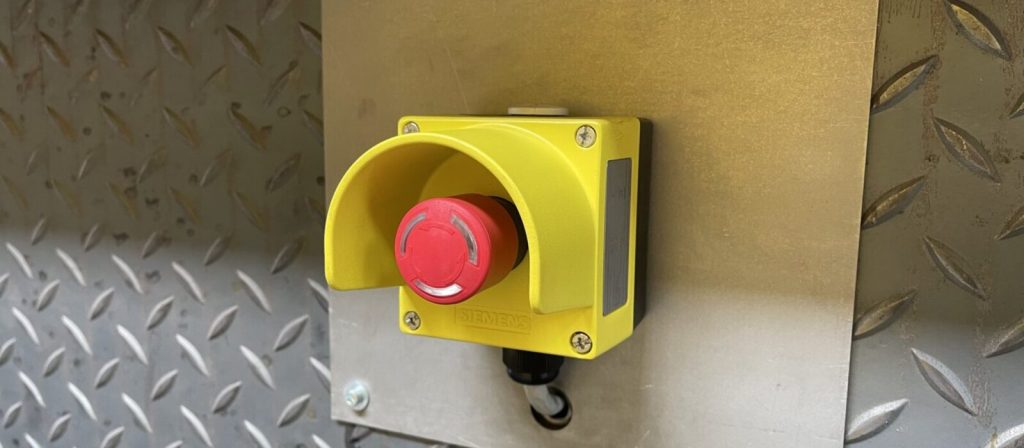
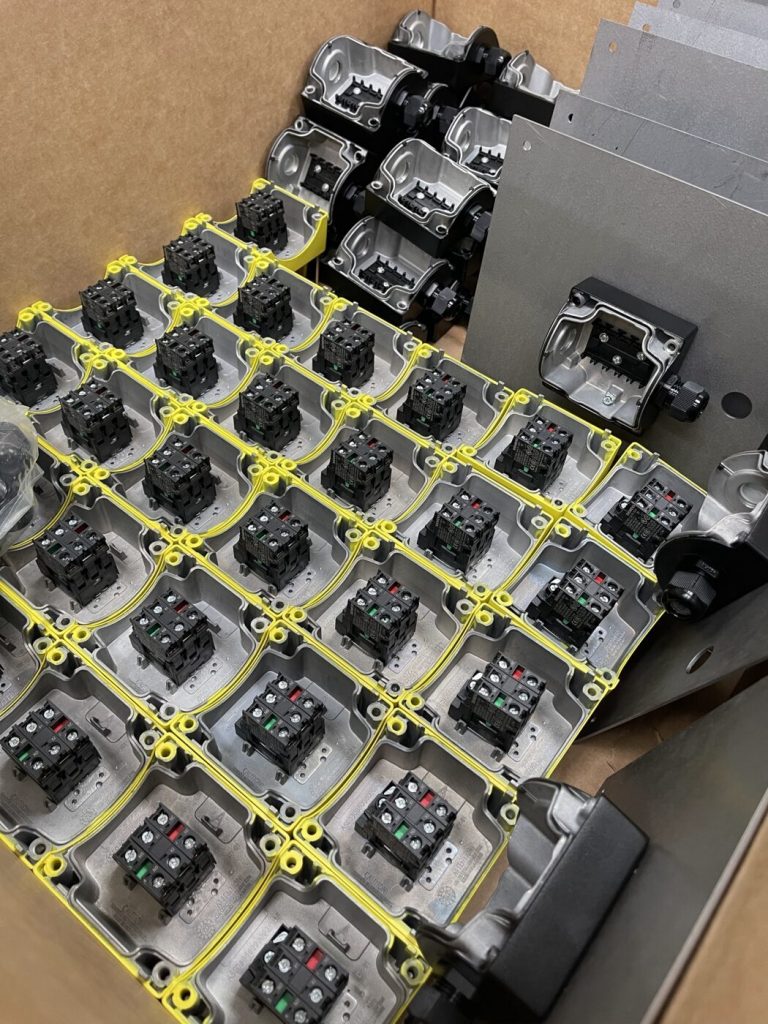
With the retrofit of emergency stop buttons on a sorting system at Frankfurt Airport a parcel sorting system was extended by 32 emergency stop buttons and several sensors. All units were pre-assembled: mounting brackets, housings with cable gland, terminals and labelling, tested and sorted by installation point. What remained for the window was setting, bolting, connecting and the function test in the safety circuit. Two fitters needed two working days, during daytime standstill periods; sorting operations continued. This is exactly how retrofits are planned before a freeze.
Logistics centre Frankfurt: loading bay renewed in one day
During the replacement of two folding ramps at a logistics centre in Frankfurt two manually operated ramps were replaced with hydraulic ones. In a single working day, two mechatronics technicians dismantled the old ramps, positioned the new ones with the forklift, welded the hinge strips to the steel structure and installed hydraulics and electrics. Added to this were two control cabinets with door control and operating boxes with traffic lights. The conversion had been triggered, among other things, by the finding of worn dock bumpers. For the freeze, this is the typical lead-up measure: a loading bay that is renewed before the season does not need to be touched by anyone during the season. More on the technology in the guide on maintenance of loading ramps.
Logistics centre near Leipzig: 32 loading bays handed over on schedule
With the installation of 32 vehicle restraint systems at a logistics centre near Leipzig – systems that prevent lorries from rolling away during loading and unloading – the scope ranged from the mechanics through hydraulic power units, traffic light systems and 32 control panels to the preparation for commissioning. In the first week, a team of eight was on site, then three technicians. Handover took place on schedule. This is how a series project with a fixed end date is organised: main installation with a large team, then scale down as planned, commissioning before the cut-off date.
Data center Frankfurt: cooling unit replacement with work permits during live operation
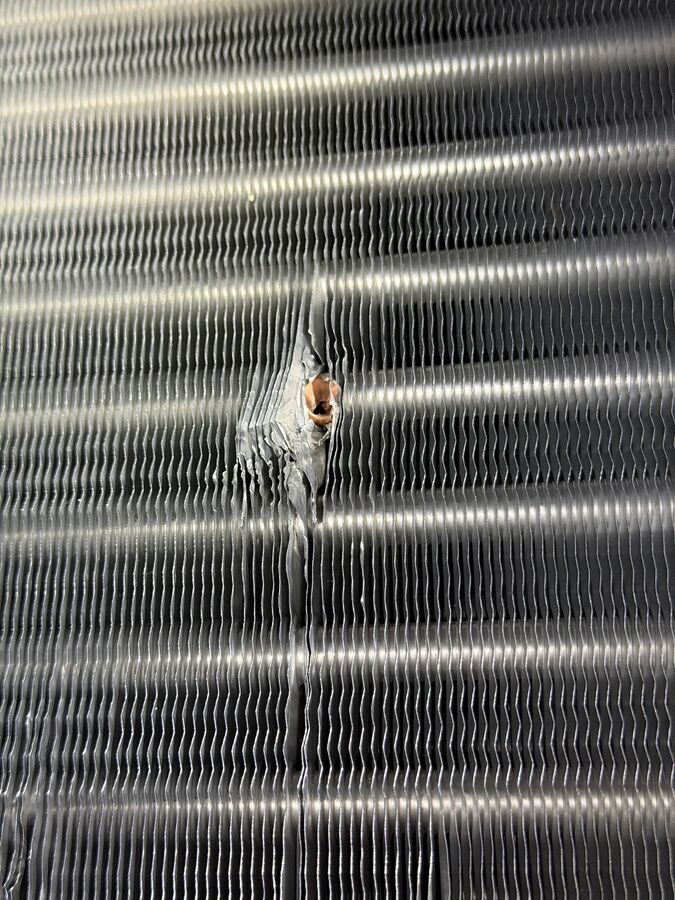
During the replacement of a CRAH unit in a data center in Frankfurt – a recirculating air cooling unit for the data hall – the reason was a damaged heat exchanger. The data center kept running at full capacity; access was through security gates, every job needed a permit and continuous coordination with the operator. A supervisor and three riggers brought the new unit to the second floor in two working days using two synchronously controlled lifting devices, removed the defective unit and worked beneath the ceiling from scissor lifts with fall protection. Floor protection with fleece and masking was in place before the first machine was used. This is what an intervention after approval looks like during live operation – the pattern of an Emergency Change.
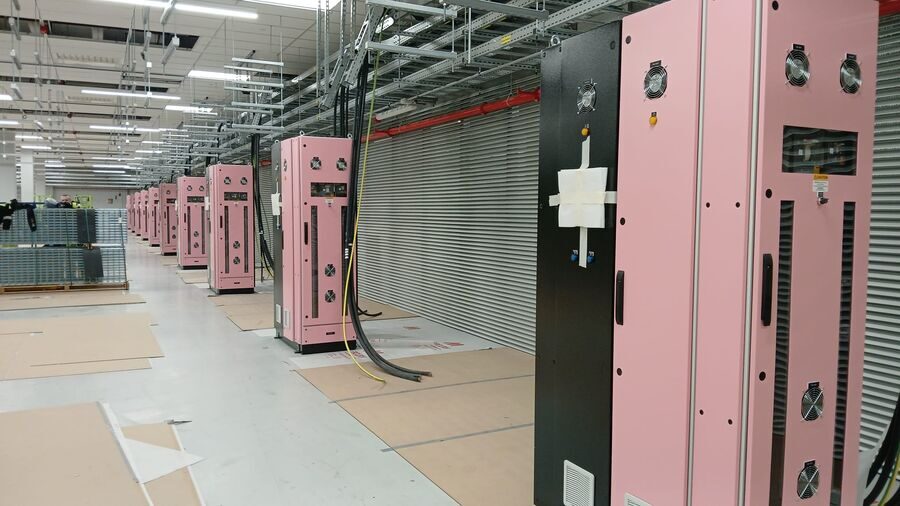
Data center in the Rhine-Main region: 160 power distribution cabinets ahead of the electrical trade
During the installation of 160 power distribution cabinets in a data center in the Rhine-Main region six lift & shift fitters set up the cabinets in eight data halls on four levels over several weeks. The halls were measured by laser, the set-down positions marked on the floor protection, each cabinet aligned in the row and positioned beneath the cable outlet. Then the electrical trade took over – without rework on the cabinets. For the freeze, the job stands for a project that must be completed before the cut-off date.
High-bay warehouse at Frankfurt Airport: breakdown with parts on site
With the emergency repair at a high-bay warehouse at Frankfurt Airport a worn gear on the drive unit had jammed the drive chain; chain conveyor and high-bay warehouse were at a standstill. The emergency team narrowed the fault down to the drive unit, dismantled the chain conveyor, replaced drive chains and gears with new parts and put the system back into operation. This was possible because the customer had suitable spare parts in stock. That is the exception during the freeze in its purest form: narrow down, rectify with parts available, do not modernise.
Is a Change Freeze coming up for you – and is the lead-up list not yet finished?
Then get in touch with us. During a site walk in Frankfurt, Offenbach, Hanau, Darmstadt or elsewhere in the Rhine-Main region, we go through your critical plant with the eye of an installation contractor: what has to be done before the cut-off date, which parts need lead time, which fallback plan can be built?
What this means for your role
For buyers: Include the start and end of the freeze as dates in the framework agreement and agree on-call service, approval route and spare parts stocking for this phase. Award lead-up measures early enough for parts with lead times to be there before the cut-off date. Evaluate suppliers by whether they bring mechanical, electrical and lifting technology from a single source – every interface fewer shortens the lead-up.
For designers: Every plant you design with redundancy, bypass or a second line needs no exception during the freeze. Design loading bays, conveyor technology and cooling so that one unit can fail without the need for intervention – and include storage space for the season's spare parts at the same time.
For project managers and site managers: As project manager, you schedule projects with an end date before the freeze and plan the capacity reduction after the main installation. As site manager, you keep the approval route for the exception ready: who is called, who decides, who signs – on a Sunday too. During the freeze, you accept every intervention with documented evidence.
For maintenance managers: You are the author of the backward count. Bring forward inspections and findings, replace wearing parts with a foreseeable end, build the season's spare parts store and test every fallback plan before the last site walk. You plan the window in January before the freeze begins.
For facility managers and operators: Define which plant the freeze really covers, and keep everything else open for maintenance. Name the person responsible for the freeze who approves exceptions, and make sure that external companies have access in a breakdown without first having to submit documents.
For warehouse and logistics managers: Your fallback plans are the spare ramp, the door kept free, the second sorter line and the forklift route. Have them rehearsed in earnest once before the season. And report warning signs on ramps, rollers and sensors immediately – during the freeze, early reporting counts for more than fast repair.
Freeze preparation plan: template on request
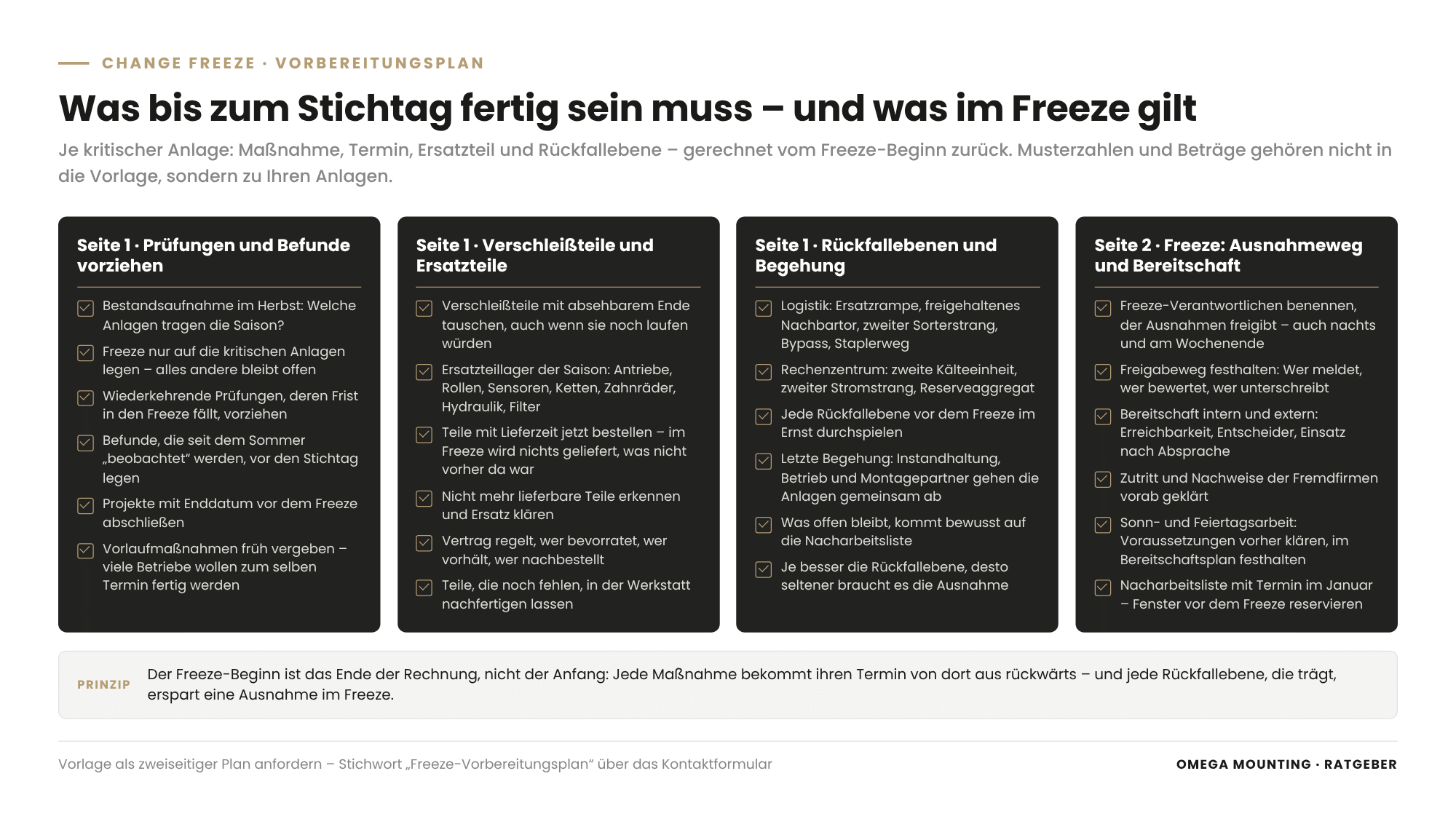
The freeze preparation plan is a two-page backward count from the start of the freeze. Page 1 lists the lead-up measures per plant with the columns plant, measure, date, spare part and fallback plan – from the condition survey through inspections, repairs and wearing part replacement to the last site walk. Page 2 regulates the freeze itself: exception route with responsible persons, on-call service internal and external, rework list with a date in January. The template deliberately contains no sample figures or amounts – those belong to your plant. Request the plan via our Contact form – keyword “Freeze preparation plan”.
Why Omega Mounting?
We are based in Rodgau near Frankfurt, can be reached via our 24-hour hotline and have our own workshop for parts that are still missing before the freeze. The linked jobs show the working method a freeze depends on: pre-assembly before the window on the sorting system at the airport, a loading bay in Frankfurt renewed in one day, a cooling unit replacement with work permits in a live data center, a breakdown at the high-bay warehouse rectified with stocked parts. For you this means: one contact for the lead-up, availability during the freeze and the rework in January – mechanical, electrical, lifting technology and refabrication from a single source, with short distances from Rodgau. If that is what you want for your next season, get in touch.
Conclusion
A Change Freeze does not postpone maintenance, it moves it forward. Everything that could fail during the freeze is done beforehand: bring forward inspections and findings, replace wearing parts, stock spare parts, build fallback plans, walk the plant. During the freeze, the approval route applies, and every intervention remains an emergency repair with documentation. After the freeze, the rework list becomes the permanent solution. Anyone who takes the start of the freeze as the end date of their backward count gets through the season without an exception – or with one that runs cleanly. If you would like to know what your freeze list looks like from the perspective of an installation contractor, send us your critical plant, the freeze date and the open findings. We will get back to you with an honest assessment of what can be achieved by the cut-off date.
Planning maintenance, moving in or installation in the Rhine-Main region?
Tell us briefly what it is about – we will come back to you with an honest assessment.
100% free and without obligation
You may also be interested in these guides
Maintenance & Servicing
Maintenance & Servicing

About the author
Tobias Schott
Managing director of Omega Mounting GmbH, Rodgau · more than 20 years of hands-on experience in installation and maintenance
A trained mechatronics technician, at home in maintenance, servicing and industrial installation since 2004 – first at his father's side, since 2012 with Omega Mounting: from the overhead conveyor in Frankfurt to the crane system in a new-build hall. Plans and leads lifting operations as appointed person in data centers and on industrial sites in the Rhine-Main region, is an instructor and examiner for cranes, mobile elevating work platforms and telehandlers, and a safety officer. On jobs abroad he is known as the “German Troubleshooter” – the one you call when things get stuck on site. He learned what quality means not from a manual but from his father: Made in Germany as a standard for his own work, not as a label. That is why it comes first at Omega Mounting – before speed and before price. He writes these guides from that practice: what works on our sites is in them – what only exists in the standard is not.
Frequently asked questions
The Change Freeze is the rule, the Peak Season the occasion. The Peak Season is the high season in logistics from Black Friday to Christmas, sometimes until mid-January with the returns. The freeze is the prohibition of planned changes to productive plant within a defined period – in data centers usually mid-November to early January. Many logistics companies impose it without using the word.
Yes, but only without changing the plant. Observing, cleaning, lubricating, reading measured values and reporting warning signs are welcome. Not permitted are planned repairs, conversions, retrofits and the replacement of assemblies without a fault. A fault is handled as an Emergency Change: with exception approval, limited to fault rectification, documented.
Backwards from the start of the freeze. For each critical plant, record which inspection, repair or wearing part replacement must be completed before the cut-off date, which spare part has a lead time and which fallback plan carries the season. The last site walk before the cut-off date checks whether everything has been done.
An Emergency Change is an intervention on frozen plant that rectifies a fault and receives an accelerated exception approval for it. It remains limited to fault rectification – emergency repair instead of permanent solution – and is documented with findings, approval, intervention, parts installed and inspection. The permanent solution follows after the freeze.
The same as outside it: maintenance work requires release, isolation and coordination, and after safety-relevant repairs the plant is inspected before reuse. Sunday and public holiday work is subject to exceptions whose admissibility the company clarifies. The freeze only adds the operator's approval step.
Yes, wherever a season or a major order makes the plant indispensable for a few weeks. Beverage companies before the summer, food companies before Christmas, automotive suppliers before a production ramp-up work according to the same pattern – with a different name and different dates, but the same preparation.
For the data center Change Freeze, the rule from IT change management is transferred to cooling, power, standby power system and fire suppression: between mid-November and early January, change requests are suspended, and exceptions go through the person responsible for change management. Maintenance windows for unit replacement and overhauls lie before or after the freeze; the redundancy of the systems serves as the fallback plan during the freeze.
From Rodgau, Omega Mounting prepares plant in logistics centres and data centers in Frankfurt, Offenbach, Hanau, Raunheim and the surrounding area for the season: renewing ramps and doors, overhauling conveyor technology, retrofitting safety devices, installing cooling units and power distribution cabinets, refabricating spare parts. During the freeze we can be reached; in January we work through the rework list.
Via a short enquiry with three details: the list of your critical plant, the start and end of your freeze and the open findings and faults of the current year. We arrange a site walk and send you a written assessment of what can be achieved by the cut-off date and which parts need lead time. Your contact is Tobias Schott – reachable via our Contact form.
 English
 German