
- Guide – Data Center
Preparing a load bank test: planning set-down area, moving in, cable route and exhaust air for the load test of the standby power supply
By Tobias Schott · 20-minute read · As of November 2026

Preparing a load bank test means that before the first kilowatt flows, set-down area, moving in, cable route, exhaust air and fuel must be clarified. The test itself often lasts only hours. Preparation decides whether it runs safely and without interruption on the planned day.
A standby generator only shows what it can do under load. Almost every generator starts at idle. But whether it delivers full power, holds the voltage and the cooling keeps up is only shown by a load test. That is what the load bank is for. It absorbs the generator's power and converts it into heat.
Anyone who has to prepare a load bank test soon realises that the load bank technology is the smaller problem. Everything around it is harder. Where does the load bank stand? How does it get there? Where does the hot exhaust air blow? How do the cables run without anyone tripping over them or a vehicle running them over? And is there enough diesel for the test?
This guide shows what has to be planned before a load bank test – from the set-down area and moving in by crane to removal. It is written for commissioning managers and project managers in data centers, technical managers and facility managers with standby power systems, generator service companies, electrical design engineers and buyers.
Key points at a glance
- Preparing a load bank test means: define the test, choose the set-down area, plan moving in, secure the cable route, organise operation, plan removal.
- The set-down area decides. It must be load-bearing, level and accessible. The exhaust air must hit neither people nor buildings nor the generator.
- Exhaust air is hot. A load bank blows out the entire power as heat. A clear, cordoned-off zone belongs in front of it.
- Moving in is lift & shift. Container load banks are heavy. Crane, lifting plan and lifting accessories belong in the planning.
- Cables need protection. Cable protectors cross roadways – never loose cables.
- Clarify fuel beforehand. At full load, a generator uses a lot of diesel. The tank must be full and refuelling arranged.
- Clear roles. Test programme and assessment lie with commissioning and the manufacturer. Logistics, set-up and connection can be in one pair of hands.
What does preparing a load bank test actually involve?
A load bank test checks whether a standby power system delivers what it promises in an emergency. The load bank simulates the load of servers, cooling and building services. The generator runs in load steps up to full load. Voltage, frequency, temperatures and behaviour when large loads are switched in are measured.
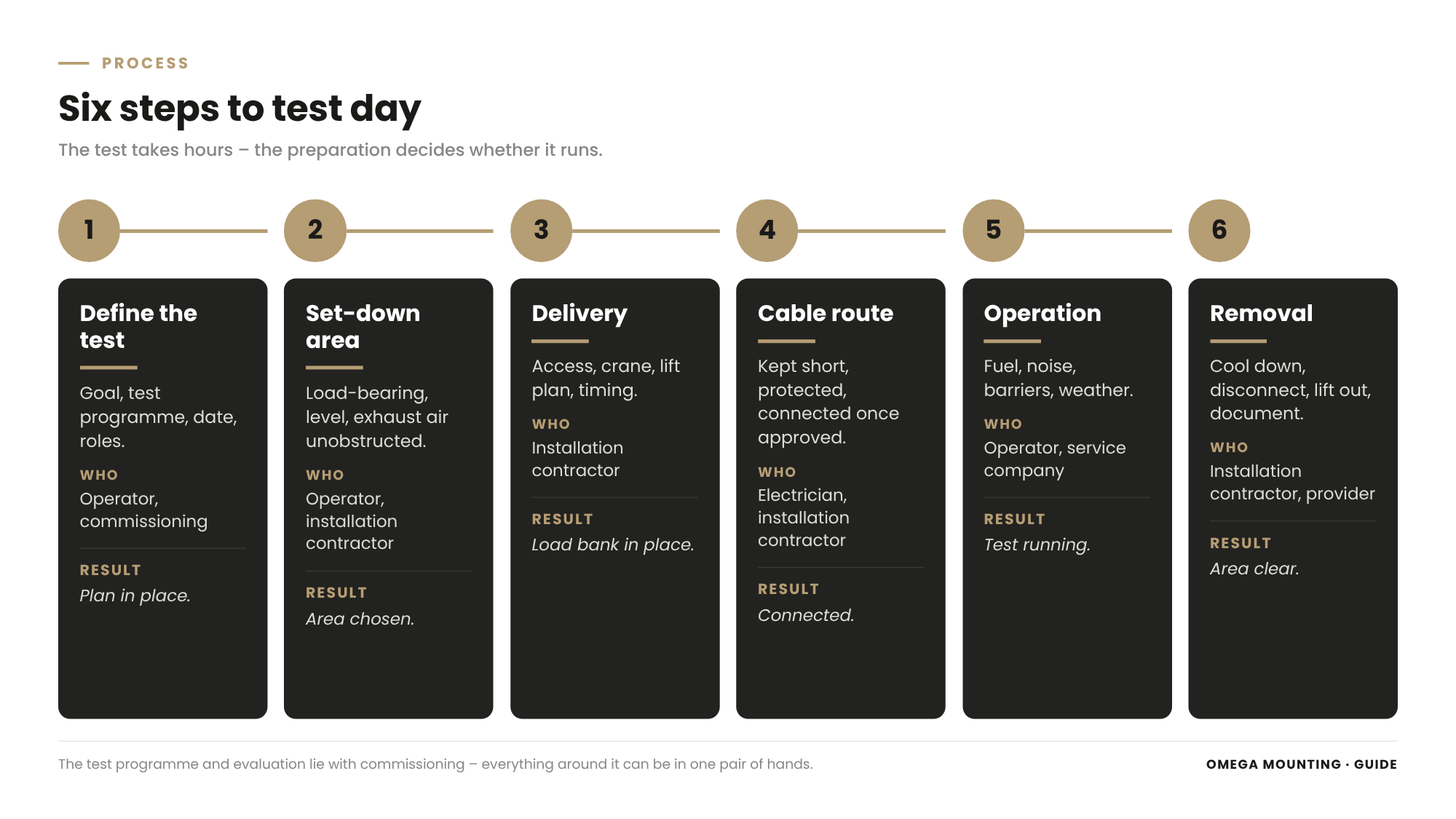
Preparation has six steps. First the test is defined: goal, test programme, date and responsibilities. Then comes the set-down area with space, clearances and exhaust direction. Next, moving in is planned – often by crane. Fourth, the cable route is fixed and protected. Fifth, operation is organised: fuel, noise, cordoning off, weather. And finally removal.
Why a load test at all?
In many installations, a standby generator runs for years only in test operation without significant load. That has consequences. At low load, the diesel does not burn cleanly. Soot and unburnt fuel build up in the exhaust system. Specialists call this wet stacking. A load bank test brings the engine up to temperature and burns off these deposits.
More importantly, only under load does it become clear whether cooling, control and fuel supply work together. A radiator that is sufficient at idle can reach its limit at full load. A governor that is calm at idle can oscillate at a load step. The load bank test reveals such weaknesses before an emergency does.
Load bank test in the data center
In the data center, the load bank test is a fixed part of commissioning. It is one of the tests that must be demonstrated before handover. In later operation, many operators repeat the test at fixed intervals. How commissioning works as a whole is described in our guide commissioning in the data center.
How a load bank works
At its core, a load bank is a large, adjustable heating resistor. The generator's current flows through resistor elements. They get hot, and fans blow the heat outside. That way the load bank absorbs exactly the power it is supposed to absorb – step by step.
Design
A load bank consists of resistor elements, fans, contactors and controls. Small units stand on castors or skids. Large load banks are built into containers. The controls sit on the unit or in a control desk, often with measuring equipment and data logging.
Resistive and resistive-reactive
A purely resistive load bank absorbs active power. It checks whether the engine delivers the power. But real loads in a data center also have a reactive component, for example from motors of fans and pumps. A resistive-reactive load bank simulates this component. It also tests the generator itself and its control. The test programme determines which type is needed.
Load banks in the data hall
Besides the large load bank at the generator, there are smaller load banks for the data hall. They stand in the racks or aisles and produce the heat that the servers will later give off. That tests the cooling under real load. In the integrated systems test, generator, UPS, cooling and building services run together under load. Then both types of load bank are often in use.
Which load bank for which test?
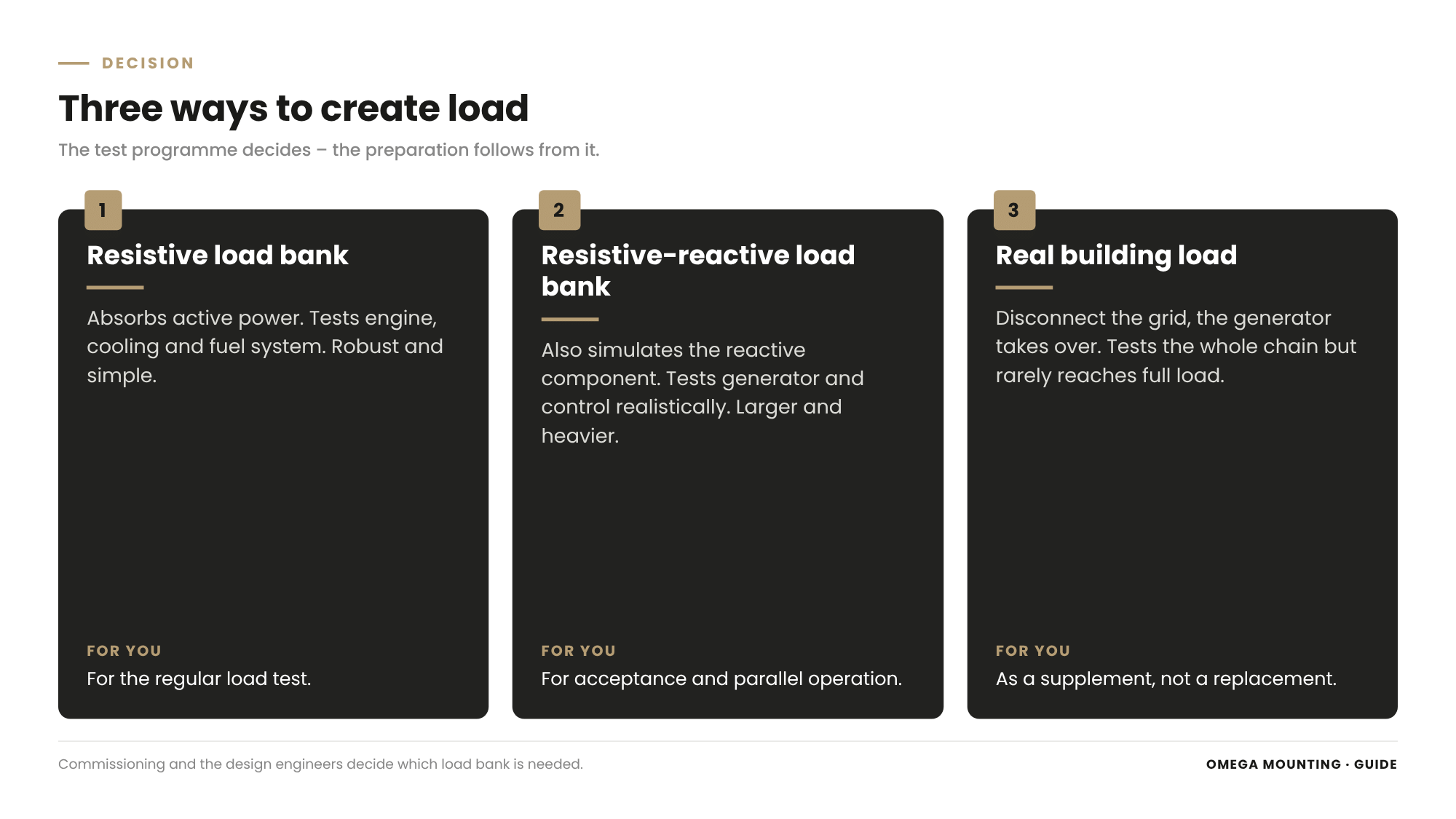
The choice of load bank depends on the goal of the test. Three options are common.
Resistive load bank
It is the standard for load testing a generator set. Robust, easy to operate, good for testing engine, cooling and fuel system. For regular load testing of a standby generator it is often sufficient.
Resistive-reactive load bank
It is used when the generator is to be tested under realistic conditions. That is typical for acceptance of new installations and for installations with several generators in parallel operation. It is larger, heavier and needs more planning.
Real load instead of a load bank
Some operators test with the real building load: disconnect the mains, the generator takes over. That tests the whole chain under real conditions. But it carries risks for ongoing operations and often does not reach full load. That is why it rarely replaces the load bank test, but supplements it.
Hire a load bank or have one provided?
If you want to hire a load bank, it usually comes with operating staff. The provider brings the unit, measuring equipment and experience. What they often do not take on: moving it onto hard-to-reach areas, the crane lift, laying cables across the site and cordoning off. That is exactly where the work of an installation contractor begins.
The set-down area: space, clearances, exhaust air
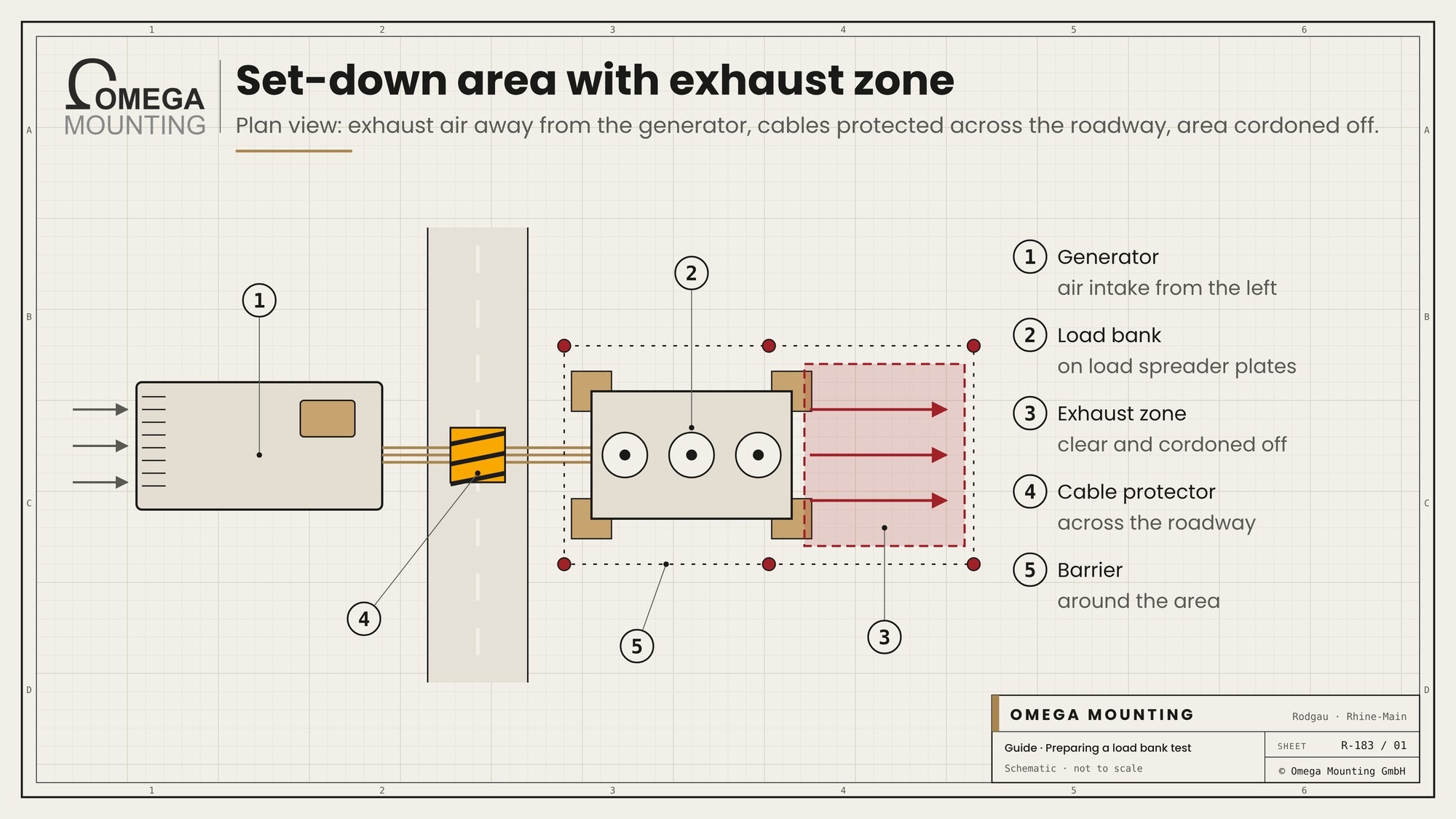
The set-down area is the most important decision when preparing a load bank test. A poor location costs hours on test day or makes the test impossible.
Load-bearing capacity and ground
A container load bank is heavy. The ground must carry the load – including at the corners where the support feet stand. On asphalt, paving or grass, load spreader plates are needed. On roofs, platforms and floors, the structural engineer decides. More on load spreading is in the guide Planning moving in: floor load.
Level and accessible
The load bank must stand level. Otherwise the fans and controls do not work as intended. And the location must be accessible: for the low-loader, for the crane and for the staff on test day.
The exhaust air
This is where the most common planning mistake lies. A load bank blows out the entire absorbed power as hot air – often vertically upwards, sometimes to the side. In front of the outlet there is a zone where nobody may stay. Windows, ventilation intakes, façades, trees, cables and vehicles do not belong in this area.
No short circuit of the air
Particularly critical: the hot exhaust air must not get into the generator's air intake. Otherwise the engine sucks in its own heat again. The cooling reaches its limit and the test is aborted. The set-down area is therefore chosen so that exhaust and intake point away from each other. The wind plays a part too.
Noise
Generator and fans are loud. In residential areas, next to offices or hospitals, the test has to be agreed with residents and neighbours. The test time is often chosen accordingly.

Delivery: heavy transport and crane in sync
Small load banks come by lorry and are unloaded with a forklift. Container load banks and mobile generators come on low-loaders. Then delivery becomes a logistics task.
Checking access
Can the low-loader get to the set-down area? Clearance heights, turning radii, gates, barriers and the load-bearing capacity of the access road are checked beforehand. On data center sites, access controls and fixed delivery times come on top.
Choosing the crane
If the load bank cannot drive directly from the low-loader onto the area, a crane lifts it. Whether a mobile crane or a smaller lifting device fits depends on weight, radius and space. The trade-off is described in the guide Spider crane or mobile crane.
Planning the sequence
With several transports, timing counts. Every low-loader should arrive when the crane is ready – not earlier and not later. Waiting heavy transports block access roads. Late ones cost crane hours.
Thinking of the material
Cables, connectors, cable protectors, load spreader plates and barrier material come with the load bank. If a cable is missing on test day, everything stops. A packing list agreed beforehand with the load bank provider prevents this.
Lifting in and setting down the load bank
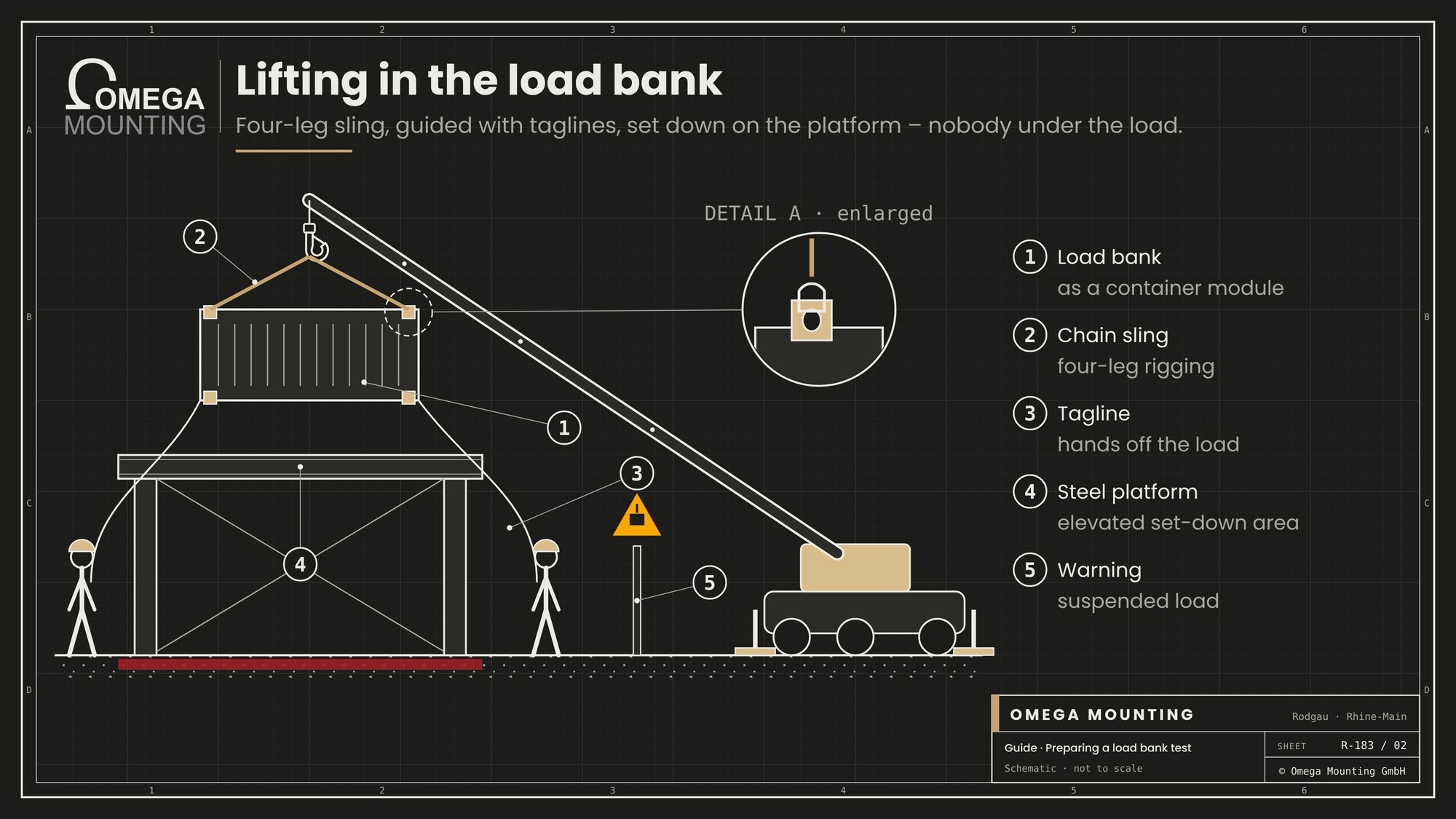
The crane lift is the moment of greatest risk. It is planned like any other move-in at a data center.
The lift plan
A lifting plan is drawn up for every lift: weight of the load, crane position, radius, lifting accessories, exclusion zone. On data center sites, it is filed and approved in the operator's system. Only then may lifting begin. Who is responsible for the lift is described in the guide Appointed person for lifting operations.
Slinging
Container load banks have lifting points at the corners. They are slung with chain slings, usually four-leg. The legs must suit the load and be inspected. Which lifting accessories are suitable is set out in the guide Lifting accessories for heavy loads.
Guiding with lines
During the lift, riggers guide the load with taglines. That stops the container turning and swinging against fences, steelwork or façades. Nobody stands under the load.
Setting down at height
If the load bank stands on a platform or roof, slinging and unhooking are done at height. A mobile elevating work platform is used for this. A colleague on the ground stays in contact with the crane operator. More on work platforms is in the guide Mobile elevating work platform installation.
The cable route from generator to load bank
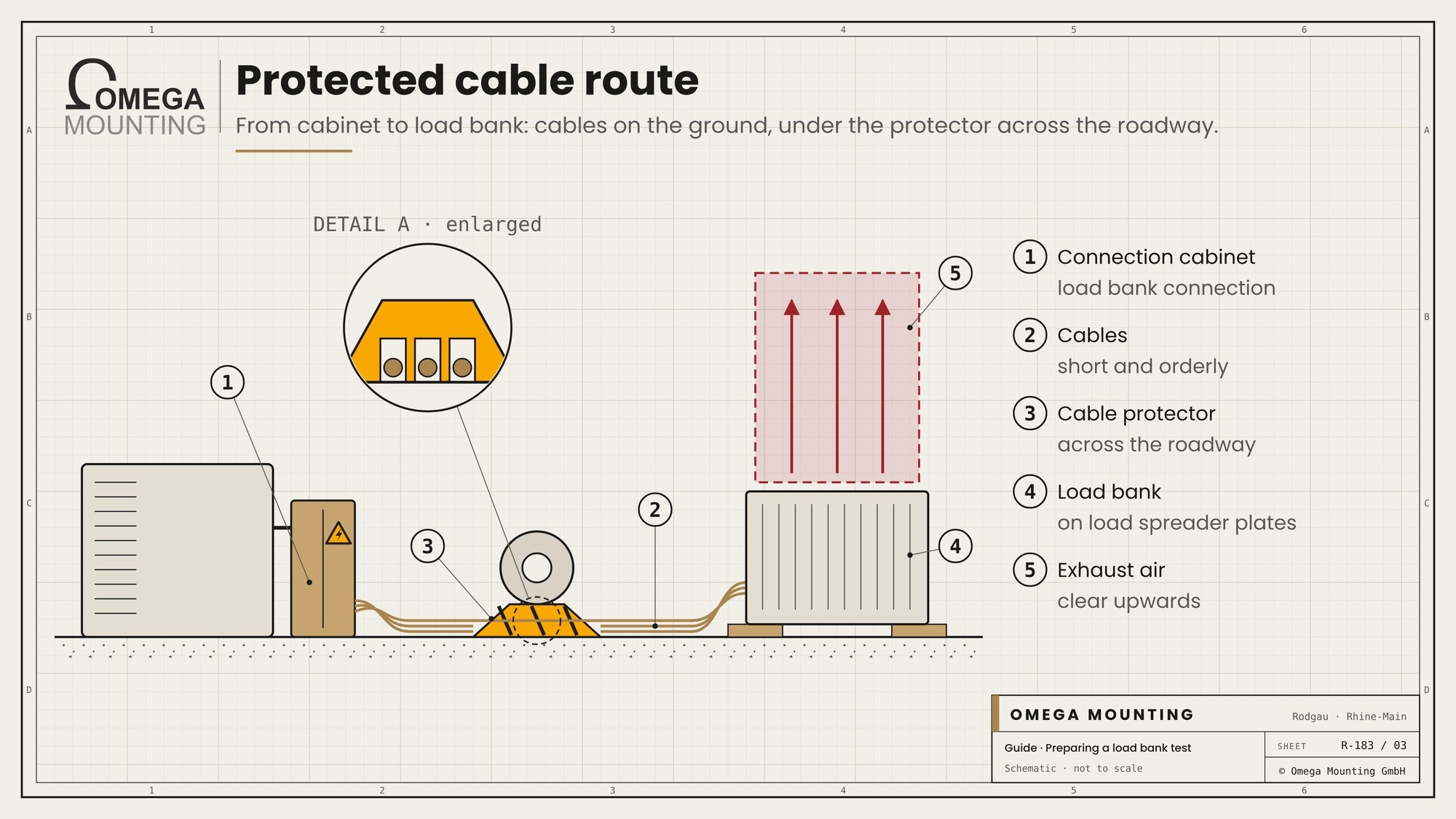
The full power flows between generator and load bank. The cables are correspondingly thick, heavy and numerous. The cable route is planned before the load bank is in place.
Where is it connected?
Many newer standby power systems have their own connection point for the load bank – a load bank connection or connection cabinet. Then the route is clear. If there is none, the connection is made at the generator or at a suitable point in the distribution. That is decided by the electrical design engineer together with the operator.
Short and protected
The cable route should be as short as possible. Every metre of cable costs time when laying out and removing. Where cables cross roadways, cable protectors go over them. Where they cross walkways, cable mats or ramps. Loose cables across an access road are an accident waiting to happen.
Connection only after release
The cables are connected with the system de-energised, after release by the person responsible for the installation. With us, our own qualified electricians do this. Before the first start they check connections, phase rotation and protective measures. Only then does the generator go on load.
Cables in wet weather
Load bank tests often take place outdoors. Plug connections and connection boxes must be suitable for rain. Cables do not lie in puddles. In a thunderstorm the test is interrupted.
Fuel: the underestimated part
A generator at full load uses many times its idle consumption. A load bank test lasting several hours can empty the day tank.
Tank full
Before the test, the day tank is filled and the supply in the storage tank checked. Refilling from the storage tank must work – and is tested as part of the test as well.
Arranging refuelling
If the supply is not enough, refuelling during the test is organised. The tanker needs an access route that is not blocked by cables or barriers. Who orders the tanker and who guides it in is decided beforehand.
Diesel quality
Old diesel can cause problems. If the fuel has been in the tank for a long time, the service company checks its quality before the test. A clogged filter in the middle of the test is annoying and avoidable.
Cordon off, mark, supervise
On test day, many trades work in a confined space. Clear areas protect everyone.
Defining zones
Three zones belong in every plan: the crane's slewing range during moving in, the load bank's exhaust zone and the area around cables and connections. All three are cordoned off and marked.
Labelling
Warning signs for hot surfaces, electrical voltage and noise. Site fencing or barrier boards instead of tape where vehicles pass. Lighting if the test runs into darkness.
Supervision
If the test runs for many hours or overnight, someone stays on site. A load bank at full load is not left unattended.
Test day
Once everything is prepared, test day belongs to commissioning and the load bank provider.
Before the start
A short briefing for everyone involved: who runs the test, who measures, who is the emergency contact? Where are the emergency stop and fire extinguishers? Radios or phone numbers are checked.
During the test
The generator is run in load steps, often with load steps to test the control behaviour. Temperatures, voltage, frequency and fuel consumption are recorded. The installation contractor keeps the set-down area clear, checks cables and barriers and is on hand for changes.
When something is not right
If the test is aborted, the cause is investigated – not improvised around. If it is the exhaust air, the set-up is changed. If it is the generator, the service company decides. If you are well prepared, you lose minutes rather than days.
Removal and documentation
After the test comes removal. That is planned too.
Letting it cool down
Load bank and cables are hot after the test. They are only disconnected after cooling down – de-energised and after release.
Dismantling in reverse order
Pull in the cables, remove the cable protectors, sling and lift out the load bank, pick up the load spreader plates. If the crane has to come a second time, the date is planned at the same time as moving in.
Documentation
The load bank provider supplies the test record. The installation contractor documents moving in, lifting plans, connection and removal. Together, this belongs in the acceptance documents. How the handover works is described in the guide commissioning and handover of a plant.
Mobile generators and load banks as a package
It is not always the permanently installed generator that is tested. Sometimes generator and load bank arrive on site together.
When this happens
When a data center is commissioned, the cooling is often tested before the site's own standby power supply is ready. Then a mobile generator supplies the power for load banks in the data hall. Mobile generators are also used during conversions in which a generator is out of service.
Double planning
Then everything applies twice: two set-down areas, two lifts, exhaust air and exhaust gas kept separate, fuel for the mobile generator. The cable route leads from the generator to the distribution board and from there to the load banks.
Container modules
Mobile generators and load banks are mostly built as container modules. The same rules apply to setting them up as to any container installation. More on this is in the guide Installing a container facility.
Time windows and dates
In the data center, the load bank test is closely linked with other dates.
Dependencies
The test needs a finished generator, a working fuel circuit and released connections. At the same time, acceptance is waiting for the result. If the test slips, the whole handover often slips.
Planning in a buffer
There should be a buffer between moving in and the test. It absorbs delays in delivery, weather or connection. Anyone who puts moving in and the test on the same morning has no room for manoeuvre.
One day for all lifts
If several load banks and generators arrive, it pays to bundle all lifts into one day. The crane comes once, the cordon is set up once, the approvals apply once. That requires precise planning and a well-practised team.
Recurring load bank tests in operation
The first load bank test at commissioning is rarely the last. Many operators repeat the test regularly to demonstrate the standby power supply and keep the generator healthy.
Setting up a permanent area
Anyone testing regularly should set up a permanent set-down area: paved, load-bearing, with a clear exhaust direction and a short distance to the connection point. Then the search for a location and the load spreader plates are no longer needed for each test.
Permanent connection point
A permanently installed load bank connection saves time and risk at every test. The cables are connected at a prepared point, not in the generator or the distribution. The retrofit is planned by the electrical design engineer and installed by qualified electricians.
Procedure as standard
Once set-down area, cable route and roles have been clarified, they become a standard procedure. The checklist from the first test becomes the template for every further one. That turns the load test into routine rather than a project.
Combining load bank test and maintenance
Many operators schedule the load bank test directly after the annual service of the generator. Then the test immediately shows whether the service has worked. And small defects can be fixed while the service company is on site anyway.
Safety during the load bank test
High power, hot air, heavy loads, many parties: the rules are clear.
The basic rules
- Lifts only with an approved lifting plan, cordoned-off slewing range and inspected lifting accessories.
- Nobody under the suspended load.
- Exhaust zone clear and cordoned off.
- Connection only when de-energised and after release by the person responsible for the installation.
- Cables over roadways only under cable protectors.
- Fire extinguisher within reach, emergency stop known.
- Hearing protection near generator and load bank.
Legal framework
Lifting operations, electrical work and the use of work equipment are subject to the German Occupational Safety Act (ArbSchG), the Industrial Safety Ordinance (BetrSichV), the rules of the statutory accident insurance and the operator's requirements. This guide is not legal advice – which obligations apply in your case you should clarify with your occupational safety specialist.
Who does what in a load bank test?
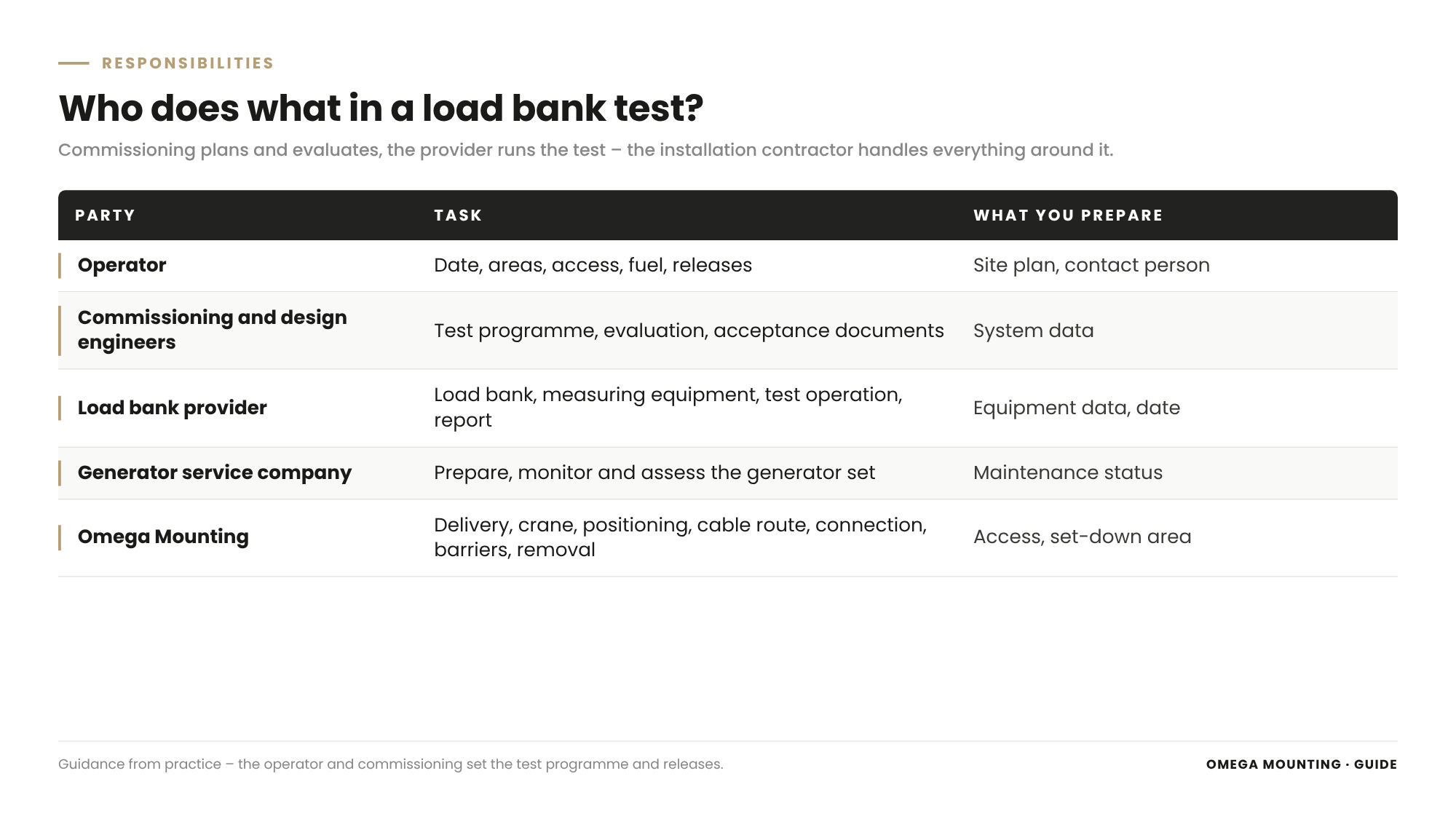
A load bank test brings several parties together. Clear roles prevent gaps.
Operator
The operator sets the date and goal, releases areas and access, provides fuel and coordinates the test with ongoing operations.
Commissioning and design engineers
They draw up the test programme: which load steps, which load jumps, which readings. They assess the results and include them in the acceptance documents.
Load bank provider
The provider supplies load bank, measuring equipment and operating staff, runs the test according to the programme and delivers the test record.
Generator manufacturer or service company
They prepare the generator, monitor it during the test and assess its behaviour. If anything unusual shows up, they decide how to proceed.
Omega Mounting
We take care of everything around it: coordinating delivery, providing crane and lifting plans, moving in and setting up the load bank, laying and protecting the cable route, connection by our own qualified electricians after release, cordoning off, standby on test day and removal. Test programme, measurement and assessment remain with commissioning, provider and manufacturer.
Preparing a load bank test: what it means for your planning
Four questions help to estimate the effort early.
Where should the load bank stand?
Check space, load-bearing capacity, exhaust direction and clearances. A site plan with the exhaust zone marked clarifies a lot.
How does it get there?
Clarify access, crane requirements and lifting plan. The heavier the load bank and the tighter the space, the earlier.
How long is the cable route?
Measure the route from the connection point to the load bank. Plan cable protectors for every crossing.
Who does what?
Decide who runs the test, who measures, who connects and who keeps the area clear. A one-page list of roles is enough.
Typical mistakes in load bank tests
Most problems arise before test day.
- Exhaust air into the intake: the generator sucks in its own heat and the test is aborted.
- Set-down area not load-bearing: the support feet sink in and the load bank stands crooked.
- Cables too short: metres are missing on test day and no replacement is to hand.
- Cables unprotected: a vehicle runs over the cable and the test stops.
- Fuel forgotten: the day tank is empty before full load is reached.
- No lifting plan: the crane is in position but the approval is missing.
- Removal not planned: the load bank stays days longer than necessary.
The mistake behind the mistakes
Almost all these mistakes happen when the load bank test is seen purely as an electrical task. It is also a logistics and installation task. If you plan both together, you have only one task left on test day: testing.
Preparing a load bank test in the Rhine-Main region: how we do it
From Rodgau we quickly reach Frankfurt, Offenbach, Hanau, Eschborn and the region's other data center locations. There are a particularly large number of standby power systems here – and each one needs a load test at some point.
We clarify set-down area, access and cable route on site in advance, draw up the lifting plans and agree the date with the load bank provider and commissioning. How else we work in data centers is on our page on Data Center. What makes work in the data center special is in the guide installation in data centers. And how the generator is looked after between tests is described in the guide Standby Generator Maintenance.
For you, that means one point of contact for everything that has to happen before and after the test.
Project examples
A job from our project diary shows how load banks and generators got into place in one day.
Load banks and generators at a data center in Frankfurt
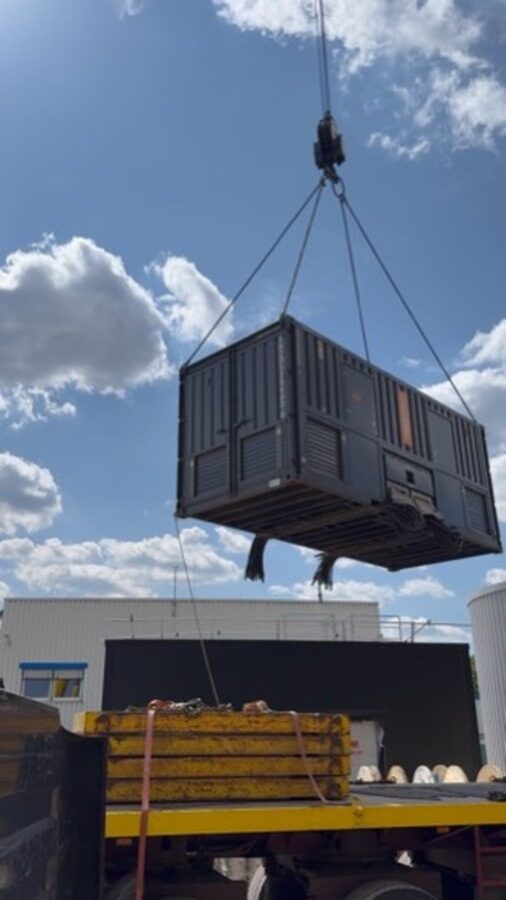
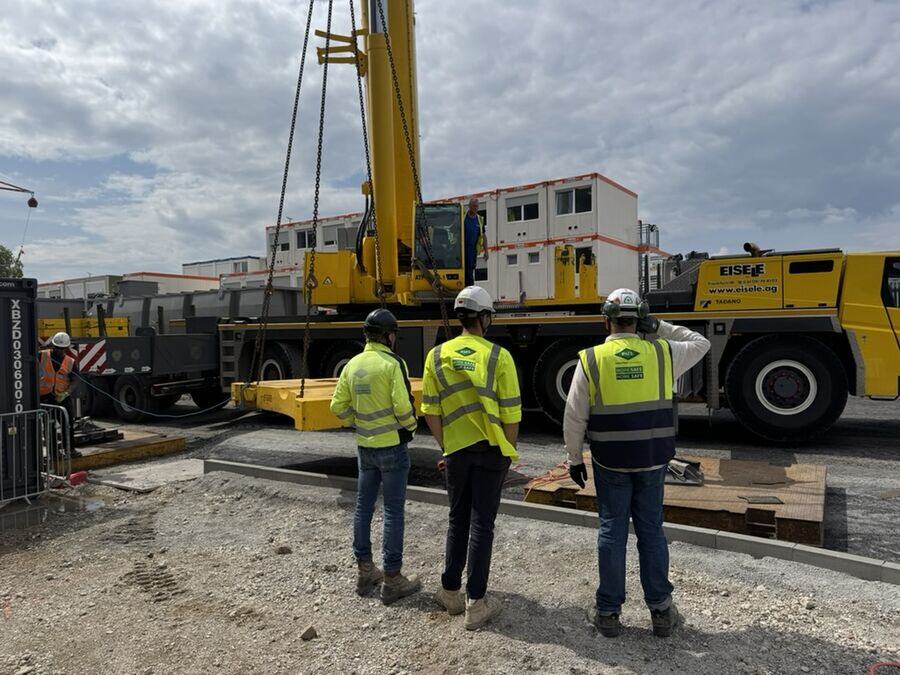
For a load test at a data center in Frankfurt, we delivered, unloaded and moved in generators and load banks. Five heavy transports arrived in sequence, and a heavy-duty mobile crane lifted the container modules into position – partly into a multi-storey steel structure, tight between tank installation, generators and access road. Every lift had been calculated beforehand in a lift plan and approved in the operator's system. Our riggers guided the loads with taglines; at height, slinging and unhooking were done from a mobile elevating work platform. Cables, connectors and installation material came at the same time. All lifts took place on one long working day – without damage and without rework. The full job is described in the report Moving in load banks and generators at a data center in Frankfurt.
Is a load bank test coming up for you?
Send us the site plan, date and load bank data – we will tell you what needs planning for set-down area, moving in and cable route. Get in touch now.
What this means for your role
Buyers: When asking for quotes, check whether moving in, crane, cable laying and removal are included. Hiring the load bank is often only part of it.
Planners: For new standby power systems, provide a load bank connection and a set-down area with a clear exhaust direction. That saves effort at every later test.
Project and site managers: Put the load bank test into the schedule with a buffer and check set-down area and access on site early.
Maintenance managers: Plan recurring load tests as fixed dates. A well-practised procedure makes every further test easier.
Commissioning managers: Separate test programme and logistics. If everything around it is in one pair of hands, you can concentrate on the measurements.
Load bank test checklist: template on request
For the next test, we have put together the load bank test checklist. On one page it asks about test, set-down area, moving in, cable route, operation and removal. You fill it in, and we plan everything around it without follow-up questions. Request the template via our contact form – keyword “Load bank test checklist”.
Why Omega Mounting?
With over twenty years of experience in installation, moving equipment in and maintenance – including in data centers – we know that a test is only as good as its preparation. That is why we plan set-down area, lift and cable route on site beforehand, bring crane and riggers from a single source and connect with our own qualified electricians after release. We leave the test programme and assessment to those responsible for them. For you, that means a test day on which the only thing left to do is test. Talk to us about your next load test – get in touch.
Conclusion
Preparing a load bank test means clarifying everything that is not measuring equipment: set-down area, exhaust air, moving in, cable route, fuel, cordoning off and removal. If you plan this early, you avoid aborted tests on test day.
The load bank itself is connected quickly. What costs time is a wrong set-down area, a missing lifting plan or a cable that is too short. With clear roles and a partner for everything around it, the test runs as it should. If a load test is coming up for you, get in touch with us.
Planning a move-in, installation or maintenance in the Rhine-Main region?
Tell us briefly what you need – we'll come back with an honest assessment.
Free, no-obligation callback
You may also be interested in these guides

About the author
Tobias Schott
Managing director of Omega Mounting GmbH, Rodgau · more than 20 years of hands-on experience in installation and maintenance
A trained mechatronics technician, working in maintenance, servicing and industrial installation since 2004 – first alongside his father, and with Omega Mounting since 2012: from overhead conveyors in Frankfurt to the crane system in a new-build hall. He plans and leads lifting operations as an appointed person (AP) in data centers and on industrial sites in the Rhine-Main region, trains and examines operators of cranes, mobile elevating work platforms and telehandlers, and is a qualified occupational safety specialist. On jobs abroad he is known as the “German Troubleshooter” – the person you call when a site gets stuck. He learned what quality means from his father, not from a manual: Made in Germany as a standard for his own work, not a label. That is why quality comes first at Omega Mounting – ahead of speed and price. He writes these guides from that practice: what works on our sites is in them – what exists only on paper is not.
Frequently asked questions
A load bank test checks a standby generator under load. A load bank absorbs the generator's power and converts it into heat. That shows whether engine, generator, cooling and control deliver in an emergency.
As early as possible, as soon as the date is fixed. Set-down area, crane and lifting plan need lead time, and on data center sites so do the operator's approvals.
Load-bearing capacity, a level surface, good access and above all the exhaust air. The hot air must hit neither people nor buildings nor the generator's air intake.
For container load banks often yes, if they cannot drive directly from the low-loader onto the set-down area. Small load banks on castors can manage without a crane.
A qualified electrician, with the system de-energised and after release by the person responsible for the installation. With us, our own qualified electricians do this.
The load bank provider runs the test according to the commissioning test programme. The assessment lies with commissioning, the design engineers and the generator manufacturer.
Because a generator at full load uses much more diesel than at idle. If the tank is not full beforehand or refuelling has not been arranged, the test is aborted.
Yes. From Rodgau we are quickly on site at all data center locations in the Rhine-Main region, including Frankfurt, Offenbach, Eschborn and Hanau.
Send us the site plan, date and load bank data. We will check set-down area, moving in and cable route and come back with a proposal. Go to the contact page.
 English
 German