
- Guide – Maintenance
Sorting system maintenance: keeping cross-belt and tilt-tray sorters running in continuous operation
By Tobias Schott · 24-minute read · Updated October 2026
A sorting system rarely fails all at once. First a carrier knocks with every circuit, then parcels end up in the wrong discharge point, then the chain stops – and the whole parcel hub with it. If you regularly look at running gear, drive, belts and trays, discharge points and the safety circuit, handle them during a secured shutdown and record the findings, you turn that failure into a planned replacement within a shutdown window.
A sorter runs as long as the parcels keep coming – and they come day and night. In a parcel hub near Frankfurt, in air cargo handling at the airport or in a distribution warehouse in Dietzenbach, there is no Friday afternoon when the system can “just stop for a while”. Sorting system maintenance is therefore above all a question of windows: what is checked from the outside while running, what during a secured shutdown, what during the overhaul? And who does what – operator, installation contractor, manufacturer, qualified electrician?
This guide describes cross-belt and tilt-tray sorters from the point of view of the people who have to keep them running. It covers the assemblies and their wear patterns, the mechanical maintenance points, the safety circuit with emergency stops and access points, maintenance within the shutdown periods of continuous operation and the rules for contractors in the security area at the airport. It builds on our overview guide to the maintenance of conveyor technology.
It is written from the practice of an installation and maintenance contractor based in Rodgau near Frankfurt. We maintain sorting systems mechanically, install safety devices and coordinate shutdown windows. Controls, sorting logic and scanners remain the manufacturer's responsibility; power supply and electrical testing remain with the qualified electrician.
Key points at a glance
- A sorting system consists of the induction, a circulating sorter chain with carriers, cross-belts or tilt trays, the drive, guides, discharge points with chutes, scanners, controls and the safety circuit – each assembly has its own wear pattern.
- Mechanically, the first parts to wear are running and guide rollers, chain joints and sprockets, belts and drive rollers, tray bearings and locking mechanisms – almost everything announces itself audibly, visibly or as missorts.
- Inspection has three levels: look and listen while running, handle and measure during a secured shutdown, dismantle during the overhaul.
- The safety circuit grows with the system: every extension needs reachable emergency stop buttons, secured access points and a function test – retrofits are carried out during shutdowns, with pre-assembly beforehand.
- In continuous operation, work is done section by section: short windows for visual checks and small parts, weekend windows for series work, the annual overhaul for dismantling.
- At the airport, access control, background checks, escorts and tool checks are added – contractors are brought in beforehand, not at the gate.
- Controls, scanners, sorting logic and safety controls belong to the manufacturer, power supply and electrical testing to the qualified electrician; mechanics, installation and coordination to the installation contractor.
What is a sorting system?
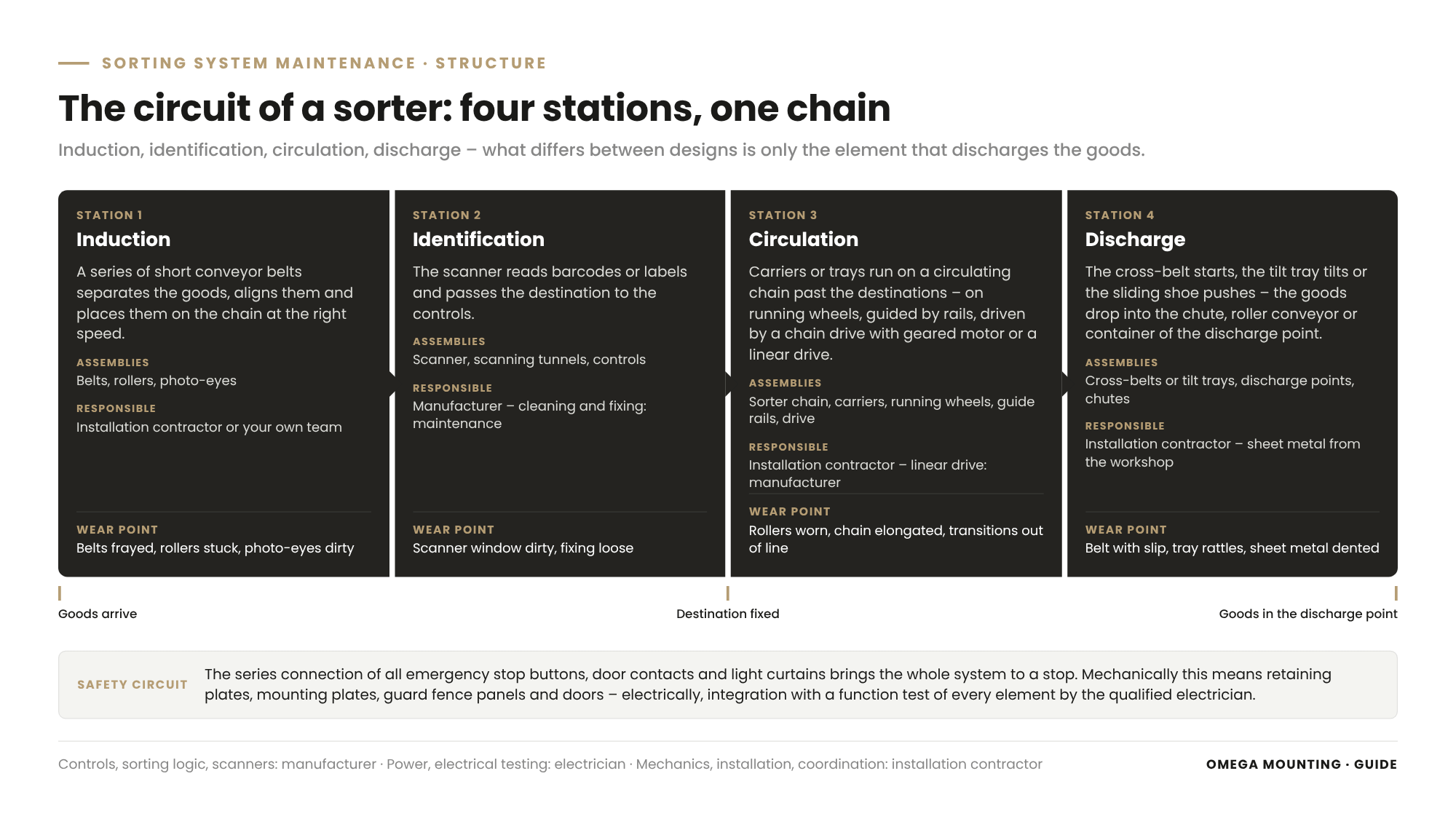
A sorting system is a continuous conveyor that automatically captures parcels, baggage or totes, assigns them to a destination and discharges them at discharge points. To do this, carriers or trays run on a circulating chain past the destinations and discharge the goods sideways.
In operation, the same thing is called a sorter, parcel sorting system or baggage handling system. All designs share the same circuit: induction, identification, circulation, discharge. What differs is the element that discharges the goods.
Cross-belt, tilt tray, sliding shoe
- Cross-belt sorter: Each carrier has a short conveyor belt running across the direction of travel. At the destination the belt starts and pushes the parcel into the discharge point. For maintenance this means: many small belts, many small drives.
- Tilt-tray sorter: Each carrier has a tray that tilts to the left or right at the destination. For maintenance this means: bearings, tilt mechanism and locking on every tray – a classic in baggage handling.
- Sliding-shoe sorter: The goods lie on slats, and shoes push them off sideways. For maintenance this means: slats, shoes and guides.
The assemblies that matter
The induction is a series of conveyor belts that separates the goods, aligns them and places them on the chain at the right speed. The scanner reads barcodes or labels and passes the destination to the controls. The sorter chain is a circulating link chain or a train of carriers on running wheels, guided by rails. The drive is a chain drive with a geared motor or a linear drive. The discharge points are chutes, roller conveyors or containers into which the goods drop. Then there is the safety circuit – the series connection of all emergency stop buttons, door contacts and light curtains that together bring the system to a stop. For which conveyor type suits which job, see our overview of conveyor systems as well.
Which assemblies of a sorting system wear – and how do you spot it?
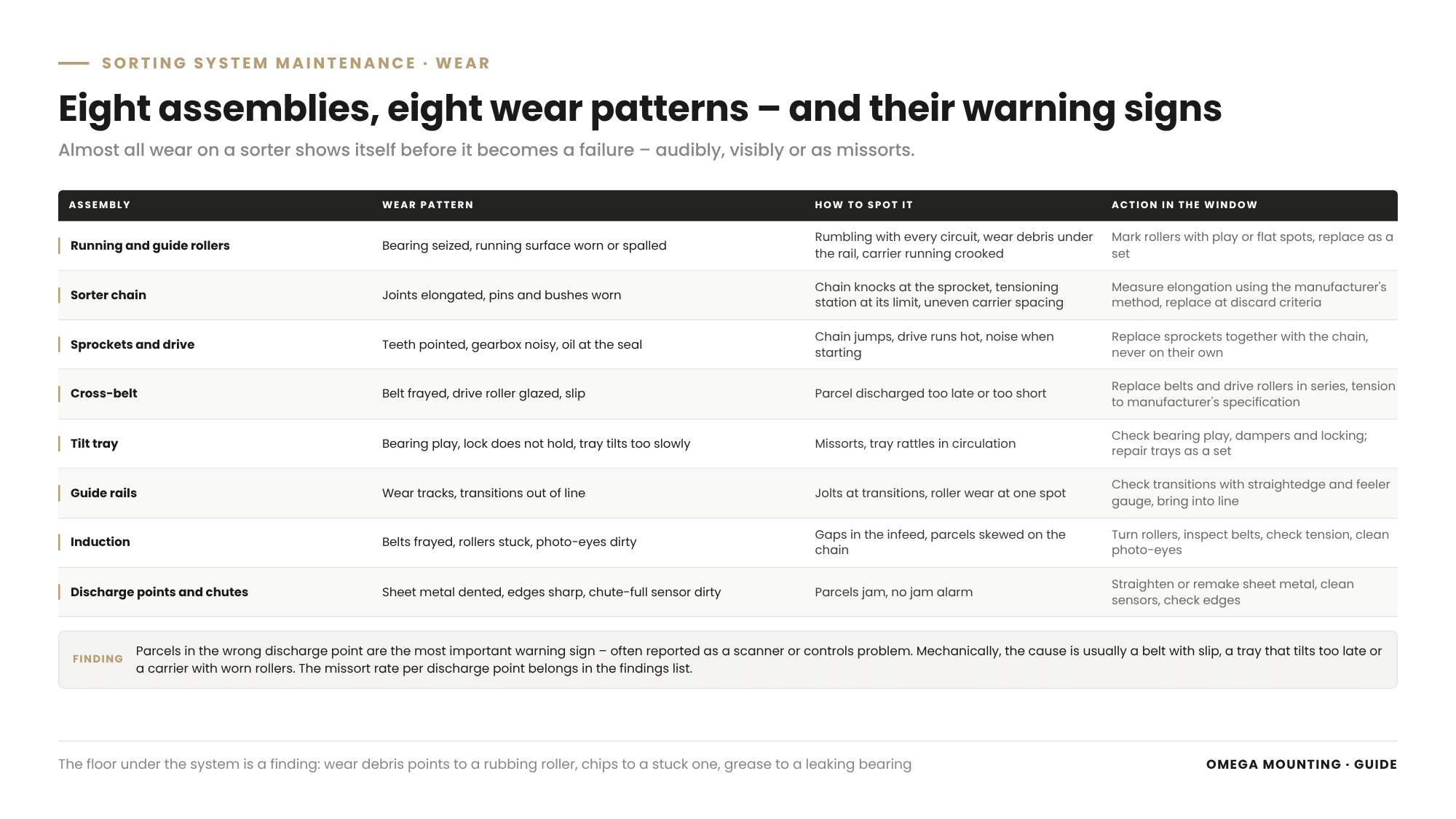
On a sorting system, the first parts to wear are those that move in every circuit: running and guide rollers, chain joints and sprockets, cross-belts with their drive rollers, tray bearings and locking mechanisms, current collectors and the belts of the induction. Almost every one of these processes shows itself before it turns into a failure.
| Assembly | Wear pattern | How to spot it |
|---|---|---|
| Running and guide rollers | Bearing seized, running surface worn or spalled | Rumbling with every circuit, wear debris under the rail, carrier running crooked |
| Sorter chain | Joints elongated, pins and bushes worn | Chain knocks at the sprocket, tensioning station at its limit, uneven carrier spacing |
| Sprockets and drive | Teeth pointed, gearbox noisy, oil at the seal | Chain jumps, drive runs hot, noise when starting |
| Cross-belt | Belt frayed, drive roller glazed, slip | Parcel discharged too late or too short |
| Tilt tray | Bearing play, lock does not hold, tray tilts too slowly | Missorts, tray rattles in circulation |
| Guide rails | Wear tracks, transitions out of line | Jolts at transitions, roller wear at one spot |
| induction | Belts frayed, rollers stuck, photo-eyes dirty | Gaps in the infeed, parcels skewed on the chain |
| Discharge points and chutes | Sheet metal dented, edges sharp, chute-full sensor dirty | Parcels jam, no jam alarm |
A missort is a finding
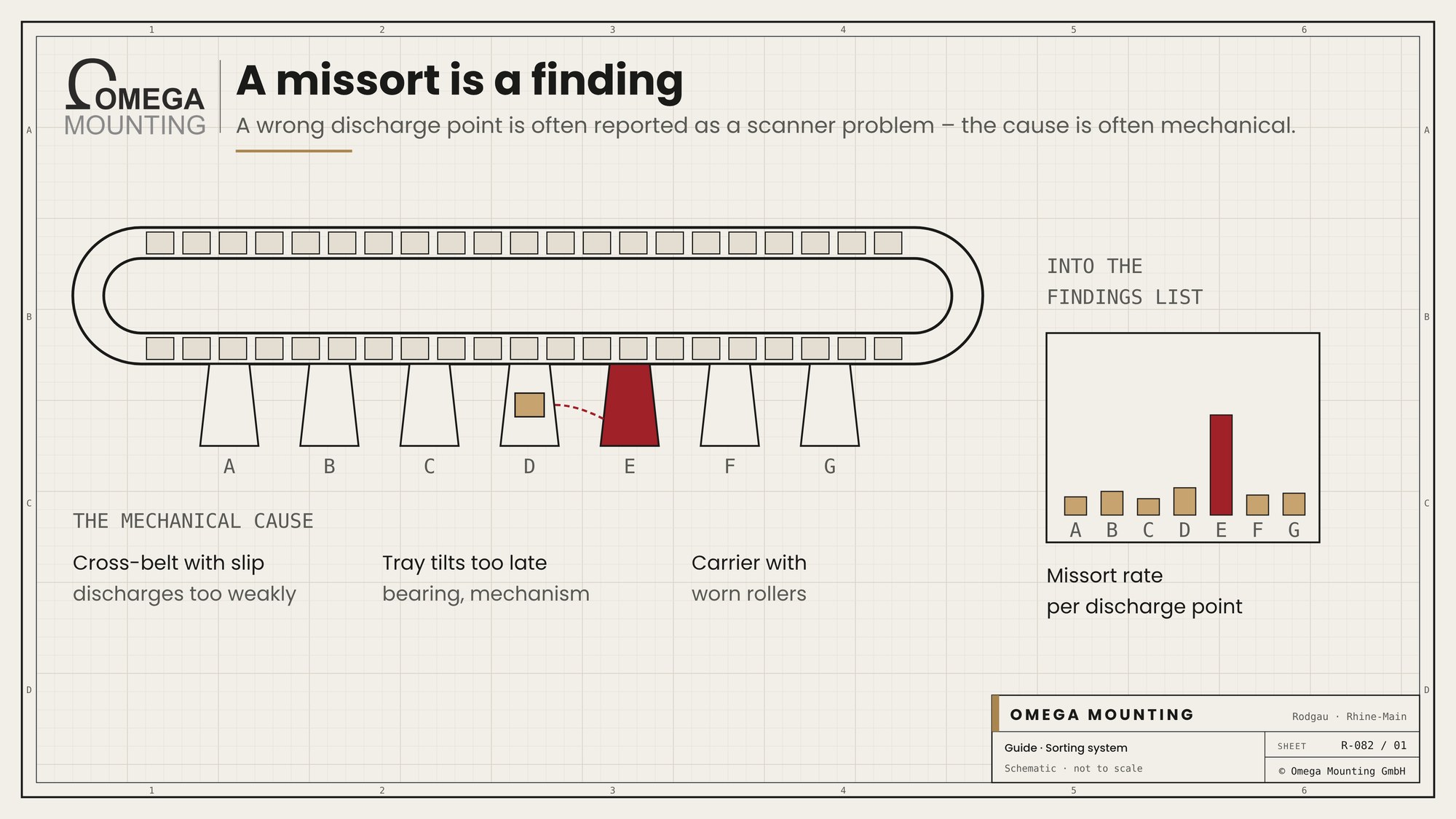
The most important warning sign on a sorter is not a noise but a number: parcels that end up in the wrong discharge point or are not discharged at all. This is often reported as a controls or scanner problem. Mechanically, the cause is often a belt with slip, a tray that tilts too late or a carrier with worn rollers. That is why the missort rate per discharge point belongs in the findings list. How operators hear and feel wear is described in our guide to spotting wear on machines.
How do you maintain the running gear, drive and guides of a sorter?
You maintain the running gear, drive and guides of a sorter by checking running and guide rollers by hand during a shutdown and replacing them if they show play or flat spots, assessing chain and sprockets as a pair, setting the chain tension to the manufacturer's specification and keeping the rail transitions in line. The principle is the same as on an overhead conveyor – only faster and with more carriers.
Running and guide rollers
Each sorter carrier runs on running wheels and is guided sideways by guide rollers. A roller whose bearing seizes becomes a brake and a rubbing point. It wears, goes out of round and strikes the rail on every circuit. That is why the first question on every inspection list is: does every roller turn freely? During a secured shutdown the carriers are turned through section by section, rollers with play or flat spots are marked and replaced as a set in the next window. Letting rollers “run in” is not an option – they take the rail with them.
Chain, sprockets and tension
The sorter chain elongates because pins and bushes rub against each other in every joint. Elongated chains jump on the sprocket, change the carrier spacing and run the tensioning station to its limit. Measure the elongation using the manufacturer's method and replace the chain when it reaches its discard criteria – the limit beyond which the chain may no longer be used. Sprockets with pointed teeth are replaced together with the chain, never on their own. What elongation, discard criteria and lubrication mean in detail is explained in our guide to wear on conveyor chains. For geared motors, bearings and couplings, see our guide to the maintenance of drives, gearboxes and pumps. Linear drives are the manufacturer's responsibility; there we only check fixings and cleanliness.
Guides, rails, transitions
Rails wear at the points where the rollers follow the same track on every circuit – in curves, on inclines, at transitions. A transition out of line creates a jolt that wears rollers and joints faster at exactly that point. That is why transitions are checked with a straightedge and feeler gauge, brackets for cracks and bolted joints for tightening torque. On an overhead conveyor around thirty years old, we offset worn running rails by several centimetres instead of replacing them – more on that in the practice section. Lubrication follows a plan, not gut feeling; what that plan looks like is shown in our guide to the lubrication schedule in maintenance.
How do you maintain cross-belts and tilt trays?
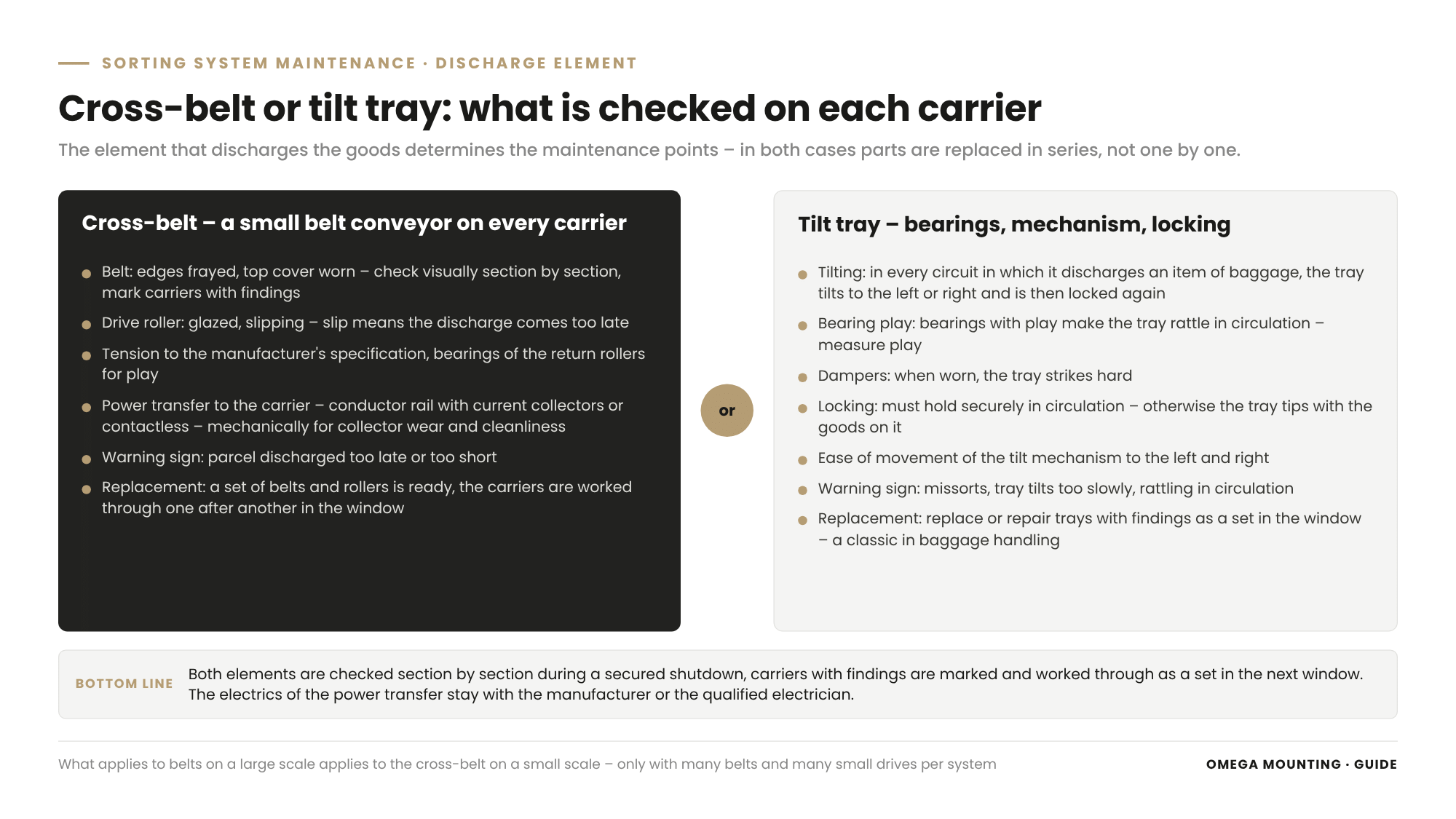
Maintain cross-belts like many small belt conveyors: check the belt for edges and top cover, the drive roller for slip and lagging, the tension to the manufacturer's specification and the bearings of the return rollers for play. Maintain tilt trays at the bearings, tilt mechanism and locking: measure play, check dampers, check that the lock holds securely in circulation.
Cross-belts: belt, drive roller, tension
A cross-belt has the same wear as a belt conveyor, only on a small scale: frayed edges, a worn top cover, a drive roller that has become glazed and slips. Slip on the cross-belt means a discharge that comes too late. That is why belts are checked visually section by section and carriers with findings are marked. Replacement is done in series, not one by one: a set of belts and rollers is ready, and the carriers are worked through one after another during the window. The power transfer to the carrier – conductor rail with current collectors or contactless – is checked mechanically for collector wear and cleanliness; the electrics are handled by a qualified electrician, from our team if you wish. What applies to belts on a large scale is covered in our guide to conveyor belt maintenance.
Tilt trays: bearings, mechanism, locking
A tilt tray tilts in every circuit in which it discharges an item of baggage and is then locked again. Bearings with play make the tray rattle, worn dampers make it strike hard, and a lock that does not hold tips the tray in circulation – with the goods on it. Bearing play, damper condition, ease of movement and secure locking are checked. Trays with findings are replaced as a set or repaired during the window.
What does maintenance at the induction, discharge points and chutes involve?
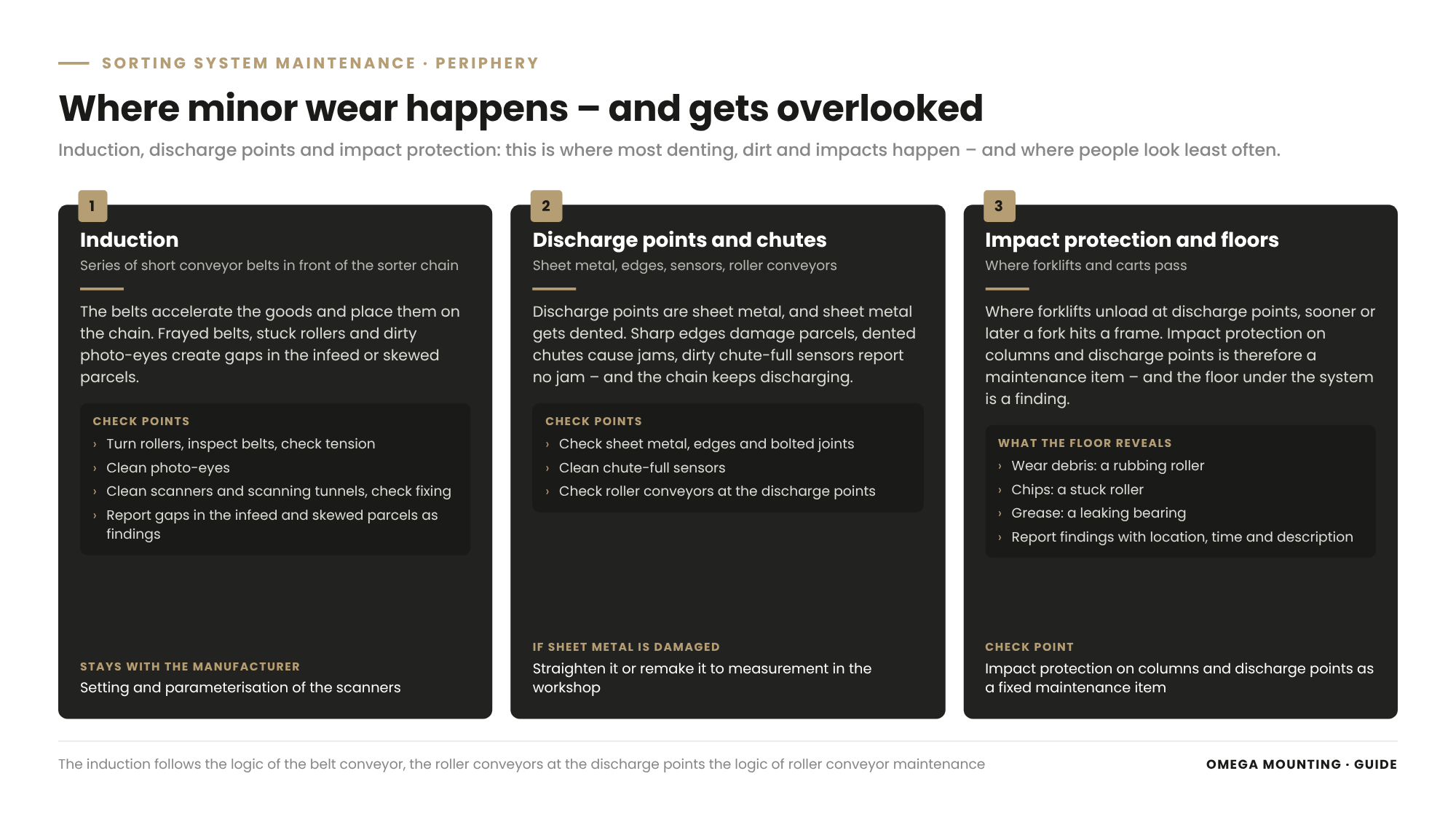
Maintenance at the induction, discharge points and chutes covers the belts and rollers of the induction, cleaning of scanner windows and photo-eyes, the sheet metal, edges and chute-full sensors of the discharge points, and the impact protection wherever forklifts or carts pass. This is where most minor wear happens – and where it is most often overlooked.
induction
The induction is a series of short conveyor belts that accelerate the goods and place them on the chain. Frayed belts, stuck rollers and dirty photo-eyes create gaps in the infeed or skewed parcels. Maintenance follows the logic of the belt conveyor: turn rollers, inspect belts, check tension, clean photo-eyes. Scanners and scanning tunnels are cleaned and checked for secure fixing; setting and parameterisation stay with the manufacturer.
Discharge points and chutes
Discharge points are sheet metal, and sheet metal gets dented. Sharp edges damage parcels, dented chutes cause jams, dirty chute-full sensors report no jam – and the chain keeps discharging. Sheet metal, edges, bolted joints, sensors and the roller conveyors at the discharge points are checked; see also our guide to roller conveyor maintenance. We straighten damaged sheet metal or remake it to measurement in our workshop in Rodgau.
Impact protection and floors
Where forklifts unload at discharge points, sooner or later a fork hits a frame. Impact protection on columns and discharge points is therefore a maintenance item. And the floor under the system is a finding: wear debris points to a rubbing roller, chips to a stuck one, grease to a leaking bearing.
Which safety rules apply to sorting system maintenance?
For sorting system maintenance the rule is: any work on the chain, carriers, belts, trays, guides and discharge points takes place only on a section that has been stopped, isolated and secured against restarting. Access points stay secured during operation, emergency stop buttons are never bypassed and are tested after every maintenance job, and the electrics are a matter for a qualified electrician.
A sorter has many draw-in points – between carriers, at sprockets, at transitions – and it runs fast. In its chapter on continuous conveyors, DGUV Rule 100-500 states that draw-in points must be guarded, emergency stop devices must be within reach and maintenance work is only permitted with the conveyor stopped. In practice: an access door whose contact has been bypassed “for cleaning” is a defect that calls continued operation into question. The safety standard DIN EN 619 is aimed at manufacturers of conveyors for parcels, containers and workpieces; for you it is the benchmark for extensions and conversions.
Isolation before every intervention

The German technical rule TRBS 1112 (maintenance) requires that, before work starts, it is defined how the system is isolated, secured against restarting and afterwards returned to service. For the sorter this means: the section is isolated at the main isolator or section isolator and secured with a padlock, and the key stays with the person working inside the system. An emergency stop button stops the system, but it does not secure it against restarting. If the neighbouring section keeps running, the isolation must genuinely separate the section – drive, controls, safety circuit. How to organise this is shown in our guide: Lockout tagout in maintenance.
The safety circuit grows with the system
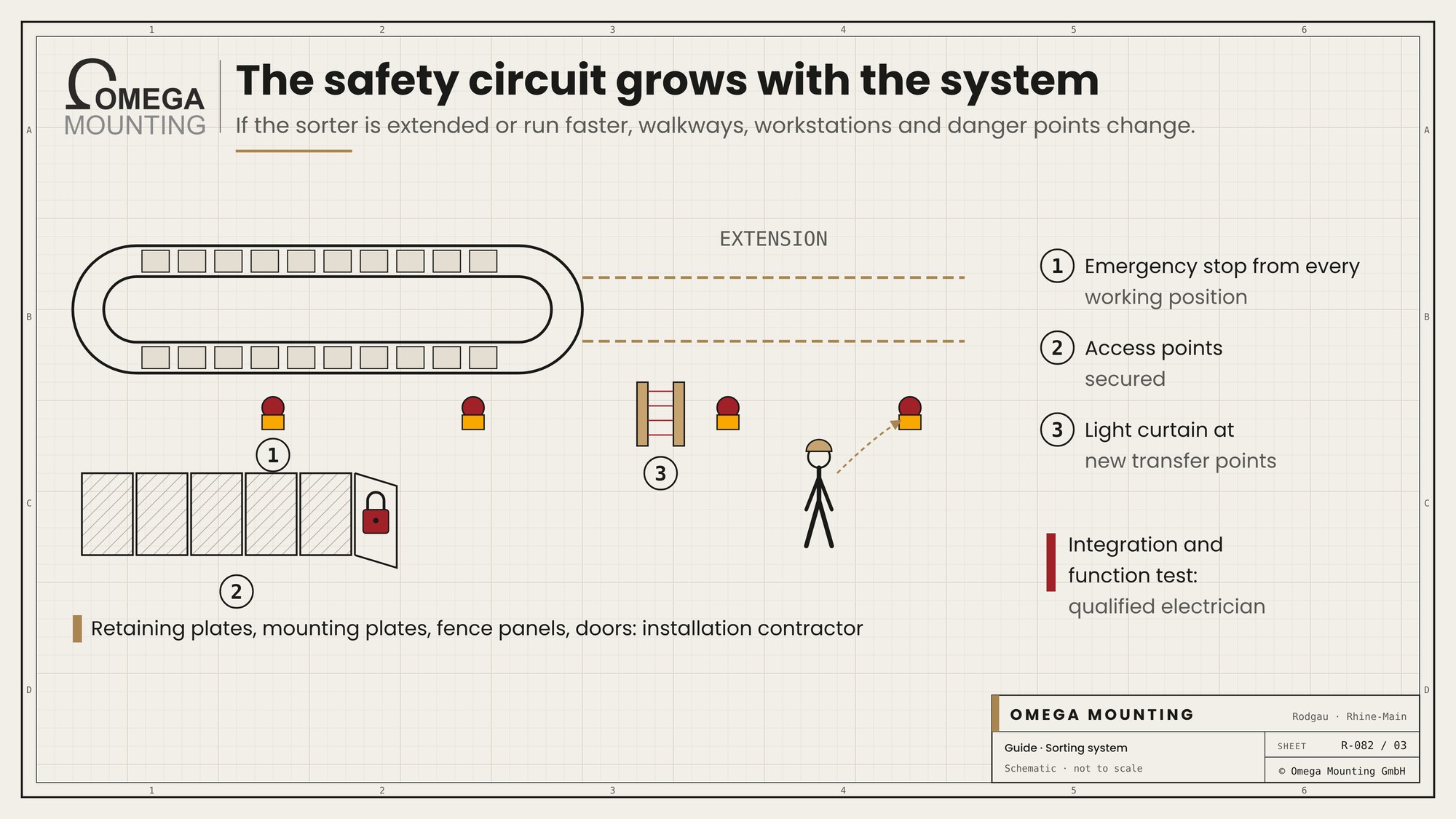
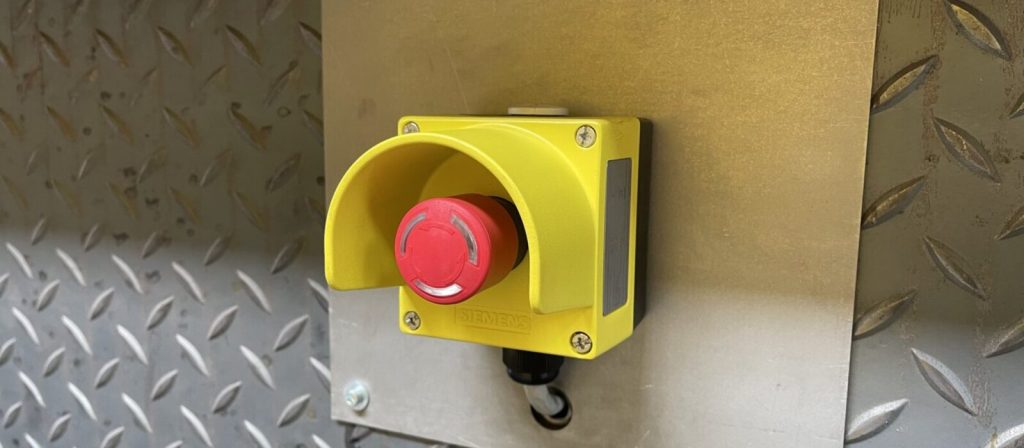
If a sorter is extended or run faster, walkways, workstations and danger points change. Emergency stop buttons must then be reachable from every working position, access points secured and light curtains fitted at the new transfer points. The German technical rule TRBS 1115 (safety devices) makes it clear that safety devices must not be bypassed – and that they are tested after changes. Mechanically, this means retaining plates, mounting plates, guard fence panels and doors; electrically, integration into the safety circuit with a function test of every element. Work on electrical installations is carried out only by qualified electricians – as laid down in DGUV Regulation 3. Our guide to retrofitting safety devices explains when a retrofit becomes a substantial modification. This guide is not legal advice; what your sorter needs follows from your risk assessment.
How does sorting system maintenance fit into the shutdown periods of continuous operation?
Sorting system maintenance fits into continuous operation if you divide the system into sections that can be isolated, sort the work by window length and do everything that does not need a shutdown in advance. Short windows at the start or end of the day cover visual checks, cleaning and small parts; weekend windows cover series work on rollers, belts and trays; the annual overhaul covers dismantling.
The Industrial Safety Ordinance (BetrSichV) requires the employer to define in the risk assessment which checks and inspections a piece of work equipment needs, and at what intervals. In practice: the three types of window are the form in which you make this definition – and the proof that it is being met.
Three windows, three levels
- While running, from the outside: Operators and shift supervisors walk along the sorter without touching anything. Is the chain running smoothly? Is a carrier knocking? Is there wear debris under the rail? Are discharge points jamming? Anything noticeable is reported with location, time and description.
- During a secured shutdown: Maintenance isolates the section and checks what cannot be checked while running – turning rollers, measuring chain elongation, inspecting belts and trays, checking transitions, testing safety devices. Every finding gets a grade: OK, finding without immediate action, defect with action.
- During the overhaul: Drives are dismantled, chain sections and sprockets replaced, carrier sets overhauled, rails surveyed. This is where an installation partner with more hands and lifting gear joins in. How to plan such an overhaul is described in our guide to planning annual overhauls and shutdowns.
Pre-assembly and fallback
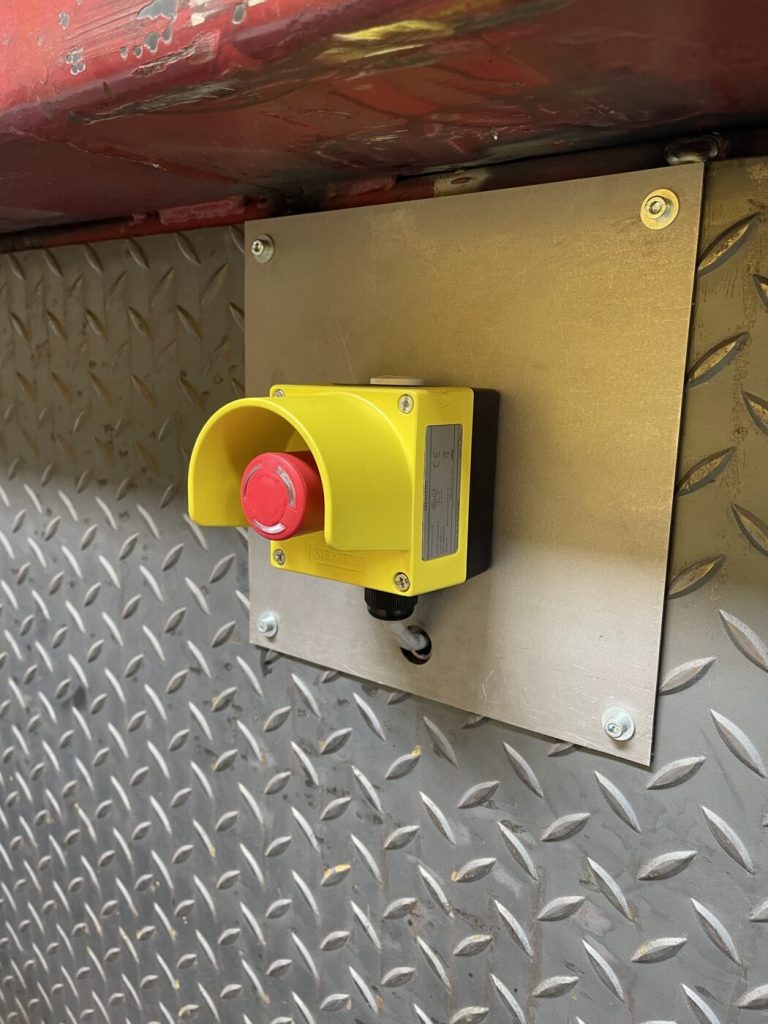
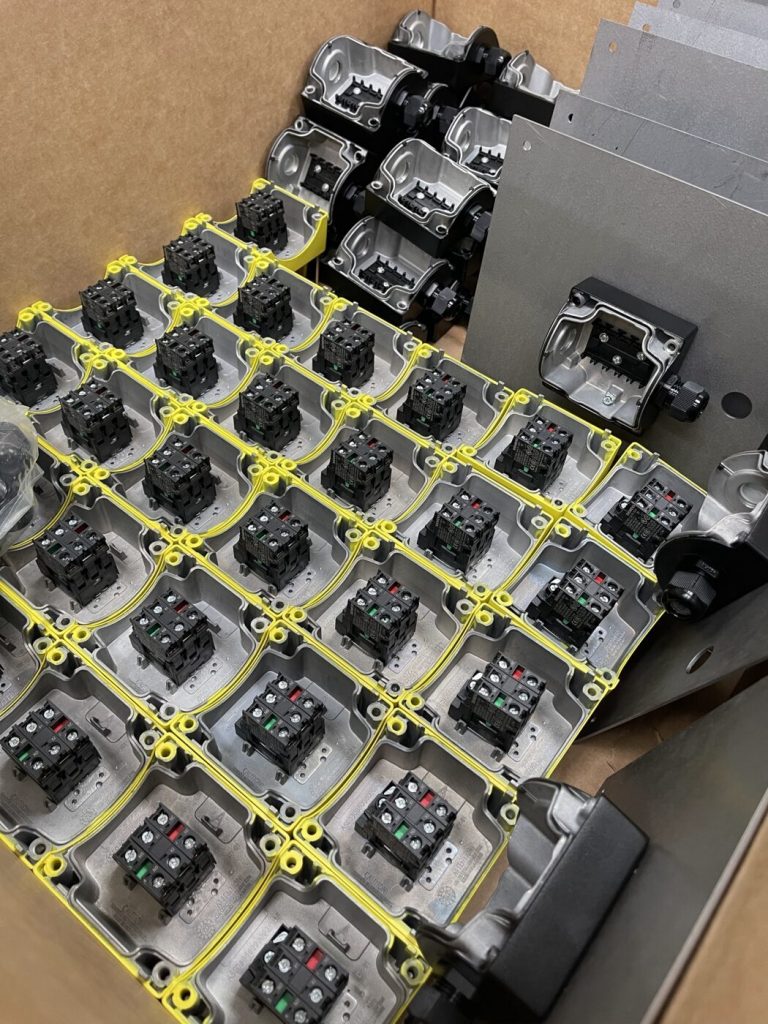
Whatever can be prepared is prepared: roller sets, belts and trays counted and allocated to the section, retaining plates made to measurement, housings fitted with cable glands and labels. On a sorting system at Frankfurt Airport, this was exactly why 32 emergency stop buttons fitted into the shutdown periods over two working days. And for every window it is clear beforehand what happens if the work is not finished: the old carrier set stays ready for use, the section can be run in bypass, and the manufacturer can be reached for the return to service.
Spare parts before the window
A sorter stops when a part is missing – not when a part is broken. Rollers of every type installed, chain links and sprockets, belts and drive rollers, tray bearings and dampers, current collectors, emergency stop buttons and door contacts belong on the shelf. What the manufacturer no longer supplies, our workshop in Rodgau remakes from a sample or measurements; what to bear in mind is covered in our guide to spare parts that are no longer available. How a manufacturer's manual and a findings list become an annual plan is shown in our guide to creating a maintenance plan.
What applies to contractors in the security area at the airport?
For contractors in the security area at the airport: access is only granted with passes applied for in advance and a background check under German aviation security law, tools and materials are checked, fitters are escorted or inducted, and the window is as long as operations allow. If you only sort this out at the gate, you lose the working day.
Many sorting systems in the Rhine-Main region are at Frankfurt Airport – in baggage handling and in parcel and cargo handling. There, organisation decides whether a maintenance job succeeds: which fitters have been vetted? Which tools have been registered? Who escorts? When does the window really end? What needs organising is described in our guide to installation at airports and in security areas; the specifics of maintenance there are brought together in our guide to maintenance at Frankfurt Airport.
For the operator this means: contractors are brought into the maintenance plan before the window is fixed. Site induction, sign-off, permit to work and isolation are handled through the site manager or the operator's responsible person; how this is organised is shown in our guide to contractor management. For the installation contractor this means: pre-assembly outside the security area, complete parts lists, no surprises at the checkpoint.
When is it no longer maintenance but a retrofit?
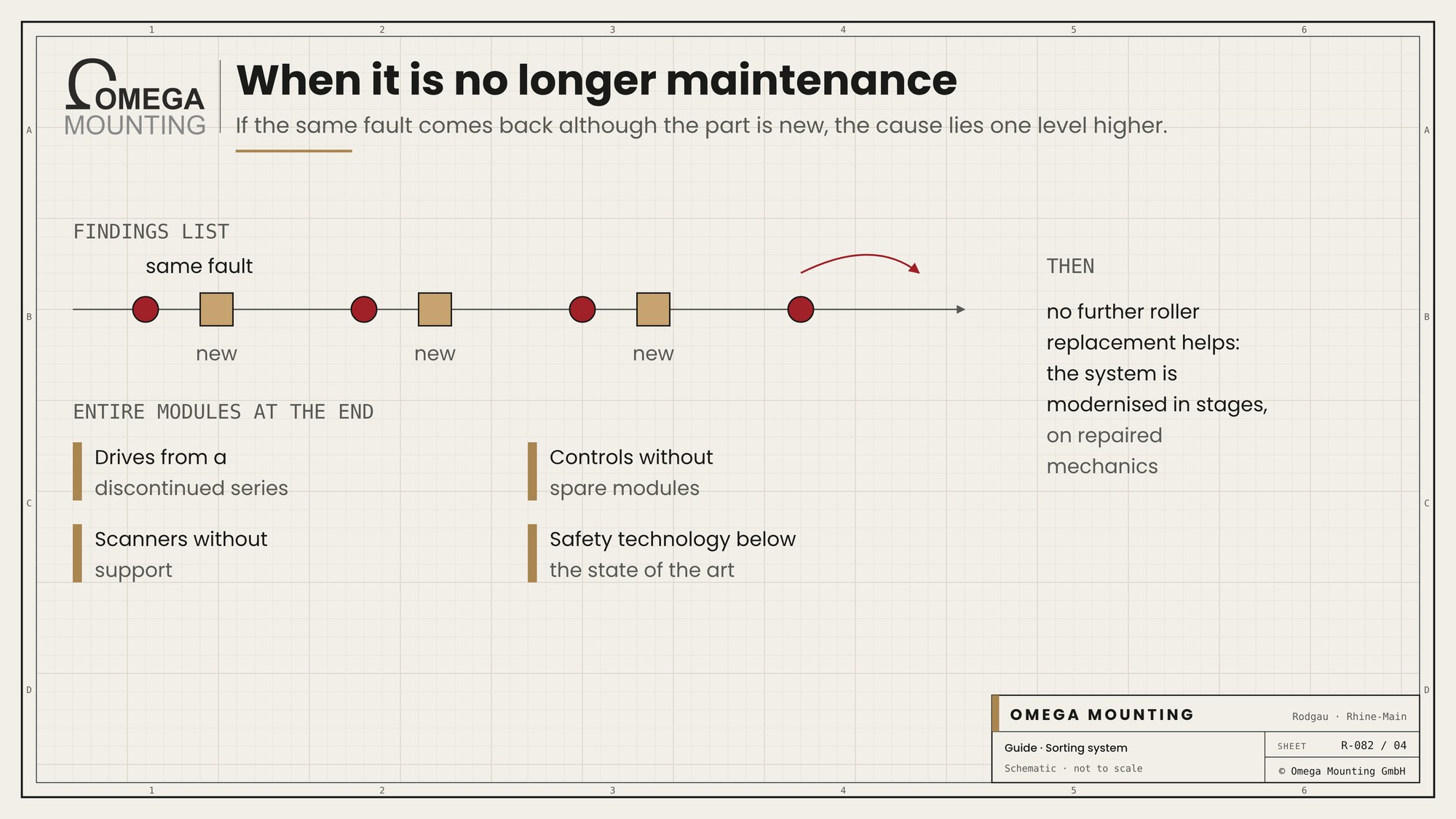
It is no longer maintenance but a retrofit when it is not individual wear parts but entire modules that have reached the end of their life: drives from a discontinued series, controls without spare modules, scanners without support, safety technology below the state of the art. Then no further roller replacement will help – the system is modernised, in stages, on mechanics that have been repaired first.
The boundary shows in the findings list: if the same fault keeps coming back even though the part is new, the cause lies one level higher. When a retrofit pays off instead of a new system, and who takes on what, is described in our guide to retrofitting conveyor systems. If the sorter is down right now, start with our guide to troubleshooting on conveyor systems.
How we do it in the Rhine-Main region
For us, sorting system maintenance in the Rhine-Main region means: parcel and logistics centres near Frankfurt, Offenbach and Hanau, distribution warehouses in Dietzenbach and Rodgau, and Frankfurt Airport with baggage and cargo handling. The systems run continuously, the windows are short, and at the airport the security organisation comes on top.
Our jobs start with a site visit: condition of running gear, chain, belts or trays, guides, discharge points and safety circuit, possible windows. This results in a findings list with priorities. With us you get mechanics, installation of safety devices with connection by our own mechatronics technicians, remade parts from our workshop in Rodgau, and coordination with the manufacturer and electrical contractor. Our fitters are prepared for deployment in airport and security areas and have been vetted for it. Our scope of services is set out on the pages Maintenance and servicing and Logistics.
Project examples
Three jobs from our project diary show the way of working behind every sorting system maintenance job: retrofitting the safety circuit during shutdowns, working with the parts that are there in a breakdown, and planning series work in weekend windows.
Frankfurt Airport: 32 emergency stop buttons within the shutdown periods of a sorting system
On a parcel sorting system at Frankfurt Airport, the system had been extended. With every new section, walkways and work areas change, and an emergency stop must remain reachable from every working position. For the retrofit of emergency stop buttons on the sorting system we sent two fitters covering mechanics and electrics. They installed 32 emergency stop buttons and several sensors, integrated them all into the existing safety circuit and tested their function – over two working days, during the day, within the system's shutdown periods.
The key was pre-assembly: retaining plates prepared to suit the installation situation, every housing fitted with a cable gland, terminals and labels, all units sorted by mounting point. In the window, all that was left was to mount, connect and test. For your sorting system this means: the safety circuit grows with the system, and retrofitting it fits into existing windows – if everything that can be done without a shutdown happens beforehand.
Frankfurt Airport: breakdown at the drive unit of a high-bay warehouse
A call from Frankfurt Airport: a high-bay warehouse had stopped, and the caller only knew that nothing was running any more. During the emergency call-out to the high-bay warehouse at the airport the first thing noticed on site was that a roller conveyor was no longer conveying. That narrowed down the source of the fault: a worn gear in the drive unit had caused the drive chain to jam and partly jump off. The chain conveyor had stopped, and with it the entire high-bay warehouse. Because the operator had suitable spare parts on site, the repair began immediately: dismantle the chain conveyor, replace drive chains and gears with new parts, reassemble, adjust the chain and travel systems, put back into operation.
For your sorter this means: chain and sprockets are replaced as a pair and kept on the shelf as a set. And a drive unit that can bring a whole system to a stop belongs in preventive maintenance, not on the fault list.
Weekend windows: around a hundred switches of an overhead conveyor in series
With the maintenance of an overhead monorail system in Frankfurt we were dealing with a system around thirty years old with about a hundred switches in two production areas. It is directly integrated into production; at times the window was around 36 hours between the end of production on Saturday and restart on Monday. We found worn and torn-off rollers, worn running rails, transitions out of line, damaged brackets and switches taken out of service. Every switch was inspected, documented and prioritised by condition and importance for production. Repairs then followed over several weekend shutdowns: replacing rollers and switch shoes, aligning rails, resetting end positions, welding brackets, checking switch motors and limit switches. Where possible, worn running rails were offset by several centimetres so that the end positions moved onto less worn areas.
For your sorting system this means: series work on many identical assemblies succeeds with findings, prioritisation and parts set aside in advance – window by window, without complete replacement. More on this type of system in our guide: Overhead conveyor maintenance and repair.
Sorting system maintenance at your site: is an overhaul, a retrofit or a breakdown coming up?
Then get in touch with us. On a site visit in Frankfurt, Offenbach, Hanau or elsewhere in the Rhine-Main region, we walk through your sorter with you. Afterwards we tell you honestly what your team can take on itself, what belongs in a window and where the manufacturer or a qualified electrician is needed.
What this means for your role
For buyers: For every sorting system, ask for the spare parts list, the roller and carrier list and the manufacturer's maintenance specifications as part of the delivery. For maintenance contracts, what counts is whether the provider delivers mechanics, installation of safety devices and coordination with the manufacturer and electrical contractor from one contractor – and whether they say where their scope ends.
For designers: Accessibility decides tomorrow's maintenance. Plan sections that can be isolated individually, access doors with room for a fitter and a carrier set, standing areas for lifting gear at drives, and impact protection at every discharge point where forklifts operate.
For project managers and site managers: As project manager, you include the reference condition in the handover documentation: chain elongation, rail alignment, roller list, function test of the safety circuit. As site manager, you coordinate isolation, induction and sign-off within the window – and keep the fallback ready when the manufacturer, electrical contractor and installation contractor are in the system at the same time.
For maintenance managers: Define the three inspection levels for each section, with the person responsible and the window, in the risk assessment and maintenance plan. Keep a findings list with missort rate, chain elongation and roller replacement. And treat recurring faults as a retrofit question, not a spare parts question.
For warehouse and logistics managers: Your sorter runs in shifts that do not belong to maintenance. Include the walk-round while running in the shift handover, give the team a reporting route for knocking carriers and jamming discharge points, and decide which windows operations can really release – better honestly short than planned long.
For facility managers and operators: You bear the operator's responsibility for risk assessment, inspections and contractors. Make sure contractors are brought in before the window – at the airport with access and background checks – and that every maintenance job ends with a findings list and a tested safety circuit.
Sorter maintenance plan: template on request
The sorter maintenance plan is a two-page template per assembly of a sorting system – induction, sorter chain and running gear, drive, cross-belts or tilt trays, guides, discharge points, scanners and sensors as a cleaning and visual check item, safety circuit. For each check point it lists the type of check, responsibility, window and record. It deliberately contains no sample intervals – those belong to your system and your manufacturer. Request the plan via our contact form – keyword “Sorter maintenance plan”.
Why Omega Mounting?
We are based in Rodgau near Frankfurt, can be reached by phone (Mon–Fri 9 am–3 pm) and WhatsApp, and have our own workshop for rollers, sheet-metal parts and brackets that the market no longer supplies. The linked jobs show how we work in conveyor technology: at Frankfurt Airport, pre-assembly made 32 emergency stop buttons fit into two working days within the shutdown periods. At the high-bay warehouse, the breakdown repair started immediately because the parts were there. On the overhead conveyor, around a hundred switches were brought to a sound condition over several weekend windows. In practice: one point of contact for findings, running gear, chains, belts and trays, safety retrofits and remade parts, a clear statement of where the manufacturer and the qualified electrician take over, short distances in the Rhine-Main region – and a findings list after every job. If you want that for your sorter, get in touch.
Conclusion
Sorting system maintenance means taking seriously a system that must never stop: running gear, chain, belts or trays, guides and discharge points show their wear pattern in circulation before it becomes a failure. Inspection runs on three levels, the safety circuit grows with every extension, and the work fits into the windows of continuous operation – provided sections, pre-assembly and spare parts are in place beforehand. If you would like to know how your sorter looks from an installation contractor's point of view, send us the type, location and age of the system, last year's faults and your shutdown windows – we will get back to you with an honest assessment of what comes first.
Further reading: New in the knowledge base: Extending a sorting system.
Planning a move-in, installation or maintenance in the Rhine-Main region?
Tell us briefly what you need – we'll come back with an honest assessment.
Free, no-obligation callback
You may also be interested in these guides
Maintenance & Servicing
Maintenance & Servicing

About the author
Tobias Schott
Managing director of Omega Mounting GmbH, Rodgau · more than 20 years of hands-on experience in installation and maintenance
A trained mechatronics technician, working in maintenance, servicing and industrial installation since 2004 – first alongside his father, and with Omega Mounting since 2012: from overhead conveyors in Frankfurt to the crane system in a new-build hall. He plans and leads lifting operations as an appointed person (AP) in data centers and on industrial sites in the Rhine-Main region, trains and examines operators of cranes, mobile elevating work platforms and telehandlers, and is a qualified occupational safety specialist. On jobs abroad he is known as the “German Troubleshooter” – the person you call when a site gets stuck. He learned what quality means from his father, not from a manual: Made in Germany as a standard for his own work, not a label. That is why quality comes first at Omega Mounting – ahead of speed and price. He writes these guides from that practice: what works on our sites is in them – what exists only on paper is not.
Frequently asked questions
There is no universal figure: the interval comes from the manufacturer's specifications, running time, goods and environment, and is set in your risk assessment. A proven approach is to separate three levels: visual and listening checks while running by the operators, inspection during a secured shutdown by maintenance in short windows, and dismantling during the annual overhaul.
The running and guide rollers of the carriers, the joints of the sorter chain, the cross-belts themselves and their drive rollers. A belt with slip discharges too late, a worn roller strikes the rail, an elongated chain jumps on the sprocket. All three give warning – as missorts, as noise with every circuit or as wear debris under the rail.
On a tilt-tray sorter, the focus is on the bearings, tilt mechanism, dampers and locking of every tray. A lock that does not hold tips the tray in circulation – with the item of baggage on it. Bearing play, dampers, ease of movement and secure locking are checked; trays with findings are replaced as a set or repaired during the window.
Mechanics – running gear, chain, belts, trays, guides, discharge points, impact protection – are handled by an installation contractor or your own team. Controls, sorting logic, scanner settings, linear drives and safety controls belong to the manufacturer. Power supply, electrical testing and integration into the safety circuit belong to the qualified electrician. After changes, safety functions are tested by a competent person (befähigte Person).
Any work on the chain, carriers, belts, trays, guides and discharge points takes place only on a section that has been stopped, isolated and secured against restarting – as required by TRBS 1112. An emergency stop button stops the system, but it does not secure it against restarting. Safety devices are never bypassed and are tested after every maintenance job; this guide is not legal advice.
In sections that can be isolated individually, and with work sorted by window length. Short windows at the start or end of the day cover visual checks, cleaning and small parts, weekend windows cover series work on rollers, belts and trays, and the annual overhaul covers dismantling. Pre-assembly outside the system, parts sets set aside in advance and a fallback for each window keep shutdown times short.
Access is only granted with passes applied for in advance and a background check, tools and materials are checked, fitters are escorted or inducted, and the window is as long as operations allow. Contractors are therefore brought in before the window. Our fitters are vetted for work in the security area; on a parcel sorting system at Frankfurt Airport, two fitters retrofitted 32 emergency stop buttons over two working days within the shutdown periods.
Yes, the three inspection levels, the findings list, the safety rules and the spare parts logic are the same; the wear patterns shift. On baggage handling systems the focus is on tilt trays and transfers, on roller conveyors on roller bearings and drive belts, on overhead conveyors on running wheels, switches and conductor rails.
With a short enquiry giving three details: type, location and age of your sorter, last year's faults and the shutdown windows your operation can release. We arrange a site visit – from Rodgau to Frankfurt, Offenbach, Hanau, Darmstadt or the airport – walk through the system with you and send you a written assessment of what your team can take on itself and what belongs in the next window. Your contact is Tobias Schott – reachable via our contact form.
 English
 German