
- Guide – Maintenance
Conveyor systems at a glance: types, applications and maintenance
By Tobias Schott · 24-minute read · Updated October 2026
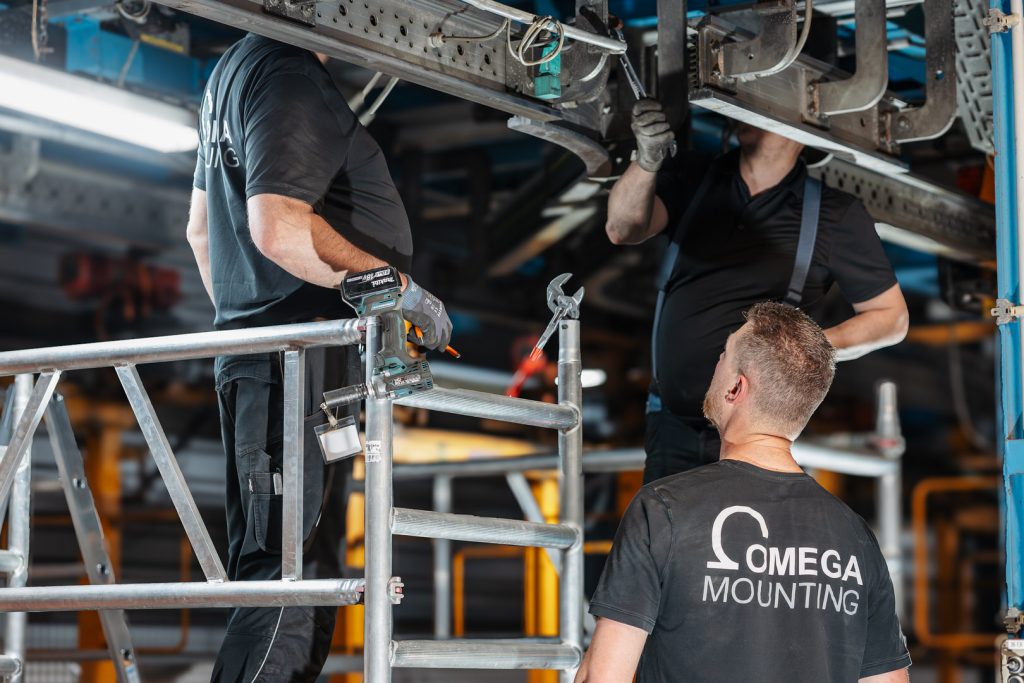
Conveyor systems are conveyors: electrified monorails, power and free, belt, roller, chain and skid conveyors move goods along a fixed route through warehouses and production. Each type has its own field of use, its own wear pattern and its own maintenance effort. If you know the type, you know where the inspection list starts – and which partner can work through it.
The tender says “conveyor”, the quotation says “conveyor technology”, and on the shop floor it is “the belt”. They all mean the same thing: a system that moves parcels, totes, car bodies or pallets from A to B. Conveyor systems are the backbone of the material flow in logistics centres near Frankfurt, in production plants in Hanau and at the airport. When the conveyor stops, the operation stops.
The types differ more than the umbrella terms suggest. An electrified monorail has switches, conductor rails and trolleys. A belt conveyor has pulleys, rollers and a take-up. Wear patterns, spare parts, access and the windows available for maintenance differ just as much.
This guide gives planners, buyers, project managers and maintenance managers an overview of conveyor systems: what is a conveyor system, which type suits which job, and what does maintenance mean for each type? It is the overview page for our in-depth guides. It is written from the point of view of an installation and maintenance contractor from Rodgau near Frankfurt that maintains, installs and modifies conveyor systems mechanically – and it says where the manufacturer, the controls contractor or a qualified electrician is needed.
Key points at a glance
- Conveyor is simply the English word for the German “Förderer”. Continuous conveyors move goods steadily along a fixed route; discontinuous conveyors such as the electrified monorail and the stacker crane travel individually in cycles.
- Overhead conveyors (electrified monorail, power and free) use the space below the ceiling. Floor-mounted conveyors (belt, roller, chain, skid) are easier to reach.
- The choice depends on the goods, the cycle, the layout, hygiene and the environment – and on how easily the system can be maintained later.
- Each type has three assemblies that set the maintenance plan: on the EMS the trolleys, switches and conductor rail; on the belt conveyor the belt, rollers and tension; on the chain conveyor the chain, sprockets and guides.
- All types share drives, the safety circuit, isolation before every intervention, cleaning, spare parts and shutdown windows.
- An installation contractor takes on the mechanical side, assembly replacement, modifications in existing systems and coordination – controls and electrics stay with the specialists responsible for them.
What is a conveyor system?
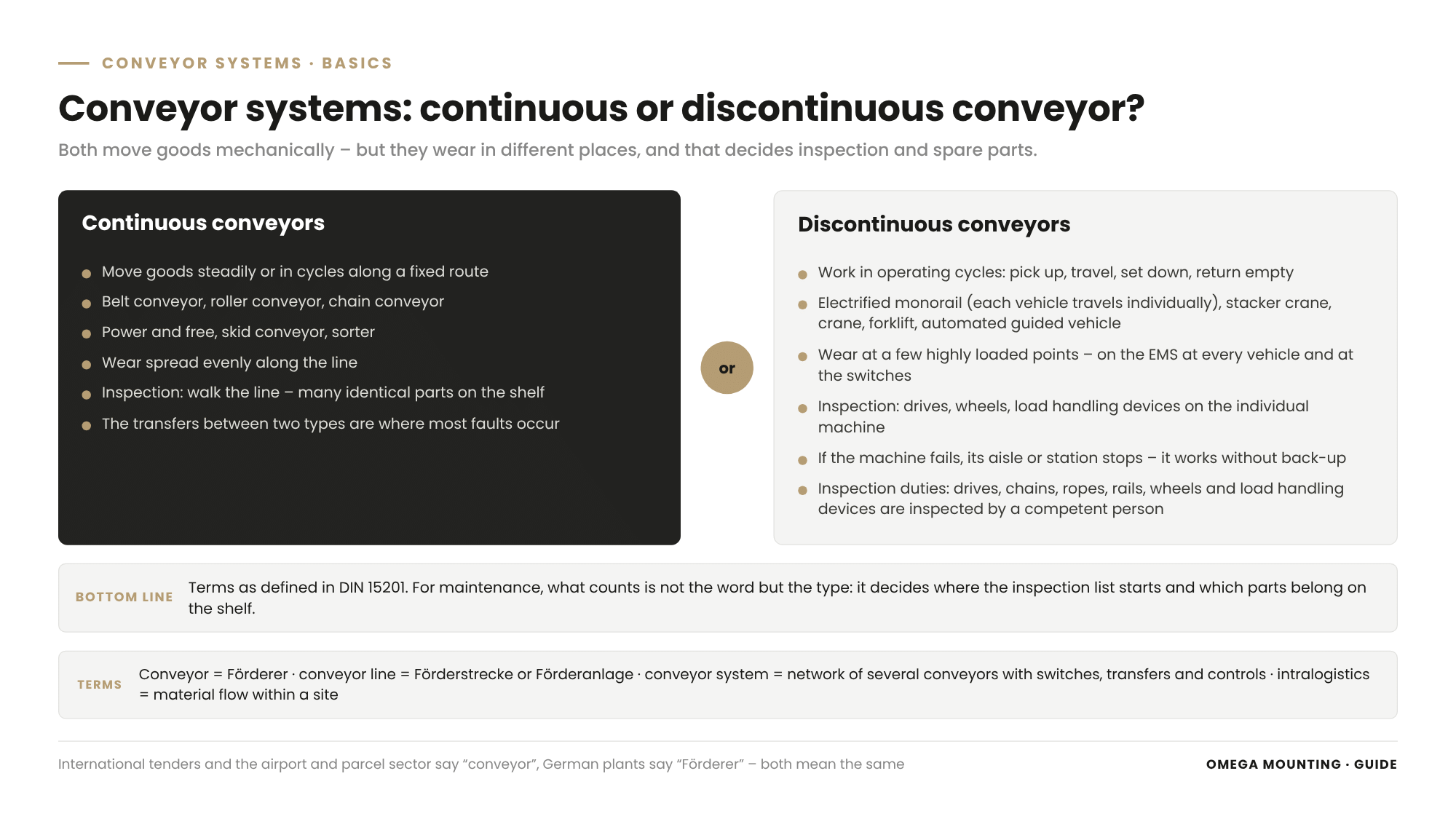
A conveyor system is a materials handling system that moves goods mechanically from one point to the next along a fixed route – powered or by gravity, overhead or on the floor, as a single line or as a networked system with switches, transfers and controls.
Conveyor is the English word for Förderer. In German usage the terms Förderer, Förderstrecke, Förderanlage and Fördertechnik are used; conveyor systems (Fördersysteme) are networks of several conveyors. In intralogistics – the material flow within a site – the term conveyor is common above all in tenders from international clients and in the airport and parcel sector.
Continuous and discontinuous conveyors
Conveyor technology has two basic kinds. Continuous conveyors move goods steadily or in cycles along a fixed route: belt conveyors, roller conveyors, chain conveyors, power and free, skid conveyors and sorters belong to this group. Discontinuous conveyors work in operating cycles – pick up, travel, set down, return empty: stacker cranes, cranes, forklifts and automated guided vehicles. The electrified monorail counts as a discontinuous conveyor even though it runs on a fixed rail: each vehicle travels individually with its own drive, stops at stations and is diverted via switches. The terms are defined in the standard DIN 15201. In practice, a continuous conveyor wears evenly along the line, a discontinuous conveyor at a few highly loaded points – on the electrified monorail at every single vehicle and at the switches. That decides inspection and spare parts.
Which conveyor systems are there – and which type suits which job?
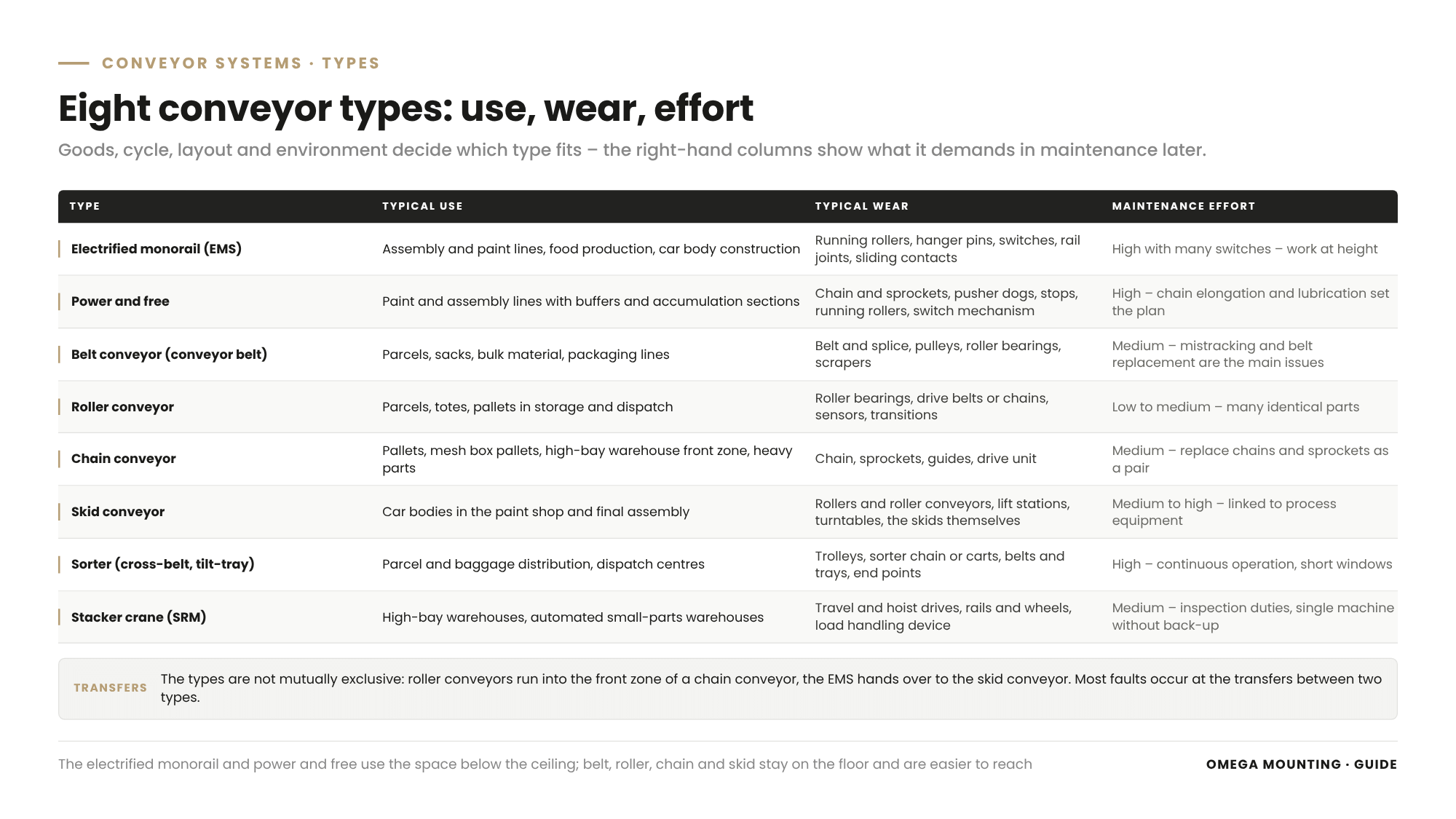
The main conveyor systems are the electrified monorail, the power and free conveyor, the belt conveyor, the roller conveyor, the chain conveyor, the skid conveyor and the sorter; which type suits depends on the goods, the cycle, the layout and the environment. The table sorts the types by use, strengths, typical wear and maintenance effort – qualitatively, without figures.
| Type | Typical use | Strengths | Typical wear | Maintenance effort |
|---|---|---|---|---|
| Electrified monorail (EMS) | Assembly and paint lines, food production, car body construction | Uses the space below the ceiling; vehicles run individually and can be controlled | Running rollers, hanger pins, switches, rail joints, sliding contacts | High with many switches; work at height |
| Power and free | Paint and assembly lines with buffers and accumulation sections | Accumulates and buffers without stopping the chain; robust in heat | Chain and sprockets, pusher dogs, stops, running rollers, switch mechanism | High – chain elongation and lubrication set the plan |
| Belt conveyor (conveyor belt) | Parcels, sacks, bulk material, packaging lines | Simple, quiet, suitable for many goods | Belt and splice, pulleys, roller bearings, scrapers | Medium – mistracking and belt replacement are the main issues |
| Roller conveyor | Parcels, totes, pallets in storage and dispatch | Modular, easy to reach, can be combined with accumulation zones | Roller bearings, drive belts or chains, sensors, transitions | Low to medium – many identical parts |
| Chain conveyor | Pallets, mesh box pallets, high-bay warehouse front zone, heavy parts | Carries heavy loads; insensitive to dirt | Chain, sprockets, guides, drive unit | Medium – replace chains and sprockets as a pair |
| Skid conveyor | Car bodies in the paint shop and final assembly | Carries defined transport frames safely through process stations | Rollers and roller conveyors, lift stations, turntables, the skids themselves | Medium to high – linked to process equipment |
| Sorter (cross-belt, tilt-tray) | Parcel and baggage distribution, dispatch centres | Distributes high volumes to many destinations | Trolleys, sorter chain or carts, belts and trays, end points | High – continuous operation, short windows |
| Stacker crane (SRM) | High-bay warehouses, automated small-parts warehouses | Stores and retrieves fully automatically at great height | Travel and hoist drives, rails and wheels, load handling device | Medium – inspection duties, single machine without back-up |
The types are not mutually exclusive: in a logistics centre in Dietzenbach, roller conveyors feed the front zone of a chain conveyor; in a car plant, the electrified monorail hands over to the skid conveyor. The transfers between types are where most faults occur.
Overhead conveyors: electrified monorail and power and free conveyor
Overhead conveyors carry the goods on trolleys that run in a rail below the hall ceiling; the electrified monorail drives each vehicle with its own motor, the power and free conveyor pulls trolleys with a circulating chain.
electrified monorail
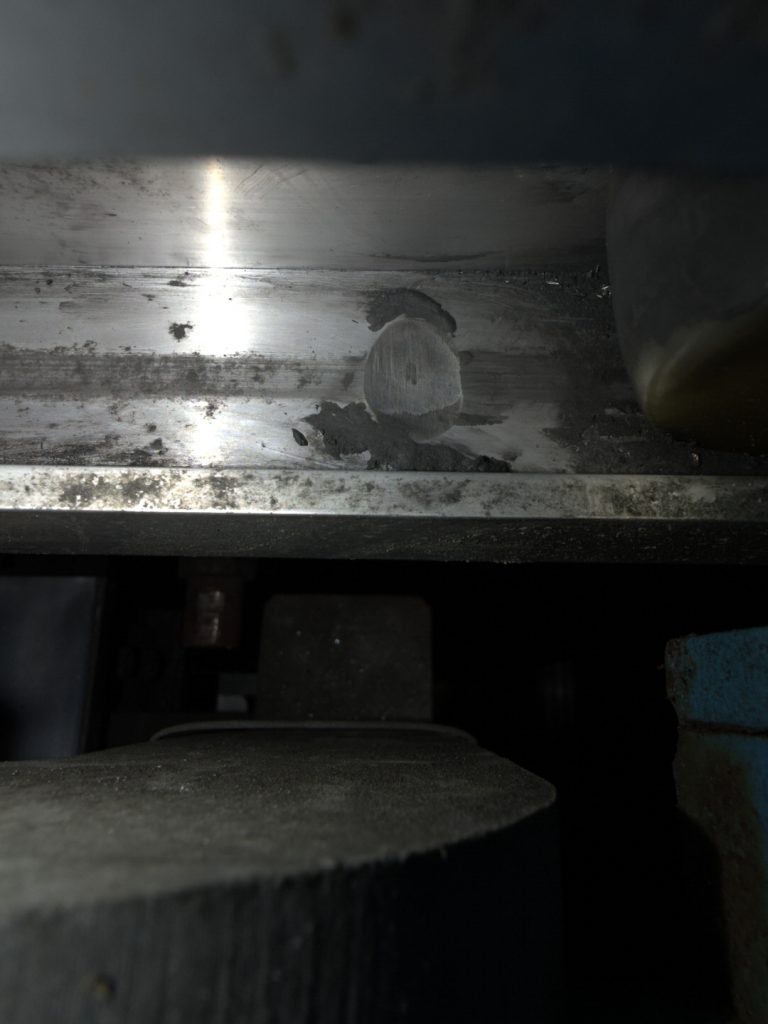
The electrified monorail consists of the track, trolleys with running rollers and a drive roller, carriers for the goods, switches, a conductor rail with sliding contacts for power and data, and the controls. Each vehicle travels individually and changes route via switches – flexible, but maintenance-intensive at running rollers, hanger pins, switch tongues, rail joints and carbon brushes.
Two jobs in the practice chapter show this. What to check on each assembly is set out in our guide to electrified monorail maintenance, and the short version for the walk-round is our EMS maintenance checklist. Whether a worn assembly is repaired or replaced is covered in the guide on Wear on the electrified monorail.
Power-and-free conveyors
On the power and free conveyor, a driven chain (power) runs in an upper rail. Below it, free trolleys (free) carry the goods in a second rail. Pusher dogs on the chain take the trolleys along; stops hold them without stopping the chain. This creates buffers in front of process stations – the reason why paint and assembly lines in Offenbach or Rüsselsheim use this type.
For maintenance, instead of many small drives there is one long chain with sprockets, a take-up and lubrication. Chain elongation, worn pusher dogs and stiff stops are the typical findings. More on this in our guide to power and free conveyor maintenance.
The question “electrified monorail or power and free” is answered by the process: changing routes with switches point to the EMS, buffers and heat on the same route point to power and free.
Floor-mounted conveyors: belt, roller, chain and skid conveyors
Floor-mounted conveyors carry the goods on a belt, on rollers, on chains or on transport frames and are therefore usually easier to reach than overhead conveyors – their weak points are bearings, drives, transitions and dirt from below.
Belt conveyor and conveyor belt
The belt conveyor is the simplest machine in the hall: an endless belt running over a drive pulley and a return pulley, carried by rollers, tensioned by a take-up and cleaned by scrapers. It suits parcels, sacks, bulk material and packaging lines. Maintenance revolves around mistracking, belt tension, seized rollers and belt replacement with vulcanised splicing by a specialist company. Everything on this is in our guide to conveyor belt maintenance.
Roller conveyor
The roller conveyor carries parcels, totes and pallets on carrying rollers – driven by belts, chains or motorised rollers, or as a gravity roller conveyor on a slope. Accumulation roller conveyors hold goods in zones. Roller conveyors are modular, easy to reach and made of many identical parts; that turns inspection into routine: do all rollers turn, do the belts run, do the sensors switch? Covered in depth in the guide to roller conveyor maintenance.
Roller conveyor or belt conveyor?
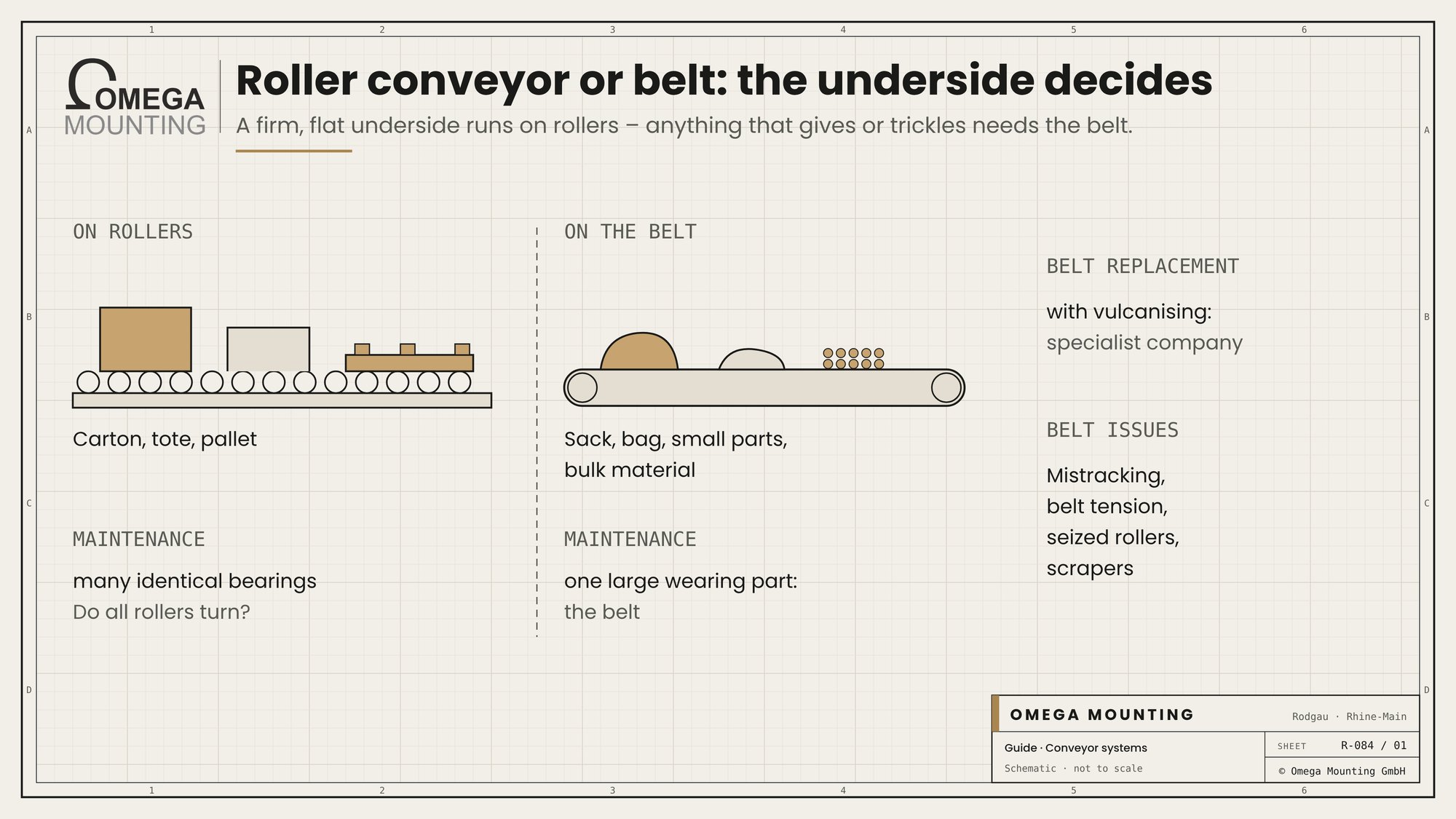
The question “roller conveyor or belt conveyor” is decided by the underside of the goods. Cartons, totes and pallets with a firm, flat underside run on rollers. Sacks, bags, small parts and bulk material need the belt. For maintenance this means: roller conveyors wear at many identical bearings, belt conveyors at one large wearing part – the belt.
Chain conveyor
The chain conveyor carries heavy loads – pallets, mesh box pallets, machine parts – on two or more parallel chains; its typical place is the front zone of the high-bay warehouse between the roller conveyor and the stacker crane, because it is insensitive to dirt. Its wear sits in the chain, sprockets, guides and drive unit. What happens when a gear wears there is shown by the breakdown at Frankfurt Airport in the practice chapter. How to measure chain elongation, recognise discard criteria and replace chains is described in our guide on wear on conveyor chains.
Skid conveyor
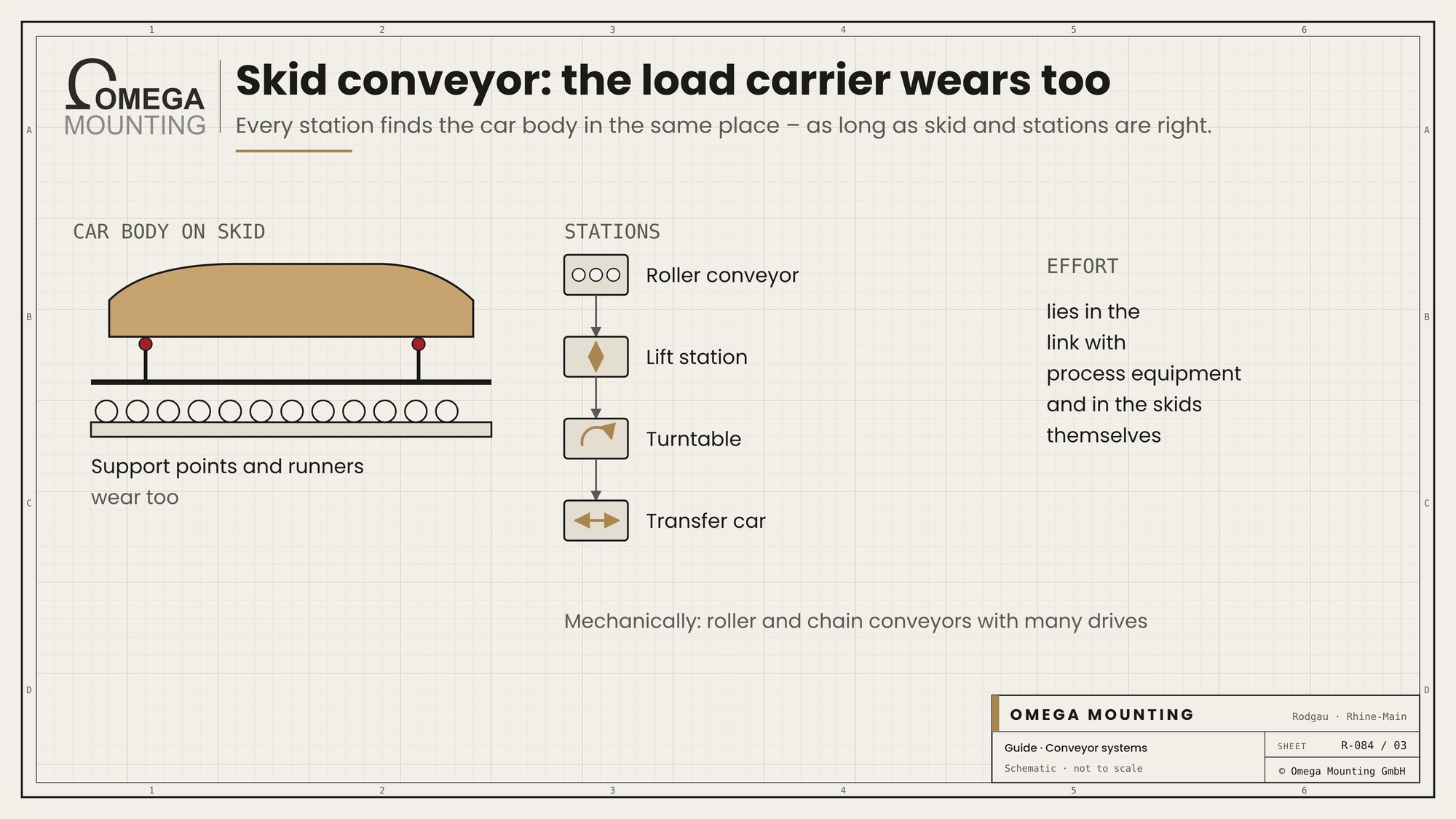
The skid conveyor is the conveyor technology of the automotive industry: car bodies stand on skids – steel transport frames with defined support points – and run over roller conveyors, lift stations, turntables and transfer cars through the paint shop and final assembly. Every station finds the car body in the same place. The maintenance effort lies in the link with the process equipment and in the skids themselves, which wear along with the goods as load carriers. Mechanically, skid conveyors are roller and chain conveyors with many drives.
Sorters and stacker cranes: relatives that often belong to the system
Sorters and stacker cranes are part of almost every larger conveyor system as the distribution and storage stage – and they have the shortest shutdown windows.
Sorting systems
A sorter distributes parcels or baggage to many destinations: cross-belt sorters with a small belt on each cart, tilt-tray sorters with tilting trays, sliding-shoe sorters with shoes that push the goods off to the side. Induction, sorter chain, scanners, end points and chutes run day and night in the parcel centre or at the airport; the windows for trolleys, drive, belts and trays are correspondingly tight. Covered in depth in the guide to sorting system maintenance.
Stacker crane
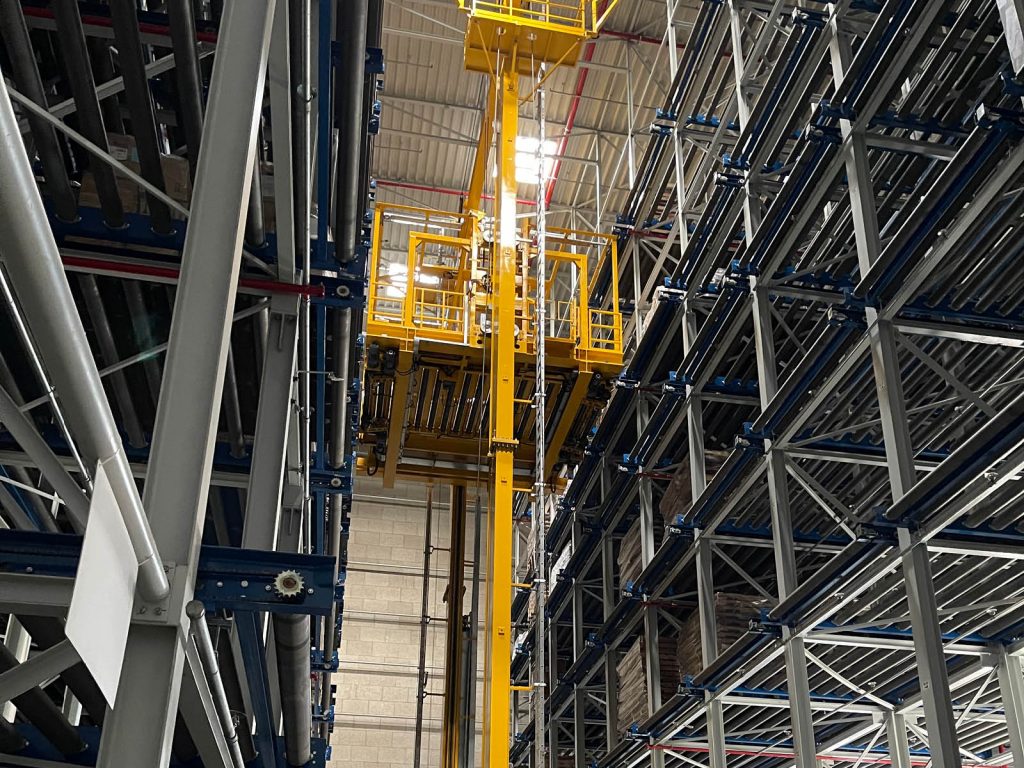
The stacker crane travels on a rail in the aisle, raises the load handling device on the mast and stores and retrieves pallets or totes. It is a discontinuous conveyor with inspection duties: drives, chains, ropes or belts, rails, wheels and the load handling device are inspected by a competent person (zur Prüfung befähigte Person). Because it works in its aisle without back-up, its failure stops the whole aisle. More on this in the guide to stacker crane maintenance.
Which criteria should you use to choose a conveyor system?
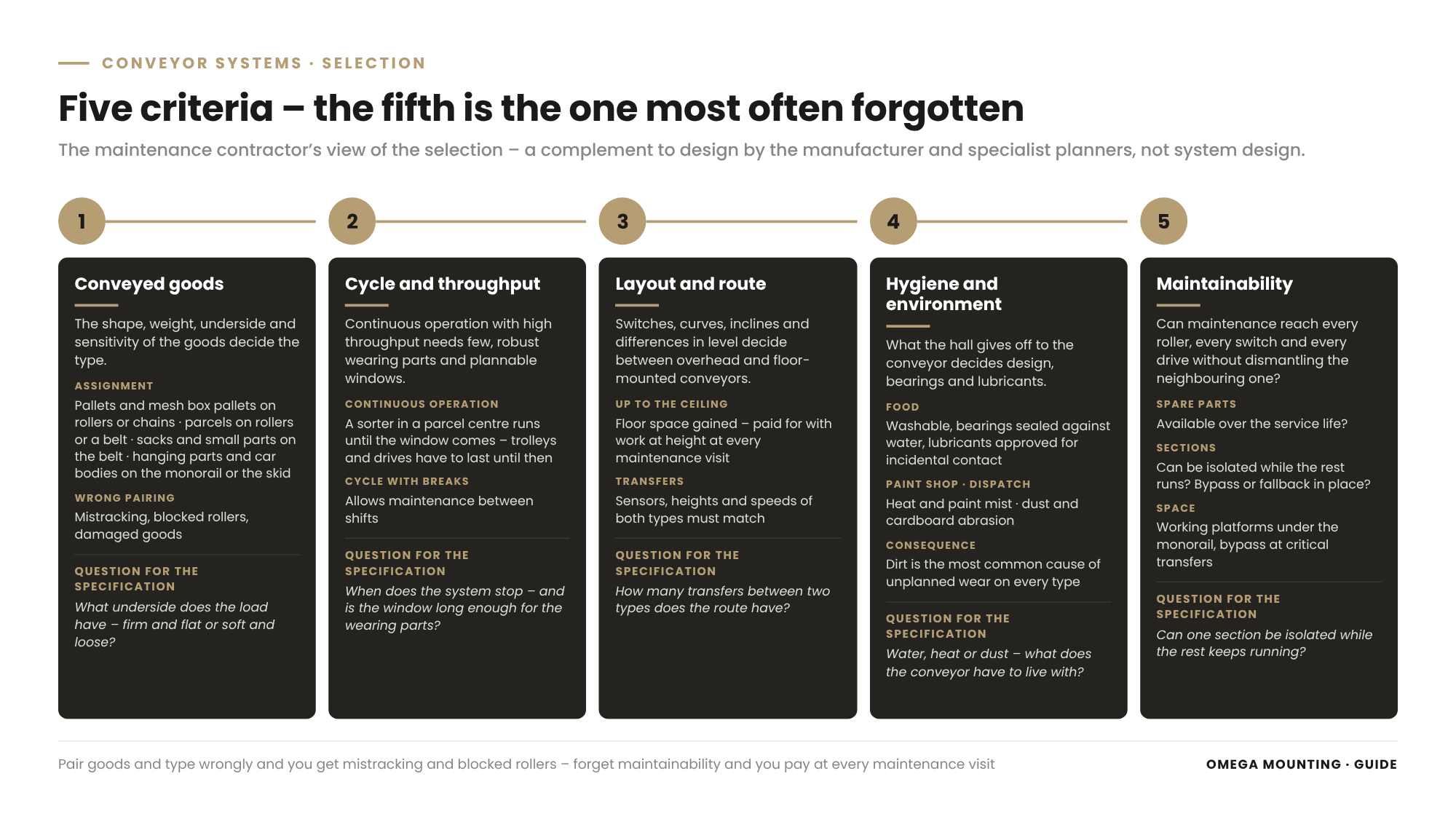
You choose a conveyor system by five criteria: the goods, cycle and throughput, layout and route, hygiene and environment – and maintainability, meaning how you will later maintain the system with good access, with spare parts and in real shutdown windows.
We do not design conveyor systems and we do not build sorters. The selection criteria here are the maintenance contractor's view – as a complement to the design by the manufacturer and the specialist planners.
Conveyed goods
The shape, weight, underside and sensitivity of the goods decide the type: pallets and mesh box pallets on rollers or chains, parcels on rollers or a belt, sacks and small parts on the belt, hanging parts and car bodies on the monorail or the skid. If you pair the goods and the type wrongly, you get mistracking, blocked rollers and damaged goods.
Cycle and throughput
Continuous operation with high throughput calls for types with few, robust wearing parts and plannable windows. A sorter in a parcel centre runs until the window comes – so trolleys and drives have to last until then. A cycle with breaks allows maintenance between shifts.
Layout and route
Switches, curves, inclines and differences in level decide between overhead and floor-mounted conveyors. If you need floor space, you go up to the ceiling – and pay for it with work at height at every maintenance visit. Every transfer between two types is a point where sensors, heights and speeds have to match.
Hygiene and environment
In a food plant, conveyors must be washable, bearings sealed against water and lubricants approved for incidental food contact. In the paint shop, heat and paint mist are added; in dispatch, dust and cardboard abrasion. What applies to maintenance and foreign bodies in food production is described in our guide on Maintenance in food production.
Maintainability
The fifth criterion is the one most often forgotten: can maintenance reach every roller, every switch and every drive without dismantling the neighbouring one? Are spare parts available over the service life? Can one section be isolated while the rest keeps running? Is there a bypass or a fallback? These questions belong in every specification.
What does maintenance mean for each conveyor system – and which guide covers it in depth?
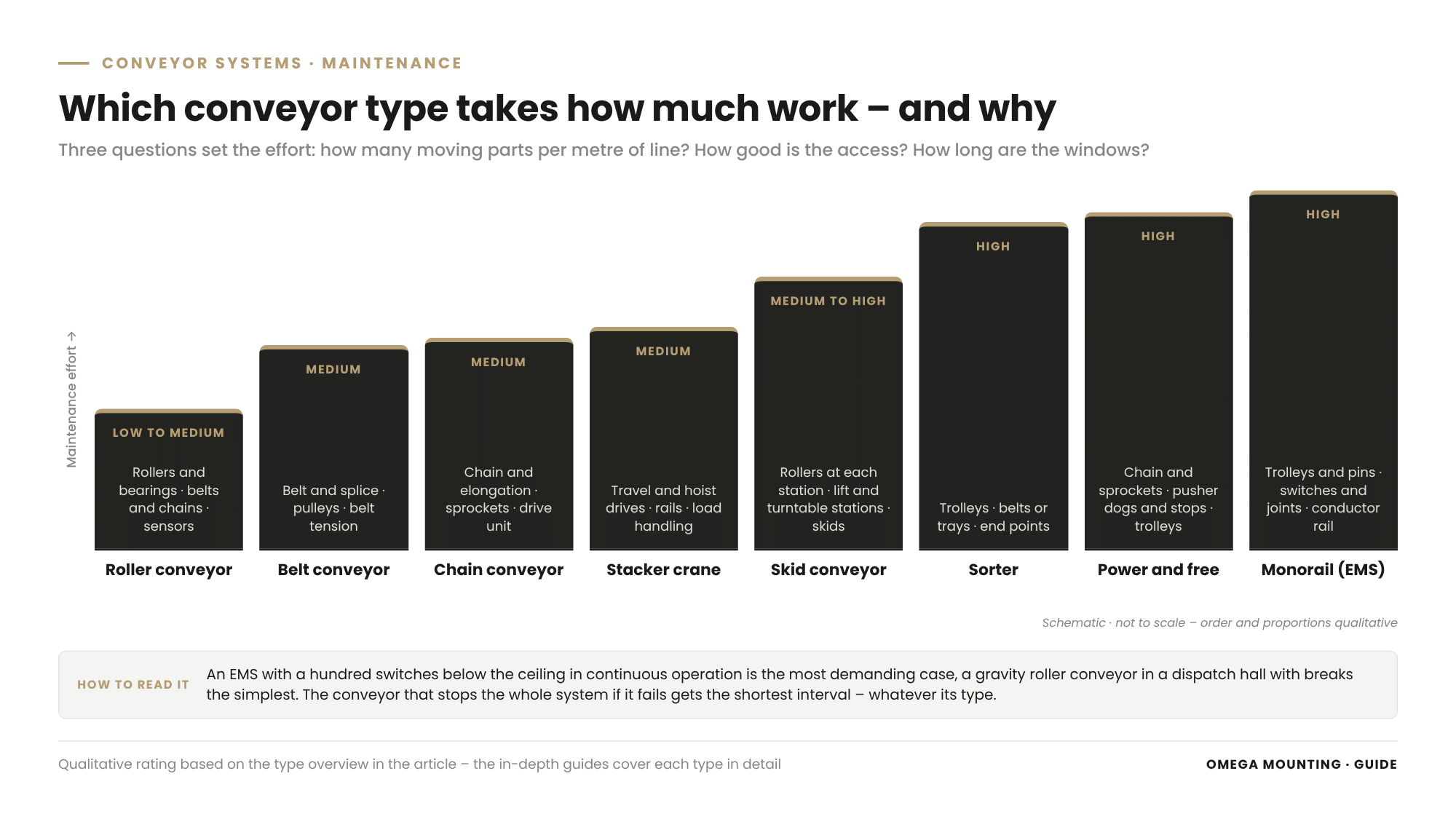
Maintenance means the same for every conveyor system – inspection, servicing, repair and improvement according to a plan – but the assemblies that set this plan differ from type to type. The table names the three focal points for each type and the guide that describes them in detail.
| Type | Three maintenance focal points | Further reading |
|---|---|---|
| electrified monorail | Trolleys and hanger pins; switches and rail joints; conductor rail and sliding contacts | Electrified monorail maintenance, EMS maintenance checklist, EMS wear |
| Power and free | Chain and sprockets; pusher dogs and stops; trolleys and switch mechanism | Power and free conveyor maintenance, wear on conveyor chains |
| Belt conveyor | Belt and splice; pulleys and rollers; tension and mistracking | Conveyor belt maintenance |
| Roller conveyor | Rollers and bearings; drive belts and chains; sensors and zero-pressure accumulation control | Roller conveyor maintenance |
| Chain conveyor | Chain and elongation; sprockets and guides; drive unit | Wear on conveyor chains, drives and gearboxes |
| Skid conveyor | Rollers and drives at each station; lift and turntable stations; skids as load carriers | Roller conveyor maintenance, drives and gearboxes |
| Sorter | Trolleys and sorter chain; belts or trays; end points and safety circuit | Sorting system maintenance, troubleshooting conveyor systems |
| Stacker crane | Travel and hoist drives; rails and wheels; load handling device and inspections | Stacker crane maintenance, inspection obligations for operators |
What the focal points mean for the effort
The maintenance effort of conveyor technology depends less on the type than on three questions: how many moving parts per metre of line? How good is the access? How long are the windows? An EMS with a hundred switches below the ceiling in continuous operation is the most demanding case, a gravity roller conveyor in a dispatch hall with breaks the simplest. How to turn the focal points into a plan with responsibilities and intervals is described in our overview guide on maintenance of conveyor technology.
What do all conveyor systems have in common in maintenance?
All conveyor systems share six maintenance topics: drives, the safety circuit, isolation before every intervention, cleaning, spare parts and shutdown windows – if these six are settled for each system, you have most of the maintenance plan.
Drives and lubrication
Whether it is the geared motor on the pulley, the chain drive on the conveyor or the travel drive on the EMS vehicle: bearings, seals, belts, couplings and oil wear in the same patterns, and noise, temperature and vibration signal the damage early. Covered in depth in our guides on maintenance of drives, gearboxes and pumps and on the lubrication schedule in maintenance.
Safety circuit and draw-in points
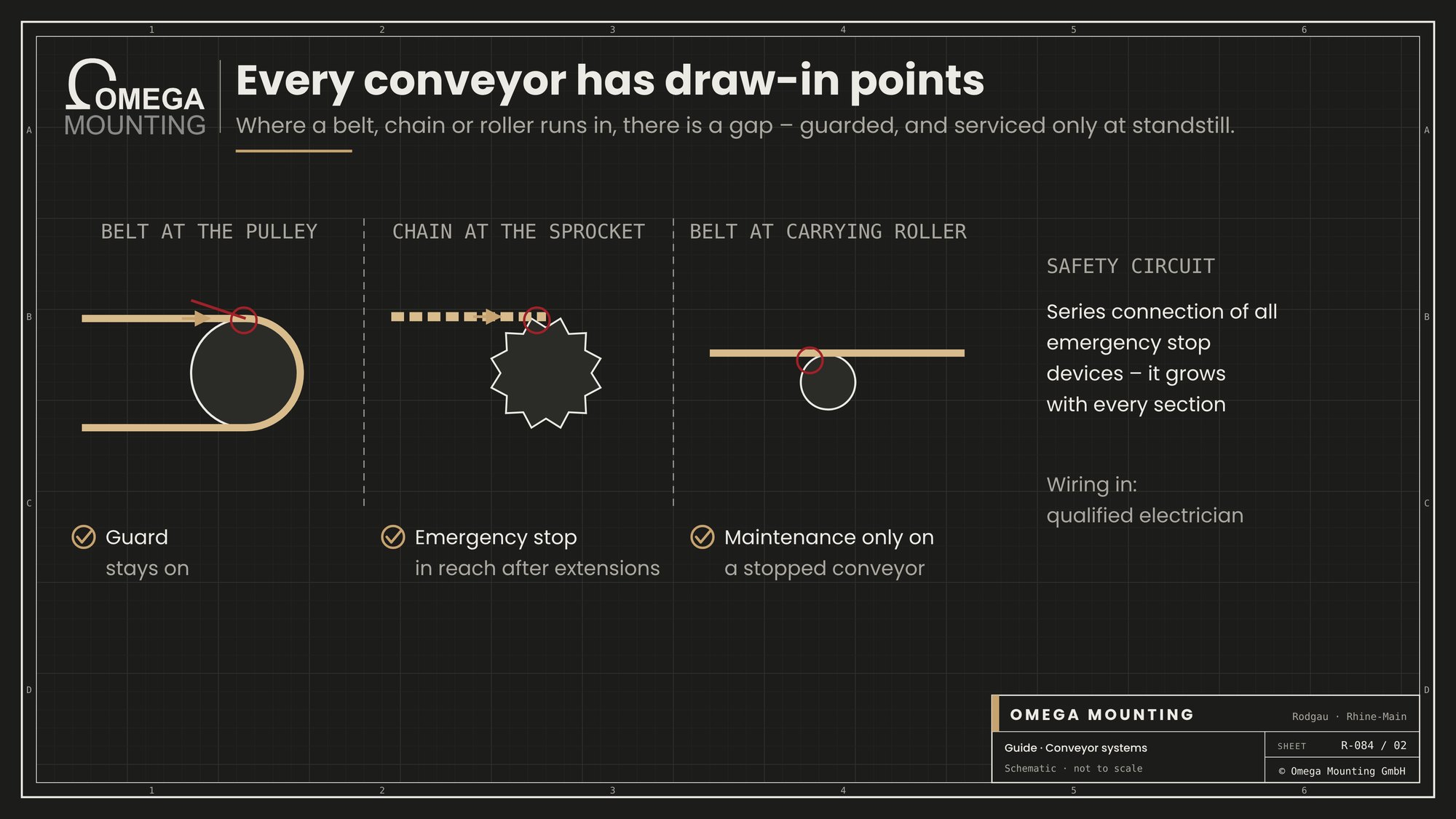
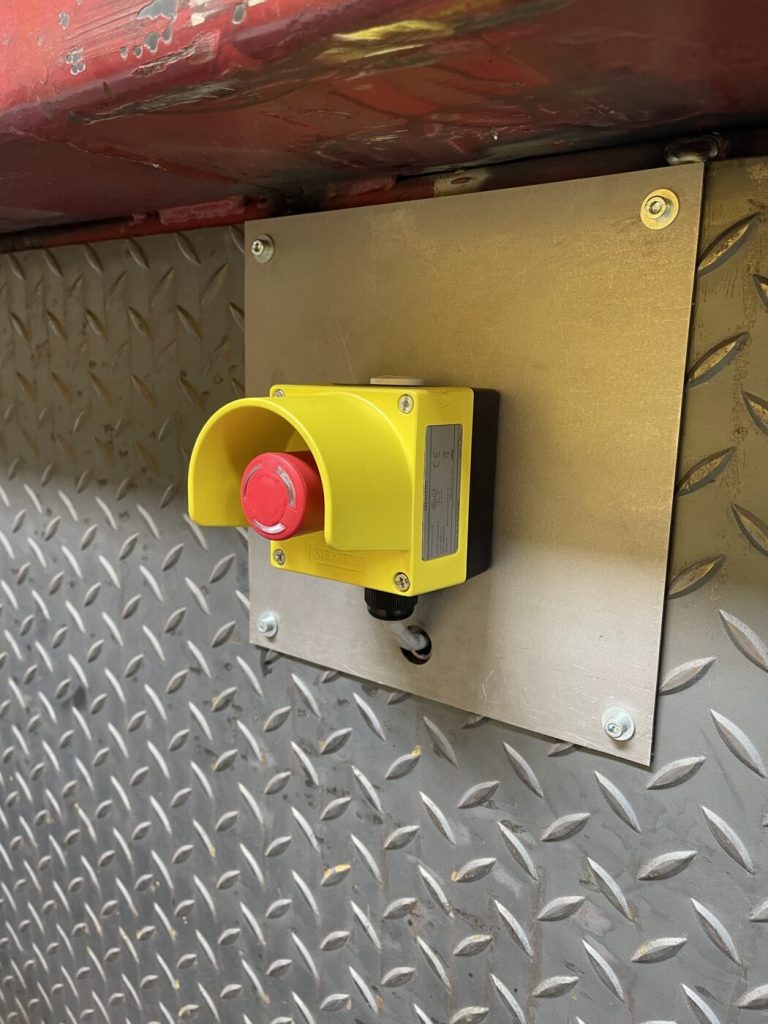
Every conveyor has draw-in points – gaps into which the running belt, chain or roller is drawn. For continuous conveyors, DGUV Rule 100-500 (German Social Accident Insurance) states that draw-in points must be guarded, emergency stop devices must be within reach and maintenance work is only permitted on a conveyor that has been stopped. In practice: every guard stays on and every emergency stop button stays within reach – even after an extension. The safety circuit – the series connection of all emergency stop devices that together stop the system – grows with every section; how this works is shown by the sorting system in the practice chapter and by our guide on retrofitting safety devices.
Isolation before every intervention
The German technical rule TRBS 1112 (maintenance) requires that, before maintenance work, it is defined how the work equipment is isolated, secured against being switched on again and returned to service. For the conveyor this means: main isolator off, lock on, key with the fitter – and on networked systems the question whether the neighbouring section really cannot drive the isolated one. The procedure is described in our guide on Lockout tagout in maintenance. Which inspections and intervals your system needs is decided by your risk assessment under the Industrial Safety Ordinance (BetrSichV) – for an overview, see the guide on inspection obligations for plant operators. This guide is not legal advice.
Cleaning
Abrasion under the belt, dust on the conductor rail, cardboard scraps in the roller conveyor, paint mist on the power chain: dirt is the most common cause of unplanned wear on every type. Cleaning therefore belongs in the maintenance plan as a separate item.
Spare parts
Rollers, bearings, chains and sprockets, carbon brushes, belt fasteners and sensors belong on the shelf – for every design installed. The high-bay warehouse breakdown in the practice chapter could be tackled at once because the parts were on site. For assemblies the market no longer supplies, see our guide on spare parts that are no longer available.
maintenance window
Conveyor technology rarely gets a maintenance day; it gets nights, weekends and plant holidays. If you know the focal points of each type, you bundle the work for each window: pre-assembly beforehand, sections one after another, a fallback for each section. How to plan a complete overhaul is described in our guide on shutdown planning in maintenance. If the conveyor stops outside any window, the systematic approach from the guide on troubleshooting conveyor systems.
Installation and modification in existing systems: how do you extend a conveyor system?
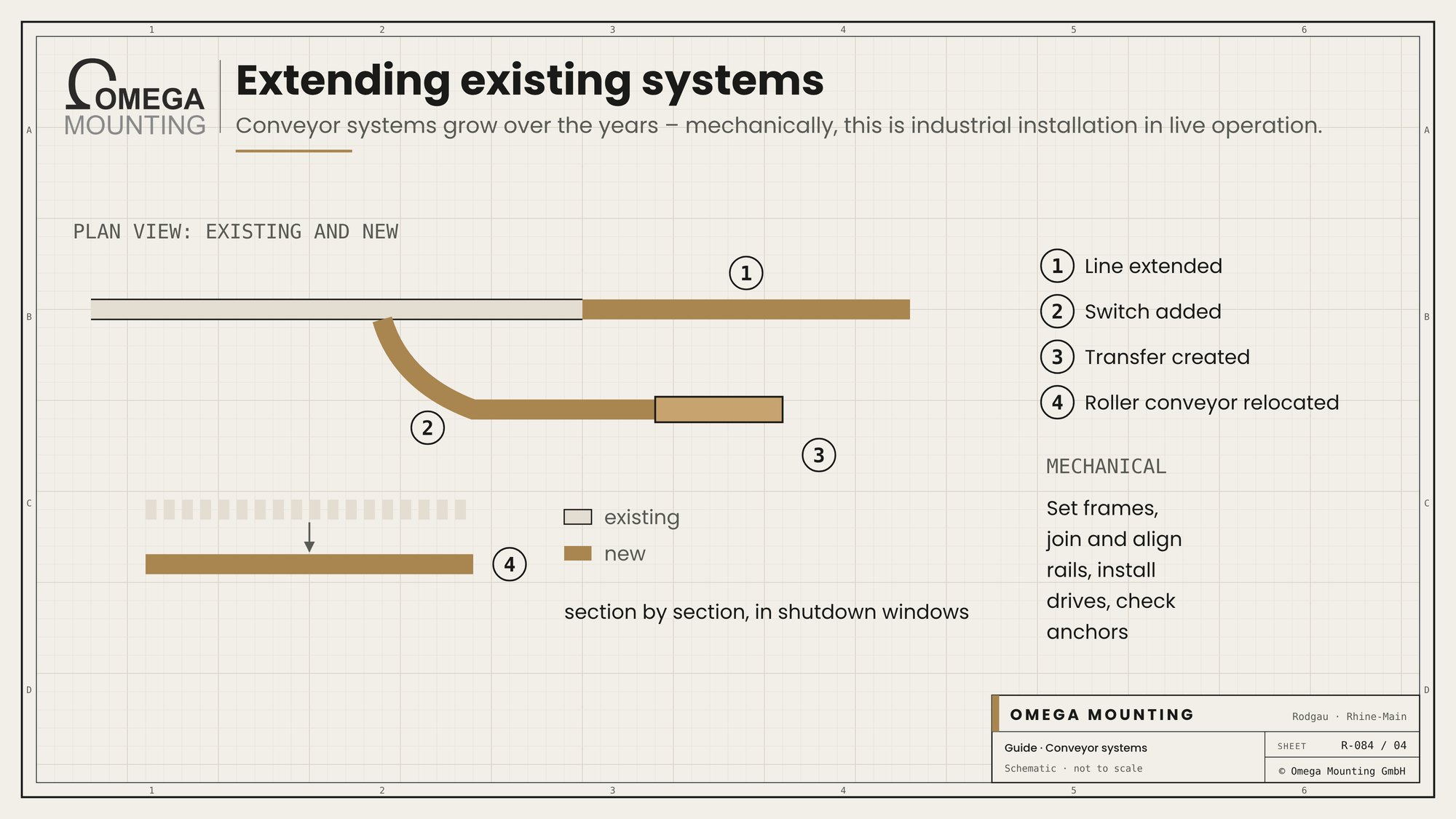
You extend or modify a conveyor system in an existing plant in stages: add, relocate or repair the mechanics, retrofit drives and sensors, let the safety circuit grow with it – section by section in shutdown windows, with pre-assembly outside the system and a fallback for each stage.
Most conveyor systems are changed over the years: a line extended, a switch added, a transfer created, a roller conveyor relocated. Mechanically, this is industrial installation in a live operation – setting frames, joining and aligning rails, installing drives, checking anchors. What matters here is described in our guide on aligning and anchoring machines; our scope of services is shown on the page Industrial installation.
Retrofit: renew the technology, keep the mechanics
If the mechanics are sound but the controls, drives or sensors are at the end of their life, a retrofit is the way to go: renew the old layers, keep the load-bearing mechanics. Control programming and safety logic lie with the controls contractor or the manufacturer. The power supply connection and electrical testing lie with a qualified electrician – under DGUV Regulation 3, only qualified electricians may work on electrical installations. The installation contractor takes on the condition assessment, the mechanics, drive replacement, installation and coordination. When this pays off and what the stages look like is described in our guide on retrofitting conveyor systems.
How we do it in the Rhine-Main region
For us, conveyor technology in the Rhine-Main region means electrified monorails in production plants in Frankfurt and Hanau, sorting and conveyor systems at the airport, roller and chain conveyors in logistics centres near Darmstadt, conveyor belts and paint lines in Offenbach and Aschaffenburg. From Rodgau these are short distances – under a maintenance contract, or by phone or WhatsApp when the conveyor stops at night.
What we bring is the installation contractor's view of all types: assessing assemblies; replacing rollers, pins, switch shoes, chains and sprockets; aligning and relocating rails; overhauling drives; mechanically retrofitting safety devices; extending and modifying systems; making parts in our own workshop. Our scope of services is set out on the pages Maintenance and servicing and Logistics. What has to be organised in addition at Frankfurt Airport is described in our guide on maintenance at Frankfurt Airport.
Project examples
Four jobs from our project diary show four conveyor types and the same way of working: findings instead of guesswork, working in windows, letting the safety circuit grow with the system.
Electrified monorail in Frankfurt: around a hundred switches in weekend windows
With the maintenance of an overhead monorail system in Frankfurt we were dealing with a system around thirty years old with around a hundred switches in two operating areas, directly integrated into the production process. At times there was a window of around 36 hours between the end of production on Saturday and restart on Monday. We found worn and torn-off running rollers, worn-in tracks, rail transitions out of alignment, damaged brackets, decommissioned switches and wear on current collectors, drive rollers and data bus contacts.
Every switch was inspected, documented and assessed; this gave the spare parts requirement and the order of work. Then came the repairs over several weekend shutdowns: replacing running and guide rollers, adjusting switch shoes and end positions, checking switch motors and limit switches, welding torn-off brackets, putting decommissioned switches back into service. Where possible, worn-in tracks were moved by several centimetres so that the end positions came to rest on less worn areas.
For your overhead conveyors this means: the switch is the assembly that sets the plan. If you count and assess the switches, you get windows that are long enough.
Food plant: from squealing to series repair on 80 vehicles
In a food plant, the vehicles of an electrified monorail squealed and repeatedly failed during production; the hanger pins were considered maintenance-free. During the EMS hanger pin repair we first pulled a single pin: practically no lubrication left, deep grooves, cracks and material loss, bronze bush and bearing seat worn in. The calliper turned this into a finding – and into the decision to refurbish all 80 vehicles: lift and support the carriers, drive out the pins, check the bearing point, fit new bush and pin as a pair. Two to three fitters managed ten to fifteen vehicles per weekend, outside production time.
For every conveyor system this means: “maintenance-free” usually just means “no grease nipple” – a bearing point nobody looks at will wear in.
Frankfurt Airport: breakdown on the chain conveyor of a high-bay warehouse
A phone call: the high-bay warehouse of a logistics company at Frankfurt Airport had stopped, and nobody on site knew why. During the repair at the high-bay warehouse at the airport troubleshooting led to a worn gear in the drive unit: the drive chain jammed and partly jumped, the chain conveyor stopped – and with it the whole high-bay warehouse. The operator had suitable spare parts on site, so work could start at once: dismantle the chain conveyor, replace chains and gears with new parts, adjust the chain and travel systems, put the conveyor back into operation.
For your floor-mounted conveyors this means: the most inconspicuous conveyor in the front zone can stop the most expensive system – it belongs in preventive maintenance, and its chains and sprockets belong on the shelf as a set.
Frankfurt Airport: safety circuit of a sorting system grown with the extension
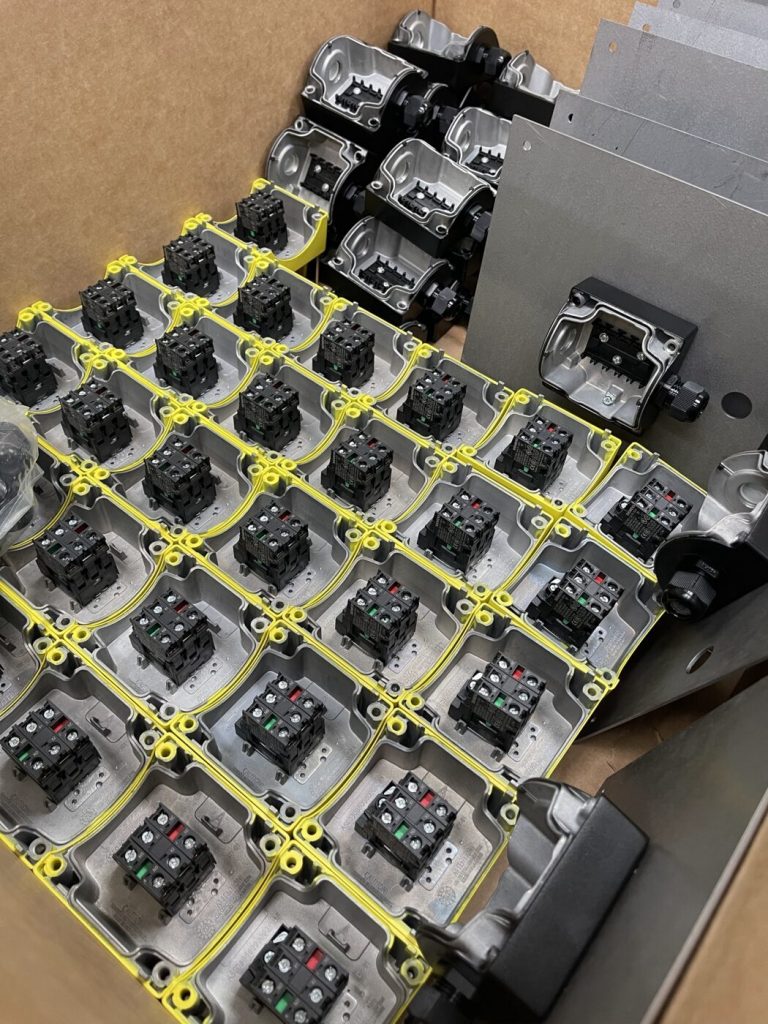
A parcel sorting system at Frankfurt Airport was extended – and with every new section, walkways, work areas and danger points change. During the retrofit of emergency stop buttons on the sorting system two fitters covering both mechanics and electrics installed 32 emergency stop buttons and a number of sensors and wired them into the existing safety circuit – on two working days during the system's shutdown periods. The key was pre-assembly: mounting plates prepared, every enclosure fitted with cable gland, terminals and labelling, all units sorted by mounting point – in the window, the team only had to install and test.
For every sorter and every conveyor line this means: an extension without the safety circuit is not an extension. Whatever is prepared outside the window uses no time inside it.
Conveyor systems on your site: is an extension, an overhaul or a breakdown coming up?
Then get in touch with us. On a site walk in Frankfurt, Offenbach, Hanau or elsewhere in the Rhine-Main region, we go through your conveyor systems with you type by type and tell you honestly what your team can handle itself, what belongs in a maintenance window and where other trades come in.
What this means for your role
For buyers: Do not tender conveyor technology as “conveyor” but with type, goods, cycle and environment – and ask every bidder for a spare parts list and a statement on access and on the availability of the product range. For maintenance contracts, what counts is whether the provider covers your types mechanically and says where its scope ends.
For designers: Put maintainability into the specification as the fifth criterion: access to every roller, switch and drive, sections that can be isolated, space for working platforms under the monorail, a bypass or fallback at critical transfers. Every transfer between two conveyor types is an interface with height, speed and sensors on both sides.
For project managers and site managers: As project manager, you keep the parties together for each conveyor type – manufacturer, controls contractor, electrical contractor, installation contractor – and record the reference condition at handover: rail alignment, take-up travel, roller lists, function test of the safety circuit. As site manager, you approve isolation and the test run and make sure that a conveyor does not wear out as a site transport aid during the construction phase.
For maintenance managers: For each conveyor type, set the three maintenance focal points with the person responsible and the interval in the risk assessment and the maintenance plan, keep a findings list for each line, and record which conveyor stops the whole system if it fails – that one gets the shortest interval.
For warehouse and logistics managers: Your conveyor lines run in shifts that do not belong to maintenance. Add the walk-round during operation to the shift handover, give your team a reporting route for seized rollers, rubbing belts and squealing trolleys, and agree which sections may stop and when.
For operations and plant managers: A conveyor system overhauled in the planned window costs a weekend; one that stops during the shift costs both. Approve the windows the maintenance plan needs for each type, and require overhaul, extension and safety inspection of the same line to be bundled.
Conveyor selection matrix: template on request
The conveyor selection matrix is a two-page template: for each conveyor type, goods, cycle, layout, hygiene, environment and expandability to tick off, plus the typical wear, the three maintenance focal points, access, spare parts, shutdown windows and the trades responsible. It deliberately contains no figures and no manufacturer data. Request the matrix via our contact form – reference “Conveyor selection matrix”.
Why Omega Mounting?
We are based in Rodgau near Frankfurt, can be reached by phone (Mon–Fri 9 am–3 pm) and WhatsApp, and have our own workshop for rollers, brackets, pins and assemblies the market no longer supplies. The linked jobs show how we work on conveyor systems: an electrified monorail around thirty years old was brought to a sound condition over several weekend windows through findings and prioritisation. In the food plant, one pulled pin led to a series repair on 80 vehicles. At the high-bay warehouse, the breakdown repair started at once because the parts were there. On the sorting system, pre-assembly fitted 32 emergency stop buttons into two working days. In practice, that means a single point of contact for condition assessment, assembly replacement, extension, modification and remanufacturing across all conveyor types, a clear statement of where our scope ends – and short distances in the Rhine-Main region.
Conclusion
Conveyor systems are conveyors – and behind the umbrella term are types with their own use, their own wear and their own maintenance effort. The electrified monorail and power and free use the ceiling and need access to switches and chain. Belt, roller, chain and skid stay on the floor and wear at bearings, drives and transitions. If you know the type, you know the three assemblies that set the plan – and you will find the inspection list in our in-depth guides. What all types share are drives, the safety circuit, isolation, cleaning, spare parts and windows. If you would like to know how your conveyor technology looks from an installation contractor's point of view, send us your conveyor types, location, last year's breakdowns and your shutdown windows – we will get back to you with an honest assessment of what comes first.
Planning a move-in, installation or maintenance in the Rhine-Main region?
Tell us briefly what you need – we'll come back with an honest assessment.
Free, no-obligation callback
You may also be interested in these guides
Maintenance & Servicing
About the author
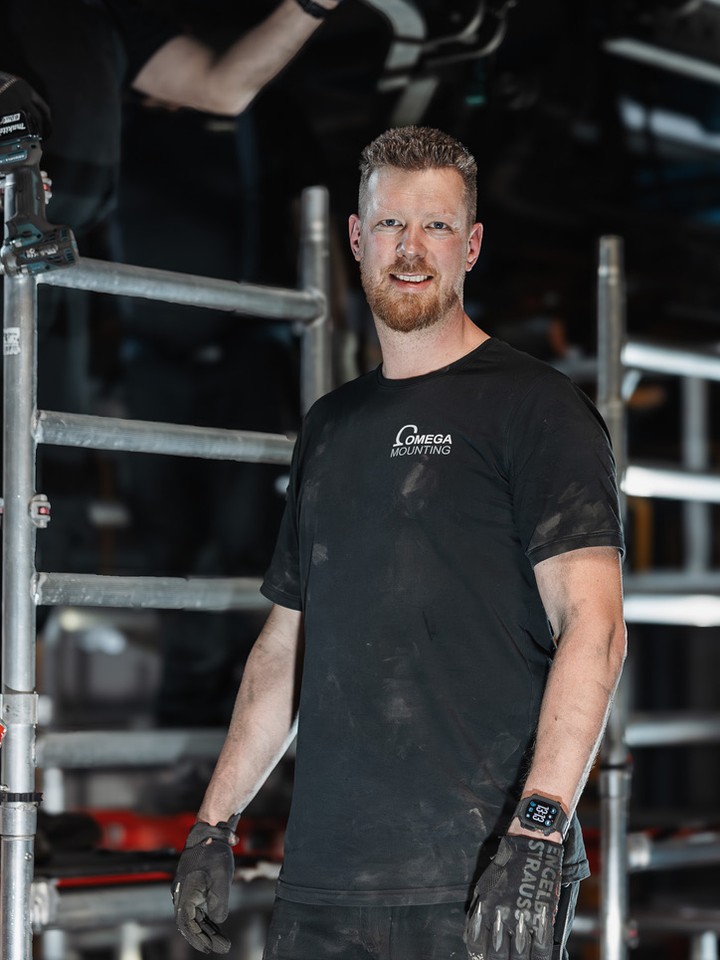
Tobias Schott
Managing director of Omega Mounting GmbH, Rodgau · more than 20 years of hands-on experience in installation and maintenance
A trained mechatronics technician, working in maintenance, servicing and industrial installation since 2004 – first alongside his father, and with Omega Mounting since 2012: from overhead conveyors in Frankfurt to the crane system in a new-build hall. He plans and leads lifting operations as an appointed person (AP) in data centers and on industrial sites in the Rhine-Main region, trains and examines operators of cranes, mobile elevating work platforms and telehandlers, and is a qualified occupational safety specialist. On jobs abroad he is known as the “German Troubleshooter” – the person you call when a site gets stuck. He learned what quality means from his father, not from a manual: Made in Germany as a standard for his own work, not a label. That is why quality comes first at Omega Mounting – ahead of speed and price. He writes these guides from that practice: what works on our sites is in them – what exists only on paper is not.
Frequently asked questions
None in substance: conveyor is the English word for Förderer. Conveyor technology is the umbrella term for all systems that move goods mechanically; conveyor systems are networks of several conveyors. Tenders from international clients and airports usually say conveyor, German plants say Förderer or Förderanlage. For maintenance, what counts is not the word but the type.
Continuous conveyors move goods steadily or in cycles along a fixed route – belt conveyors, roller conveyors, chain conveyors, power and free, skid conveyors and sorters. Discontinuous conveyors work in operating cycles of picking up, travelling and setting down – the electrified monorail with individually travelling vehicles, stacker cranes, cranes, forklifts. Continuous conveyors wear evenly along the line, discontinuous conveyors at a few highly loaded points. That decides inspection and spare parts.
The EMS drives each vehicle individually with its own drive via switches to changing destinations. Power and free pulls free trolleys along the same route with a chain and accumulates them in front of process stations without stopping the chain. Changing routes point to the EMS, buffers and heat in paint and assembly lines to power and free. In maintenance, the EMS needs access to many switches, power and free needs access to the chain along its whole length.
All work on belts, chains, rollers, switches and drives takes place only on a conveyor that has been stopped, isolated and secured against being switched on again. Draw-in points stay guarded during operation, emergency stop devices stay within reach and are never bypassed. Which inspections and intervals your system needs is set by your risk assessment. This guide is not legal advice.
No, we do not design conveyor systems and we do not build sorters. We maintain conveyor technology mechanically, replace assemblies, extend and modify existing systems and coordinate the parties involved. Control programming and safety logic lie with the controls contractor or the manufacturer, the power supply connection and electrical testing with a qualified electrician.
Yes, the types and their maintenance focal points are the same in logistics, production, food and automotive plants. What changes are the conditions: wet cleaning and approved lubricants in a food plant, heat and paint mist in the paint shop, access rules at the airport. The inspection logic for each type stays the same.
From Rodgau, Omega Mounting takes on mechanical maintenance, assembly replacement, extensions and modifications on electrified monorails, power and free conveyors, belt, roller and chain conveyors, sorters and stacker cranes – in Frankfurt, Offenbach, Hanau, Darmstadt, Aschaffenburg and at Frankfurt Airport. In the event of a breakdown, you can reach us by phone or WhatsApp.
With a short enquiry covering three points: the conveyor types in your system with location, last year's breakdowns and the shutdown windows your plant can approve. We arrange a site walk, go through the system with you type by type and send you a written assessment of what your team can do itself and what belongs in the next window. Your contact is Tobias Schott – reachable via our contact form.
 English
 German