
- Guide – Industrial installation
Installation in winter: mastering frost, grout, wind and light safely on winter installation sites
By Tobias Schott · Reading time approx. 23 minutes · Updated: November 2026
Installation in winter succeeds when light, temperature, wind and ice are not treated as disruptions but as fixed factors in the installation plan. Anyone who knows the limits from the data sheet and the crane manual, protects materials and people and has a plan B can install safely and cleanly even in frost.
In summer the working day is long, the grout sets quickly and the crane lifts in calm weather. In winter everything is tighter: it gets light late and dark early. The ground is frozen, the wind whistles through open hall walls, and there is frost on the steps. Batteries give up sooner, and a control cabinet that comes from a cold lorry into a warm hall mists up inside.
Anyone searching for “winter installation”, “installation in frost” or “grouting in cold weather” usually wants to know what is still possible and what is not. The honest answer: almost everything is possible, but not without preparation. What matters is knowing the limits that are not negotiable and planning the rest well.
This guide shows how an installation in winter is planned and carried out – from light and working hours through temperature limits, protection and heating to crane lifts, cold protection and plan B. It is written for project and site managers, installation managers and foremen, operators, maintenance managers, buyers and occupational safety specialists. How an installation plan is structured in principle is described in the guide Creating an installation plan.
Key points at a glance
- Installation in winter means: planning for light, cold, wind, ice and moisture from the outset.
- Kurze Tage. Critical work belongs in the daylight hours; the rest needs good artificial light.
- Data sheet, not gut feeling. Grout, concrete, adhesives and coatings have fixed temperature limits.
- Protect and heat. Enclosures, covers and site heaters keep conditions within limits.
- Preheating for welding. Kalter, feuchter Stahl neigt eher zu Rissen.
- Wind as specified by the manufacturer. The crane's wind limit applies, not the schedule.
- Ice and slippery surfaces. Load, lifting gear, walkways and outriggers are checked and kept clear.
- Protect people. Warm clothing, heated breaks and shorter spells in the cold.
- Plan B. Buffers and fallback work are fixed before the frost arrives.
What is an installation in winter?
An installation in winter is any installation where low temperatures, short days, wind, snow, ice or moisture affect the work. This does not only concern outdoor sites. Halls without a finished envelope, unheated new buildings, open doors and roofs also have outdoor conditions in winter.
What changes in winter
Three things change above all. First, time: the daylight is short and waiting times get longer. Second, materials: grout, concrete, adhesives and coatings react more slowly or no longer properly. Third, safety: ice, wind and darkness increase the risk of accidents.
Indoors is not automatically warm
A hall with a roof is not yet a heated hall. In a building shell, in warehouses with open doors or in new buildings without heating, the temperature is often close to the outdoor value. The hall floor cools down particularly strongly and stays cold for a long time. For the materials, it is exactly this substrate that counts.
Why planning decides
Anyone who simply starts in winter loses time at every turn: the grout does not set, the crane may not lift, the team is freezing, the light is not enough. Anyone who plans in advance, by contrast, can carry out most work safely. An installation in winter is therefore above all a planning task.
Planning: short days, light and weather
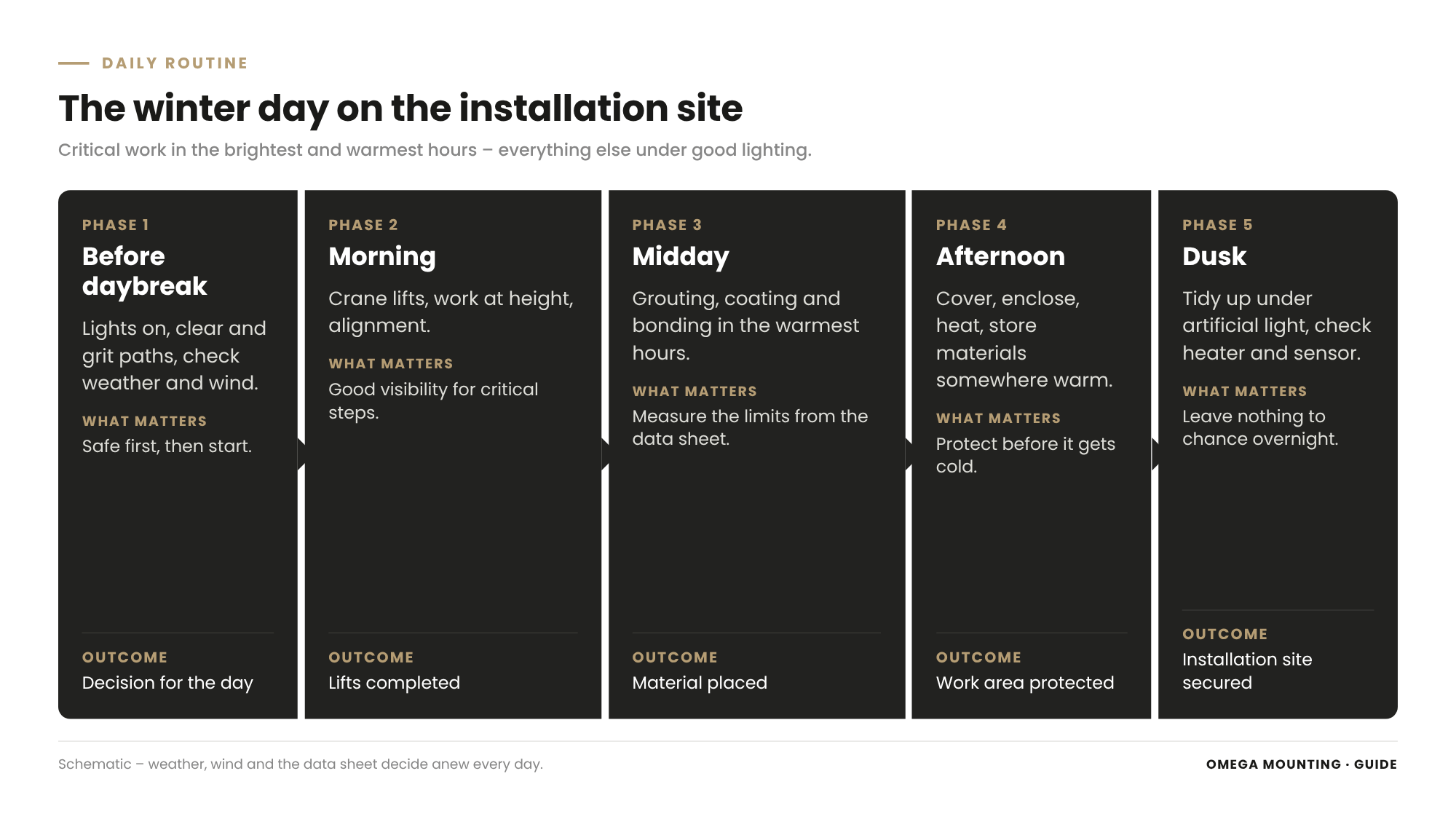
The most important difference from summer is daylight.
Using the daylight hours
Work that needs good visibility belongs in the daylight hours: crane lifts, work at height, alignment with the laser, visual inspections. Preparation, tool issue and tidying up can be moved to the dark edges of the day if the artificial light is good.
Using the warmest hours
Temperature also follows the day. It is usually coldest in the early morning and warmest around midday. Grouting, coating or bonding is therefore placed in the warmer hours where possible – so that the material can set before it gets colder again.
Weather report and wind forecast
Before every installation day the weather is checked: temperature, precipitation, wind and gusts, risk of ice. For crane lifts, the wind forecast for the lifting height is decisive. The decision whether to lift is made in the morning and again before every lift.
Planning for longer waiting times
Cold extends curing and drying times. What is firm overnight in summer may take considerably longer in winter. These waiting times belong in the sequence so that the team carries on elsewhere in the meantime.
Travel and deliveries
Snow and ice extend travel and delivery times. Abnormal loads and cranes can be cancelled because of the weather. Lorry time windows and crane bookings are agreed with this risk in mind.
Temperature limits: what the data sheet specifies
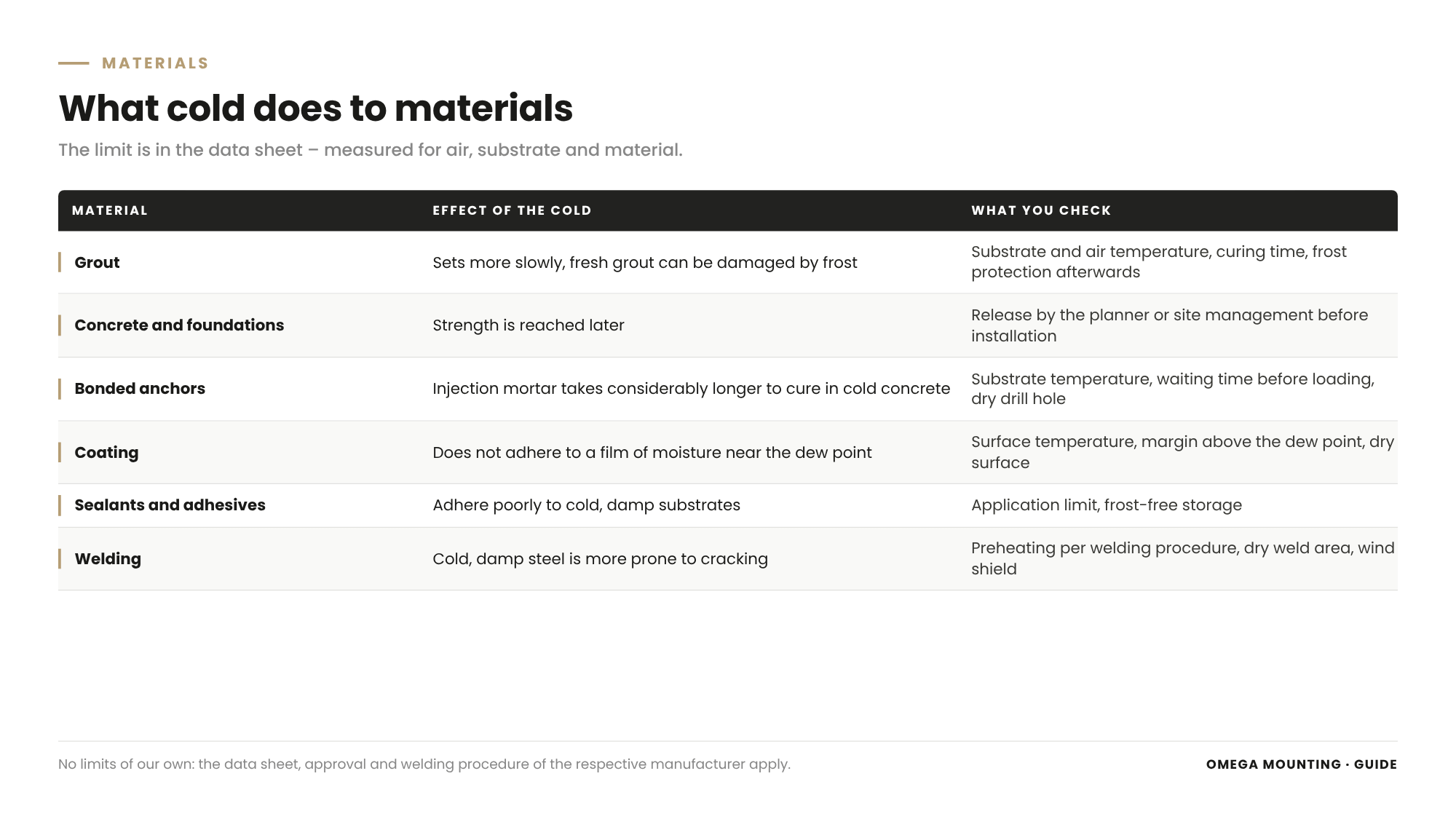
Every material that has to set, cure or dry has temperature limits. They are stated in the technical data sheet, the processing instructions or the manufacturer's approval – not in the fitter's gut feeling.
Three temperatures count
Data sheets usually refer to three values: the temperature of the air, of the substrate and of the material itself. All three must be within the permitted range during application and often for a certain time afterwards. A warm bag of grout is of little use if the foundation surface is frozen.
Measuring instead of estimating
Before application, air and substrate are measured and the values recorded. A simple surface thermometer is enough. That way it can be shown later that the specifications were met.
Setting takes time
Even if the application temperature is right: in the cold, curing takes longer. Many data sheets give curing times depending on temperature. Loading only takes place once the time for the actual temperature has been reached.
Frost in the first hours
Frost is particularly critical while the material is still fresh. If the water in the grout or concrete freezes, the structure can be permanently damaged. Freshly placed material must therefore be protected from frost as specified by the manufacturer.
If the data sheet is missing
If a data sheet is missing, it is requested from the manufacturer or supplier. Without knowing the limits, there is no grouting, bonding or coating in frost.
Grout and concrete in the cold
Grouting under base plates, anchors and crane rails is one of the most common tasks in industrial installation – and one of the most sensitive in winter.
Why grouting matters so much
The grout transfers the load evenly from the base plate into the foundation. If it does not cure properly, the plate does not sit fully, and the machine or crane does not stand securely. Why grout belongs under every base plate is described in the article Grouting.
Preparing the substrate
The foundation must be free of ice, snow, frost and standing water. A frozen substrate is not grouted. Where necessary it is warmed beforehand and covered until the temperature required by the data sheet is reached.
Storing and mixing material
Bags of grout and mixing water are stored warm, not overnight in the vehicle. Some manufacturers allow warmed mixing water within certain limits. What is permitted is stated in the data sheet. Antifreeze from the DIY store has no place in grout unless the manufacturer explicitly approves it.
Protecting after grouting
The fresh grout is covered and protected from frost, often overnight as well. An enclosure with a site heater keeps the temperature up. Loading only takes place once the curing time for the actual temperature has been reached.
Concrete and foundations
The same applies to new foundations on a larger scale. The foundation must have reached the strength specified by the planner for installation. Whether it has is decided by the planner or site manager, not the calendar. We only install after approval.

Adhesives, bonded anchors and coatings
Whatever is bonded, anchored or painted also reacts to the cold.
Bonded anchors and injection mortar
Bonded anchors hold by means of a mortar that cures in the drill hole. The approval specifies the substrate temperature at which they may be installed and how long it takes until they can be loaded. In cold concrete this time is often considerably longer. What really holds in concrete is described in the article Heavy-duty anchors and bonded anchors.
Keeping drill holes dry
Water or ice in the drill hole prevents the mortar from bonding properly. Drill holes are cleaned, blown out and protected from snow and water until the anchor is set. Cartridges are stored warm so that they can be processed.
Coatings and corrosion protection
Paints and coatings need a minimum temperature and a dry surface. The dew point is critical: if the surface temperature of the steel is too close to it, a fine film of moisture forms on which the coating does not adhere. The data sheet states the necessary margin. Which types of protection exist is described in the article Corrosion protection for steel.
Pre-assembly in the warm
Much can be pre-assembled and coated in the workshop or a heated area. Only what has to be there then goes to the cold installation site.
Protect and heat: enclosure, cover, site heater
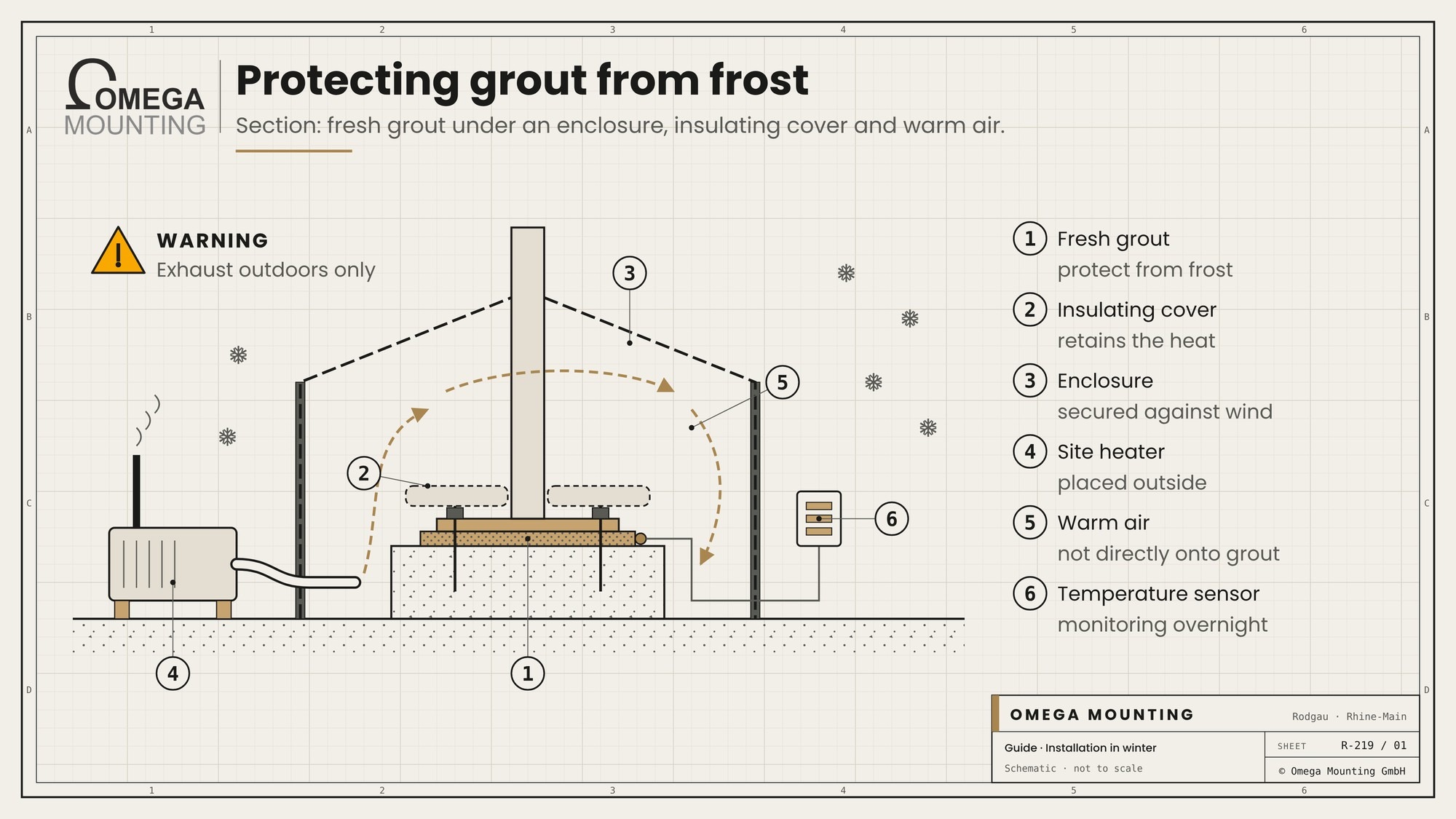
Where the temperature is not enough, it is created.
Enclosure
An enclosure made of sheeting, scaffolding or a protective tent keeps wind, snow and rain away from the work area. It must be stable and secured against wind loads. At the same time it must not block escape routes.
Cover and insulation
Fresh grout or concrete is covered with insulating mats or thermal sheets. This keeps the heat from setting in the material. The cover stays in place until the curing time has been reached.
Site heater
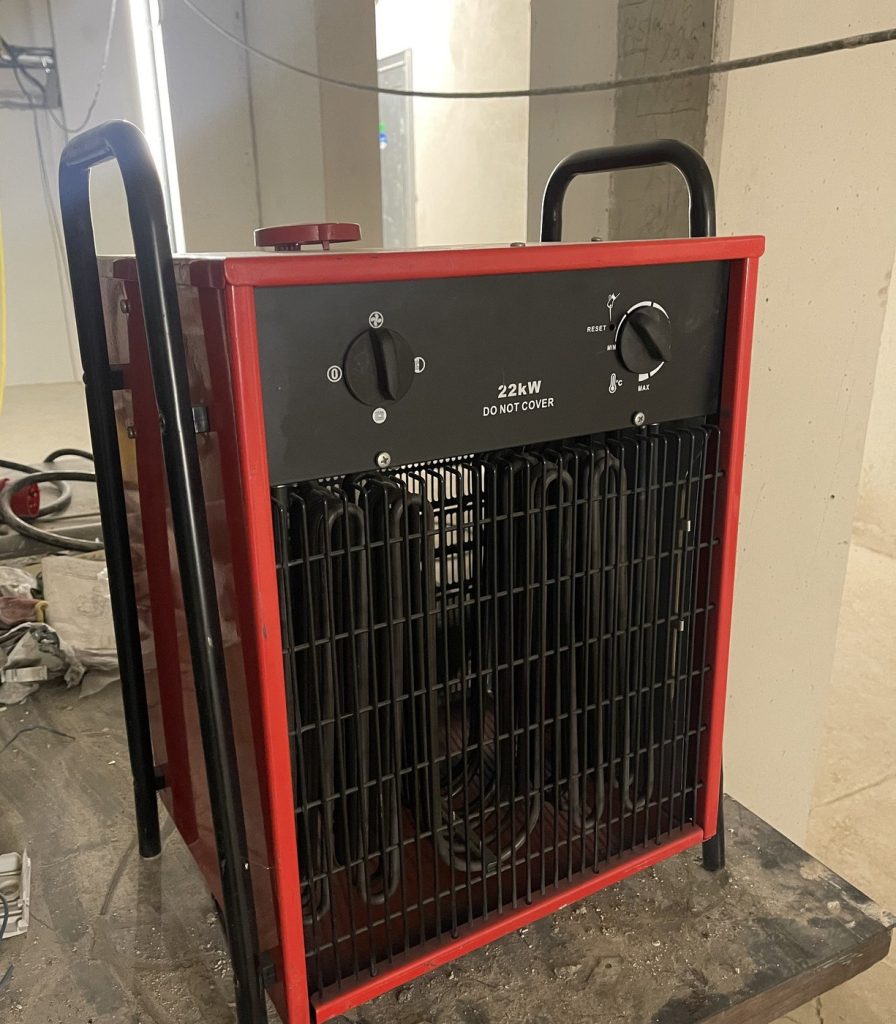
Site heaters are available as electric units, diesel units with flue or gas units. Which one fits depends on the location. In enclosed rooms and enclosures, units without a flue are dangerous because carbon monoxide can build up. Exhaust gases are always routed outdoors.
Directing warm air correctly
Warm air is not blown directly onto fresh grout, otherwise the surface dries out. The air should warm the space, not heat the material at one spot.
Monitoring the temperature
A temperature sensor on the material shows whether conditions were maintained overnight. If the heater runs at night, it needs a safe set-up, fire protection and regular checks.
Fire protection
Heaters, sheeting and fuels belong together in fire protection. Distances to combustible materials are kept and fire extinguishers are ready. Gas cylinders are stored according to the operator's rules.
Welding in the cold: preheating and dry welds
Temperature also plays a role in welding.
Why cold steel cracks
Cold steel cools the weld quickly. Depending on material and wall thickness, the risk of cracks then rises. That is why preheating is carried out when the material, thickness or welding procedure requires it. Why this is so and what applies in winter is described in the article Preheating for welding.
Removing moisture and frost
Moisture, frost and condensation on the steel introduce hydrogen into the weld. The weld area is dried and warmed before welding. Electrodes and filler materials are stored dry.
Wind protection
Wind blows the shielding gas away. Gas-shielded welding outdoors therefore needs wind protection, otherwise the weld becomes porous.
Hot work permit and fire watch
Welding remains hot work – in winter as in summer. Where the operator requires a permit, it is in place. Fire watch and follow-up checks apply even when there is snow outside.
Wind limits for crane lifts: what the crane manufacturer specifies
Crane work in winter rarely fails because of the cold alone, but because of the wind.
The limit is in the manual
Every crane has a permissible wind speed. It is stated in the manufacturer's operating manual and load charts and depends on crane, boom and configuration. This limit applies – not the schedule.
Large surfaces catch the wind
The crane's wind limit applies to normal loads. Loads with a large surface, such as containers, wall elements or ventilation units, catch considerably more wind. A lower limit may apply to them. This is taken into account in the lift plan. How a crane lift is planned in advance is described in the guide Planning a crane lift.
Gusts count
What matters is not only the average wind but also the gusts. An anemometer on the boom shows the wind at lifting height. On the ground it is often much calmer than up top.
Who stops the lift
Before the lift it is agreed who stops it if there is too much wind. As a rule, this is the crane operator together with the person responsible for the lift. This decision is not up for discussion. Who is responsible for lifting operations is described in the guide Appointed person for lifting operations.
Tag lines
Tag lines keep the load steady and at a distance. In wind they are indispensable. Nobody stands under the load or guides it by hand.
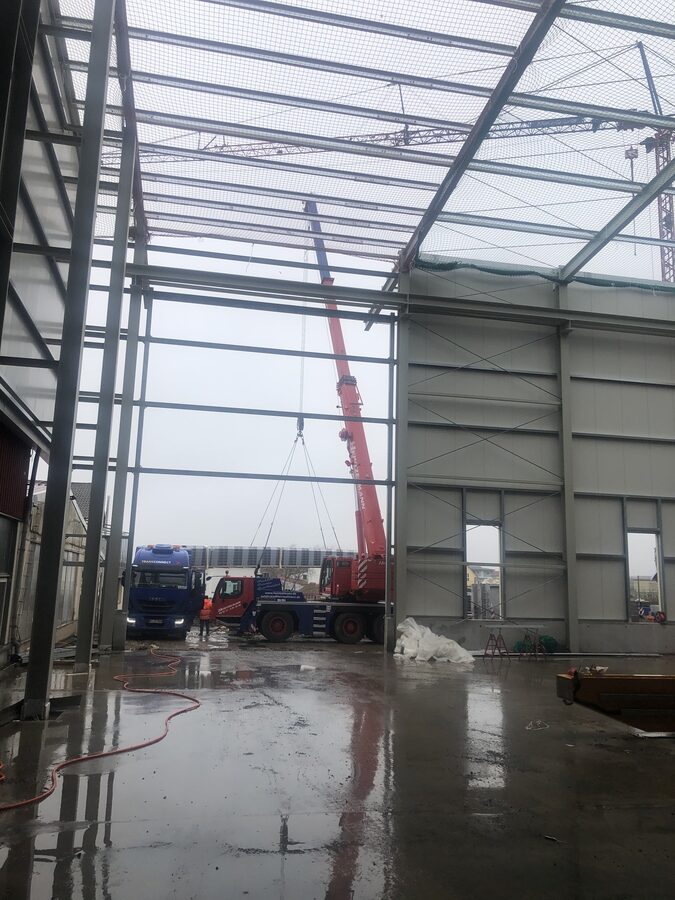
Ice, snow and slippery surfaces during crane lifts
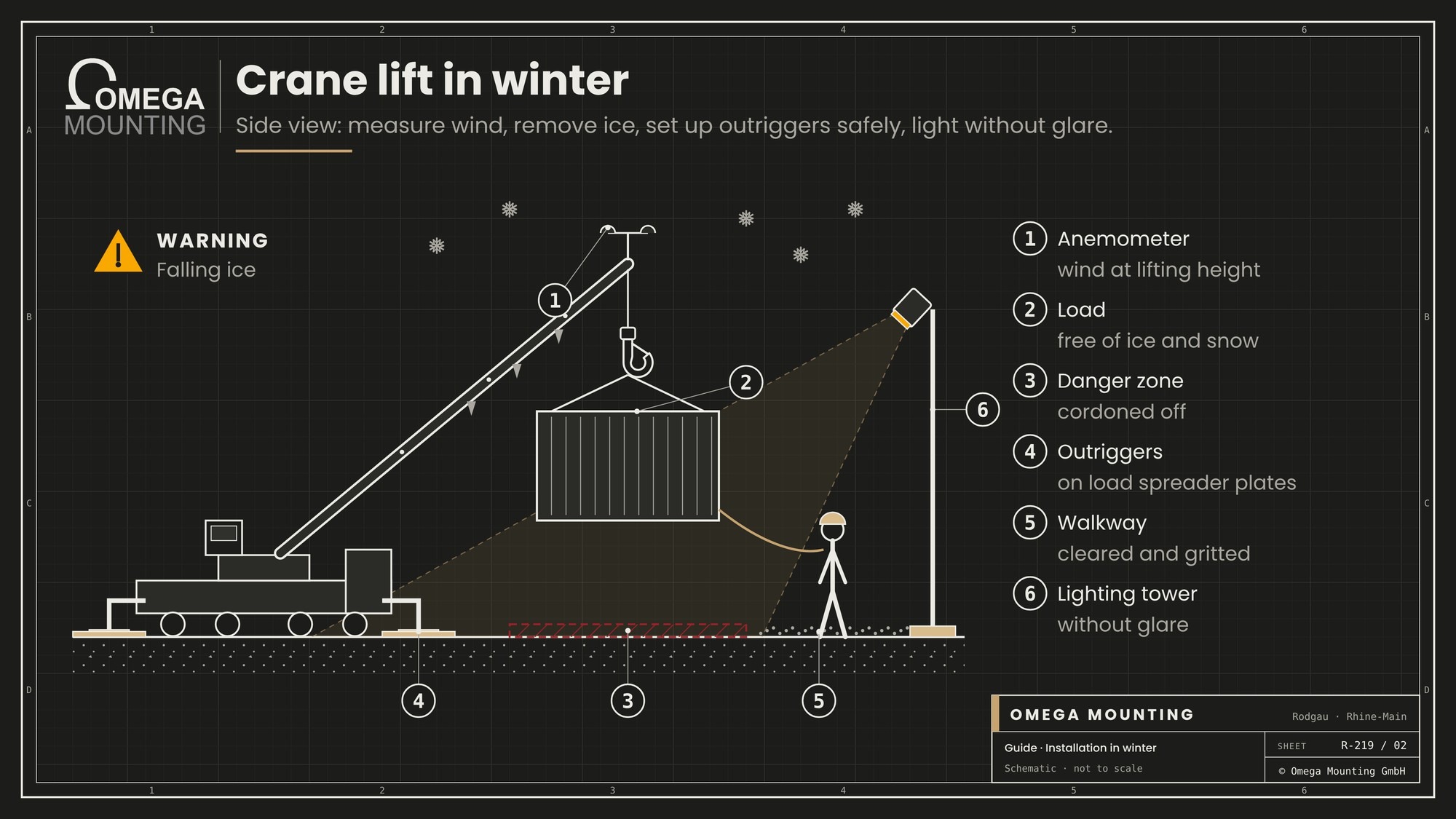
Winter adds ice and slippery surfaces to the wind.
Ice on the load and lifting gear
Snow and ice on the load increase its weight and can fall off during the lift. Loads are therefore cleared before lifting. Lifting gear is checked for icing. Frozen slings or ropes are not used until they have thawed and been inspected.
Ice on the crane
Ice can also form on the boom and fall off when it is extended or slewed. The danger zone under the boom therefore remains closed off. The crane operator checks the crane for ice and snow before starting work.
Set-up area and outriggers
Frozen ground seems firm. When it thaws, it can suddenly give way. The load-bearing capacity of the set-up area is therefore not judged by appearance. Outrigger pads and load spreading mats lie on cleared, level ground, not on snow or ice. Why the ground decides more than the crane is described in the article Load spreading mats.
Walkways for slingers and banksmen
Slingers and banksmen move around a lot during the lift. Their walkways are cleared and gritted. Anyone who slips on ice while a load is suspended endangers more than themselves.
Visibility and light
Snowfall, fog and dusk reduce visibility. If the crane operator can no longer see the load safely, there is no lifting, or the work is done with radio and a banksman. Lighting towers are positioned so that they dazzle neither the crane operator nor the slingers.
Risk of slipping on the installation site
Slips and falls are among the most common accidents in winter.
Clearing and gritting
Access roads, walkways, stairs, ramps and work areas are cleared and gritted before the team starts. Who does this is clarified in advance: the operator on its site, the installation team in its own work area.
Platforms, ladders and scaffolding
Gratings, ladder rungs and scaffold boards ice up quickly. They are checked and de-iced before use. Mobile elevating work platforms are not driven on slippery ground.
Footwear
Safety shoes with good tread and cold protection are mandatory. On very slippery surfaces, slip-on spikes also help.
Wet hall floors
At the hall door, vehicles and shoes carry in snow and wet. The floor quickly becomes slippery there. Entrance mats and regular mopping help.
Cold protection for fitters: clothing, breaks, working times
Anyone who is cold works more slowly and makes more mistakes.
The right clothing
Cold-protection clothing in layers, windproof jackets, warm gloves with good grip and hats under the helmet are part of the equipment. We provide our fitters with suitable winter clothing.
Heated breaks
A heated break room or container belongs on every winter installation. There the fitters warm up, dry their gloves and have something hot to drink. Short, more frequent breaks are better in the cold than a few long ones.
Working times in the cold
In severe cold or strong wind, the time spent outdoors is limited. Work alternates between outside and inside where possible.
Looking out for each other
Hypothermia and frostbite creep up on you. That is why colleagues look out for each other. We never send just one fitter – especially not in winter. Why is described in the guide Lone working on construction sites.
Risk assessment
Cold, wet and wind belong in the risk assessment. The measures follow from it: clothing, breaks, working times, opportunities to warm up.
Batteries, hydraulics and machines in the cold
Tools and equipment also tolerate the cold only to a limited extent.
Batteries
Batteries lose capacity in the cold. Cordless screwdrivers, measuring instruments and radios last less long. Batteries are stored warm, only used when needed and charged as specified by the manufacturer. Many manufacturers only allow charging above a certain temperature.
Hydraulics
Hydraulic oil becomes viscous in the cold. Pumps work harder, movements slow down and seals become brittle. Hydraulic equipment such as jacks, presses or lifting devices is warmed up as specified by the manufacturer before it works under load. Which oil is intended for what is described in the article oil viscosity.
Combustion engines
Generators, forklifts and compressors need winter diesel and a charged starter battery. Anyone standing in front of a generator that will not start in the morning loses the best hours of the day.
Measuring equipment
Lasers, spirit levels and electronic measuring instruments have operating limits. When a device is brought from the cold into the warm, it mists up. Alignment is therefore carried out with acclimatised instruments.
Storing material in winter
Material that is stored incorrectly can no longer be used the next morning.
Storing frost-sensitive material warm
Grout, cartridges, coatings, sealants and adhesives are stored frost-free, as the data sheet requires. A vehicle overnight is not enough for this.
Protecting from moisture
Steel parts, bolts and crates are covered and not placed directly on the ground. Condensation can collect under a sheet, which is why it needs ventilation.
Marking and keeping clear
Whatever is not marked disappears under snow. Storage areas are marked and cleared. Whatever is needed first is at the front.
Longer storage
If machines are stored over the winter, more than a sheet is needed: preservation, moisture protection and regular checks. How this works is described in the guide Preserving a machine.
Kondenswasser: Elektronik in warmen Hallen akklimatisieren
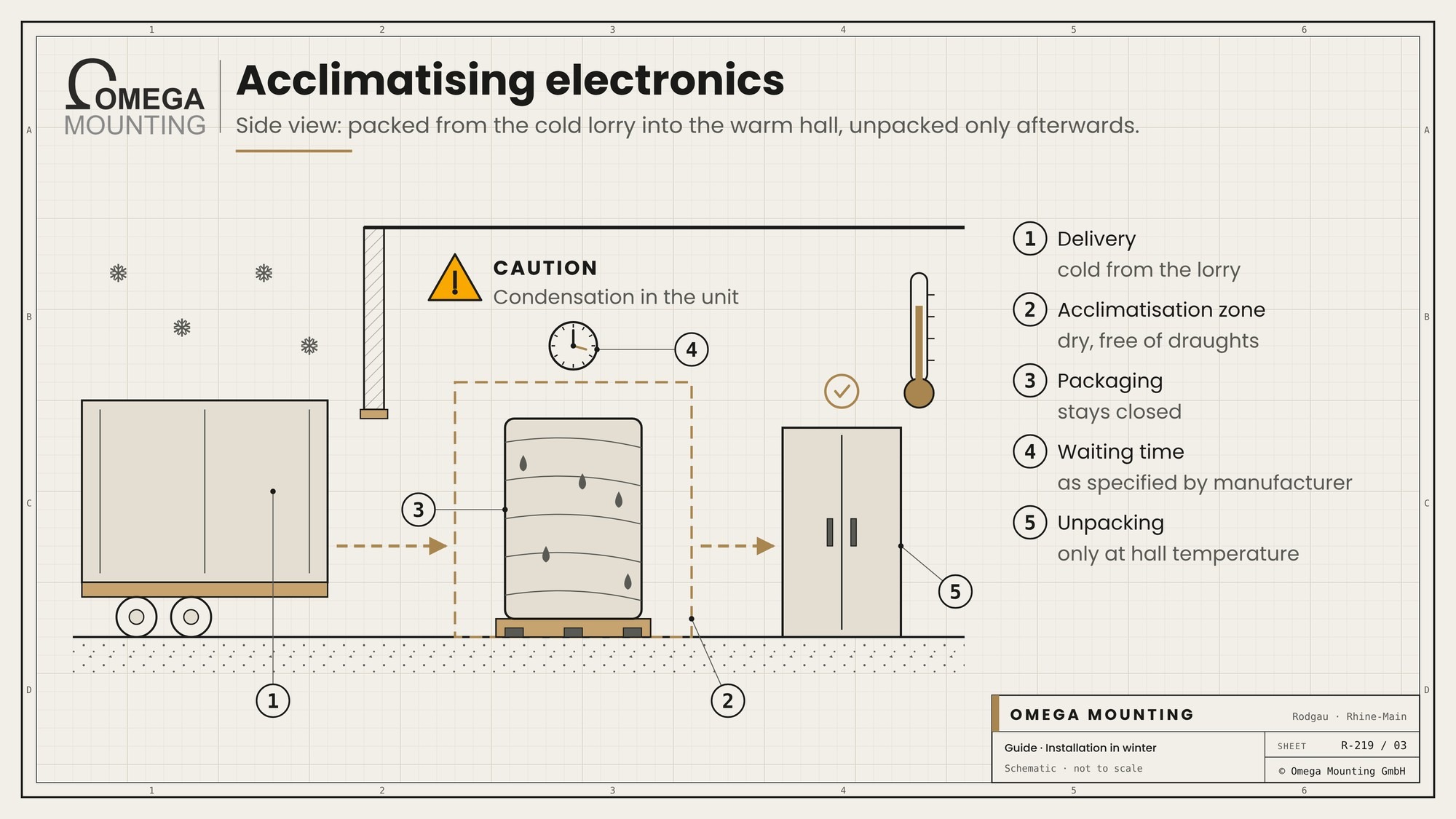
A problem that is often underestimated does not arise outside but when bringing equipment in.
What happens
When a cold device comes into a warm hall, the air at its surfaces cools down. The moisture in the air condenses as water – outside and inside, on circuit boards, terminals and contacts. The greater the difference between cold and warm, the more water.
Why that is dangerous
Moisture in control cabinets, inverters or controllers can cause short circuits and corrosion. If a damp device is switched on, there is a risk of damage that often only becomes visible later.
Acclimatising in the packaging
Electronics stay in their packaging until they have reached the hall temperature. That way the condensation forms on the outside of the film, not inside the device. How long this takes is specified by the manufacturer. Only then is it unpacked.
Planning space
Acclimatising needs a dry area in the hall, away from doors and draughts. This area and the waiting time belong in the installation plan. How control cabinets get through doors and corridors to their place is described in the guide Installing switchgear.
Connection and commissioning
Our electricians connect the equipment up to the main switch – only once the device is dry and acclimatised. Commissioning of controls and software remains with the manufacturer.
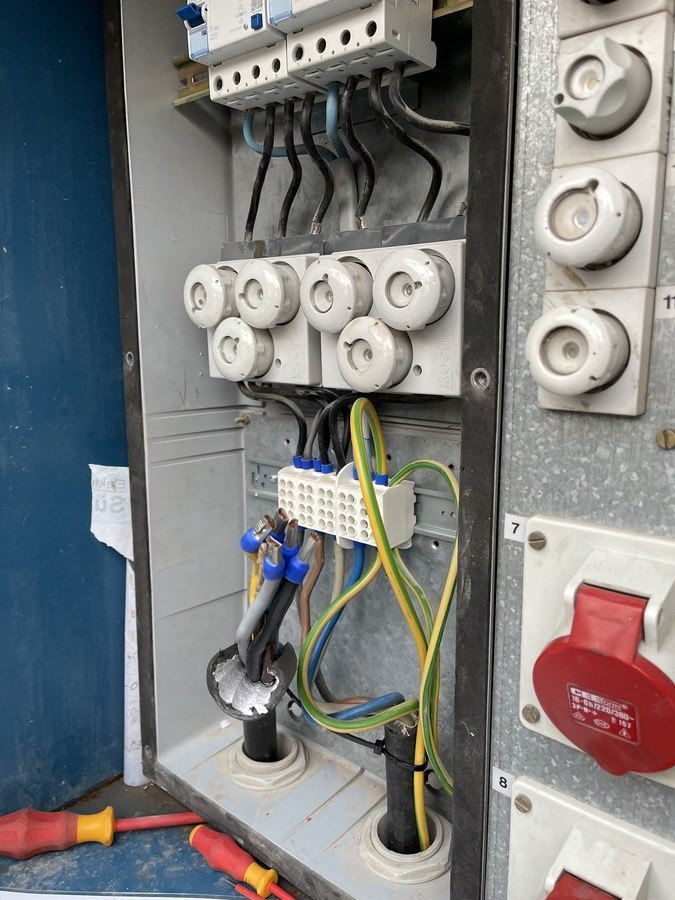
Site power and lighting in winter
In winter the installation site needs more power than in summer.
More consumers
On top of tools and crane come lighting, site heaters and often drying equipment. A site heater is often the largest single consumer. Anyone planning the site power supply includes it from the outset. How this works is described in the guide Planning construction site power.
Good lighting
Work areas, walkways, stairs and access roads are lit. Lighting towers are positioned so that they do not dazzle or cast harsh shadows. A fully extended tower is sensitive to wind and is retracted as specified by the manufacturer when the wind picks up. How work areas and walkways are lit without glare is described in the guide Planning construction site lighting.
Cables and distribution boards in the snow
Cables are not left in puddles or under snow where vehicles drive over them. Cable protectors protect crossings. Distribution boards are raised and protected from moisture. Inspection of site power equipment applies in winter just the same.
Who connects what
We bring generators, distribution boards, cables and lighting and connect them. The grid connection is provided by the network operator or an electrical contractor. On the equipment side, our electricians connect up to the main switch.
Plan B and schedule buffer: when the weather does not cooperate
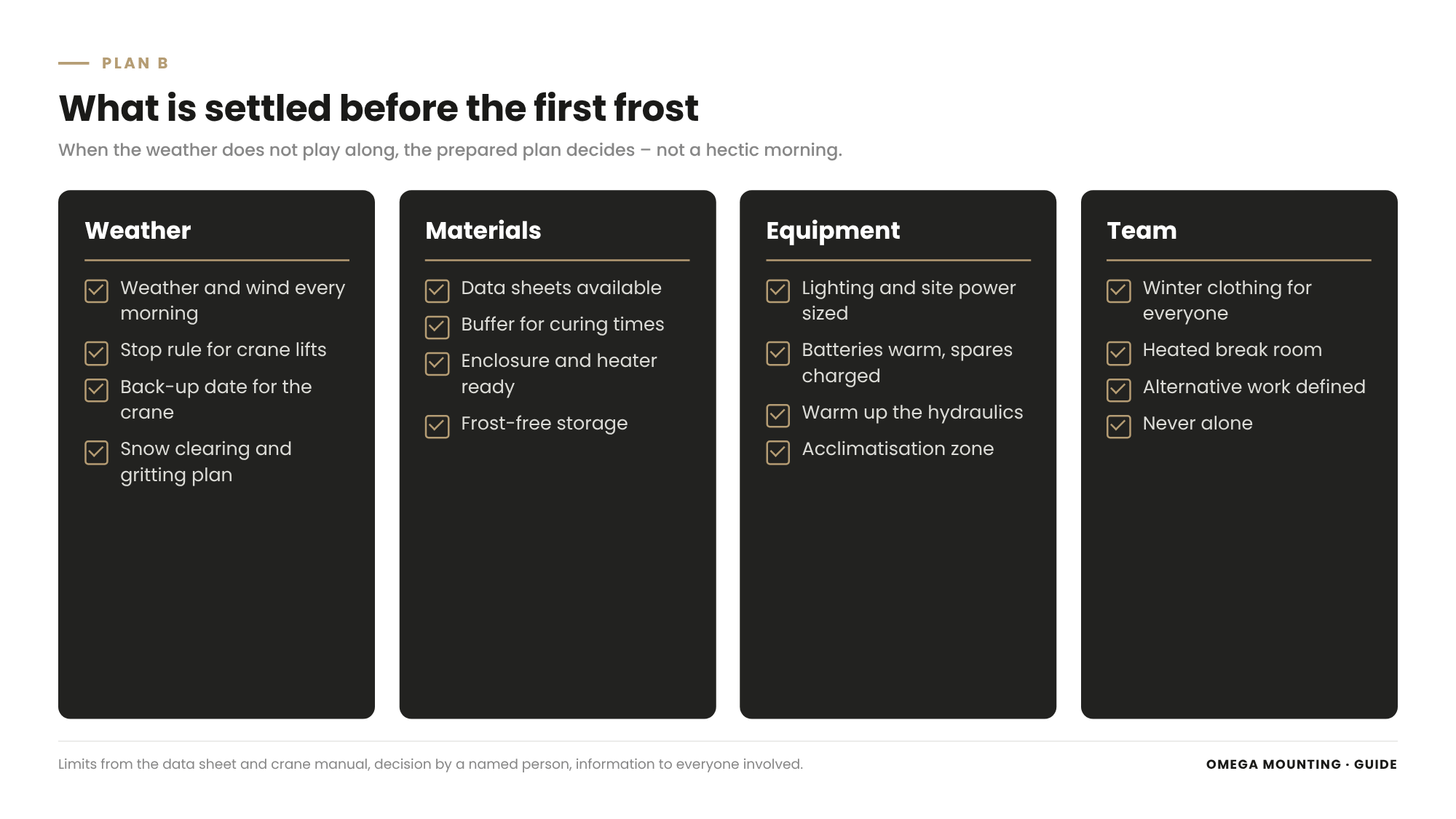
A winter installation plan without a plan B is a plan for summer.
Buffer in the schedule
In winter the plan needs more buffer: for weather, longer curing times, crane cancellations and late deliveries. How large it needs to be depends on the project. What matters is that critical steps are not planned without a reserve.
Fallback work
If the crane may not lift because of wind, the team should not stand idle. Fallback work is fixed in advance: pre-assembly in the hall, work in sheltered places, preparation of the next steps.
Replacement dates
Replacement dates for crane lifts and abnormal loads are agreed in advance. That way nobody has to improvise on the day itself.
Clear stop rules
When is work stopped, and who decides? At what wind, what temperature, what degree of ice? The limits come from the data sheet and the crane manual; the decision is made by a named person.
Communication
If the plan changes because of the weather, the operator, haulier, crane company and other trades are informed immediately. The earlier the message comes, the less it costs.
Safety rules for installation in winter
- No winter installation without a risk assessment covering cold, wet, wind, ice and light.
- Temperature limits from the data sheet are measured and complied with.
- Crane lifts only within the manufacturer's wind limit, with a named person to stop the lift.
- Load, lifting gear, walkways and outriggers are free of ice and snow.
- Heaters with exhaust only with a flue routed outdoors.
- Heated break room and winter clothing for everyone.
- Nobody works alone.
Typical mistakes in winter installation
Relying on gut feeling: “It's not that cold” – but the substrate is frozen.
Material left in the vehicle: Grout and cartridges are too cold in the morning.
Planned without a buffer: The first windy day upsets the schedule.
Grout loaded too early: The curing time was for summer, not for winter.
Electronics unpacked immediately: There is condensation in the control cabinet.
Frozen ground taken as load-bearing: During the thaw the outriggers give way.
Heater without a flue in the enclosure: Gefahr durch Kohlenmonoxid.
The mistake behind the mistakes
Most mistakes happen because winter is treated as an exception. Anyone who plans for it as a normal condition has solved most problems before the first frosty day.
Who does what in winter installation?
Operator
Clears and grits its site, provides heated areas and break rooms where possible, releases time windows and access and is informed about weather decisions.
Planners and site management
Approve foundations, specify requirements for grout and coatings and agree schedule changes.
Manufacturer
Supplies data sheets with temperature limits, requirements for acclimatising electronics and the limit values for its equipment.
Crane company
Provides the crane, checks it for ice and snow and decides with the crane operator on wind and stopping.
Omega Mounting
We plan the installation for winter conditions, measure temperatures, protect and heat work areas, bring lighting and site power, provide winter equipment for the team and keep a plan B ready.
Installation in winter: what it means for your planning
Is winter in the schedule?
Check whether buffers, fallback work and replacement dates are planned.
Are the data sheets available?
Request data sheets with temperature limits for all materials.
Who clears and grits?
Clarify who is responsible for which areas.
Are there warm areas?
Plan a break room, storage area and acclimatisation zone.
What belongs in the order for an installation in winter
Service
Winter planning, temperature measurement, protection and heating, lighting and site power, clearing in our own work area.
The frame
Time windows, heated areas, access, clearing and gritting duties, rules for replacement dates.
Record
Temperature records, weather decisions, photos, approvals before loading.
Legal framework
For installation in winter, the requirements include the Occupational Safety and Health Act with the duty to carry out a risk assessment, the Workplaces Ordinance with requirements for lighting, weather protection and break rooms, the Ordinance on Industrial Safety and Health for cranes and work equipment and, where applicable, the Construction Site Ordinance. For materials and cranes, the manufacturers' specifications and approvals apply. This guide is not legal advice – clarify which duties apply in your case with your occupational safety specialist.
Installation in winter in the Rhine-Main area: how we work
From Rodgau we quickly reach Frankfurt, Offenbach, Hanau, Darmstadt, Aschaffenburg and the region's data center and logistics sites – and our own teams work throughout Germany. For an installation in winter in Rhine-Main we bring team, lighting, site power and site heating from a single source.
We install in data centers, logistics centres and industrial plants – including halls without a finished envelope. How we work in industrial installation is shown on the page on Industrial installation.
For you this means: an installation that stays on schedule even in winter.
Project examples
Three jobs show what matters. None of the reports mentions a season – the lessons apply all the more in winter.
Gantry crane with grout curing overnight
In Babenhausen we erected a gantry, aligned it and grouted the base plates. The sequence was planned so that the grout could cure overnight before the crane bridge was lifted in on the second day. In winter this waiting time becomes longer according to the data sheet – it remains a fixed factor in the plan. The job is described in the report gantry crane installation in Babenhausen.
Site power and lighting in the Rhine-Main area
For installation sites without site power we bring generators, distribution boards, cables, lighting towers and site heaters, for example for a crane lift in a data center. The report notes that between November and February practically nothing useful is possible on outdoor sites early in the morning and from the afternoon onwards without artificial light. The job is described in the report Site power and site lighting in the Rhine-Main region.
Laufkran in einer offenen Halle
In Aschaffenburg we installed a double-girder overhead crane in a new hall whose walls were not yet finished. The team worked in wind and weather and stayed on schedule. The mobile crane lifted the bridge in over the open wall bays. The job is described in the report Double-girder overhead crane installation in Aschaffenburg.
Do you have an installation coming up in winter?
Send us the scope of work, location and time window – we will tell you what to bear in mind in winter and what the plan B looks like. Get in touch now.
What this means for your role
Project and site managers: Plan for winter from the outset – with buffers, replacement dates and clear stop rules.
Installation managers and foremen: Measure temperatures, check weather and wind every morning and stop when the limits are reached.
Operators and technical managers: Clarify clearing and gritting, provide warm areas and give information about access and time windows.
Maintenance managers: Where possible, do not schedule work involving grouting, coating or crane lifts for the coldest weeks.
Buyers: Ask whether winter protection, lighting, site power and heating are included in the quotation.
Occupational safety specialists: Check the risk assessment, cold protection, fire protection for heaters and the ice plan.
Winter installation checklist: on request
We have put together a checklist for installation in winter for your projects. It covers lighting, site power, weather and wind, temperature limits, protection and heating, clearing and gritting, cold protection, storage, acclimatisation and plan B. Request the checklist via our contact form – keyword “winter installation checklist”.
Why Omega Mounting?
From more than twenty years of experience in installation and rigging we know: winter does not forgive improvisation. That is why we plan light, temperature, wind and ice in advance, stick to the data sheet and the crane manual and have a plan B for every critical step. We bring lighting, site power and site heating ourselves, and we never send just one fitter. For you this means: an installation that runs safely and cleanly even in frost. Talk to us about your project – we will get back to you promptly.
Conclusion
Installation in winter means planning light, temperature, wind, ice and moisture as fixed factors. The limits for grout, concrete, adhesives and coatings are in the data sheet, the wind limit in the crane manual. Protection, heating, preheating, cold protection and acclimatising electronics ensure that these limits are met.
Anyone who plans for winter from the outset and has a plan B installs within the time window even in frost. If you have an installation in winter ahead of you, get in touch with us.
Planning a move-in, installation or maintenance in the Rhine-Main region?
Tell us briefly what you need – we'll come back with an honest assessment.
Free, no-obligation callback
You may also be interested in these guides
Maintenance & Servicing

About the author
Tobias Schott
Managing director of Omega Mounting GmbH, Rodgau · more than 20 years of hands-on experience in installation and maintenance
A trained mechatronics technician, working in maintenance, servicing and industrial installation since 2004 – first alongside his father, and with Omega Mounting since 2012: from overhead conveyors in Frankfurt to the crane system in a new-build hall. He plans and leads lifting operations as an appointed person (AP) in data centers and on industrial sites in the Rhine-Main region, trains and examines operators of cranes, mobile elevating work platforms and telehandlers, and is a qualified occupational safety specialist. On jobs abroad he is known as the “German Troubleshooter” – the person you call when a site gets stuck. He learned what quality means from his father, not from a manual: Made in Germany as a standard for his own work, not a label. That is why quality comes first at Omega Mounting – ahead of speed and price. He writes these guides from that practice: what works on our sites is in them – what exists only on paper is not.
Frequently asked questions
Yes, most mechanical installation work is also possible in frost. Limits are set above all by materials such as grout, concrete, adhesives and coatings, and by wind during crane lifts.
This is specified by the grout manufacturer in the data sheet – for air, substrate and material. Without knowing these limits, there is no grouting in frost.
Longer than in summer. Many data sheets give curing times depending on temperature. Loading only takes place once the time for the actual temperature has been reached.
The permissible wind speed is stated in the crane manufacturer's operating manual. A lower limit may apply to loads with a large surface.
Because condensation forms inside the device when it moves from cold to warm. If it is acclimatised in its packaging, the moisture condenses on the outside of the packaging.
Yes, if the material, thickness or welding procedure requires it. Cold and damp steel increases the risk of cracks.
Winter clothing, warm gloves with good grip, safety shoes with cold protection, a heated break room and shorter working times in the cold.
Yes. From Rodgau we are quickly on site in the region, and we work throughout Germany with our own teams.
Send us the scope of work, location, time window and the data sheets for the materials. We will review the documents and get back to you with a proposal including a plan B. Go to the contact page.
 English
 German