
- Guide – Data Center
Moving a diesel tank into a data center: setting day and storage tanks for the standby power system safely
By Tobias Schott · Reading time approx. 21 minutes · As of: November 2026

Moving a diesel tank into a data center means: checking access, ground and crane position, planning the lift with a lift plan and tested lifting points, setting the storage tank in a pit or on a foundation, bringing the day tank into the generator room without a crane, and aligning and fixing both as specified. The tank system, pipework, filling, leak monitoring and testing are then handled by the specialist contractor, approved expert, electrical contractor and manufacturer.
When the grid fails, the standby power system starts up in the data center. Its generator sets run on diesel, and that diesel has to be on site. That is why every standby power system has tanks: large storage tanks for the supply and smaller day tanks right at the generator sets. They are often set in an early construction phase, long before the first server runs – or later in an existing site, when the plant is extended.
The same questions come up on every tank job: Will the tank get onto the site at all? Where may the crane stand? How do you sling a tank without damaging the wall or the coating? How does a day tank reach a generator room that no crane can reach? And where does the installation contractor's work end and the tank specialist's begin?
This guide answers these questions from practice. It is written for project and site managers, MEP designers, data center operators and technical managers, facility managers, general contractors, buyers and occupational safety specialists. How standby generators are serviced, repaired and replaced is covered in the guide Standby Generator Maintenance.
Key points at a glance
- Diesel tank in a data center means: moving the storage tank and day tank of the standby power system in, setting them down, aligning them and fixing them mechanically.
- Two types of tank. The storage tank holds the supply, the day tank feeds the generator set directly.
- The route decides. Access roads, gates, shafts and ducts determine where the crane can stand.
- Lift it empty. The empty tank is lifted; it is filled only after it has been set.
- Never around the shell. Slinging is done at the manufacturer's lifting points, checked before every lift.
- Think about the sequence. Some crane positions later become tank areas themselves.
- No combustion engines indoors. Day tanks reach their position with electric lifting equipment and skates.
- A clear interface. Pipework, filling, monitoring and testing are done by the specialist contractor and the approved expert.
What is a diesel tank in a data center?
A diesel tank in a data center is the fuel store of the standby power system. It makes sure the generator sets start up when the grid fails and keep running until the public supply is back. Operators and designers decide how long that must be. That determines the size and number of tanks.
The standby power system is a system. It includes the diesel engine and generator, cooling, exhaust path, exhaust treatment, switchgear and, of course, the tanks. What it all includes is explained in the article The standby power system.
A tank is not a machine
A tank is a thin-walled vessel with a coated surface. It is large, light for its size and delicate at the wall. A machine is slung at its frame. A tank does not forgive a sling in the wrong place.
Single-wall, double-wall, with containment bund
Diesel is hazardous to water. That is why diesel tanks are either double-walled or stand in a containment bund. How a double-wall tank works is explained in the article The double-walled tank. For the installation, this means that both walls and every coating must stay undamaged.
What sets this guide apart from others
How a tank is generally delivered, lifted and set down – whether for diesel, water or process media – is covered in the guide Installing a tank. This guide is about the special features of data centers: two types of tank, tight sites, generator rooms without crane access, live operation and many interfaces.
Day tank and storage tank: what is the difference?
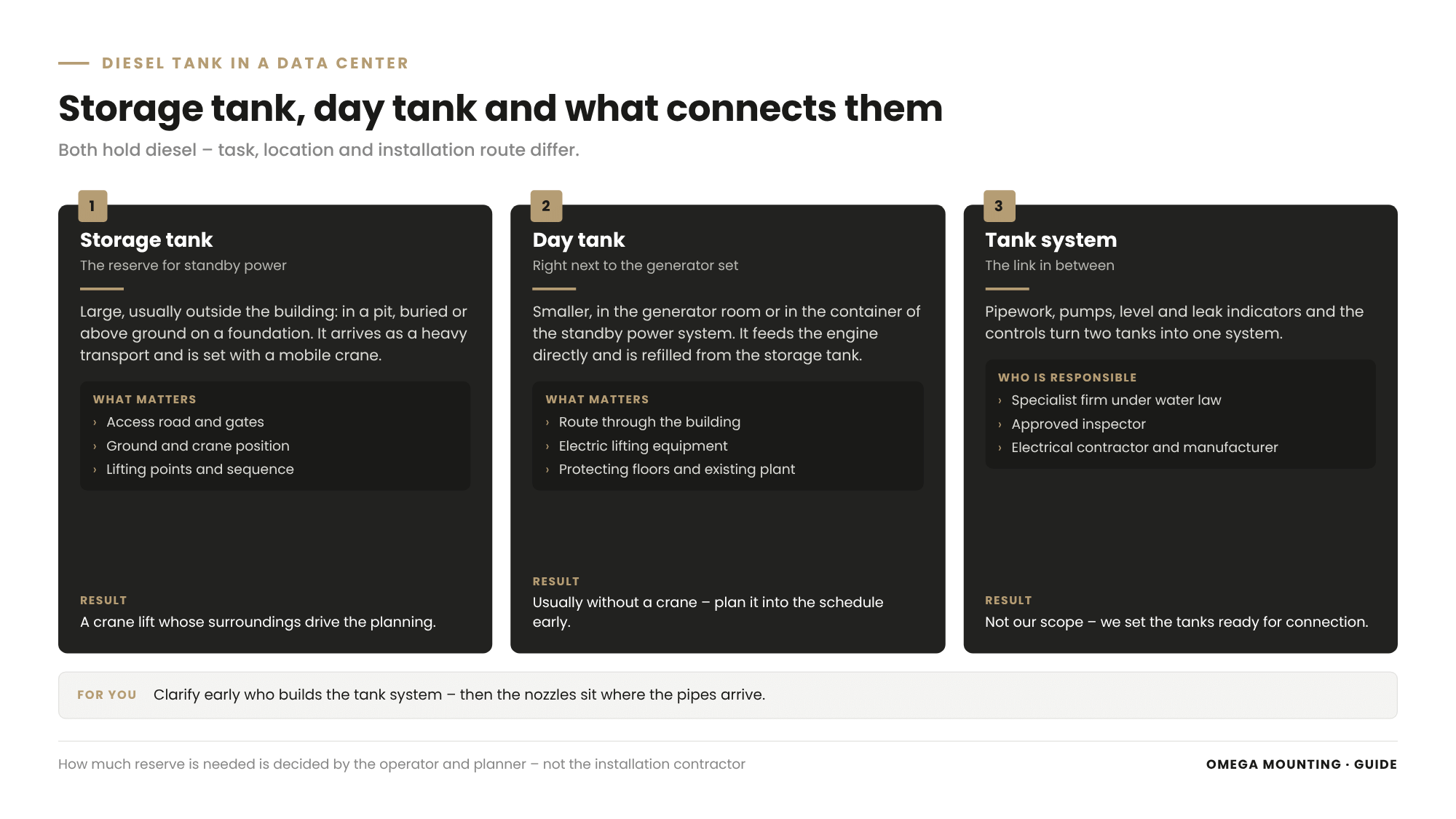
Both tanks contain diesel. But their job, their location and the way they are brought in differ.
The storage tank
The storage tank holds the diesel supply for emergency power. It is large and usually stands outside the building: above ground on a foundation, in a pit or buried. It arrives as a heavy transport and is set with the mobile crane.
The day tank
The day tank sits close to the generator set, often in the generator room or in the standby power container. It supplies the engine directly and is refilled from the storage tank. It is much smaller but often has to get to its place through doors, corridors and openings – usually without a crane.
The connection in between
Between storage tank and day tank there are pipes, pumps, level and leak indicators and the controls. All of this is part of the tank system. It is built by a specialist contractor under water law, connected electrically by an electrical contractor and commissioned by the manufacturer or installer. We bring the tanks in so that these trades can connect.
Where the diesel tank in a data center stands
The location determines how the tank arrives and what matters when setting it.
In a pit
Many storage tanks lie in a prepared pit. It is excavated, secured with shoring, the base slab is concreted and often lined with membrane. The supports rest on it. There is little room between tank and shoring wall.
On a foundation outdoors
Above-ground storage tanks stand on a foundation or in a bund. What counts here are level supports, an undamaged protective layer and fixing as specified by the manufacturer and the structural designer.
In the generator room
Day tanks usually stand in the generator room, close to the generator set. The room is tight, the routes are long, and the generator set is often already in place. How to plan an opening for large components is covered in the guide Planning an installation opening.
In the container
If the standby power system arrives as a container, the day tank is often already installed. Then it is about lifting the whole container and connecting it to the building.
Before delivery day: what must be clarified
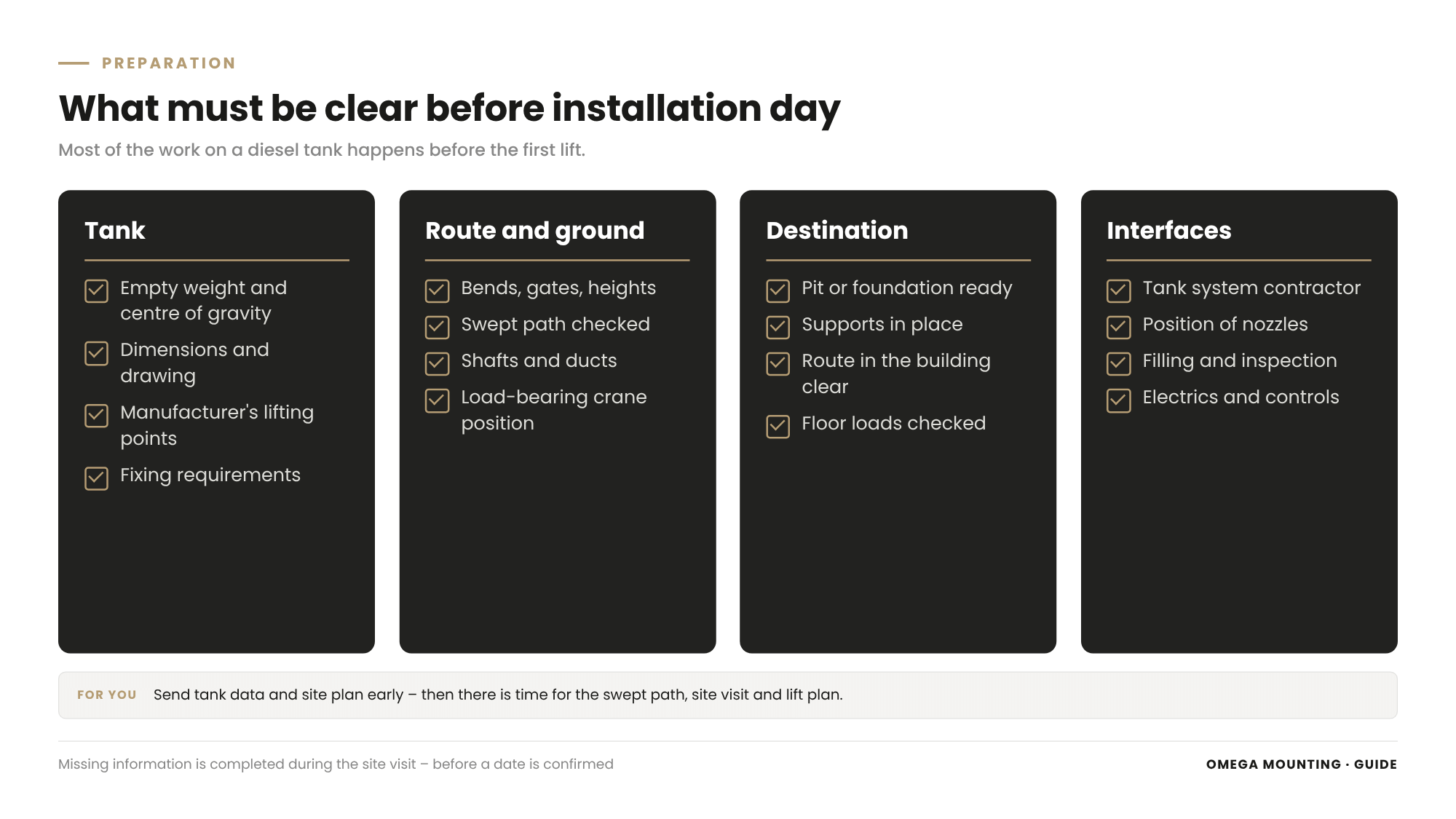
With a diesel tank in a data center, most of the work is done before the first lift. Skimp here and you face a gate that is too narrow on delivery day.
Tank data
Empty weight, dimensions and centre of gravity come from the manufacturer, ideally with a drawing. This includes the position of the lifting points and the requirements for lifting, setting down and fixing.
Access route
Will the low-loader with the tank get through? Bends, gates, fences, barriers and heights are measured. Long tanks we check in advance with a swept-path analysis, first roughly by sketch, then in CAD.
Ground
Below the site there are often shafts, ducts and basement light wells. They do not carry the point loads of a crane's outriggers. Their position belongs in the plan before a crane position is fixed.
The destination
Is the pit finished, the base slab signed off, the supports set? Has the foundation cured? Is the route in the generator room clear? A tank that cannot be set down blocks crane and low-loader.
The site survey
Nothing replaces a look on site. During the site visit we see what is on no plan: freshly paved routes that do not yet carry load, site cabins in the slewing area, cables above the access road or a slope closer to the pit than expected. Missing information is added at the same time.
The interfaces
Who builds the tank system, who fills it, who tests it? These contacts should be known before the tank arrives. Then the connections sit where the pipes arrive.
Setting the storage tank with the crane: access, crane position, lift plan
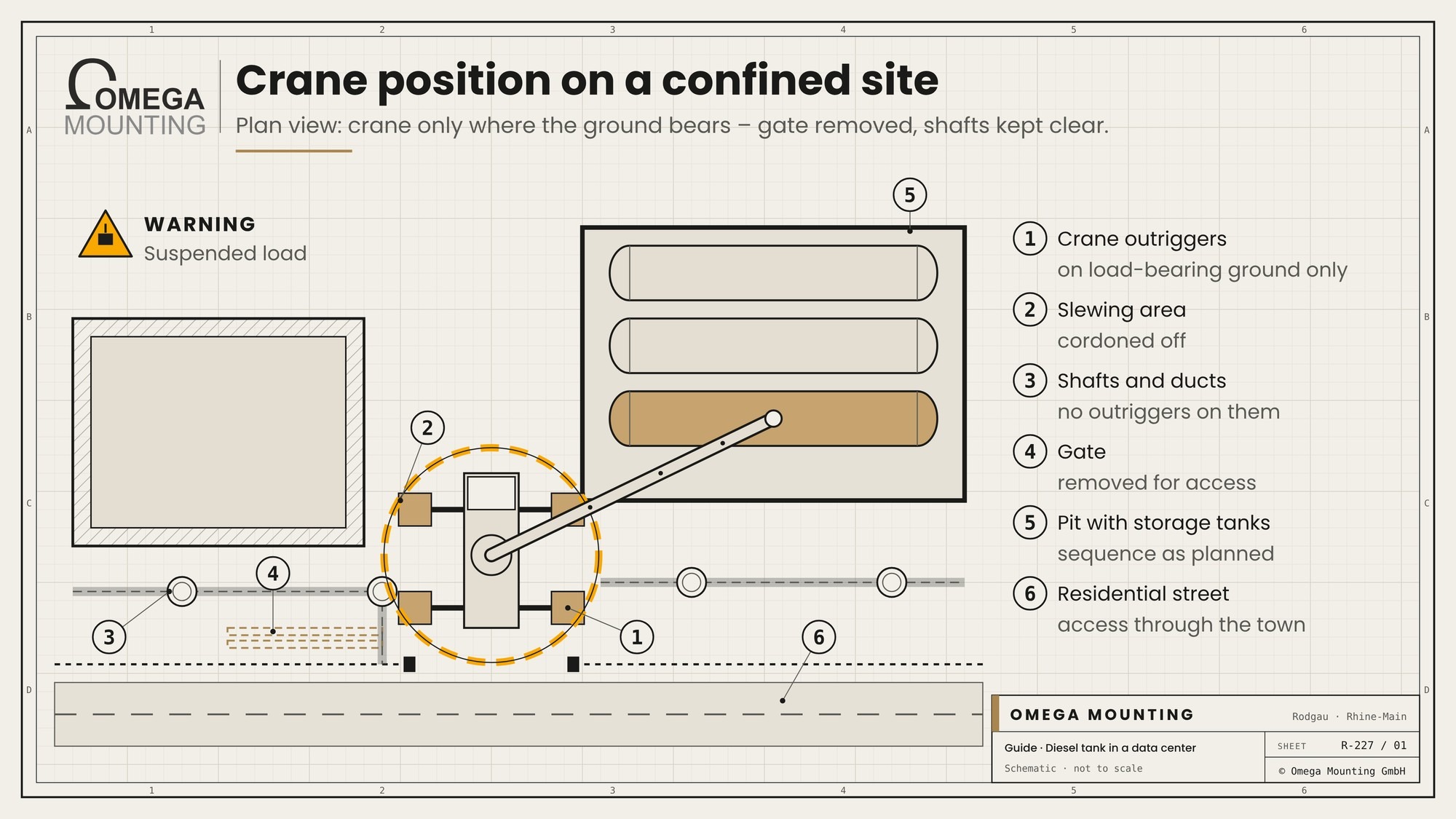
The storage tank is a classic crane lift. The difficulty is rarely the load, but the surroundings.
Finding the right crane
You need the crane that just reaches from the permitted standing areas. A bigger crane sounds safer, but it brings more weight, more outrigger area, higher outrigger forces and more space needed for rigging. On a tight site it makes the problem worse. How weight, radius and position come together is covered in the guide Planning a crane lift.
Measuring crane positions
Crane positions are measured and calculated for every tank together with the crane company. Crane planning and lift planning run in parallel, not one after the other. Where the crane stands decides the radius, and the radius decides everything else.
When the gate is in the way
If the access does not fit, it is altered. Gates are removed, fences opened, obstacles moved. That sounds like a lot of work but on a tight site it is often the better way than a bigger crane. If the crane has to stand on a public road, this is covered in the guide crane on the road Permit and process.
The lift plan
The lift plan describes in writing the sequence from delivery to the tank set in place. It fixes crane position, lifting equipment, slinging geometry, exclusion zones and sequence. Who is responsible for the lift is covered in the guide Appointed person for lifting operations.
The height of the sling set counts too
The height of the sling set adds to the lifting height. If you calculate only to the edge of the pit, you are out by several metres. That helps decide which crane is enough.
Wind and an empty load
An empty tank is large and light in relation to its size. It offers the wind a lot of surface. That is why the crane's wind limits belong in the lift plan, and tag lines keep the tank on its heading. If it gets too windy, the lift is postponed – and one person decides that, not the majority.
Slinging: why the shell is off limits
With a diesel tank in a data center, slinging is the most delicate part of the planning.
No sling around the shell
A round sling around the tank shell would damage coating and wall. That is why the manufacturer has provided lifting points on the tank, on large horizontal tanks usually welded on the crown.
The sling set spreads the load
A sling set of round slings and shackles spreads the load over all lifting points and keeps the tank level. Sling length, capacity and sling angle are set by the lift plan. Which lifting accessory suits which job is covered in the guide Lifting accessories for heavy loads.
The angle is a compromise
A shallow sling angle increases the force in each leg. A steep angle needs a taller sling set and therefore more lifting height. The right angle is a deliberate decision between the two.
Visual check before every slinging
The lifting points are welded on and documented by the manufacturer. Even so, the welds are inspected before every slinging. The tank has often been on the road for a long time, and transport damage only shows at the destination.
Recalculate instead of believing
Leg forces, sling angles and centre of gravity are recalculated. Manufacturer data is a basis, not an approval. Whoever pulls carries the responsibility.
Setting down and sequence: when the crane position becomes the tank area
Setting down is the slowest step with the storage tank. This is where it is decided whether coating and membrane stay intact.
The crane operator cannot see the target
In a pit the crane operator often cannot see the whole target. That is why the signaller stands where he can see both load and target, and guides the last centimetres by radio and hand signals.
Slowly onto the supports
The tank is slewed over the shoring wall, lowered and set on the supports. It must neither hit the wall nor damage the membrane. Only when it sits correctly is the load taken off the sling set.
Nobody under the load
Nobody stands under the tank in the pit during the lift. Work at the supports starts only once the load is safely set down.
The sequence of lifts
On tight plots, some crane positions later become tank areas themselves. The position then has to be dismantled after the lift before the next tank can be set there. Every lift has its place in a chain of lifts, alterations and sign-offs, coordinated with the groundworks.
Heavy transport in rhythm
Each storage tank usually arrives on its own as a heavy transport. The vehicles are timed so that no low-loader waits for long and no crane stands without a load.
Bringing in the day tank: into the generator room without a crane
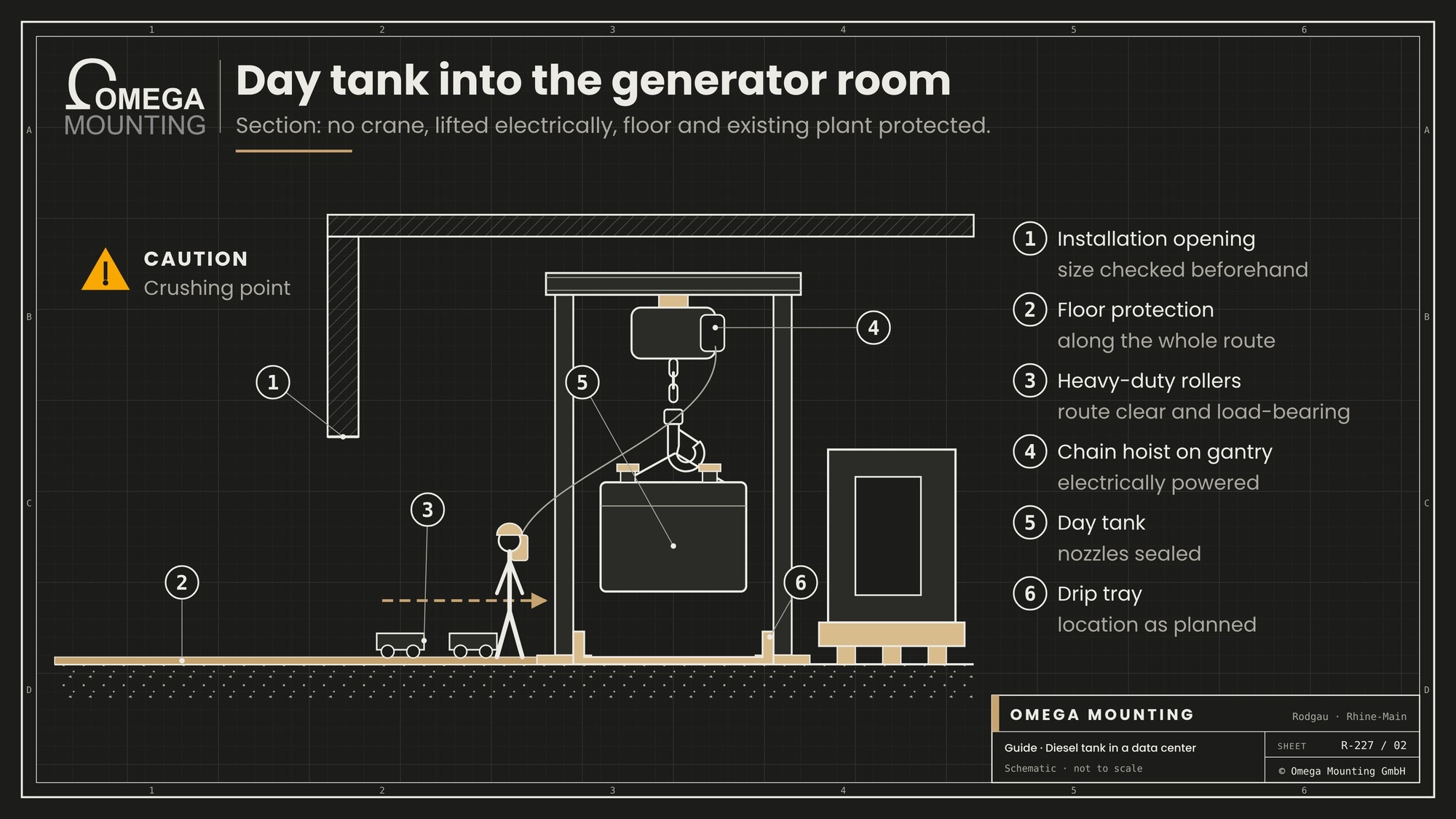
The day tank poses different tasks. It is smaller, but its route is often harder.
The route through the building
From the delivery point to the generator room there are gates, corridors, lifts or openings. Every constriction is measured, every floor load checked. If the tank does not fit through, the opening has to be altered or the tank delivered another way. That is clarified before ordering, not on delivery day.
Without combustion engines
Combustion engines are not permitted inside the building. The day tank is therefore moved with electric lifting equipment, machine skates, pallet trucks or gantries with chain hoists. This equipment needs power: we bring site power with generator, distribution and cables and connect it. How loads are moved over the floor without a crane is covered in the guide heavy-load skidding.
Protecting the floor and the existing building
Routes are covered with protection boards and fleece, walls and door frames are protected. The generator room often already holds the generator set, switch cabinets and cables. None of it may be damaged.
Setting down in a tight room
At the destination the tank is raised, the skates are removed and it is lowered into its place or into its bund. This creates pinch points between tank, floor and wall. Hands and feet stay out of the gap, and the movement is called out.
Replacing a day tank in an existing facility
If a day tank is replaced in a live data center, there is one more thing: the old tank must be empty, cleaned and signed off by the specialist contractor before we remove it. The standby power system is restricted during the replacement. How the time window and the temporary supply are planned is covered in the guide Replacing a standby generator.
Aligning and fixing as specified
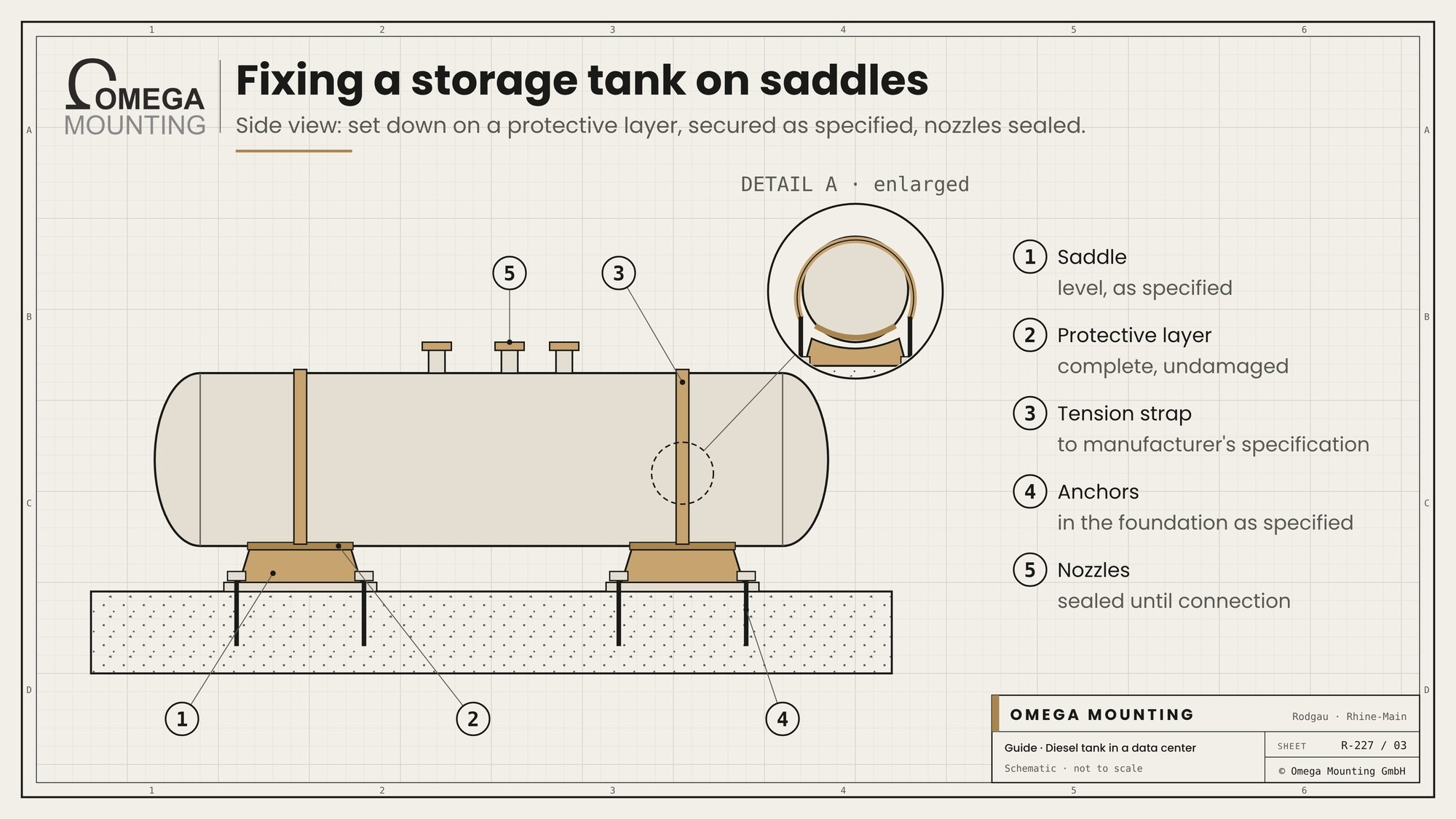
A tank that is lying is not finished yet. It has to be aligned and secured correctly.
Position and nozzles
The tank is aligned so that its nozzles sit where the specialist contractor's pipes arrive. We clarify that with them in advance. A tank that lies twisted by a hand's breadth means alterations to the pipework later.
Supports and protective layer
Horizontal tanks rest on saddles or supports. There is often a protective layer between tank and support so the coating does not suffer. It must be complete and undamaged.
Fixing as specified
How the tank is fixed – with straps, bolting or anchors – is specified by the manufacturer and the structural designer. For tanks in pits or buried tanks, securing against buoyancy also plays a role. We fix as specified. What anchors hold in concrete is covered in the article Heavy-duty anchors.
Keep the nozzles closed
Until the specialist contractor connects, all openings of the tank stay closed. Dirt, water or rubble have no business in the tank.
Documenting
Photos of the tank as set and fixed, the position of the nozzles and anything unusual at lifting points or coating go into the handover record. That way the next contractor knows what to expect.
The interface to the tank system: where our work ends
For a diesel tank in a data center there is a clear boundary between mechanics and tank system. If you know it, you plan without gaps.
What we do
We plan the lift, check route and lifting points, sling, signal, set down, move, align and fix as specified. On request we take the role of appointed person (AP) for lifting operations.
What the specialist contractor does under water law
Pipework, pumps, level indicator, leak indicator, overfill protection and venting belong to the tank system. They are built by a specialist contractor under water law. Filling with fuel is also not our job.
What the approved expert does
Depending on the size of the system, it is inspected by an approved expert before commissioning and periodically afterwards. Which inspections apply is clarified by the operator with the specialist contractor and the authority.
What the electrical contractor and the manufacturer do
Pumps, indicators and leak monitoring need power and signals. The electrics beyond the main isolator, the integration into the standby system's controls and commissioning are done by the electrical contractor and the manufacturer. Our own electricians connect on the plant side up to the main isolator if that is agreed.
Installing in a live data center: access, redundancy, cleanliness
If a diesel tank is installed in a data center that is already running, additional rules apply.
Access and permissions
Every work step is notified in advance: lift plan, risk assessment, personnel list, test certificates for work equipment. No permission, no access. What the work looks like for subcontractors in a data center is covered in the guide installation in data centers.
Do not put redundancy at risk
A lift over live equipment, a cordon in front of an emergency exit or a crane in front of the fire brigade access – all of that must be agreed with the operator. Our work must not restrict the standby power system unless that is expressly planned.
Work cleanly
Dust, swarf and packaging have no place in technical rooms. Unpacking is done outside, routes are protected, and we tidy continuously.
Neighbours and surroundings
Many data centers stand in industrial estates, some in the middle of town. A heavy transport through a residential street, a mobile crane in front of the gate or a road closure early in the morning also affects the neighbours. Cordons, notices and permits are organised in good time so the lift day does not fail on a complaint.
Installation as a time window
In new builds, installation is a window: once the wall is closed or the room is fully fitted out, the tank no longer gets in. That is why the day tank belongs early in the construction programme.
Safety rules when installing diesel tanks
- No lift without a written lift plan and a named appointed person.
- Lifting points are checked before every slinging; the shell is never wrapped.
- Crane positions only on tested ground, never over shafts or ducts without proof.
- Slewing area and pit are cordoned off, nobody stands under the load.
- Indoors only electric lifting equipment, pinch points are called out.
- The empty tank is lifted; it is filled only after it has been set.
- Every team has at least one trained first aider, nobody works alone.
Typical mistakes with a diesel tank in a data center
Access not measured: The low-loader cannot get round the bend, the lift is cancelled.
Shafts overlooked: The crane is to stand on an area that cannot carry its outrigger loads.
Crane too big: More crane means more space – on a tight site it gets worse instead of better.
Sling set height forgotten: The crane reaches the edge of the pit, but not with the sling set.
Sling around the shell: Coating or wall are damaged, the tank has to be inspected or replaced.
Day tank planned too late: The room is closed, the tank no longer fits through.
Interfaces left open: Nobody knows who connects the pipe, so the nozzles sit in the wrong place.
The mistake behind the mistakes
Most mistakes happen because the tank is seen as a simple delivery. It is a lift that needs planning, a component with a delicate surface and the start of a plant that several trades still work on.
Who does what with the diesel tank in a data center?
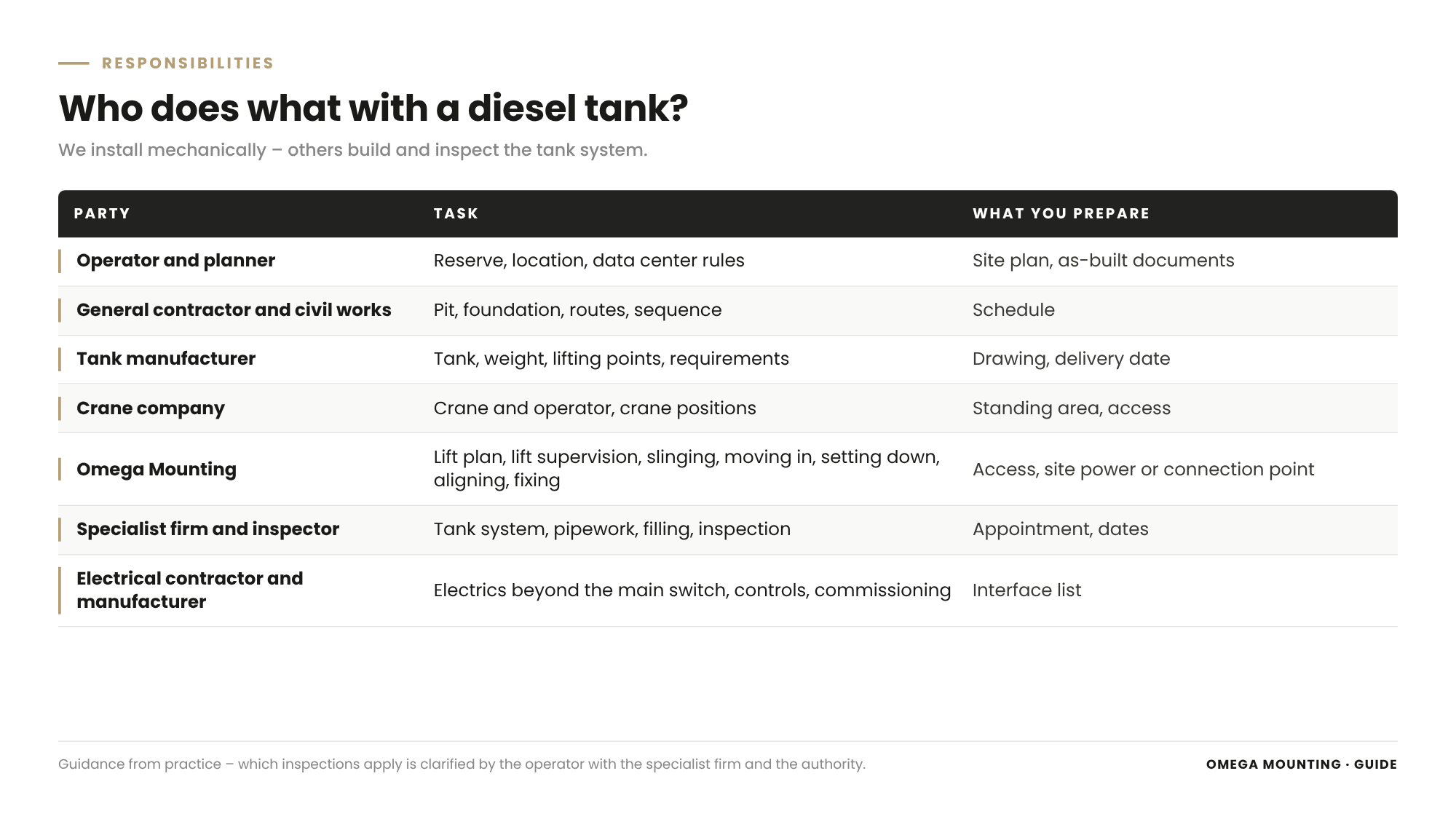
Operator and designers
They decide how much supply is needed and where the tanks stand. They provide the site plan, as-built documents and the data center's requirements.
General contractor and groundworks
They prepare pit, foundation and routes and coordinate the sequence with the other trades.
Tank manufacturer
It supplies the tank with weight, centre of gravity, lifting points and requirements for lifting and fixing.
Crane company
It provides crane and crane operator and plans the crane positions with us.
Omega Mounting
We plan and, on request, take responsibility for the lift, check lifting points, sling, signal, bring day tanks in inside the building, set down, align and fix as specified.
Specialist contractor, approved expert, electrical contractor and manufacturer
The specialist contractor under water law builds the tank system and fills it, the approved expert inspects, the electrical contractor integrates it, the manufacturer commissions it.
Diesel tank in a data center: what this means for your planning
Measure early
Have access, gates and ground measured before the tank is ordered.
Finish the target
Pit, foundation and route must be finished and signed off on delivery day.
Fix the sequence
Agree with the groundworks and the crane company which tank is set when, and from where.
Settle the handover
Name early who builds the tank system, who fills it and who tests it.
What belongs in the order for installing diesel tanks
Service
Lift plan, check of lifting points, lift supervision, slinging, signalling, installation inside the building, setting down, aligning, fixing as specified, handover record.
Supplied by others
Manufacturer's tank data, site plan with shafts and ducts, finished pit or foundation, clear route, crane as agreed, site power or connection point.
Record
Lift plan, photos of the tank as set and fixed, position of the nozzles, anything unusual, handover to the specialist contractor.
Legal framework
For the installation, the German Occupational Safety Act with the risk assessment and the Industrial Safety Ordinance for cranes, lifting equipment and lifting accessories apply above all. For the tank system itself, water law and the ordinance on installations handling substances hazardous to water apply: depending on size, certain work must be done by a specialist contractor and the system inspected by an approved expert. This guide is not legal advice – which obligations apply to your system, clarify with your specialist contractor, your occupational safety specialist (Fachkraft für Arbeitssicherheit) and the competent authority.
Diesel tank in a data center in the Rhine-Main region: how we work
From Rodgau we reach Frankfurt, Offenbach, Hanau, Darmstadt, Raunheim and the other data center locations of the region quickly – and we work nationwide with our own teams. Data centers are one of our focus areas: transformers, standby generators, load banks, cooling units and tanks.
What we do in data centers is shown on the page Data Center. How we bring switchgear through gates and corridors to its place is covered in the guide Installing switchgear.
In practice: one contact who supplies the documents and is on site on lift day.
Project examples
One project shows the setting of storage tanks directly; two related projects show how we bring standby power systems and equipment into data centers.
Storage tanks in Raunheim: a lift in the middle of town
In Raunheim, as appointed person for lifting operations, we planned and supervised the setting of five large diesel tanks for the standby power system of a data center. The site lies in the middle of town, there were shafts and ducts under the ground, and gates were removed for the crane access. We measured the crane positions with the crane company, checked and recalculated the welded lifting points, slung and signalled every tank into the pit. One crane position was dismantled after the lift because tanks were set there too. After three days on site all five were set, bolted and ready for filling. The project is described in the report Setting diesel tanks at a data center in Raunheim.
Related project: installing standby generators
Tanks are part of the standby power system, and we regularly bring in the generator sets that go with them. The report shows why combustion engines are not permitted inside the building, why the move-in is a time window and how we hand over complete mechanically before the manufacturer commissions. Read it in the report Standby generator installation in data centers.
Related project: installing equipment in data halls
How we work inside the building is shown by a project with distribution cabinets in a data center in the Rhine-Main region: routes with protection boards and fleece, surveyed setting-down positions, electric lifting equipment, and the electrical trade did the connection. The same way of working applies to a day tank in the generator room. The project is described in the report Moving in and installing PDCs in a data center.
Do you have a diesel tank coming up?
Send us tank data, site plan and your time window – we will tell you what the lift can look like and what must be clarified beforehand. Get in touch now.
What this means for your role
Project and site managers: Plan access, crane position and sequence early and insist on a lift plan.
MEP designers: Fix the position of the nozzles and the installation route of the day tank before the room is closed.
Operators and technical managers: Clarify access, cordons and effects on the running standby power system.
Facility managers: Keep the handover record and photos ready for later inspections and a possible replacement.
General contractors: Coordinate groundworks, crane and tank system in one sequence.
Buyers: Ask whether lift plan, check of lifting points and fixing are included in the quotation – and who builds the tank system.
Occupational safety specialists: Check lift plan, cordons, pinch points and emergency procedure.
Checklist for installing diesel tanks: on request
We have put together a checklist for your projects. It covers tank data, lifting points, access, ground, crane position, sequence, destination, installation route, fixing and interfaces. Request the checklist through our contact form – keyword “Diesel tank checklist”.
Why Omega Mounting?
From over 20 years of practice in installation and moving equipment in, we know: a tank is quickly lifted, but only set well if it was planned beforehand. That is why we measure access and positions, check lifting points ourselves and agree the interfaces to the tank system in advance. We know the rules in data centers and never send a single fitter alone. In practice: tanks that are in position and undamaged when the specialist contractor arrives. Talk to us about your project – we will get back to you promptly.
Conclusion
Diesel tank in a data center – this means: moving the storage tank and day tank of the standby power system in so that they are in position, undamaged and ready for connection. With the storage tank, access, ground, crane position, slinging and sequence decide. With the day tank, the route through the building, electric lifting equipment and protection of the existing building count.
After that, the specialist contractor, approved expert, electrical contractor and manufacturer take over. If you clarify this boundary early, you plan without gaps. If you want to have a diesel tank brought into a data center, get in touch with us.
Planning a move-in, installation or maintenance in the Rhine-Main region?
Tell us briefly what you need – we'll come back with an honest assessment.
Free, no-obligation callback
You may also be interested in these guides

About the author
Tobias Schott
Managing director of Omega Mounting GmbH, Rodgau · more than 20 years of hands-on experience in installation and maintenance
A trained mechatronics technician, working in maintenance, servicing and industrial installation since 2004 – first alongside his father, and with Omega Mounting since 2012: from overhead conveyors in Frankfurt to the crane system in a new-build hall. He plans and leads lifting operations as an appointed person (AP) in data centers and on industrial sites in the Rhine-Main region, trains and examines operators of cranes, mobile elevating work platforms and telehandlers, and is a qualified occupational safety specialist. On jobs abroad he is known as the “German Troubleshooter” – the person you call when a site gets stuck. He learned what quality means from his father, not from a manual: Made in Germany as a standard for his own work, not a label. That is why quality comes first at Omega Mounting – ahead of speed and price. He writes these guides from that practice: what works on our sites is in them – what exists only on paper is not.
Frequently asked questions
The storage tank holds the diesel supply of the standby power system and usually stands outside. The day tank sits close to the generator set, supplies the engine directly and is refilled from the storage tank.
Empty. It is filled only once the tank is set down and fixed and the specialist contractor has completed the system.
No. That would damage coating and wall. Slinging is done at the manufacturer's lifting points, which are checked before every lift.
Because a bigger crane needs more weight, more outrigger area and more space. On a tight site it makes the problems worse.
With electric lifting equipment, machine skates, pallet trucks or gantries along a checked route through the building. Combustion engines are not permitted inside the building.
No. Pipework, filling, leak monitoring and testing are done by the specialist contractor under water law and the approved expert. We coordinate beforehand so that the nozzles sit correctly.
The manufacturer supplies them with data. We inspect them before every slinging and recalculate leg forces and angles.
Yes. From Rodgau we are quickly on site in the region, and we work throughout Germany with our own teams.
Send us tank data, site plan and your time window. We review the documents and come back with a proposal. Go to the contact page.
 English
 German