
- Guide – Lift & Shift
SPMT: what self-propelled modular transporters can do – and when they fit
By Tobias Schott · 23-minute read · Updated October 2026
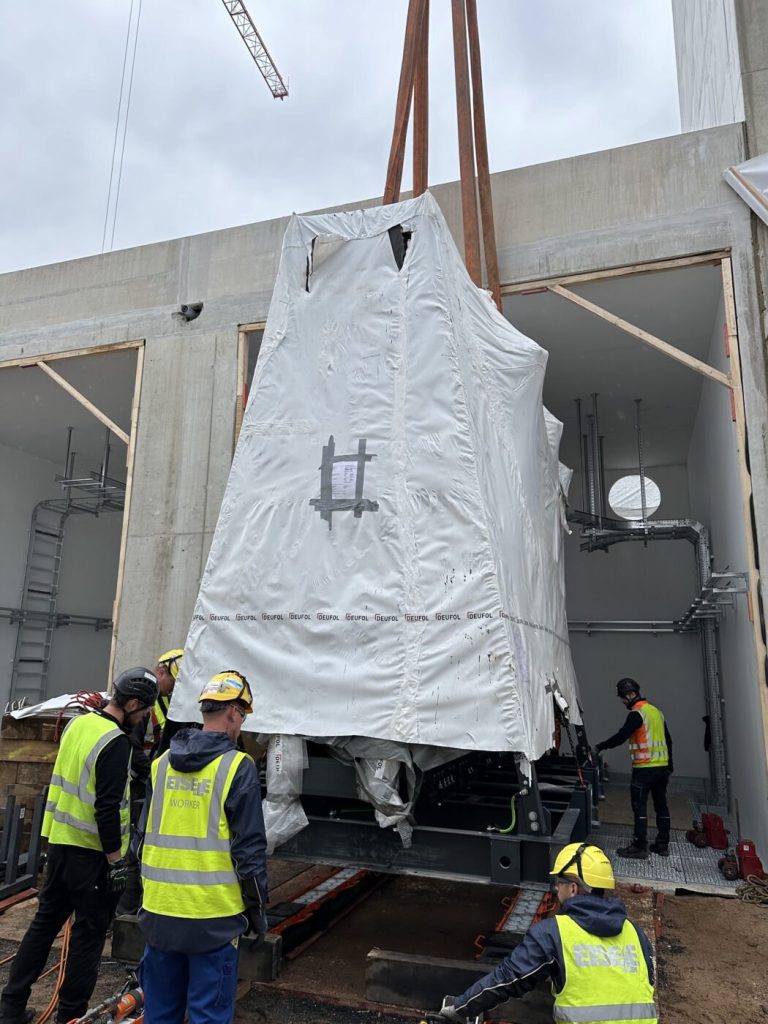
An SPMT is a self-propelled modular transporter for very heavy and bulky loads. It drives under the load, lifts it with its own suspension and brings it slowly and precisely steered to its target – across industrial sites, construction sites and port areas.
Anyone who has to move a large component will sooner or later hear the abbreviation SPMT. A transformer is to go from the unloading area to the switchgear bay. A plant module has to go from the assembly hall to the quay. A bridge is to be put in place in one night. Self-propelled modular transporters are built for tasks like these.
This guide explains what an SPMT is, how it works and what it is used for. It compares it with low-loader, heavy-duty skates, skidding track and crane. And it shows what you as the client have to prepare for an SPMT transport to succeed.
We are an installation and rigging company from Rodgau near Frankfurt. SPMTs are provided and driven by heavy haulage companies with their own equipment and drivers. Our work lies at the ends of such a transport: preparing route and load, and afterwards setting down, moving, aligning and installing. What has to be clarified when moving loads inside a building is described in our guide on heavy-load skidding.
Key points at a glance
- SPMT stands for self-propelled modular transporter, often simply called a modular transporter.
- An SPMT consists of modules with axle lines that are coupled lengthwise and crosswise. A power pack module supplies the energy for driving, steering and lifting.
- Every axle is hydraulically supported and steerable. This lets the SPMT even out unevenness, lift the load itself and travel lengthwise, crosswise, diagonally or rotate on the spot.
- It is controlled by remote control. The driver walks alongside the load.
- SPMTs suit very heavy, large loads on short routes on site – not long distances on the road and rarely tight buildings.
- The client provides a checked route, a load on stands, manufacturer's data on weight, centre of gravity and pick-up points, and a time window with reserve.
- Equipment, driver and vehicle calculation are provided by the heavy haulage company. Route and ground are assessed by the structural engineer. Setting down, aligning and installation at the target are handled by the installation company.
What is an SPMT?
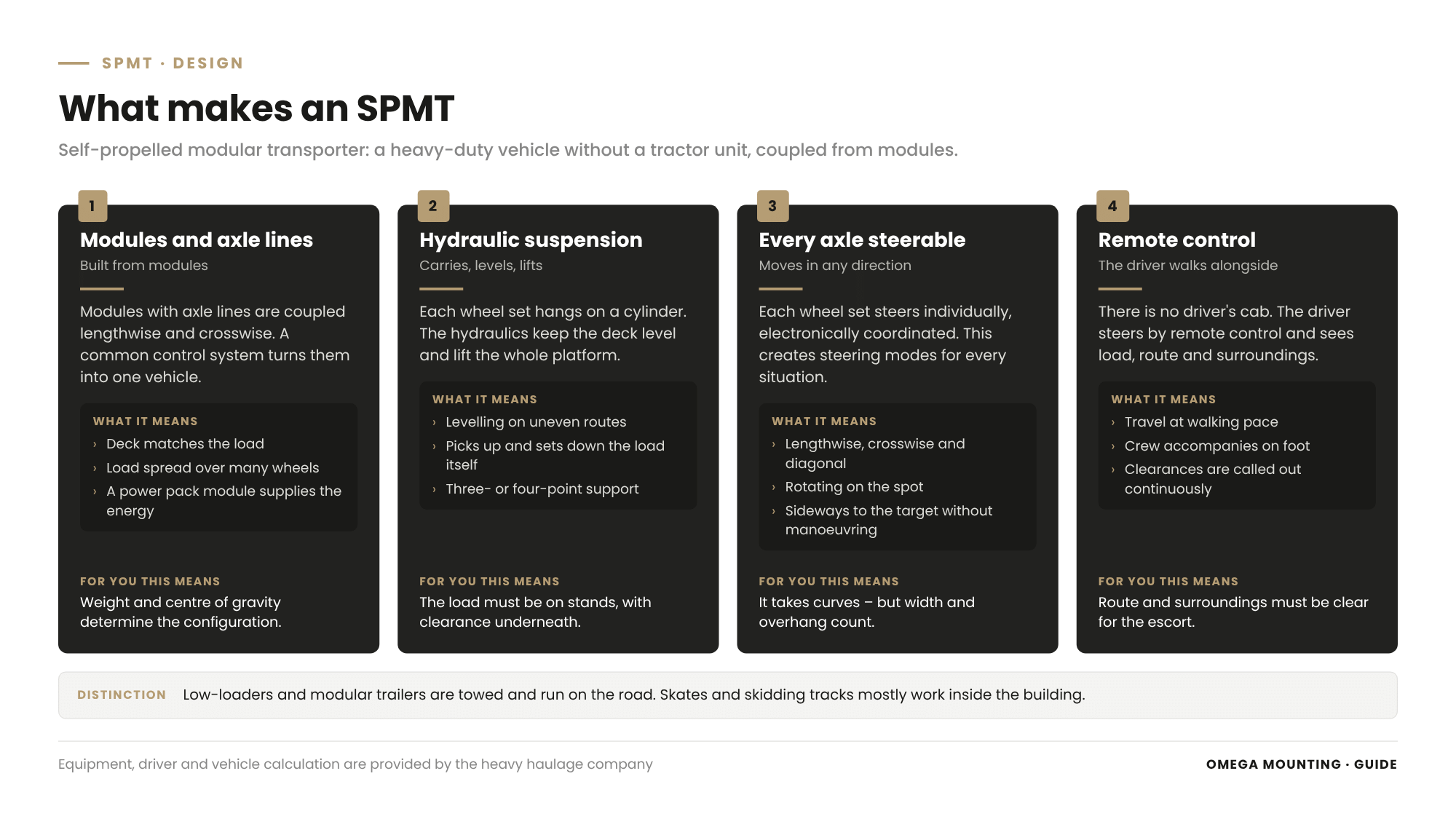
An SPMT is a self-propelled heavy-duty transporter built from modules: several modules with axle lines are coupled into a platform, its own power pack module drives it, and a hydraulic suspension carries, lifts and steers the load.
The abbreviation stands for self-propelled modular transporter. You also hear modular transporter or simply the abbreviation. It always means a heavy-duty vehicle without a tractor unit that can be assembled from modules.
Modules and axle lines
An SPMT is not a fixed vehicle. It consists of modules, and each module has several axle lines. An axle line is a row of wheel sets across the direction of travel. The modules are coupled one behind the other and side by side.
This creates a deck that matches the load. For a long girder it becomes narrow and long, for a plant module wide. Several coupled units work as one single vehicle via a common control system. How many axle lines a load needs is calculated by the heavy haulage company from weight, centre of gravity and ground.
The power pack module
Drive comes from a separate module, often called a power pack. Inside, an engine drives hydraulic pumps. The hydraulics supply travel drive, steering and suspension. The power pack is attached to the platform and can be arranged differently depending on the job.
Hydraulic suspension: levelling and lift
Each wheel set hangs on a hydraulic cylinder. The cylinders of a group are connected. If a wheel runs over a bump, oil flows to the other cylinders of the group. The load stays evenly distributed.
This levelling keeps the deck horizontal even when the ground is not quite. The same hydraulics lift and lower the whole platform. This lets the SPMT pick up a load and set it down itself – without a crane.
Every axle steerable
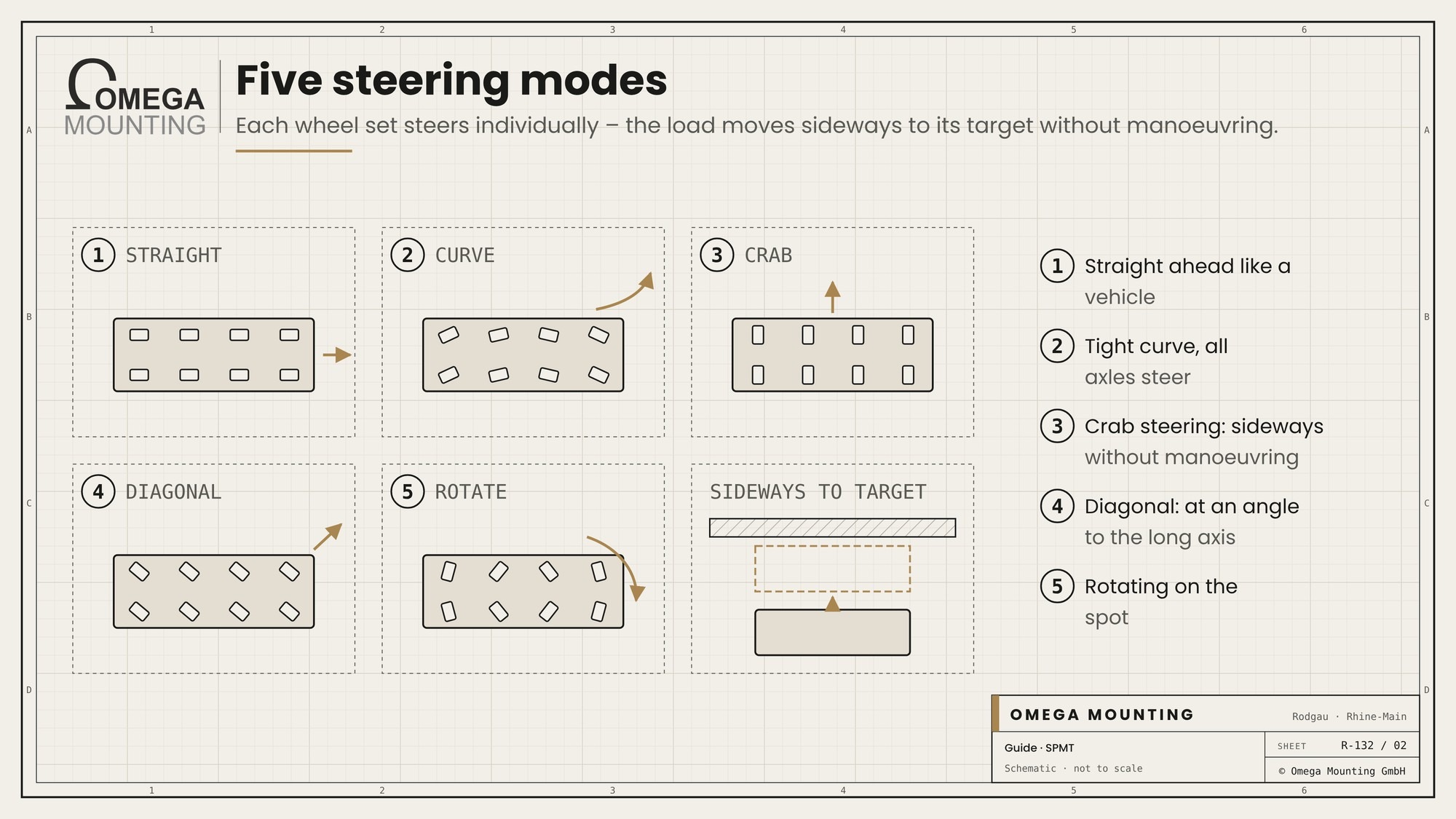
On an SPMT each wheel set steers individually, electronically coordinated. This results in steering modes an ordinary vehicle does not have. They include straight travel, tight curves, crab steering, diagonal travel and rotating on the spot. This way a load can move sideways to its target without manoeuvring.
Remote control instead of a driver's cab
An SPMT has no driver's cab. The driver steers it with a remote control and walks alongside the load. From there they see load, route and surroundings.
Distinction: low-loader, skates, skidding track
A low-loader or a modular trailer is pulled by a tractor unit. It is built for the road, for longer distances and faster travel. An SPMT drives itself, slowly and very precisely – usually on short routes off the road.
Heavy-duty skates and skidding tracks move loads even more slowly and mostly inside buildings. Skates carry the load directly on the floor, the track pushes it stroke by stroke. How skates work is explained in our article on machine skates and heavy-duty skates. Design and sequence of a track are set out in the article on the skidding system.
How an SPMT works: drive under, lift, travel, set down
An SPMT transport runs in four steps: the vehicle drives under the load on stands, lifts it with its own suspension, drives it to the target with the right steering mode and sets it down there on stands or a foundation.
Driving under
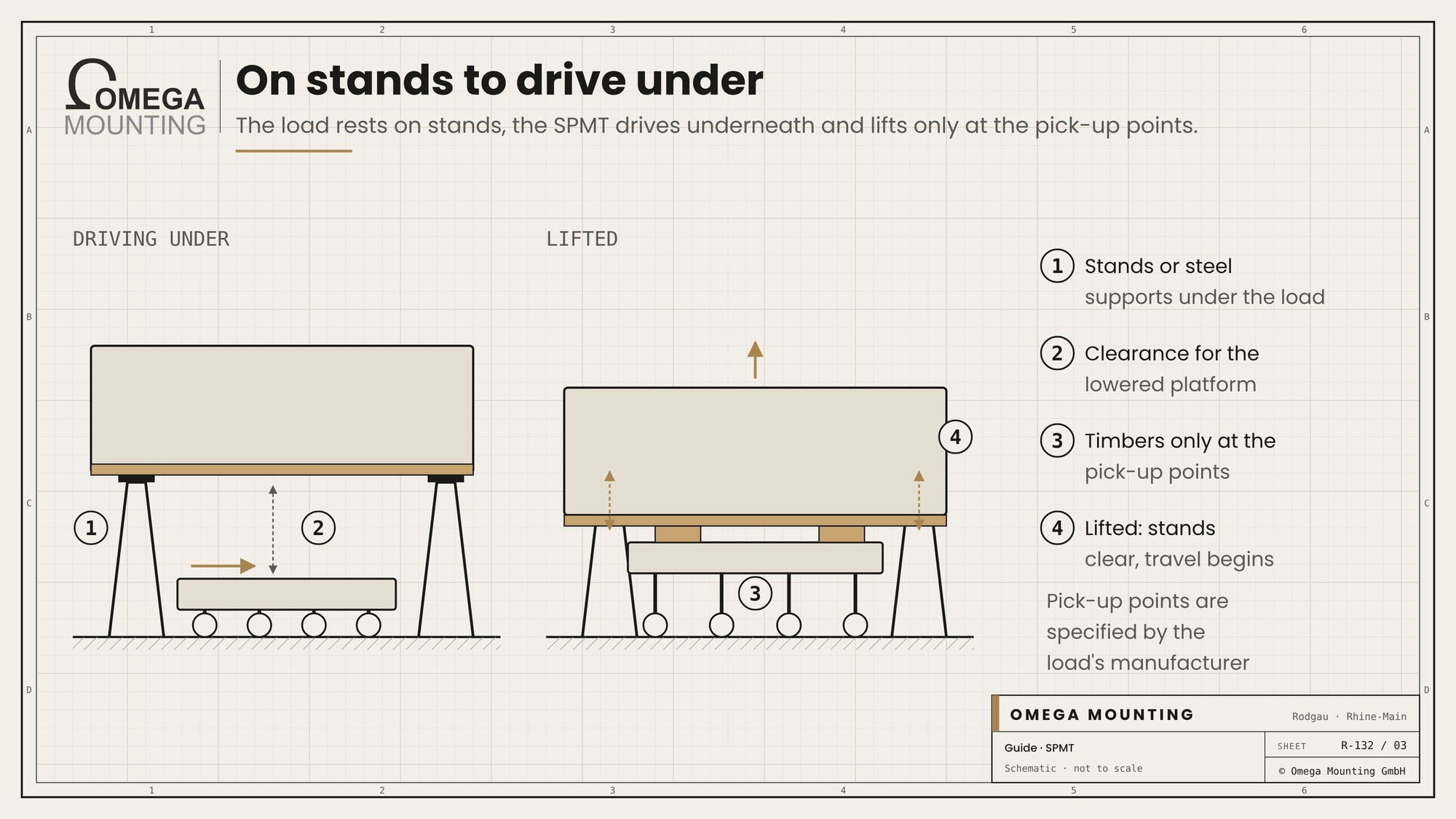
Before transport the load does not stand on the floor but on stands, steel supports or cribbing. Underneath there is clearance into which the lowered platform fits. The SPMT drives into this space and aligns itself under the intended pick-up points.
Girders, timbers or a transport frame go between platform and load. This way the load rests only where the manufacturer allows it.
Lifting
Then the suspension extends. The platform rises, takes up the load and lifts it off the stands. Only when the load is clear and steady are the stands removed.
Travel
The SPMT travels at walking pace. The steering modes take the load round curves, past obstacles and sideways to its target. On the way, levelling keeps the deck horizontal. The crew accompanies the trip on foot and watches clearances, ground and load.
Setting down
At the target, stands, cribbing or the foundation are ready again. The SPMT drives over them, lowers the platform and sets the load down. Then it drives out empty. From here other methods often take over: jacks, skidding, crane or installation.
Load distribution: many axles, few support points
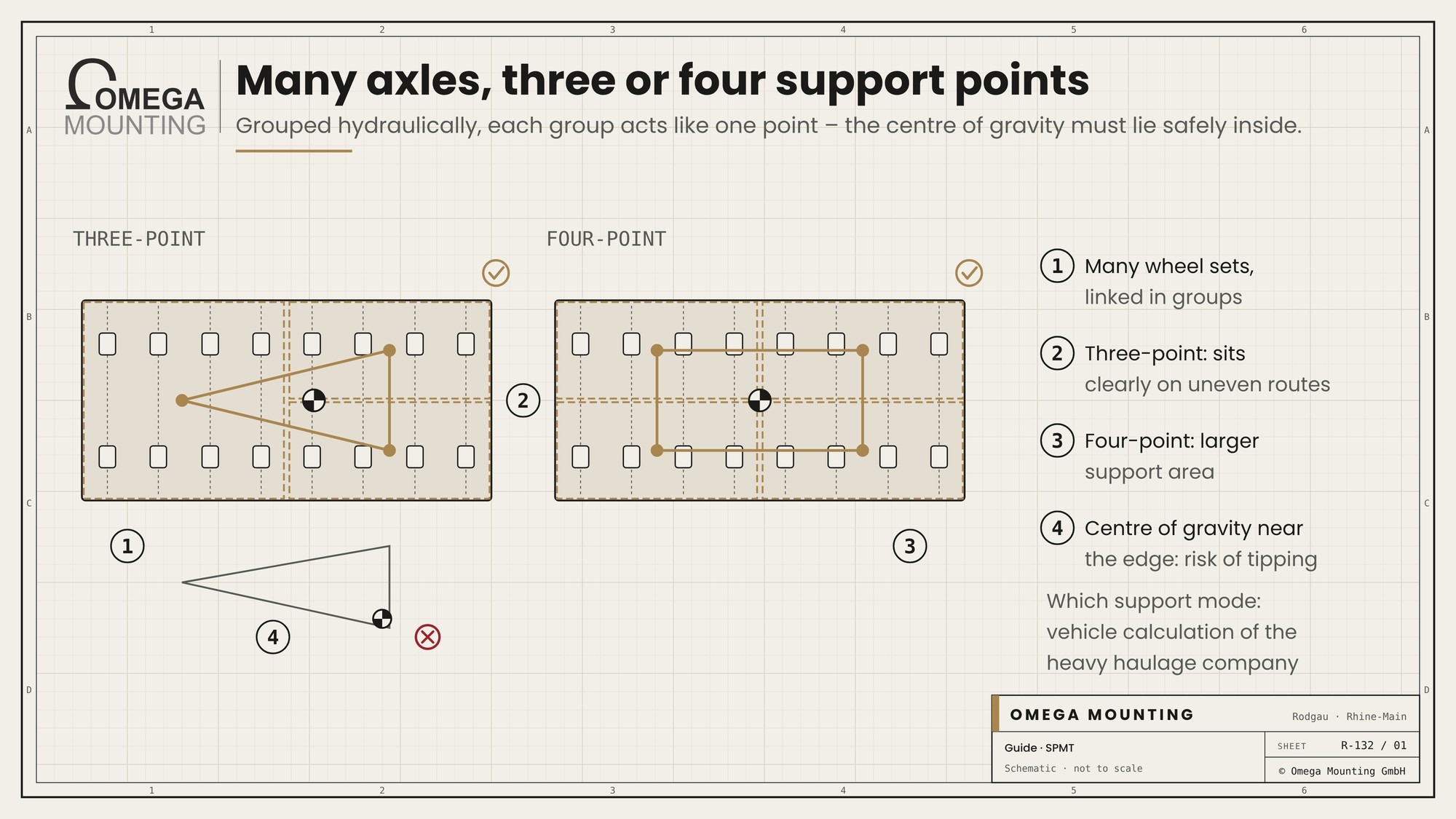
An SPMT spreads the load over many wheels and therefore over a large area. Hydraulically, however, the wheel sets are combined into a few groups. Each group acts like a single support point.
With three-point support these groups form a triangle. This evens out unevenness well, because a load on three points always sits clearly. Four-point support creates a rectangle with a larger support area. In any case the load's centre of gravity must lie safely within this area. Which support mode fits is set by the heavy haulage company's vehicle calculation.
What SPMTs are used for
SPMTs are used when very heavy or large loads have to be moved precisely over short distances: bridges and structural elements, transformers and large components on industrial and power plant sites, ship and plant modules, and site relocations.
Moving bridges and structural elements
A bridge is built next to the line and moved in during a short closure window. The SPMT drives under the finished structure, lifts it and sets it on its bearings. This keeps the closure of road or rail short.
Transformers and large components on industrial and power plant sites
A transformer comes to the site on a low-loader. From the unloading area to the bay there are often paved routes, but no road. For transporting a transformer by SPMT, this last route is what counts most. The SPMT covers the distance and sets the load down at the entry point or directly at the foundation.
The same applies to boilers, vessels, turbine parts or generators. Anyone having a large component transported therefore plans not just the delivery but also the route on site. What has to be planned overall when replacing a transformer is set out in our guide on replacing a transformer.
Ship and plant modules
In plant engineering and shipbuilding large modules are built on land. SPMTs drive them out of the hall, across the quay and onto pontoons or ships. The ship must stay level while the load drives on. This coordination between vehicle, quay and ship is planned by the heavy haulage company with those involved at the port.
Site relocations
If production moves within a site, large machines or whole assemblies have to go from hall to hall. If there are site roads in between, an SPMT can drive the heaviest parts in one piece instead of dismantling them. A heavy transport across the site then needs a checked route, a closure and clear handover points at both halls. How a relocation is planned overall is described in our guide on plant relocation.
What SPMTs rarely do
Long distances on public roads are usually covered by a low-loader or modular trailer. An SPMT is too slow for these routes. Short sections across a road do occur, but need a closure and a permit. In tight buildings an SPMT reaches its limits in width, height and room to steer. There, skates, track or jacks take over.
SPMT, low-loader, skates, skidding track, crane: what fits when
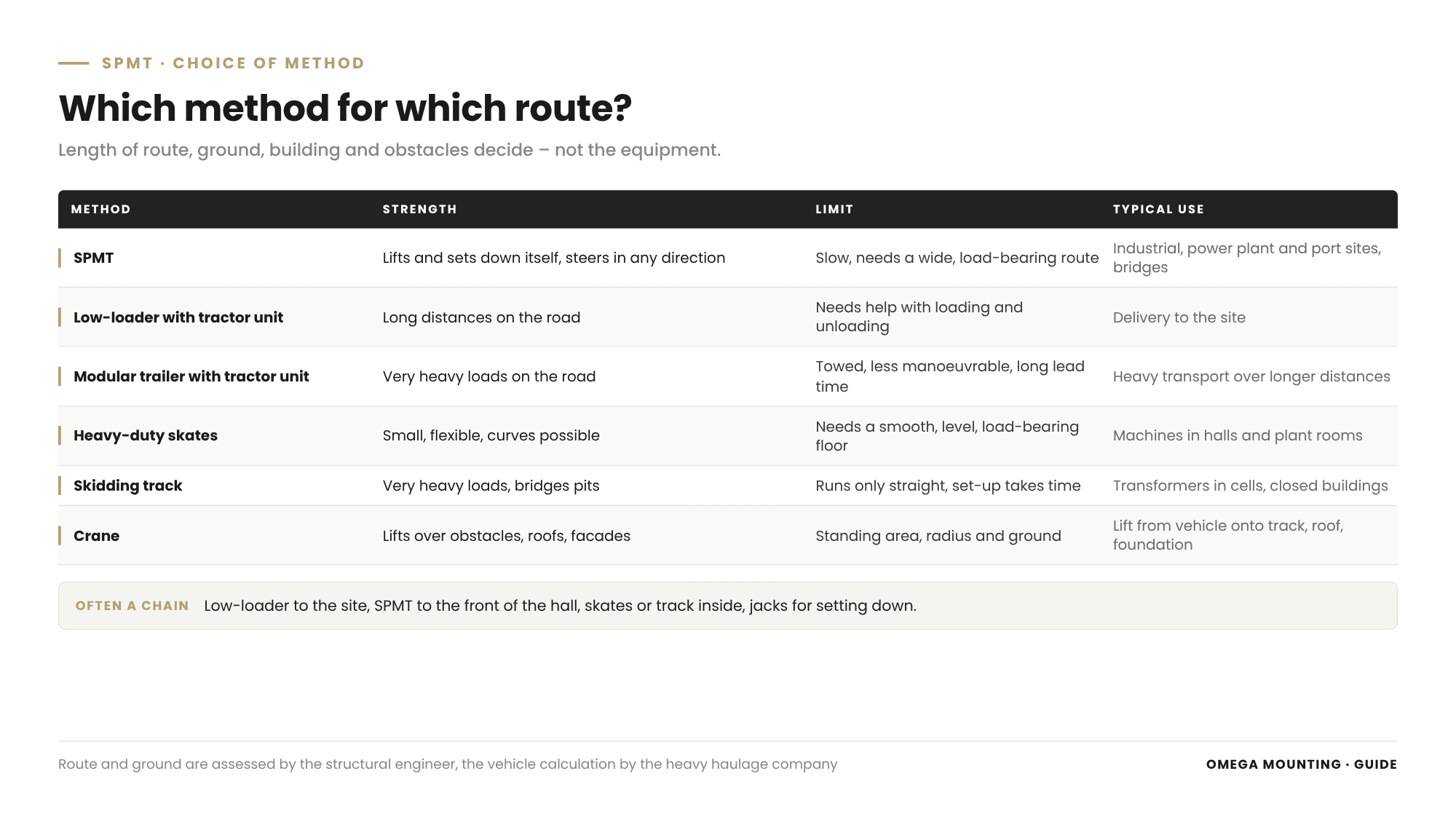
Which method fits is decided by weight and dimensions of the load, length and type of route, ground, space at the target and whether a building is in the way. An SPMT is strong on short routes on site, a low-loader on the road, skates and track inside buildings, the crane for lifting over obstacles.
| Method | Strength | Limit | Typical use |
|---|---|---|---|
| SPMT | Very heavy, large loads; lifts and sets down itself; steers in any direction. | Slow; needs a wide, load-bearing route; little room in buildings. | Industrial, power plant and port sites, bridge moves. |
| Low-loader with tractor unit | Long distances on the road. | Needs a crane or other help for loading and unloading; needs a lot of space to turn. | Delivery from the manufacturer's plant to the site. |
| Modular trailer with tractor unit | Very heavy loads on the road, can be extended modularly. | Towed and less manoeuvrable than an SPMT; route and permit need long lead time. | Heavy transport over longer distances. |
| Machine skates | Small, flexible, also inside buildings; curves possible. | Needs a smooth, level, load-bearing floor; load must be lifted to place skates. | Machines and plant in halls and plant rooms. |
| skidding system | Very heavy loads on short, straight routes; bridges pits. | Runs only straight; set-up and levelling take time. | Transformers in cells, loads in closed buildings. |
| Crane | Lifts over obstacles, roofs and facades. | Limited by standing area, radius and ground. | Lift from vehicle onto track, roof or foundation. |
Questions that decide
- How long is the route, and does it cross a road? In the question SPMT or low-loader, long road distances favour the low-loader, short routes on site the SPMT.
- Is the route wide, clear and load-bearing enough? If not, it is strengthened, or another method is needed.
- Does the load have to go over an obstacle? Then a crane is needed, for example for a lift onto a roof or into a pit. What has to be settled for that is shown in our guide on Planning a crane lift.
- Does the route end in a building? Then skates, track or jacks usually take over at the door.
- Can the load be put on stands? An SPMT needs clearance under the load.
- How precisely does it have to stand at the target? An SPMT sets down precisely, fine alignment follows afterwards.
Often the answer is a chain. The low-loader brings the load to the site, the SPMT drives it to the front of the hall, skates or track bring it inside, jacks set it down. How methods are chosen for bringing loads into buildings is shown in our guide on choosing the lifting method for a move-in.
What the client has to prepare before an SPMT transport
Before an SPMT transport the client provides five things: a checked route, a load on stands and prepared, a finished target, the necessary permits and a time window with reserve.
The route: load-bearing, clear, level enough
An SPMT spreads the load over many wheels. Even so it presses hard on the ground. Whether site road, paving, gravel or hall floor can carry it is assessed by the structural engineer and, on natural ground, the geotechnical engineer. They also check ducts, shafts, lines and tanks under the route.
Where it is not enough, steel plates or mats are laid. How load spreading plates bring forces onto a larger area is explained in our article on load spreading mats and ground pressure.
Add geometry and obstacles:
- Width and curves. Load and vehicle need more space in curves than straight ahead. Overhangs of the load sweep over signs, fences and railings.
- Gradients. Longitudinal and cross gradients are limited. Levelling helps but does not replace a suitable route.
- Kerbs, thresholds, gutters. They are bridged, removed or evened out.
- Heights. Pipe bridges, overhead lines, cable trays, canopies and gates limit the height of load and vehicle together.
- Underground lines. What nobody has on the plan any more otherwise only shows up when it is too late.
The load: on stands, with clear pick-up points
An SPMT drives under the load. For this it has to stand on stands or cribbing, with enough clearance underneath. Where the load may rest is specified by the manufacturer. The same applies to weight and centre of gravity in transport state.
Without this data nobody can do the vehicle calculation. Add-on parts that protrude beyond the outline are removed or secured as specified by the manufacturer.
The target: set-down point finished
At the end the load again needs stands, cribbing or a finished foundation. The SPMT needs space to drive over it and come out again empty.
If the route ends in front of a building, it must be clear how things continue: with crane, track, skates or jacks. This handover is the point where many plans have a gap.
Permits and site rules
On your own site the operator's rules apply: closures, fire brigade access, operating processes and access. If the route crosses public space, the transport usually needs an official permit, often with conditions on time, route and escort. The heavy haulage company applies for it.
This guide is not legal advice. What applies in the individual case is clarified by the haulier with the responsible authority. When loading turns into a heavy transport is explained in our guide on Load securing for heavy goods.
The time window
An SPMT transport needs a window in which the route is clear and closed. Add coupling the modules, putting the load on and off stands and the weather. Tall loads offer the wind a lot of surface. Plan in reserve and an alternative date.
Who does what in an SPMT transport
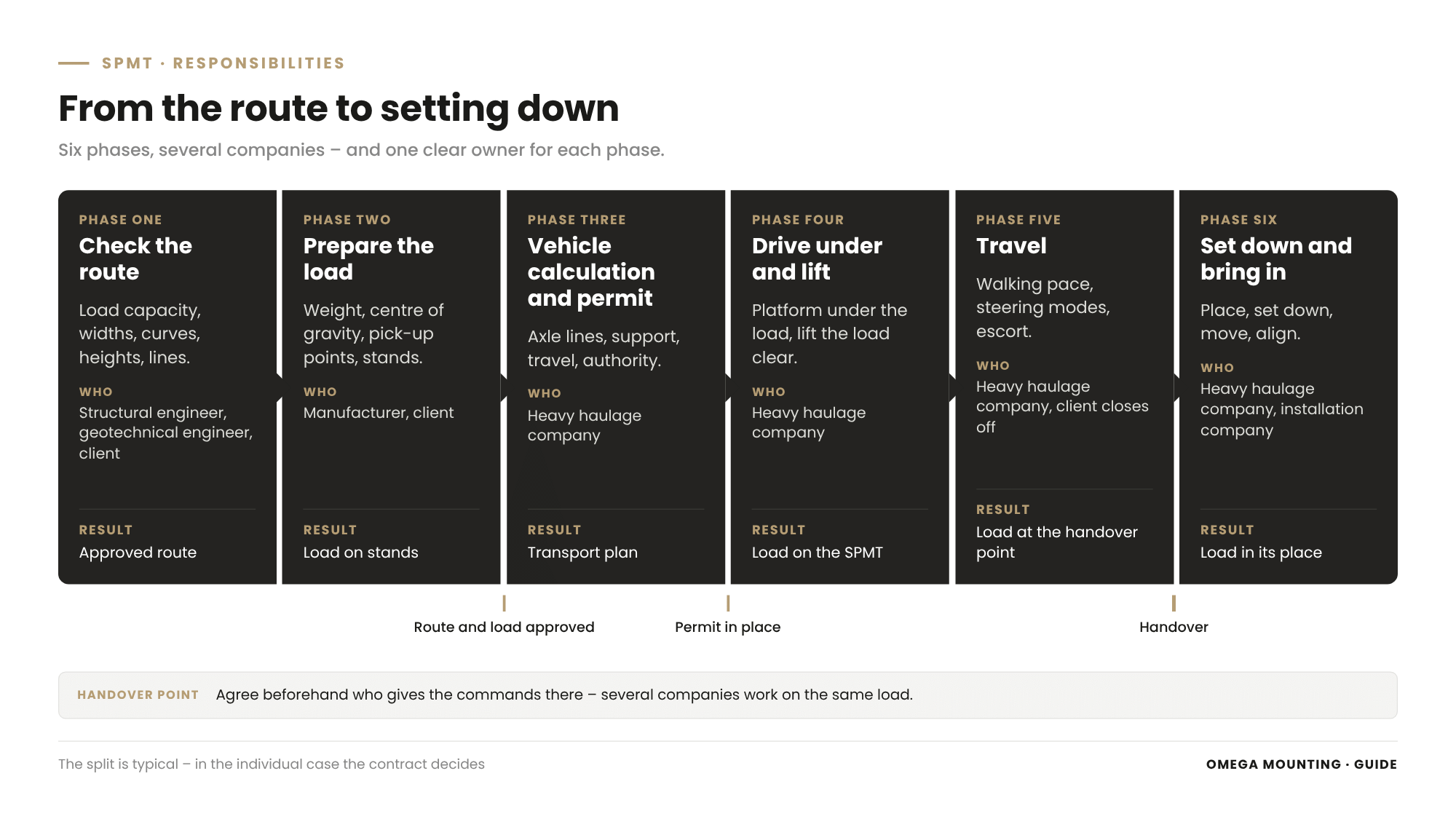
In an SPMT transport the roles are clearly split: the heavy haulage company provides equipment, driver and vehicle calculation, the structural engineer assesses route and ground, the manufacturer supplies the load data, and the installation company works at the building.
This split is typical; in the individual case the contract decides.
The heavy haulage company
It provides the SPMT, the drivers and the crew. It does the vehicle calculation: axle lines, support, utilisation and stability. It plans the trip, applies for permits for public space and carries out the transport.
Structural engineer and geotechnical engineer
They assess whether route, ground, slabs, ducts and shafts can carry the load and specify strengthening. Without their approval no heavy vehicle crosses critical sections. How slab loads are taken into account when bringing loads in is described in our guide on move-in planning with slab loads in mind.
The load's manufacturer
It supplies weight, centre of gravity, pick-up and lifting points, permitted supports and specifications for the transport state.
The client
They pool the details, provide as-built drawings, release areas and arrange closure and time window. They name a contact for the transport day.
The installation company
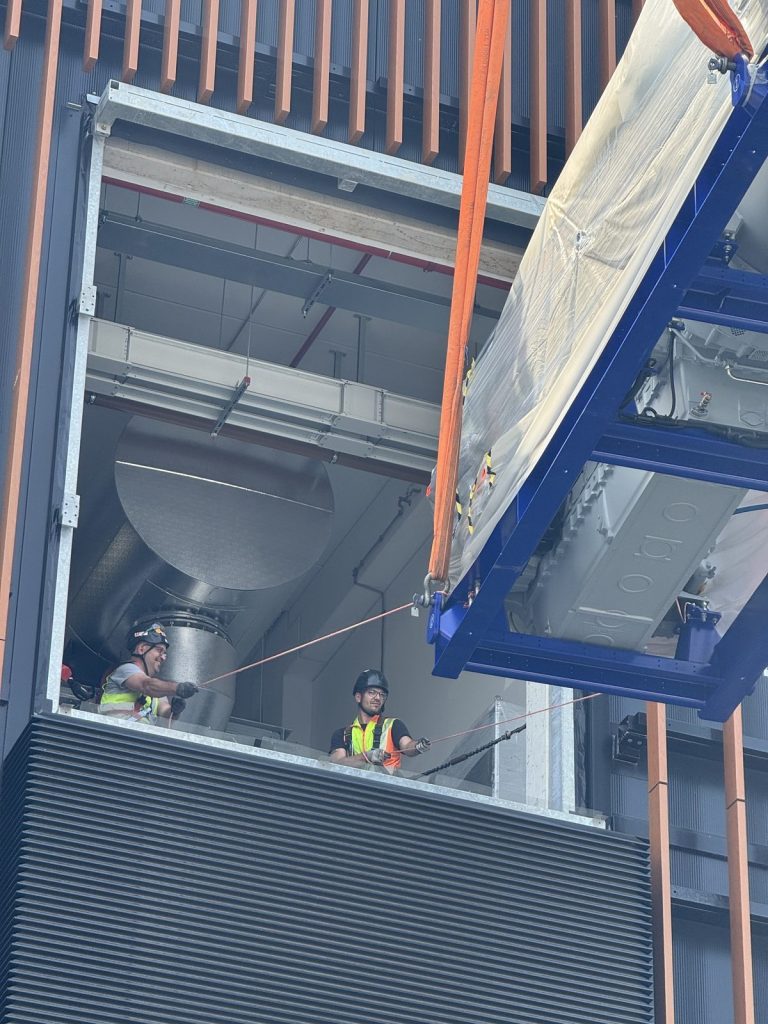
The installation company works at the ends of the transport. Beforehand it prepares the route at the building with the structural engineer: gates, thresholds, floor protection and set-down points. After the handover it sets the load down, moves it into the building, aligns it and installs it.
How setting down works without a crane is shown in our guide on hydraulic jacks. How the load is then aligned and anchored is set out in the guide on aligning and anchoring machines.
Limits and risks of the SPMT
The limits of an SPMT lie in the ground, in wind on tall loads, in the load's centre of gravity and in pinch points – especially at the transition into the building.
Ground
Soft ground, freshly backfilled trenches and unknown voids are the greatest risk. If the ground gives way under a wheel group, the load shifts. Levelling absorbs small settlements, not large ones.
Wind on tall loads
Tall, flat loads such as modules, vessels or bridge sections offer the wind a large surface. Side wind presses on the load and loads one side more. Limits are set by the heavy haulage company. On the transport day: if it gets too windy, there is no travel.
Centre of gravity
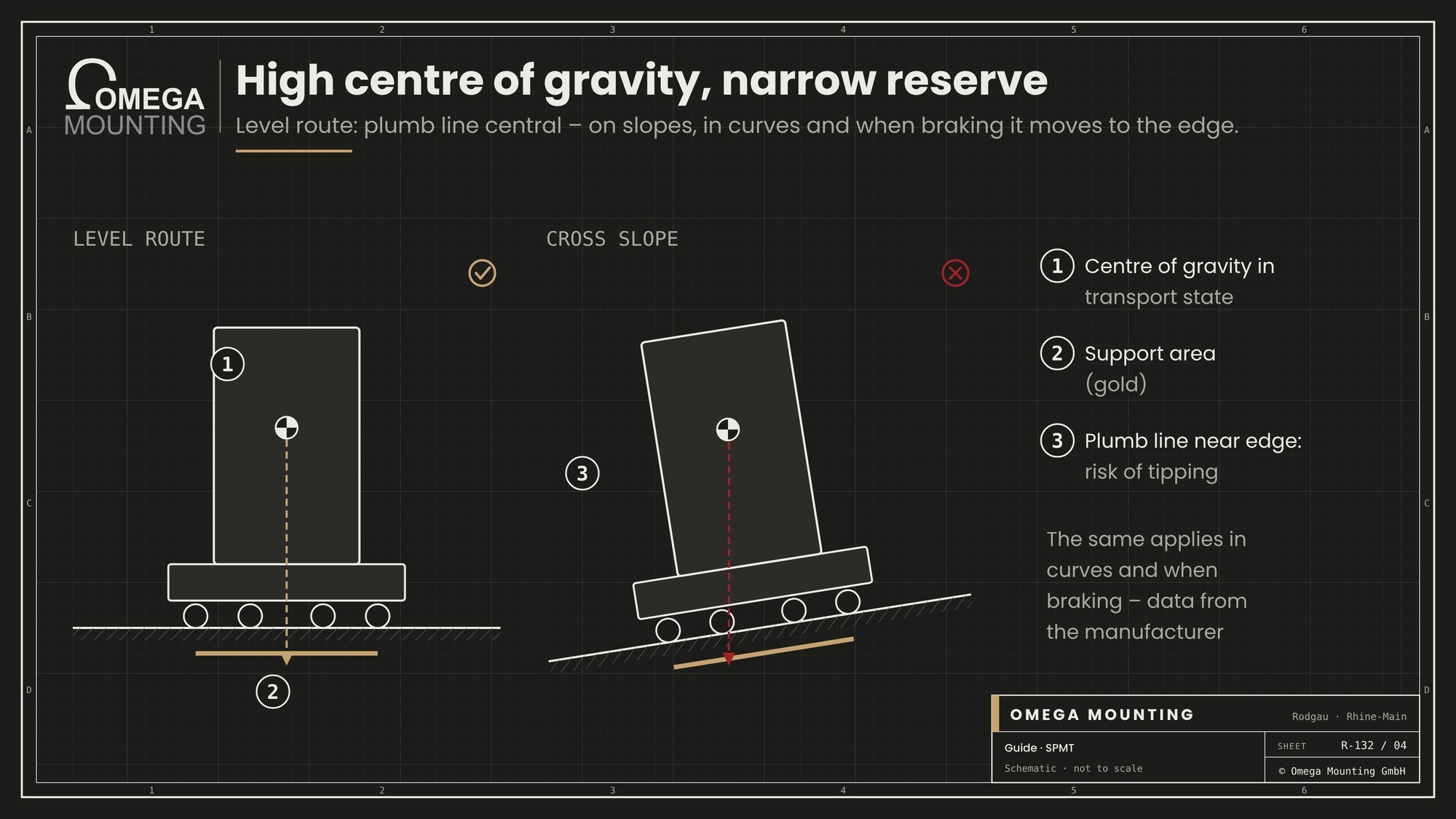
An unknown or incorrectly stated centre of gravity is dangerous. If it lies too close to the edge of the support area, the load can tip. This applies especially on slopes, in curves and when braking. That is why the manufacturer's data on the centre of gravity in transport state belongs in every enquiry.
Pinch points and buildings
An SPMT is wide and needs room to steer. Gates, passages and hall aisles are often too narrow. Then there is the power pack. In buildings with sensitive technology a combustion engine may be undesirable or not permitted. Whether an SPMT may drive into a hall is clarified jointly by operator, structural engineer and heavy haulage company.
Several companies on one load
At the handover point several companies work on the same load. It becomes dangerous when it is not clear who gives the commands. Decide beforehand who is responsible at which point. How this role is organised in lifting operations is described in our guide on the appointed person for lifting operations.
Overview: preparation, why it counts, who provides it
For every point of preparation there is a reason and a responsible party – the table summarises this.
| Preparation | Why it counts | Who provides it |
|---|---|---|
| Route with widths, curves and heights. | The narrowest point decides whether an SPMT gets through. | Client with as-built drawings; survey at the site visit. |
| Load capacity of route and ground. | The load acts on the ground through the wheel groups. | Structural engineer and geotechnical engineer. |
| Lines, ducts, shafts in the ground. | They must not be loaded or damaged. | Client with as-built drawings. |
| Weight, centre of gravity, pick-up points. | Without them there is no vehicle calculation. | Manufacturer via the client. |
| Stands or cribbing at the load. | The SPMT needs clearance to drive under. | Heavy haulage company as specified by the manufacturer. |
| Vehicle calculation and support. | Centre of gravity and stability must fit. | Heavy haulage company. |
| Permit for public space. | Without it no transport crosses the road. | Heavy haulage company with the authority. |
| Site rules and closure. | Route and areas must be clear. | Client. |
| Set-down point and onward route into the building. | The load needs a finished target. | Client with site management and installation company. |
| Time window with alternative date. | Weather and wind can wreck the date. | Client with everyone involved. |
Typical mistakes in SPMT transports
The typical mistakes in SPMT transports are an unsurveyed route, ground without approval, an estimated centre of gravity, missing clearance under the load and a route whose end nobody has planned.
- Route only checked on the drawing. The site road is wide enough, but not the curve with the load's overhang.
- Ground without approval. The route crosses a duct, a backfilled trench or a slab, and nobody asked the structural engineer.
- Centre of gravity estimated. The manufacturer's data is missing or applies to a different state of the load.
- No clearance under the load. The load stands flat on the floor, and stands are missing.
- End of route not planned. The SPMT stands in front of the hall, but nobody has clarified how the load gets inside.
- Permit applied for too late. The route crosses a public road, and the lead time is missing.
- No back-up date. Wind or rain comes, and crane, vehicle and crew are booked for one day only.
The mistake behind the mistakes
Behind many mistakes lies the same assumption: that the SPMT solves the whole route. But it only solves the part on site. Before it comes delivery, after it the move-in.
What we know from move-ins
We have not documented an SPMT job, and we do not drive SPMTs. What we know are the sections before and after: taking over the load from the vehicle, preparing route and set-down point, setting down, moving and aligning. Three jobs from our project diary show these related methods.
Data center in the Frankfurt area: from the low-loader onto the track
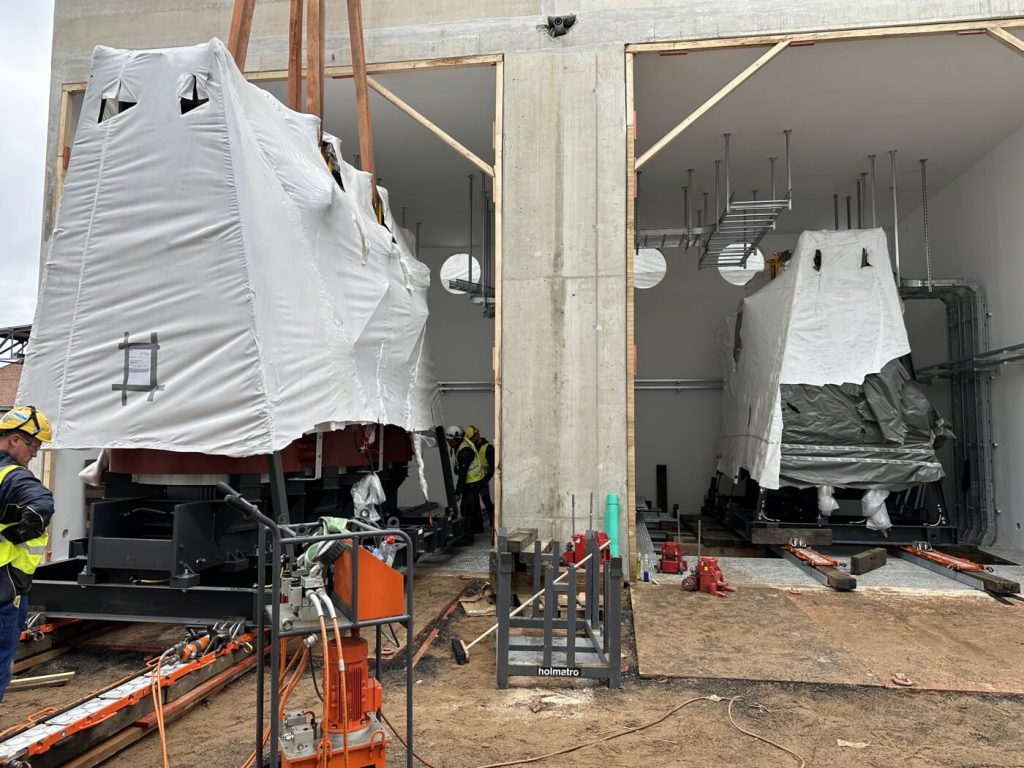
During the bringing in transformers via a skidding track in a data center in the Frankfurt area, the transformers arrived on a heavy-duty low-loader. The building was already closed. The crane only brought the load to the front of the transformer cell opening. Each transformer was set directly from the low-loader onto the track, without setting it down in between.
In front of the building there was no prepared surface, but a ramp and differences in level. The track was packed, measured and levelled element by element. At the target, hydraulic blocks lifted the load, and it was set down on prepared timber blocks. We were booked as a subcontractor, planned and accompanied the lift and operated the track provided by the client.
For an SPMT transport this means: the handover from the vehicle to the next method must be planned just like the trip.
Data center in the Frankfurt area: when the building is already standing
During the installation of standby power systems in a data center, the generator stood on the low-loader in front of the building after delivery. Which method followed depended on the building. If it was already standing, the route continued on heavy-duty or tank skates over existing routes: through gates, over ramps and through plant corridors. Where necessary, units were dismantled.
In the data center combustion engines were not permitted inside the building, so lifting was done electrically. Before each lift a lift plan set standing area, outrigger forces and ground pressure, approved by the general contractor. Our part was bringing in, positioning, fixing and mechanical installation.
For an SPMT transport this means: at the building, what is permitted inside the building decides.
Industrial plant in Fulda: tight site, lift plan in advance
During the tank installation in Fulda the tanks arrived by lorry and low-loader. The site was tight. Our fitters guided the vehicles so that unloading could take place without detours. Each lift followed a lift plan prepared in advance, the lifting points were agreed with the manufacturer. A specially made lifting beam prevented side pull on the lugs. The tanks went onto cleaned concrete foundations and were anchored.
For an SPMT transport this means: on a tight site the route is guided, not estimated – and the pick-up points come from the manufacturer.
Questions about bringing in around an SPMT transport?
Is your large component arriving by heavy-duty vehicle, and does it then have to go into the building or onto the foundation? Then get in touch with us. For the trip itself we recommend bringing in a heavy haulage company early – we are happy to coordinate with them.
Move-ins in the Rhine-Main area: what we take on around the SPMT
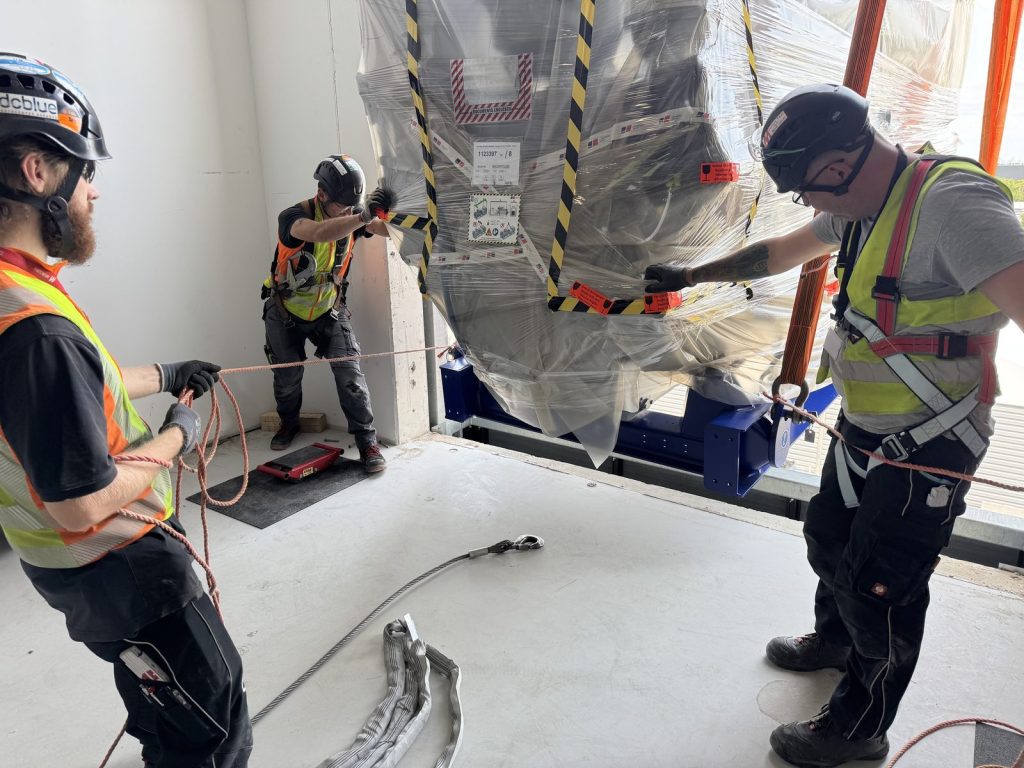
In the Rhine-Main area we take on the work at the building for transports by SPMT or low-loader: preparing route and set-down point with the structural engineer, taking over the load, setting down, moving, aligning and installing.
Many sites in the region are densely built. Data centers, substations and factory halls are often already standing when the heaviest component arrives. Unloading areas are on roads and in tight yards. Then the trip usually ends at the gate, and the move-in begins.
From Rodgau, Frankfurt, Offenbach, Hanau, Darmstadt and Aschaffenburg are short distances. What we offer in Lift & Shift and heavy-load installation overall is set out on our service page.
What we don't take on, we say clearly beforehand. The SPMT is provided and driven by the heavy haulage company. Route, ground and slabs are assessed by the structural engineer. Weight and pick-up points are specified by the manufacturer. We are happy to answer questions about bringing loads in via our contact form.
What this means for your role
For buyers: Separate transport from move-in, but not the coordination. Clarify in the contract who provides stands, who has the route checked and who gives the commands at the handover point.
For designers: Record the route from the unloading area to the foundation in the documents. Plan widths, heights, curves and floor loads for transport too, not just for operation.
For project managers and site managers: As project manager you collect the details from manufacturer, structural engineer and heavy haulage company and keep the time window with an alternative date. As site manager you make sure that route, set-down point and foundation are finished and clear on the transport day.
For technical managers, plant managers and facility managers: You know lines, ducts, site roads and operating times best. Provide as-built drawings and name a contact for the transport day.
For management and operators: Give the project the lead time that checks, permits and coordination between several companies need.
Transport route check for large components: template on request
The transport route check for large components is a one-page working document for the first coordination round. It has four blocks: load, route, handover and setting down, and approvals. Each point has a field for the source of the detail and the status “clarified” or “open”. Number fields are deliberately not pre-filled – the check shows you what is still missing before transport and who provides it. Request the template via our contact form – keyword “transport route check”.
Conclusion
An SPMT is a powerful tool for very heavy and large loads on short routes on site. It lifts itself, steers in any direction and spreads the load over many wheels. Its limits lie in the ground, the wind, the centre of gravity and pinch points. Whether an SPMT transport succeeds is decided beforehand: by the checked route, the manufacturer's data, stands and clearance, and a planned end of the route. If you are preparing the move-in after transport, send us photos and documents – we will get back to you with an honest assessment.
Planning a move-in, installation or maintenance in the Rhine-Main region?
Tell us briefly what you need – we'll come back with an honest assessment.
Free, no-obligation callback
You may also be interested in these guides

About the author
Tobias Schott
Managing director of Omega Mounting GmbH, Rodgau · more than 20 years of hands-on experience in installation and maintenance
A trained mechatronics technician, working in maintenance, servicing and industrial installation since 2004 – first alongside his father, and with Omega Mounting since 2012: from overhead conveyors in Frankfurt to the crane system in a new-build hall. He plans and leads lifting operations as an appointed person (AP) in data centers and on industrial sites in the Rhine-Main region, trains and examines operators of cranes, mobile elevating work platforms and telehandlers, and is a qualified occupational safety specialist. On jobs abroad he is known as the “German Troubleshooter” – the person you call when a site gets stuck. He learned what quality means from his father, not from a manual: Made in Germany as a standard for his own work, not a label. That is why quality comes first at Omega Mounting – ahead of speed and price. He writes these guides from that practice: what works on our sites is in them – what exists only on paper is not.
Frequently asked questions
An SPMT is a self-propelled heavy-duty transporter built from modules. Several modules with axle lines are coupled into a platform. A power pack module supplies the energy, a hydraulic suspension carries, lifts and steers the load. It is controlled by remote control.
SPMT stands for self-propelled modular transporter. It is also called a self-propelled modular trailer or simply a modular transporter.
When a very heavy or large load has to be moved precisely over a short distance on site. An SPMT lifts the load itself, steers in any direction and sets it down without a crane. For long routes on the road the low-loader is the better choice. Often both work one after the other.
Yes, if floor, gates and space allow it. The hall floor must carry the load, which is assessed by the structural engineer. Gates and aisles must be wide enough, and the drive must be permitted in the building. In many halls skates, track or jacks take over from the gate.
It has to carry the load acting on it through the wheel groups without giving way. Ducts, shafts, lines and voids must not be overloaded. Whether the route is sufficient is assessed by the structural engineer and geotechnical engineer. Where necessary, steel plates or mats are laid to spread the load.
On your own site the operator's rules apply. If the route crosses public space, the transport usually needs an official permit. The heavy haulage company applies for it. Plan lead time for this.
An SPMT suits routes on site with curves and enough space. A skidding track suits short, straight distances, often in closed buildings, over pits or into cells. Often the track follows the SPMT: one brings the load to the front of the building, the other inside.
The heavy haulage company plans the trip and the vehicle calculation. The structural engineer assesses route and ground, the manufacturer supplies the load data. The client pools the details and arranges areas and time window. The installation company plans the move-in at the end of the route.
Send us a short enquiry with three details: what is being moved, where the trip ends and where the load is to go. Photos of the route and the set-down point help. Together with you and the heavy haulage company we clarify what is still missing for the move-in. Your contact is Tobias Schott – reachable via our contact form.
 English
 German