
- Guide – Lift & Shift
Jacking gantries and lifting towers: lifting heavy loads where no crane can reach
By Tobias Schott · 22-minute read · Updated October 2026
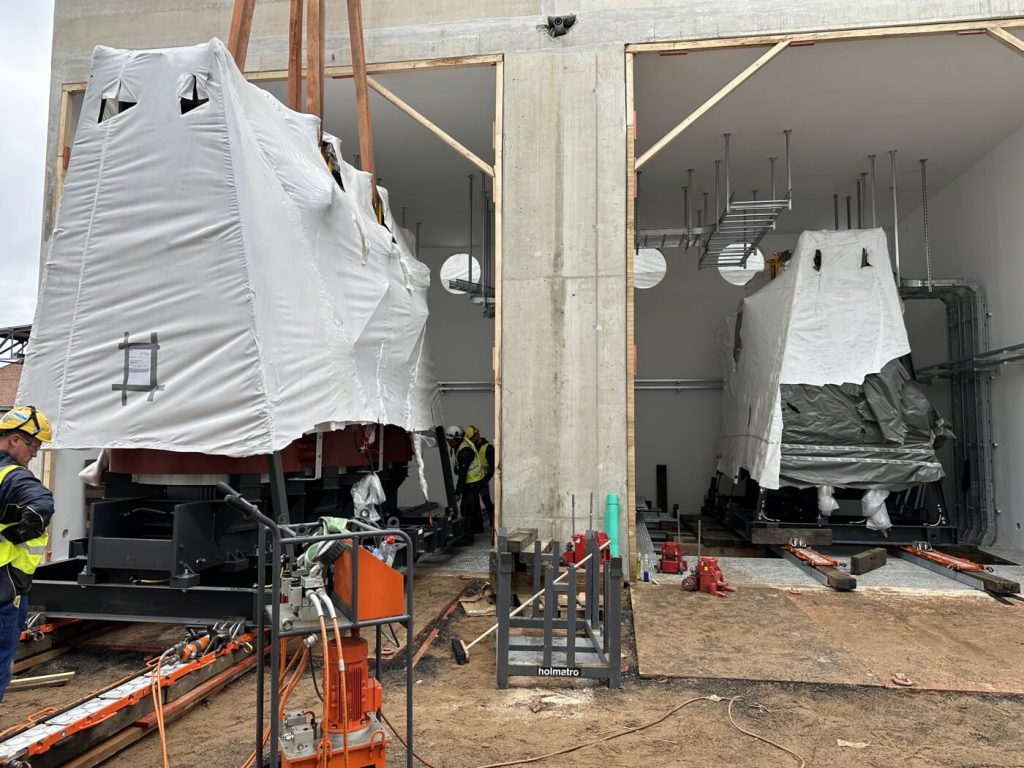
A jacking gantry is a lifting system made up of several towers with hydraulic lifting units and beams on top. It lifts very heavy loads evenly without a crane – where no crane hook can reach: in halls, under ceilings and in enclosed buildings.
Some loads are too heavy for jacks and stand where no crane can reach. A transformer stands in an enclosed cell. A press is to be raised so that a new foundation can be built underneath. A plant component has to be set onto a vehicle inside a hall. For tasks like these there are jacking gantries, lifting towers and jack-up systems.
This guide explains what a jacking gantry is, how a jack-up system works and when you need such systems. It distinguishes them from the hydraulic gantry, hydraulic jacks and the crane. And it shows what you as the client need to prepare so that a lift without a crane succeeds.
We are an installation and move-in contractor from Rodgau near Frankfurt. Jacking gantries and jack-up systems are provided and operated by specialist heavy-lift companies with their own equipment and their own team. Our work lies before and after: preparing the location and the load, skidding, setting down, aligning and installing. How smaller lifts without a crane are done with jacks is described in our guide on hydraulic jacks.
Key points at a glance
- A jacking gantry consists of several lifting towers with hydraulic lifting units. Beams sit on top of the towers and carry the load or have it suspended from them.
- All towers lift synchronously. A control system keeps the load level and reports if a tower deviates.
- Many jacking gantries run on rails. The raised load can then also be moved.
- A jack-up system lifts the load in small steps and builds stacks of steel elements underneath it. The load rests mechanically on the stacks, not on the hydraulics.
- Lifting systems fit when a load is very heavy, no crane can reach it and jacks are not enough – for example in halls, cells and under ceilings.
- The client provides checked ground under every tower, manufacturer's data on weight, centre of gravity and support points, enough space and height, a ready destination and a time window with reserve.
- Equipment, team and lift calculation come from the heavy-lift company. Floor and slab are assessed by the structural engineer. Skidding, setting down, aligning and installation can be taken on by the installation contractor.
What is a jacking gantry?
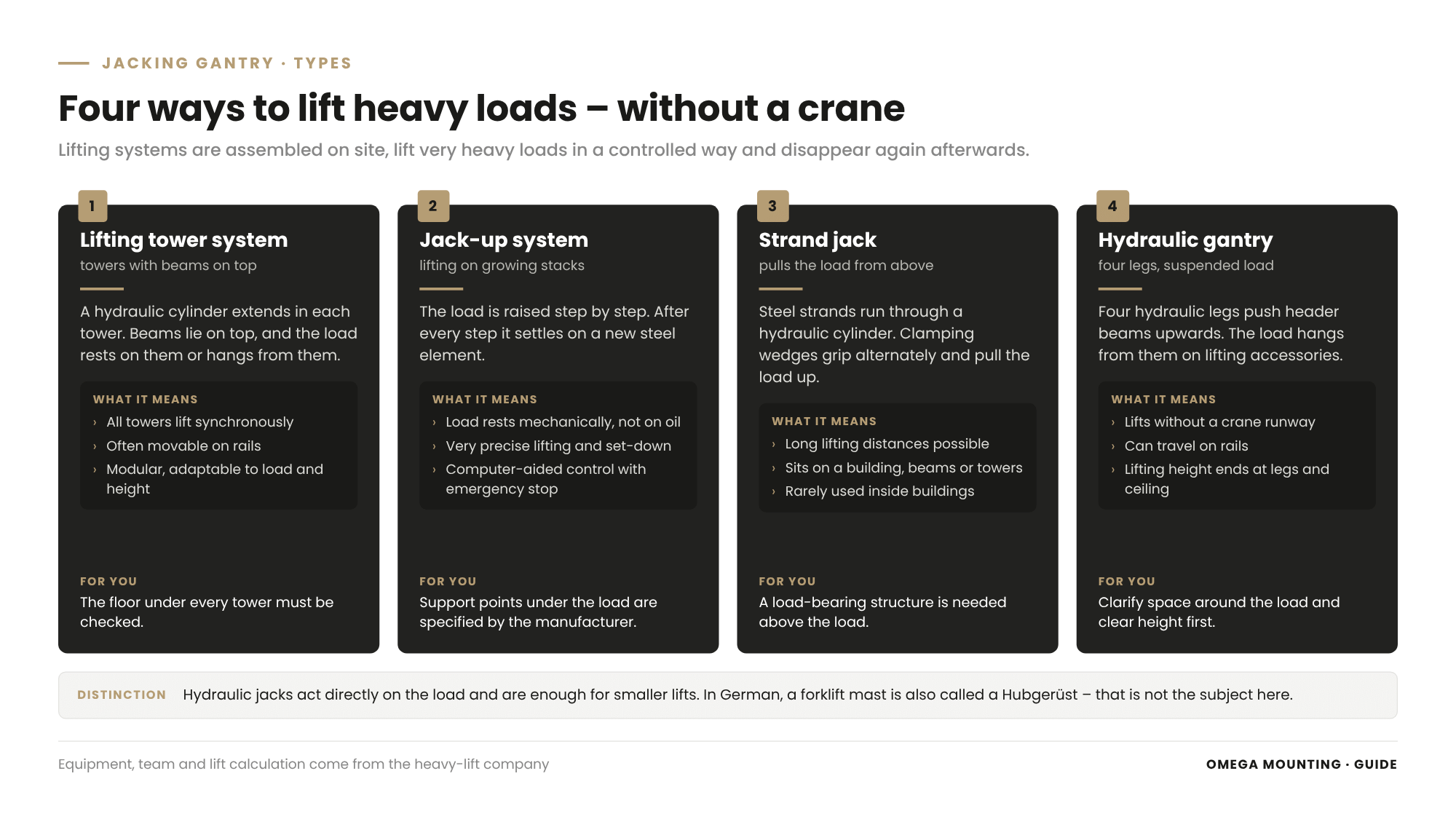
A jacking gantry is a modular lifting system made up of several towers: a hydraulic lifting unit works in each tower, beams lie on top, and a common control system lifts all towers at the same time. The result is a piece of lifting equipment that is assembled on site and disappears again after the lift.
In German these systems are called Hubgerüst, Hubturmsystem, Hubtürme or Hubportal; in English, jacking gantry, lifting tower system or lifting towers. The boundaries between the terms are fluid. What is always meant is a system that lifts heavy loads from below or via its own beams instead of hanging them on a crane hook.
One possible confusion: in German, the mast of a forklift truck is also called a Hubgerüst. This guide is not about forklifts.
Base frames and towers
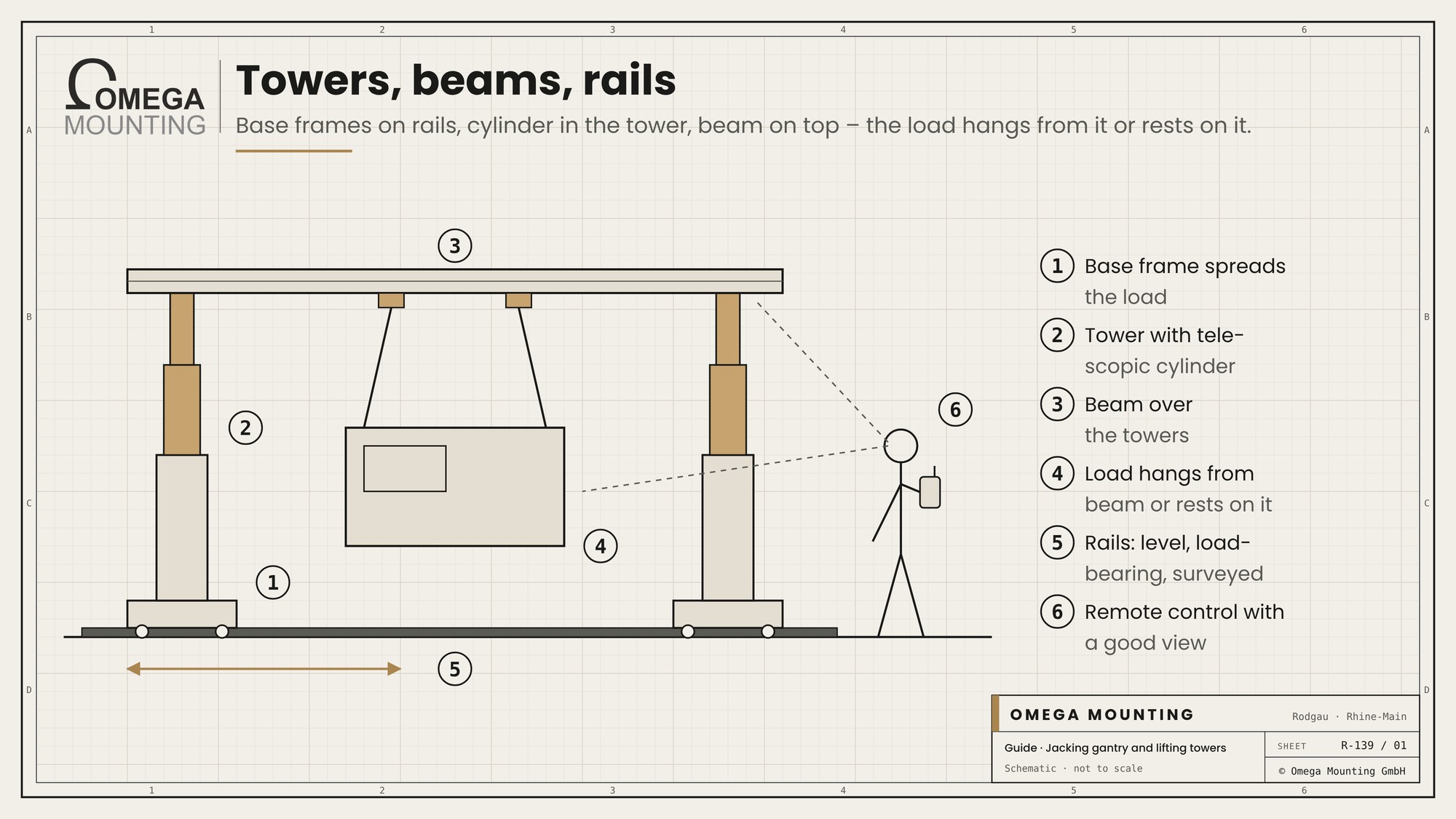
Each tower stands on a base frame. The base frame spreads the load onto the floor or onto a rail. Inside the tower a hydraulic cylinder works, often multi-stage, which extends telescopically when lifting. Some systems can be raised with extension pieces if the load has to go higher.
Beams over the towers
Beams, also called header beams or gantry beams, are placed on the towers. Depending on the task, the load rests on these beams or hangs from them on lifting accessories. How loads are slung safely on beams is shown in our guide on lifting accessories for heavy loads.
Synchronous lifting
The core of a jacking gantry is synchronisation. If one tower lifts faster than the others, the load tilts and side forces arise. That is why a control system monitors that all towers move to the same height. It stops if a tower deviates. Operation is often by remote control from a position with a good view.
Lifting and travelling
Many jacking gantries stand on rails. Their base frames are connected in pairs and run guided. A separate travel drive moves the units. The jacking gantry can then raise the load, move it along the rails and set it down again elsewhere. The same applies to moving a load on a jacking gantry as to any skidding operation: the route must be level, load-bearing and surveyed.
The jack-up system: lifting on growing stacks
A jack-up system lifts a load in many small steps and builds stacks of steel elements underneath it as it goes. After each step the load rests on these stacks – mechanically, not on hydraulic pressure. In English the principle is known as a jack-up system.
How a lifting cycle works
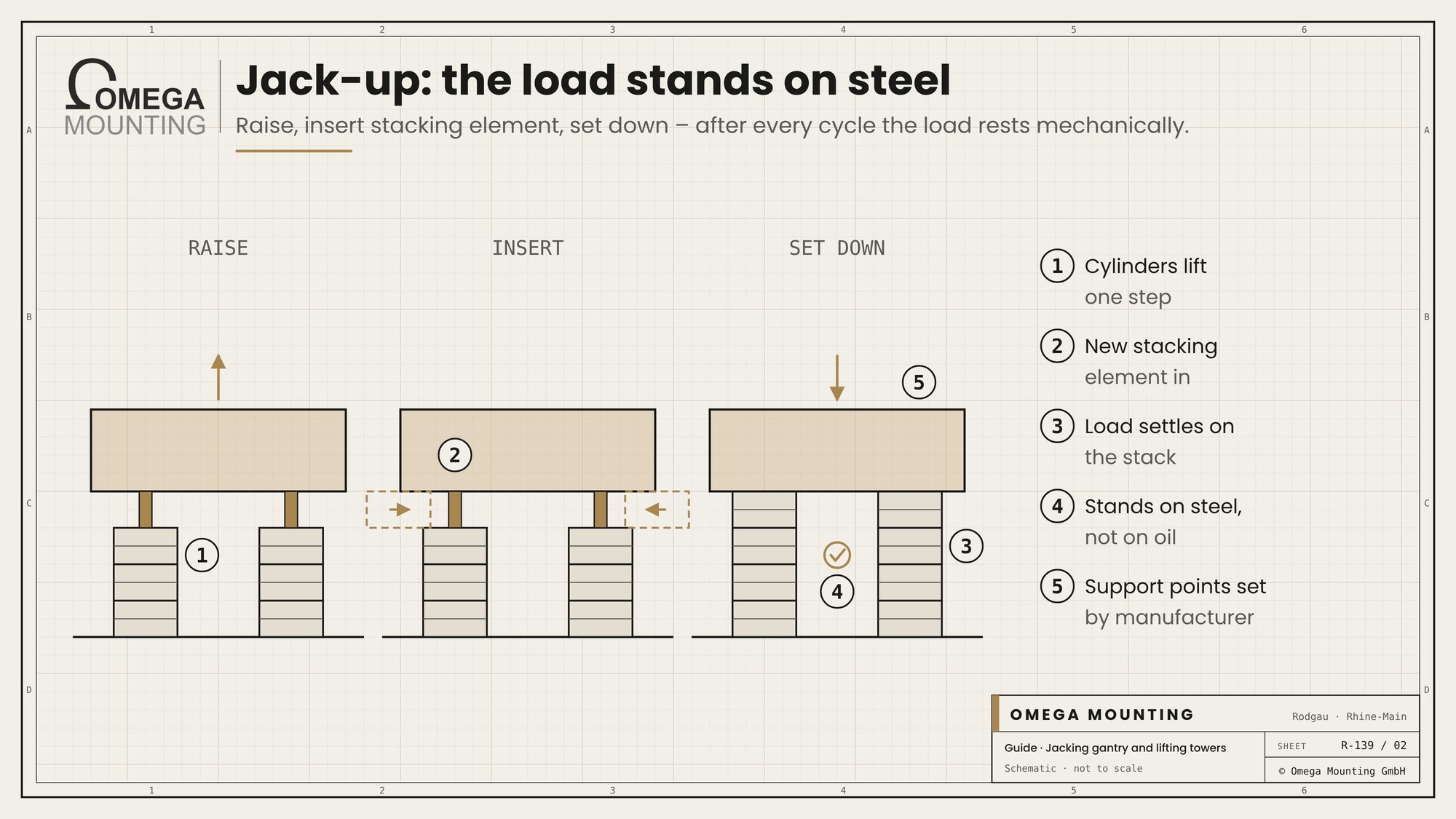
Several lifting units stand under the load, often one at each corner. Each unit has its own cylinders. A lifting cycle goes like this:
- The cylinders lift the load by one step.
- A new stacking element, often called a jack-up barrel, is pushed into each unit.
- The cylinders retract and the load settles on the grown stack.
- The next cycle begins.
In this way towers of steel elements grow under the load. On the way down everything runs in reverse: element by element is removed.
Why this is so safe
After every cycle the load stands on steel, not on oil. If the pressure drops, it stays where it is. That is exactly the principle every fitter knows from lifting with jacks: a load never stands on the cylinder alone. In a climbing lift with jacks and timber this is done by hand. In a jack-up system it is part of the equipment.
Control and travel
A computer-aided control system moves all units synchronously. It distributes the load, reports overload and has emergency stop buttons on the units and on the control desk. Some systems stand on slide rails or trolleys. The raised load can then also be moved sideways.
What jack-up systems are used for
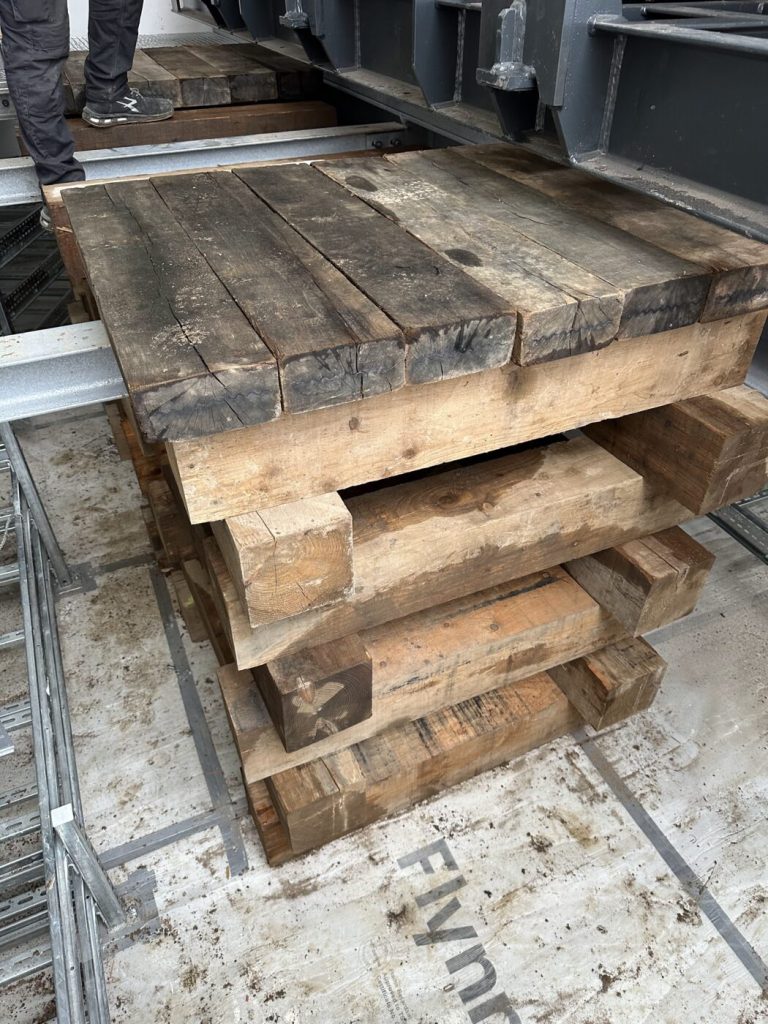
Jack-up systems raise machines and plant so that work can be done underneath. They lift bridges for bearing replacement, set components to a new height and release loads from temporary supports. Setting a load onto a vehicle also works this way: it is lifted high enough for a vehicle to drive underneath.
When you need a jacking gantry
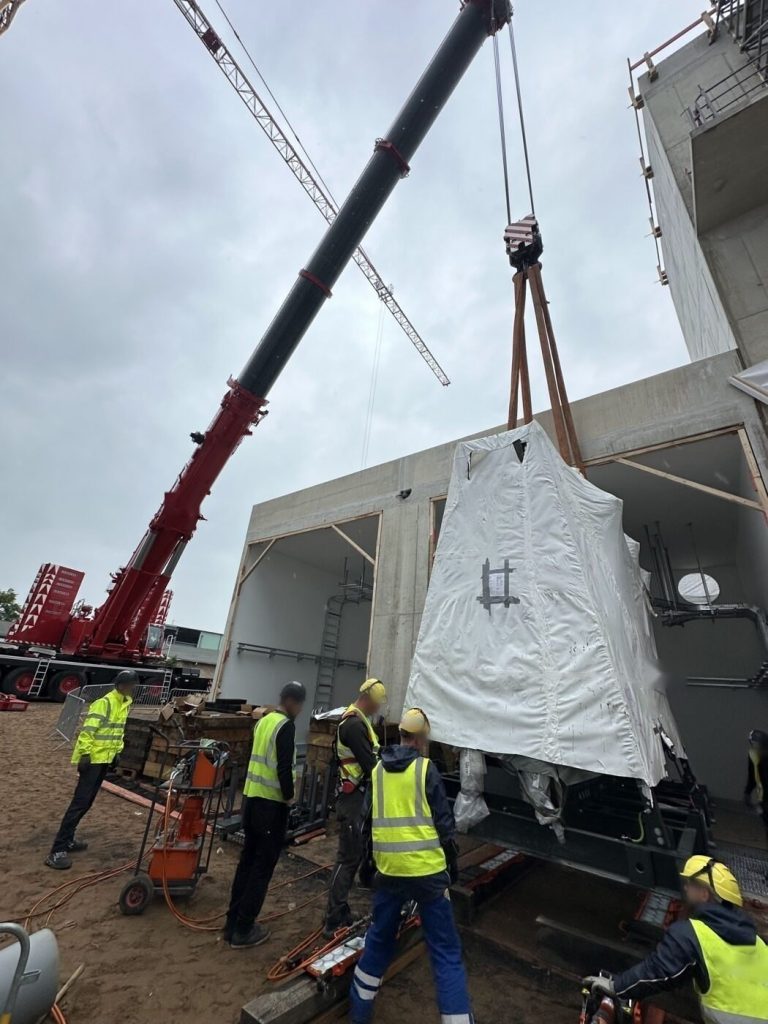
You need a jacking gantry or a jack-up system when a very heavy load has to be raised, no crane can reach it and simple jacks are not enough. Five situations are typical.
No crane opening
The building is enclosed. A lift from above through the roof or an opening is no longer possible. The load is already inside or comes in on skates or a skid track. Then it has to be lifted inside the building.
Hall height and overhead crane
There is no overhead crane, it is too weak or it does not hang over the spot. A crane from outside cannot get into the hall. A jacking gantry is assembled around the load and only needs as much height as tower, beam and load take up together.
The load is very heavy
For very heavy loads individual jacks are often not enough, or the load has to go higher than a climbing lift makes sense. Lifting systems spread the load over several guided points and lift it in a controlled way.
Precision when lifting and setting down
Some loads must be lifted and set down very precisely: level, without impact, onto prepared bearings or foundations. Synchronous control and small steps make this possible.
Handover to vehicle, skid track or skates
Often the lift is only part of the route. The load is raised so that a vehicle, a skid track or skates can go underneath – or it is taken off them. How a self-propelled modular transporter drives under a load is described in our guide on the SPMT. What has to be clarified when moving heavy loads horizontally is covered in the guide on heavy-load skidding.
Jacking gantry, hydraulic gantry, jacks, crane: what fits when
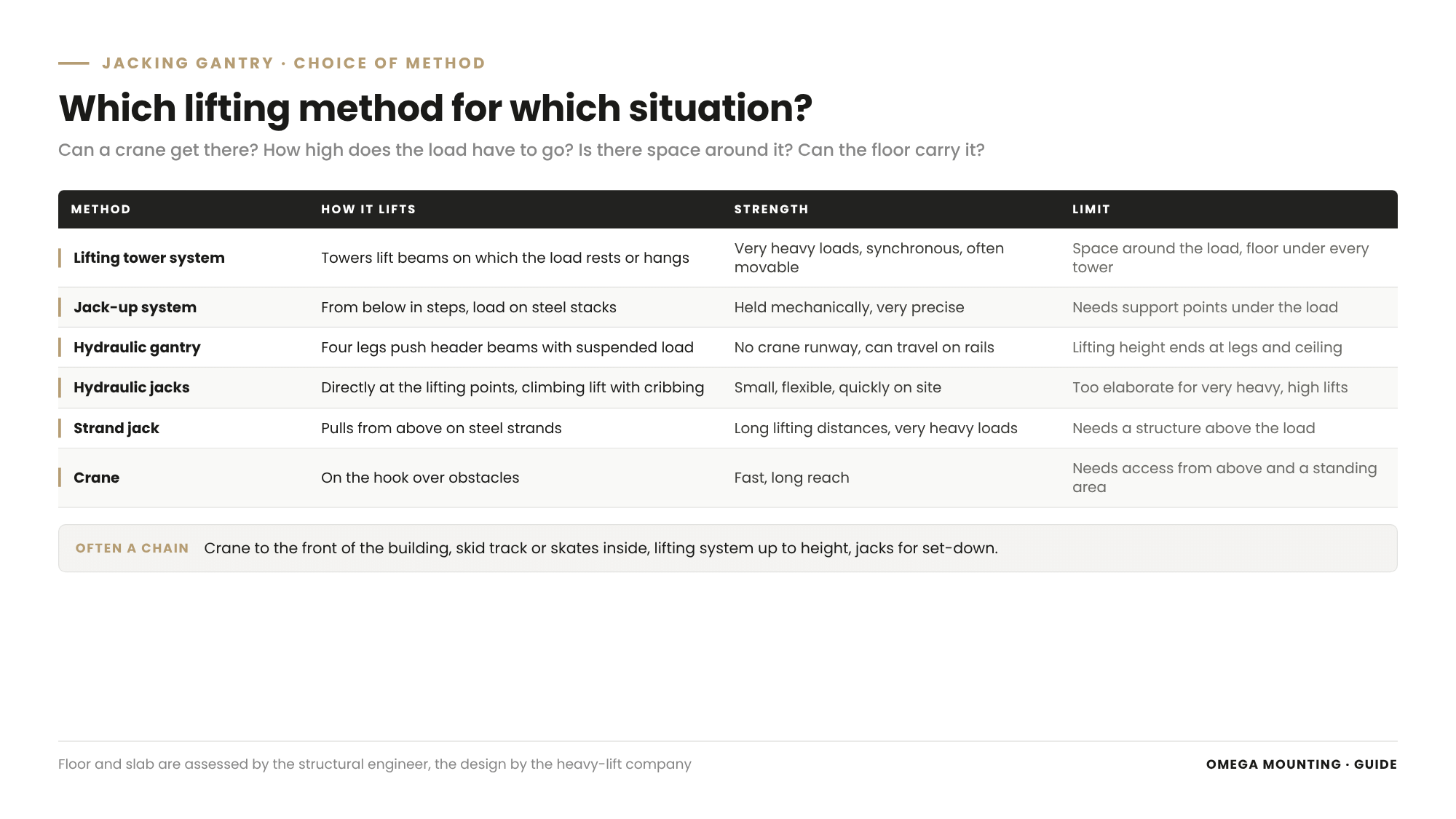
Which method fits is decided by the weight and dimensions of the load, access from above, the required lifting height, the space around the load and the floor. A crane is strong if it can get there. Jacks are enough for smaller lifts. Hydraulic gantry, jacking gantry and jack-up system take over when it gets heavy and there is no hook.
| Method | How it lifts | Strength | Limit |
|---|---|---|---|
| Lifting tower system | Several towers with hydraulic cylinders lift beams on which the load rests or from which it hangs | Very heavy loads, synchronous, often movable on rails | Needs space around the load, load-bearing floor under every tower, assembly time |
| Jack-up system | Lifts from below in steps; the load rests on growing steel stacks | Held mechanically, very precise, also for great heights | Needs support points under the load and space for the units |
| Hydraulic gantry | Four hydraulic legs push header beams with a suspended load upwards | Lifts without a crane runway, can travel on rails | Lifting height ends at legs and ceiling; high load on four points |
| Hydraulic jacks | Cylinders, jacks and flat jacks at the lifting points; climbing lift with cribbing | Small, flexible, quickly on site | Too elaborate for very heavy loads and great heights |
| Strand jack | Pulls the load up from above on steel strands, step by step | Very heavy loads, long lifting distances | Needs a load-bearing structure above the load |
| Crane | Lifts on the hook over obstacles, roofs and facades | Fast, long reach | Needs access from above, a standing area and ground |
Difference from the hydraulic gantry
A hydraulic gantry is a design with four hydraulic legs and header beams from which the load hangs. Some suppliers call this a jacking gantry too. Lifting tower systems are usually more modular, can be adapted to load and height with more towers and extension pieces, and often carry the load from below. How a hydraulic gantry works is explained in our article on gantry cranes and hydraulic gantries.
Difference from hydraulic jacks
Hydraulic jacks act directly on the load. For higher lifts, cribbing is added in a climbing lift. That is the right approach for many machines. A jack-up system basically does the same, only with equipment, synchronous control and steel elements instead of timber.
Strand jacks: lifting from above
A strand jack is a hydraulic cylinder through which steel strands run. Clamping wedges grip the strands alternately and pull the load up step by step. For this, the strand jack sits on a structure above the load: on a building, on beams or on lifting towers. It plays a smaller role in move-ins inside buildings. We mention it here because it often comes up in the same breath as jacking gantries.
Questions that decide
- Can a crane reach the load? If so, a crane lift is often the simplest route. What has to be settled for it is shown in our guide Planning a crane lift.
- How high does the load have to go? A small lift works with jacks, a large one rather with a lifting system.
- Is there space around the load? Towers and base frames need space next to the load.
- Can the floor carry the loads under the towers? The structural engineer clarifies this.
- Does the load have to go further afterwards? Then rails, skid track, skates or vehicle count.
Often the answer is a chain: the crane sets down in front of the building, a skid track brings the load in, a lifting system raises it to height, jacks set it down at the end. How the methods for a move-in are chosen is shown in our guide on choosing the lifting method for a move-in.
What the client must prepare before a lift with a jacking gantry
Before a lift with a jacking gantry or jack-up system, the client takes care of five things: checked ground under every tower, complete data on the load, enough space and height, a ready destination and a time window with reserve.
Floor and slab under every tower
A lifting system puts the entire load onto a few points. High pressure arises under every base frame. Whether the hall floor, slab or basement ceiling can carry this is assessed by the structural engineer. The engineer also checks ducts, shafts, pits and pipes under the set-up points.
Where it is not enough, load spreading mats, beams or props go underneath. How load spreading mats spread forces over a larger area is explained in our article on load spreading mats and ground pressure. How slab loads are taken into account in move-ins is described in our guide on move-in planning with slab loads in mind.
The load: weight, centre of gravity, support points
The manufacturer specifies the weight and centre of gravity in the lifting condition. The manufacturer also states where the load may be supported or slung. Without this data nobody can calculate how the load is distributed over the towers.
Attachments, cladding and pipes are removed or secured beforehand. Operating fluids such as oil or coolant are drained according to the manufacturer's instructions if the lift requires it. Utilities and power are disconnected by the specialist company.
Space and height
Towers and base frames stand next to the load. Add to that the control system, hydraulic power unit, hoses and space for the crew. The clear height must be enough for tower, beam, lifting accessories and raised load – at the lifting location and along any travel route. Pipework, cable trays and downstand beams are often the tightest spot.
The destination
Where does the load go? Onto a new foundation, onto bearings, onto a vehicle or onto a skid track? The destination must be ready, surveyed and clear before lifting. If the load is only raised so that work can be done underneath, that work must be planned just as carefully as the lift.
Time window and operations next door
Assembly and dismantling of a lifting system take time; the lift itself is often the shorter part. If operations continue next door, you need barriers, routes and clear times. Plan in reserve and a back-up date.
The sequence: from assembly to set-down
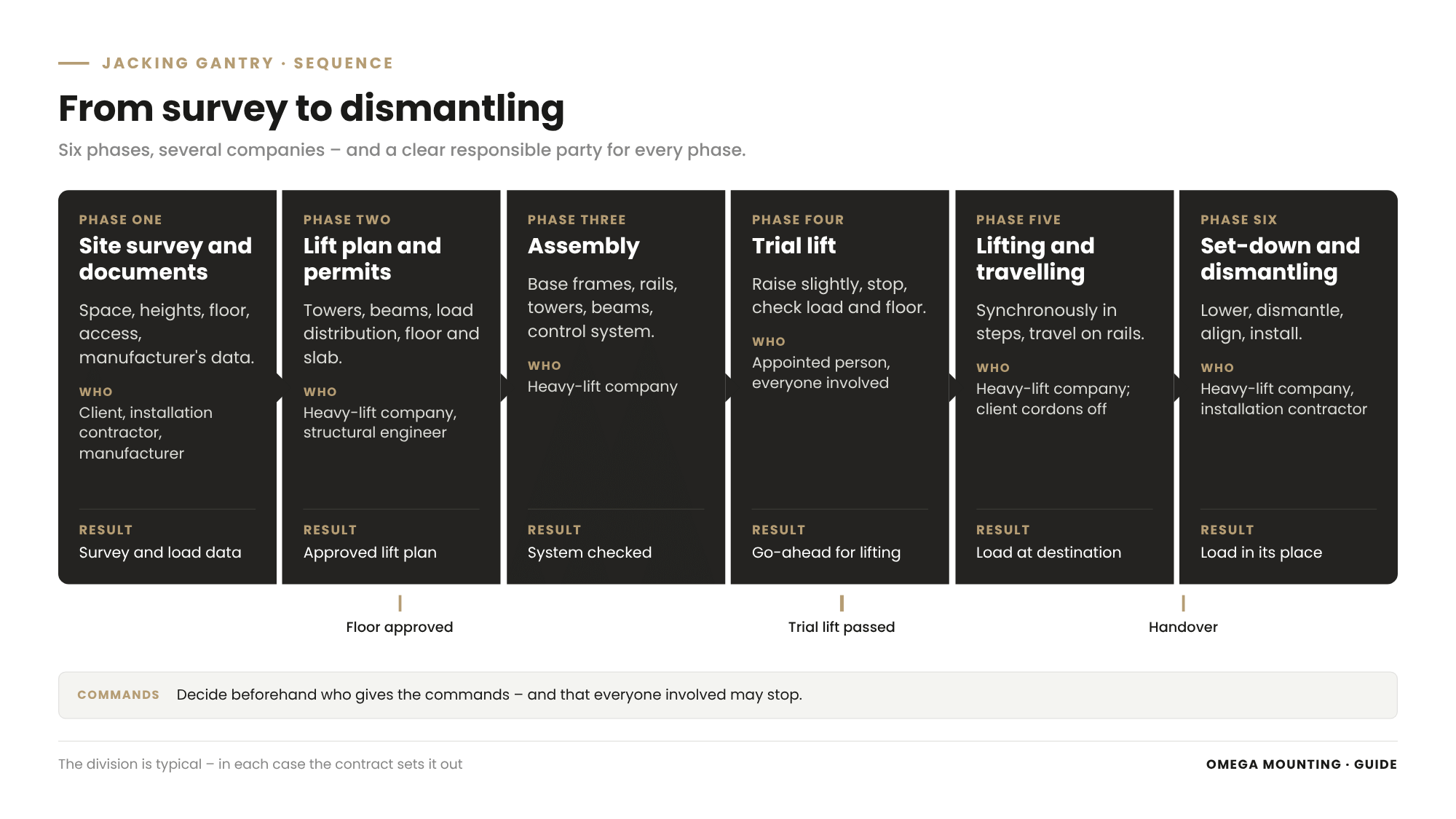
A lift with a jacking gantry runs in six phases: site survey and documents, lift plan and permits, assembly, trial lift, lifting and travelling if required, and finally set-down and dismantling.
Site survey and documents
It starts with the location and the load. During the site survey, space, heights, floor, access and obstacles are recorded. The client provides as-built drawings and manufacturer's data.
Lift plan and permits
The heavy-lift company plans the system: number and position of towers, beams, slinging or support, load distribution. The structural engineer approves floor and slab. An appointed person for the lift is named. How this role is organised is described in our guide on the appointed person for lifting operations.
Design
Base frames, rails and towers are set up, aligned and placed on load spreading mats or props. Then come the beams. Hoses and control system are connected and checked.
Trial lift
The load is raised just clear of the floor or its supports. Then the lift stops. Everyone checks: is the load steady, are the towers evenly loaded, is the floor giving way? Only then does it continue.
Lifting and travelling
Lifting is done in controlled steps. The control system keeps the towers synchronised; the crew watches the load, towers and surroundings. If the load has to travel, the towers run on their rails. With a jack-up system, cycle follows cycle.
Set-down and dismantling
At the destination the load is lowered onto bearings, foundation, skid track or vehicle. Then the system is dismantled. This is often where the installation contractor's part begins: fine alignment, anchoring, installation. How machines are aligned afterwards is covered in the guide on aligning and anchoring machines.
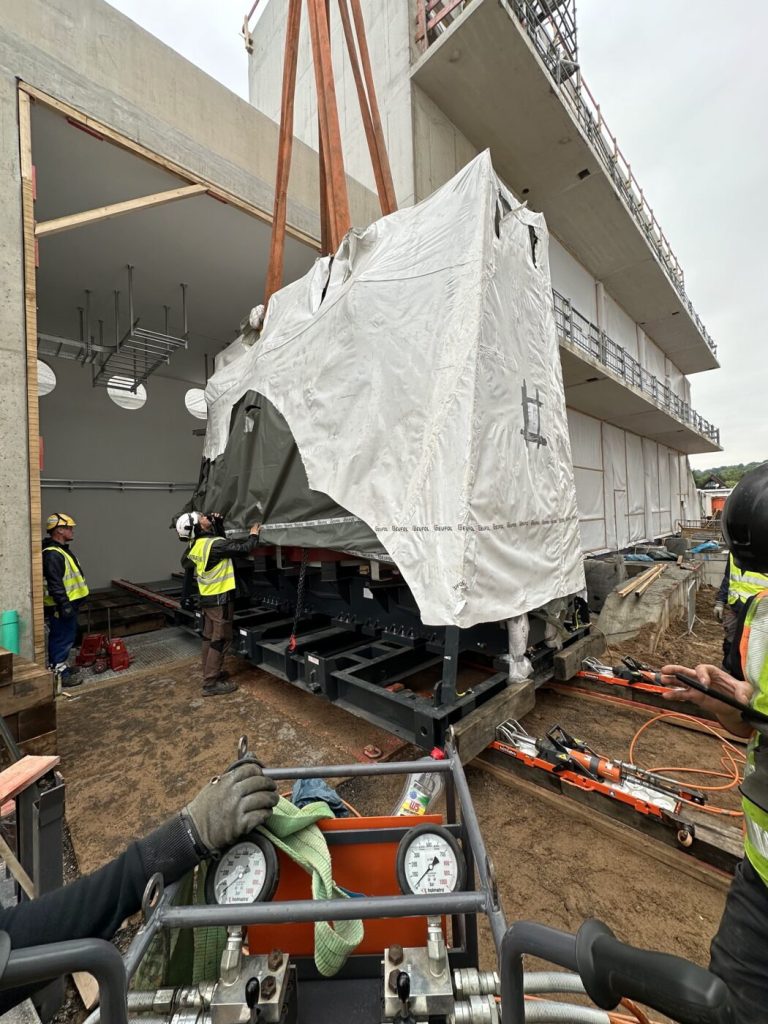
Safety when lifting with lifting towers
When lifting with lifting towers, four things matter: synchronous movement, a load that never stands on the hydraulics alone, a cordoned-off danger zone and one person who gives the commands.
Synchronisation and side forces
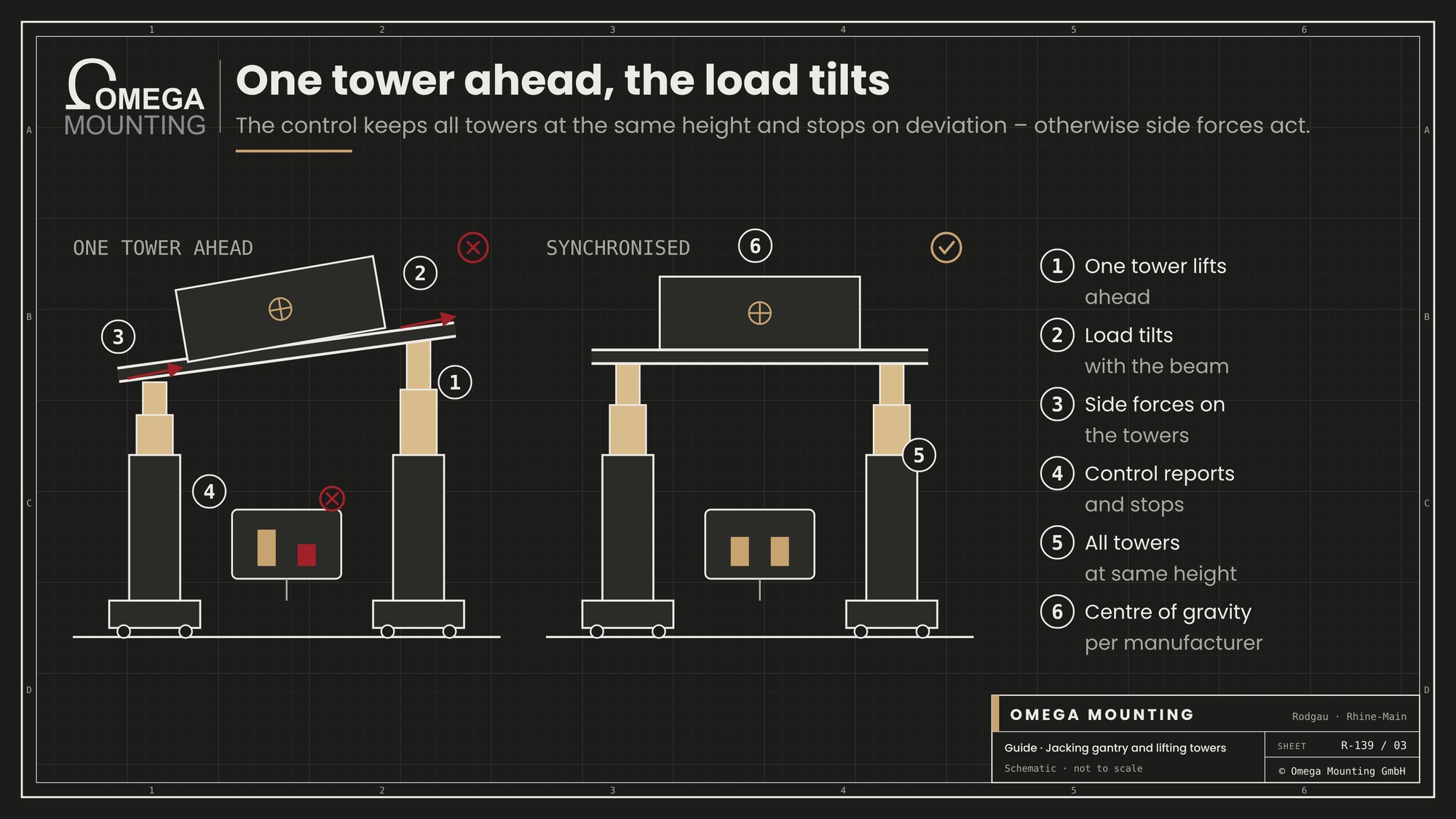
If one tower runs ahead, the load tilts. Then forces act for which the system is not built. That is why there is no lifting as long as the control system reports a deviation. A load with an off-centre centre of gravity is distributed unevenly over the towers – another reason why the manufacturer's data on the centre of gravity is needed.
Mechanical securing
In a jack-up system the stack holds the load. Many lifting towers also have a mechanical lock on the cylinder. Whether and how this works for a given system is stated in the operating instructions. The principle remains: nobody works under a load that stands only on oil.
Danger zone and crew

The area around the load is cordoned off. Nobody stays under the load. Everyone involved has a fixed task: control, watching the towers, clearance from components and walls. Anyone may stop. Pressure and synchronisation are watched continuously.
Wind and weather outdoors
If a jacking gantry stands outdoors, a high load offers the wind a large surface. Limits are set by the heavy-lift company. If it gets too windy, there is no lifting.
Two systems on one load
Sometimes a crane and a lifting system work one after the other on the same load. Or two pieces of lifting equipment lift together. Then it must be settled beforehand who gives the commands and how the load is handed over. What applies when lifting with two pieces of lifting equipment is described in our guide on the Tandem lift.
Inspection as work equipment
Lifting towers, cylinders, hoses and control system are work equipment. They are inspected according to the risk assessment and the manufacturer's data – before use and periodically, by a competent person. The framework is set by the German Industrial Safety Ordinance (BetrSichV). Who may carry out which inspection is explained in our article on the competent person. This guide is not legal advice. Ask to see the system's inspection records before the lift.
Overview: preparation, why it counts, who provides it
For every point in preparing a lift with a jacking gantry there is a reason and a responsible party – the table sums this up.
| Preparation | Why it counts | Who provides it |
|---|---|---|
| Weight and centre of gravity in the lifting condition | They determine the load per tower | Manufacturer via the client. |
| Support or lifting points | Only there may the load be carried | Manufacturer via the client. |
| Floor and slab under every tower | The load goes into the floor through a few points | Structural engineer |
| Pipes, ducts, pits in the floor | They must not be overloaded | Client with as-built drawings. |
| Space and clear height | Towers, beams and load must fit in | Survey during the site visit |
| Design of the lifting system | Towers, beams and control system must suit the load | Heavy haulage company. |
| Destination ready and surveyed | The load needs a place to be set down | Client with site management and installation company. |
| Utilities and power disconnected | No line may tear during the lift | Specialist company or qualified electrician |
| Appointed person and commands | With several companies it must be clear who decides | Client with everyone involved. |
| Time window with alternative date. | Assembly and dismantling take time, and so do disruptions | Client with everyone involved. |
Typical mistakes when using a jacking gantry
The typical mistakes when using a jacking gantry are a floor without approval, an estimated centre of gravity, missing height, an unplanned destination and a schedule without assembly time.
- Floor only checked under the load. The towers stand next to it, and that is exactly where a duct or a thin slab lies.
- Centre of gravity estimated. The manufacturer's data is missing or applies to a different condition of the load.
- Height only measured at the lifting location. During travel, the load hits a pipe or a downstand beam.
- Support points not approved. The load is carried at a point that is not built for it.
- Destination not ready. The lifting system holds the load up, but the foundation or vehicle is not ready yet.
- Assembly time forgotten. The time window is enough for the lift, not for assembly and dismantling.
- Commands not agreed. Crane, lifting system and installation work on the same load, and nobody knows who stops.
The mistake behind the mistakes
Many mistakes share the same assumption: that the jacking gantry solves the lift on its own. But it only solves the lifting. Before it come floor, load and route; after it, set-down and installation.
What we know from move-ins
We have not documented a job with a jacking gantry, lifting towers or a jack-up system, and we do not provide such systems. What we know are related tasks: lifting, skidding and setting down heavy loads without a crane inside buildings. Three jobs from our project diary show this.
Data center near Frankfurt: no lift from above
During the bringing in transformers via a skidding track in a data center in the Frankfurt area, the building was already closed. A lift from above was no longer possible. The crane only brought the load as far as the opening of the transformer cell and set it straight from the low-loader onto the skid track.
At the destination, hydraulic blocks raised the transformer far enough for the rail elements to come out. Then it was set down on stacked timber cribbing in the pit. These set-down points were prepared before the load arrived – and dismantling the skid track was planned in too. We monitored the pressure on the hydraulic control continuously. Every movement was authorised or stopped by an appointed person.
What this means for a jacking gantry: the destination and dismantling belong in the planning, not only on the site.
Paint shop near Offenbach: lifting where no overhead crane can reach
During the fan bearing replacement on a paint shop system near Offenbach a heavy motor-fan unit had to come out in one piece. There was no access from outside. Only a narrow gap remained between control cabinets. On the preparation day we fabricated and welded a rail system from steel tube. A gantry crane lifted the unit off the assembly stand and later back in.
What this means for a jacking gantry: the lifting equipment is planned around the situation, not the other way round. And everything is ready before the plant stops.
Standby power system: lifting from a checked structure
With the overhaul of a standby power system there was no crane in the plant room. The generator was lifted with chain hoists from a beam structure above the set. Beforehand we checked whether the suspension points could carry the loads. Every movement was planned in advance and ran slowly on command. Then it went through the corridors on machine skates.
What this means for a jacking gantry: every point on which the load rests is checked beforehand – beams, floor and slab.
Questions about a move-in involving a jacking gantry?
Does your load have to be lifted without a crane, and does it then need to be skidded, set down or installed? Then get in touch with us. For the lifting system itself, we recommend involving a specialist heavy-lift company early – we are happy to coordinate with them.

Move-ins in the Rhine-Main region: what we take on around the jacking gantry
In the Rhine-Main region we take on the work before and after lifts without a crane: preparing the location and load with the structural engineer, skidding, setting down, aligning and installing.
Many sites in the region are densely built up. Data centers, substations and factory halls are often already standing when the heaviest component arrives or has to be replaced. Then there is no route for the crane, and lifting is done inside the building.
From Rodgau, Frankfurt, Offenbach, Hanau, Darmstadt and Aschaffenburg are short distances. What we offer in Lift & Shift and heavy-load installation overall is set out on our service page. How loads get through halls on skates is explained in our article on machine skates and heavy-duty skates. How a skid track is built is described in the article on the skidding system.
We say clearly in advance what we do not take on. The jacking gantry and jack-up system are provided and operated by the heavy-lift company. Floor, slab and beams are assessed by the structural engineer. Weight and support points are specified by the manufacturer. We are happy to answer questions about the move-in via our contact form.
What this means for your role
For buyers: Separate the lift from the move-in, but not the coordination. Clarify in the contract who provides the lifting system, who has floor and slab checked and who gives the commands.
For designers: With heavy components, think about replacement, not just installation. Record set-up areas, heights and floor loads for a lifting system in the documents.
For project managers and site managers: As project manager, you collect the data from the manufacturer, structural engineer and heavy-lift company and hold the time window with a back-up date. As site manager, you make sure that set-up points, route and destination are ready and clear on the day of the lift.
For technical managers, plant managers and facility managers: You know the ducts, pits, pipes and operating times best. Provide as-built drawings and name a contact person for the day of the lift.
For management and operators: Give the project the lead time that inspections, permits and coordination between several companies need. A lift without a crane is not a makeshift solution but a project in its own right.
Lifting system check: template on request
The lifting system check is a one-page working document for the first round of coordination before a lift with a jacking gantry, lifting towers or a jack-up system. It has four blocks: load, location, lift and handover, and permits. Each point has a field for the source of the information and the status “clarified” or “open”. Number fields are deliberately left blank – the check shows you what is still missing before the lift and who supplies it. Request the template via our contact form using the keyword “Lifting system check”.
Conclusion
A jacking gantry lifts very heavy loads where no crane can reach and jacks are not enough. Lifting towers lift synchronously and can move the load on rails. A jack-up system lifts in small steps and holds the load mechanically on steel stacks. Whether the lift succeeds is decided beforehand: by the checked floor under every tower, the manufacturer's data, space and height and a ready destination. If you are preparing the move-in before or after such a lift, send us photos and documents – we will get back to you with an honest assessment.
Planning a move-in, installation or maintenance in the Rhine-Main region?
Tell us briefly what you need – we'll come back with an honest assessment.
Free, no-obligation callback
You may also be interested in these guides

About the author
Tobias Schott
Managing director of Omega Mounting GmbH, Rodgau · more than 20 years of hands-on experience in installation and maintenance
A trained mechatronics technician, working in maintenance, servicing and industrial installation since 2004 – first alongside his father, and with Omega Mounting since 2012: from overhead conveyors in Frankfurt to the crane system in a new-build hall. He plans and leads lifting operations as an appointed person (AP) in data centers and on industrial sites in the Rhine-Main region, trains and examines operators of cranes, mobile elevating work platforms and telehandlers, and is a qualified occupational safety specialist. On jobs abroad he is known as the “German Troubleshooter” – the person you call when a site gets stuck. He learned what quality means from his father, not from a manual: Made in Germany as a standard for his own work, not a label. That is why quality comes first at Omega Mounting – ahead of speed and price. He writes these guides from that practice: what works on our sites is in them – what exists only on paper is not.
Frequently asked questions
A jacking gantry is a modular lifting system made up of several towers with hydraulic lifting units and beams on top. All towers lift synchronously and carry the load from below or on the beams. It is assembled on site, lifts very heavy loads without a crane and is dismantled again afterwards.
A hydraulic gantry is a design with four hydraulic legs and header beams from which the load hangs. Lifting tower systems are usually more modular and can be adapted to load and height with more towers and extension pieces. In everyday use the terms are often mixed up.
A jack-up system lifts a load in many small steps. After each step a steel element is pushed in under the load, and the load settles on it. In this way it rests mechanically on growing stacks and not on hydraulic pressure.
When no crane can reach the load: in enclosed buildings, in cells, under ceilings or in halls without a suitable overhead crane. In addition, the load is too heavy for simple jacks or has to go too high.
It must carry the load acting on it through the base frames of the towers – on a few points, so with high pressure. Ducts, pits and pipes must not be overloaded. Whether the floor is sufficient is assessed by the structural engineer. Where necessary, load spreading mats or props go underneath.
A strand jack is a hydraulic cylinder through which steel strands run. Clamping wedges grip alternately and pull the load up step by step. It needs a load-bearing structure above the load, such as a building, beams or lifting towers.
The heavy-lift company plans and operates the lifting tower system: design, assembly, control and lift. The structural engineer assesses floor and slab, and the manufacturer supplies the load data. The installation contractor takes on skidding, set-down, alignment and installation around the lift.
Yes, if it stands on rails and has a travel drive. It then raises the load, moves it along the rails and sets it down again. The route must be level, load-bearing and surveyed. For longer routes inside the building, a skid track or skates are often simpler.
Send us a short enquiry with three details: what is being lifted, where it stands and where it needs to go. Photos of the load, floor and surroundings help. We clarify with you and the heavy-lift company what is still missing for the move-in. Your contact is Tobias Schott – reachable via our contact form.
 English
 German